prashob7@outlook.com
Basis of
Vector Control in AC Drives
Presentation by
Prashob P K
in.linkedin.com/in/prashob7
prashob7@outlook.com
VFD or AC Drive
• VFD stands for Variable Frequency Drive
• VFD is used for speed control of AC motors
• The Hardware components of VFD comprise
of
1. A Converter section with convert AC TO DC
2. A Inverter Section which convert DC back to AC of which frequency
can be varied within in a range
3. Control card or Control circuit
4. Input output interface for controlling the operation of the VFD
5. Optional Communication cards or interfaces
prashob7@outlook.com
AC POWER
INPUT
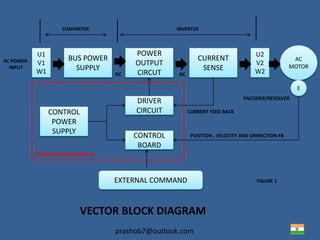
VECTOR BLOCK DIAGRAM
U1
V1
W1
BUS POWER
SUPPLY
POWER
OUTPUT
CIRCUT
CONTROL
POWER
SUPPLY
DRIVER
CIRCUIT
CONTROL
BOARD
CURRENT
SENSE
U2
V2
W2
EXTERNAL COMMAND
AC
MOTOR
E
POSITION , VELOCITY AND DRIRECTION FB
CURRENT FEED BACK
ENCODER/RESOLVER
CONVERTER INVERTER
DC AC
FIGURE 1
CONTROL BOARD/CIRCUIT
prashob7@outlook.com
Speed Control Schemes Employed in
VFD
• There are mainly two type of control schemes
employed
1. V/F control
In this output AC maintain a ration between Voltage and
Current.
V/f or V/Hz is the basic control scheme employed in AC drives
and is used for Pump applications mainly
In V/f control, current is controlled only based on fault or
over current level.
prashob7@outlook.com
Vector Control
• Two closed loop controls :-
Current loop and Speed loop
• Using Mathematical vectors drive can separate
toque producing current from magnetizing
current
• Vector control can tune themselves to the motor
after getting basic motor name plate parameter
• Tuning also known in certain cases as
optimization or auto tuning
prashob7@outlook.com
Auto tuning
• Auto tune feature measure several variable of
motor like resistance , inductance of rotor and
stator, slip
• Based on these values mathematical motor
model is setup and thus controls loops are
executed at their best
• New age drives have adaptive tuning feature
which is active continuously as the motor runs
prashob7@outlook.com
What are the additional configurations in Vector
drive compared to that of normal V/f drives?
• A feedback circuit with at least two current feedbacks from
the motor leads
• With above configuration vector drives are capable of
“encoder less operation”, however there is provision to
provide encoder/resolver feedback
• More powerful controller to perform vector analysis on
current and voltage feedback
prashob7@outlook.com
Advantages of Vector Control
• Vector control can deliver 100% torque form 0 to rated
speed
• Speed control is more precise than that of V/F
• Since closed loop control is excellent, vector control can
be implemented were PID loops or set point is
continuously coming from a process feed back or other
systems
• This control is suitable for applications involving
1. Torque control
2. Basic position control[advance control require servo drives]
3. Electronic gearing , pulse following
4. Tension control with dance adjustment etc

Vector speed control

  • 1.
    prashob7@outlook.com Basis of Vector Controlin AC Drives Presentation by Prashob P K in.linkedin.com/in/prashob7
  • 2.
    prashob7@outlook.com VFD or ACDrive • VFD stands for Variable Frequency Drive • VFD is used for speed control of AC motors • The Hardware components of VFD comprise of 1. A Converter section with convert AC TO DC 2. A Inverter Section which convert DC back to AC of which frequency can be varied within in a range 3. Control card or Control circuit 4. Input output interface for controlling the operation of the VFD 5. Optional Communication cards or interfaces
  • 3.
    prashob7@outlook.com AC POWER INPUT VECTOR BLOCKDIAGRAM U1 V1 W1 BUS POWER SUPPLY POWER OUTPUT CIRCUT CONTROL POWER SUPPLY DRIVER CIRCUIT CONTROL BOARD CURRENT SENSE U2 V2 W2 EXTERNAL COMMAND AC MOTOR E POSITION , VELOCITY AND DRIRECTION FB CURRENT FEED BACK ENCODER/RESOLVER CONVERTER INVERTER DC AC FIGURE 1 CONTROL BOARD/CIRCUIT
  • 4.
    prashob7@outlook.com Speed Control SchemesEmployed in VFD • There are mainly two type of control schemes employed 1. V/F control In this output AC maintain a ration between Voltage and Current. V/f or V/Hz is the basic control scheme employed in AC drives and is used for Pump applications mainly In V/f control, current is controlled only based on fault or over current level.
  • 5.
    prashob7@outlook.com Vector Control • Twoclosed loop controls :- Current loop and Speed loop • Using Mathematical vectors drive can separate toque producing current from magnetizing current • Vector control can tune themselves to the motor after getting basic motor name plate parameter • Tuning also known in certain cases as optimization or auto tuning
  • 6.
    prashob7@outlook.com Auto tuning • Autotune feature measure several variable of motor like resistance , inductance of rotor and stator, slip • Based on these values mathematical motor model is setup and thus controls loops are executed at their best • New age drives have adaptive tuning feature which is active continuously as the motor runs
  • 7.
    prashob7@outlook.com What are theadditional configurations in Vector drive compared to that of normal V/f drives? • A feedback circuit with at least two current feedbacks from the motor leads • With above configuration vector drives are capable of “encoder less operation”, however there is provision to provide encoder/resolver feedback • More powerful controller to perform vector analysis on current and voltage feedback
  • 8.
    prashob7@outlook.com Advantages of VectorControl • Vector control can deliver 100% torque form 0 to rated speed • Speed control is more precise than that of V/F • Since closed loop control is excellent, vector control can be implemented were PID loops or set point is continuously coming from a process feed back or other systems • This control is suitable for applications involving 1. Torque control 2. Basic position control[advance control require servo drives] 3. Electronic gearing , pulse following 4. Tension control with dance adjustment etc