Electric Drives
and Control
SYNCHRONOUS MOTOR DRIVES
D.Poornima,
Assistant Professor (Sr.Gr),
Department of EEE,
Sri Ramakrishna Institute of Technology, Coimbatore
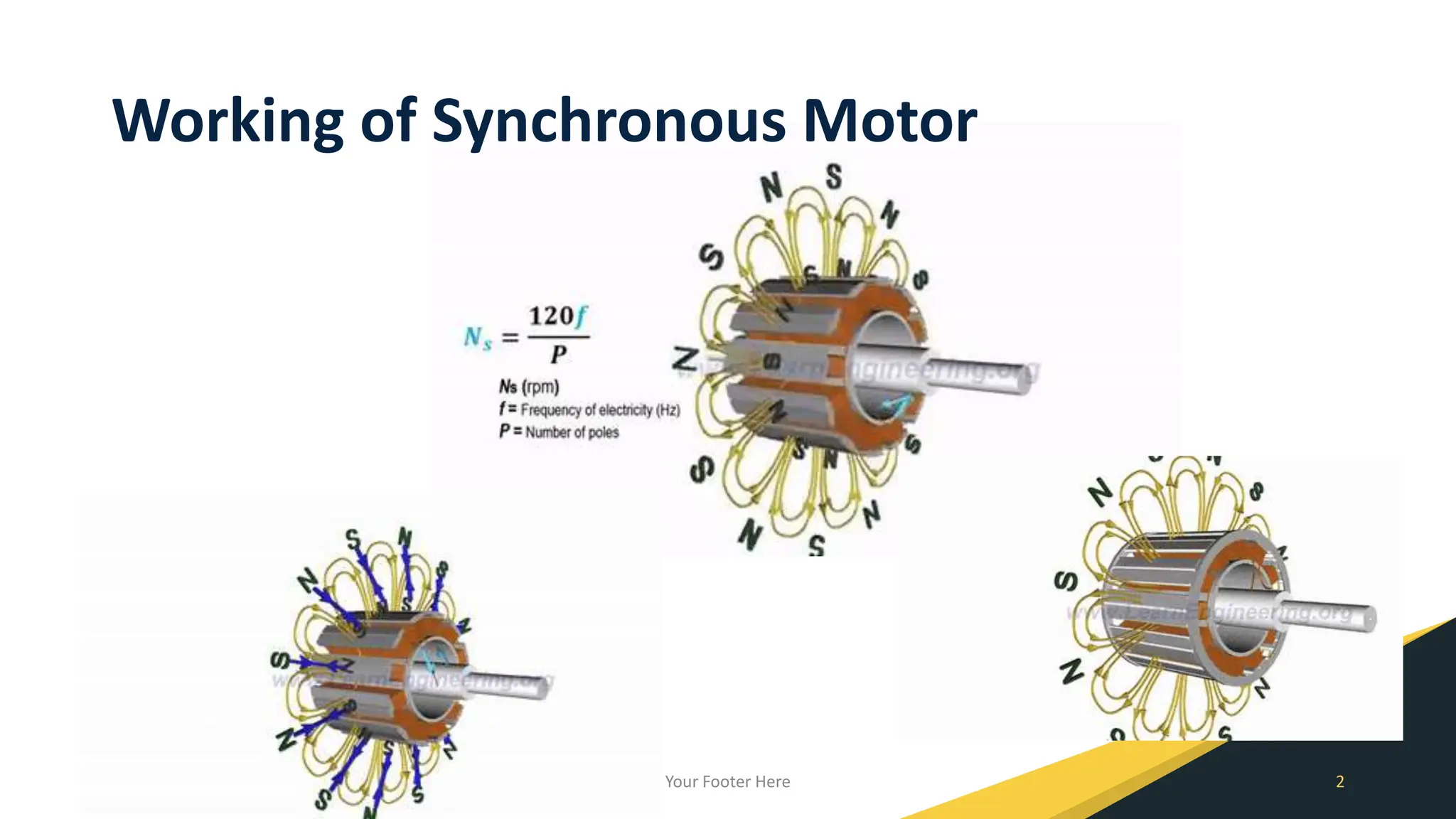
Working of Synchronous Motor
Date Your Footer Here 2
Speed Control of Synchronous Motor
• Synchronous motors are constant-speed motors running at the
synchronous speed of the supply.
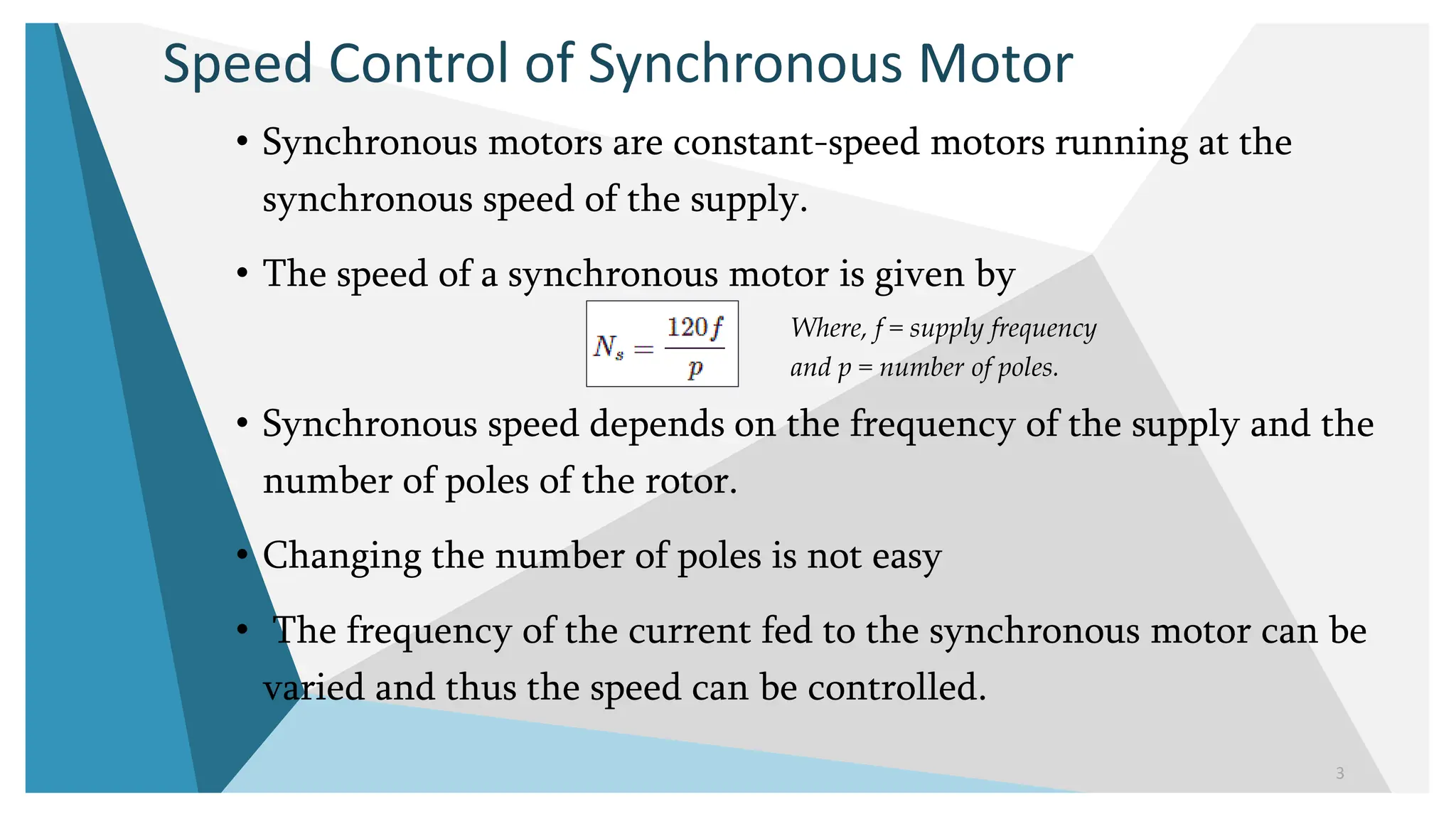
• The speed of a synchronous motor is given by
• Synchronous speed depends on the frequency of the supply and the
number of poles of the rotor.
• Changing the number of poles is not easy
• The frequency of the current fed to the synchronous motor can be
varied and thus the speed can be controlled.
3
Where, f = supply frequency
and p = number of poles.
Variable Frequency Control:
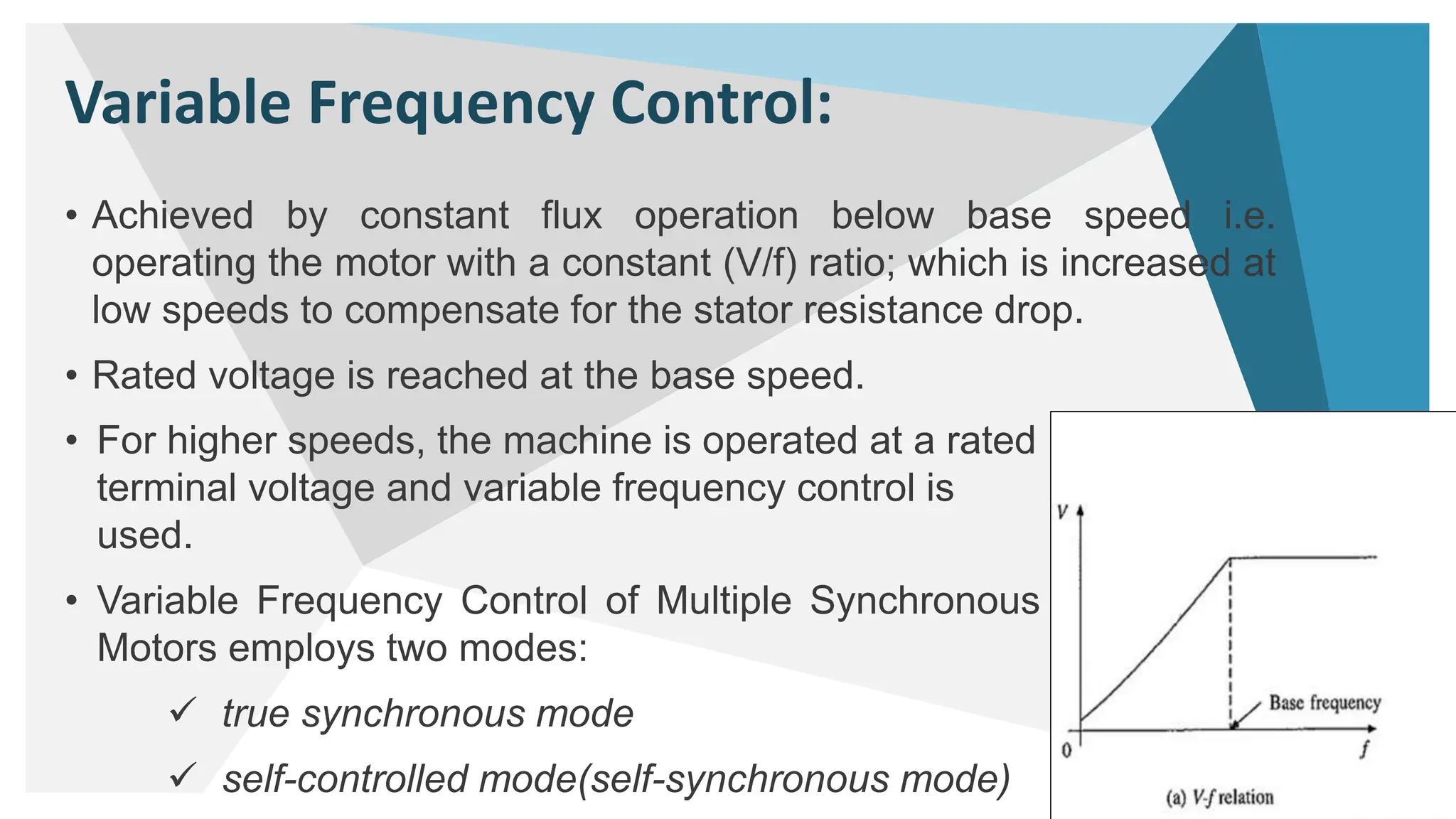
• Achieved by constant flux operation below base speed i.e.
operating the motor with a constant (V/f) ratio; which is increased at
low speeds to compensate for the stator resistance drop.
• Rated voltage is reached at the base speed.
4
• For higher speeds, the machine is operated at a rated
terminal voltage and variable frequency control is
used.
• Variable Frequency Control of Multiple Synchronous
Motors employs two modes:
 true synchronous mode
 self-controlled mode(self-synchronous mode)
True Synchronous Mode (Open Loop Control)
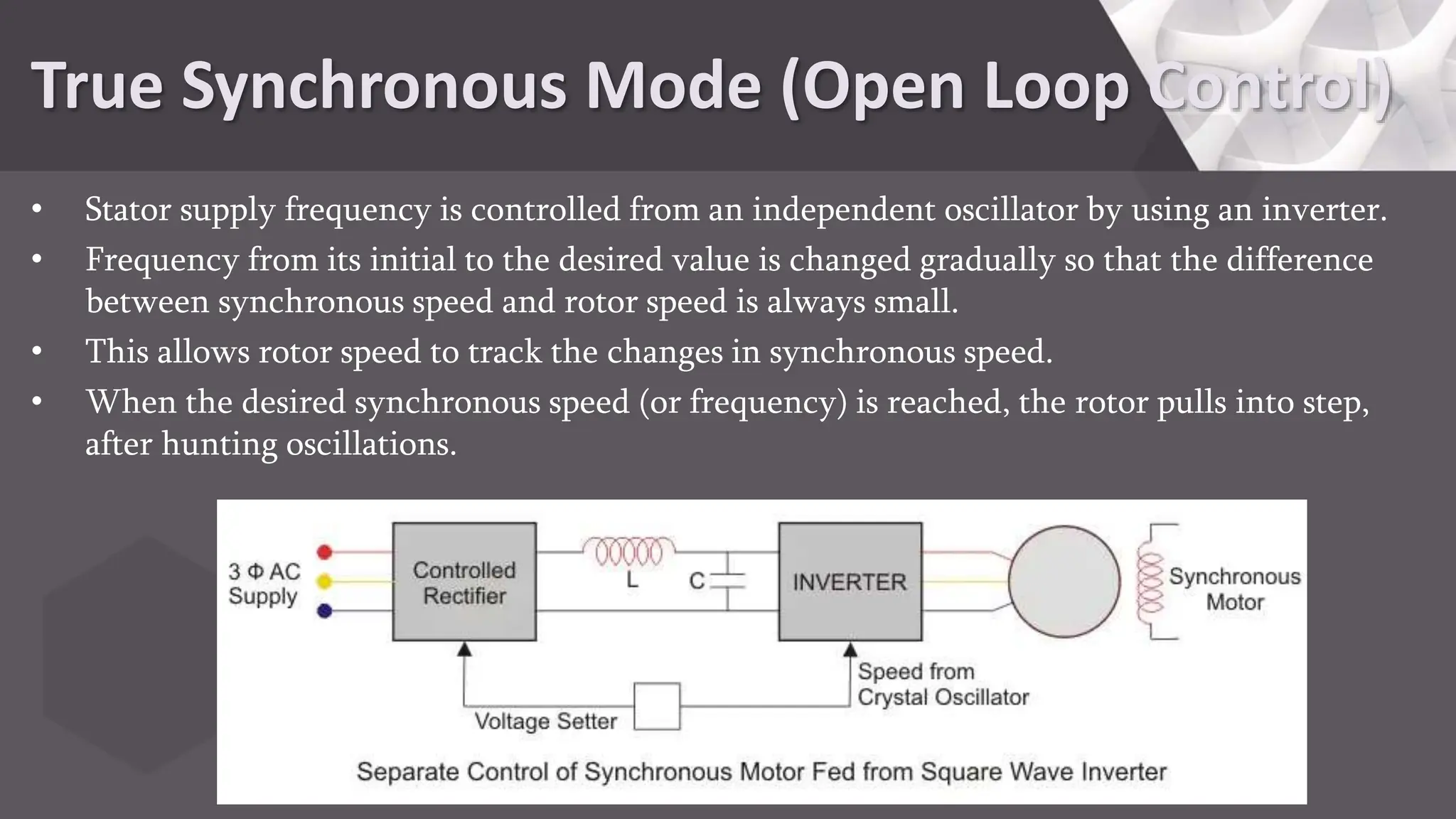
• Stator supply frequency is controlled from an independent oscillator by using an inverter.
• Frequency from its initial to the desired value is changed gradually so that the difference
between synchronous speed and rotor speed is always small.
• This allows rotor speed to track the changes in synchronous speed.
• When the desired synchronous speed (or frequency) is reached, the rotor pulls into step,
after hunting oscillations.
True Synchronous Mode
• Used for speed control, smooth starting and regenerative braking
of the motor
• Possible as long as the changes in frequency are slow enough for
the rotor to track changes in synchronous speed.
• A motor with damper winding is used for pull-in to synchronism.
• Open loop operation is useful when several motors need to be run
at the same speed.
• Causes spontaneous oscillation or hunting.
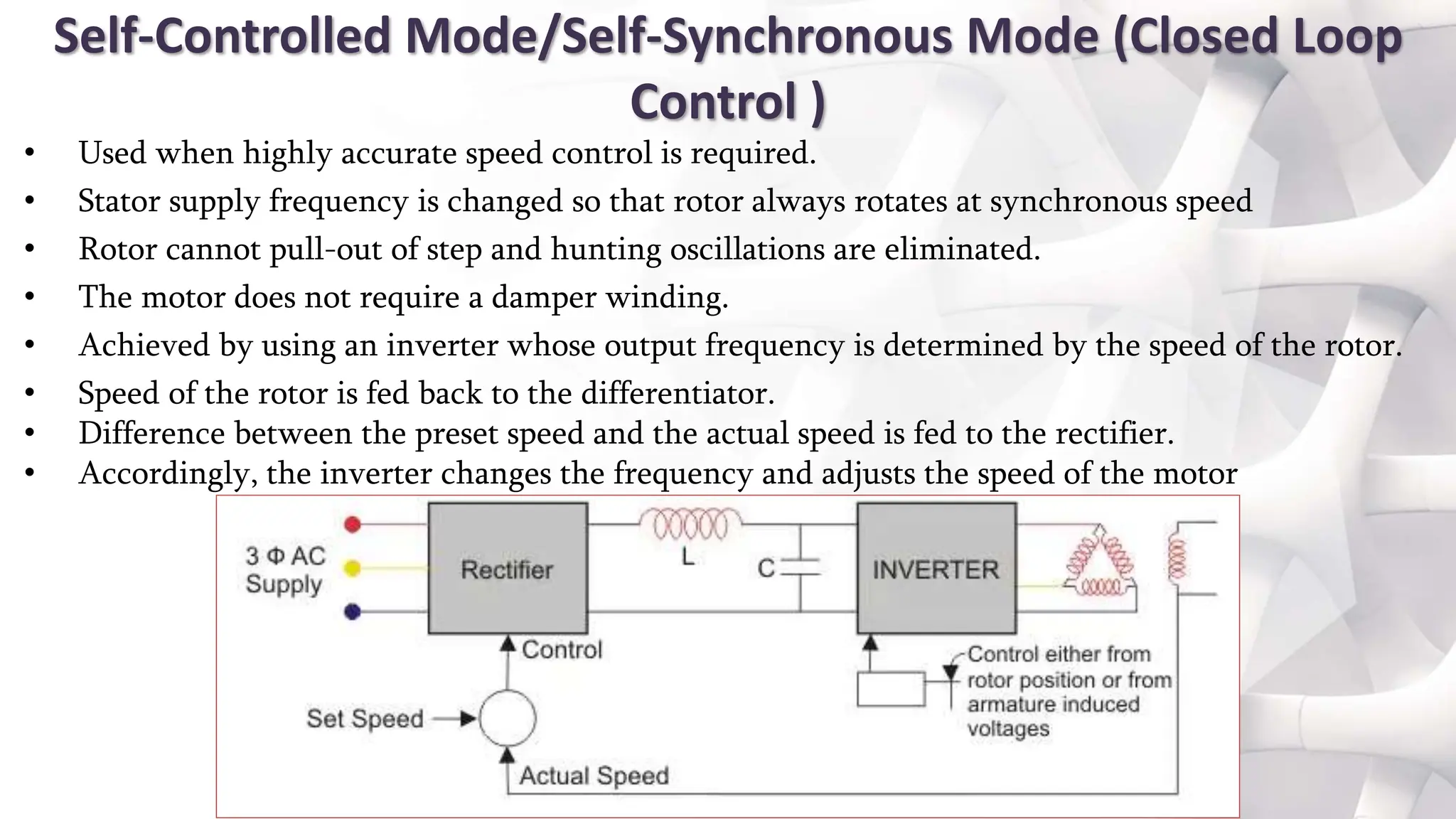
Self-Controlled Mode/Self-Synchronous Mode (Closed Loop
Control )
• Used when highly accurate speed control is required.
• Stator supply frequency is changed so that rotor always rotates at synchronous speed
• Rotor cannot pull-out of step and hunting oscillations are eliminated.
• The motor does not require a damper winding.
• Achieved by using an inverter whose output frequency is determined by the speed of the rotor.
• Speed of the rotor is fed back to the differentiator.
• Difference between the preset speed and the actual speed is fed to the rectifier.
• Accordingly, the inverter changes the frequency and adjusts the speed of the motor
Self-Controlled Mode/Self-Synchronous Mode.
• Voltage induced in the stator phase has a frequency proportional
to rotor speed
• So self-control can be realized by making the stator supply
frequency to track the frequency of induced voltage.
• Sensors can also be mounted on the stator to track the rotor
position.
• These sensors are called rotor position sensors.
• The frequency of signals generated by these sensors is
proportional to rotor speed.
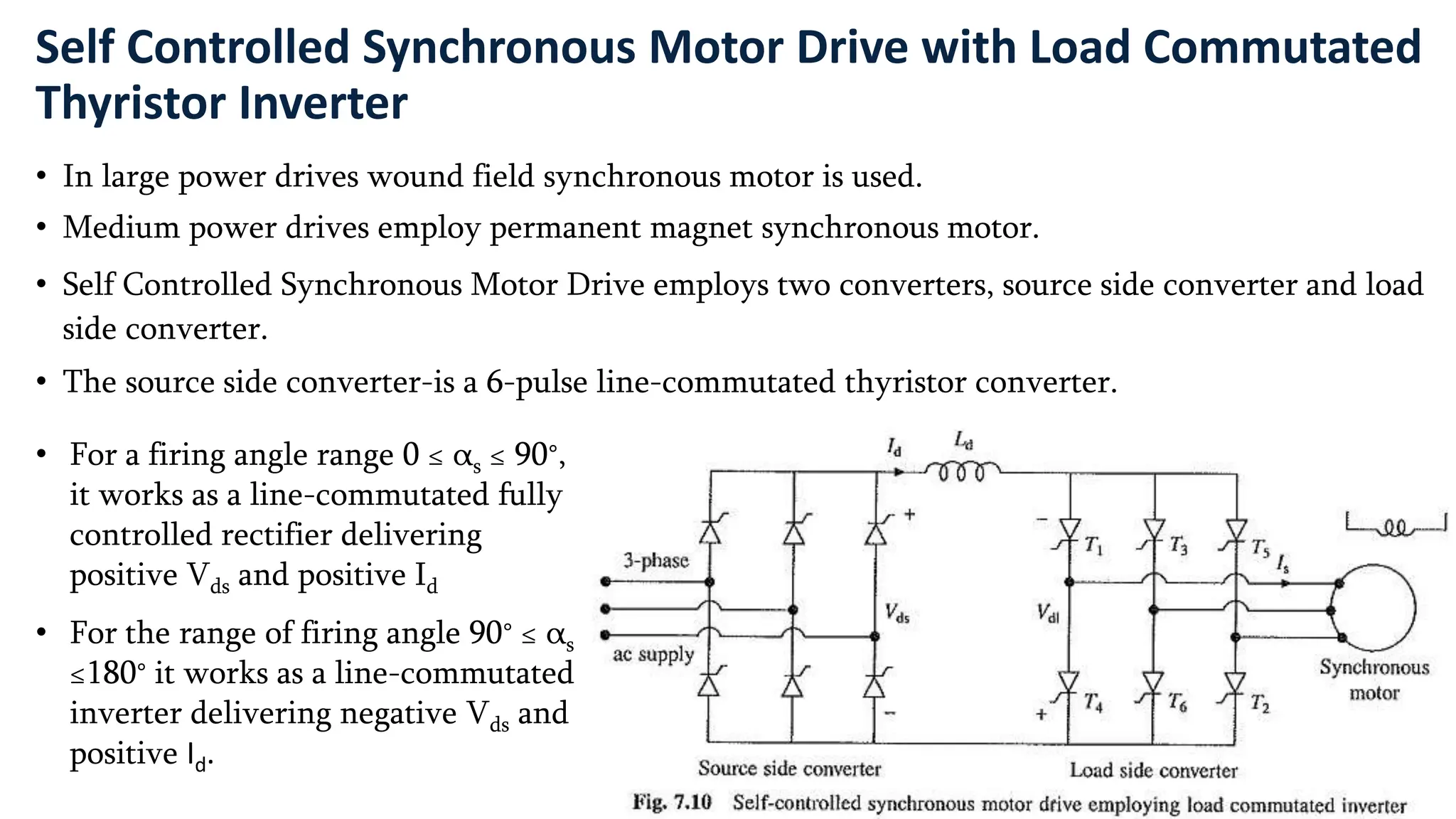
Self Controlled Synchronous Motor Drive with Load Commutated
Thyristor Inverter
• In large power drives wound field synchronous motor is used.
• Medium power drives employ permanent magnet synchronous motor.
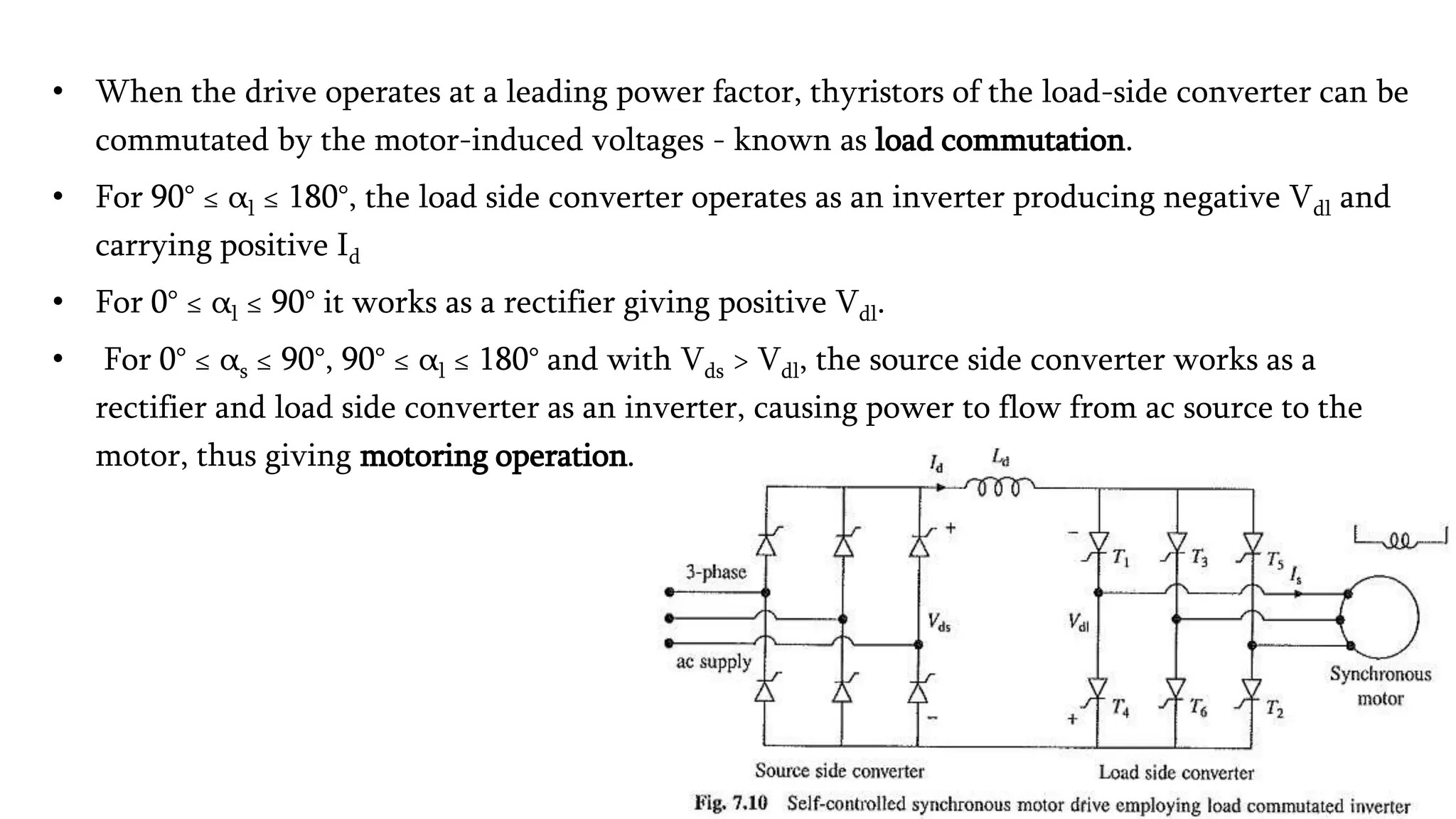
• Self Controlled Synchronous Motor Drive employs two converters, source side converter and load
side converter.
• The source side converter-is a 6-pulse line-commutated thyristor converter.
• For a firing angle range 0 ≤ αs ≤ 90∘,
it works as a line-commutated fully
controlled rectifier delivering
positive Vds and positive Id
• For the range of firing angle 90∘ ≤ αs
≤180∘ it works as a line-commutated
inverter delivering negative Vds and
positive Id.
• When the drive operates at a leading power factor, thyristors of the load-side converter can be
commutated by the motor-induced voltages - known as load commutation.
• For 90° ≤ αl ≤ 180°, the load side converter operates as an inverter producing negative Vdl and
carrying positive Id
• For 0° ≤ αl ≤ 90° it works as a rectifier giving positive Vdl.
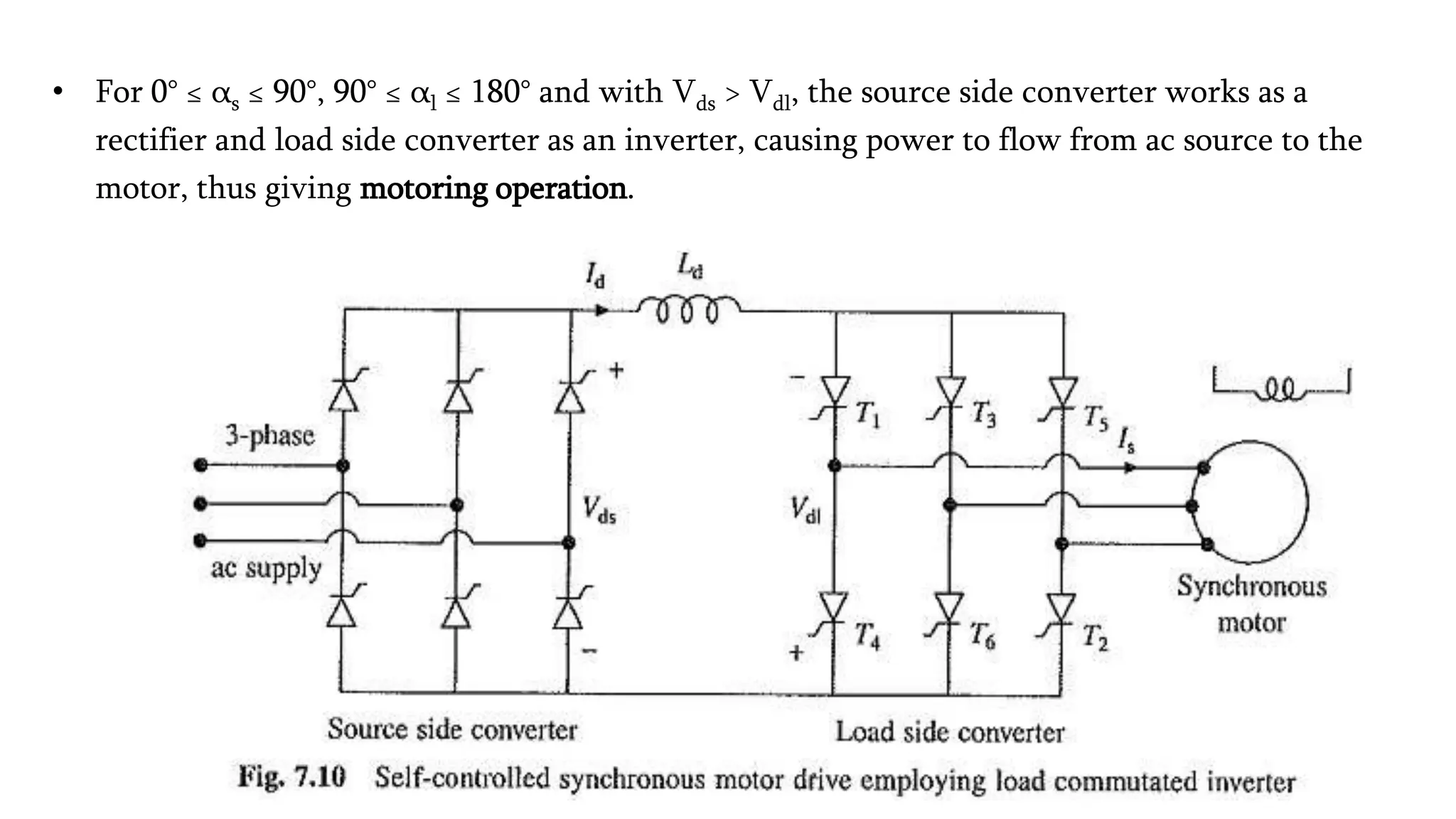
• For 0° ≤ αs ≤ 90°, 90° ≤ αl ≤ 180° and with Vds > Vdl, the source side converter works as a
rectifier and load side converter as an inverter, causing power to flow from ac source to the
motor, thus giving motoring operation.
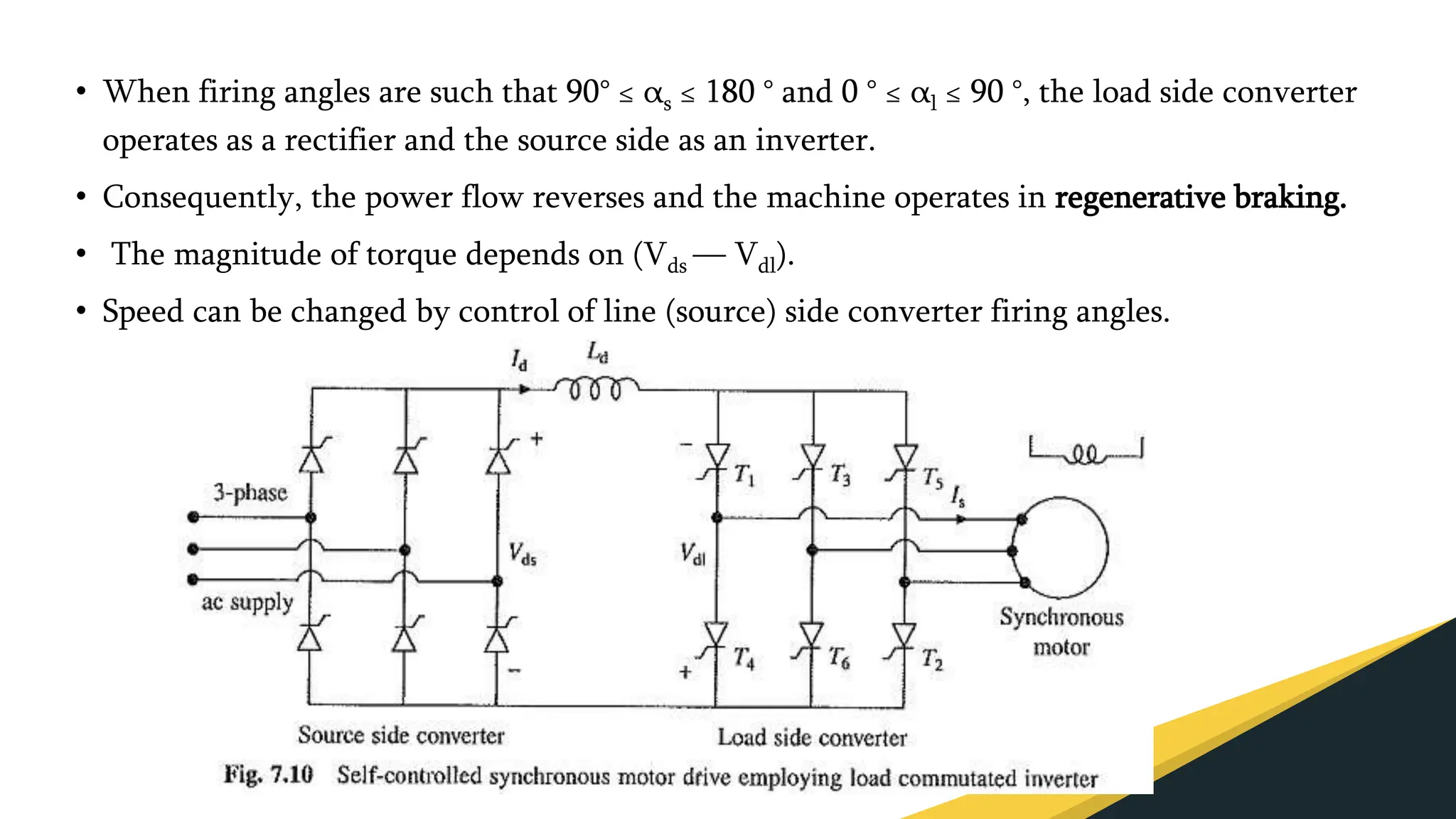
• When firing angles are such that 90° ≤ αs ≤ 180 ° and 0 ° ≤ αl ≤ 90 °, the load side converter
operates as a rectifier and the source side as an inverter.
• Consequently, the power flow reverses and the machine operates in regenerative braking.
• The magnitude of torque depends on (Vds — Vdl).
• Speed can be changed by control of line (source) side converter firing angles.
Margin Angle Control
12
What is Margin Angle?
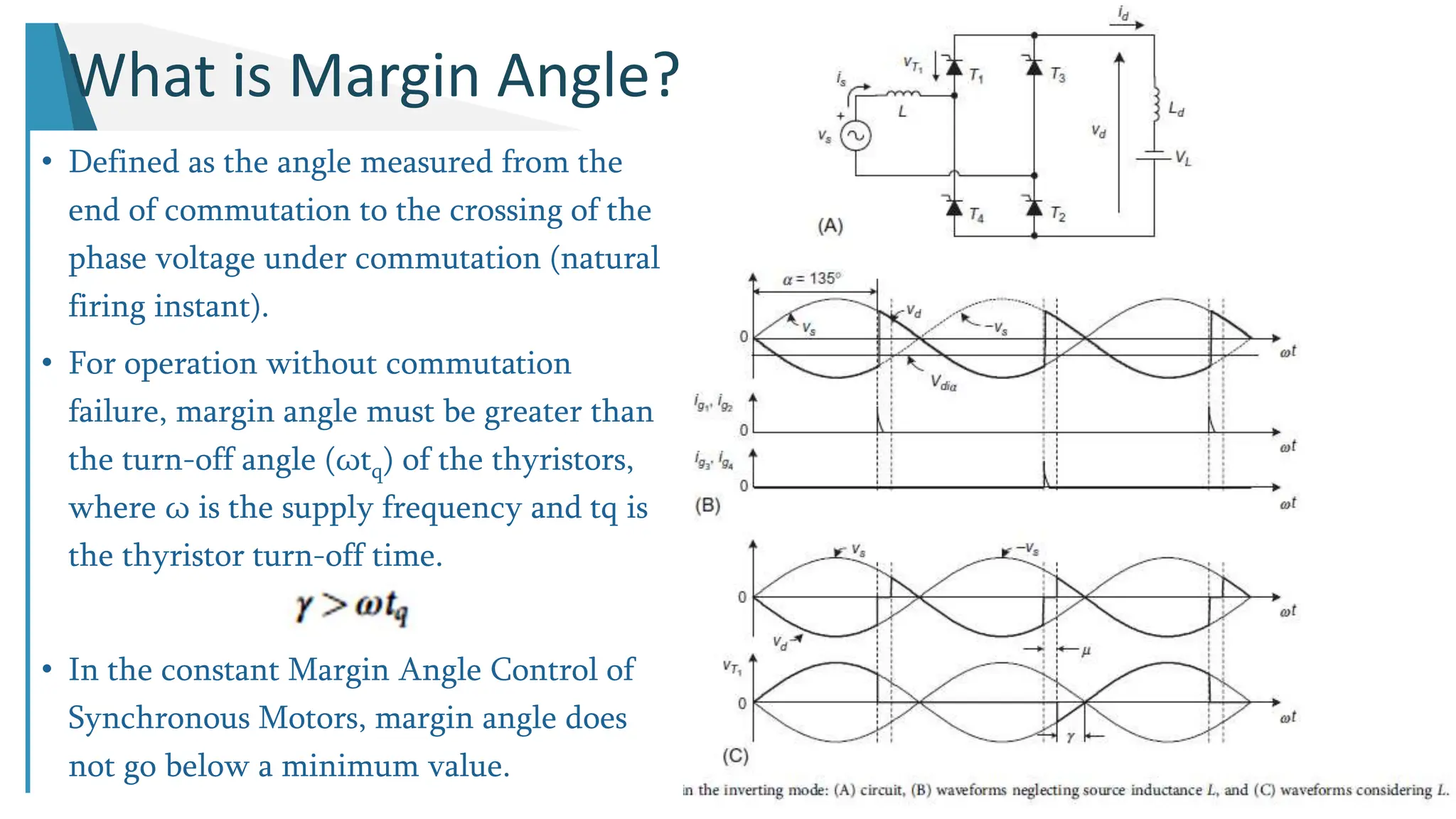
• Defined as the angle measured from the
end of commutation to the crossing of the
phase voltage under commutation (natural
firing instant).
• For operation without commutation
failure, margin angle must be greater than
the turn-off angle (ωtq) of the thyristors,
where ω is the supply frequency and tq is
the thyristor turn-off time.
• In the constant Margin Angle Control of
Synchronous Motors, margin angle does
not go below a minimum value.
• For 0° ≤ αs ≤ 90°, 90° ≤ αl ≤ 180° and with Vds > Vdl, the source side converter works as a
rectifier and load side converter as an inverter, causing power to flow from ac source to the
motor, thus giving motoring operation.
Marginal Angle
Control
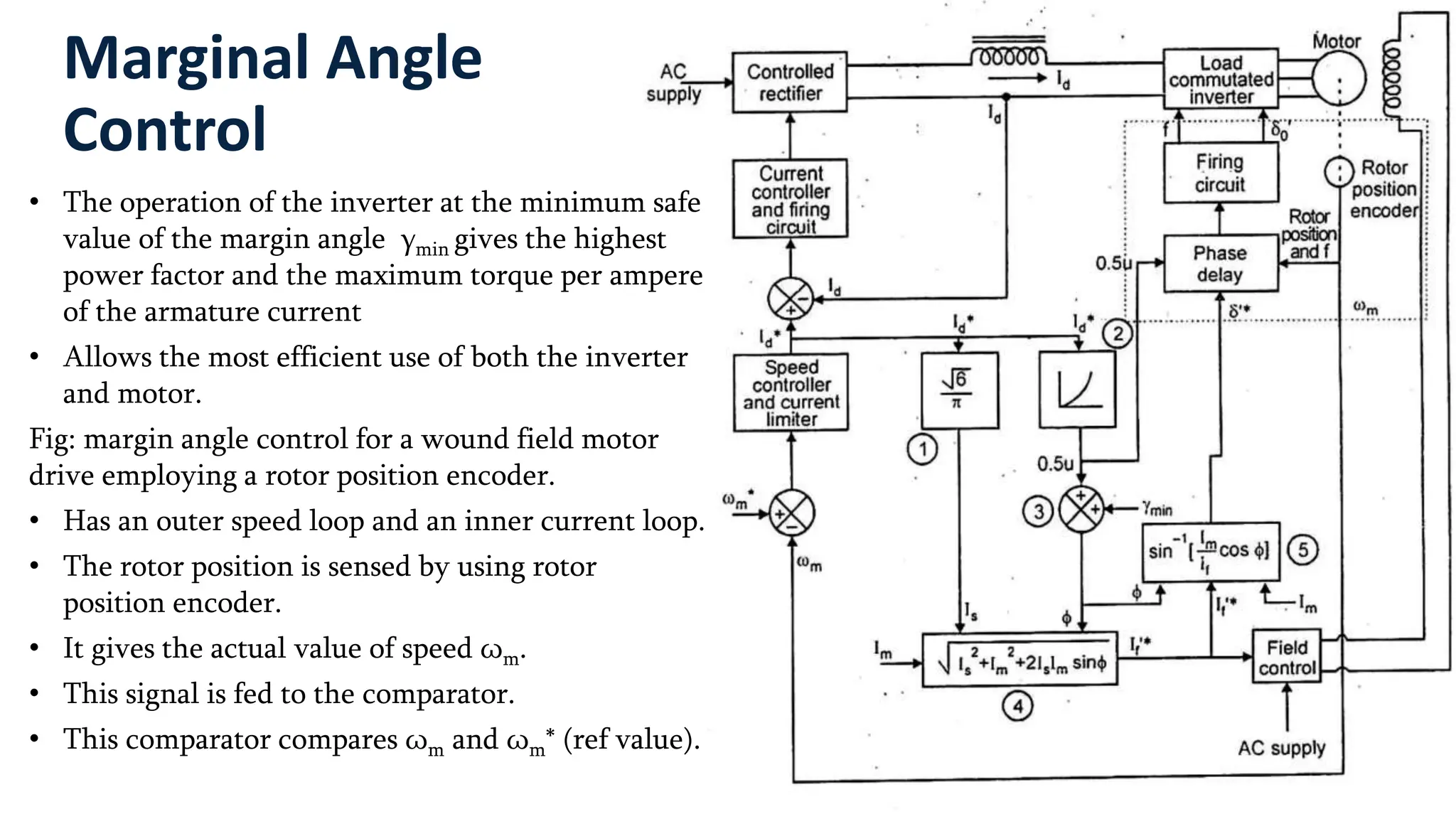
• The operation of the inverter at the minimum safe
value of the margin angle γmin gives the highest
power factor and the maximum torque per ampere
of the armature current
• Allows the most efficient use of both the inverter
and motor.
Fig: margin angle control for a wound field motor
drive employing a rotor position encoder.
• Has an outer speed loop and an inner current loop.
• The rotor position is sensed by using rotor
position encoder.
• It gives the actual value of speed ωm.
• This signal is fed to the comparator.
• This comparator compares ωm and ωm* (ref value).
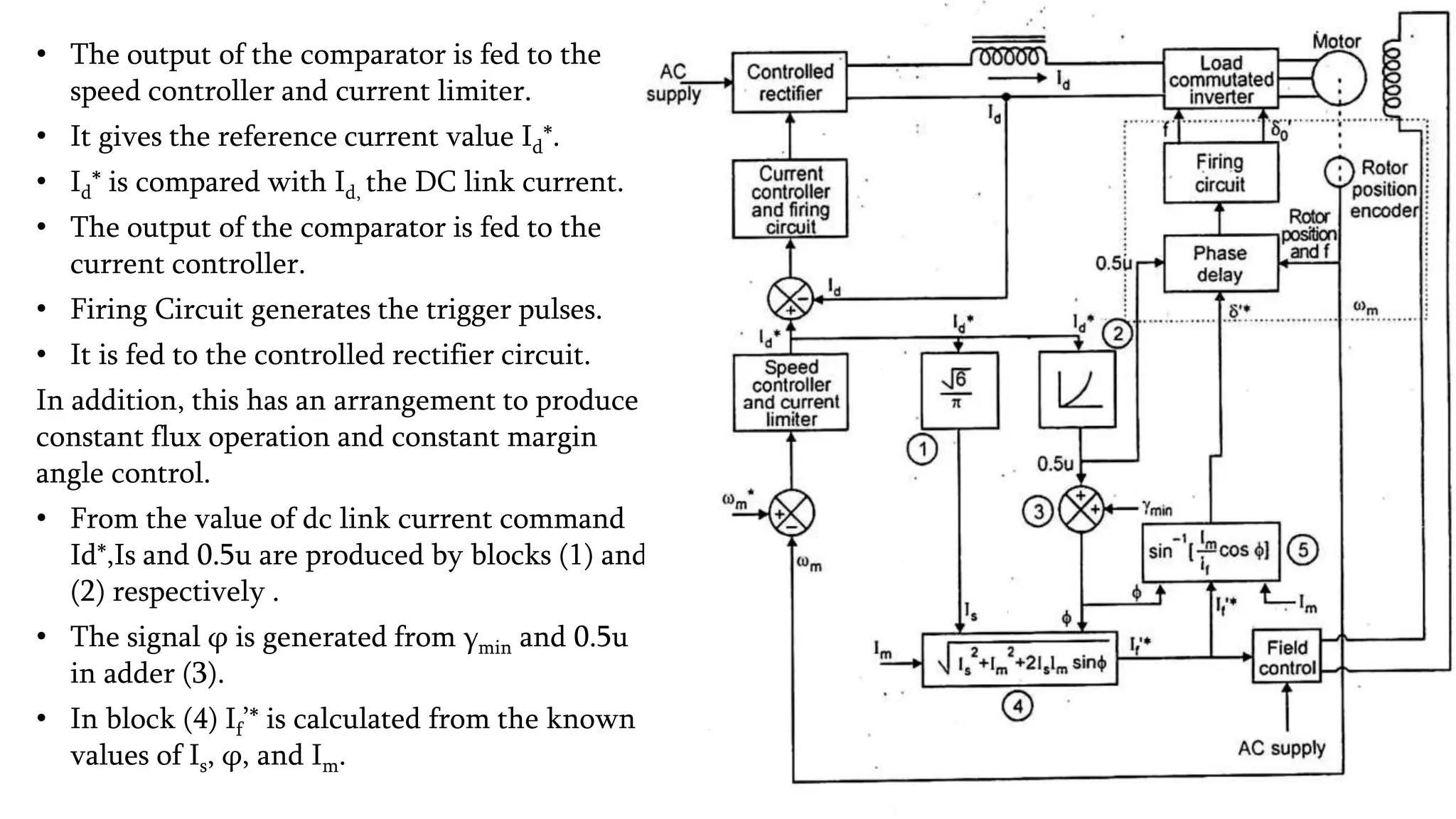
• The output of the comparator is fed to the
speed controller and current limiter.
• It gives the reference current value Id*.
• Id* is compared with Id, the DC link current.
• The output of the comparator is fed to the
current controller.
• Firing Circuit generates the trigger pulses.
• It is fed to the controlled rectifier circuit.
In addition, this has an arrangement to produce
constant flux operation and constant margin
angle control.
• From the value of dc link current command
Id*,Is and 0.5u are produced by blocks (1) and
(2) respectively .
• The signal φ is generated from γmin and 0.5u
in adder (3).
• In block (4) If’* is calculated from the known
values of Is, φ, and Im.
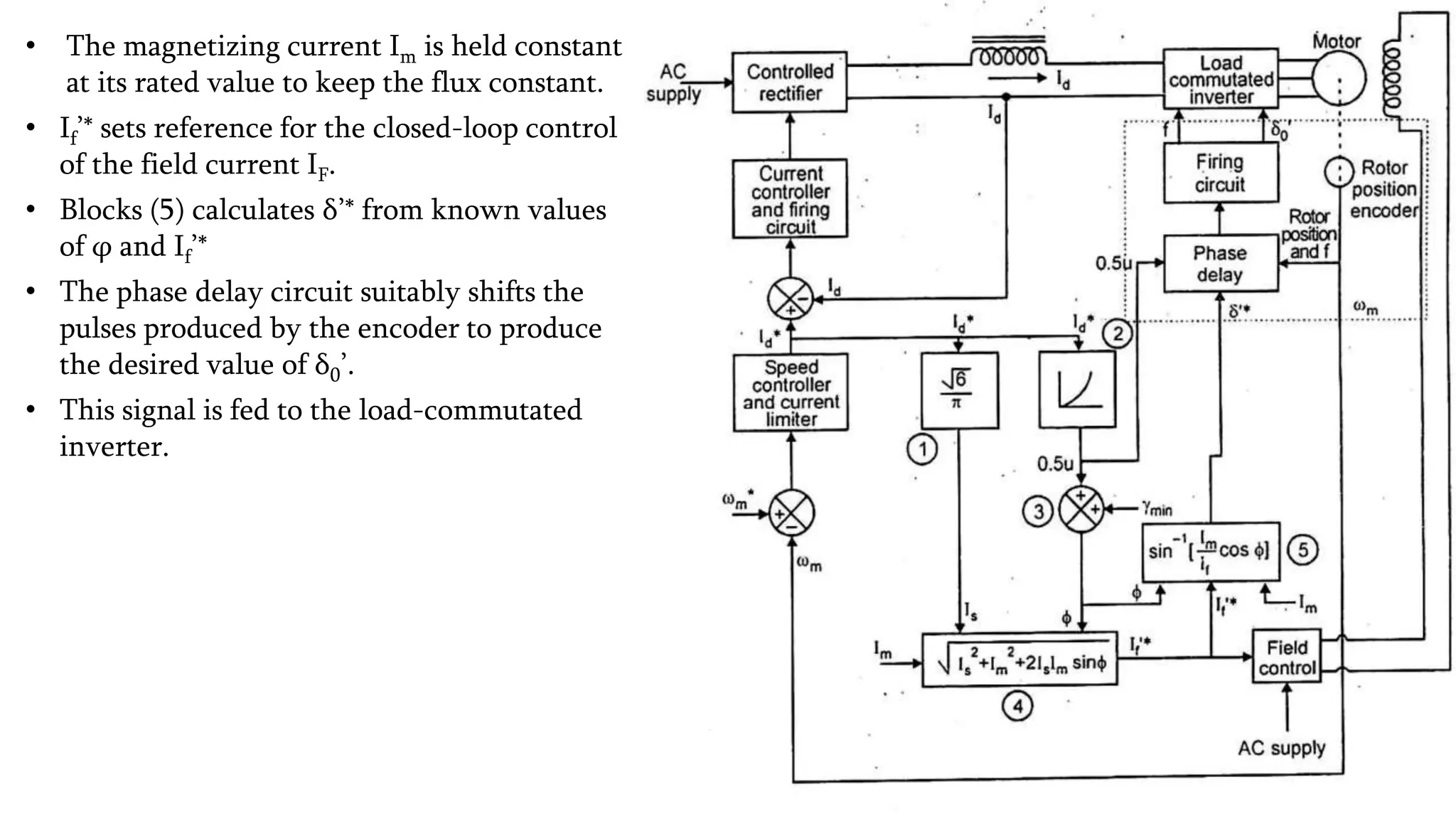
• The magnetizing current Im is held constant
at its rated value to keep the flux constant.
• If’* sets reference for the closed-loop control
of the field current IF.
• Blocks (5) calculates δ’* from known values
of φ and If’*
• The phase delay circuit suitably shifts the
pulses produced by the encoder to produce
the desired value of δ0’.
• This signal is fed to the load-commutated
inverter.
Advantages
• The load commutated inverter drives are used in medium power, high power and very
high power drives, and high-speed drives such as compressors, extractors, induced and
forced draft fans, blowers, conveyers, aircraft test facilities, steel rolling mills, large ship
propulsion, main line traction, flywheel energy storage and so on.
• This drive also used for the starting of large synchronous machines in gas turbine and
pumped storage plant.
• High-power drives employ rectifiers with higher pulse numbers, to reduce torque
pulsations.
• The converter voltage ratings are also high so that efficient high-voltage motors can be
employed.
Power Factor Control
19
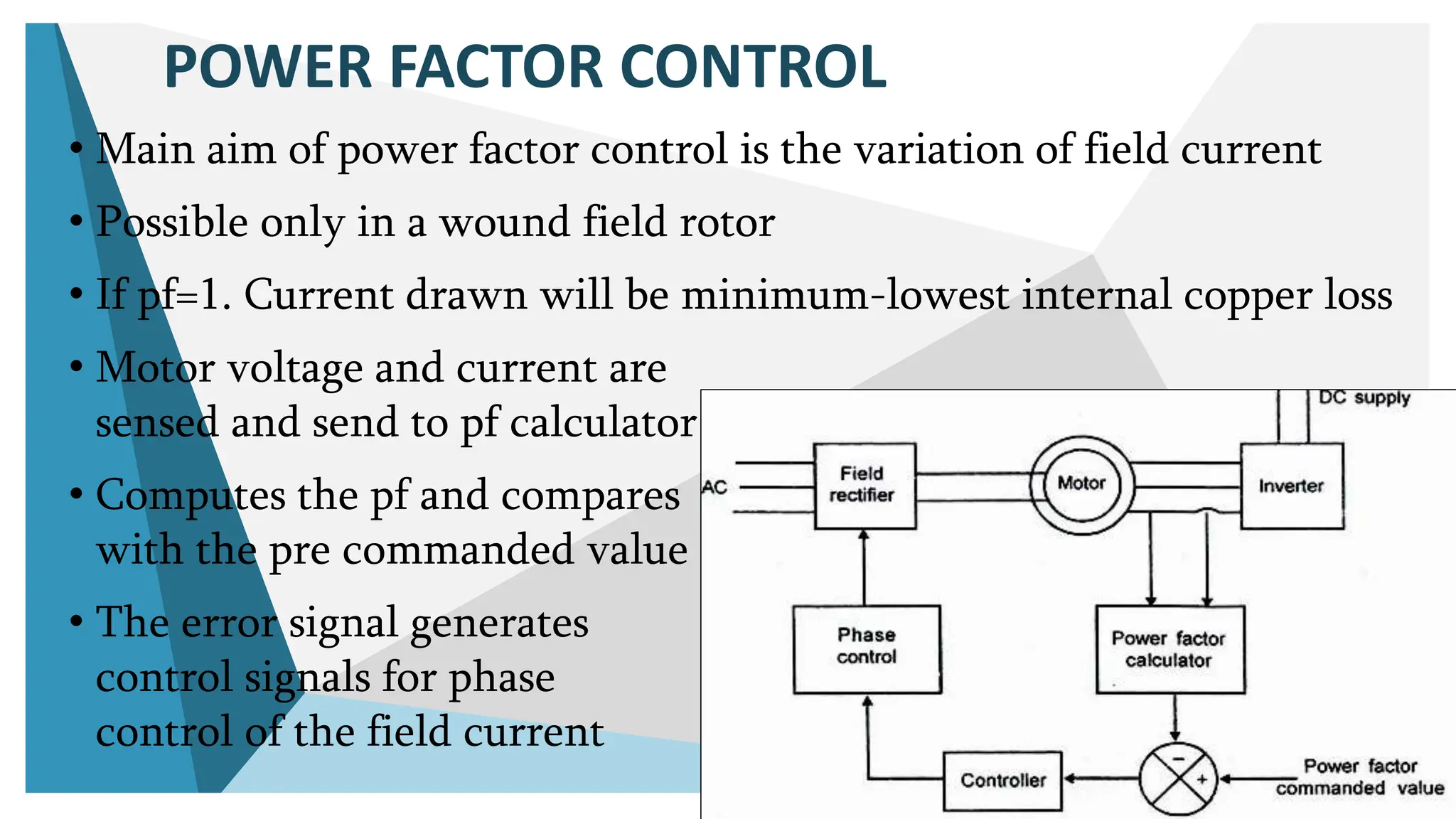
POWER FACTOR CONTROL
• Main aim of power factor control is the variation of field current
• Possible only in a wound field rotor
• If pf=1. Current drawn will be minimum-lowest internal copper loss
• Motor voltage and current are
sensed and send to pf calculator
• Computes the pf and compares
with the pre commanded value
• The error signal generates
control signals for phase
control of the field current
20
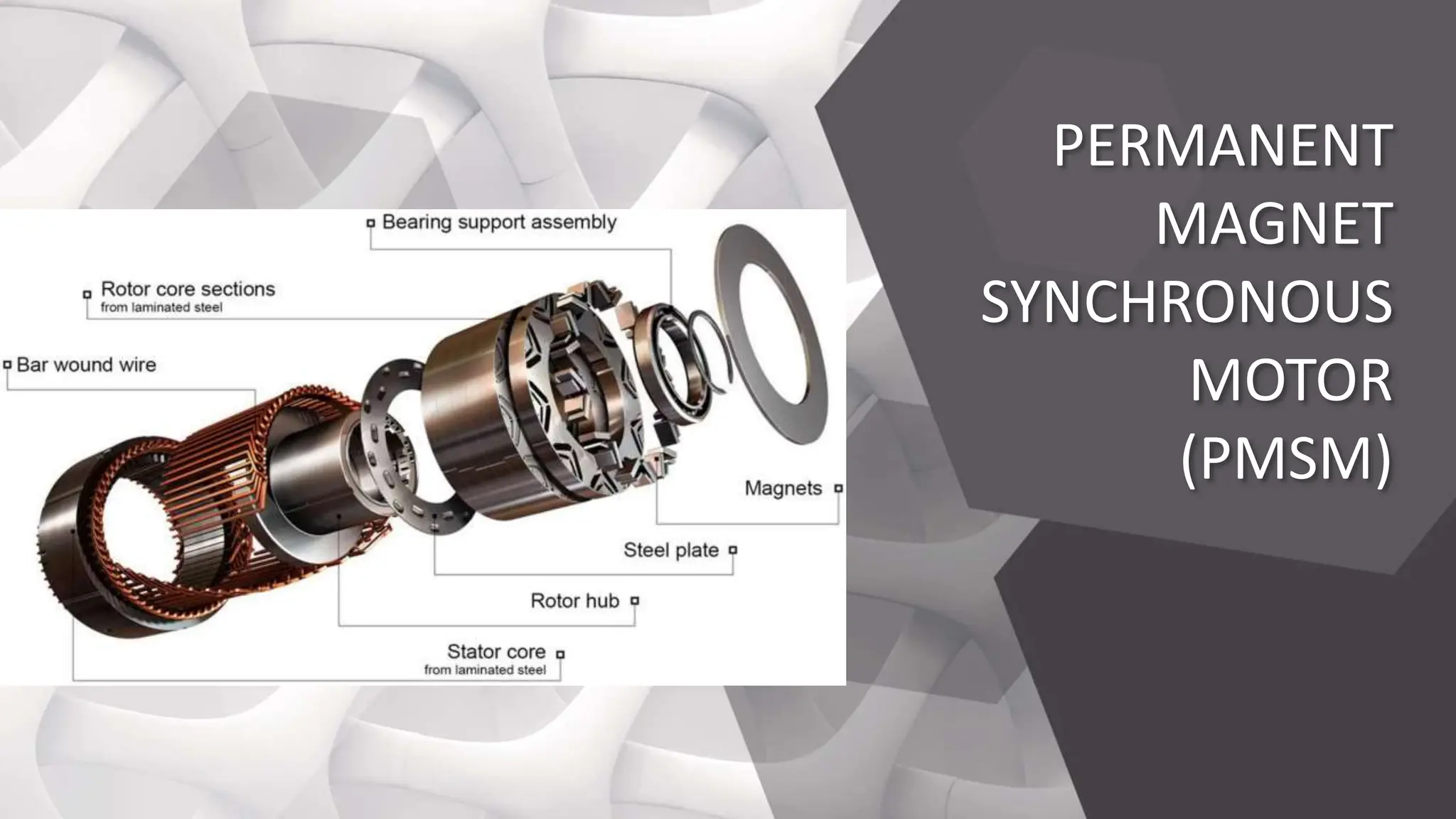
PERMANENT
MAGNET
SYNCHRONOUS
MOTOR
(PMSM)
Introduction to PMSM
• One of the types of AC synchronous motors, where
the field is excited by permanent magnets that
generate sinusoidal back EMF.
• Contains a rotor and stator same as that of an
induction motor, but a permanent magnet is used as a
rotor to create a magnetic field.
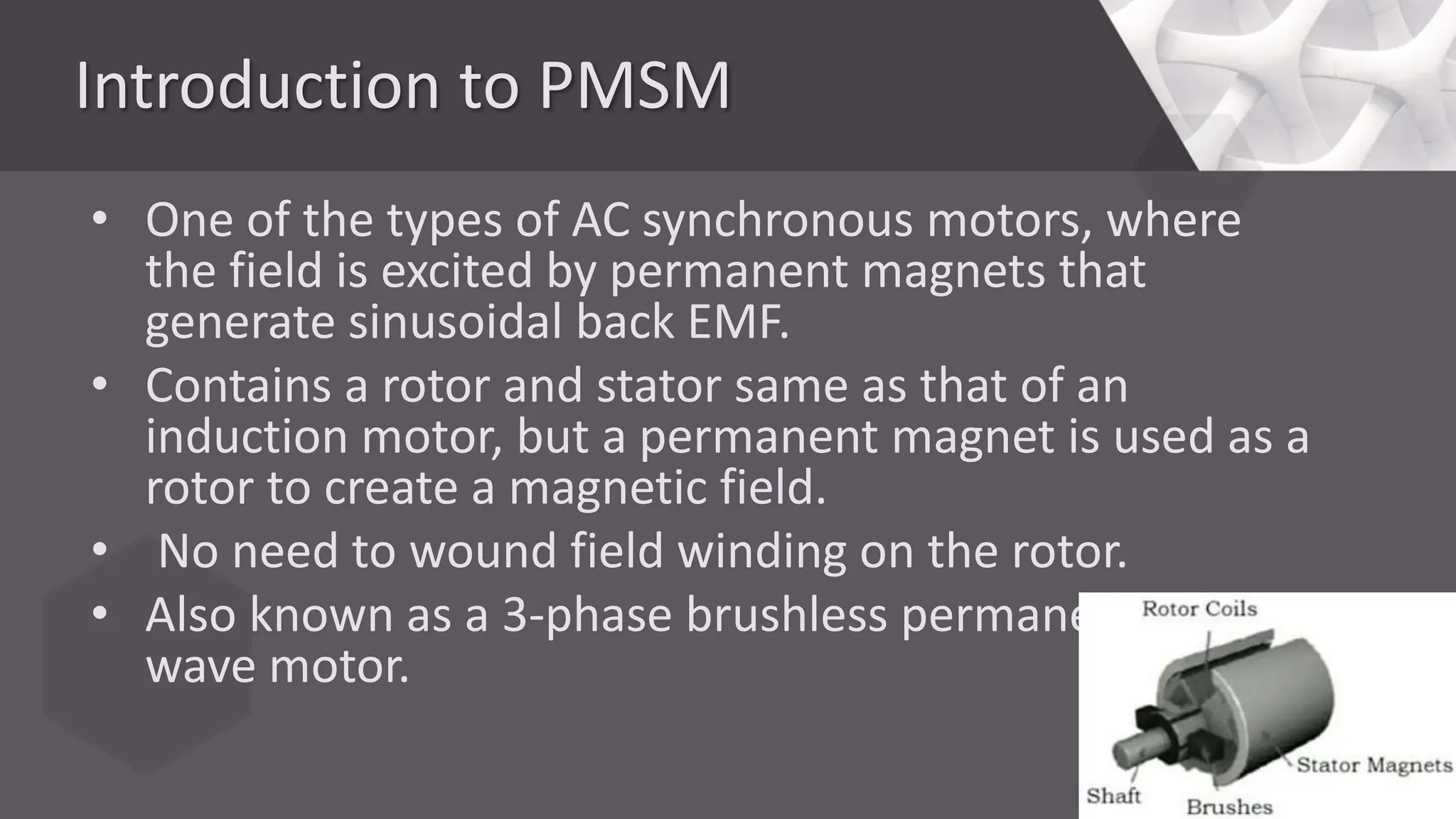
• No need to wound field winding on the rotor.
• Also known as a 3-phase brushless permanent sine
wave motor.
Construction and Working
• PMSM consists of a rotor and a stator.
• Rotor is placed inside the stator of the electric motor.
• The rotor doesn’t have any field winding, but the permanent magnets are used to create field
poles.
• The permanent magnets used in the PMSM are made up of samarium-cobalt and medium,
iron, and boron because of their higher permeability.
• The most widely used permanent magnet is neodymium-boron-iron because of its effective
cost and ease of availability.
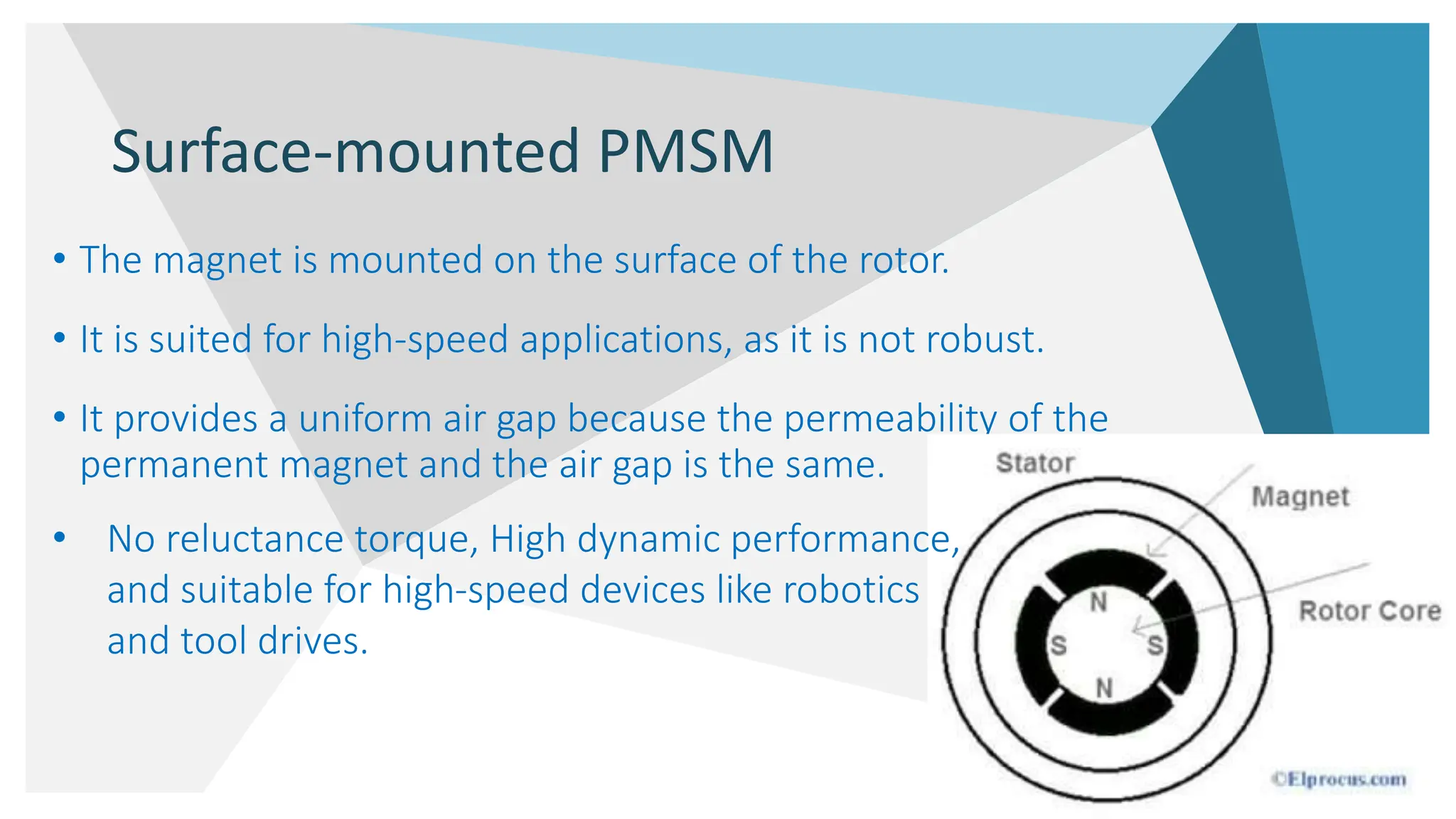
• In this type, the permanent magnets are mounted on the rotor.
• Based on the mounting of the permanent magnet on the rotor, the construction of a
permanent magnet synchronous motor is divided into two types.
Surface permanent magnet synchronous motor
Interior permanent magnet synchronous motor.
Surface-mounted PMSM
• The magnet is mounted on the surface of the rotor.
• It is suited for high-speed applications, as it is not robust.
• It provides a uniform air gap because the permeability of the
permanent magnet and the air gap is the same.
24
• No reluctance torque, High dynamic performance,
and suitable for high-speed devices like robotics
and tool drives.
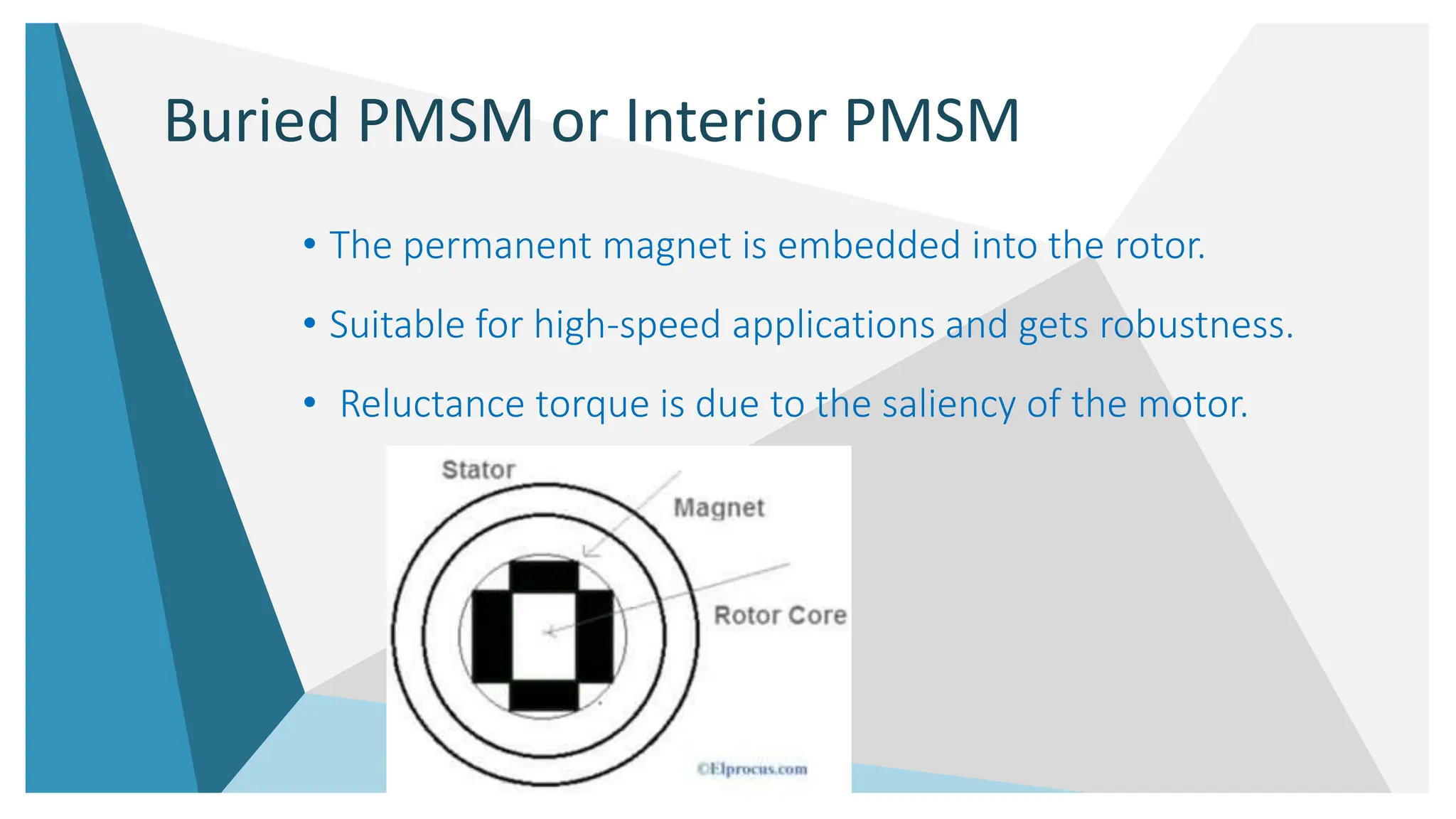
Buried PMSM or Interior PMSM
• The permanent magnet is embedded into the rotor.
• Suitable for high-speed applications and gets robustness.
• Reluctance torque is due to the saliency of the motor.
Your Footer Here
Working
• When a three-phase AC supply is applied to the windings of the stator coils, a rotating magnetic field is generated that
rotates at a speed proportional to the frequency of the supply voltage.
• The permanent magnets on the PMSM rotor create a constant magnetic field.
• The interaction between the rotating magnetic field of the stator and the constant magnetic field of the rotor creates a
torque, according to Ampere’s Law, thereby forcing the rotor to rotate.
• If an initial rotation is given to the rotor in the same direction as that of the rotating magnetic field, the opposite poles
of the rotating magnetic field and the rotor will be attracted to each other leading to the interlocking of rotor poles with
the rotating magnetic field of the stator.
• Thus, a PMSM cannot start itself when it is connected directly to the three-phase current network.
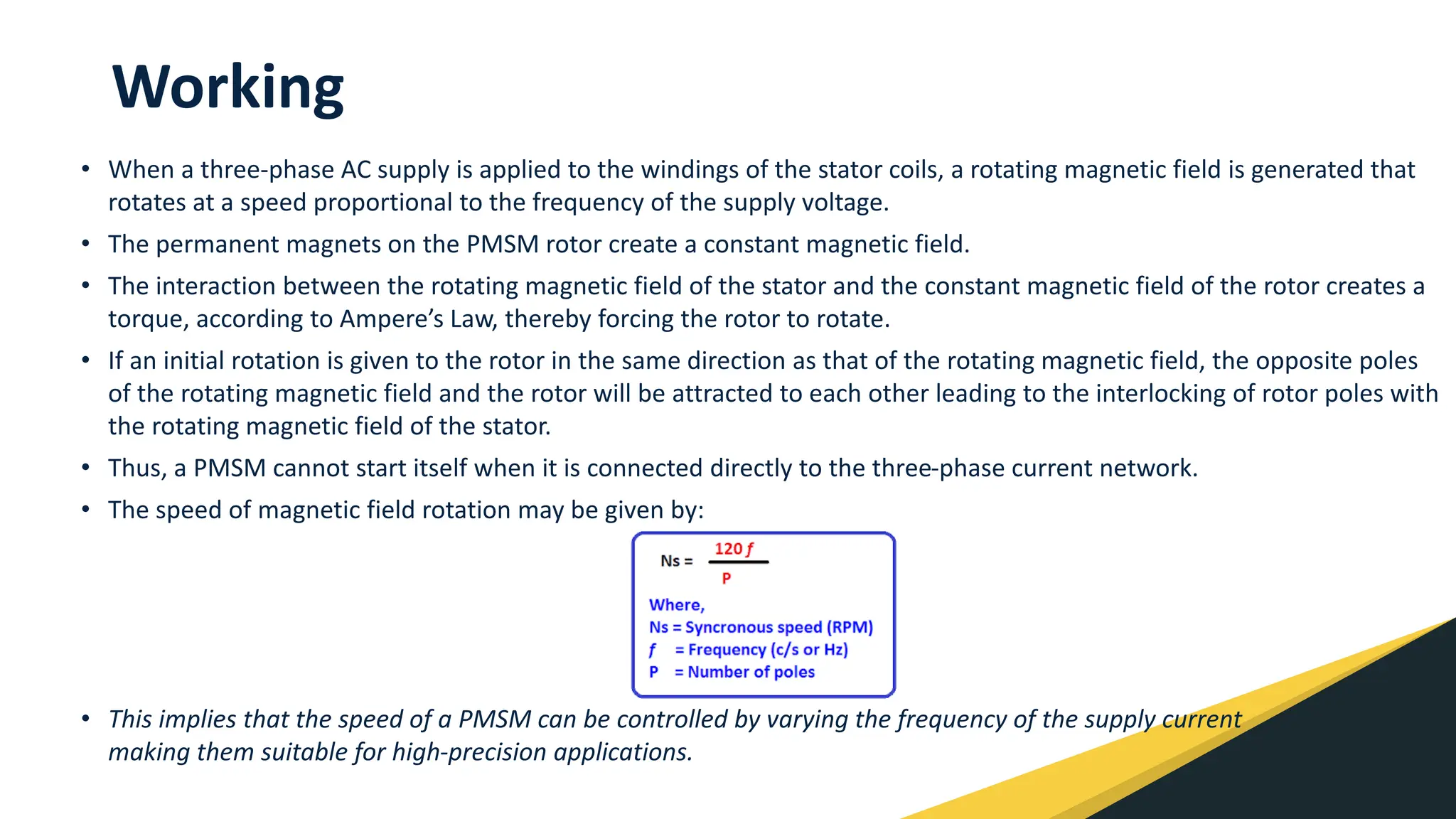
• The speed of magnetic field rotation may be given by:
• This implies that the speed of a PMSM can be controlled by varying the frequency of the supply current
making them suitable for high-precision applications.
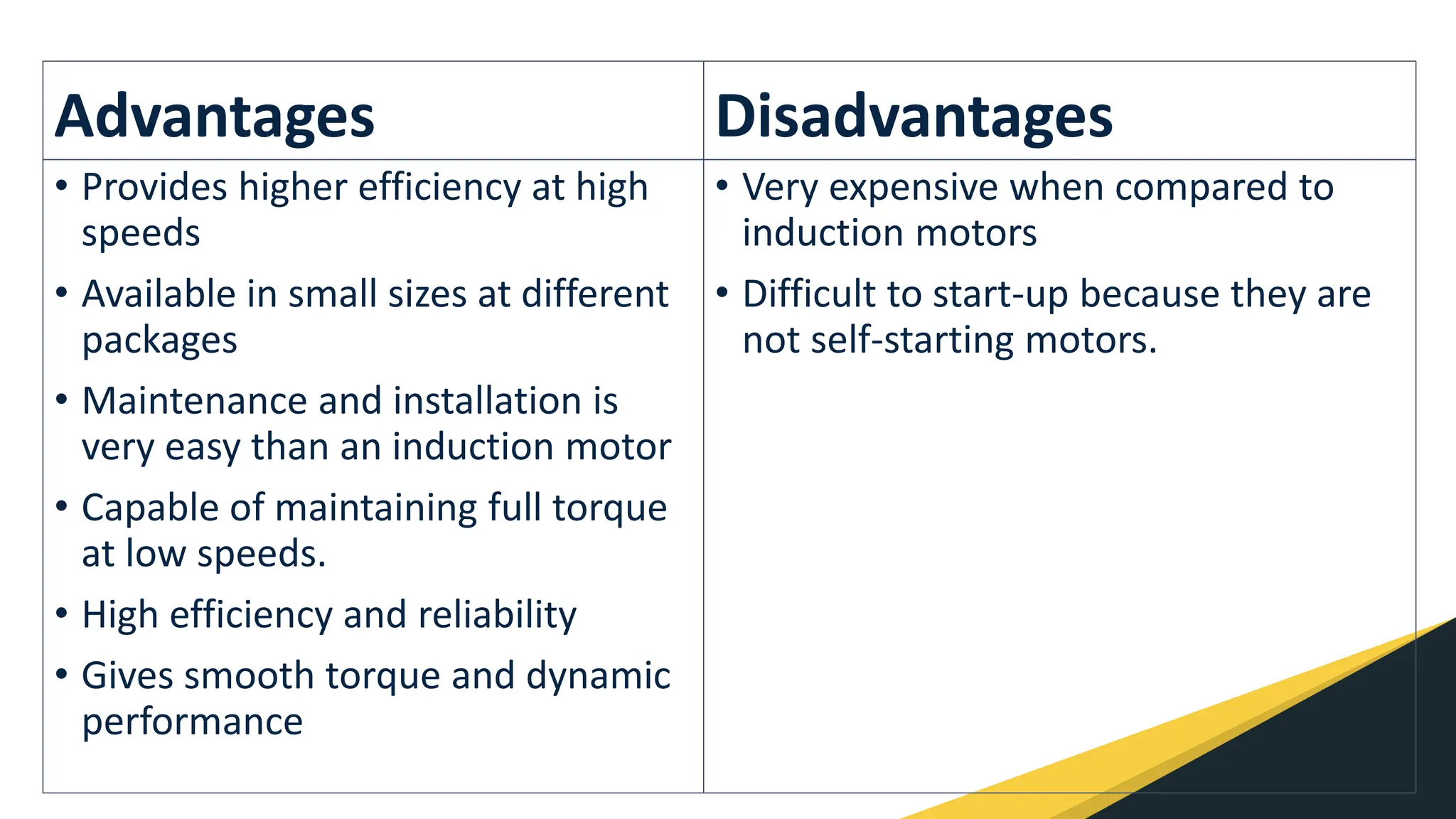
Advantages
• Provides higher efficiency at high
speeds
• Available in small sizes at different
packages
• Maintenance and installation is
very easy than an induction motor
• Capable of maintaining full torque
at low speeds.
• High efficiency and reliability
• Gives smooth torque and dynamic
performance
Disadvantages
• Very expensive when compared to
induction motors
• Difficult to start-up because they are
not self-starting motors.
Applications
• Air conditioners
• Refrigerators
• AC compressors
• Direct-drive Washing machines
• Automotive electrical power steering
• Machine tools
• Large power systems to improve leading, and lagging
power factor
• Control of traction
• Data storage units.
• Servo drives
• Industrial applications like robotics, aerospace etc 28
Synchronous motor speed control using electric drives.pptx

Synchronous motor speed control using electric drives.pptx

  • 1.
    Electric Drives and Control SYNCHRONOUSMOTOR DRIVES D.Poornima, Assistant Professor (Sr.Gr), Department of EEE, Sri Ramakrishna Institute of Technology, Coimbatore
  • 2.
    Working of SynchronousMotor Date Your Footer Here 2
  • 3.
    Speed Control ofSynchronous Motor • Synchronous motors are constant-speed motors running at the synchronous speed of the supply. • The speed of a synchronous motor is given by • Synchronous speed depends on the frequency of the supply and the number of poles of the rotor. • Changing the number of poles is not easy • The frequency of the current fed to the synchronous motor can be varied and thus the speed can be controlled. 3 Where, f = supply frequency and p = number of poles.
  • 4.
    Variable Frequency Control: •Achieved by constant flux operation below base speed i.e. operating the motor with a constant (V/f) ratio; which is increased at low speeds to compensate for the stator resistance drop. • Rated voltage is reached at the base speed. 4 • For higher speeds, the machine is operated at a rated terminal voltage and variable frequency control is used. • Variable Frequency Control of Multiple Synchronous Motors employs two modes:  true synchronous mode  self-controlled mode(self-synchronous mode)
  • 5.
    True Synchronous Mode(Open Loop Control) • Stator supply frequency is controlled from an independent oscillator by using an inverter. • Frequency from its initial to the desired value is changed gradually so that the difference between synchronous speed and rotor speed is always small. • This allows rotor speed to track the changes in synchronous speed. • When the desired synchronous speed (or frequency) is reached, the rotor pulls into step, after hunting oscillations.
  • 6.
    True Synchronous Mode •Used for speed control, smooth starting and regenerative braking of the motor • Possible as long as the changes in frequency are slow enough for the rotor to track changes in synchronous speed. • A motor with damper winding is used for pull-in to synchronism. • Open loop operation is useful when several motors need to be run at the same speed. • Causes spontaneous oscillation or hunting.
  • 7.
    Self-Controlled Mode/Self-Synchronous Mode(Closed Loop Control ) • Used when highly accurate speed control is required. • Stator supply frequency is changed so that rotor always rotates at synchronous speed • Rotor cannot pull-out of step and hunting oscillations are eliminated. • The motor does not require a damper winding. • Achieved by using an inverter whose output frequency is determined by the speed of the rotor. • Speed of the rotor is fed back to the differentiator. • Difference between the preset speed and the actual speed is fed to the rectifier. • Accordingly, the inverter changes the frequency and adjusts the speed of the motor
  • 8.
    Self-Controlled Mode/Self-Synchronous Mode. •Voltage induced in the stator phase has a frequency proportional to rotor speed • So self-control can be realized by making the stator supply frequency to track the frequency of induced voltage. • Sensors can also be mounted on the stator to track the rotor position. • These sensors are called rotor position sensors. • The frequency of signals generated by these sensors is proportional to rotor speed.
  • 9.
    Self Controlled SynchronousMotor Drive with Load Commutated Thyristor Inverter • In large power drives wound field synchronous motor is used. • Medium power drives employ permanent magnet synchronous motor. • Self Controlled Synchronous Motor Drive employs two converters, source side converter and load side converter. • The source side converter-is a 6-pulse line-commutated thyristor converter. • For a firing angle range 0 ≤ αs ≤ 90∘, it works as a line-commutated fully controlled rectifier delivering positive Vds and positive Id • For the range of firing angle 90∘ ≤ αs ≤180∘ it works as a line-commutated inverter delivering negative Vds and positive Id.
  • 10.
    • When thedrive operates at a leading power factor, thyristors of the load-side converter can be commutated by the motor-induced voltages - known as load commutation. • For 90° ≤ αl ≤ 180°, the load side converter operates as an inverter producing negative Vdl and carrying positive Id • For 0° ≤ αl ≤ 90° it works as a rectifier giving positive Vdl. • For 0° ≤ αs ≤ 90°, 90° ≤ αl ≤ 180° and with Vds > Vdl, the source side converter works as a rectifier and load side converter as an inverter, causing power to flow from ac source to the motor, thus giving motoring operation.
  • 11.
    • When firingangles are such that 90° ≤ αs ≤ 180 ° and 0 ° ≤ αl ≤ 90 °, the load side converter operates as a rectifier and the source side as an inverter. • Consequently, the power flow reverses and the machine operates in regenerative braking. • The magnitude of torque depends on (Vds — Vdl). • Speed can be changed by control of line (source) side converter firing angles.
  • 12.
  • 13.
    What is MarginAngle? • Defined as the angle measured from the end of commutation to the crossing of the phase voltage under commutation (natural firing instant). • For operation without commutation failure, margin angle must be greater than the turn-off angle (ωtq) of the thyristors, where ω is the supply frequency and tq is the thyristor turn-off time. • In the constant Margin Angle Control of Synchronous Motors, margin angle does not go below a minimum value.
  • 14.
    • For 0°≤ αs ≤ 90°, 90° ≤ αl ≤ 180° and with Vds > Vdl, the source side converter works as a rectifier and load side converter as an inverter, causing power to flow from ac source to the motor, thus giving motoring operation.
  • 15.
    Marginal Angle Control • Theoperation of the inverter at the minimum safe value of the margin angle γmin gives the highest power factor and the maximum torque per ampere of the armature current • Allows the most efficient use of both the inverter and motor. Fig: margin angle control for a wound field motor drive employing a rotor position encoder. • Has an outer speed loop and an inner current loop. • The rotor position is sensed by using rotor position encoder. • It gives the actual value of speed ωm. • This signal is fed to the comparator. • This comparator compares ωm and ωm* (ref value).
  • 16.
    • The outputof the comparator is fed to the speed controller and current limiter. • It gives the reference current value Id*. • Id* is compared with Id, the DC link current. • The output of the comparator is fed to the current controller. • Firing Circuit generates the trigger pulses. • It is fed to the controlled rectifier circuit. In addition, this has an arrangement to produce constant flux operation and constant margin angle control. • From the value of dc link current command Id*,Is and 0.5u are produced by blocks (1) and (2) respectively . • The signal φ is generated from γmin and 0.5u in adder (3). • In block (4) If’* is calculated from the known values of Is, φ, and Im.
  • 17.
    • The magnetizingcurrent Im is held constant at its rated value to keep the flux constant. • If’* sets reference for the closed-loop control of the field current IF. • Blocks (5) calculates δ’* from known values of φ and If’* • The phase delay circuit suitably shifts the pulses produced by the encoder to produce the desired value of δ0’. • This signal is fed to the load-commutated inverter.
  • 18.
    Advantages • The loadcommutated inverter drives are used in medium power, high power and very high power drives, and high-speed drives such as compressors, extractors, induced and forced draft fans, blowers, conveyers, aircraft test facilities, steel rolling mills, large ship propulsion, main line traction, flywheel energy storage and so on. • This drive also used for the starting of large synchronous machines in gas turbine and pumped storage plant. • High-power drives employ rectifiers with higher pulse numbers, to reduce torque pulsations. • The converter voltage ratings are also high so that efficient high-voltage motors can be employed.
  • 19.
  • 20.
    POWER FACTOR CONTROL •Main aim of power factor control is the variation of field current • Possible only in a wound field rotor • If pf=1. Current drawn will be minimum-lowest internal copper loss • Motor voltage and current are sensed and send to pf calculator • Computes the pf and compares with the pre commanded value • The error signal generates control signals for phase control of the field current 20
  • 21.
  • 22.
    Introduction to PMSM •One of the types of AC synchronous motors, where the field is excited by permanent magnets that generate sinusoidal back EMF. • Contains a rotor and stator same as that of an induction motor, but a permanent magnet is used as a rotor to create a magnetic field. • No need to wound field winding on the rotor. • Also known as a 3-phase brushless permanent sine wave motor.
  • 23.
    Construction and Working •PMSM consists of a rotor and a stator. • Rotor is placed inside the stator of the electric motor. • The rotor doesn’t have any field winding, but the permanent magnets are used to create field poles. • The permanent magnets used in the PMSM are made up of samarium-cobalt and medium, iron, and boron because of their higher permeability. • The most widely used permanent magnet is neodymium-boron-iron because of its effective cost and ease of availability. • In this type, the permanent magnets are mounted on the rotor. • Based on the mounting of the permanent magnet on the rotor, the construction of a permanent magnet synchronous motor is divided into two types. Surface permanent magnet synchronous motor Interior permanent magnet synchronous motor.
  • 24.
    Surface-mounted PMSM • Themagnet is mounted on the surface of the rotor. • It is suited for high-speed applications, as it is not robust. • It provides a uniform air gap because the permeability of the permanent magnet and the air gap is the same. 24 • No reluctance torque, High dynamic performance, and suitable for high-speed devices like robotics and tool drives.
  • 25.
    Buried PMSM orInterior PMSM • The permanent magnet is embedded into the rotor. • Suitable for high-speed applications and gets robustness. • Reluctance torque is due to the saliency of the motor. Your Footer Here
  • 26.
    Working • When athree-phase AC supply is applied to the windings of the stator coils, a rotating magnetic field is generated that rotates at a speed proportional to the frequency of the supply voltage. • The permanent magnets on the PMSM rotor create a constant magnetic field. • The interaction between the rotating magnetic field of the stator and the constant magnetic field of the rotor creates a torque, according to Ampere’s Law, thereby forcing the rotor to rotate. • If an initial rotation is given to the rotor in the same direction as that of the rotating magnetic field, the opposite poles of the rotating magnetic field and the rotor will be attracted to each other leading to the interlocking of rotor poles with the rotating magnetic field of the stator. • Thus, a PMSM cannot start itself when it is connected directly to the three-phase current network. • The speed of magnetic field rotation may be given by: • This implies that the speed of a PMSM can be controlled by varying the frequency of the supply current making them suitable for high-precision applications.
  • 27.
    Advantages • Provides higherefficiency at high speeds • Available in small sizes at different packages • Maintenance and installation is very easy than an induction motor • Capable of maintaining full torque at low speeds. • High efficiency and reliability • Gives smooth torque and dynamic performance Disadvantages • Very expensive when compared to induction motors • Difficult to start-up because they are not self-starting motors.
  • 28.
    Applications • Air conditioners •Refrigerators • AC compressors • Direct-drive Washing machines • Automotive electrical power steering • Machine tools • Large power systems to improve leading, and lagging power factor • Control of traction • Data storage units. • Servo drives • Industrial applications like robotics, aerospace etc 28

Editor's Notes

  • #2 © Copyright PresentationGO.com – The free PowerPoint and Google Slides template library
  • #3 © Copyright PresentationGO.com – The free PowerPoint and Google Slides template library
  • #4 © Copyright PresentationGO.com – The free PowerPoint and Google Slides template library
  • #5 © Copyright PresentationGO.com – The free PowerPoint and Google Slides template library