Abnormal LFT’s Dr E M Said
why do we  check LFT’s? Well person screening To investigate unexplained symptoms For pre-operative or base line assessment For investigation of suspected liver disease
What are LFT’s? The term “LFTs” is imprecise… Many of the tests reflecting the  health  of the liver are not direct measure if its  function . Normal test values are arbitrarily defined as those occurring within two standard deviation of the the mean i.e 5% of of healthy individuals will have abnormal LFTs
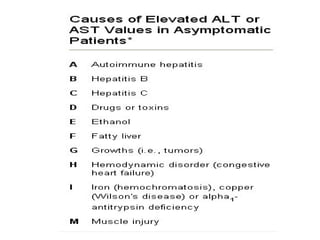
According to the American  Gastroenterological Association (AGA), 1 to 4 percent of the asymptomatic population may have elevated serum liver chemistries. This is consistent with the usual definition .
Remember…. abnormal LFTs often,but not always,indicate something wrong with the liver. The commonly used LFTs may be abnormal even in a healthy liver. Normal LFTs do not always mean that the liver is normal.
approach History: The most important part in evaluation of a patient with abnormal LFTs
approach History: The most important part in evaluation of a patient with abnormal LFTs Exposure to any chemicals Use of any medications  The duration of abnormal LFTs The presence of accompanying symptoms e.g jaundice ,artheralgia,Wt loss fever,pruritus
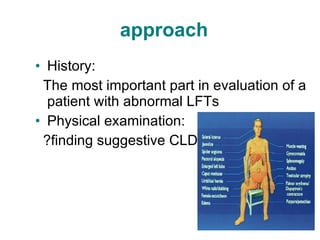
approach History: The most important part in evaluation of a patient with abnormal LFTs Physical examination: ?finding suggestive CLD
approach History: The most important part in evaluation of a patient with abnormal LFTs Physical examination: ?finding suggestive CLD Lap testing: evaluate the overall pattern
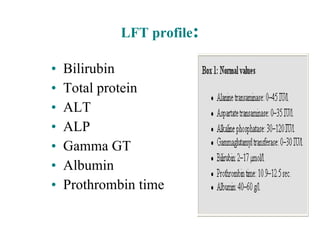
LFT profile : Bilirubin Total protein ALT ALP Gamma GT Albumin Prothrombin time
Patterns of abnormal LFT’s Sole or combined elevation acute or chronic Predominantly Hepatocellular Predominantly cholestatic
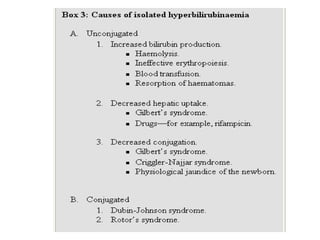
Bilirubin Produced by haemoglobin catabolism Isolated hyper bilirubinaemia occurs in tow settings: Over production Impaired uptake,conjugation or excretion
 
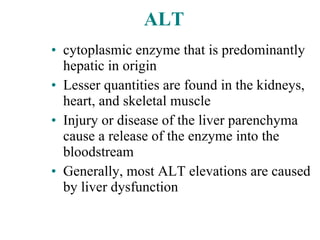
ALT cytoplasmic enzyme that is predominantly hepatic in origin Lesser quantities are found in the kidneys, heart, and skeletal muscle   Injury or disease of the liver parenchyma cause a release of the enzyme into the bloodstream   Generally, most ALT elevations are caused by liver dysfunction
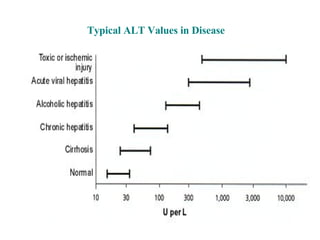
Typical ALT Values in Disease
 
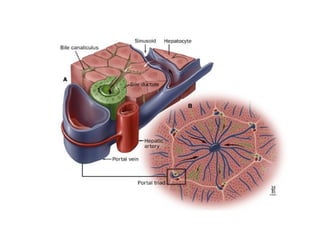
ALP Largely originate from the liver,mainly cells lining biliary ducts or membranes adjoining the bile canaliculi,and bones Marked increase is typical of cholestasis (often with raised GGT) Variety of bone disorders (usually without raised GGT) Isoenzymes may be useful for distinguishing these sources
 
 
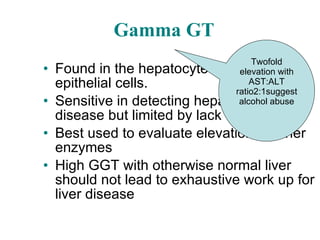
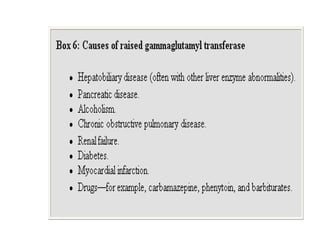
Gamma GT Found in the hepatocytes and biliary epithelial cells. Sensitive in detecting hepatobiliary disease but limited by lack of specificity Best used to evaluate elevation of other enzymes High GGT with otherwise normal liver should not lead to exhaustive work up for liver disease
Gamma GT Found in the hepatocytes and biliary epithelial cells. Sensitive in detecting hepatobiliary disease but limited by lack of specificity Best used to evaluate elevation of other enzymes High GGT with otherwise normal liver should not lead to exhaustive work up for liver disease Twofold elevation with AST:ALT ratio2:1suggest alcohol abuse
 
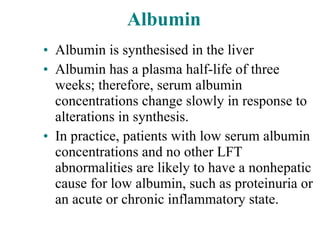
Albumin Albumin is synthesised in the liver Albumin has a plasma half-life of three weeks; therefore, serum albumin concentrations change slowly in response to alterations in synthesis. In practice, patients with low serum albumin concentrations and no other LFT abnormalities are likely to have a nonhepatic cause for low albumin, such as proteinuria or an acute or chronic inflammatory state.
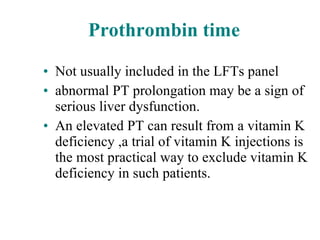
Prothrombin time Not usually included in the LFTs panel abnormal PT prolongation may be a sign of serious liver dysfunction. An elevated PT can result from a vitamin K deficiency ,a trial of vitamin K injections is the most practical way to exclude vitamin K deficiency in such patients.
Predominantly Hepatocellular Usually ALT>ALP Alcoholic hepatitis
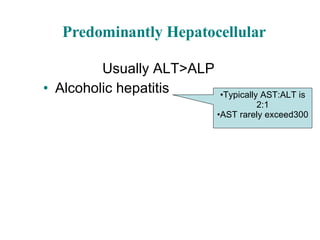
Predominantly Hepatocellular Usually ALT>ALP Alcoholic hepatitis Typically AST:ALT is 2:1 AST rarely exceed300
Predominantly Hepatocellular Usually ALT>ALP Alcoholic hepatitis Viral hepatitis
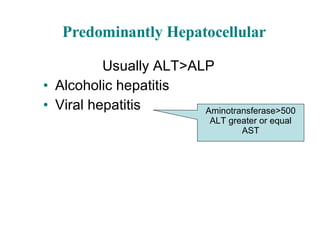
Predominantly Hepatocellular Usually ALT>ALP Alcoholic hepatitis Viral hepatitis Aminotransferase>500 ALT greater or equal AST
Predominantly Hepatocellular Usually ALT>ALP Alcoholic hepatitis Viral hepatitis Toxic hepatitis Shock liver(ischemic hepatitis)
Predominantly Hepatocellular Usually ALT>ALP Alcoholic hepatitis Viral hepatitis Toxic hepatitis Shock liver(ischemic hepatitis) exceeding1000IU/L Or 50x upper limit of normal
Predominantly Hepatocellular Usually ALT>ALP Alcoholic hepatitis Viral hepatitis Toxic hepatitis Shock liver(ischemic hepatitis) Wilson disease Autoimmune hepatitis
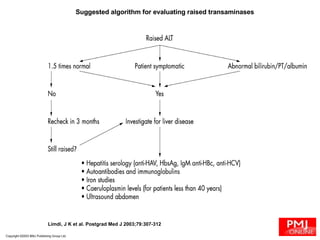
Copyright ©2003 BMJ Publishing Group Ltd. Limdi, J K et al. Postgrad Med J 2003;79:307-312 Suggested algorithm for evaluating raised transaminases
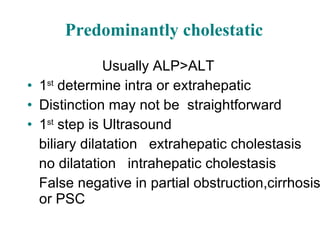
Predominantly cholestatic Usually ALP>ALT 1 st  determine intra or extrahepatic Distinction may not be  straightforward 1 st  step is Ultrasound biliary dilatation  extrahepatic cholestasis no dilatation  intrahepatic cholestasis False negative in partial obstruction,cirrhosis or PSC
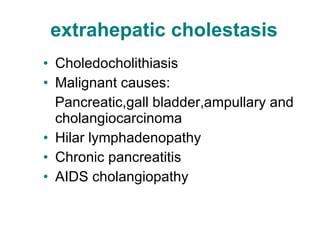
extrahepatic cholestasis Choledocholithiasis Malignant causes: Pancreatic,gall bladder,ampullary and cholangiocarcinoma Hilar lymphadenopathy Chronic pancreatitis AIDS cholangiopathy
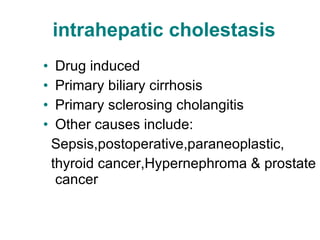
intrahepatic cholestasis Drug induced Primary biliary cirrhosis Primary sclerosing cholangitis Other causes include: Sepsis,postoperative,paraneoplastic, thyroid cancer,Hypernephroma & prostate cancer
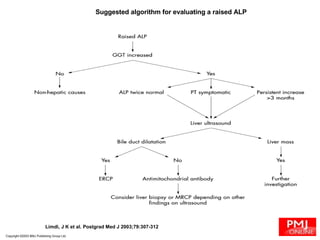
Copyright ©2003 BMJ Publishing Group Ltd. Limdi, J K et al. Postgrad Med J 2003;79:307-312 Suggested algorithm for evaluating a raised ALP
The role of liver biopsy  Most patients with abnormal LFTs with suspected etiologic factors for liver disease are identified by history taking, physical examination, further blood tests, and imaging In patients with unexplained LFTs elevations, a liver biopsy may be helpful to identify the cause of liver disease The decision to perform a liver biopsy must balance the possible risks of the procedure (eg, discomfort, bleeding, peritonitis, pneumothorax) with the potential benefits
 

Abnormal LFT's

  • 1.
  • 2.
    why do we check LFT’s? Well person screening To investigate unexplained symptoms For pre-operative or base line assessment For investigation of suspected liver disease
  • 3.
    What are LFT’s?The term “LFTs” is imprecise… Many of the tests reflecting the health of the liver are not direct measure if its function . Normal test values are arbitrarily defined as those occurring within two standard deviation of the the mean i.e 5% of of healthy individuals will have abnormal LFTs
  • 4.
    According to theAmerican Gastroenterological Association (AGA), 1 to 4 percent of the asymptomatic population may have elevated serum liver chemistries. This is consistent with the usual definition .
  • 5.
    Remember…. abnormal LFTsoften,but not always,indicate something wrong with the liver. The commonly used LFTs may be abnormal even in a healthy liver. Normal LFTs do not always mean that the liver is normal.
  • 6.
    approach History: Themost important part in evaluation of a patient with abnormal LFTs
  • 7.
    approach History: Themost important part in evaluation of a patient with abnormal LFTs Exposure to any chemicals Use of any medications The duration of abnormal LFTs The presence of accompanying symptoms e.g jaundice ,artheralgia,Wt loss fever,pruritus
  • 8.
    approach History: Themost important part in evaluation of a patient with abnormal LFTs Physical examination: ?finding suggestive CLD
  • 9.
    approach History: Themost important part in evaluation of a patient with abnormal LFTs Physical examination: ?finding suggestive CLD
  • 10.
    approach History: Themost important part in evaluation of a patient with abnormal LFTs Physical examination: ?finding suggestive CLD Lap testing: evaluate the overall pattern
  • 11.
    LFT profile :Bilirubin Total protein ALT ALP Gamma GT Albumin Prothrombin time
  • 12.
    Patterns of abnormalLFT’s Sole or combined elevation acute or chronic Predominantly Hepatocellular Predominantly cholestatic
  • 13.
    Bilirubin Produced byhaemoglobin catabolism Isolated hyper bilirubinaemia occurs in tow settings: Over production Impaired uptake,conjugation or excretion
  • 14.
  • 15.
    ALT cytoplasmic enzymethat is predominantly hepatic in origin Lesser quantities are found in the kidneys, heart, and skeletal muscle Injury or disease of the liver parenchyma cause a release of the enzyme into the bloodstream Generally, most ALT elevations are caused by liver dysfunction
  • 16.
  • 17.
  • 18.
    ALP Largely originatefrom the liver,mainly cells lining biliary ducts or membranes adjoining the bile canaliculi,and bones Marked increase is typical of cholestasis (often with raised GGT) Variety of bone disorders (usually without raised GGT) Isoenzymes may be useful for distinguishing these sources
  • 19.
  • 20.
  • 21.
    Gamma GT Foundin the hepatocytes and biliary epithelial cells. Sensitive in detecting hepatobiliary disease but limited by lack of specificity Best used to evaluate elevation of other enzymes High GGT with otherwise normal liver should not lead to exhaustive work up for liver disease
  • 22.
    Gamma GT Foundin the hepatocytes and biliary epithelial cells. Sensitive in detecting hepatobiliary disease but limited by lack of specificity Best used to evaluate elevation of other enzymes High GGT with otherwise normal liver should not lead to exhaustive work up for liver disease Twofold elevation with AST:ALT ratio2:1suggest alcohol abuse
  • 23.
  • 24.
    Albumin Albumin issynthesised in the liver Albumin has a plasma half-life of three weeks; therefore, serum albumin concentrations change slowly in response to alterations in synthesis. In practice, patients with low serum albumin concentrations and no other LFT abnormalities are likely to have a nonhepatic cause for low albumin, such as proteinuria or an acute or chronic inflammatory state.
  • 25.
    Prothrombin time Notusually included in the LFTs panel abnormal PT prolongation may be a sign of serious liver dysfunction. An elevated PT can result from a vitamin K deficiency ,a trial of vitamin K injections is the most practical way to exclude vitamin K deficiency in such patients.
  • 26.
    Predominantly Hepatocellular UsuallyALT>ALP Alcoholic hepatitis
  • 27.
    Predominantly Hepatocellular UsuallyALT>ALP Alcoholic hepatitis Typically AST:ALT is 2:1 AST rarely exceed300
  • 28.
    Predominantly Hepatocellular UsuallyALT>ALP Alcoholic hepatitis Viral hepatitis
  • 29.
    Predominantly Hepatocellular UsuallyALT>ALP Alcoholic hepatitis Viral hepatitis Aminotransferase>500 ALT greater or equal AST
  • 30.
    Predominantly Hepatocellular UsuallyALT>ALP Alcoholic hepatitis Viral hepatitis Toxic hepatitis Shock liver(ischemic hepatitis)
  • 31.
    Predominantly Hepatocellular UsuallyALT>ALP Alcoholic hepatitis Viral hepatitis Toxic hepatitis Shock liver(ischemic hepatitis) exceeding1000IU/L Or 50x upper limit of normal
  • 32.
    Predominantly Hepatocellular UsuallyALT>ALP Alcoholic hepatitis Viral hepatitis Toxic hepatitis Shock liver(ischemic hepatitis) Wilson disease Autoimmune hepatitis
  • 33.
    Copyright ©2003 BMJPublishing Group Ltd. Limdi, J K et al. Postgrad Med J 2003;79:307-312 Suggested algorithm for evaluating raised transaminases
  • 34.
    Predominantly cholestatic UsuallyALP>ALT 1 st determine intra or extrahepatic Distinction may not be straightforward 1 st step is Ultrasound biliary dilatation extrahepatic cholestasis no dilatation intrahepatic cholestasis False negative in partial obstruction,cirrhosis or PSC
  • 35.
    extrahepatic cholestasis CholedocholithiasisMalignant causes: Pancreatic,gall bladder,ampullary and cholangiocarcinoma Hilar lymphadenopathy Chronic pancreatitis AIDS cholangiopathy
  • 36.
    intrahepatic cholestasis Druginduced Primary biliary cirrhosis Primary sclerosing cholangitis Other causes include: Sepsis,postoperative,paraneoplastic, thyroid cancer,Hypernephroma & prostate cancer
  • 37.
    Copyright ©2003 BMJPublishing Group Ltd. Limdi, J K et al. Postgrad Med J 2003;79:307-312 Suggested algorithm for evaluating a raised ALP
  • 38.
    The role ofliver biopsy Most patients with abnormal LFTs with suspected etiologic factors for liver disease are identified by history taking, physical examination, further blood tests, and imaging In patients with unexplained LFTs elevations, a liver biopsy may be helpful to identify the cause of liver disease The decision to perform a liver biopsy must balance the possible risks of the procedure (eg, discomfort, bleeding, peritonitis, pneumothorax) with the potential benefits
  • 39.