Honorary Senior Clinical Lecturer, University of Sheffield 
Consultant Gastroenterologist 
Barnsley Hospital NHS Foundation Trust, UK 
©1st Postgraduate course, SSG Feb 13 elmuhtady.said@nhs.net
Introduction 
Epidemiology 
Classification 
General Management 
Management of certain polyps 
Summary and Recommendations 
©1st Postgraduate course, SSG Feb 13, SAID EM
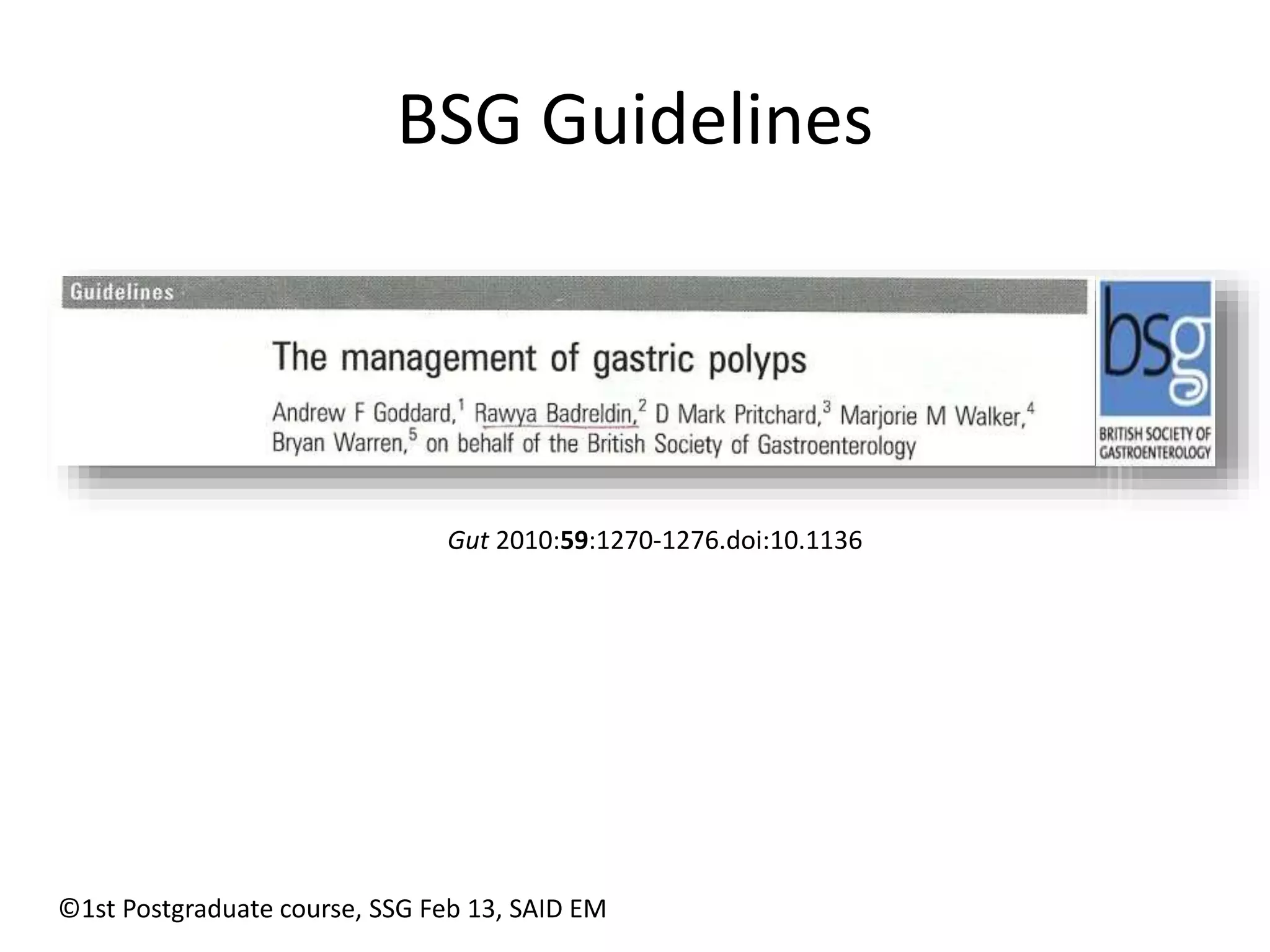
BSG Guidelines 
Gut 2010:59:1270-1276.doi:10.1136 
©1st Postgraduate course, SSG Feb 13, SAID EM
= 
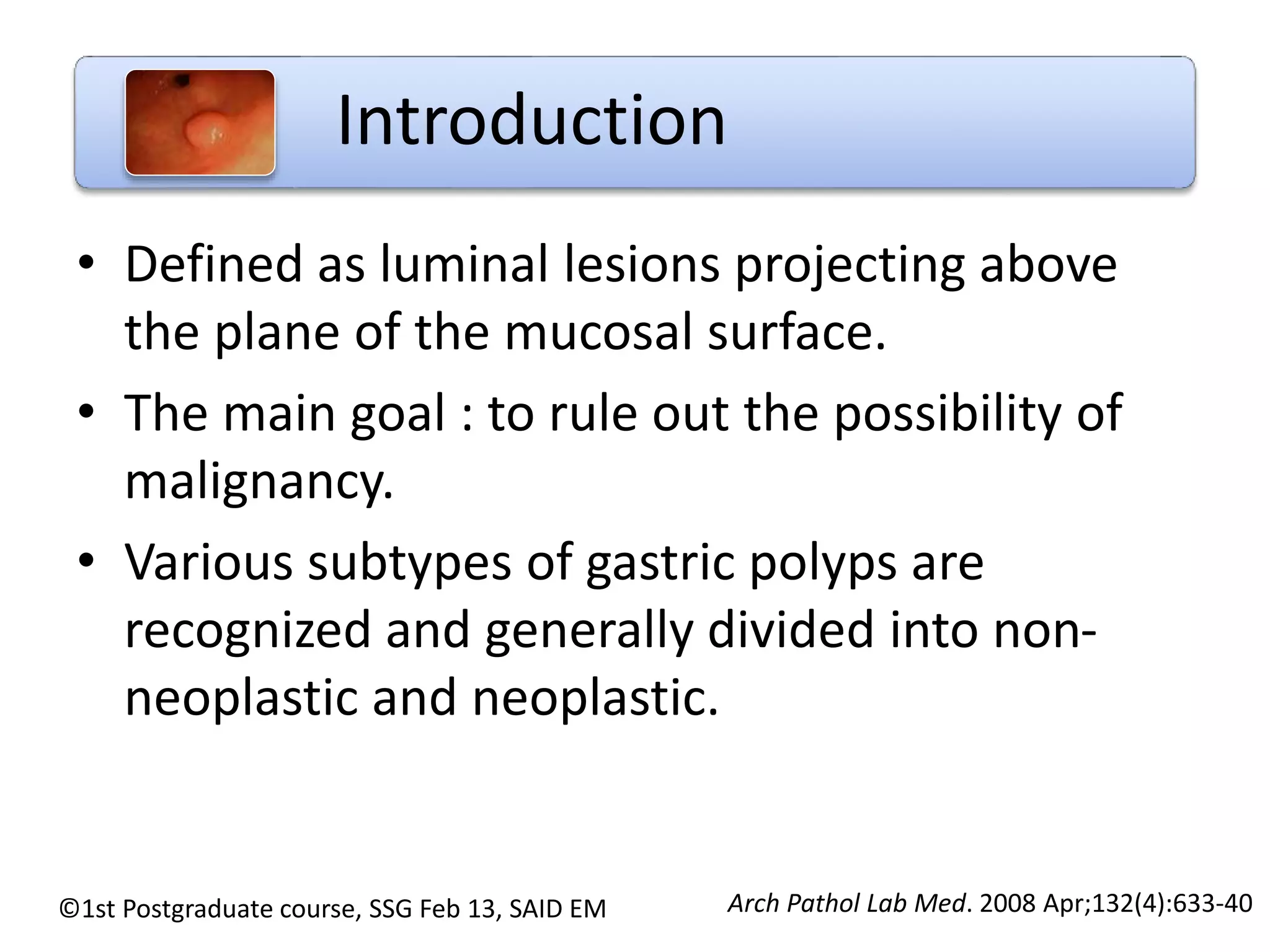
Introduction 
• Defined as luminal lesions projecting above 
the plane of the mucosal surface. 
• The main goal : to rule out the possibility of 
malignancy. 
• Various subtypes of gastric polyps are 
recognized and generally divided into non-neoplastic 
and neoplastic. 
Arch Pathol ©1st Postgraduate course, SSG Feb 13, SAID EM Lab Med. 2008 Apr;132(4):633-40
= 
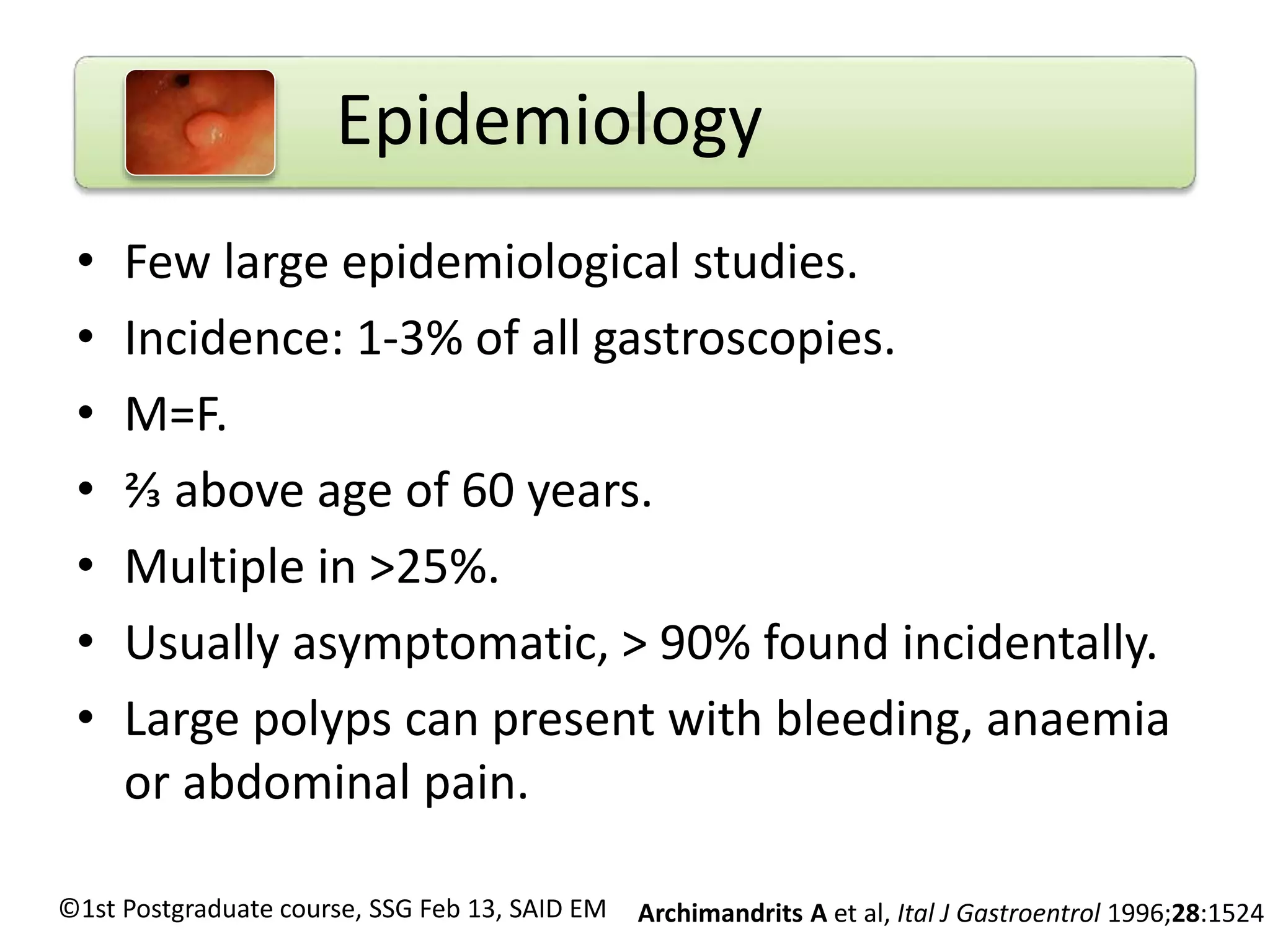
Epidemiology 
• Few large epidemiological studies. 
• Incidence: 1-3% of all gastroscopies. 
• M=F. 
• ⅔ above age of 60 years. 
• Multiple in >25%. 
• Usually asymptomatic, > 90% found incidentally. 
• Large polyps can present with bleeding, anaemia 
or abdominal pain. 
Archimandrits A et ©1st Postgraduate course, SSG Feb 13, SAID EM al, Ital J Gastroentrol 1996;28:1524
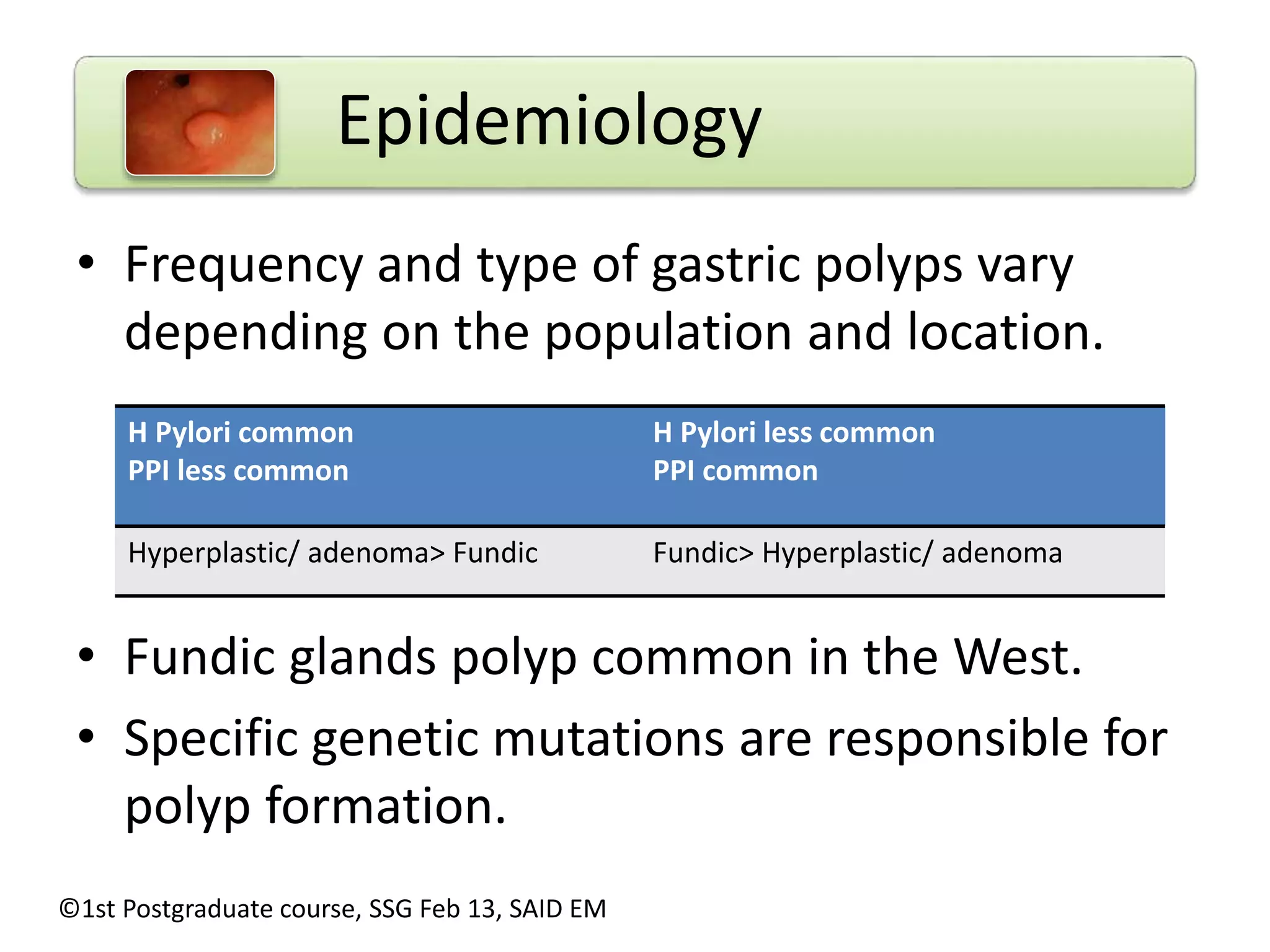
Epidemiology 
• Frequency and type of gastric polyps vary 
depending on the population and location. 
H Pylori common 
PPI less common 
H Pylori less common 
PPI common 
Hyperplastic/ adenoma> Fundic Fundic> Hyperplastic/ adenoma 
• Fundic glands polyp common in the West. 
• Specific genetic mutations are responsible for 
polyp formation. 
©1st Postgraduate course, SSG Feb 13, SAID EM
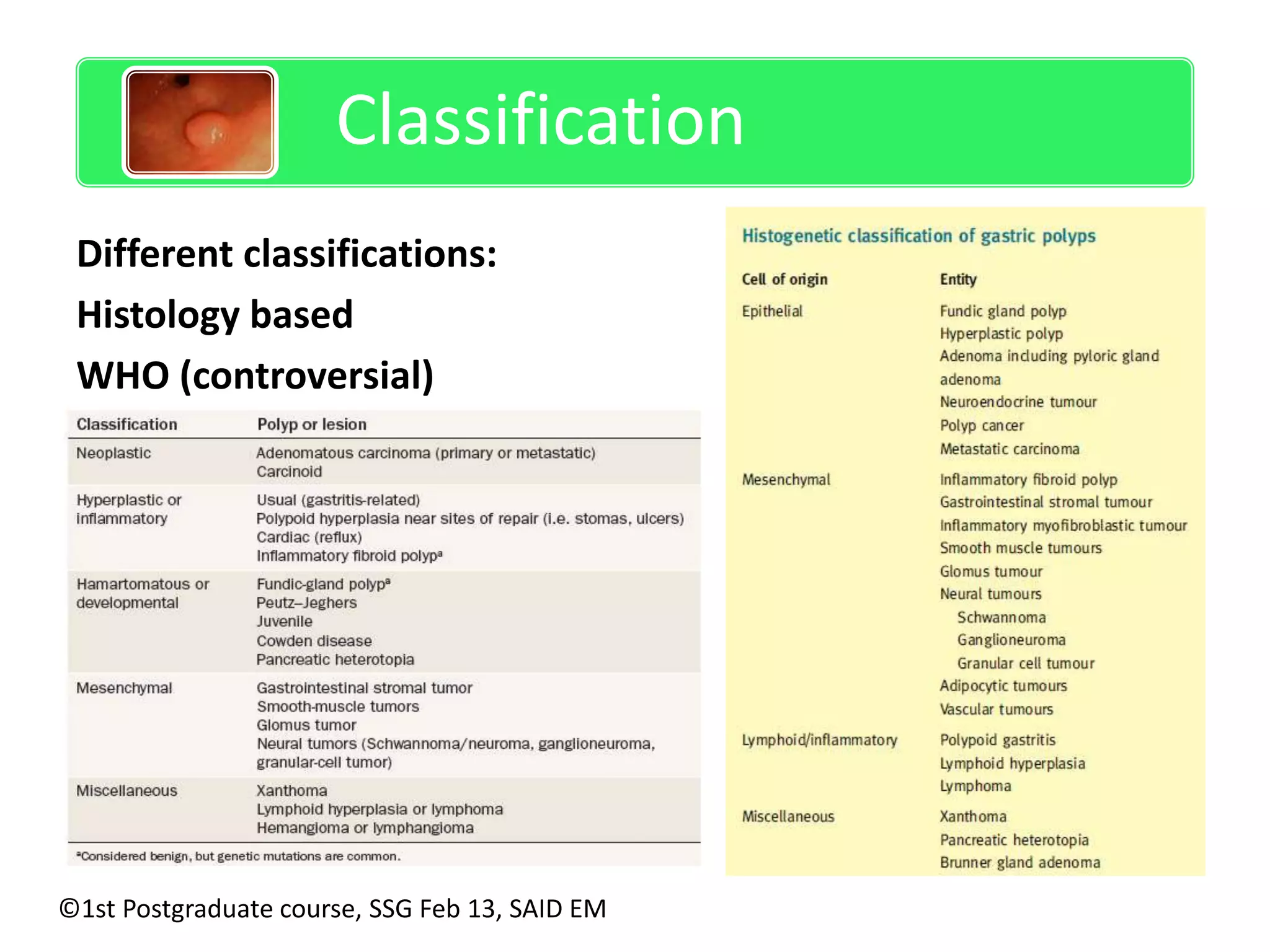
Classification 
Different classifications: 
Histology based 
WHO (controversial) 
©1st Postgraduate course, SSG Feb 13, SAID EM
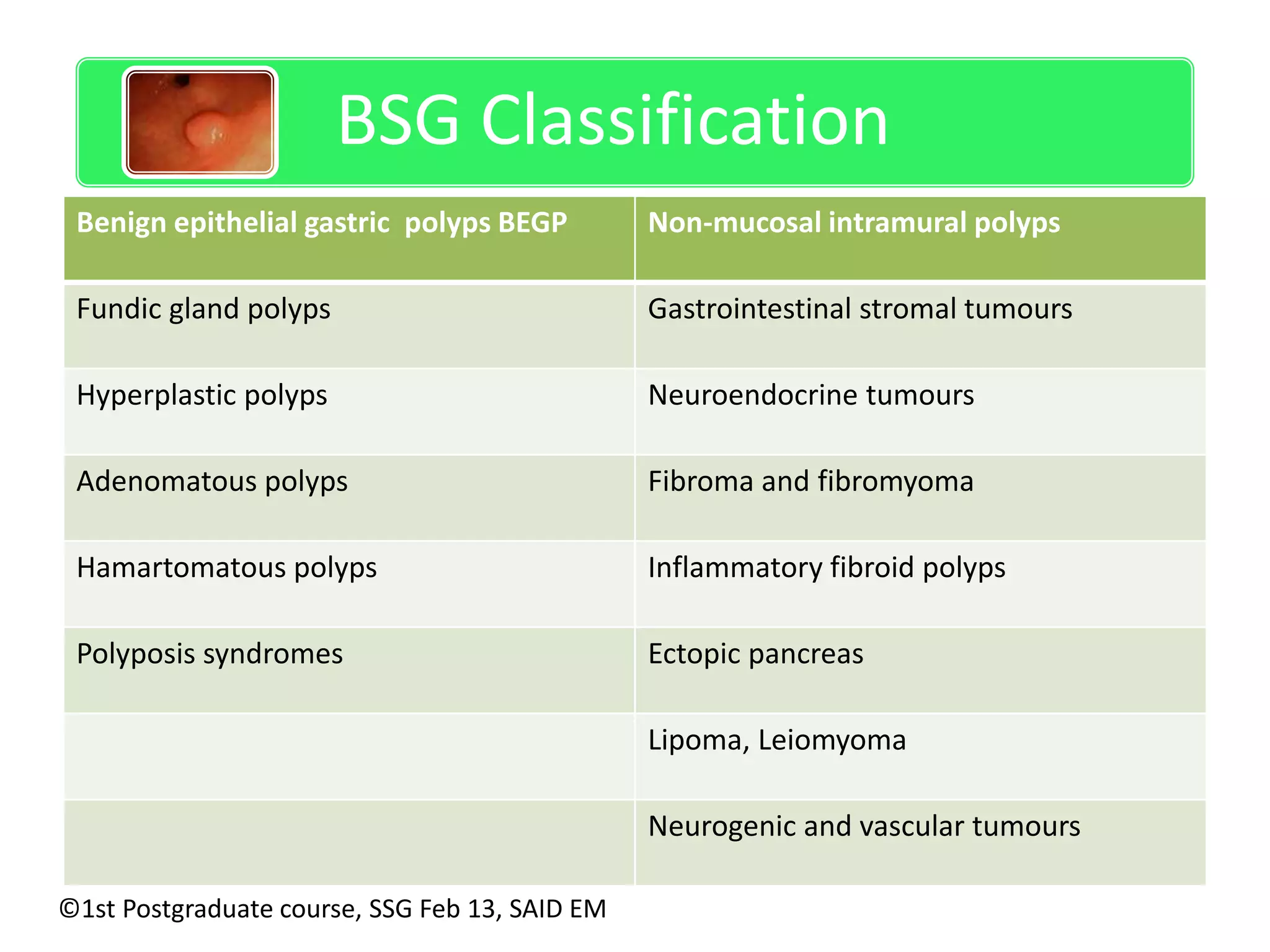
BSG Classification 
Benign epithelial gastric polyps BEGP Non-mucosal intramural polyps 
Fundic gland polyps Gastrointestinal stromal tumours 
Hyperplastic polyps Neuroendocrine tumours 
Adenomatous polyps Fibroma and fibromyoma 
Hamartomatous polyps Inflammatory fibroid polyps 
Polyposis syndromes Ectopic pancreas 
Lipoma, Leiomyoma 
Neurogenic and vascular tumours 
©1st Postgraduate course, SSG Feb 13, SAID EM
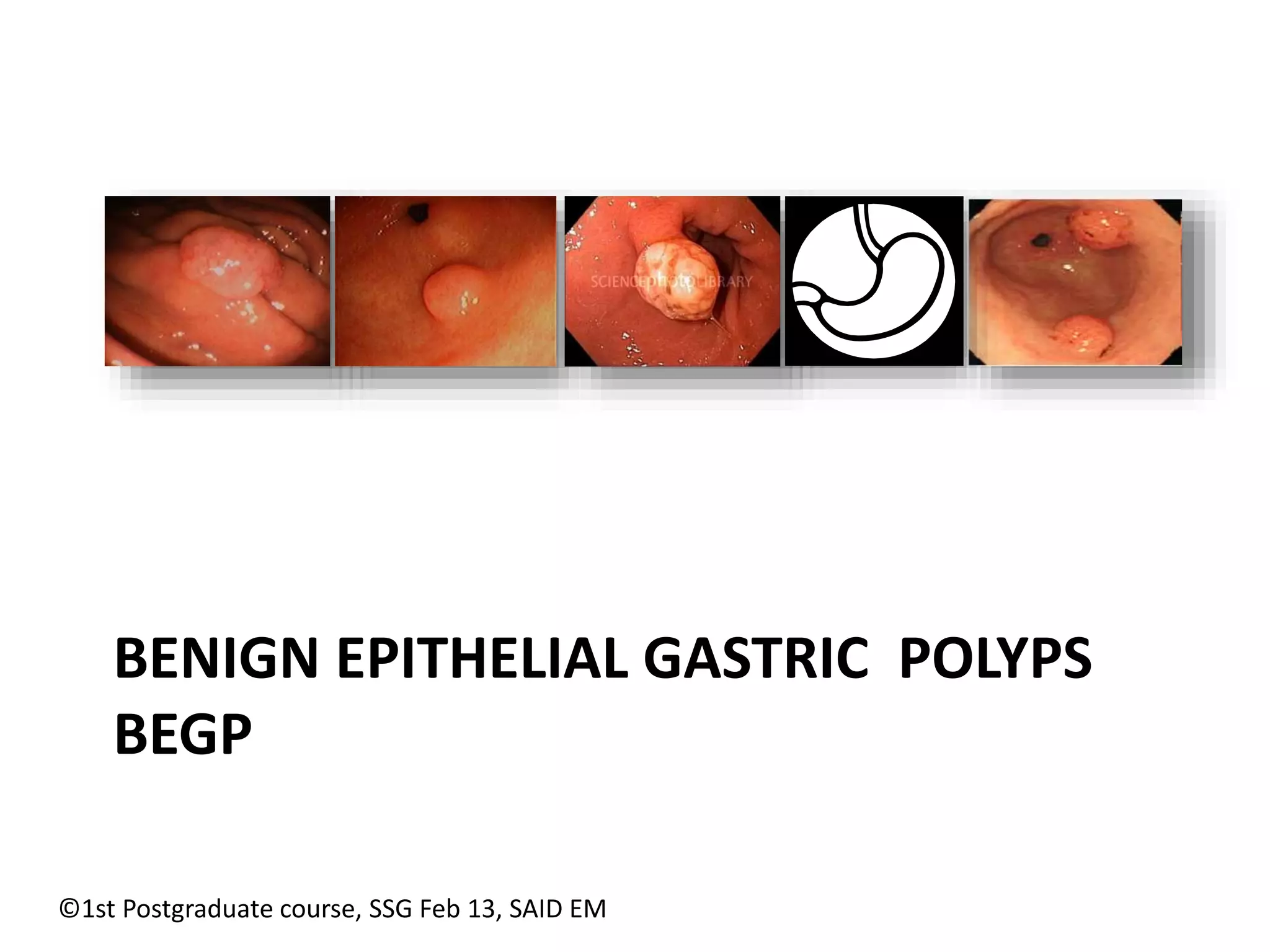
BENIGN EPITHELIAL GASTRIC POLYPS 
BEGP 
©1st Postgraduate course, SSG Feb 13, SAID EM
Sporadic Fundic gland polyps 
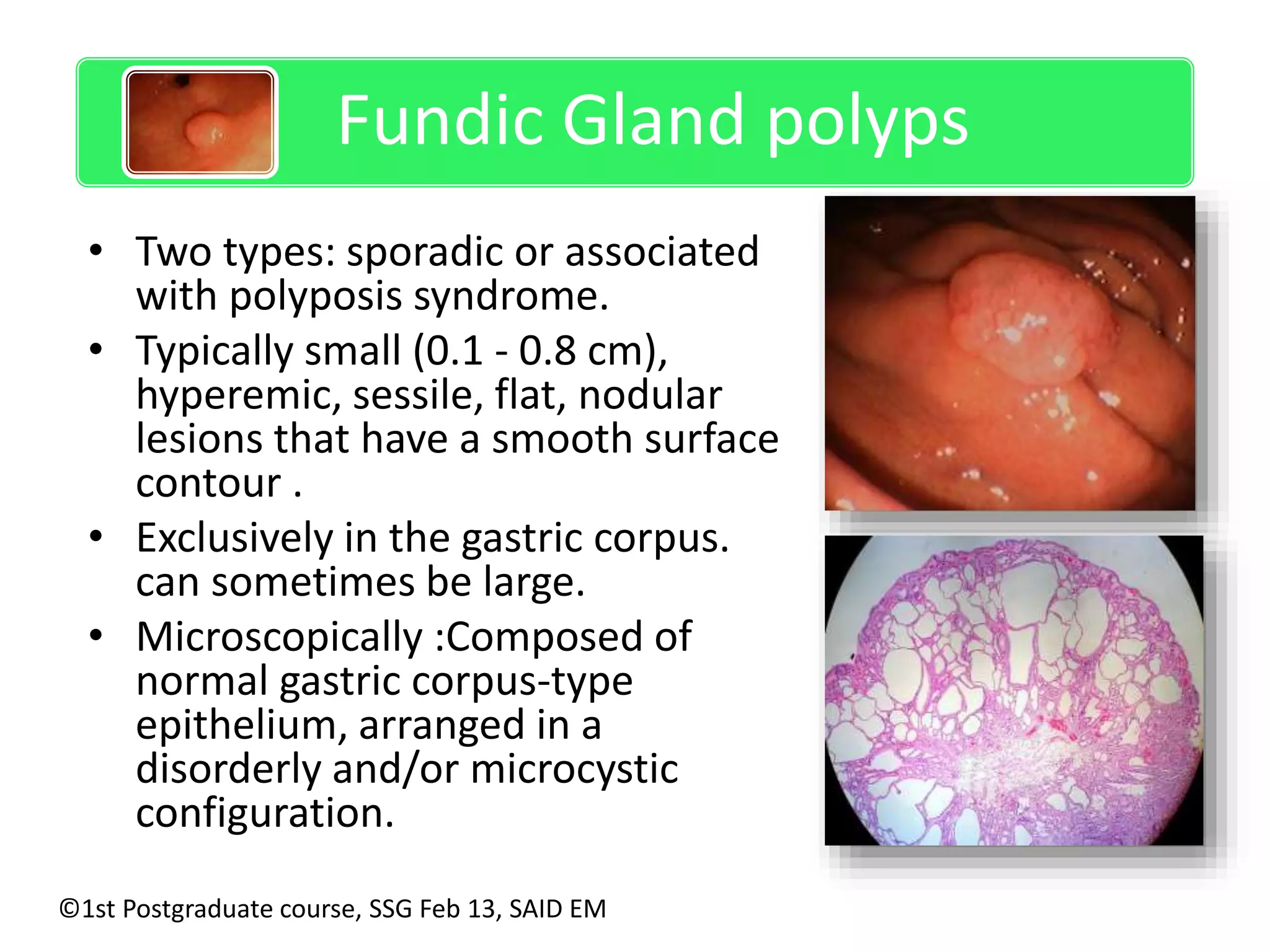
Fundic Gland polyps 
• Two types: sporadic or associated 
with polyposis syndrome. 
• Typically small (0.1 - 0.8 cm), 
hyperemic, sessile, flat, nodular 
lesions that have a smooth surface 
contour . 
• Exclusively in the gastric corpus. 
can sometimes be large. 
• Microscopically :Composed of 
normal gastric corpus-type 
epithelium, arranged in a 
disorderly and/or microcystic 
configuration. 
©1st Postgraduate course, SSG Feb 13, SAID EM
Sporadic Fundic gland polyps 
Fundic Gland polyps 
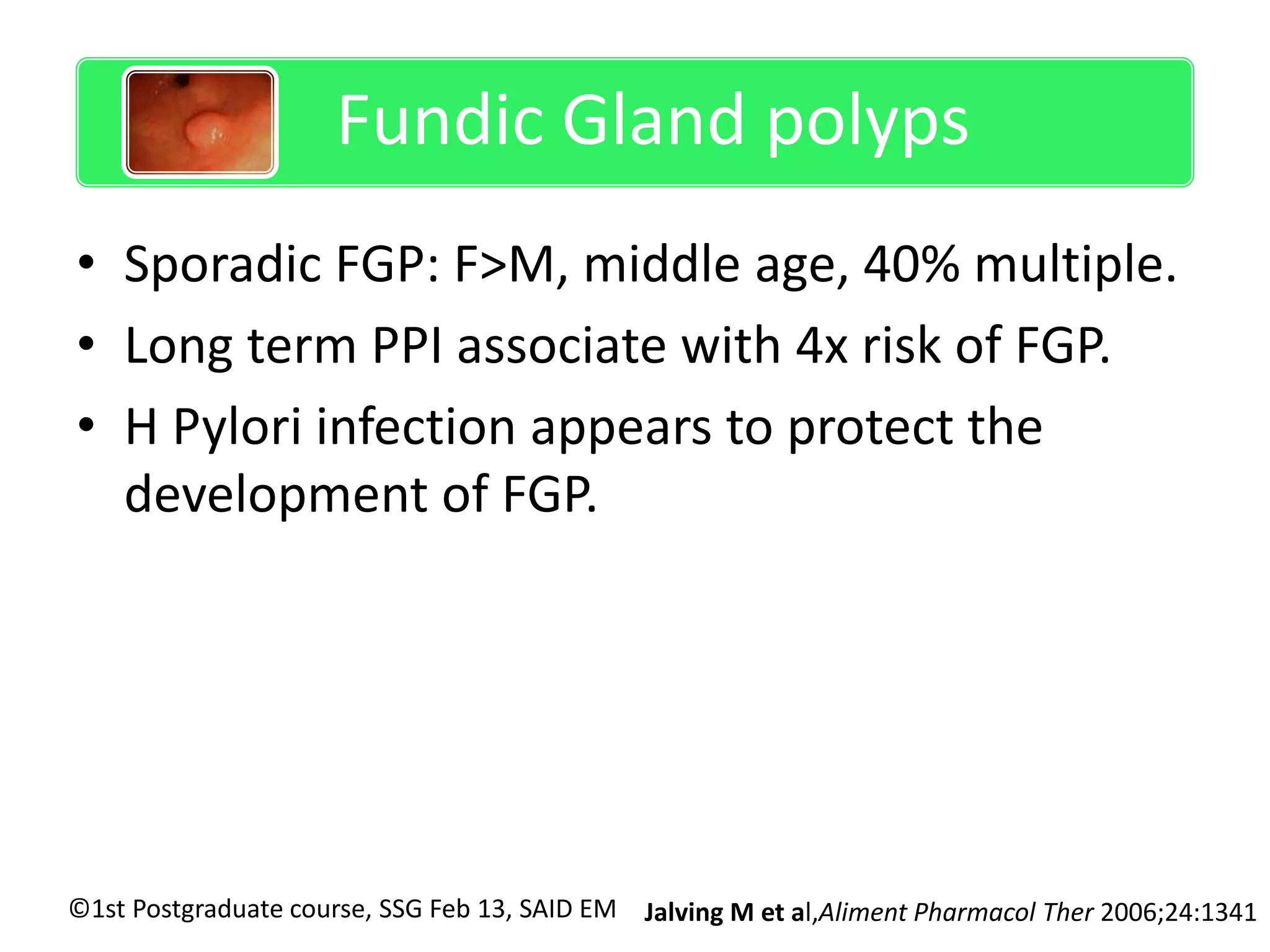
• Sporadic FGP: F>M, middle age, 40% multiple. 
• Long term PPI associate with 4x risk of FGP. 
• H Pylori infection appears to protect the 
development of FGP. 
©1st Postgraduate course, SSG Feb 13, SAID EM 
Jalving M et al,Aliment Pharmacol Ther 2006;24:1341
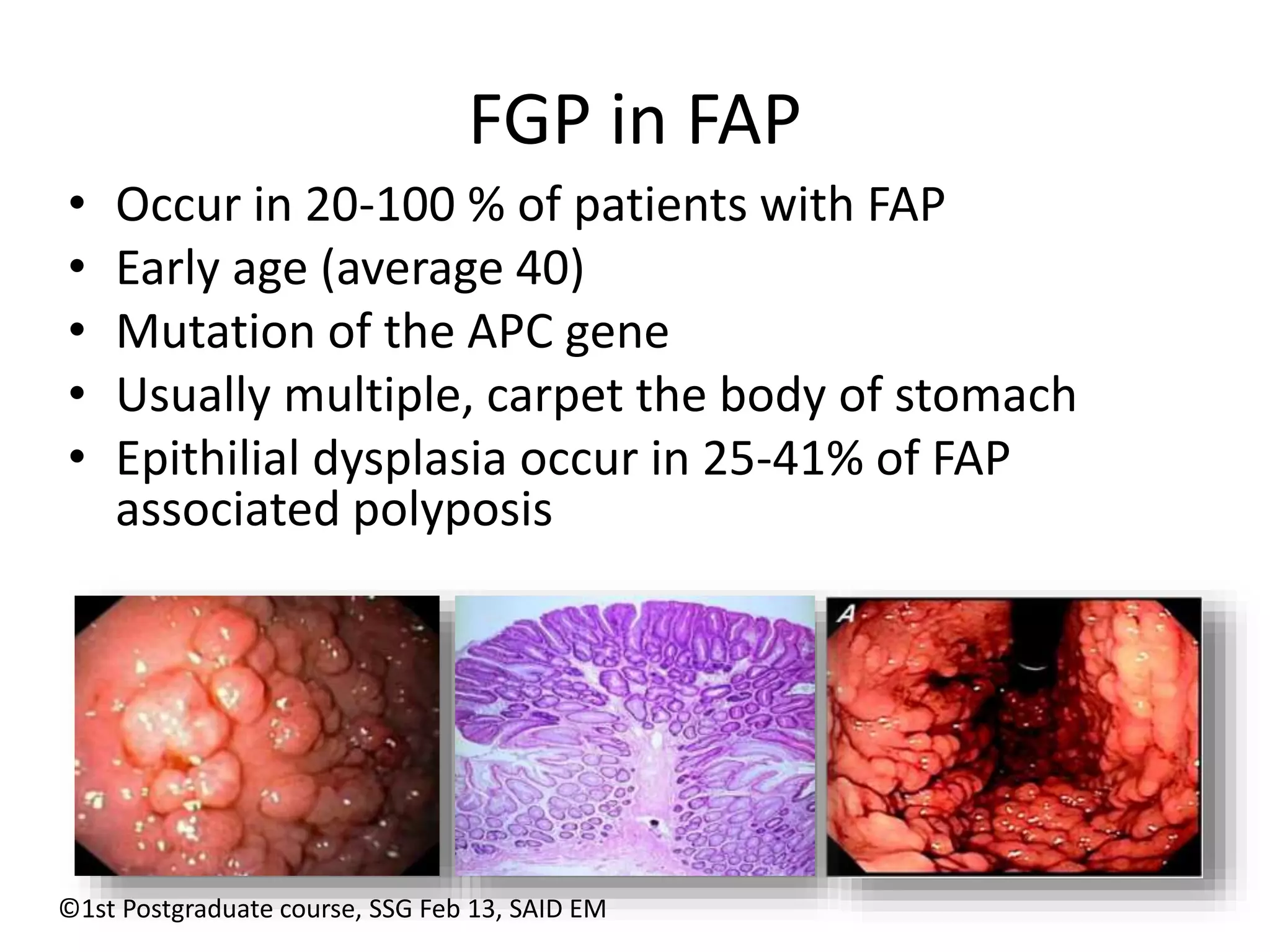
FGP in FAP 
• Occur in 20-100 % of patients with FAP 
• Early age (average 40) 
• Mutation of the APC gene 
• Usually multiple, carpet the body of stomach 
• Epithilial dysplasia occur in 25-41% of FAP 
associated polyposis 
©1st Postgraduate course, SSG Feb 13, SAID EM
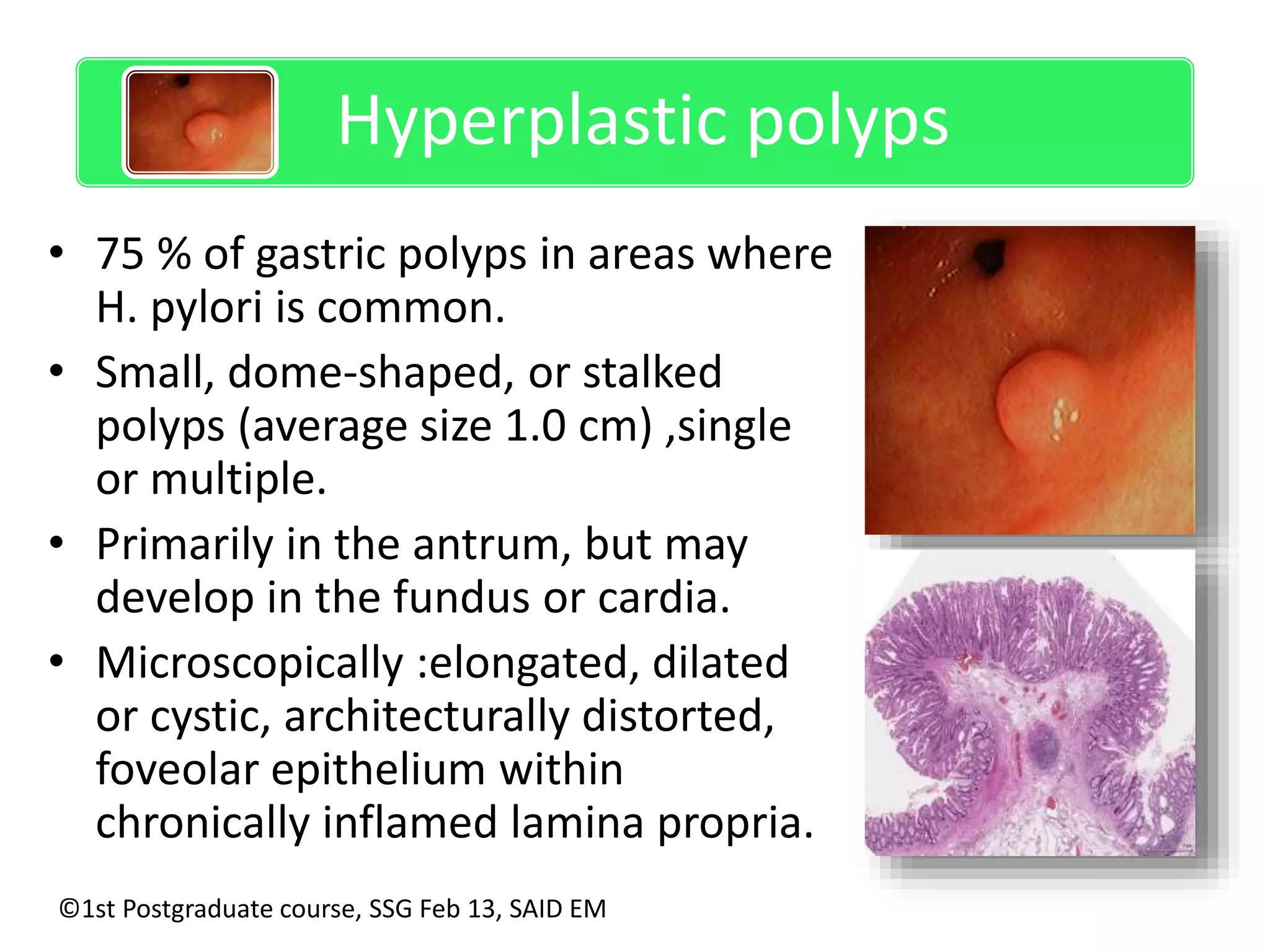
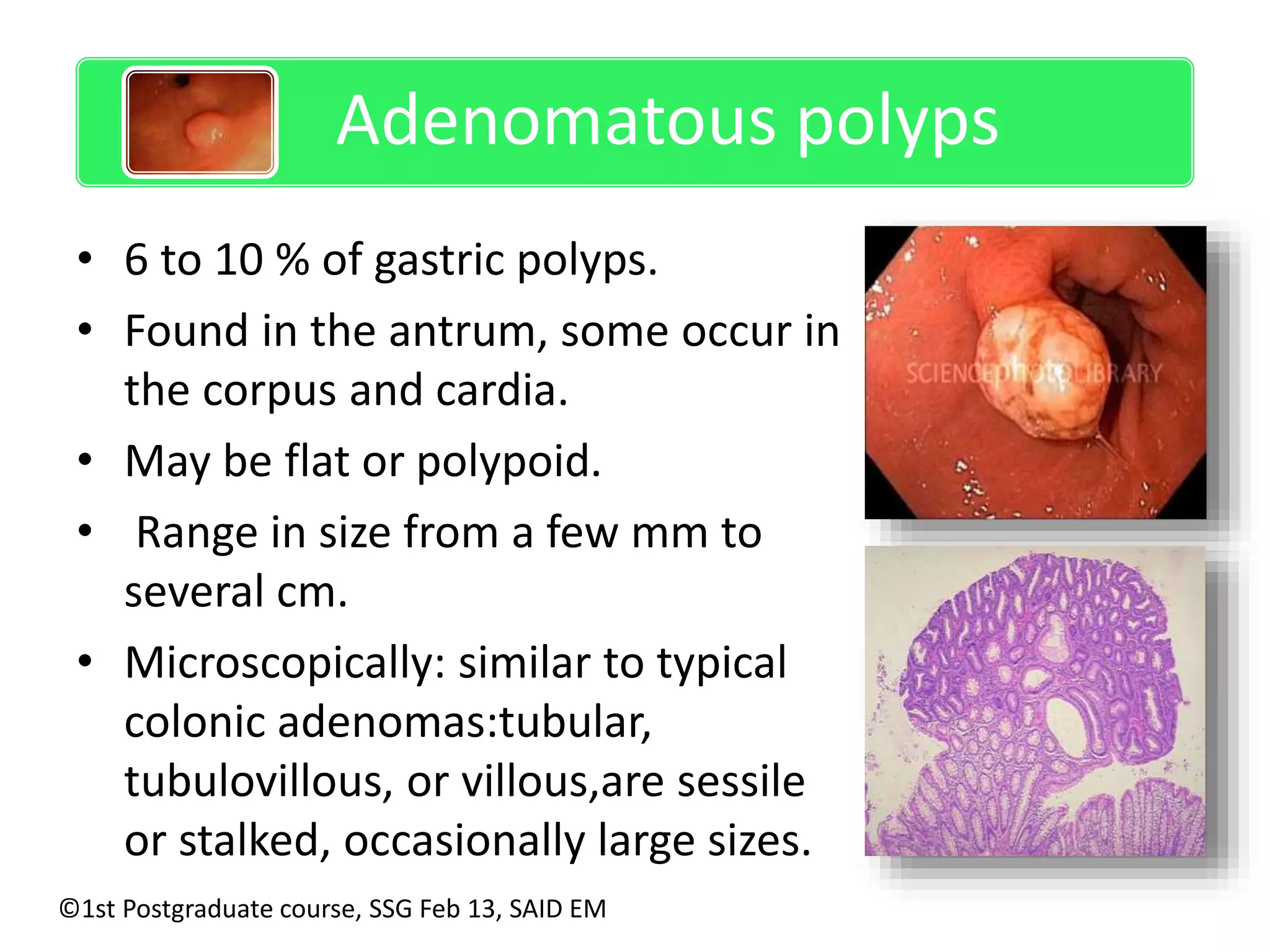
Hyperplastic polyps 
• 75 % of gastric polyps in areas where 
H. pylori is common. 
• Small, dome-shaped, or stalked 
polyps (average size 1.0 cm) ,single 
or multiple. 
• Primarily in the antrum, but may 
develop in the fundus or cardia. 
• Microscopically :elongated, dilated 
or cystic, architecturally distorted, 
foveolar epithelium within 
chronically inflamed lamina propria. 
©1st Postgraduate course, SSG Feb 13, SAID EM
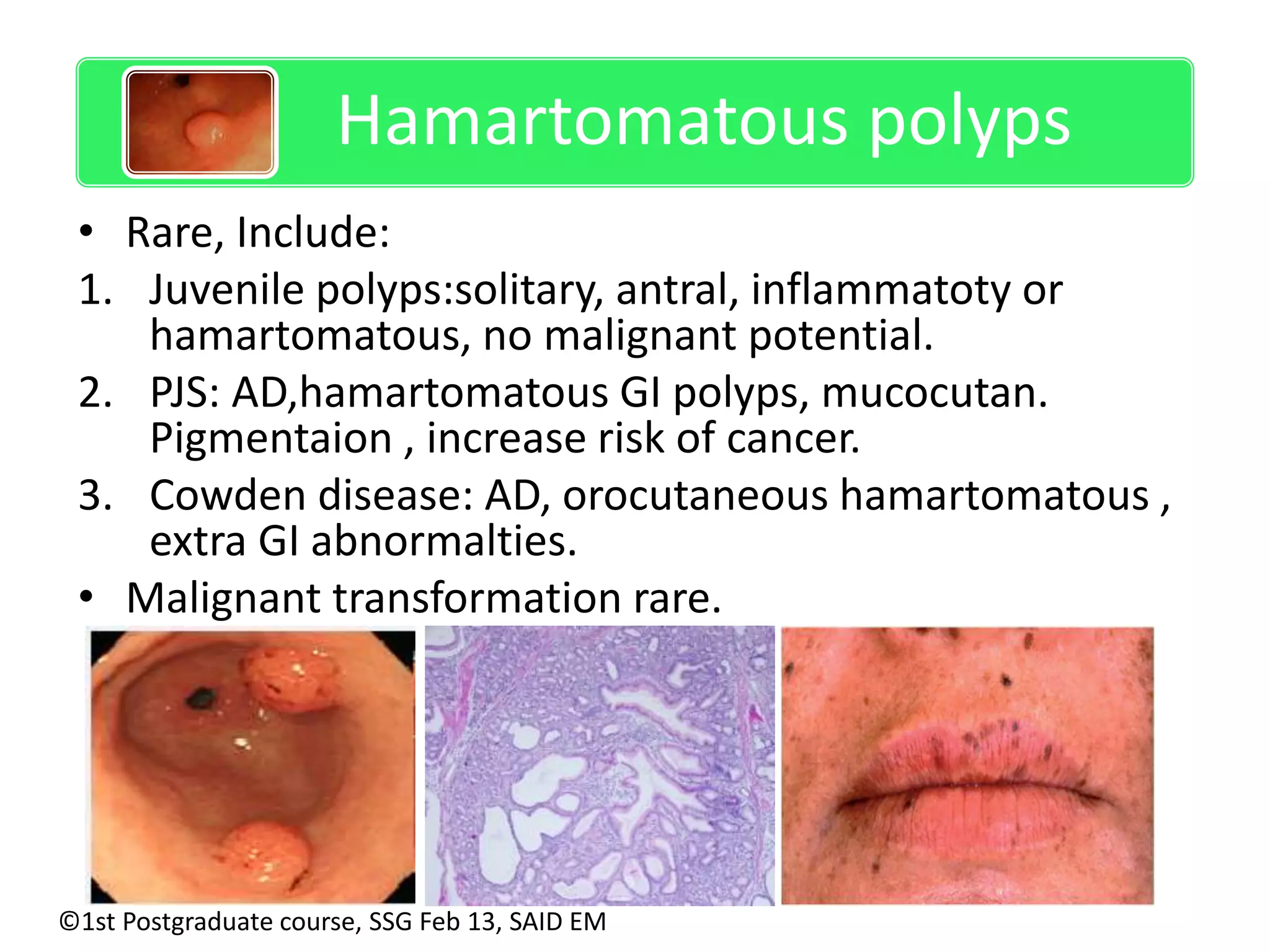
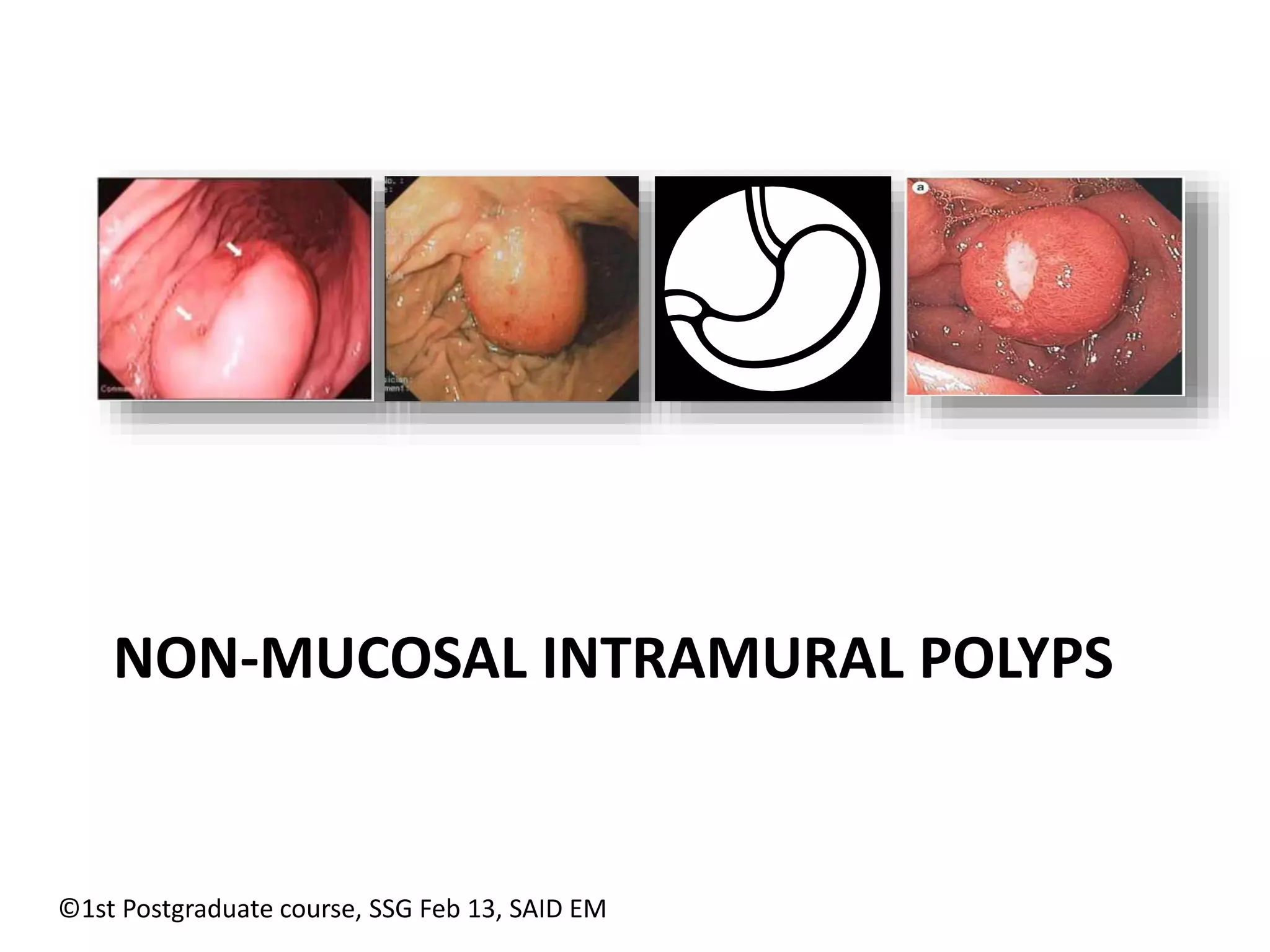
Adenomatous polyps 
• 6 to 10 % of gastric polyps. 
• Found in the antrum, some occur in 
the corpus and cardia. 
• May be flat or polypoid. 
• Range in size from a few mm to 
several cm. 
• Microscopically: similar to typical 
colonic adenomas:tubular, 
tubulovillous, or villous,are sessile 
or stalked, occasionally large sizes. 
©1st Postgraduate course, SSG Feb 13, SAID EM
Hamartomatous polyps 
• Rare, Include: 
1. Juvenile polyps:solitary, antral, inflammatoty or 
hamartomatous, no malignant potential. 
2. PJS: AD,hamartomatous GI polyps, mucocutan. 
Pigmentaion , increase risk of cancer. 
3. Cowden disease: AD, orocutaneous hamartomatous , 
extra GI abnormalties. 
• Malignant transformation rare. 
©1st Postgraduate course, SSG Feb 13, SAID EM
NON-MUCOSAL INTRAMURAL POLYPS 
©1st Postgraduate course, SSG Feb 13, SAID EM
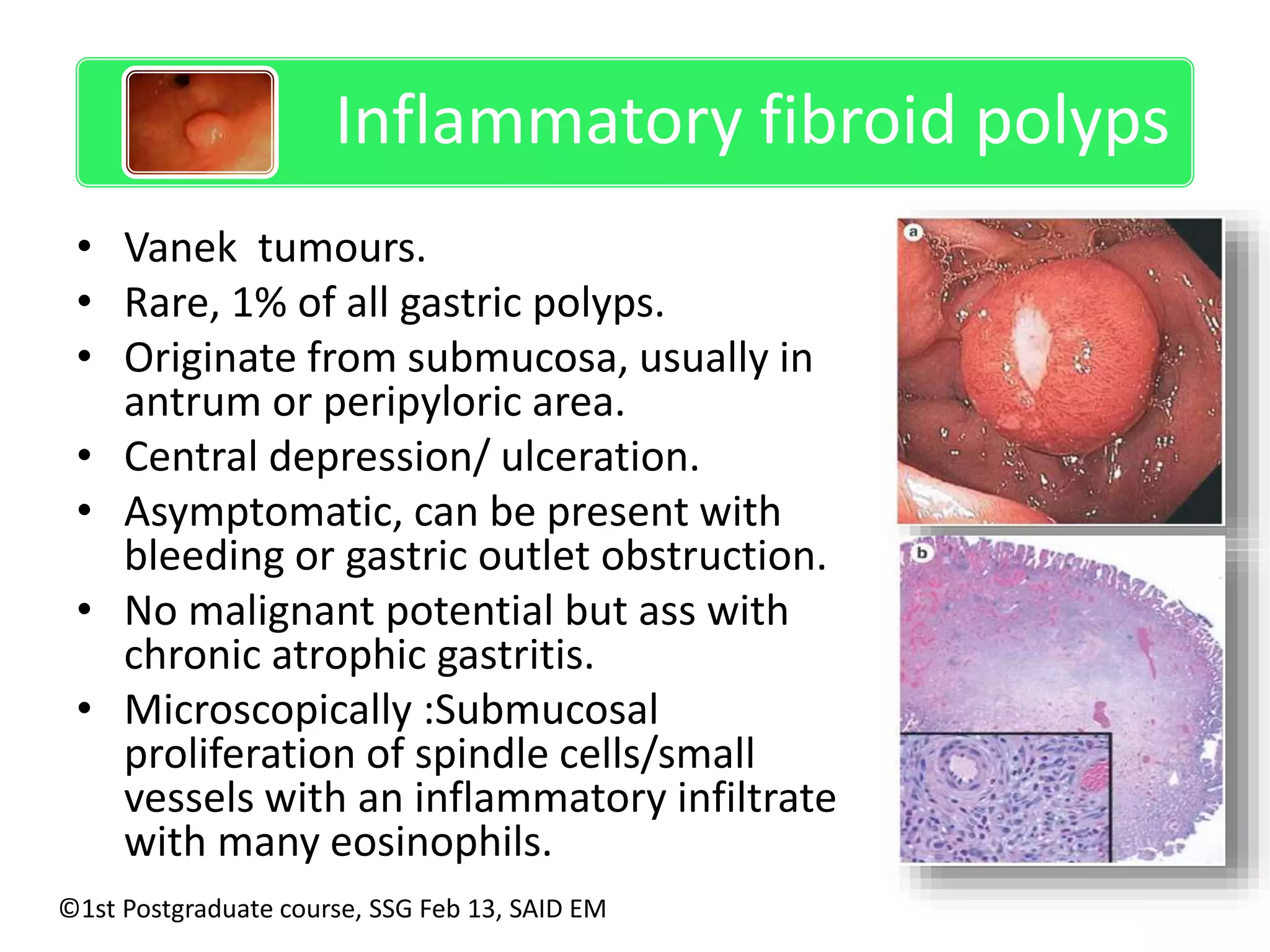
Inflammatory fibroid polyps 
• Vanek tumours. 
• Rare, 1% of all gastric polyps. 
• Originate from submucosa, usually in 
antrum or peripyloric area. 
• Central depression/ ulceration. 
• Asymptomatic, can be present with 
bleeding or gastric outlet obstruction. 
• No malignant potential but ass with 
chronic atrophic gastritis. 
• Microscopically :Submucosal 
proliferation of spindle cells/small 
vessels with an inflammatory infiltrate 
with many eosinophils. 
©1st Postgraduate course, SSG Feb 13, SAID EM
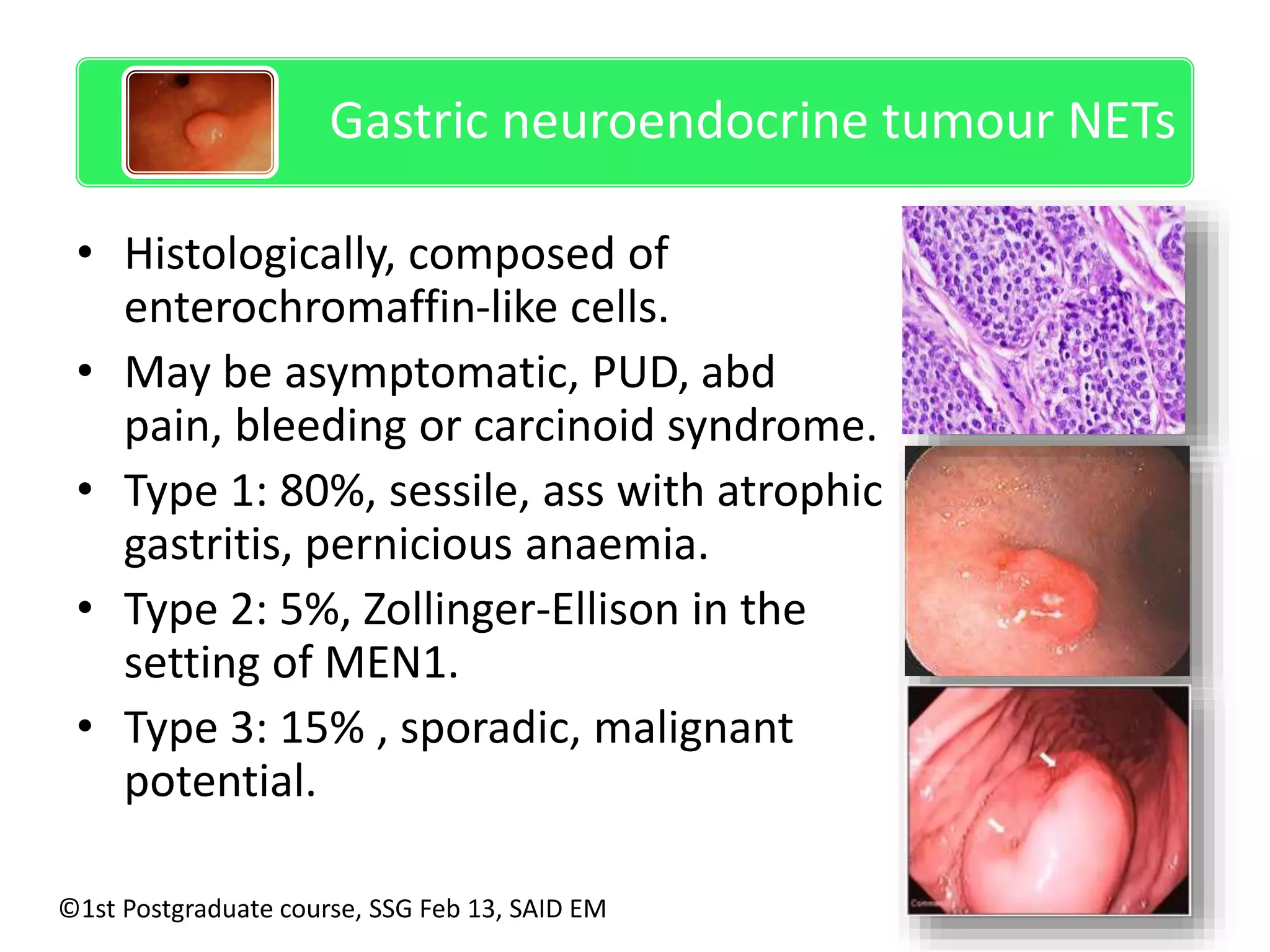
Gastric neuroendocrine tumour NETs 
• Histologically, composed of 
enterochromaffin-like cells. 
• May be asymptomatic, PUD, abd 
pain, bleeding or carcinoid syndrome. 
• Type 1: 80%, sessile, ass with atrophic 
gastritis, pernicious anaemia. 
• Type 2: 5%, Zollinger-Ellison in the 
setting of MEN1. 
• Type 3: 15% , sporadic, malignant 
potential. 
©1st Postgraduate course, SSG Feb 13, SAID EM
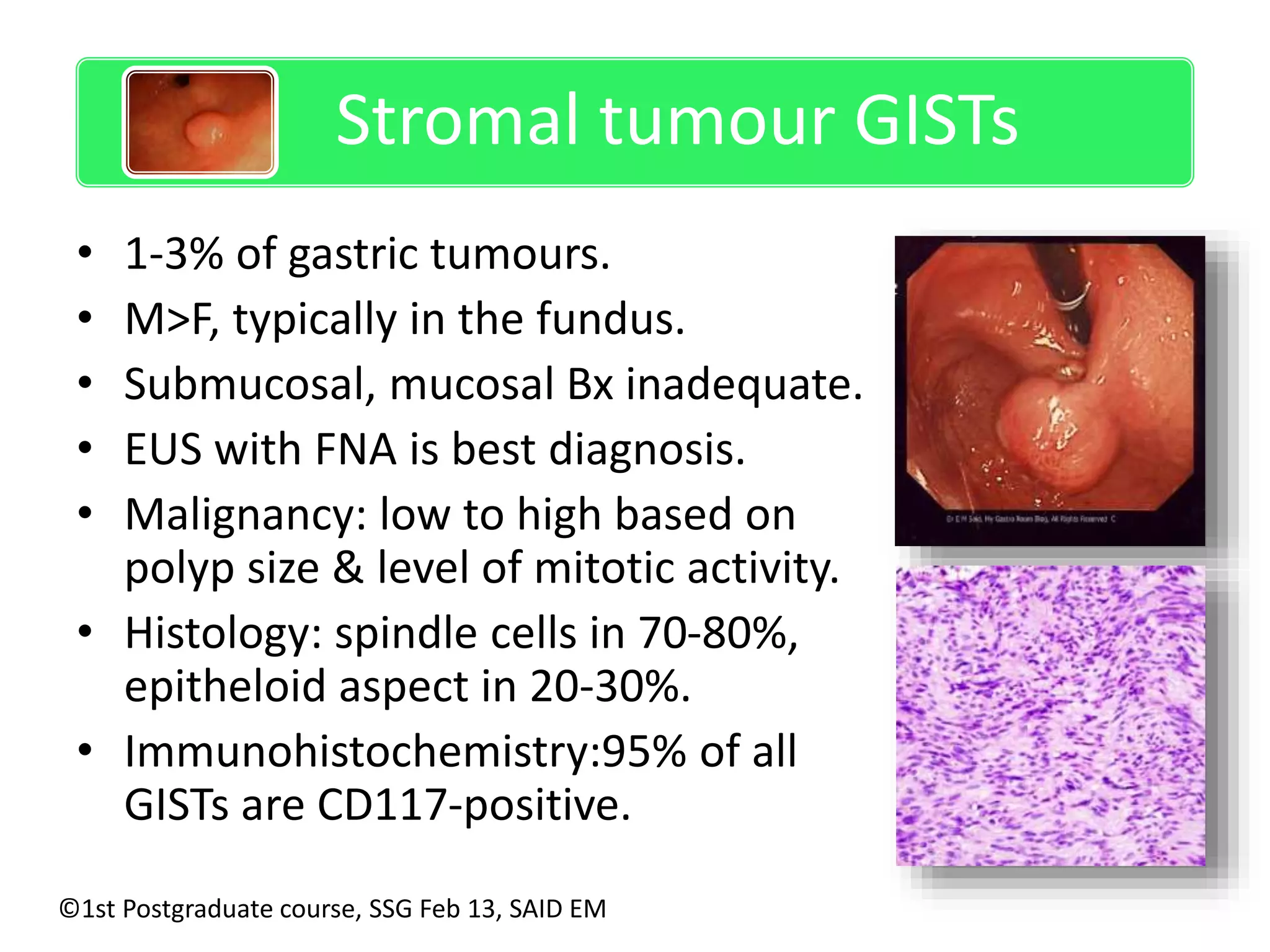
Stromal tumour GISTs 
• 1-3% of gastric tumours. 
• M>F, typically in the fundus. 
• Submucosal, mucosal Bx inadequate. 
• EUS with FNA is best diagnosis. 
• Malignancy: low to high based on 
polyp size & level of mitotic activity. 
• Histology: spindle cells in 70-80%, 
epitheloid aspect in 20-30%. 
• Immunohistochemistry:95% of all 
GISTs are CD117-positive. 
©1st Postgraduate course, SSG Feb 13, SAID EM
GENERAL MANAGEMENT 
©1st Postgraduate course, SSG Feb 13, SAID EM
General principles 
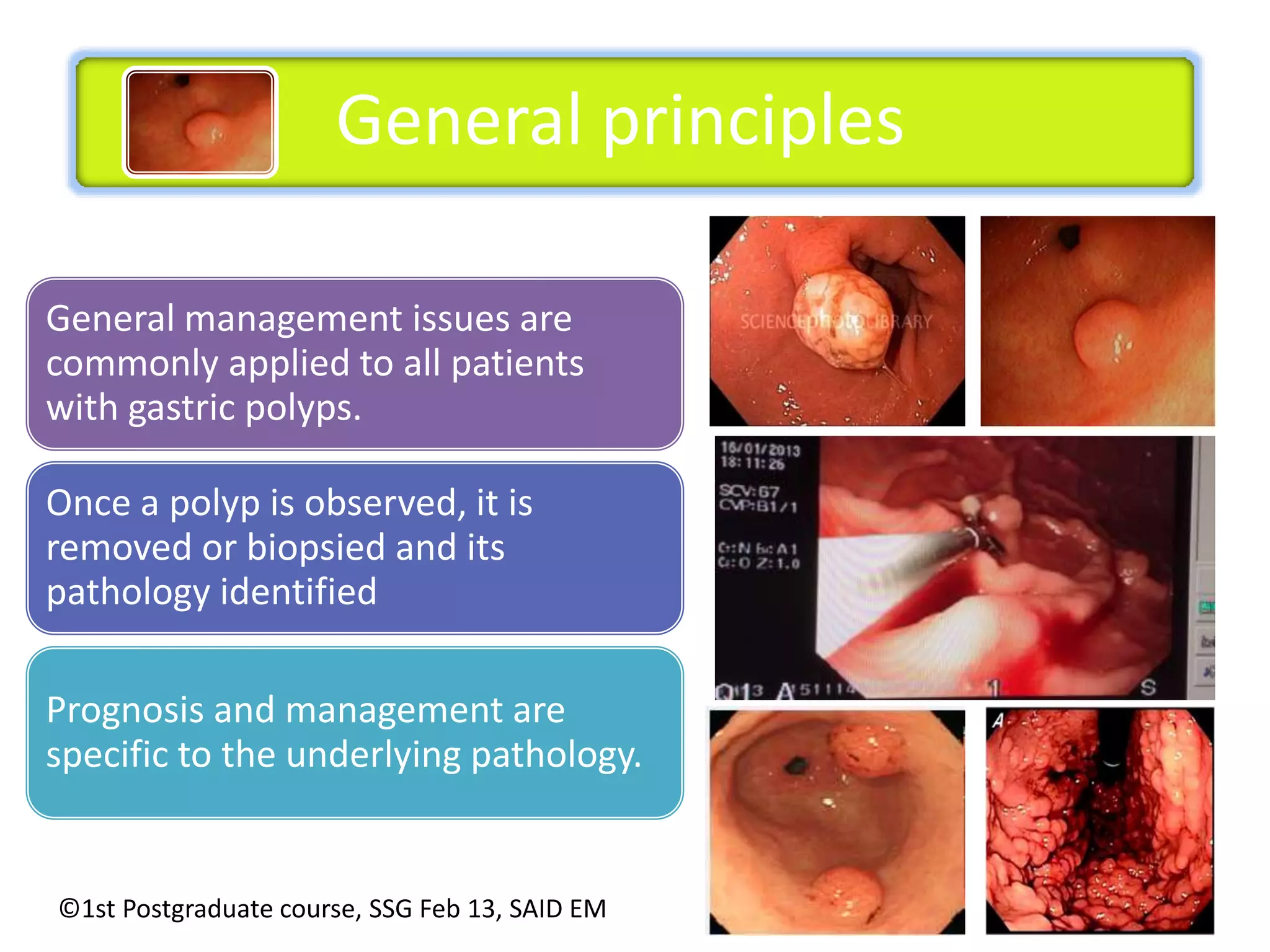
General management issues are 
commonly applied to all patients 
with gastric polyps. 
Once a polyp is observed, it is 
removed or biopsied and its 
pathology identified 
Prognosis and management are 
specific to the underlying pathology. 
©1st Postgraduate course, SSG Feb 13, SAID EM
Polyp Histology 
Check for H.Pylori infection 
Gastric mucosa histology 
Multiple polyps 
Relationship to colonic polyps 
Surveillance 
General principles 
©1st Postgraduate course, SSG Feb 13, SAID EM
Polyp Histology 
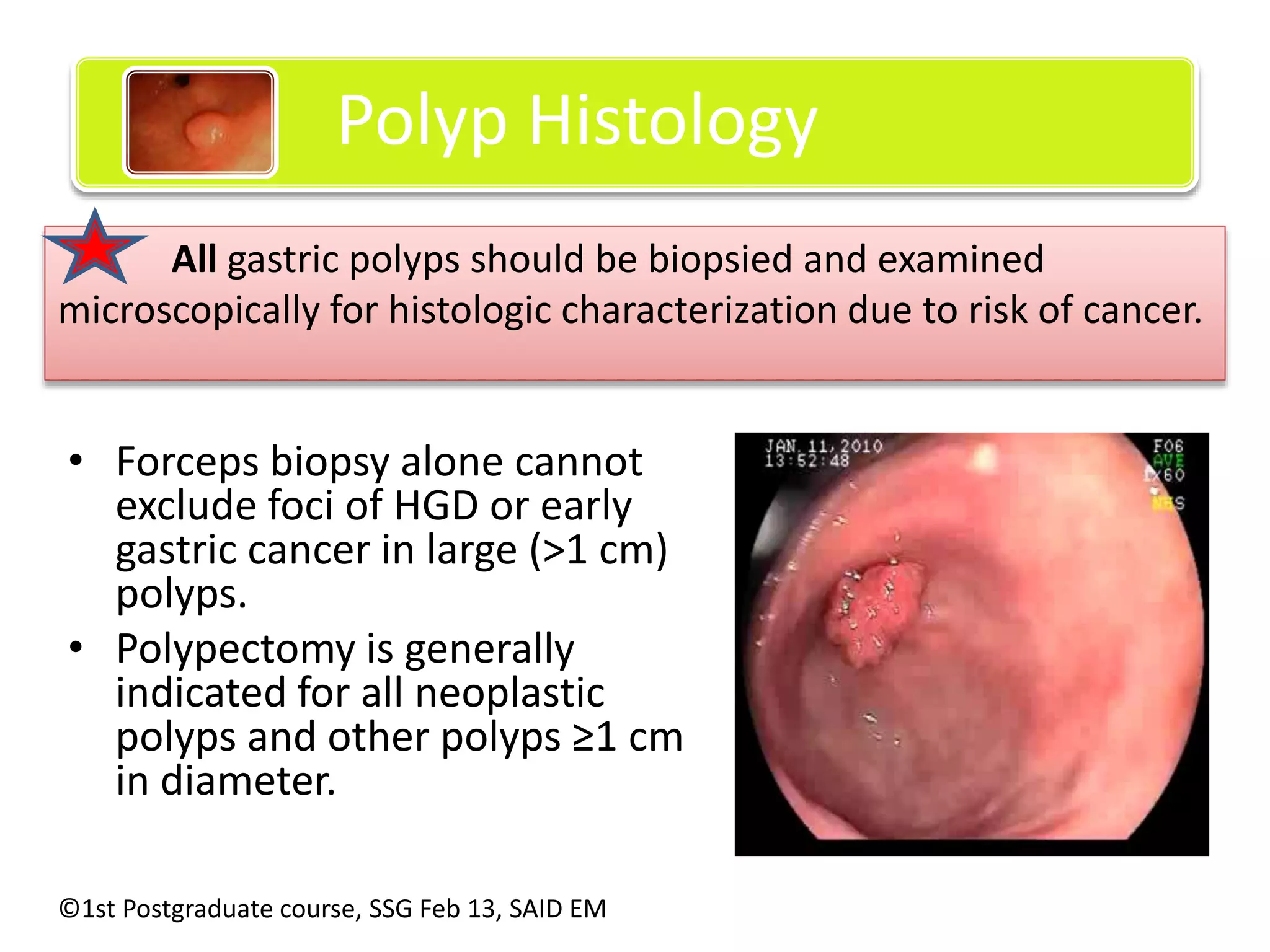
All gastric polyps should be biopsied and examined 
microscopically for histologic characterization due to risk of cancer. 
• Forceps biopsy alone cannot 
exclude foci of HGD or early 
gastric cancer in large (>1 cm) 
polyps. 
• Polypectomy is generally 
indicated for all neoplastic 
polyps and other polyps ≥1 cm 
in diameter. 
©1st Postgraduate course, SSG Feb 13, SAID EM
H.Pylori infection 
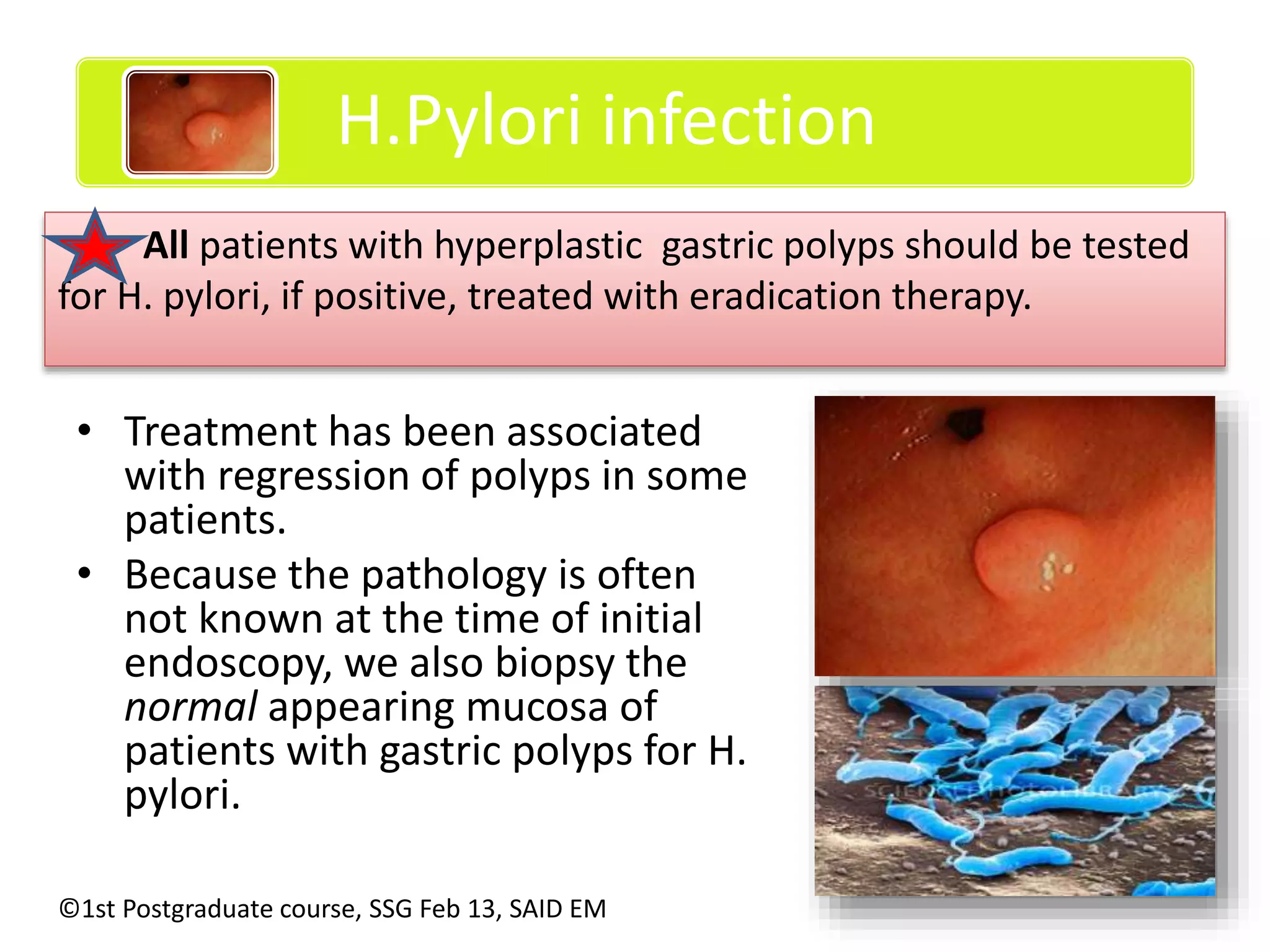
All patients with hyperplastic gastric polyps should be tested 
for H. pylori, if positive, treated with eradication therapy. 
• Treatment has been associated 
with regression of polyps in some 
patients. 
• Because the pathology is often 
not known at the time of initial 
endoscopy, we also biopsy the 
normal appearing mucosa of 
patients with gastric polyps for H. 
pylori. 
©1st Postgraduate course, SSG Feb 13, SAID EM
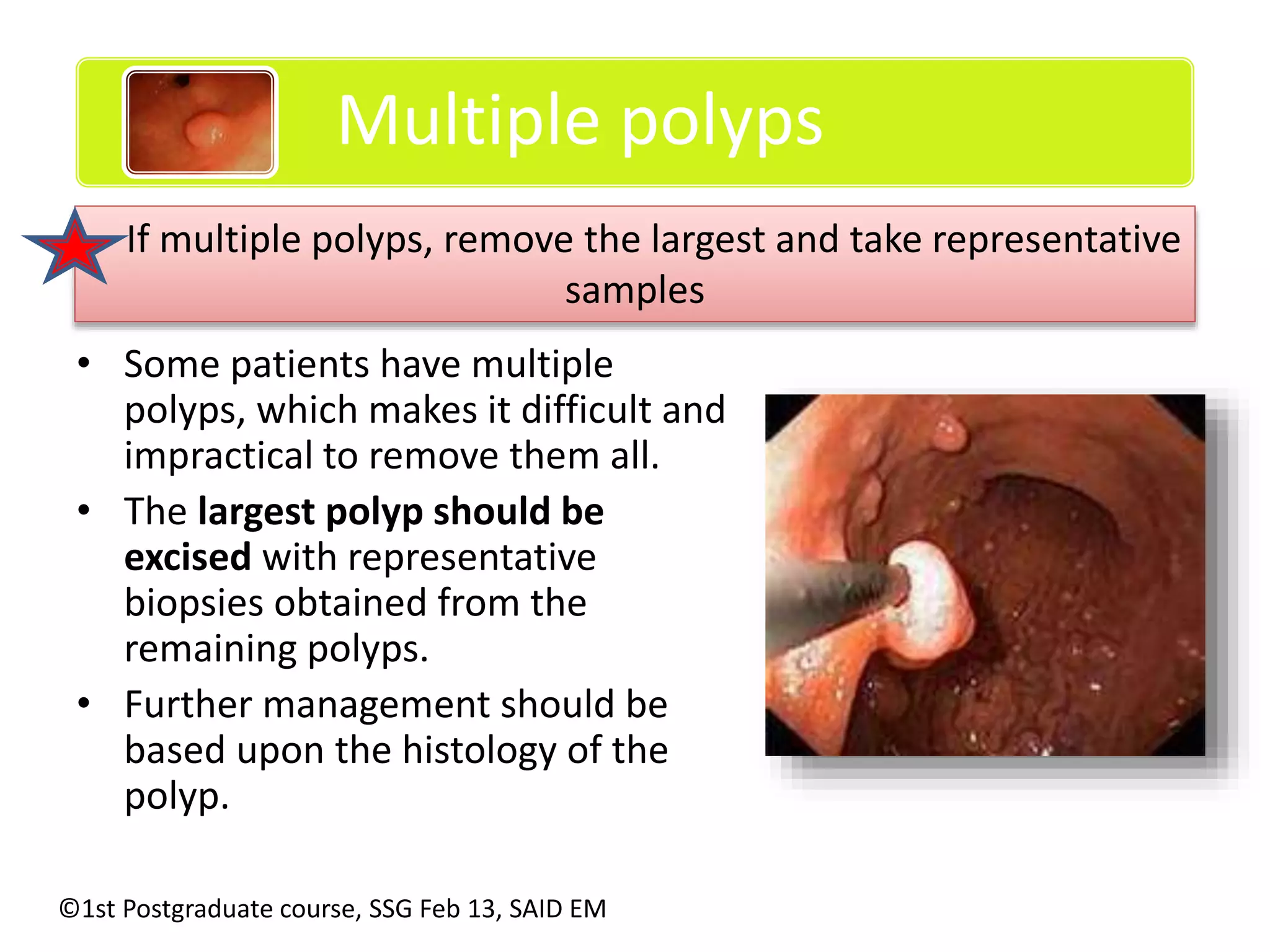
Gastric mucosa histology 
Take biopsy of the normal mucosa 
• Because hyperplastic polyps & 
adenomatous polyps are often 
associated with atrophic 
gastritis→ the normal intervening 
non-polypoid gastric mucosa 
should be sampled to assess the 
stage and type of gastritis and, 
thus, cancer risk. 
©1st Postgraduate course, SSG Feb 13, SAID EM
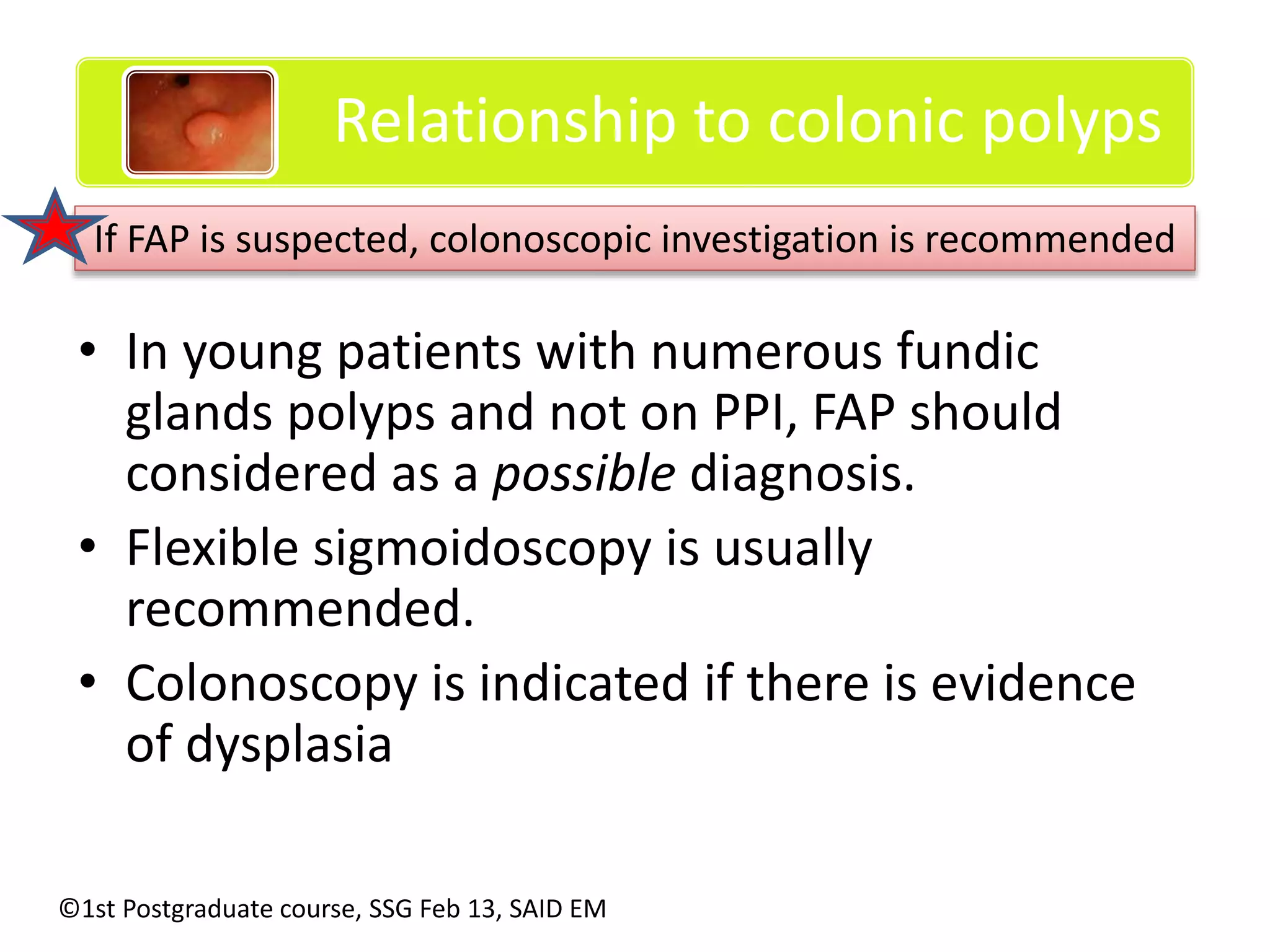
Multiple polyps 
If multiple polyps, remove the largest and take representative 
samples 
• Some patients have multiple 
polyps, which makes it difficult and 
impractical to remove them all. 
• The largest polyp should be 
excised with representative 
biopsies obtained from the 
remaining polyps. 
• Further management should be 
based upon the histology of the 
polyp. 
©1st Postgraduate course, SSG Feb 13, SAID EM
Relationship to colonic polyps 
If FAP is suspected, colonoscopic investigation is recommended 
• In young patients with numerous fundic 
glands polyps and not on PPI, FAP should 
considered as a possible diagnosis. 
• Flexible sigmoidoscopy is usually 
recommended. 
• Colonoscopy is indicated if there is evidence 
of dysplasia 
©1st Postgraduate course, SSG Feb 13, SAID EM
Surveillance 
• Repeat gastroscopy should be performed at 1 
year for all polyps with dysplasia that have not 
been removed. 
• Repeat gastroscopy should be performed at 1 
year following complete polypectomy for high 
risk polyp. 
©1st Postgraduate course, SSG Feb 13, SAID EM
MANAGEMENT OF CERTAIN POLYPS 
©1st Postgraduate course, SSG Feb 13, SAID EM
Hyperplastic polyps 
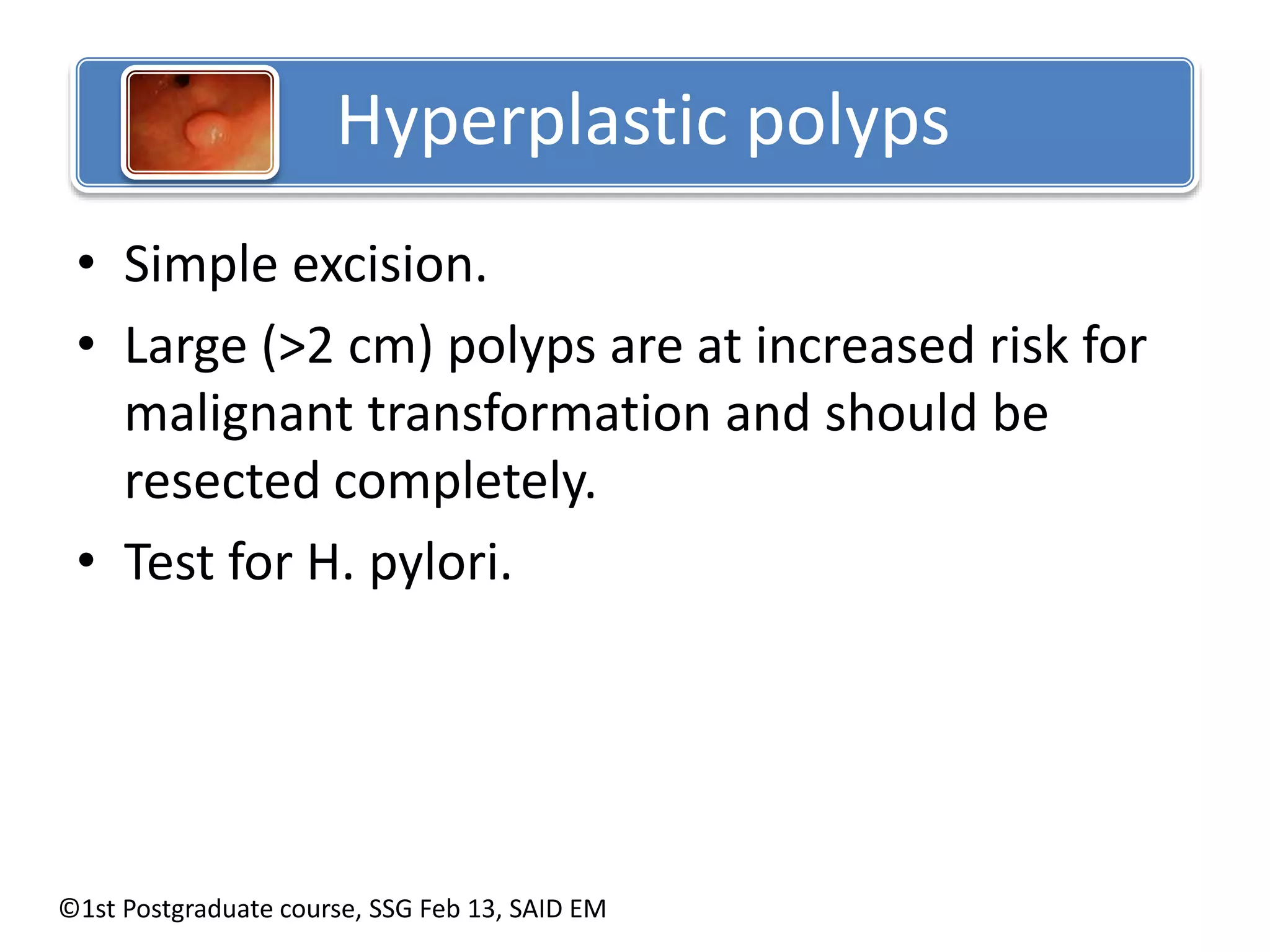
• Simple excision. 
• Large (>2 cm) polyps are at increased risk for 
malignant transformation and should be 
resected completely. 
• Test for H. pylori. 
©1st Postgraduate course, SSG Feb 13, SAID EM
Fundic gland polyps 
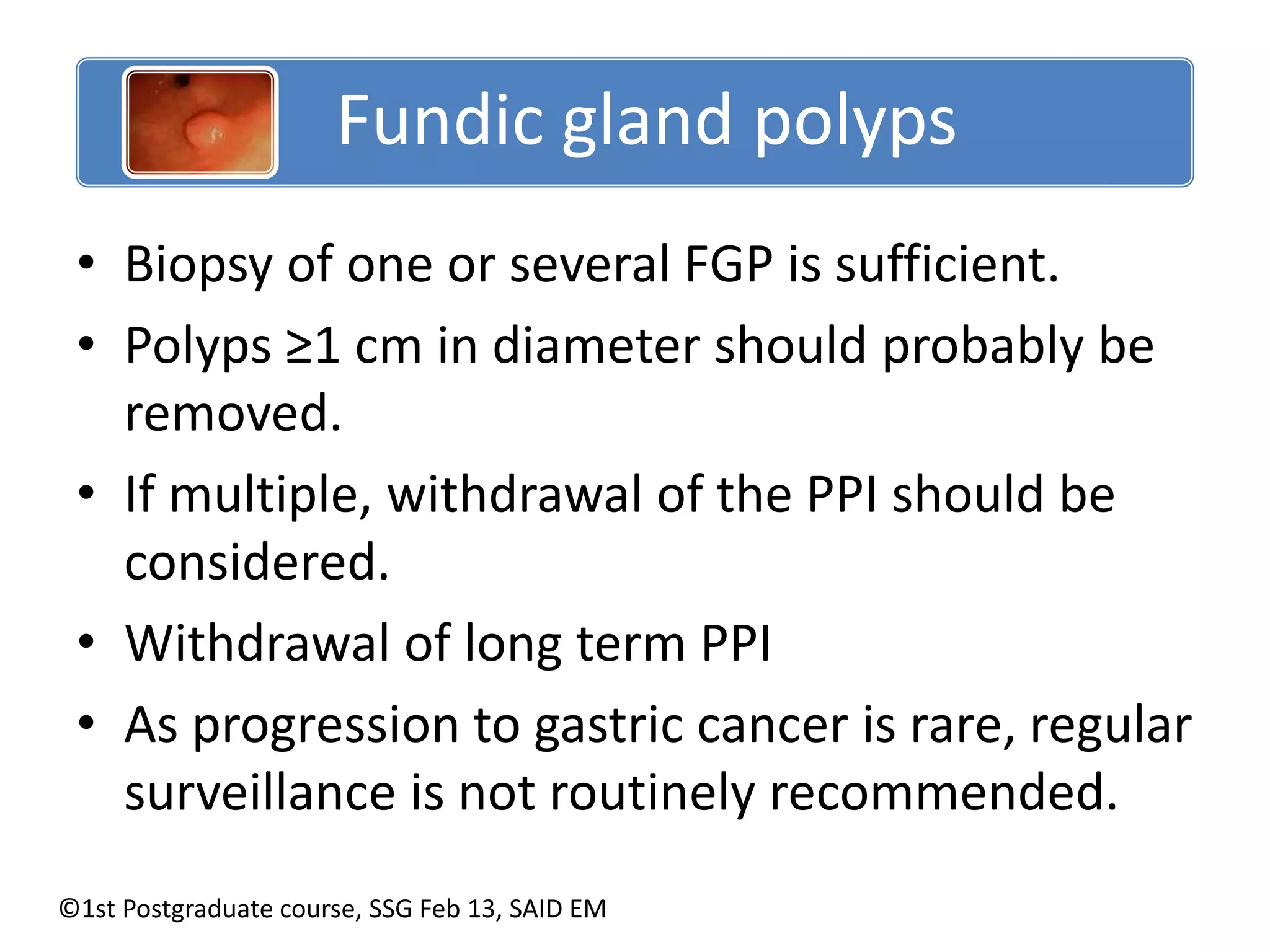
• Biopsy of one or several FGP is sufficient. 
• Polyps ≥1 cm in diameter should probably be 
removed. 
• If multiple, withdrawal of the PPI should be 
considered. 
• Withdrawal of long term PPI 
• As progression to gastric cancer is rare, regular 
surveillance is not routinely recommended. 
©1st Postgraduate course, SSG Feb 13, SAID EM
Gastric adenomas 
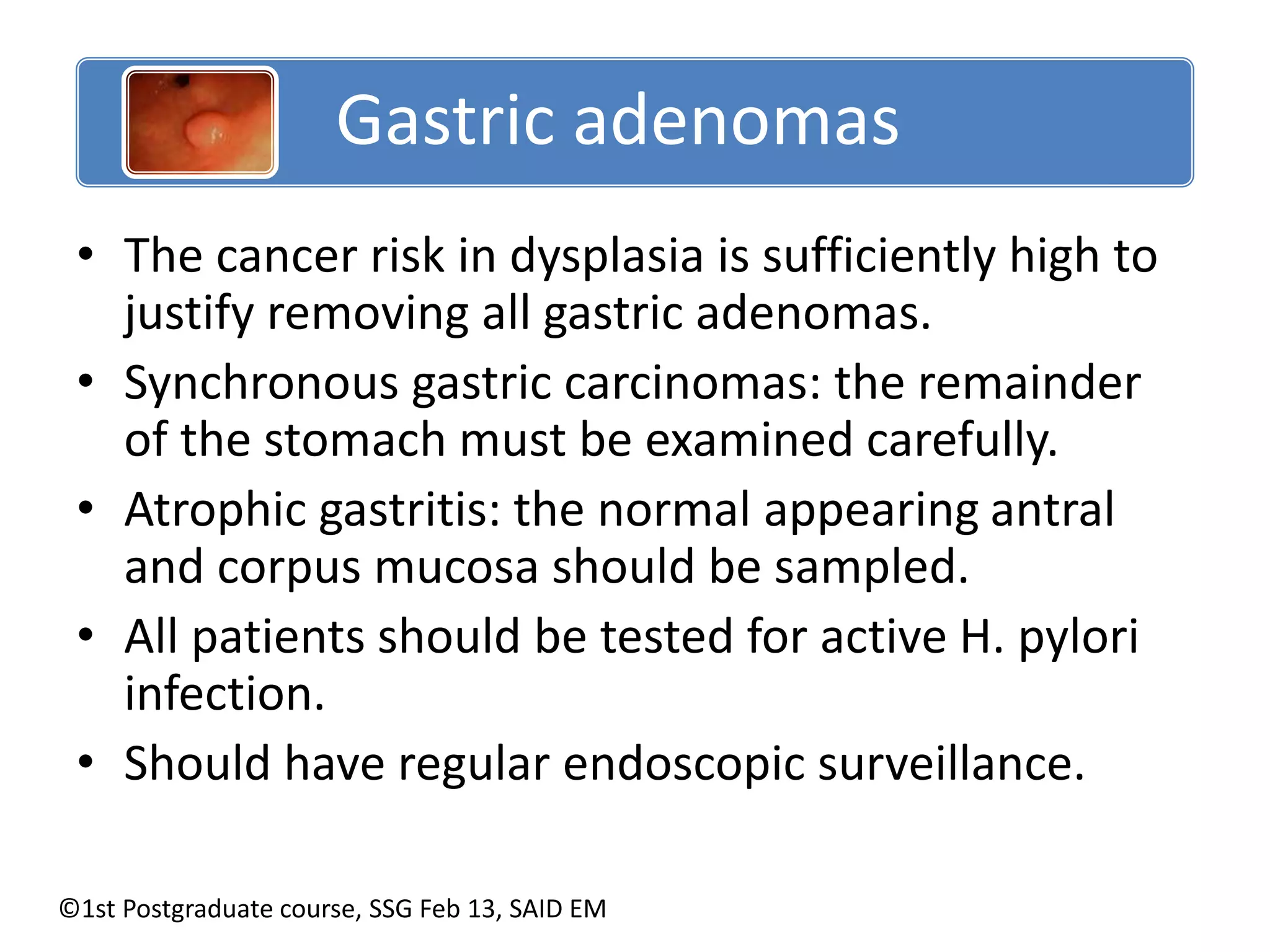
• The cancer risk in dysplasia is sufficiently high to 
justify removing all gastric adenomas. 
• Synchronous gastric carcinomas: the remainder 
of the stomach must be examined carefully. 
• Atrophic gastritis: the normal appearing antral 
and corpus mucosa should be sampled. 
• All patients should be tested for active H. pylori 
infection. 
• Should have regular endoscopic surveillance. 
©1st Postgraduate course, SSG Feb 13, SAID EM
Gastric carcinoid tumors 
• The type Gastric NET should be determined by Bx 
of lesion & surrounding mucosa and measure the 
fasting serum gastrin level. 
• Management depend on tumour type, size of 
polyp and presence of metastasis. 
• Type 1 : good prognosis, No treatment but if <1 
cm →endoscopic resection. 
• Type 2: regress if gastrinoma removed. 
• Type 3: partial or total gastrectomy with local 
lymph node clearance. 
©1st Postgraduate course, SSG Feb 13, SAID EM
Stromal tumour GISTs 
• Evaluation by CT & EUS (Local spread/mets). 
• If localized →surgical resection. 
• If unresectable/ metastasis present→ 
Imatinib. 
©1st Postgraduate course, SSG Feb 13, SAID EM
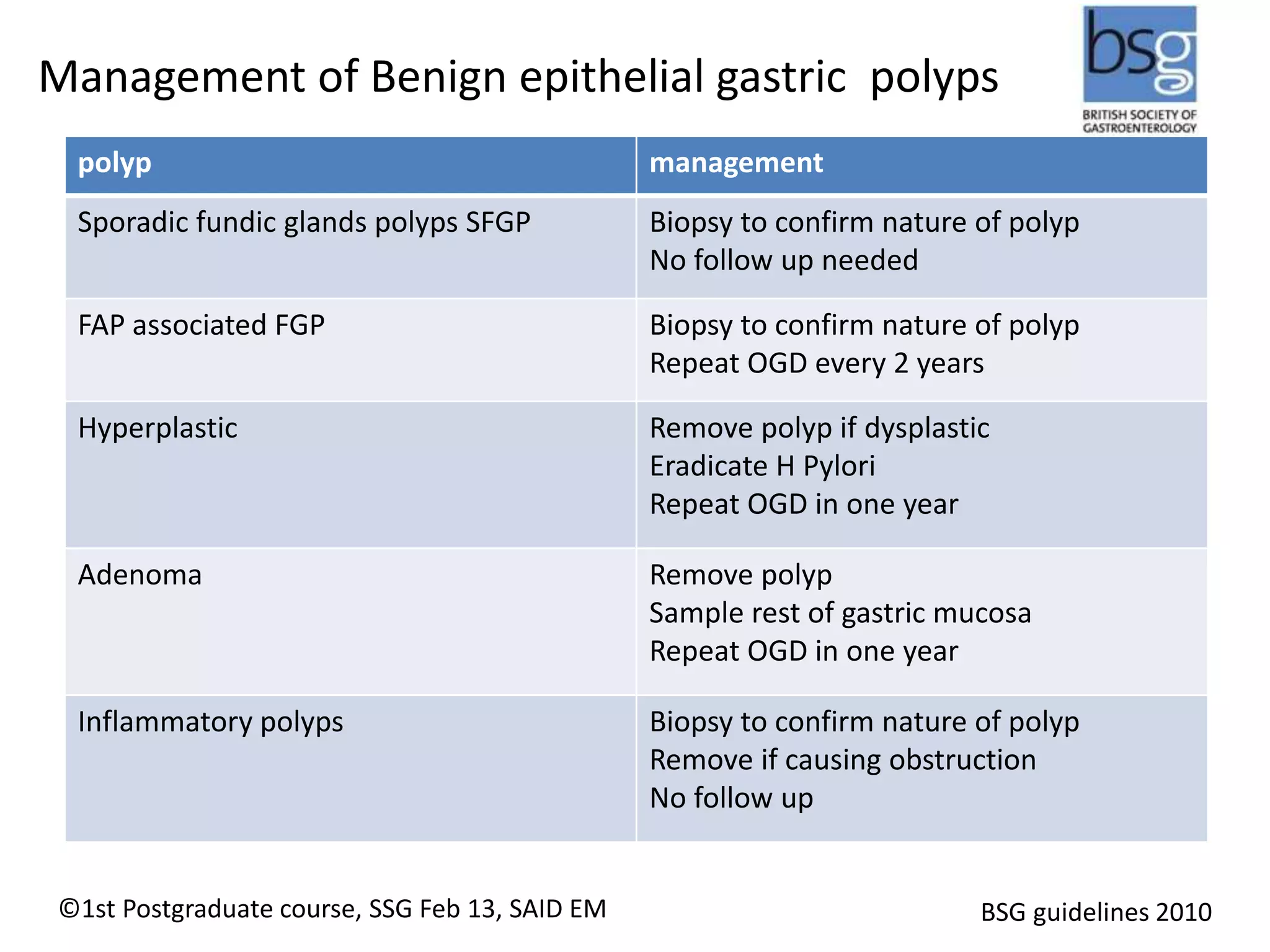
Management of Benign epithelial gastric polyps 
polyp management 
Sporadic fundic glands polyps SFGP Biopsy to confirm nature of polyp 
No follow up needed 
FAP associated FGP Biopsy to confirm nature of polyp 
Repeat OGD every 2 years 
Hyperplastic Remove polyp if dysplastic 
Eradicate H Pylori 
Repeat OGD in one year 
Adenoma Remove polyp 
Sample rest of gastric mucosa 
Repeat OGD in one year 
Inflammatory polyps Biopsy to confirm nature of polyp 
Remove if causing obstruction 
No follow up 
©1st Postgraduate course, SSG Feb 13, SAID EM BSG guidelines 2010
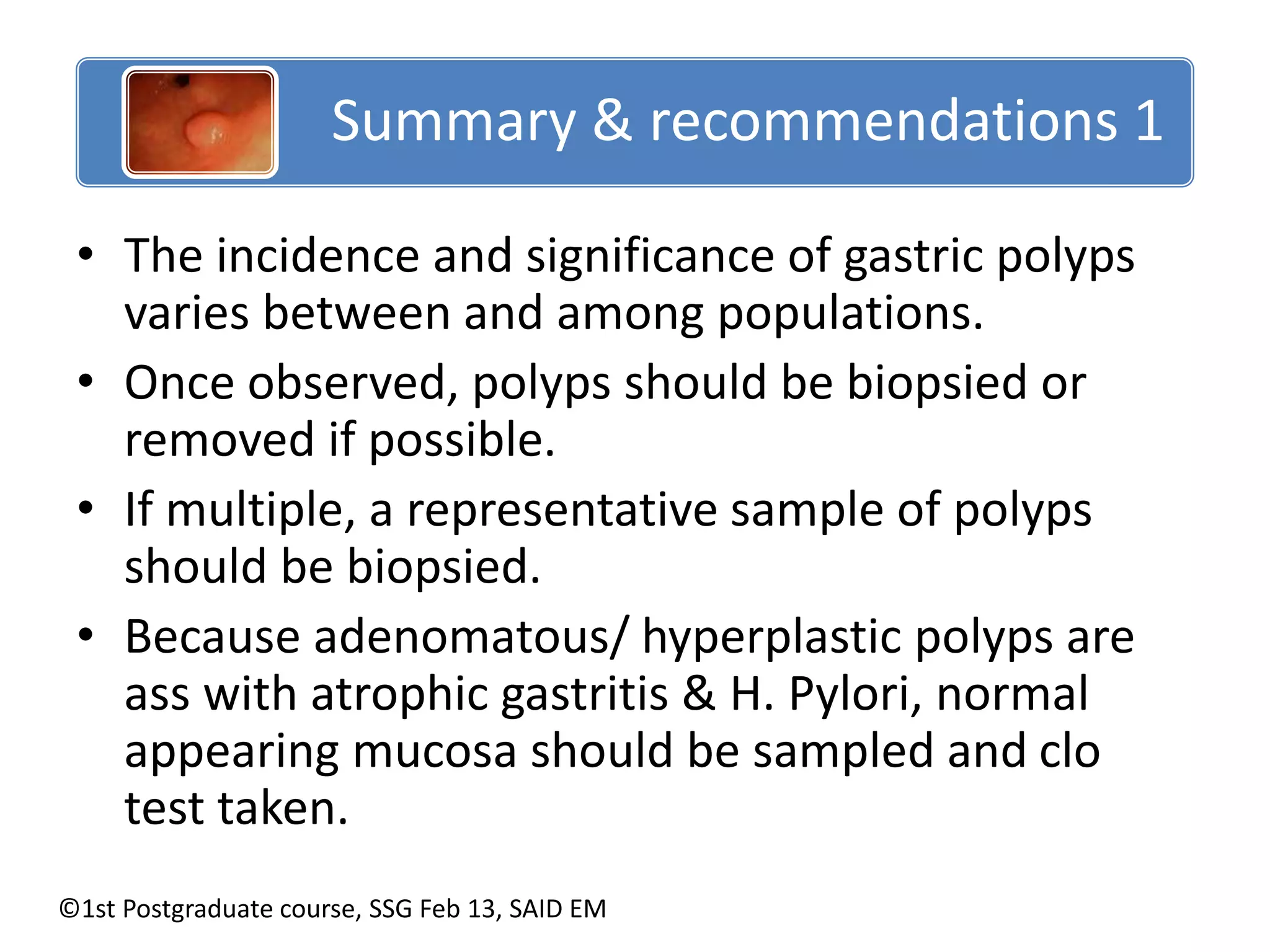
Management of gastric polyps associated 
with polyposis 
Syndrome Life time risk of 
malignancy 
Surveillance recommendation 
FAP 100% (colon) OGD every 2 years after 18 
Biopsy > 5 polyps 
Remove polyps > 1 cm 
Peutz-Jeghers >50% (extra-GI) OGD every 2 years after 18 
Biopsy > 5 polyps 
Remove polyp > 1 cm 
Juvenile polyp >50% OGD every 3 years after 18 
Cowden’s Rare Eradicate H pylori 
No further OGD needed 
©1st Postgraduate course, SSG Feb 13, SAID EM BSG guidelines 2010
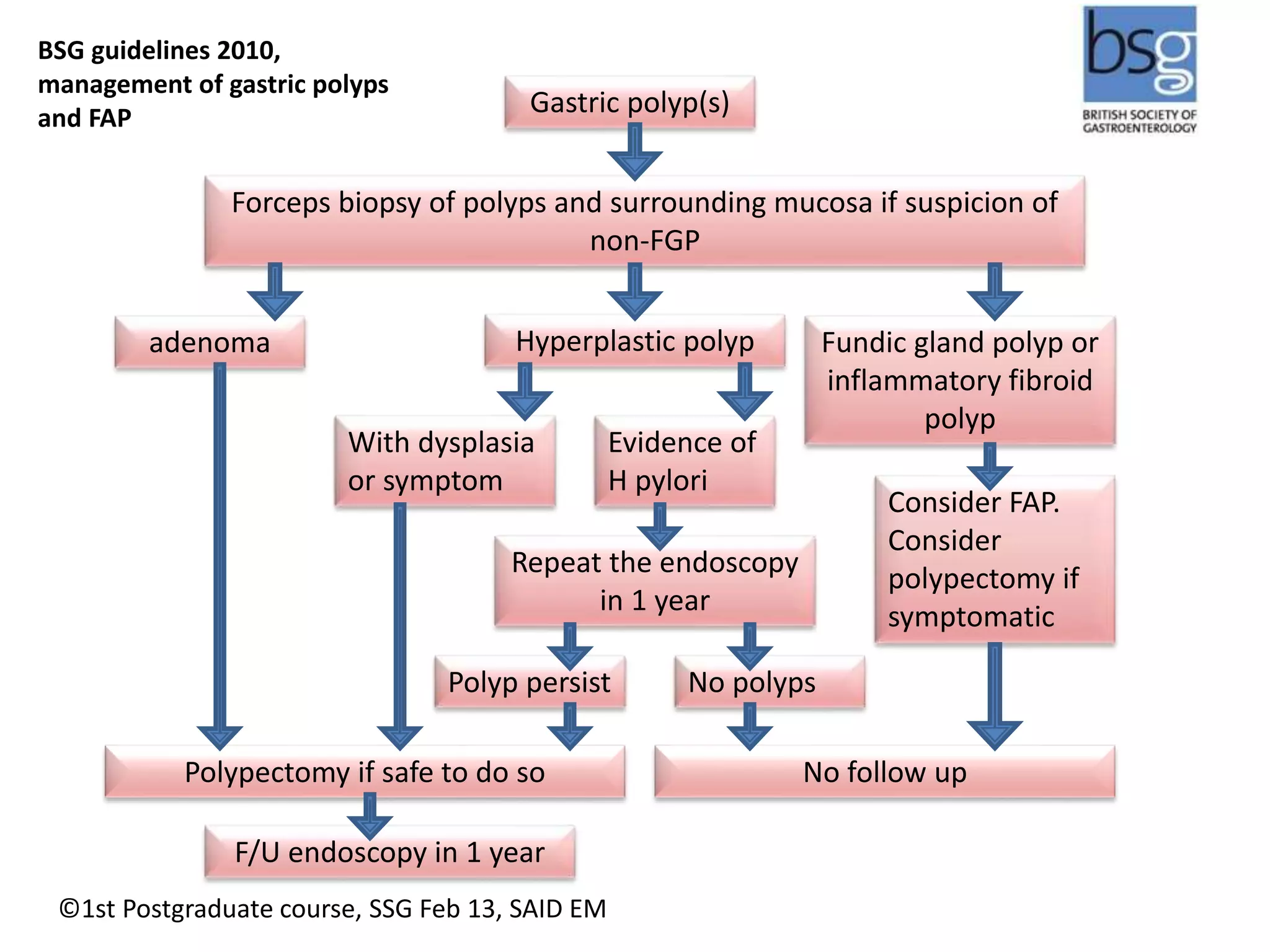
Gastric polyp(s) 
Forceps biopsy of polyps and surrounding mucosa if suspicion of 
non-FGP 
adenoma Hyperplastic polyp Fundic gland polyp or 
inflammatory fibroid 
polyp 
With dysplasia 
or symptom 
Evidence of 
H pylori 
Repeat the endoscopy 
in 1 year 
Polyp persist No polyps 
Polypectomy if safe to do so 
F/U endoscopy in 1 year 
Consider FAP. 
Consider 
polypectomy if 
symptomatic 
No follow up 
BSG guidelines 2010, 
management of gastric polyps 
and FAP 
©1st Postgraduate course, SSG Feb 13, SAID EM
Summary & recommendations 1 
• The incidence and significance of gastric polyps 
varies between and among populations. 
• Once observed, polyps should be biopsied or 
removed if possible. 
• If multiple, a representative sample of polyps 
should be biopsied. 
• Because adenomatous/ hyperplastic polyps are 
ass with atrophic gastritis & H. Pylori, normal 
appearing mucosa should be sampled and clo 
test taken. 
©1st Postgraduate course, SSG Feb 13, SAID EM
Summary & recommendations 2 
• Fundic gland polyps > 1cm should be removed 
and if multiple withdrawal of PPI considered. 
• Treatment of H Pylori is ass with regression of 
polyps in some patients with hyperplastic polyps. 
• Due to high risk of cancer, all gastric adenomas 
should be removed endoscopically or surgically. 
• Management of gastric carcinoid depend on its 
type. 
©1st Postgraduate course, SSG Feb 13, SAID EM

Management of gastric polyps

  • 1.
    Honorary Senior ClinicalLecturer, University of Sheffield Consultant Gastroenterologist Barnsley Hospital NHS Foundation Trust, UK ©1st Postgraduate course, SSG Feb 13 elmuhtady.said@nhs.net
  • 2.
    Introduction Epidemiology Classification General Management Management of certain polyps Summary and Recommendations ©1st Postgraduate course, SSG Feb 13, SAID EM
  • 3.
    BSG Guidelines Gut2010:59:1270-1276.doi:10.1136 ©1st Postgraduate course, SSG Feb 13, SAID EM
  • 4.
    = Introduction •Defined as luminal lesions projecting above the plane of the mucosal surface. • The main goal : to rule out the possibility of malignancy. • Various subtypes of gastric polyps are recognized and generally divided into non-neoplastic and neoplastic. Arch Pathol ©1st Postgraduate course, SSG Feb 13, SAID EM Lab Med. 2008 Apr;132(4):633-40
  • 5.
    = Epidemiology •Few large epidemiological studies. • Incidence: 1-3% of all gastroscopies. • M=F. • ⅔ above age of 60 years. • Multiple in >25%. • Usually asymptomatic, > 90% found incidentally. • Large polyps can present with bleeding, anaemia or abdominal pain. Archimandrits A et ©1st Postgraduate course, SSG Feb 13, SAID EM al, Ital J Gastroentrol 1996;28:1524
  • 6.
    Epidemiology • Frequencyand type of gastric polyps vary depending on the population and location. H Pylori common PPI less common H Pylori less common PPI common Hyperplastic/ adenoma> Fundic Fundic> Hyperplastic/ adenoma • Fundic glands polyp common in the West. • Specific genetic mutations are responsible for polyp formation. ©1st Postgraduate course, SSG Feb 13, SAID EM
  • 7.
    Classification Different classifications: Histology based WHO (controversial) ©1st Postgraduate course, SSG Feb 13, SAID EM
  • 8.
    BSG Classification Benignepithelial gastric polyps BEGP Non-mucosal intramural polyps Fundic gland polyps Gastrointestinal stromal tumours Hyperplastic polyps Neuroendocrine tumours Adenomatous polyps Fibroma and fibromyoma Hamartomatous polyps Inflammatory fibroid polyps Polyposis syndromes Ectopic pancreas Lipoma, Leiomyoma Neurogenic and vascular tumours ©1st Postgraduate course, SSG Feb 13, SAID EM
  • 9.
    BENIGN EPITHELIAL GASTRICPOLYPS BEGP ©1st Postgraduate course, SSG Feb 13, SAID EM
  • 10.
    Sporadic Fundic glandpolyps Fundic Gland polyps • Two types: sporadic or associated with polyposis syndrome. • Typically small (0.1 - 0.8 cm), hyperemic, sessile, flat, nodular lesions that have a smooth surface contour . • Exclusively in the gastric corpus. can sometimes be large. • Microscopically :Composed of normal gastric corpus-type epithelium, arranged in a disorderly and/or microcystic configuration. ©1st Postgraduate course, SSG Feb 13, SAID EM
  • 11.
    Sporadic Fundic glandpolyps Fundic Gland polyps • Sporadic FGP: F>M, middle age, 40% multiple. • Long term PPI associate with 4x risk of FGP. • H Pylori infection appears to protect the development of FGP. ©1st Postgraduate course, SSG Feb 13, SAID EM Jalving M et al,Aliment Pharmacol Ther 2006;24:1341
  • 12.
    FGP in FAP • Occur in 20-100 % of patients with FAP • Early age (average 40) • Mutation of the APC gene • Usually multiple, carpet the body of stomach • Epithilial dysplasia occur in 25-41% of FAP associated polyposis ©1st Postgraduate course, SSG Feb 13, SAID EM
  • 13.
    Hyperplastic polyps •75 % of gastric polyps in areas where H. pylori is common. • Small, dome-shaped, or stalked polyps (average size 1.0 cm) ,single or multiple. • Primarily in the antrum, but may develop in the fundus or cardia. • Microscopically :elongated, dilated or cystic, architecturally distorted, foveolar epithelium within chronically inflamed lamina propria. ©1st Postgraduate course, SSG Feb 13, SAID EM
  • 14.
    Adenomatous polyps •6 to 10 % of gastric polyps. • Found in the antrum, some occur in the corpus and cardia. • May be flat or polypoid. • Range in size from a few mm to several cm. • Microscopically: similar to typical colonic adenomas:tubular, tubulovillous, or villous,are sessile or stalked, occasionally large sizes. ©1st Postgraduate course, SSG Feb 13, SAID EM
  • 15.
    Hamartomatous polyps •Rare, Include: 1. Juvenile polyps:solitary, antral, inflammatoty or hamartomatous, no malignant potential. 2. PJS: AD,hamartomatous GI polyps, mucocutan. Pigmentaion , increase risk of cancer. 3. Cowden disease: AD, orocutaneous hamartomatous , extra GI abnormalties. • Malignant transformation rare. ©1st Postgraduate course, SSG Feb 13, SAID EM
  • 16.
    NON-MUCOSAL INTRAMURAL POLYPS ©1st Postgraduate course, SSG Feb 13, SAID EM
  • 17.
    Inflammatory fibroid polyps • Vanek tumours. • Rare, 1% of all gastric polyps. • Originate from submucosa, usually in antrum or peripyloric area. • Central depression/ ulceration. • Asymptomatic, can be present with bleeding or gastric outlet obstruction. • No malignant potential but ass with chronic atrophic gastritis. • Microscopically :Submucosal proliferation of spindle cells/small vessels with an inflammatory infiltrate with many eosinophils. ©1st Postgraduate course, SSG Feb 13, SAID EM
  • 18.
    Gastric neuroendocrine tumourNETs • Histologically, composed of enterochromaffin-like cells. • May be asymptomatic, PUD, abd pain, bleeding or carcinoid syndrome. • Type 1: 80%, sessile, ass with atrophic gastritis, pernicious anaemia. • Type 2: 5%, Zollinger-Ellison in the setting of MEN1. • Type 3: 15% , sporadic, malignant potential. ©1st Postgraduate course, SSG Feb 13, SAID EM
  • 19.
    Stromal tumour GISTs • 1-3% of gastric tumours. • M>F, typically in the fundus. • Submucosal, mucosal Bx inadequate. • EUS with FNA is best diagnosis. • Malignancy: low to high based on polyp size & level of mitotic activity. • Histology: spindle cells in 70-80%, epitheloid aspect in 20-30%. • Immunohistochemistry:95% of all GISTs are CD117-positive. ©1st Postgraduate course, SSG Feb 13, SAID EM
  • 20.
    GENERAL MANAGEMENT ©1stPostgraduate course, SSG Feb 13, SAID EM
  • 21.
    General principles Generalmanagement issues are commonly applied to all patients with gastric polyps. Once a polyp is observed, it is removed or biopsied and its pathology identified Prognosis and management are specific to the underlying pathology. ©1st Postgraduate course, SSG Feb 13, SAID EM
  • 22.
    Polyp Histology Checkfor H.Pylori infection Gastric mucosa histology Multiple polyps Relationship to colonic polyps Surveillance General principles ©1st Postgraduate course, SSG Feb 13, SAID EM
  • 23.
    Polyp Histology Allgastric polyps should be biopsied and examined microscopically for histologic characterization due to risk of cancer. • Forceps biopsy alone cannot exclude foci of HGD or early gastric cancer in large (>1 cm) polyps. • Polypectomy is generally indicated for all neoplastic polyps and other polyps ≥1 cm in diameter. ©1st Postgraduate course, SSG Feb 13, SAID EM
  • 24.
    H.Pylori infection Allpatients with hyperplastic gastric polyps should be tested for H. pylori, if positive, treated with eradication therapy. • Treatment has been associated with regression of polyps in some patients. • Because the pathology is often not known at the time of initial endoscopy, we also biopsy the normal appearing mucosa of patients with gastric polyps for H. pylori. ©1st Postgraduate course, SSG Feb 13, SAID EM
  • 25.
    Gastric mucosa histology Take biopsy of the normal mucosa • Because hyperplastic polyps & adenomatous polyps are often associated with atrophic gastritis→ the normal intervening non-polypoid gastric mucosa should be sampled to assess the stage and type of gastritis and, thus, cancer risk. ©1st Postgraduate course, SSG Feb 13, SAID EM
  • 26.
    Multiple polyps Ifmultiple polyps, remove the largest and take representative samples • Some patients have multiple polyps, which makes it difficult and impractical to remove them all. • The largest polyp should be excised with representative biopsies obtained from the remaining polyps. • Further management should be based upon the histology of the polyp. ©1st Postgraduate course, SSG Feb 13, SAID EM
  • 27.
    Relationship to colonicpolyps If FAP is suspected, colonoscopic investigation is recommended • In young patients with numerous fundic glands polyps and not on PPI, FAP should considered as a possible diagnosis. • Flexible sigmoidoscopy is usually recommended. • Colonoscopy is indicated if there is evidence of dysplasia ©1st Postgraduate course, SSG Feb 13, SAID EM
  • 28.
    Surveillance • Repeatgastroscopy should be performed at 1 year for all polyps with dysplasia that have not been removed. • Repeat gastroscopy should be performed at 1 year following complete polypectomy for high risk polyp. ©1st Postgraduate course, SSG Feb 13, SAID EM
  • 29.
    MANAGEMENT OF CERTAINPOLYPS ©1st Postgraduate course, SSG Feb 13, SAID EM
  • 30.
    Hyperplastic polyps •Simple excision. • Large (>2 cm) polyps are at increased risk for malignant transformation and should be resected completely. • Test for H. pylori. ©1st Postgraduate course, SSG Feb 13, SAID EM
  • 31.
    Fundic gland polyps • Biopsy of one or several FGP is sufficient. • Polyps ≥1 cm in diameter should probably be removed. • If multiple, withdrawal of the PPI should be considered. • Withdrawal of long term PPI • As progression to gastric cancer is rare, regular surveillance is not routinely recommended. ©1st Postgraduate course, SSG Feb 13, SAID EM
  • 32.
    Gastric adenomas •The cancer risk in dysplasia is sufficiently high to justify removing all gastric adenomas. • Synchronous gastric carcinomas: the remainder of the stomach must be examined carefully. • Atrophic gastritis: the normal appearing antral and corpus mucosa should be sampled. • All patients should be tested for active H. pylori infection. • Should have regular endoscopic surveillance. ©1st Postgraduate course, SSG Feb 13, SAID EM
  • 33.
    Gastric carcinoid tumors • The type Gastric NET should be determined by Bx of lesion & surrounding mucosa and measure the fasting serum gastrin level. • Management depend on tumour type, size of polyp and presence of metastasis. • Type 1 : good prognosis, No treatment but if <1 cm →endoscopic resection. • Type 2: regress if gastrinoma removed. • Type 3: partial or total gastrectomy with local lymph node clearance. ©1st Postgraduate course, SSG Feb 13, SAID EM
  • 34.
    Stromal tumour GISTs • Evaluation by CT & EUS (Local spread/mets). • If localized →surgical resection. • If unresectable/ metastasis present→ Imatinib. ©1st Postgraduate course, SSG Feb 13, SAID EM
  • 35.
    Management of Benignepithelial gastric polyps polyp management Sporadic fundic glands polyps SFGP Biopsy to confirm nature of polyp No follow up needed FAP associated FGP Biopsy to confirm nature of polyp Repeat OGD every 2 years Hyperplastic Remove polyp if dysplastic Eradicate H Pylori Repeat OGD in one year Adenoma Remove polyp Sample rest of gastric mucosa Repeat OGD in one year Inflammatory polyps Biopsy to confirm nature of polyp Remove if causing obstruction No follow up ©1st Postgraduate course, SSG Feb 13, SAID EM BSG guidelines 2010
  • 36.
    Management of gastricpolyps associated with polyposis Syndrome Life time risk of malignancy Surveillance recommendation FAP 100% (colon) OGD every 2 years after 18 Biopsy > 5 polyps Remove polyps > 1 cm Peutz-Jeghers >50% (extra-GI) OGD every 2 years after 18 Biopsy > 5 polyps Remove polyp > 1 cm Juvenile polyp >50% OGD every 3 years after 18 Cowden’s Rare Eradicate H pylori No further OGD needed ©1st Postgraduate course, SSG Feb 13, SAID EM BSG guidelines 2010
  • 37.
    Gastric polyp(s) Forcepsbiopsy of polyps and surrounding mucosa if suspicion of non-FGP adenoma Hyperplastic polyp Fundic gland polyp or inflammatory fibroid polyp With dysplasia or symptom Evidence of H pylori Repeat the endoscopy in 1 year Polyp persist No polyps Polypectomy if safe to do so F/U endoscopy in 1 year Consider FAP. Consider polypectomy if symptomatic No follow up BSG guidelines 2010, management of gastric polyps and FAP ©1st Postgraduate course, SSG Feb 13, SAID EM
  • 38.
    Summary & recommendations1 • The incidence and significance of gastric polyps varies between and among populations. • Once observed, polyps should be biopsied or removed if possible. • If multiple, a representative sample of polyps should be biopsied. • Because adenomatous/ hyperplastic polyps are ass with atrophic gastritis & H. Pylori, normal appearing mucosa should be sampled and clo test taken. ©1st Postgraduate course, SSG Feb 13, SAID EM
  • 39.
    Summary & recommendations2 Summary & recommendations 2 • Fundic gland polyps > 1cm should be removed and if multiple withdrawal of PPI considered. • Treatment of H Pylori is ass with regression of polyps in some patients with hyperplastic polyps. • Due to high risk of cancer, all gastric adenomas should be removed endoscopically or surgically. • Management of gastric carcinoid depend on its type. ©1st Postgraduate course, SSG Feb 13, SAID EM
  • 40.
    ©1st Postgraduate course,SSG Feb 13, SAID EM