Honorary senior clinical lecturer, University of Sheffield
Consultant Gastroenterologist
Barnsley Hospital NHS Foundation trust, UK
elmuhtady.said@nhs.net
Learning outcomes
• Definition and causes of dyspepsia.
• How to investigate dyspepsia.
• Indications for urgent and non-urgent
endoscopy.
• Red flag symptoms that may indicate
malignancy.
SAID EM © April 2017
Introduction
• Common.
• Prevalence 8-56%.
• 40% of adults in UK.
• 1% of UK population consult GP annually.
• 4% of GP consultation.
• Significant cost to the NHS.
• Increase use of endoscopy.
Wallander AM et al. Dyspepsia in general practice, incidence, risk factors, comorbidites
And mortality. Fam Prac 2007,vol 24(2).SAID EM © April 2017
Definition
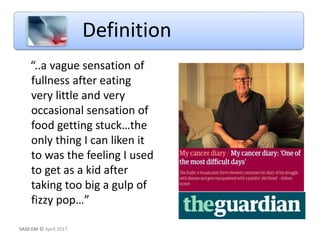
“..a vague sensation of
fullness after eating
very little and very
occasional sensation of
food getting stuck…the
only thing I can liken it
to was the feeling I used
to get as a kid after
taking too big a gulp of
fizzy pop…”
SAID EM © April 2017
Definition
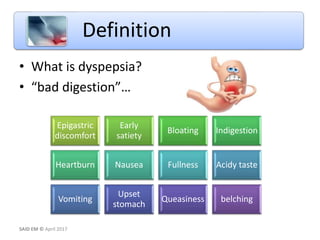
• What is dyspepsia?
• “bad digestion”…
Epigastric
discomfort
Early
satiety
Bloating Indigestion
Heartburn Nausea Fullness Acidy taste
Vomiting
Upset
stomach
Queasiness belching
SAID EM © April 2017
NICE quality standard [QS96]
Dyspepsia pain or discomfort in the upper abdomen, including
upper abdominal fullness, early satiety, belching, bloating, and
nausea and/or vomiting
Functional presence of gastroduodenal symptoms in the
absence of any organic, metabolic, or systemic disease to explain
them.
Definition
Dyspepsia and gastro-oesophageal reflux disease
in adults: investigation and management July 2015SAID EM © April 2017
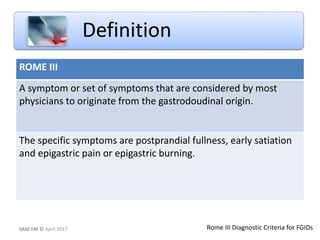
ROME III
A symptom or set of symptoms that are considered by most
physicians to originate from the gastrodoudinal origin.
The specific symptoms are postprandial fullness, early satiation
and epigastric pain or epigastric burning.
Definition
SAID EM © April 2017 Rome III Diagnostic Criteria for FGIDs
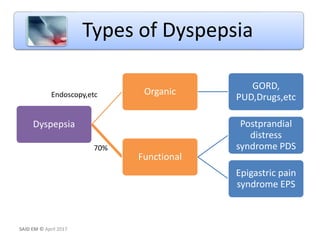
Dyspepsia
Organic
GORD,
PUD,Drugs,etc
Functional
Postprandial
distress
syndrome PDS
Epigastric pain
syndrome EPS
Types of Dyspepsia
70%
Endoscopy,etc
SAID EM © April 2017
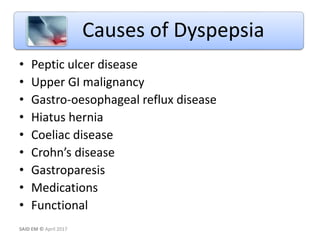
• Peptic ulcer disease
• Upper GI malignancy
• Gastro-oesophageal reflux disease
• Hiatus hernia
• Coeliac disease
• Crohn’s disease
• Gastroparesis
• Medications
• Functional
Causes of Dyspepsia
SAID EM © April 2017
How common is malignancy?
1. 70%
2. 10%
3. 5%
4. <1%
SAID EM © April 2017
How common is malignancy?
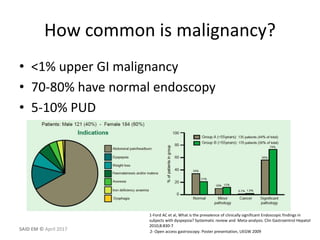
• <1% upper GI malignancy
• 70-80% have normal endoscopy
• 5-10% PUD
1-Ford AC et al, What is the prevalence of clinically significant Endoscopic findings in
subjects with dyspepsia? Systematic review and Meta-analysis. Clin Gastroentrol Hepatol
2010;8:830-7
2- Open access gastroscopy. Poster presentation, UEGW 2009SAID EM © April 2017
NICE Guidelines milestone
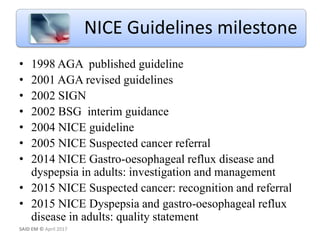
• 1998 AGA published guideline
• 2001 AGA revised guidelines
• 2002 SIGN
• 2002 BSG interim guidance
• 2004 NICE guideline
• 2005 NICE Suspected cancer referral
• 2014 NICE Gastro-oesophageal reflux disease and
dyspepsia in adults: investigation and management
• 2015 NICE Suspected cancer: recognition and referral
• 2015 NICE Dyspepsia and gastro-oesophageal reflux
disease in adults: quality statement
SAID EM © April 2017
NICE Guidelines 2015
List of quality statements
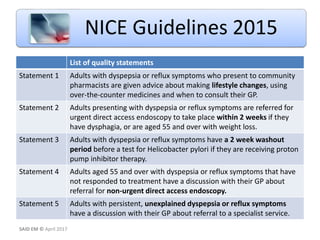
Statement 1 Adults with dyspepsia or reflux symptoms who present to community
pharmacists are given advice about making lifestyle changes, using
over-the-counter medicines and when to consult their GP.
Statement 2 Adults presenting with dyspepsia or reflux symptoms are referred for
urgent direct access endoscopy to take place within 2 weeks if they
have dysphagia, or are aged 55 and over with weight loss.
Statement 3 Adults with dyspepsia or reflux symptoms have a 2 week washout
period before a test for Helicobacter pylori if they are receiving proton
pump inhibitor therapy.
Statement 4 Adults aged 55 and over with dyspepsia or reflux symptoms that have
not responded to treatment have a discussion with their GP about
referral for non-urgent direct access endoscopy.
Statement 5 Adults with persistent, unexplained dyspepsia or reflux symptoms
have a discussion with their GP about referral to a specialist service.
SAID EM © April 2017
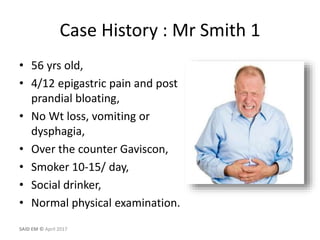
Case History : Mr Smith 1
• 56 yrs old,
• 4/12 epigastric pain and post
prandial bloating,
• No Wt loss, vomiting or
dysphagia,
• Over the counter Gaviscon,
• Smoker 10-15/ day,
• Social drinker,
• Normal physical examination.
SAID EM © April 2017
Question 1
• Select 2 answers:
1. Refer for OGD.
2. Prescribe H2Blocker for 4/52, return if
symptoms persist.
3. Prescribe PPI for 4/52, return if symptoms
persist.
4. Arrange for H Pylori test, eradicate if positive
and 4/25 of PPI.
SAID EM © April 2017
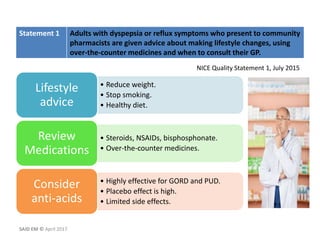
• Reduce weight.
• Stop smoking.
• Healthy diet.
Lifestyle
advice
• Steroids, NSAIDs, bisphosphonate.
• Over-the-counter medicines.
Review
Medications
• Highly effective for GORD and PUD.
• Placebo effect is high.
• Limited side effects.
Consider
anti-acids
NICE Quality Statement 1, July 2015
Statement 1 Adults with dyspepsia or reflux symptoms who present to community
pharmacists are given advice about making lifestyle changes, using
over-the-counter medicines and when to consult their GP.
SAID EM © April 2017
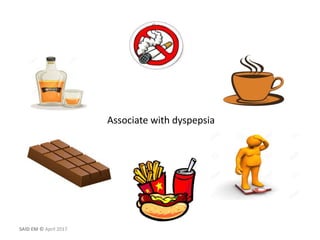
Associate with dyspepsia
SAID EM © April 2017
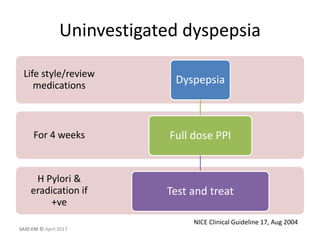
Uninvestigated dyspepsia
H Pylori &
eradication if
+ve
For 4 weeks
Life style/review
medications
Dyspepsia
Full dose PPI
Test and treat
NICE Clinical Guideline 17, Aug 2004
SAID EM © April 2017
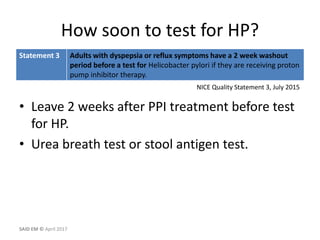
How soon to test for HP?
• Leave 2 weeks after PPI treatment before test
for HP.
• Urea breath test or stool antigen test.
NICE Quality Statement 3, July 2015
SAID EM © April 2017
Statement 3 Adults with dyspepsia or reflux symptoms have a 2 week washout
period before a test for Helicobacter pylori if they are receiving proton
pump inhibitor therapy.
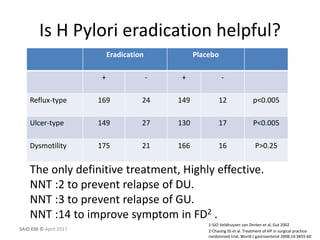
Is H Pylori eradication helpful?
1-SJO Veldhuyzen van Zenten et al, Gut 2002
Eradication Placebo
+ - + -
Reflux-type 169 24 149 12 p<0.005
Ulcer-type 149 27 130 17 P<0.005
Dysmotility 175 21 166 16 P>0.25
The only definitive treatment, Highly effective.
NNT :2 to prevent relapse of DU.
NNT :3 to prevent relapse of GU.
NNT :14 to improve symptom in FD2 .
2-Chasing SS et al. Treatment of HP in surgical practice:
randomised trial, World J gastroenterol 2008;14:3855-60
SAID EM © April 2017
Should we confirm eradication?
1. Yes
2. No
SAID EM © April 2017
Should we confirm eradication?
• Not a recommendation by NICE!
• The European guidelines on H Pylori
management recommend non-invasive follow
up to verify successful treatment after 4
weeks1.
• Consider if still symptomatic.
1-The Maastrichit conensus report Gut Jan 2007SAID EM © April 2017
Is Prompt OGD Good idea?
1. Yes
2. No
SAID EM © April 2017
Is Prompt OGD Good idea?
• Prompt endoscopy Vs test and treat in simple
dyspepsia1.
• OGD as first line reduce risk of recurrence
dyspeptic symptoms but not cost effective.
1-Ford AC et al, What is the prevalence of clinically significant Endoscopic findings in
subjects with dyspepsia? Systematic review and Meta-analysis. Clin Gastroentrol Hepatol
2010;8:830-7SAID EM © April 2017
Case History : Mr Smith 2
• 2 months later.
• Finished course of treatment.
• Symptoms recurred, OTC antiacids.
• Unintentional Wt loss.
SAID EM © April 2017
Question 2
• What is the best course of action?
1. Restart PPI and arrange to see in 3/12.
2. Arrange for UBT and treat if +ve.
3. Prescribe lower continued dose of PPI.
4. Arrange urgent upper GI endoscopy.
SAID EM © April 2017
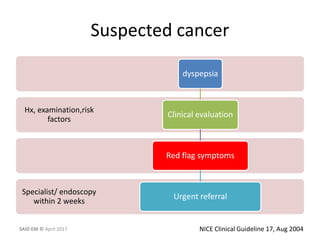
Suspected cancer
Specialist/ endoscopy
within 2 weeks
Hx, examination,risk
factors
dyspepsia
Clinical evaluation
Red flag symptoms
Urgent referral
NICE Clinical Guideline 17, Aug 2004SAID EM © April 2017
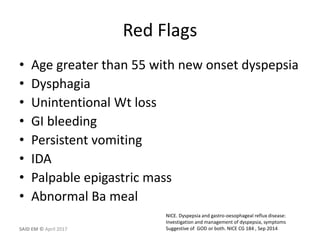
Red Flags
• Age greater than 55 with new onset dyspepsia
• Dysphagia
• Unintentional Wt loss
• GI bleeding
• Persistent vomiting
• IDA
• Palpable epigastric mass
• Abnormal Ba meal
NICE. Dyspepsia and gastro-oesophageal reflux disease:
Investigation and management of dyspepsia, symptoms
Suggestive of GOD or both. NICE CG 184 , Sep 2014SAID EM © April 2017
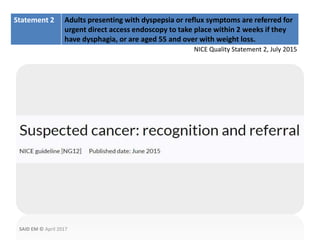
Statement 2 Adults presenting with dyspepsia or reflux symptoms are referred for
urgent direct access endoscopy to take place within 2 weeks if they
have dysphagia, or are aged 55 and over with weight loss.
NICE Quality Statement 2, July 2015
SAID EM © April 2017
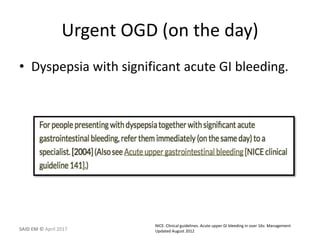
Urgent OGD (on the day)
• Dyspepsia with significant acute GI bleeding.
NICE. Clinical guidelines. Acute upper GI bleeding in over 16s: Management
Updated August 2012SAID EM © April 2017
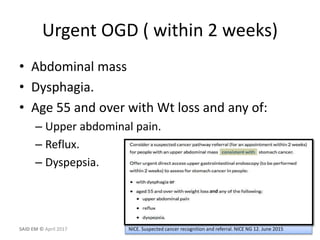
Urgent OGD ( within 2 weeks)
• Abdominal mass
• Dysphagia.
• Age 55 and over with Wt loss and any of:
– Upper abdominal pain.
– Reflux.
– Dyspepsia.
NICE. Suspected cancer recognition and referral. NICE NG 12. June 2015SAID EM © April 2017
Urgent OGD ( within 2 weeks)
• Primary care arranges for an endoscopy to be
carried out within 2 weeks and retain the
clinical responsibility throughout, including
acting on the results.
NICE. Suspected cancer recognition and referral
NICE NG 12. June 2015SAID EM © April 2017
Non-urgent OGD
• Patient aged 55 or over with:
1. Treatment resistant dyspepsia OR
2. Upper abdominal pain with low Hb OR
3. Raised platelet with any of the following:
Nausea/vomiting/Wt loss/Reflux/dyspepsia/
upper abd pain OR
4. Nausea and vomiting with any of the
following:
Wt loss/ Reflux/ dyspepsia/ upper abd pain
NICE. Suspected cancer recognition and referral
NICE NG 12. June 2015SAID EM © April 2017
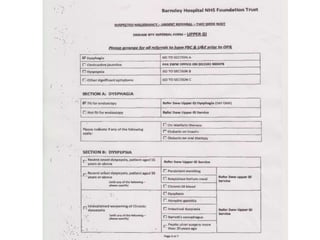
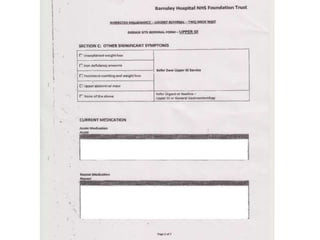
• So what if you have a patient with new onset
dyspepsia and persistent vomiting?
– 2WW OGD
– Non-urgent OGD
• These alarm feature are still relevant. GP
should still refer if appropriate to perform
OGD.
SAID EM © April 2017
Case History : Mr Smith 3
• 2 months later..
• Finished course of treatment.
• Symptoms recurred, OTC antiacids.
• No alarm features.
SAID EM © April 2017
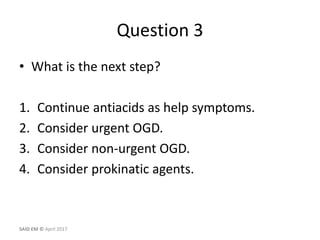
Question 3
• What is the next step?
1. Continue antiacids as help symptoms.
2. Consider urgent OGD.
3. Consider non-urgent OGD.
4. Consider prokinatic agents.
SAID EM © April 2017
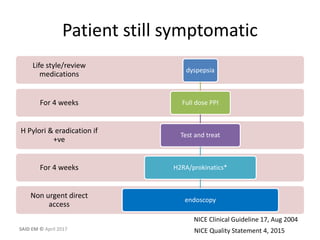
Patient still symptomatic
Non urgent direct
access
For 4 weeks
H Pylori & eradication if
+ve
For 4 weeks
Life style/review
medications
dyspepsia
Full dose PPI
Test and treat
H2RA/prokinatics*
endoscopy
NICE Clinical Guideline 17, Aug 2004
NICE Quality Statement 4, 2015SAID EM © April 2017
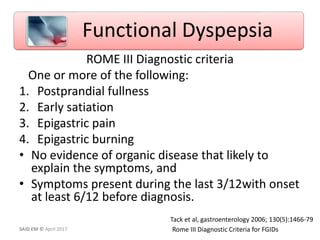
ROME III Diagnostic criteria
One or more of the following:
1. Postprandial fullness
2. Early satiation
3. Epigastric pain
4. Epigastric burning
• No evidence of organic disease that likely to
explain the symptoms, and
• Symptoms present during the last 3/12with onset
at least 6/12 before diagnosis.
Rome III Diagnostic Criteria for FGIDs
Tack et al, gastroenterology 2006; 130(5):1466-79
Functional Dyspepsia
SAID EM © April 2017
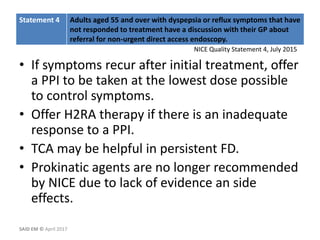
• If symptoms recur after initial treatment, offer
a PPI to be taken at the lowest dose possible
to control symptoms.
• Offer H2RA therapy if there is an inadequate
response to a PPI.
• TCA may be helpful in persistent FD.
• Prokinatic agents are no longer recommended
by NICE due to lack of evidence an side
effects.
Statement 4 Adults aged 55 and over with dyspepsia or reflux symptoms that have
not responded to treatment have a discussion with their GP about
referral for non-urgent direct access endoscopy.
NICE Quality Statement 4, July 2015
SAID EM © April 2017
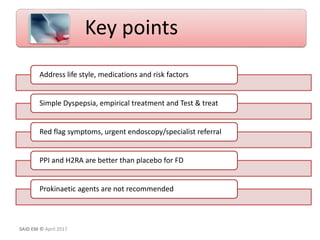
Address life style, medications and risk factors
Simple Dyspepsia, empirical treatment and Test & treat
Red flag symptoms, urgent endoscopy/specialist referral
PPI and H2RA are better than placebo for FD
Prokinaetic agents are not recommended
Key points
SAID EM © April 2017
THANK YOU
Questions?

Dyspepsia

  • 1.
    Honorary senior clinicallecturer, University of Sheffield Consultant Gastroenterologist Barnsley Hospital NHS Foundation trust, UK elmuhtady.said@nhs.net
  • 2.
    Learning outcomes • Definitionand causes of dyspepsia. • How to investigate dyspepsia. • Indications for urgent and non-urgent endoscopy. • Red flag symptoms that may indicate malignancy. SAID EM © April 2017
  • 3.
    Introduction • Common. • Prevalence8-56%. • 40% of adults in UK. • 1% of UK population consult GP annually. • 4% of GP consultation. • Significant cost to the NHS. • Increase use of endoscopy. Wallander AM et al. Dyspepsia in general practice, incidence, risk factors, comorbidites And mortality. Fam Prac 2007,vol 24(2).SAID EM © April 2017
  • 4.
    Definition “..a vague sensationof fullness after eating very little and very occasional sensation of food getting stuck…the only thing I can liken it to was the feeling I used to get as a kid after taking too big a gulp of fizzy pop…” SAID EM © April 2017
  • 5.
    Definition • What isdyspepsia? • “bad digestion”… Epigastric discomfort Early satiety Bloating Indigestion Heartburn Nausea Fullness Acidy taste Vomiting Upset stomach Queasiness belching SAID EM © April 2017
  • 6.
    NICE quality standard[QS96] Dyspepsia pain or discomfort in the upper abdomen, including upper abdominal fullness, early satiety, belching, bloating, and nausea and/or vomiting Functional presence of gastroduodenal symptoms in the absence of any organic, metabolic, or systemic disease to explain them. Definition Dyspepsia and gastro-oesophageal reflux disease in adults: investigation and management July 2015SAID EM © April 2017
  • 7.
    ROME III A symptomor set of symptoms that are considered by most physicians to originate from the gastrodoudinal origin. The specific symptoms are postprandial fullness, early satiation and epigastric pain or epigastric burning. Definition SAID EM © April 2017 Rome III Diagnostic Criteria for FGIDs
  • 8.
  • 9.
    • Peptic ulcerdisease • Upper GI malignancy • Gastro-oesophageal reflux disease • Hiatus hernia • Coeliac disease • Crohn’s disease • Gastroparesis • Medications • Functional Causes of Dyspepsia SAID EM © April 2017
  • 10.
    How common ismalignancy? 1. 70% 2. 10% 3. 5% 4. <1% SAID EM © April 2017
  • 11.
    How common ismalignancy? • <1% upper GI malignancy • 70-80% have normal endoscopy • 5-10% PUD 1-Ford AC et al, What is the prevalence of clinically significant Endoscopic findings in subjects with dyspepsia? Systematic review and Meta-analysis. Clin Gastroentrol Hepatol 2010;8:830-7 2- Open access gastroscopy. Poster presentation, UEGW 2009SAID EM © April 2017
  • 12.
    NICE Guidelines milestone •1998 AGA published guideline • 2001 AGA revised guidelines • 2002 SIGN • 2002 BSG interim guidance • 2004 NICE guideline • 2005 NICE Suspected cancer referral • 2014 NICE Gastro-oesophageal reflux disease and dyspepsia in adults: investigation and management • 2015 NICE Suspected cancer: recognition and referral • 2015 NICE Dyspepsia and gastro-oesophageal reflux disease in adults: quality statement SAID EM © April 2017
  • 13.
    NICE Guidelines 2015 Listof quality statements Statement 1 Adults with dyspepsia or reflux symptoms who present to community pharmacists are given advice about making lifestyle changes, using over-the-counter medicines and when to consult their GP. Statement 2 Adults presenting with dyspepsia or reflux symptoms are referred for urgent direct access endoscopy to take place within 2 weeks if they have dysphagia, or are aged 55 and over with weight loss. Statement 3 Adults with dyspepsia or reflux symptoms have a 2 week washout period before a test for Helicobacter pylori if they are receiving proton pump inhibitor therapy. Statement 4 Adults aged 55 and over with dyspepsia or reflux symptoms that have not responded to treatment have a discussion with their GP about referral for non-urgent direct access endoscopy. Statement 5 Adults with persistent, unexplained dyspepsia or reflux symptoms have a discussion with their GP about referral to a specialist service. SAID EM © April 2017
  • 14.
    Case History :Mr Smith 1 • 56 yrs old, • 4/12 epigastric pain and post prandial bloating, • No Wt loss, vomiting or dysphagia, • Over the counter Gaviscon, • Smoker 10-15/ day, • Social drinker, • Normal physical examination. SAID EM © April 2017
  • 15.
    Question 1 • Select2 answers: 1. Refer for OGD. 2. Prescribe H2Blocker for 4/52, return if symptoms persist. 3. Prescribe PPI for 4/52, return if symptoms persist. 4. Arrange for H Pylori test, eradicate if positive and 4/25 of PPI. SAID EM © April 2017
  • 16.
    • Reduce weight. •Stop smoking. • Healthy diet. Lifestyle advice • Steroids, NSAIDs, bisphosphonate. • Over-the-counter medicines. Review Medications • Highly effective for GORD and PUD. • Placebo effect is high. • Limited side effects. Consider anti-acids NICE Quality Statement 1, July 2015 Statement 1 Adults with dyspepsia or reflux symptoms who present to community pharmacists are given advice about making lifestyle changes, using over-the-counter medicines and when to consult their GP. SAID EM © April 2017
  • 17.
  • 18.
    Uninvestigated dyspepsia H Pylori& eradication if +ve For 4 weeks Life style/review medications Dyspepsia Full dose PPI Test and treat NICE Clinical Guideline 17, Aug 2004 SAID EM © April 2017
  • 19.
    How soon totest for HP? • Leave 2 weeks after PPI treatment before test for HP. • Urea breath test or stool antigen test. NICE Quality Statement 3, July 2015 SAID EM © April 2017 Statement 3 Adults with dyspepsia or reflux symptoms have a 2 week washout period before a test for Helicobacter pylori if they are receiving proton pump inhibitor therapy.
  • 20.
    Is H Pylorieradication helpful? 1-SJO Veldhuyzen van Zenten et al, Gut 2002 Eradication Placebo + - + - Reflux-type 169 24 149 12 p<0.005 Ulcer-type 149 27 130 17 P<0.005 Dysmotility 175 21 166 16 P>0.25 The only definitive treatment, Highly effective. NNT :2 to prevent relapse of DU. NNT :3 to prevent relapse of GU. NNT :14 to improve symptom in FD2 . 2-Chasing SS et al. Treatment of HP in surgical practice: randomised trial, World J gastroenterol 2008;14:3855-60 SAID EM © April 2017
  • 21.
    Should we confirmeradication? 1. Yes 2. No SAID EM © April 2017
  • 22.
    Should we confirmeradication? • Not a recommendation by NICE! • The European guidelines on H Pylori management recommend non-invasive follow up to verify successful treatment after 4 weeks1. • Consider if still symptomatic. 1-The Maastrichit conensus report Gut Jan 2007SAID EM © April 2017
  • 23.
    Is Prompt OGDGood idea? 1. Yes 2. No SAID EM © April 2017
  • 24.
    Is Prompt OGDGood idea? • Prompt endoscopy Vs test and treat in simple dyspepsia1. • OGD as first line reduce risk of recurrence dyspeptic symptoms but not cost effective. 1-Ford AC et al, What is the prevalence of clinically significant Endoscopic findings in subjects with dyspepsia? Systematic review and Meta-analysis. Clin Gastroentrol Hepatol 2010;8:830-7SAID EM © April 2017
  • 25.
    Case History :Mr Smith 2 • 2 months later. • Finished course of treatment. • Symptoms recurred, OTC antiacids. • Unintentional Wt loss. SAID EM © April 2017
  • 26.
    Question 2 • Whatis the best course of action? 1. Restart PPI and arrange to see in 3/12. 2. Arrange for UBT and treat if +ve. 3. Prescribe lower continued dose of PPI. 4. Arrange urgent upper GI endoscopy. SAID EM © April 2017
  • 27.
    Suspected cancer Specialist/ endoscopy within2 weeks Hx, examination,risk factors dyspepsia Clinical evaluation Red flag symptoms Urgent referral NICE Clinical Guideline 17, Aug 2004SAID EM © April 2017
  • 28.
    Red Flags • Agegreater than 55 with new onset dyspepsia • Dysphagia • Unintentional Wt loss • GI bleeding • Persistent vomiting • IDA • Palpable epigastric mass • Abnormal Ba meal NICE. Dyspepsia and gastro-oesophageal reflux disease: Investigation and management of dyspepsia, symptoms Suggestive of GOD or both. NICE CG 184 , Sep 2014SAID EM © April 2017
  • 29.
    Statement 2 Adultspresenting with dyspepsia or reflux symptoms are referred for urgent direct access endoscopy to take place within 2 weeks if they have dysphagia, or are aged 55 and over with weight loss. NICE Quality Statement 2, July 2015 SAID EM © April 2017
  • 30.
    Urgent OGD (onthe day) • Dyspepsia with significant acute GI bleeding. NICE. Clinical guidelines. Acute upper GI bleeding in over 16s: Management Updated August 2012SAID EM © April 2017
  • 31.
    Urgent OGD (within 2 weeks) • Abdominal mass • Dysphagia. • Age 55 and over with Wt loss and any of: – Upper abdominal pain. – Reflux. – Dyspepsia. NICE. Suspected cancer recognition and referral. NICE NG 12. June 2015SAID EM © April 2017
  • 32.
    Urgent OGD (within 2 weeks) • Primary care arranges for an endoscopy to be carried out within 2 weeks and retain the clinical responsibility throughout, including acting on the results. NICE. Suspected cancer recognition and referral NICE NG 12. June 2015SAID EM © April 2017
  • 33.
    Non-urgent OGD • Patientaged 55 or over with: 1. Treatment resistant dyspepsia OR 2. Upper abdominal pain with low Hb OR 3. Raised platelet with any of the following: Nausea/vomiting/Wt loss/Reflux/dyspepsia/ upper abd pain OR 4. Nausea and vomiting with any of the following: Wt loss/ Reflux/ dyspepsia/ upper abd pain NICE. Suspected cancer recognition and referral NICE NG 12. June 2015SAID EM © April 2017
  • 34.
    • So whatif you have a patient with new onset dyspepsia and persistent vomiting? – 2WW OGD – Non-urgent OGD • These alarm feature are still relevant. GP should still refer if appropriate to perform OGD. SAID EM © April 2017
  • 37.
    Case History :Mr Smith 3 • 2 months later.. • Finished course of treatment. • Symptoms recurred, OTC antiacids. • No alarm features. SAID EM © April 2017
  • 38.
    Question 3 • Whatis the next step? 1. Continue antiacids as help symptoms. 2. Consider urgent OGD. 3. Consider non-urgent OGD. 4. Consider prokinatic agents. SAID EM © April 2017
  • 39.
    Patient still symptomatic Nonurgent direct access For 4 weeks H Pylori & eradication if +ve For 4 weeks Life style/review medications dyspepsia Full dose PPI Test and treat H2RA/prokinatics* endoscopy NICE Clinical Guideline 17, Aug 2004 NICE Quality Statement 4, 2015SAID EM © April 2017
  • 40.
    ROME III Diagnosticcriteria One or more of the following: 1. Postprandial fullness 2. Early satiation 3. Epigastric pain 4. Epigastric burning • No evidence of organic disease that likely to explain the symptoms, and • Symptoms present during the last 3/12with onset at least 6/12 before diagnosis. Rome III Diagnostic Criteria for FGIDs Tack et al, gastroenterology 2006; 130(5):1466-79 Functional Dyspepsia SAID EM © April 2017
  • 41.
    • If symptomsrecur after initial treatment, offer a PPI to be taken at the lowest dose possible to control symptoms. • Offer H2RA therapy if there is an inadequate response to a PPI. • TCA may be helpful in persistent FD. • Prokinatic agents are no longer recommended by NICE due to lack of evidence an side effects. Statement 4 Adults aged 55 and over with dyspepsia or reflux symptoms that have not responded to treatment have a discussion with their GP about referral for non-urgent direct access endoscopy. NICE Quality Statement 4, July 2015 SAID EM © April 2017
  • 42.
    Address life style,medications and risk factors Simple Dyspepsia, empirical treatment and Test & treat Red flag symptoms, urgent endoscopy/specialist referral PPI and H2RA are better than placebo for FD Prokinaetic agents are not recommended Key points SAID EM © April 2017
  • 43.

Editor's Notes

  • #4 A firm clinical diagnosis can be difficult on the basis of these symptoms as few are discriminatory.
  • #9 PDS meal related FD EPS meal unrelated FD
  • #11  January 1, 2008 to June 30, 2008 369 patients were referred for OAG The 3 patients diagnosed with cancer were exclusively in group B 1 patient from group A
  • #12  January 1, 2008 to June 30, 2008 369 patients were referred for OAG The 3 patients diagnosed with cancer were exclusively in group B 1 patient from group A
  • #14 Concise set of prioritised statements designed to drive measurable improvement in the 3 dimensions of quality, patient safty, patient experience and clinical effectiveness- for a particular area in health care.
  • #19 Leave a 2-week washout period after PPI use before testing for H. pylori with a breath test or a stool antigen test. Offer H2RA therapy if there is an inadequate response to a PPI.
  • #42 If all investigations normal, treat as functional dyspepsia