LIVER FUNCTION TESTS   1
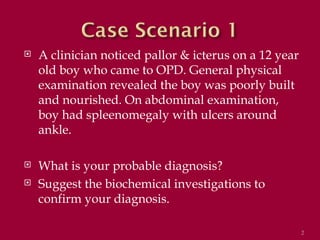
   A clinician noticed pallor & icterus on a 12 year
    old boy who came to OPD. General physical
    examination revealed the boy was poorly built
    and nourished. On abdominal examination,
    boy had spleenomegaly with ulcers around
    ankle.

   What is your probable diagnosis?
   Suggest the biochemical investigations to
    confirm your diagnosis.

                                                        2
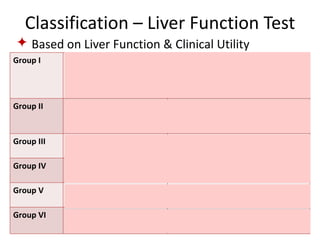
Classification – Liver Function Test
 Based on Liver Function & Clinical Utility
Group I     Markers of liver            Serum bilirubin – Total and
            dysfunction                 Conjugated
                                        Urine – Bile salts, Bile pigments,
                                        Urobilinogen
Group II    Synthetic function          Total protein, Albumin and A/G ratio
                                        Prothrombin time
                                        Serum Cholesterol
Group III   Markers of hepatocellular   Alanine transaminase (ALT)
            injury                      Aspartate transaminase (AST)
Group IV    Markers of obstructive      Alkaline phosphatase
            liver disease               Gamma glutamyl transferase
Group V     Metabolic capacity          Blood ammonia
                                        Galactose tolerance test
Group VI    Excretory & Detoxifying     Bromsulfthalein excretory test
            capacity                    Hippuric acid test                   3
Tests based on
         Excretory capacity of liver
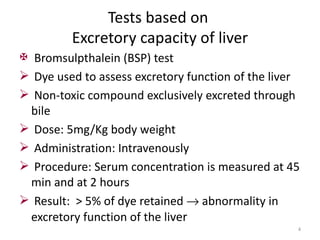
 Bromsulpthalein (BSP) test
 Dye used to assess excretory function of the liver
 Non-toxic compound exclusively excreted through
  bile
 Dose: 5mg/Kg body weight
 Administration: Intravenously
 Procedure: Serum concentration is measured at 45
  min and at 2 hours
 Result: > 5% of dye retained → abnormality in
  excretory function of the liver
                                                   4
Tests based on
            Detoxifying capacity of liver
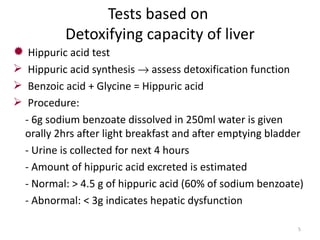
    Hippuric acid test
    Hippuric acid synthesis → assess detoxification function
    Benzoic acid + Glycine = Hippuric acid
    Procedure:
    - 6g sodium benzoate dissolved in 250ml water is given
    orally 2hrs after light breakfast and after emptying bladder
    - Urine is collected for next 4 hours
    - Amount of hippuric acid excreted is estimated
    - Normal: > 4.5 g of hippuric acid (60% of sodium benzoate)
    - Abnormal: < 3g indicates hepatic dysfunction

                                                              5
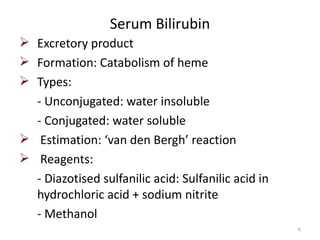
Serum Bilirubin
 Excretory product
 Formation: Catabolism of heme
 Types:
  - Unconjugated: water insoluble
  - Conjugated: water soluble
 Estimation: ‘van den Bergh’ reaction
 Reagents:
  - Diazotised sulfanilic acid: Sulfanilic acid in
  hydrochloric acid + sodium nitrite
  - Methanol
                                                     6
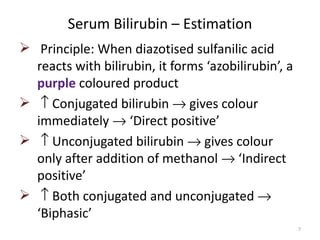
Serum Bilirubin – Estimation
 Principle: When diazotised sulfanilic acid
  reacts with bilirubin, it forms ‘azobilirubin’, a
  purple coloured product
 ↑ Conjugated bilirubin → gives colour
  immediately → ‘Direct positive’
 ↑ Unconjugated bilirubin → gives colour
  only after addition of methanol → ‘Indirect
  positive’
 ↑ Both conjugated and unconjugated →
  ‘Biphasic’
                                                      7
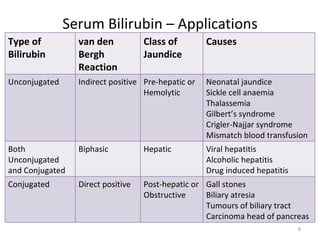
Serum Bilirubin – Applications
Type of          van den           Class of         Causes
Bilirubin        Bergh             Jaundice
                 Reaction
Unconjugated     Indirect positive Pre-hepatic or   Neonatal jaundice
                                   Hemolytic        Sickle cell anaemia
                                                    Thalassemia
                                                    Gilbert’s syndrome
                                                    Crigler-Najjar syndrome
                                                    Mismatch blood transfusion
Both             Biphasic          Hepatic          Viral hepatitis
Unconjugated                                        Alcoholic hepatitis
and Conjugated                                      Drug induced hepatitis
Conjugated       Direct positive   Post-hepatic or Gall stones
                                   Obstructive     Biliary atresia
                                                   Tumours of biliary tract
                                                   Carcinoma head of pancreas
                                                                             8
Urine – Urobilinogen
 Ehrlich’s test
 Principle: Urobilinogen reacts with p-
  dimethylamino-benzaldehyde in chloroform
  to form a pink coloured aldehyde complex.

    Reagents:
    - Ehrlich’s reagent
    - Saturate sodium acetate
    - Chloroform

                                              9
Urine – Urobilinogen
 Procedure:
 5 ml Urine + 5 ml Ehrlich’s reagent → Mix
  and allow to stand for 10 min → + 5 ml
  saturated sodium acetate and mix → + 5 ml
  chloroform → shake vigourously and allow
  layers to separate
 Appearance of pink colour in the chloroform
  layer indicates presence of urobilinogen
 Colour is easily detected when viewed from
  top of the test tube
                                            10
Urine – Bile salts & Bile pigments
 Bile salts: Hay’s test
 Principle: Bile salts have the property of
  lowering surface tension. Hence when sulphur
  poweder is sprinkled to urine containing bile
  salts, it sinks to the bottom.
 Bile pigments: Fouchet’s test
 Principle: Bile pigments adhare to the
  precipitate of barium sulphate. On addition of
  Fouchet’s reagent, ferric chloride in the
  presence of trichloroacetic acid oxidises yellow
  colour bilirubin to green colour biliverdin.
                                                     11
   A 45 year female patient was admitted to
    casualty with the complaints of severe pain in
    the right hypocondriac region, decreased
    appetite and vomiting. She also complained of
    pruritis. General physical examination revealed
    that the female was obese. Per abdomen
    examination showed tenderness in right
    hypochondriac region.
   What is your probable diagnosis?
   Suggest the biochemical investigations to
    confirm your diagnosis.
                                                      12
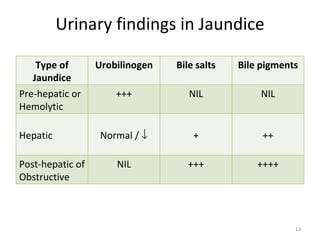
Urinary findings in Jaundice

    Type of       Urobilinogen   Bile salts   Bile pigments
   Jaundice
Pre-hepatic or        +++           NIL           NIL
Hemolytic

Hepatic            Normal / ↓        +             ++

Post-hepatic of       NIL          +++            ++++
Obstructive


                                                          13
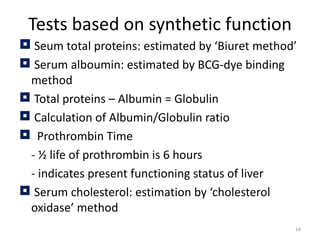
Tests based on synthetic function
 Seum total proteins: estimated by ‘Biuret method’
 Serum alboumin: estimated by BCG-dye binding
 method
 Total proteins – Albumin = Globulin
 Calculation of Albumin/Globulin ratio
 Prothrombin Time
 - ½ life of prothrombin is 6 hours
 - indicates present functioning status of liver
 Serum cholesterol: estimation by ‘cholesterol
 oxidase’ method
                                                  14
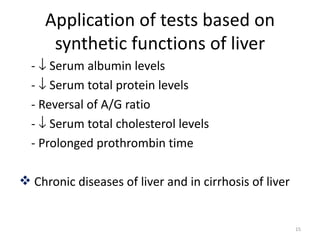
Application of tests based on
      synthetic functions of liver
  - ↓ Serum albumin levels
  - ↓ Serum total protein levels
  - Reversal of A/G ratio
  - ↓ Serum total cholesterol levels
  - Prolonged prothrombin time

 Chronic diseases of liver and in cirrhosis of liver


                                                        15
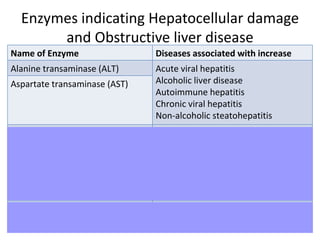
Enzymes indicating Hepatocellular damage
       and Obstructive liver disease
Name of Enzyme                 Diseases associated with increase
Alanine transaminase (ALT)     Acute viral hepatitis
Aspartate transaminase (AST)   Alcoholic liver disease
                               Autoimmune hepatitis
                               Chronic viral hepatitis
                               Non-alcoholic steatohepatitis
Alkaline Phosphatase           Cholestatic jaundice
                               Hepatic carcinoma
                               Gall stones
                               Biliary atresia
                               Tumours of Biliary tract
                               Carcinoma head of the pancreas
Gamma Glutamyl transferase     Chronic alcoholism
5’ Nucleotidase                Biliary obstruction                 16
Tests based on
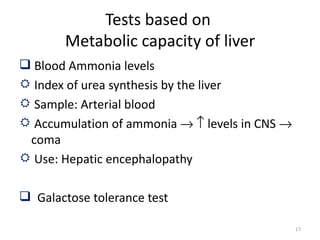
        Metabolic capacity of liver
 Blood Ammonia levels
 Index of urea synthesis by the liver
 Sample: Arterial blood
 Accumulation of ammonia → ↑ levels in CNS →
 coma
 Use: Hepatic encephalopathy

 Galactose tolerance test

                                                17
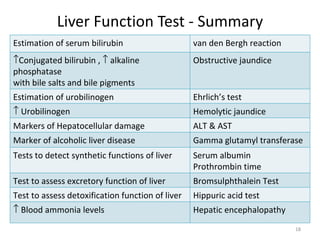
Liver Function Test - Summary
Estimation of serum bilirubin                     van den Bergh reaction
↑Conjugated bilirubin , ↑ alkaline                Obstructive jaundice
phosphatase
with bile salts and bile pigments
Estimation of urobilinogen                        Ehrlich’s test
↑ Urobilinogen                                    Hemolytic jaundice
Markers of Hepatocellular damage                  ALT & AST
Marker of alcoholic liver disease                 Gamma glutamyl transferase
Tests to detect synthetic functions of liver      Serum albumin
                                                  Prothrombin time
Test to assess excretory function of liver        Bromsulphthalein Test
Test to assess detoxification function of liver   Hippuric acid test
↑ Blood ammonia levels                            Hepatic encephalopathy
                                                                           18
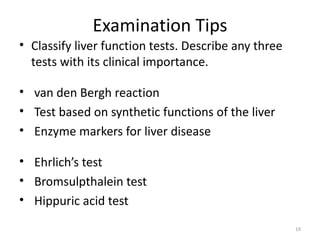
Examination Tips
• Classify liver function tests. Describe any three
  tests with its clinical importance.

• van den Bergh reaction
• Test based on synthetic functions of the liver
• Enzyme markers for liver disease

• Ehrlich’s test
• Bromsulpthalein test
• Hippuric acid test

                                                      19
20

Liver function test

  • 1.
  • 2.
    A clinician noticed pallor & icterus on a 12 year old boy who came to OPD. General physical examination revealed the boy was poorly built and nourished. On abdominal examination, boy had spleenomegaly with ulcers around ankle.  What is your probable diagnosis?  Suggest the biochemical investigations to confirm your diagnosis. 2
  • 3.
    Classification – LiverFunction Test  Based on Liver Function & Clinical Utility Group I Markers of liver Serum bilirubin – Total and dysfunction Conjugated Urine – Bile salts, Bile pigments, Urobilinogen Group II Synthetic function Total protein, Albumin and A/G ratio Prothrombin time Serum Cholesterol Group III Markers of hepatocellular Alanine transaminase (ALT) injury Aspartate transaminase (AST) Group IV Markers of obstructive Alkaline phosphatase liver disease Gamma glutamyl transferase Group V Metabolic capacity Blood ammonia Galactose tolerance test Group VI Excretory & Detoxifying Bromsulfthalein excretory test capacity Hippuric acid test 3
  • 4.
    Tests based on Excretory capacity of liver  Bromsulpthalein (BSP) test  Dye used to assess excretory function of the liver  Non-toxic compound exclusively excreted through bile  Dose: 5mg/Kg body weight  Administration: Intravenously  Procedure: Serum concentration is measured at 45 min and at 2 hours  Result: > 5% of dye retained → abnormality in excretory function of the liver 4
  • 5.
    Tests based on Detoxifying capacity of liver  Hippuric acid test  Hippuric acid synthesis → assess detoxification function  Benzoic acid + Glycine = Hippuric acid  Procedure: - 6g sodium benzoate dissolved in 250ml water is given orally 2hrs after light breakfast and after emptying bladder - Urine is collected for next 4 hours - Amount of hippuric acid excreted is estimated - Normal: > 4.5 g of hippuric acid (60% of sodium benzoate) - Abnormal: < 3g indicates hepatic dysfunction 5
  • 6.
    Serum Bilirubin  Excretoryproduct  Formation: Catabolism of heme  Types: - Unconjugated: water insoluble - Conjugated: water soluble  Estimation: ‘van den Bergh’ reaction  Reagents: - Diazotised sulfanilic acid: Sulfanilic acid in hydrochloric acid + sodium nitrite - Methanol 6
  • 7.
    Serum Bilirubin –Estimation  Principle: When diazotised sulfanilic acid reacts with bilirubin, it forms ‘azobilirubin’, a purple coloured product  ↑ Conjugated bilirubin → gives colour immediately → ‘Direct positive’  ↑ Unconjugated bilirubin → gives colour only after addition of methanol → ‘Indirect positive’  ↑ Both conjugated and unconjugated → ‘Biphasic’ 7
  • 8.
    Serum Bilirubin –Applications Type of van den Class of Causes Bilirubin Bergh Jaundice Reaction Unconjugated Indirect positive Pre-hepatic or Neonatal jaundice Hemolytic Sickle cell anaemia Thalassemia Gilbert’s syndrome Crigler-Najjar syndrome Mismatch blood transfusion Both Biphasic Hepatic Viral hepatitis Unconjugated Alcoholic hepatitis and Conjugated Drug induced hepatitis Conjugated Direct positive Post-hepatic or Gall stones Obstructive Biliary atresia Tumours of biliary tract Carcinoma head of pancreas 8
  • 9.
    Urine – Urobilinogen Ehrlich’s test  Principle: Urobilinogen reacts with p- dimethylamino-benzaldehyde in chloroform to form a pink coloured aldehyde complex.  Reagents: - Ehrlich’s reagent - Saturate sodium acetate - Chloroform 9
  • 10.
    Urine – Urobilinogen Procedure:  5 ml Urine + 5 ml Ehrlich’s reagent → Mix and allow to stand for 10 min → + 5 ml saturated sodium acetate and mix → + 5 ml chloroform → shake vigourously and allow layers to separate  Appearance of pink colour in the chloroform layer indicates presence of urobilinogen  Colour is easily detected when viewed from top of the test tube 10
  • 11.
    Urine – Bilesalts & Bile pigments  Bile salts: Hay’s test  Principle: Bile salts have the property of lowering surface tension. Hence when sulphur poweder is sprinkled to urine containing bile salts, it sinks to the bottom.  Bile pigments: Fouchet’s test  Principle: Bile pigments adhare to the precipitate of barium sulphate. On addition of Fouchet’s reagent, ferric chloride in the presence of trichloroacetic acid oxidises yellow colour bilirubin to green colour biliverdin. 11
  • 12.
    A 45 year female patient was admitted to casualty with the complaints of severe pain in the right hypocondriac region, decreased appetite and vomiting. She also complained of pruritis. General physical examination revealed that the female was obese. Per abdomen examination showed tenderness in right hypochondriac region.  What is your probable diagnosis?  Suggest the biochemical investigations to confirm your diagnosis. 12
  • 13.
    Urinary findings inJaundice Type of Urobilinogen Bile salts Bile pigments Jaundice Pre-hepatic or +++ NIL NIL Hemolytic Hepatic Normal / ↓ + ++ Post-hepatic of NIL +++ ++++ Obstructive 13
  • 14.
    Tests based onsynthetic function  Seum total proteins: estimated by ‘Biuret method’  Serum alboumin: estimated by BCG-dye binding method  Total proteins – Albumin = Globulin  Calculation of Albumin/Globulin ratio  Prothrombin Time - ½ life of prothrombin is 6 hours - indicates present functioning status of liver  Serum cholesterol: estimation by ‘cholesterol oxidase’ method 14
  • 15.
    Application of testsbased on synthetic functions of liver - ↓ Serum albumin levels - ↓ Serum total protein levels - Reversal of A/G ratio - ↓ Serum total cholesterol levels - Prolonged prothrombin time  Chronic diseases of liver and in cirrhosis of liver 15
  • 16.
    Enzymes indicating Hepatocellulardamage and Obstructive liver disease Name of Enzyme Diseases associated with increase Alanine transaminase (ALT) Acute viral hepatitis Aspartate transaminase (AST) Alcoholic liver disease Autoimmune hepatitis Chronic viral hepatitis Non-alcoholic steatohepatitis Alkaline Phosphatase Cholestatic jaundice Hepatic carcinoma Gall stones Biliary atresia Tumours of Biliary tract Carcinoma head of the pancreas Gamma Glutamyl transferase Chronic alcoholism 5’ Nucleotidase Biliary obstruction 16
  • 17.
    Tests based on Metabolic capacity of liver  Blood Ammonia levels  Index of urea synthesis by the liver  Sample: Arterial blood  Accumulation of ammonia → ↑ levels in CNS → coma  Use: Hepatic encephalopathy  Galactose tolerance test 17
  • 18.
    Liver Function Test- Summary Estimation of serum bilirubin van den Bergh reaction ↑Conjugated bilirubin , ↑ alkaline Obstructive jaundice phosphatase with bile salts and bile pigments Estimation of urobilinogen Ehrlich’s test ↑ Urobilinogen Hemolytic jaundice Markers of Hepatocellular damage ALT & AST Marker of alcoholic liver disease Gamma glutamyl transferase Tests to detect synthetic functions of liver Serum albumin Prothrombin time Test to assess excretory function of liver Bromsulphthalein Test Test to assess detoxification function of liver Hippuric acid test ↑ Blood ammonia levels Hepatic encephalopathy 18
  • 19.
    Examination Tips • Classifyliver function tests. Describe any three tests with its clinical importance. • van den Bergh reaction • Test based on synthetic functions of the liver • Enzyme markers for liver disease • Ehrlich’s test • Bromsulpthalein test • Hippuric acid test 19
  • 20.