Alcoholic Hepatitis Dr E M Said Gastroenterology Ward 11
Background Spectrum of ALD Alcoholic Hepatitis Presentation Investigation Prognosis management
background major cause of morbidity and mortality in the West Per capita consumption has doubled between 1980-1995  Even though per capita consumption has plateaued in 1990s, recent surveys suggest drinking among females and the young continues to rise Alcohol consumption in the UK accounts for:  40,000 premature deaths per year  1.3% of GP consultations  12.5% of A&E attendances  25% of ICU admissions  30% of male and 15% of female admissions to general medical and surgical wards
background CMO's report 2001 stated a significant increase in liver cirrhosis and mortality rate in England and Wales (four- to eight-fold increase in males, three- to seven-fold increase females)  Alcoholic cirrhosis mortality rate:  11/100,000 males  6/100,000 females Alcohol accounts for 50% of chronic liver disease  Economic cost: £10 billion per year
Metabolism of Alcohol Alcohol metabolism by the liver result in increase in the NADH/NAD ratio & change in the oxidation-reduction status with reduced intracelluar state.this lead to: 1-Increase hepatic fatty acid production 2-Impaired carbohydrate and protein metabolism 3-Centrilobular necrosis of the hepatic acinus The exact mechanism of alcohol hepatitis and cirrhosis is unknown.
 
Spectrum of alcoholic liver disease   The three most widely recognised forms of ALD are : alcoholic fatty liver (steatosis). acute alcoholic hepatitis. alcoholic cirrhosis.
 
alcoholic fatty liver (steatosis ) appears to be the initial change and is the most common response to alcohol ingestion The increased liver fat is derived from the diet, from free fatty acids mobilized from adipose tissue, and from lipid synthesized in the liver and inadequately degraded or excreted may cause mild abnormalities of liver function tests, including elevated ALT  patients have an excellent prognosis if they abstain from alcohol.
 
alcoholic hepatitis It is characterized by necrosis of hepatocytes, and deposition of Mallory hyaline bodies.  A polymorphonuclear reaction develops locally in response to the Mallory-containing and necrotic liver cells. typically presents with jaundice, low grade fever, and tender hepatomegaly   Alcoholic hepatitis is often viewed as the intermediary step between fatty liver and cirrhosis
alcoholic cirrhosis represents end-stage disease Classically of micronodular type develop in 10 to 20% of those who are chronically heavy drinkers. Although irreversible, patients may live many years with few obvious effects particularly with cessation of drinking   Decompensation of cirrhosis triggered by sepsis, bleeding, continued excessive drinking
 
It is estimated ,that although 90-100% of heavy drinkers show evidence of fatty liver, only 10-35% develop alcoholic hepatitis and 8-20% develop cirrhosis
Mechanisms of liver injury in Alcoholic hepatitis Genetic factors  Malnutrition Toxic effects on cell membranes  Hypermetabolic state of the hepatocyte  Generation of free radicals and oxidative injury  Formation of acetaldehyde adducts  Role of the immune system Cytokines Role of concomitant viral disease
presentation
INVESTIGATIONS Laboratory findings  Ultrasonography Liver biopsy
laboratory findings in alcoholic hepatitis Liver Function tests  Increased AST to ALT ratio (2 to 1) (below 400IU/L) ALT usually < 100 IU/L Increased Gamma-GT (variable)  Increased alkaline phosphatase (variable) Note: AST has 50% sensitivity, 82% specificity for alcohol-induced liver injury. ALT has 35% sensitivity, 86% specificity for alcohol-induced liver injury.  Liver synthetic function (decrease after significant liver injury)  INR  Albumin
laboratory findings in alcoholic hepatitis Renal function (impaired in advanced ALD)  Urea/ creatinine Haematological  Mild anaemia (usually macrocytic)  Thrombocytopenia Other abnormalities  Hyperuricaemia  Hypertriglyceridaemia  Raised IgA  Hyperglycaemia
Exclusion of other causes of liver disease: Alpha-1 antitrypsin genotype Serum caeruloplasmin/ serum copper Iron studies Autoantibodies (including LKM (Liver kidney microsomal)/ AMA (anti-mitochondrial)/ ANCA (anti-nuclear)) Immunoglobulins/ complement Hepatitis serology (HBsAg/HbCAb/HCVAb)
Ultrasonography Preferred study as inexpensive ,noninvasive and widely available The liver appears enlarged and diffusely hyperechoic. Helpful in excluding gallstones ,bile duct obstruction and hepatic or biliary neoplasm.
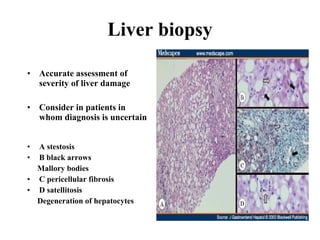
Liver biopsy Accurate assessment of severity of liver damage Consider in patients in whom diagnosis is uncertain A stestosis B black arrows  Mallory bodies C pericellular fibrosis D satellitosis Degeneration of hepatocytes
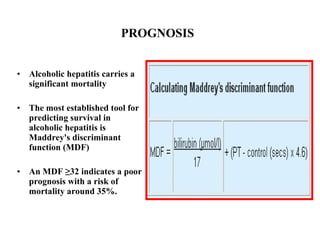
PROGNOSIS   Alcoholic hepatitis carries a significant mortality The most established tool for predicting survival in alcoholic hepatitis is Maddrey's discriminant function (MDF) An MDF ≥32 indicates a poor prognosis with a risk of mortality around 35%.
PROGNOSIS   Others factors that correlate with poor prognosis include : older age,  impaired renal function,  encephalopathy,  rise in the white blood cell count in the first 2 weeks of hospitalization Nearly 2/3 of patients with severe alcoholic hepatitis will die in the hospital
management General measures: Stop drinking Treat withdrawal symptoms Thiamine/multivitamins Bed rest High protein diet Treat decompansaton
THERAPY Evidence support use of: 1-corticosteroids 2-pentoxifylline 3-nutritional support Insufficient evidence: 1-Anabolic steroids 2-Malotilate 3-Etanercept 4-Infliximab Therapeutic agents for alcoholic hepatitis: Evidence not supporting use: 1-Propylthiouracil  2-Insulin and glucagon 3-Colchicine
Corticosteroids  Steroid effects are mediated through a decrease in immune mediated injury, inhibition of cytokine production and activation, as well as suppression of extracellular matrix protein expression.  should not be started until a sepsis screen has excluded infection Meta-analysis of three randomised trials showed an improvement in 28 day survival, but benefit was not seen at later time points The side effects of corticosteroids are justified only in patients with severe alcoholic hepatitis (MDF >32).
Randomized, controlled trials using prednisolone 40 mg/d (or an equivalent) for 28 days have shown an increase in both short-term (30 and 60 day) and long-term (1 year) survival in a subgroup of patients with severe alcoholic hepatitis
Pentoxifylline  Pentoxifylline inhibits tumor necrosis factor (TNF)-  production.  showed promise in one randomised controlled trial of patients with an MDF ≥32 who were not treated by steroids  associated with a marked reduction in the incidence of hepatorenal syndrome and improved 28 day mortality with no significant side effects  No trial has assessed combination therapy with steroids and pentoxifylline
A recent randomized, controlled study in severe alcoholic hepatitis used pentoxifylline 400mg thrice daily (mean duration, 21 days), to show a short-term survival benefit of 22% (absolute risk reduction)
Nutritional support Energy expenditure increased up to 60% in AH  Severe negative nitrogen balance occurs in AH  Nutritional status correlates with survival in moderate and severe AH  1-1.5g/Kg/day protein is required to achieve neutral balance in cirrhotics. This requirement increases significantly in AH  Total enteral nutrition is recommended in patients admitted with AH. Studies have shown a decreased mortality rate in patients receiving enteral feeding.  Oral supplementation is ineffective due to anorexia and poor compliance due to encephalopathy and insufficient protein-calorie content to meet metabolic demands
In summary… Common condition, high mortality Diagnosis :history of alcohol intake, physical finings,imaging,lab results and exclusion of other conditions Treatment:steroids,after exclusion of sepsis,pentoxifylline and nutrition support.
 
Thank you Questions?

Alcoholic Hepatitis

  • 1.
    Alcoholic Hepatitis DrE M Said Gastroenterology Ward 11
  • 2.
    Background Spectrum ofALD Alcoholic Hepatitis Presentation Investigation Prognosis management
  • 3.
    background major causeof morbidity and mortality in the West Per capita consumption has doubled between 1980-1995 Even though per capita consumption has plateaued in 1990s, recent surveys suggest drinking among females and the young continues to rise Alcohol consumption in the UK accounts for: 40,000 premature deaths per year 1.3% of GP consultations 12.5% of A&E attendances 25% of ICU admissions 30% of male and 15% of female admissions to general medical and surgical wards
  • 4.
    background CMO's report2001 stated a significant increase in liver cirrhosis and mortality rate in England and Wales (four- to eight-fold increase in males, three- to seven-fold increase females) Alcoholic cirrhosis mortality rate: 11/100,000 males 6/100,000 females Alcohol accounts for 50% of chronic liver disease Economic cost: £10 billion per year
  • 5.
    Metabolism of AlcoholAlcohol metabolism by the liver result in increase in the NADH/NAD ratio & change in the oxidation-reduction status with reduced intracelluar state.this lead to: 1-Increase hepatic fatty acid production 2-Impaired carbohydrate and protein metabolism 3-Centrilobular necrosis of the hepatic acinus The exact mechanism of alcohol hepatitis and cirrhosis is unknown.
  • 6.
  • 7.
    Spectrum of alcoholicliver disease The three most widely recognised forms of ALD are : alcoholic fatty liver (steatosis). acute alcoholic hepatitis. alcoholic cirrhosis.
  • 8.
  • 9.
    alcoholic fatty liver(steatosis ) appears to be the initial change and is the most common response to alcohol ingestion The increased liver fat is derived from the diet, from free fatty acids mobilized from adipose tissue, and from lipid synthesized in the liver and inadequately degraded or excreted may cause mild abnormalities of liver function tests, including elevated ALT patients have an excellent prognosis if they abstain from alcohol.
  • 10.
  • 11.
    alcoholic hepatitis Itis characterized by necrosis of hepatocytes, and deposition of Mallory hyaline bodies. A polymorphonuclear reaction develops locally in response to the Mallory-containing and necrotic liver cells. typically presents with jaundice, low grade fever, and tender hepatomegaly Alcoholic hepatitis is often viewed as the intermediary step between fatty liver and cirrhosis
  • 12.
    alcoholic cirrhosis representsend-stage disease Classically of micronodular type develop in 10 to 20% of those who are chronically heavy drinkers. Although irreversible, patients may live many years with few obvious effects particularly with cessation of drinking Decompensation of cirrhosis triggered by sepsis, bleeding, continued excessive drinking
  • 13.
  • 14.
    It is estimated,that although 90-100% of heavy drinkers show evidence of fatty liver, only 10-35% develop alcoholic hepatitis and 8-20% develop cirrhosis
  • 15.
    Mechanisms of liverinjury in Alcoholic hepatitis Genetic factors Malnutrition Toxic effects on cell membranes Hypermetabolic state of the hepatocyte Generation of free radicals and oxidative injury Formation of acetaldehyde adducts Role of the immune system Cytokines Role of concomitant viral disease
  • 16.
  • 17.
    INVESTIGATIONS Laboratory findings Ultrasonography Liver biopsy
  • 18.
    laboratory findings inalcoholic hepatitis Liver Function tests Increased AST to ALT ratio (2 to 1) (below 400IU/L) ALT usually < 100 IU/L Increased Gamma-GT (variable) Increased alkaline phosphatase (variable) Note: AST has 50% sensitivity, 82% specificity for alcohol-induced liver injury. ALT has 35% sensitivity, 86% specificity for alcohol-induced liver injury. Liver synthetic function (decrease after significant liver injury) INR Albumin
  • 19.
    laboratory findings inalcoholic hepatitis Renal function (impaired in advanced ALD) Urea/ creatinine Haematological Mild anaemia (usually macrocytic) Thrombocytopenia Other abnormalities Hyperuricaemia Hypertriglyceridaemia Raised IgA Hyperglycaemia
  • 20.
    Exclusion of othercauses of liver disease: Alpha-1 antitrypsin genotype Serum caeruloplasmin/ serum copper Iron studies Autoantibodies (including LKM (Liver kidney microsomal)/ AMA (anti-mitochondrial)/ ANCA (anti-nuclear)) Immunoglobulins/ complement Hepatitis serology (HBsAg/HbCAb/HCVAb)
  • 21.
    Ultrasonography Preferred studyas inexpensive ,noninvasive and widely available The liver appears enlarged and diffusely hyperechoic. Helpful in excluding gallstones ,bile duct obstruction and hepatic or biliary neoplasm.
  • 22.
    Liver biopsy Accurateassessment of severity of liver damage Consider in patients in whom diagnosis is uncertain A stestosis B black arrows Mallory bodies C pericellular fibrosis D satellitosis Degeneration of hepatocytes
  • 23.
    PROGNOSIS Alcoholic hepatitis carries a significant mortality The most established tool for predicting survival in alcoholic hepatitis is Maddrey's discriminant function (MDF) An MDF ≥32 indicates a poor prognosis with a risk of mortality around 35%.
  • 24.
    PROGNOSIS Others factors that correlate with poor prognosis include : older age, impaired renal function, encephalopathy, rise in the white blood cell count in the first 2 weeks of hospitalization Nearly 2/3 of patients with severe alcoholic hepatitis will die in the hospital
  • 25.
    management General measures:Stop drinking Treat withdrawal symptoms Thiamine/multivitamins Bed rest High protein diet Treat decompansaton
  • 26.
    THERAPY Evidence supportuse of: 1-corticosteroids 2-pentoxifylline 3-nutritional support Insufficient evidence: 1-Anabolic steroids 2-Malotilate 3-Etanercept 4-Infliximab Therapeutic agents for alcoholic hepatitis: Evidence not supporting use: 1-Propylthiouracil 2-Insulin and glucagon 3-Colchicine
  • 27.
    Corticosteroids Steroideffects are mediated through a decrease in immune mediated injury, inhibition of cytokine production and activation, as well as suppression of extracellular matrix protein expression. should not be started until a sepsis screen has excluded infection Meta-analysis of three randomised trials showed an improvement in 28 day survival, but benefit was not seen at later time points The side effects of corticosteroids are justified only in patients with severe alcoholic hepatitis (MDF >32).
  • 28.
    Randomized, controlled trialsusing prednisolone 40 mg/d (or an equivalent) for 28 days have shown an increase in both short-term (30 and 60 day) and long-term (1 year) survival in a subgroup of patients with severe alcoholic hepatitis
  • 29.
    Pentoxifylline Pentoxifyllineinhibits tumor necrosis factor (TNF)- production. showed promise in one randomised controlled trial of patients with an MDF ≥32 who were not treated by steroids associated with a marked reduction in the incidence of hepatorenal syndrome and improved 28 day mortality with no significant side effects No trial has assessed combination therapy with steroids and pentoxifylline
  • 30.
    A recent randomized,controlled study in severe alcoholic hepatitis used pentoxifylline 400mg thrice daily (mean duration, 21 days), to show a short-term survival benefit of 22% (absolute risk reduction)
  • 31.
    Nutritional support Energyexpenditure increased up to 60% in AH Severe negative nitrogen balance occurs in AH Nutritional status correlates with survival in moderate and severe AH 1-1.5g/Kg/day protein is required to achieve neutral balance in cirrhotics. This requirement increases significantly in AH Total enteral nutrition is recommended in patients admitted with AH. Studies have shown a decreased mortality rate in patients receiving enteral feeding. Oral supplementation is ineffective due to anorexia and poor compliance due to encephalopathy and insufficient protein-calorie content to meet metabolic demands
  • 32.
    In summary… Commoncondition, high mortality Diagnosis :history of alcohol intake, physical finings,imaging,lab results and exclusion of other conditions Treatment:steroids,after exclusion of sepsis,pentoxifylline and nutrition support.
  • 33.
  • 34.