DCM & Surgery Msambweni
By Charles Ng’ang’a
Liver function tests
• Liver function tests (LFTs or LFs) are
– groups of blood tests that give
– information about the state of a patient's liver.
– These tests include prothrombin
– time (PT/INR), aPTT, albumin, bilirubin
– (direct and indirect), and others.
General approach
• Cholestatic—intrahepatic/extrahepatic biliary obstruction
• Hepatocellular—hepatocyte damage (e.g. viral hepatitis,
drugs/toxins, ETOH, ischemia, malignant infiltration)
• Isolated hyperbilirubinemia—e.g. congestive hepatopathy
Pt with hx of intermittent abdominal pain associated with meals
undergoes RUQ (Right upper Quadrant)
Liver function tests
Tests that measure Biosynthetic function of liver
Liver function tests
• The liver
– transaminases aspartate transaminase
– (AST or SGOT) and alanine transaminase
– (ALT or SGPT) are useful biomarkers of
– liver injury in a patient with some degree
– of intact liver function.[2][3][4] Most liver
– diseases cause only mild symptoms
Liver function tests
• initially, but these diseases must be
• detected early. Hepatic (liver)
• involvement in some diseases can be of
• crucial importance. This testing is
• performed on a patient's blood sample.
• Some tests are associated with
• functionality
Major Metabolic Functions of the Liver
• Synthetic Function
– Plasma proteins (albumin, globulins), cholesterol, triglycerides and
lipoproteins
• Detoxification and excretion
– Ammonia to urea (urea cycle), bilirubin, cholesterol, drug metabolites
• Storage Function
– Vitamins A, D, E, K and B12
• Production of bile salts
– Helps in digestion
Some example of liver dysfunction
• Hepatocellular disease
• Cholestasis (obstruction of bile flow)
• Cirrhosis
• Hepatitis
• Jaundice
• Liver cancer
• Steatosis (fatty liver)
• Genetic Disorders
– Hemochromatosis (iron storage)
Liver Function Tests (LFTs)
• Noninvasive methods for screening of liver dysfunction
• Help in identifying general types of disorder
• Assess severity and allow prediction of outcome
• Disease and treatment follow up
Liver Function Tests (LFTs)
Broadly classified as:
1.Tests to detect hepatic injury:
• Mild or severe; acute or chronic
• Nature of liver injury (hepatocellular or cholestasis)
2.Tests to assess hepatic function
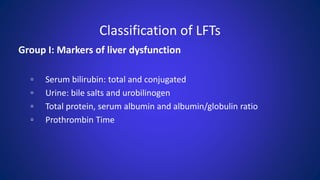
Classification of LFTs
Group I: Markers of liver dysfunction
▫ Serum bilirubin: total and conjugated
▫ Urine: bile salts and urobilinogen
▫ Total protein, serum albumin and albumin/globulin ratio
▫ Prothrombin Time
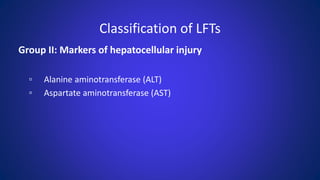
Classification of LFTs
Group II: Markers of hepatocellular injury
▫ Alanine aminotransferase (ALT)
▫ Aspartate aminotransferase (AST)
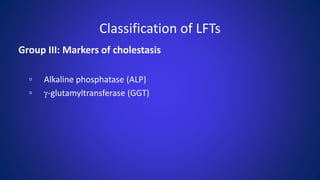
Classification of LFTs
Group III: Markers of cholestasis
▫ Alkaline phosphatase (ALP)
▫ g-glutamyltransferase (GGT)
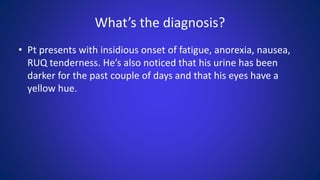
What’s the diagnosis?
• Pt presents with insidious onset of fatigue, anorexia, nausea,
RUQ tenderness. He’s also noticed that his urine has been
darker for the past couple of days and that his eyes have a
yellow hue.
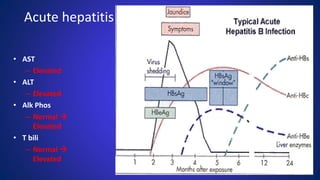
Acute hepatitis
• AST
– Elevated
• ALT
– Elevated
• Alk Phos
– Normal 
Elevated
• T bili
– Normal 
Elevated
http://www.atsu.edu/faculty/chamberlain/Website/lectures/lecture/hepatit2.htm
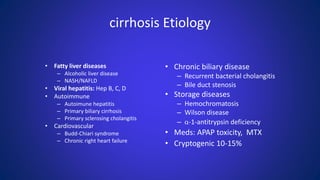
• Fatty liver diseases
– Alcoholic liver disease
– NASH/NAFLD
• Viral hepatitis: Hep B, C, D
• Autoimmune
– Autoimune hepatitis
– Primary biliary cirrhosis
– Primary sclerosing cholangitis
• Cardiovascular
– Budd-Chiari syndrome
– Chronic right heart failure
cirrhosis Etiology
• Chronic biliary disease
– Recurrent bacterial cholangitis
– Bile duct stenosis
• Storage diseases
– Hemochromatosis
– Wilson disease
– α-1-antitrypsin deficiency
• Meds: APAP toxicity, MTX
• Cryptogenic 10-15%
• Fatty liver diseases
– Alcoholic liver disease
– NASH/NAFLD
• Viral hepatitis: Hep B, C, D
• Autoimmune
– Autoimune hepatitis
– Primary biliary cirrhosis
– Primary sclerosing cholangitis
• Cardiovascular
– Budd-Chiari syndrome
– Chronic right heart failure
cirrhosis Etiology
• Chronic biliary disease
– Recurrent bacterial cholangitis
– Bile duct stenosis
• Storage diseases
– Hemochromatosis
– Wilson disease
– α-1-antitrypsin deficiency
• Meds: APAP toxicity, MTX
• Cryptogenic 10-15%
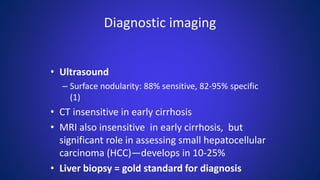
Diagnostic imaging
• Ultrasound
– Surface nodularity: 88% sensitive, 82-95% specific
(1)
• CT insensitive in early cirrhosis
• MRI also insensitive in early cirrhosis, but
significant role in assessing small hepatocellular
carcinoma (HCC)—develops in 10-25%
• Liver biopsy = gold standard for diagnosis
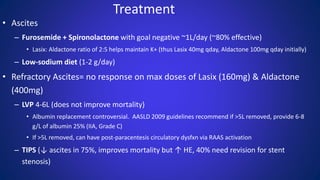
Treatment
• Ascites
– Furosemide + Spironolactone with goal negative ~1L/day (~80% effective)
• Lasix: Aldactone ratio of 2:5 helps maintain K+ (thus Lasix 40mg qday, Aldactone 100mg qday initially)
– Low-sodium diet (1-2 g/day)
• Refractory Ascites= no response on max doses of Lasix (160mg) & Aldactone
(400mg)
– LVP 4-6L (does not improve mortality)
• Albumin replacement controversial. AASLD 2009 guidelines recommend if >5L removed, provide 6-8
g/L of albumin 25% (IIA, Grade C)
• If >5L removed, can have post-paracentesis circulatory dysfxn via RAAS activation
– TIPS (↓ ascites in 75%, improves mortality but ↑ HE, 40% need revision for stent
stenosis)
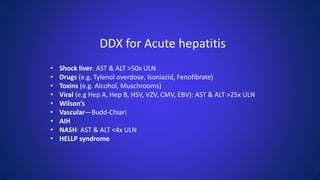
DDX for Acute hepatitis
• Shock liver: AST & ALT >50x ULN
• Drugs (e.g. Tylenol overdose, Isoniazid, Fenofibrate)
• Toxins (e.g. Alcohol, Muschrooms)
• Viral (e.g Hep A, Hep B, HSV, VZV, CMV, EBV): AST & ALT >25x ULN
• Wilson’s
• Vascular—Budd-Chiari
• AIH
• NASH: AST & ALT <4x ULN
• HELLP syndrome
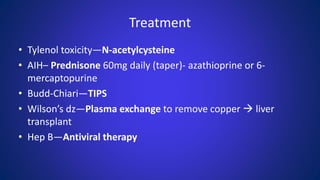
Treatment
• Tylenol toxicity—N-acetylcysteine
• AIH– Prednisone 60mg daily (taper)- azathioprine or 6-
mercaptopurine
• Budd-Chiari—TIPS
• Wilson’s dz—Plasma exchange to remove copper  liver
transplant
• Hep B—Antiviral therapy
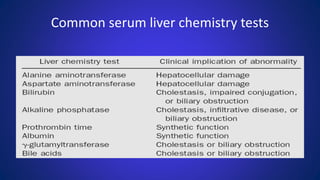
Common serum liver chemistry tests
Liver function tests
• (e.g., albumin), some with
• cellular integrity (e.g., transaminase), and
• some with conditions linked to the biliary
• tract (gamma-glutamyl transferase and
• alkaline phosphatase).
• Several
• biochemical tests are useful in the
• evaluation and management of patients
• with hepatic dysfunction. These tests
• can be used to detect the presence of
• liver disease, distinguish among different
• types of liver disorders, gauge the extent
• of known liver damage, and follow the
• response to treatment.
Liver function tests
• Some or all of
• these measurements are also carried out
• (usually about twice a year for routine
• cases) on those individuals taking
• certain medications, such as
• anticonvulsants, to ensure the
• medications are not damaging the
• person's liver.
Liver function tests
• Although example reference ranges are
• given, these will vary depending on age,
• gender and his/her health, ethnicity,
• method of analysis, and units of
• measurement. Individual results should
• always be interpreted using the reference
• range provided by the laboratory that
• performed the test.
Liver function tests-Standard liver panel
Total bilirubin
• Reference range in adults
• Parameters/units Total bilirubin Unconjugated bilirubin
Conjugated bilirubin
• mg/dL 0.1–1.0[5] 0.2-0.7[5] 0.1–0.4[5]
• μmol/l 2.0 to 21[6] < 12[6] < 8[6]
• Measurement of total bilirubin includes
• both unconjugated (indirect) and
• conjugated (direct) bilirubin.
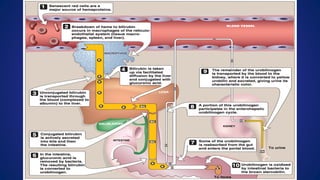
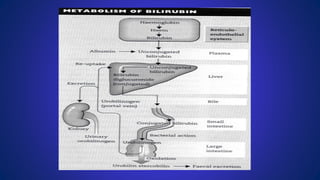
• Unconjugated bilirubin is a breakdown
• product of heme (a part of hemoglobin in
• red blood cells). The liver is responsible
• for clearing the blood of unconjugated
• bilirubin, by 'conjugating' it (modified to
• make it water-soluble) through an
• enzyme named UDP-glucuronyltransferase.
Total bilirubin
• When the total bilirubin level
• exceeds 17 μmol/l, it indicates liver
• disease. When total bilirubin level
• exceeds 40 μmol/l, bilirubin deposition at
• the sclera, skin, and mucous membranes
• will give these areas yellow colour, thus it
• is called jaundice
• The increase in predominantly
• unconjugated bilirubin is due to
• overproducion, reduced hepatic uptake of
• the unconjugated bilirubin and reduced
• conjugation of bilirubin. Overproduction
• can be due to reabsorption of
• haematoma and ineffective
• erythropoiesis that increased red blood
• cell destruction. Gilbert's syndrome and
• Crigler–Najjar syndrome have defects in
• UDP glucuronyl transferase defect,
• affecting bilirubin conjugation
• The degree of rise in conjugated bilirubin
• is directly proportional to the degree of
• hepatocyte injury. Viral hepatitis can also
• cause the rise in conjugated bilirubin.
• In parenchymal liver disease and
• incomplete extrahepatic obstruction, the rise in conjugated
bilirubin is less than the complete common bile duct
• obstruction due to malignant causes. In
• Dubin–Johnson syndrome, a mutation in
• multiple drug-resistance protein 2
• (MRP2) causes a rise in conjugated
• bilirubin
• In acute appendicitis, total bilirubin can
• rise from 20.52 μmol/l to 143 μmol/l. In
• pregnant women, the total bilirubin level
• is low in all three trimesters.[6]
• The measurement of bilirubin levels in
• the newborns is done through the use of
• bilimeter or transcutanoeus
• bilirubinometer instead of performing
• LFTs. When the total serum bilirubin
• increases over 95th percentile for age
• during the first week of life for high risk
• babies, it is known as hyperbilirubinemia
• of the newborn (neonatal jaundice) and
• requires light therapy to reduce the
• amount of bilirubin in the blood.
• Pathological jaundice in newbornsshould be suspected when
the serum bilirubin level rises by more than 5 mg/dL
• per day, serum bilirubin more than the
• physiological range, clinical jaundice
• more than 2 weeks, and conjugated
• bilirubin (dark urine staining clothes).
• Haemolytic jaundice is the commonest
• cause of pathological jaundice.
• Those
• babies with Rh hemolytic disease, ABO
• incompatibility with the mother, Glucose-
• 6-phosphate dehydrogenase (G-6-PD)
• deficiency and minor blood group
• incompatibility are at increased risk of
• getting haemolytic jaundice
Alanine transaminase (ALT)
• Apart from being found in high concentrations in liver, ALT is
found in kidneys, heart, and muscles. It catalyses the
transamination reaction, and only exists in cytoplasmic form.
Any kind of liver injury can cause the rise in ALT. A rise up to
300 IU/L is not specific to liver,
• but can be due to the damage of other
• organs such as kidneys or muscles.
• When ALT rises to more than 500 IU/L,
• causes are usually from the liver
Aspartate aminotransferase (AST)
• Normal range: 8 – 20 U/L
• A marker of hepatocellular damage
• High serum levels are observed in:
– Chronic hepatitis, cirrhosis and liver cancer
Alanine aminotransferase (ALT)
• More liver-specific than AST
• Normal range (U/L):
▫ Male: 13-35
▫ Female: 10-30
• High serum levels in acute hepatitis (300-1000U/L)
• Moderate elevation in alcoholic hepatitis (100-300U/L)
• Minor elevation in cirrhosis, hepatitis C and non-alcoholic
steatohepatitis (NASH) (50-100U/L)
Alanine aminotransferase (ALT)
• Appears in plasma many days before clinical signs appear
• A normal value does not always indicate absence of liver
damage
• Obese but otherwise normal individuals may have elevated ALT
levels
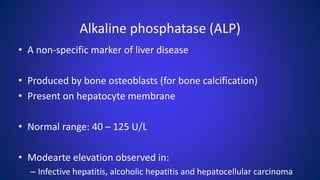
Alkaline phosphatase (ALP)
• A non-specific marker of liver disease
• Produced by bone osteoblasts (for bone calcification)
• Present on hepatocyte membrane
• Normal range: 40 – 125 U/L
• Modearte elevation observed in:
– Infective hepatitis, alcoholic hepatitis and hepatocellular carcinoma
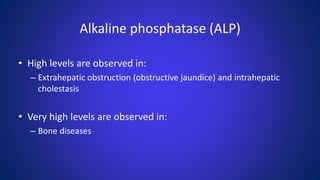
Alkaline phosphatase (ALP)
• High levels are observed in:
– Extrahepatic obstruction (obstructive jaundice) and intrahepatic
cholestasis
• Very high levels are observed in:
– Bone diseases
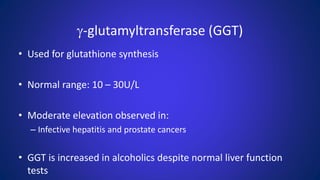
g-glutamyltransferase (GGT)
• Used for glutathione synthesis
• Normal range: 10 – 30U/L
• Moderate elevation observed in:
– Infective hepatitis and prostate cancers
• GGT is increased in alcoholics despite normal liver function
tests
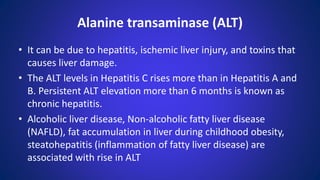
• It can be due to hepatitis, ischemic liver injury, and toxins that
causes liver damage.
• The ALT levels in Hepatitis C rises more than in Hepatitis A and
B. Persistent ALT elevation more than 6 months is known as
chronic hepatitis.
• Alcoholic liver disease, Non-alcoholic fatty liver disease
(NAFLD), fat accumulation in liver during childhood obesity,
steatohepatitis (inflammation of fatty liver disease) are
associated with rise in ALT
Alanine transaminase (ALT)
• Rise in ALT is
• also associated with reduced insulin
• response, reduced glucose tolerance, and
• increased free fatty acids and
• triglycerides. Bright liver syndrome
• (bright liver on ultrasound suggestive of
• fatty liver) with raised ALT is suggestive
• of metabolic syndrome
Alanine transaminase (ALT)
• In pregnancy, ALT levels would rise during second trimester. In
one of the studies, measured ALT levels in pregnancy-related
conditions such as
• hyperemesis gravidarum was 103.5 IU/L,
• pre-eclampsia was 115, HELLP syndrome
• was 149. ALT levels would reduce by
• greater than 50% in three days after child
• delivery.
Alanine transaminase (ALT)
• ALT levels would reduce by
• greater than 50% in three days after child
• delivery. Another study also shows that
• caffeine consumption can reduce the risk
• of ALT elevation in those who consume
• alcohol, overweight people, impaired
• glucose metabolism, and viral
• hepatitis
Alanine transaminase (ALT)
Aspartate transaminase (AST)
• AST exists in two isoenzymes namely mitochondrial form and cytoplasmic form.
• It is found in highest concentration in the heart, followed by liver, muscle, and
• kidney.
• The increase of mitochondrial AST in bloods is highly suggestive of tissue necrosis in
myocardial infarction
• and chronic liver disease. More than 80%
• of the liver AST activity are contributed
• by mitochondrial form of the isoenzymes,
• while the circulating AST in blood are
• contributed by cytoplasmic form of AST
• AST is especially markedly raised in
• those with liver cirrhosis.[6] AST can be
• released from a variety of other tissues
• and if the elevation is less than two times
• the normal AST then no further workup
• needs to be performed if a patient is
• proceeding to surgery.
Aspartate transaminase (AST)
• In certain pregnancy conditions such as
• hyperemesis gravidarum, AST can reach
• as high as 73 IU/L, 66 IU/L in preeclampsia,
• and 81 IU/L in HELLP
• syndrome
Aspartate transaminase (AST)
AST/ALT ratio
• The AST/ALT ratio increases in liver functional impairment. In
alcoholic liver disease, the mean ratio is 1.45, and mean ratio is
1.33 in post necrotic liver cirrhosis.
• Ratio is greater than 1.17 in
• viral cirrhosis, greater than 2.0 in
• alcoholic hepatitis, and 0.9 in nonalcoholic
• hepatitis. Ratio is greater 4.5 in
• Wilson disease or hyperthyroidism
Alkaline phosphatase (ALP)
Bilirubin
• A byproduct of red blood cell breakdown
• It is the yellowish pigment observed in jaundice
• High bilirubin levels are observed in:
– Gallstones, acute and chronic hepatitis
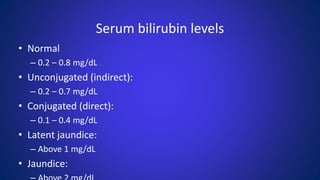
Serum bilirubin levels
• Normal
– 0.2 – 0.8 mg/dL
• Unconjugated (indirect):
– 0.2 – 0.7 mg/dL
• Conjugated (direct):
– 0.1 – 0.4 mg/dL
• Latent jaundice:
– Above 1 mg/dL
• Jaundice:
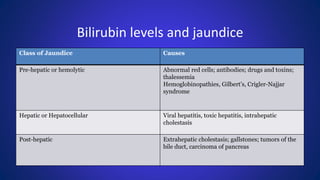
Bilirubin levels and jaundice
Class of Jaundice Causes
Pre-hepatic or hemolytic Abnormal red cells; antibodies; drugs and toxins;
thalessemia
Hemoglobinopathies, Gilbert’s, Crigler-Najjar
syndrome
Hepatic or Hepatocellular Viral hepatitis, toxic hepatitis, intrahepatic
cholestasis
Post-hepatic Extrahepatic cholestasis; gallstones; tumors of the
bile duct, carcinoma of pancreas
Urobilinogen (UBG) and bile salts
• Most UBG is metabolized in the large intestine but a fraction is
excreted in urine (less than 4 mg/day)
• Normally bile salts are NOT present in urine
• Obstruction in the biliary passages causes:
– Leakage of bile salts into circulation
– Excretion in urine
Serum Albumin
• The most abundant protein synthesized by the liver
• Normal serum levels: 3.5 – 5 g/dL
• Synthesis depends on the extent of functioning liver cell mass
• Longer half-life: 20 days
• Its levels decrease in all chronic liver diseases
Serum Globulin
• Normal serum levels: 2.5 – 3.5g/dL
• a and b-globulins mainly synthesized by the liver
• They constitute immunoglobulins (antibodies)
• High serum g-globulins are observed in chronic hepatitis and
cirrhosis:
– IgG in autoimmune hepatitis
Albumin to globulin (A/G) ratio
• Normal A/G ratio: 1.2/1 – 1.5/1
• Globulin levels increase in hypoalbuminemia as a
compensation
Prothrombin Time (PT)
• Prothrombin: synthesized by the liver, a marker of liver
function
• Half-life: 6 hrs. (indicates the present function of the liver)
• PT is prolonged only when liver loses more than 80% of its
reserve capacity
• Vitamin K deficiency also causes prolonged PT
• Intake of vitamin K does not affect PT in liver disease
Take Home Messages
• LFTs help detect liver injury and function.
• LFTs do have some limitations.
References
• Lippincott’s Illustrated Reviews Biochemistry: 6th edition, Unit IV, Chapter 21, Pages
282 - 285.
• Lecture notes: Clinical Biochemistry: 9th edition, Chapter 13, Pages 174 - 187.
• Clinical Chemistry - Techniques, Principales and Correlations: 6th edition, Chapter 24,
Pages 520 -521.

LFTs.pdf

  • 1.
    DCM & SurgeryMsambweni By Charles Ng’ang’a Liver function tests
  • 2.
    Liver function tests •Liver function tests (LFTs or LFs) are – groups of blood tests that give – information about the state of a patient's liver. – These tests include prothrombin – time (PT/INR), aPTT, albumin, bilirubin – (direct and indirect), and others.
  • 3.
    General approach • Cholestatic—intrahepatic/extrahepaticbiliary obstruction • Hepatocellular—hepatocyte damage (e.g. viral hepatitis, drugs/toxins, ETOH, ischemia, malignant infiltration) • Isolated hyperbilirubinemia—e.g. congestive hepatopathy Pt with hx of intermittent abdominal pain associated with meals undergoes RUQ (Right upper Quadrant)
  • 4.
    Liver function tests Teststhat measure Biosynthetic function of liver Tests that measure Biosynthetic function of liver
  • 5.
    Liver function tests •The liver – transaminases aspartate transaminase – (AST or SGOT) and alanine transaminase – (ALT or SGPT) are useful biomarkers of – liver injury in a patient with some degree – of intact liver function.[2][3][4] Most liver – diseases cause only mild symptoms
  • 6.
    Liver function tests •initially, but these diseases must be • detected early. Hepatic (liver) • involvement in some diseases can be of • crucial importance. This testing is • performed on a patient's blood sample. • Some tests are associated with • functionality
  • 7.
    Major Metabolic Functionsof the Liver • Synthetic Function – Plasma proteins (albumin, globulins), cholesterol, triglycerides and lipoproteins • Detoxification and excretion – Ammonia to urea (urea cycle), bilirubin, cholesterol, drug metabolites • Storage Function – Vitamins A, D, E, K and B12 • Production of bile salts – Helps in digestion
  • 8.
    Some example ofliver dysfunction • Hepatocellular disease • Cholestasis (obstruction of bile flow) • Cirrhosis • Hepatitis • Jaundice • Liver cancer • Steatosis (fatty liver) • Genetic Disorders – Hemochromatosis (iron storage)
  • 9.
    Liver Function Tests(LFTs) • Noninvasive methods for screening of liver dysfunction • Help in identifying general types of disorder • Assess severity and allow prediction of outcome • Disease and treatment follow up
  • 10.
    Liver Function Tests(LFTs) Broadly classified as: 1.Tests to detect hepatic injury: • Mild or severe; acute or chronic • Nature of liver injury (hepatocellular or cholestasis) 2.Tests to assess hepatic function
  • 11.
    Classification of LFTs GroupI: Markers of liver dysfunction ▫ Serum bilirubin: total and conjugated ▫ Urine: bile salts and urobilinogen ▫ Total protein, serum albumin and albumin/globulin ratio ▫ Prothrombin Time
  • 12.
    Classification of LFTs GroupII: Markers of hepatocellular injury ▫ Alanine aminotransferase (ALT) ▫ Aspartate aminotransferase (AST)
  • 13.
    Classification of LFTs GroupIII: Markers of cholestasis ▫ Alkaline phosphatase (ALP) ▫ g-glutamyltransferase (GGT)
  • 14.
    What’s the diagnosis? •Pt presents with insidious onset of fatigue, anorexia, nausea, RUQ tenderness. He’s also noticed that his urine has been darker for the past couple of days and that his eyes have a yellow hue.
  • 15.
    Acute hepatitis • AST –Elevated • ALT – Elevated • Alk Phos – Normal  Elevated • T bili – Normal  Elevated http://www.atsu.edu/faculty/chamberlain/Website/lectures/lecture/hepatit2.htm
  • 16.
    • Fatty liverdiseases – Alcoholic liver disease – NASH/NAFLD • Viral hepatitis: Hep B, C, D • Autoimmune – Autoimune hepatitis – Primary biliary cirrhosis – Primary sclerosing cholangitis • Cardiovascular – Budd-Chiari syndrome – Chronic right heart failure cirrhosis Etiology • Chronic biliary disease – Recurrent bacterial cholangitis – Bile duct stenosis • Storage diseases – Hemochromatosis – Wilson disease – α-1-antitrypsin deficiency • Meds: APAP toxicity, MTX • Cryptogenic 10-15%
  • 17.
    • Fatty liverdiseases – Alcoholic liver disease – NASH/NAFLD • Viral hepatitis: Hep B, C, D • Autoimmune – Autoimune hepatitis – Primary biliary cirrhosis – Primary sclerosing cholangitis • Cardiovascular – Budd-Chiari syndrome – Chronic right heart failure cirrhosis Etiology • Chronic biliary disease – Recurrent bacterial cholangitis – Bile duct stenosis • Storage diseases – Hemochromatosis – Wilson disease – α-1-antitrypsin deficiency • Meds: APAP toxicity, MTX • Cryptogenic 10-15%
  • 18.
    Diagnostic imaging • Ultrasound –Surface nodularity: 88% sensitive, 82-95% specific (1) • CT insensitive in early cirrhosis • MRI also insensitive in early cirrhosis, but significant role in assessing small hepatocellular carcinoma (HCC)—develops in 10-25% • Liver biopsy = gold standard for diagnosis
  • 19.
    Treatment • Ascites – Furosemide+ Spironolactone with goal negative ~1L/day (~80% effective) • Lasix: Aldactone ratio of 2:5 helps maintain K+ (thus Lasix 40mg qday, Aldactone 100mg qday initially) – Low-sodium diet (1-2 g/day) • Refractory Ascites= no response on max doses of Lasix (160mg) & Aldactone (400mg) – LVP 4-6L (does not improve mortality) • Albumin replacement controversial. AASLD 2009 guidelines recommend if >5L removed, provide 6-8 g/L of albumin 25% (IIA, Grade C) • If >5L removed, can have post-paracentesis circulatory dysfxn via RAAS activation – TIPS (↓ ascites in 75%, improves mortality but ↑ HE, 40% need revision for stent stenosis)
  • 20.
    DDX for Acutehepatitis • Shock liver: AST & ALT >50x ULN • Drugs (e.g. Tylenol overdose, Isoniazid, Fenofibrate) • Toxins (e.g. Alcohol, Muschrooms) • Viral (e.g Hep A, Hep B, HSV, VZV, CMV, EBV): AST & ALT >25x ULN • Wilson’s • Vascular—Budd-Chiari • AIH • NASH: AST & ALT <4x ULN • HELLP syndrome
  • 21.
    Treatment • Tylenol toxicity—N-acetylcysteine •AIH– Prednisone 60mg daily (taper)- azathioprine or 6- mercaptopurine • Budd-Chiari—TIPS • Wilson’s dz—Plasma exchange to remove copper  liver transplant • Hep B—Antiviral therapy
  • 22.
    Common serum liverchemistry tests
  • 23.
    Liver function tests •(e.g., albumin), some with • cellular integrity (e.g., transaminase), and • some with conditions linked to the biliary • tract (gamma-glutamyl transferase and • alkaline phosphatase).
  • 24.
    • Several • biochemicaltests are useful in the • evaluation and management of patients • with hepatic dysfunction. These tests • can be used to detect the presence of • liver disease, distinguish among different • types of liver disorders, gauge the extent • of known liver damage, and follow the • response to treatment. Liver function tests
  • 25.
    • Some orall of • these measurements are also carried out • (usually about twice a year for routine • cases) on those individuals taking • certain medications, such as • anticonvulsants, to ensure the • medications are not damaging the • person's liver. Liver function tests
  • 26.
    • Although examplereference ranges are • given, these will vary depending on age, • gender and his/her health, ethnicity, • method of analysis, and units of • measurement. Individual results should • always be interpreted using the reference • range provided by the laboratory that • performed the test. Liver function tests-Standard liver panel
  • 27.
    Total bilirubin • Referencerange in adults • Parameters/units Total bilirubin Unconjugated bilirubin Conjugated bilirubin • mg/dL 0.1–1.0[5] 0.2-0.7[5] 0.1–0.4[5] • μmol/l 2.0 to 21[6] < 12[6] < 8[6] • Measurement of total bilirubin includes • both unconjugated (indirect) and
  • 28.
    • conjugated (direct)bilirubin. • Unconjugated bilirubin is a breakdown • product of heme (a part of hemoglobin in • red blood cells). The liver is responsible • for clearing the blood of unconjugated • bilirubin, by 'conjugating' it (modified to • make it water-soluble) through an • enzyme named UDP-glucuronyltransferase. Total bilirubin
  • 29.
    • When thetotal bilirubin level • exceeds 17 μmol/l, it indicates liver • disease. When total bilirubin level • exceeds 40 μmol/l, bilirubin deposition at • the sclera, skin, and mucous membranes • will give these areas yellow colour, thus it • is called jaundice
  • 30.
    • The increasein predominantly • unconjugated bilirubin is due to • overproducion, reduced hepatic uptake of • the unconjugated bilirubin and reduced • conjugation of bilirubin. Overproduction • can be due to reabsorption of • haematoma and ineffective • erythropoiesis that increased red blood • cell destruction. Gilbert's syndrome and • Crigler–Najjar syndrome have defects in • UDP glucuronyl transferase defect, • affecting bilirubin conjugation
  • 31.
    • The degreeof rise in conjugated bilirubin • is directly proportional to the degree of • hepatocyte injury. Viral hepatitis can also • cause the rise in conjugated bilirubin.
  • 32.
    • In parenchymalliver disease and • incomplete extrahepatic obstruction, the rise in conjugated bilirubin is less than the complete common bile duct • obstruction due to malignant causes. In • Dubin–Johnson syndrome, a mutation in • multiple drug-resistance protein 2 • (MRP2) causes a rise in conjugated • bilirubin
  • 33.
    • In acuteappendicitis, total bilirubin can • rise from 20.52 μmol/l to 143 μmol/l. In • pregnant women, the total bilirubin level • is low in all three trimesters.[6] • The measurement of bilirubin levels in • the newborns is done through the use of • bilimeter or transcutanoeus
  • 34.
    • bilirubinometer insteadof performing • LFTs. When the total serum bilirubin • increases over 95th percentile for age • during the first week of life for high risk • babies, it is known as hyperbilirubinemia • of the newborn (neonatal jaundice) and • requires light therapy to reduce the • amount of bilirubin in the blood.
  • 35.
    • Pathological jaundicein newbornsshould be suspected when the serum bilirubin level rises by more than 5 mg/dL • per day, serum bilirubin more than the • physiological range, clinical jaundice • more than 2 weeks, and conjugated • bilirubin (dark urine staining clothes). • Haemolytic jaundice is the commonest • cause of pathological jaundice.
  • 36.
    • Those • babieswith Rh hemolytic disease, ABO • incompatibility with the mother, Glucose- • 6-phosphate dehydrogenase (G-6-PD) • deficiency and minor blood group • incompatibility are at increased risk of • getting haemolytic jaundice
  • 37.
    Alanine transaminase (ALT) •Apart from being found in high concentrations in liver, ALT is found in kidneys, heart, and muscles. It catalyses the transamination reaction, and only exists in cytoplasmic form. Any kind of liver injury can cause the rise in ALT. A rise up to 300 IU/L is not specific to liver, • but can be due to the damage of other • organs such as kidneys or muscles. • When ALT rises to more than 500 IU/L, • causes are usually from the liver
  • 38.
    Aspartate aminotransferase (AST) •Normal range: 8 – 20 U/L • A marker of hepatocellular damage • High serum levels are observed in: – Chronic hepatitis, cirrhosis and liver cancer
  • 39.
    Alanine aminotransferase (ALT) •More liver-specific than AST • Normal range (U/L): ▫ Male: 13-35 ▫ Female: 10-30 • High serum levels in acute hepatitis (300-1000U/L) • Moderate elevation in alcoholic hepatitis (100-300U/L) • Minor elevation in cirrhosis, hepatitis C and non-alcoholic steatohepatitis (NASH) (50-100U/L)
  • 40.
    Alanine aminotransferase (ALT) •Appears in plasma many days before clinical signs appear • A normal value does not always indicate absence of liver damage • Obese but otherwise normal individuals may have elevated ALT levels
  • 41.
    Alkaline phosphatase (ALP) •A non-specific marker of liver disease • Produced by bone osteoblasts (for bone calcification) • Present on hepatocyte membrane • Normal range: 40 – 125 U/L • Modearte elevation observed in: – Infective hepatitis, alcoholic hepatitis and hepatocellular carcinoma
  • 42.
    Alkaline phosphatase (ALP) •High levels are observed in: – Extrahepatic obstruction (obstructive jaundice) and intrahepatic cholestasis • Very high levels are observed in: – Bone diseases
  • 43.
    g-glutamyltransferase (GGT) • Usedfor glutathione synthesis • Normal range: 10 – 30U/L • Moderate elevation observed in: – Infective hepatitis and prostate cancers • GGT is increased in alcoholics despite normal liver function tests
  • 44.
    • It canbe due to hepatitis, ischemic liver injury, and toxins that causes liver damage. • The ALT levels in Hepatitis C rises more than in Hepatitis A and B. Persistent ALT elevation more than 6 months is known as chronic hepatitis. • Alcoholic liver disease, Non-alcoholic fatty liver disease (NAFLD), fat accumulation in liver during childhood obesity, steatohepatitis (inflammation of fatty liver disease) are associated with rise in ALT Alanine transaminase (ALT)
  • 45.
    • Rise inALT is • also associated with reduced insulin • response, reduced glucose tolerance, and • increased free fatty acids and • triglycerides. Bright liver syndrome • (bright liver on ultrasound suggestive of • fatty liver) with raised ALT is suggestive • of metabolic syndrome Alanine transaminase (ALT)
  • 46.
    • In pregnancy,ALT levels would rise during second trimester. In one of the studies, measured ALT levels in pregnancy-related conditions such as • hyperemesis gravidarum was 103.5 IU/L, • pre-eclampsia was 115, HELLP syndrome • was 149. ALT levels would reduce by • greater than 50% in three days after child • delivery. Alanine transaminase (ALT)
  • 47.
    • ALT levelswould reduce by • greater than 50% in three days after child • delivery. Another study also shows that • caffeine consumption can reduce the risk • of ALT elevation in those who consume • alcohol, overweight people, impaired • glucose metabolism, and viral • hepatitis Alanine transaminase (ALT)
  • 48.
    Aspartate transaminase (AST) •AST exists in two isoenzymes namely mitochondrial form and cytoplasmic form. • It is found in highest concentration in the heart, followed by liver, muscle, and • kidney. • The increase of mitochondrial AST in bloods is highly suggestive of tissue necrosis in myocardial infarction • and chronic liver disease. More than 80% • of the liver AST activity are contributed • by mitochondrial form of the isoenzymes, • while the circulating AST in blood are • contributed by cytoplasmic form of AST
  • 49.
    • AST isespecially markedly raised in • those with liver cirrhosis.[6] AST can be • released from a variety of other tissues • and if the elevation is less than two times • the normal AST then no further workup • needs to be performed if a patient is • proceeding to surgery. Aspartate transaminase (AST)
  • 50.
    • In certainpregnancy conditions such as • hyperemesis gravidarum, AST can reach • as high as 73 IU/L, 66 IU/L in preeclampsia, • and 81 IU/L in HELLP • syndrome Aspartate transaminase (AST)
  • 51.
    AST/ALT ratio • TheAST/ALT ratio increases in liver functional impairment. In alcoholic liver disease, the mean ratio is 1.45, and mean ratio is 1.33 in post necrotic liver cirrhosis. • Ratio is greater than 1.17 in • viral cirrhosis, greater than 2.0 in • alcoholic hepatitis, and 0.9 in nonalcoholic • hepatitis. Ratio is greater 4.5 in • Wilson disease or hyperthyroidism
  • 52.
  • 53.
    Bilirubin • A byproductof red blood cell breakdown • It is the yellowish pigment observed in jaundice • High bilirubin levels are observed in: – Gallstones, acute and chronic hepatitis
  • 56.
    Serum bilirubin levels •Normal – 0.2 – 0.8 mg/dL • Unconjugated (indirect): – 0.2 – 0.7 mg/dL • Conjugated (direct): – 0.1 – 0.4 mg/dL • Latent jaundice: – Above 1 mg/dL • Jaundice:
  • 57.
    Bilirubin levels andjaundice Class of Jaundice Causes Pre-hepatic or hemolytic Abnormal red cells; antibodies; drugs and toxins; thalessemia Hemoglobinopathies, Gilbert’s, Crigler-Najjar syndrome Hepatic or Hepatocellular Viral hepatitis, toxic hepatitis, intrahepatic cholestasis Post-hepatic Extrahepatic cholestasis; gallstones; tumors of the bile duct, carcinoma of pancreas
  • 58.
    Urobilinogen (UBG) andbile salts • Most UBG is metabolized in the large intestine but a fraction is excreted in urine (less than 4 mg/day) • Normally bile salts are NOT present in urine • Obstruction in the biliary passages causes: – Leakage of bile salts into circulation – Excretion in urine
  • 59.
    Serum Albumin • Themost abundant protein synthesized by the liver • Normal serum levels: 3.5 – 5 g/dL • Synthesis depends on the extent of functioning liver cell mass • Longer half-life: 20 days • Its levels decrease in all chronic liver diseases
  • 60.
    Serum Globulin • Normalserum levels: 2.5 – 3.5g/dL • a and b-globulins mainly synthesized by the liver • They constitute immunoglobulins (antibodies) • High serum g-globulins are observed in chronic hepatitis and cirrhosis: – IgG in autoimmune hepatitis
  • 61.
    Albumin to globulin(A/G) ratio • Normal A/G ratio: 1.2/1 – 1.5/1 • Globulin levels increase in hypoalbuminemia as a compensation
  • 62.
    Prothrombin Time (PT) •Prothrombin: synthesized by the liver, a marker of liver function • Half-life: 6 hrs. (indicates the present function of the liver) • PT is prolonged only when liver loses more than 80% of its reserve capacity • Vitamin K deficiency also causes prolonged PT • Intake of vitamin K does not affect PT in liver disease
  • 63.
    Take Home Messages •LFTs help detect liver injury and function. • LFTs do have some limitations.
  • 64.
    References • Lippincott’s IllustratedReviews Biochemistry: 6th edition, Unit IV, Chapter 21, Pages 282 - 285. • Lecture notes: Clinical Biochemistry: 9th edition, Chapter 13, Pages 174 - 187. • Clinical Chemistry - Techniques, Principales and Correlations: 6th edition, Chapter 24, Pages 520 -521.