NASAL SEPTUM & ITS
DISEASES
NAVASSHAREEF .P .P
KMCTMEDCOLLEGE ; CALICUT; INDIA
Email:nasmbbs@gmail.com
Nasal septum
Anatomy
3 parts
1)Columellar septum
2)Membranous septum
3)Septum proper
Nasal septum
1.Columellar septum
Formed of columella containing the
medial crura of alar cartilage united
together by fibrous tissue and covered
on either side by skin
2.Membranous Septum
 Double layer of skin
 No bony or cartilaginous support
 Lies b/w columella & caudal border of septal
cartilage.
 Both columella & membranous parts are freely
movable from side to side
3.Septum proper
Osteocartilagenous frame work
Covered with nasal mucous membrane
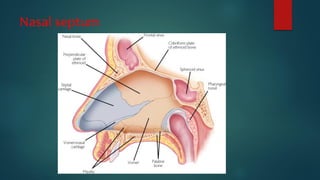
1.Perpendicular plate of ethmoid
2.The vomer
3.Large septal cartilage
Minor contributions from
-Crest of nasal bone
-Nasal spine of frontal bone
-Rostrum of sphenoid
-Crest of palatine bone
-Crest of maxilla
-Anterior nasal spine of maxilla
Septal cartilage
 Partition b/w right&left nasal cavities.
 Provides support to the tip & dorsum of cartilaginous part
of nose.
 Its destruction ( in Septal abscess, injuries, tuberculosis,
excessive removal during septal surgery ) causes
depression of lower part of nose &drooping of nasal tip
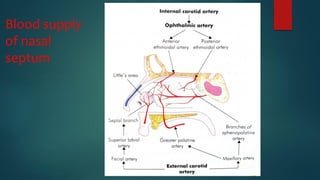
Blood supply
of nasal
septum
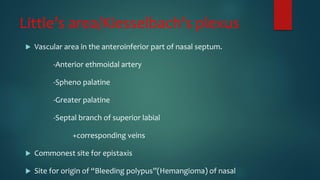
Little’s area/Kiesselbach’s plexus
 Vascular area in the anteroinferior part of nasal septum.
-Anterior ethmoidal artery
-Spheno palatine
-Greater palatine
-Septal branch of superior labial
+corresponding veins
 Commonest site for epistaxis
 Site for origin of “Bleeding polypus”(Hemangioma) of nasal
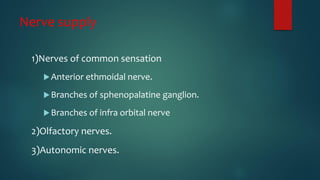
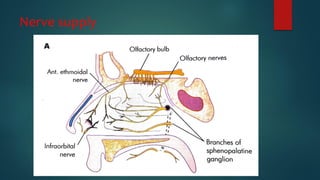
Nerve supply
1)Nerves of common sensation
Anterior ethmoidal nerve.
Branches of sphenopalatine ganglion.
Branches of infra orbital nerve
2)Olfactory nerves.
3)Autonomic nerves.
Nerve supply
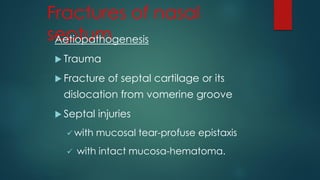
Fractures of nasal
septumAetiopathogenesis
 Trauma
 Fracture of septal cartilage or its
dislocation from vomerine groove
 Septal injuries
 with mucosal tear-profuse epistaxis
 with intact mucosa-hematoma.
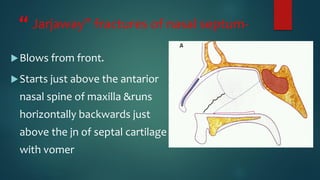
“ Jarjaway” fractures of nasal septum-
Blows from front.
Starts just above the antarior
nasal spine of maxilla &runs
horizontally backwards just
above the jn of septal cartilage
with vomer
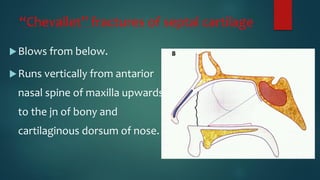
“Chevallet” fractures of septal cartilage
Blows from below.
Runs vertically from antarior
nasal spine of maxilla upwards
to the jn of bony and
cartilaginous dorsum of nose.
Treatment of Fractures of nasal
septum
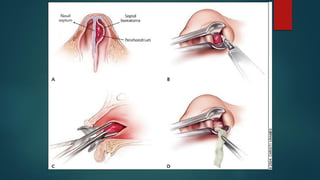
Hematoma should be drained
Dislocated or fractured septal fragments
should be repositioned& supported.
Complications of Fractures of nasal
septum
If injuries are ignored ,they would result in
 deviation of cartilaginous nose
 assymetry of nasal tip,columella
or the nostril.
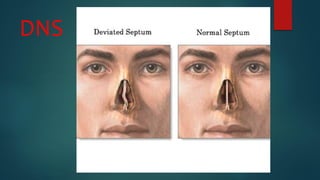
DNS
DEVIATED NASAL SEPTUM
Aetiology
1)Trauma
Lateral blow on nose:-displacement of septal
cartilage from the vomerine groove&maxillary
crest
Crushing blow from the front:-buckling or
twisting fractures
Trauma at birth during passage thru birth canal.
2)Developmental error
3)Racial factors
Caucasians affected more than negroes
4)Hereditary factors
Several members of the same family may have
deviated nasal septum.
Types of DNS
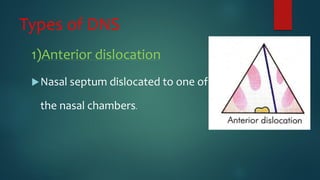
1)Anterior dislocation
Nasal septum dislocated to one of
the nasal chambers.
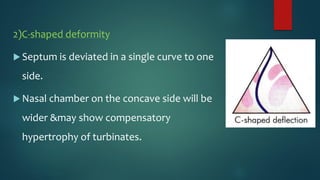
2)C-shaped deformity
 Septum is deviated in a single curve to one
side.
 Nasal chamber on the concave side will be
wider &may show compensatory
hypertrophy of turbinates.
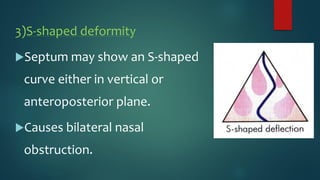
3)S-shaped deformity
Septum may show an S-shaped
curve either in vertical or
anteroposterior plane.
Causes bilateral nasal
obstruction.
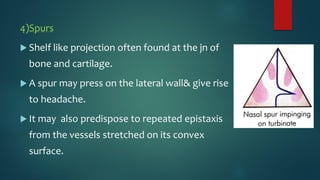
4)Spurs
 Shelf like projection often found at the jn of
bone and cartilage.
 A spur may press on the lateral wall& give rise
to headache.
 It may also predispose to repeated epistaxis
from the vessels stretched on its convex
surface.
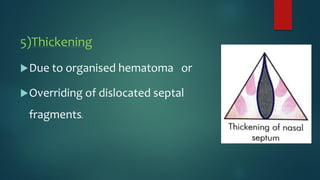
5)Thickening
Due to organised hematoma or
Overriding of dislocated septal
fragments.
Clinical features :DNS
 DNS can involve any age and sex
 Males are affected more than females
1)Nasal obstruction
 Unilateral/bilateral
 Site of obstuction
i. Vestibular
ii. At the nasal valve
iii. Attic
iv. Turbinal
v. Choanal
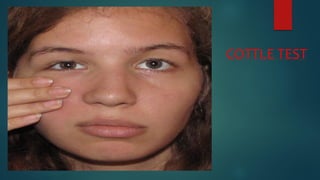
COTTLE TEST
 Used to know whether nasal obstruction is due to
septal abnormality or not?
 Cheek is drawn laterally while the patient breathes
quietly
 If the nasal airway improves on the test side,test is +
ve
 Indicates abnormality vestibular component of nasal
valve
COTTLE TEST
2)Headache
Deviated septum,esp. a spur may press on
lateral wall of nose giving rise to pressure
headache
3)Sinusitis
Deviated septum may obstruct sinus ostia
poor ventillation of sinus predispose or
perpetuate sinus infection.
4)Epistaxis
Mucosa over the deviated parts of
septum exposed to drying effects of
air currents formation of crusts which
when removed causes bleeding
Bleeding may occur from vessels over a
nasal spur
5)Anosmia
Failure of inspired air to reach the
olfactory region may result in total or
partial loss of sense of smell.
6)External deformity
7)Middle ear infection
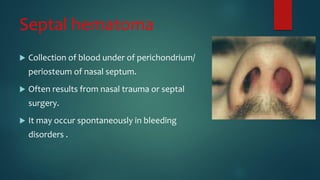
Septal hematoma
 Collection of blood under of perichondrium/
periosteum of nasal septum.
 Often results from nasal trauma or septal
surgery.
 It may occur spontaneously in bleeding
disorders .
Clinical features :Septal hematoma
 Bilateral nasal obstruction.
 Frontal headache & sense of pressure over
nasal bridge.
 Examn –smooth rounded swelling of the
septum in both the nasal fossa.
 Palpation-mass soft & fluctuant.
Treatment :Septal hematoma
Small hematomas aspirated with a wide
bore sterile needle.
Large hematomas incised and drained.
Following drainage nose is packed on
both sides to prevent reaccumulation.
Systemic antibiotics should be given to
prevent septal abscess.
Complications :Septal hematoma
Septal hematoma if not
drainedorganise into fibrous tissue
leading to permanantly thickened septum
Secondary infection results in septal
abscess with necrosis of
cartilage&depression of nasal septum.
Septal abscess
Aetiology
 Mostly from secondary infection of septal
hematoma.
 Occassionally it follows furuncle of the nose or
upper lip.
 It may follow a/c infection such typhoid or measles
Complications Septal abscess
Necrosis of septal cartilagedepression of
the cartilaginous dorsum.
Necrosis of septal flapsseptal
perforation.
Meningitis&cavernous sinus thrombosis-
rare &serious complication
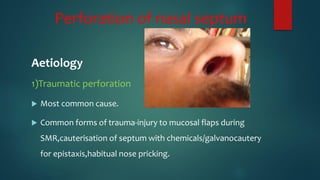
Perforation of nasal septum
Aetiology
1)Traumatic perforation
 Most common cause.
 Common forms of trauma-injury to mucosal flaps during
SMR,cauterisation of septum with chemicals/galvanocautery
for epistaxis,habitual nose pricking.
2)Pathologic perforation
 Septal abscess
 Nasal myiasis
 Rhinolith/neglected foreign body causing pressure
necrosis.
 c/c granulomatous condn
 lupus,TB,leprosy (perforation in cart. Part)
 Syphilis (bony part)
 Wegener’s granuloma-midline destructive lesion-
cause total septal perforation.
3)Drugs & chemicals
i. Prolonged use of steroid sprays in nasal allergy.
ii. Coccaine addicts.
iii. Workers in certain occupations,eg.Cr plating,dichromate/soda
ash(sod.carbonate) manufacture or those exposed to As.
4)Idiopathic
 No h/o trauma,previous disease or Pt. may be unaware of
existence of perforation.
Clinical features:Perforation
Small ant.perforation-whistling sound
during inspiration/expiration.
Larger perforation-develop crusts
which obstruct the nose or may cause
severe epistaxis when removed
Treatment of septal perforation
 Find the cause of perforation first
 Inactive small perforation can be surgically closed by
plastic flaps.
 Larger perforation difficult to close.
 Their t/t is aimed to keep the nose crust free by alkaline
nasal douches&application of a bland oinment.
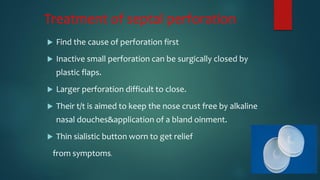
 Thin sialistic button worn to get relief
from symptoms.
.....THANK U.....

Nasal septum & its diseases

  • 1.
    NASAL SEPTUM &ITS DISEASES NAVASSHAREEF .P .P KMCTMEDCOLLEGE ; CALICUT; INDIA Email:nasmbbs@gmail.com
  • 2.
    Nasal septum Anatomy 3 parts 1)Columellarseptum 2)Membranous septum 3)Septum proper
  • 3.
  • 4.
    1.Columellar septum Formed ofcolumella containing the medial crura of alar cartilage united together by fibrous tissue and covered on either side by skin
  • 5.
    2.Membranous Septum  Doublelayer of skin  No bony or cartilaginous support  Lies b/w columella & caudal border of septal cartilage.  Both columella & membranous parts are freely movable from side to side
  • 6.
    3.Septum proper Osteocartilagenous framework Covered with nasal mucous membrane 1.Perpendicular plate of ethmoid 2.The vomer 3.Large septal cartilage
  • 7.
    Minor contributions from -Crestof nasal bone -Nasal spine of frontal bone -Rostrum of sphenoid -Crest of palatine bone -Crest of maxilla -Anterior nasal spine of maxilla
  • 8.
    Septal cartilage  Partitionb/w right&left nasal cavities.  Provides support to the tip & dorsum of cartilaginous part of nose.  Its destruction ( in Septal abscess, injuries, tuberculosis, excessive removal during septal surgery ) causes depression of lower part of nose &drooping of nasal tip
  • 9.
  • 10.
    Little’s area/Kiesselbach’s plexus Vascular area in the anteroinferior part of nasal septum. -Anterior ethmoidal artery -Spheno palatine -Greater palatine -Septal branch of superior labial +corresponding veins  Commonest site for epistaxis  Site for origin of “Bleeding polypus”(Hemangioma) of nasal
  • 11.
    Nerve supply 1)Nerves ofcommon sensation Anterior ethmoidal nerve. Branches of sphenopalatine ganglion. Branches of infra orbital nerve 2)Olfactory nerves. 3)Autonomic nerves.
  • 12.
  • 13.
    Fractures of nasal septumAetiopathogenesis Trauma  Fracture of septal cartilage or its dislocation from vomerine groove  Septal injuries  with mucosal tear-profuse epistaxis  with intact mucosa-hematoma.
  • 14.
    “ Jarjaway” fracturesof nasal septum- Blows from front. Starts just above the antarior nasal spine of maxilla &runs horizontally backwards just above the jn of septal cartilage with vomer
  • 15.
    “Chevallet” fractures ofseptal cartilage Blows from below. Runs vertically from antarior nasal spine of maxilla upwards to the jn of bony and cartilaginous dorsum of nose.
  • 16.
    Treatment of Fracturesof nasal septum Hematoma should be drained Dislocated or fractured septal fragments should be repositioned& supported.
  • 18.
    Complications of Fracturesof nasal septum If injuries are ignored ,they would result in  deviation of cartilaginous nose  assymetry of nasal tip,columella or the nostril.
  • 19.
  • 20.
    DEVIATED NASAL SEPTUM Aetiology 1)Trauma Lateralblow on nose:-displacement of septal cartilage from the vomerine groove&maxillary crest Crushing blow from the front:-buckling or twisting fractures Trauma at birth during passage thru birth canal.
  • 21.
    2)Developmental error 3)Racial factors Caucasiansaffected more than negroes 4)Hereditary factors Several members of the same family may have deviated nasal septum.
  • 22.
    Types of DNS 1)Anteriordislocation Nasal septum dislocated to one of the nasal chambers.
  • 23.
    2)C-shaped deformity  Septumis deviated in a single curve to one side.  Nasal chamber on the concave side will be wider &may show compensatory hypertrophy of turbinates.
  • 24.
    3)S-shaped deformity Septum mayshow an S-shaped curve either in vertical or anteroposterior plane. Causes bilateral nasal obstruction.
  • 25.
    4)Spurs  Shelf likeprojection often found at the jn of bone and cartilage.  A spur may press on the lateral wall& give rise to headache.  It may also predispose to repeated epistaxis from the vessels stretched on its convex surface.
  • 26.
    5)Thickening Due to organisedhematoma or Overriding of dislocated septal fragments.
  • 27.
    Clinical features :DNS DNS can involve any age and sex  Males are affected more than females 1)Nasal obstruction  Unilateral/bilateral  Site of obstuction i. Vestibular ii. At the nasal valve iii. Attic iv. Turbinal v. Choanal
  • 28.
    COTTLE TEST  Usedto know whether nasal obstruction is due to septal abnormality or not?  Cheek is drawn laterally while the patient breathes quietly  If the nasal airway improves on the test side,test is + ve  Indicates abnormality vestibular component of nasal valve
  • 29.
  • 30.
    2)Headache Deviated septum,esp. aspur may press on lateral wall of nose giving rise to pressure headache 3)Sinusitis Deviated septum may obstruct sinus ostia poor ventillation of sinus predispose or perpetuate sinus infection.
  • 31.
    4)Epistaxis Mucosa over thedeviated parts of septum exposed to drying effects of air currents formation of crusts which when removed causes bleeding Bleeding may occur from vessels over a nasal spur
  • 32.
    5)Anosmia Failure of inspiredair to reach the olfactory region may result in total or partial loss of sense of smell. 6)External deformity 7)Middle ear infection
  • 33.
    Septal hematoma  Collectionof blood under of perichondrium/ periosteum of nasal septum.  Often results from nasal trauma or septal surgery.  It may occur spontaneously in bleeding disorders .
  • 34.
    Clinical features :Septalhematoma  Bilateral nasal obstruction.  Frontal headache & sense of pressure over nasal bridge.  Examn –smooth rounded swelling of the septum in both the nasal fossa.  Palpation-mass soft & fluctuant.
  • 35.
    Treatment :Septal hematoma Smallhematomas aspirated with a wide bore sterile needle. Large hematomas incised and drained. Following drainage nose is packed on both sides to prevent reaccumulation. Systemic antibiotics should be given to prevent septal abscess.
  • 36.
    Complications :Septal hematoma Septalhematoma if not drainedorganise into fibrous tissue leading to permanantly thickened septum Secondary infection results in septal abscess with necrosis of cartilage&depression of nasal septum.
  • 37.
    Septal abscess Aetiology  Mostlyfrom secondary infection of septal hematoma.  Occassionally it follows furuncle of the nose or upper lip.  It may follow a/c infection such typhoid or measles
  • 38.
    Complications Septal abscess Necrosisof septal cartilagedepression of the cartilaginous dorsum. Necrosis of septal flapsseptal perforation. Meningitis&cavernous sinus thrombosis- rare &serious complication
  • 39.
    Perforation of nasalseptum Aetiology 1)Traumatic perforation  Most common cause.  Common forms of trauma-injury to mucosal flaps during SMR,cauterisation of septum with chemicals/galvanocautery for epistaxis,habitual nose pricking.
  • 40.
    2)Pathologic perforation  Septalabscess  Nasal myiasis  Rhinolith/neglected foreign body causing pressure necrosis.  c/c granulomatous condn  lupus,TB,leprosy (perforation in cart. Part)  Syphilis (bony part)  Wegener’s granuloma-midline destructive lesion- cause total septal perforation.
  • 41.
    3)Drugs & chemicals i.Prolonged use of steroid sprays in nasal allergy. ii. Coccaine addicts. iii. Workers in certain occupations,eg.Cr plating,dichromate/soda ash(sod.carbonate) manufacture or those exposed to As. 4)Idiopathic  No h/o trauma,previous disease or Pt. may be unaware of existence of perforation.
  • 42.
    Clinical features:Perforation Small ant.perforation-whistlingsound during inspiration/expiration. Larger perforation-develop crusts which obstruct the nose or may cause severe epistaxis when removed
  • 43.
    Treatment of septalperforation  Find the cause of perforation first  Inactive small perforation can be surgically closed by plastic flaps.  Larger perforation difficult to close.  Their t/t is aimed to keep the nose crust free by alkaline nasal douches&application of a bland oinment.  Thin sialistic button worn to get relief from symptoms.
  • 44.