Guide : Dr V A KOTHIWALE
Co Guide : Dr Raju Badiger
Presenter : Dr Prudhvi Krishna
References▪ Sleisenger and
Fordtran’s - 9th edition.
▪ Harrison Principles of
internal medicine –
18th edition.
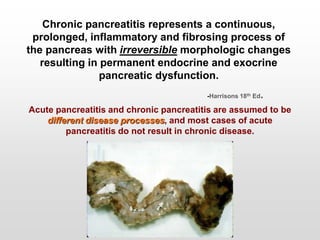
Chronic pancreatitis represents a continuous,
prolonged, inflammatory and fibrosing process of
the pancreas with irreversible morphologic changes
resulting in permanent endocrine and exocrine
pancreatic dysfunction.
-Harrisons 18th Ed.
Acute pancreatitis and chronic pancreatitis are assumed to be
different disease processes, and most cases of acute
pancreatitis do not result in chronic disease.
PREVALANCE
10-15/1,00,000 in western
countries.
114-200/1,00,000 in southern
India.
Typical age 35-55
Chronic pancreatitis
Pathophysiology
Etiology
Clinical features
Diagnosis
Management
Complications
PATHOPHYSIOLOGY
Incompletely understood
Why 10% heavy alcoholics develop
chronic pancreatitis and the rest not, or
limited to asymptomatic pancreatic fibrosis
Alcohol is the most studied
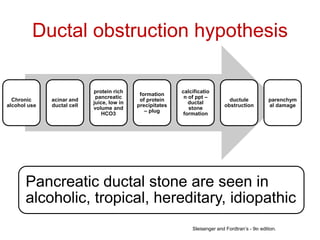
Ductal obstruction hypothesis
Chronic
alcohol use
acinar and
ductal cell
protein rich
pancreatic
juice, low in
volume and
HCO3
formation
of protein
precipitates
– plug
calcificatio
n of ppt –
ductal
stone
formation
ductule
obstruction
parenchym
al damage
Pancreatic ductal stone are seen in
alcoholic, tropical, hereditary, idiopathic
Sleisenger and Fordtran’s - 9th edition.
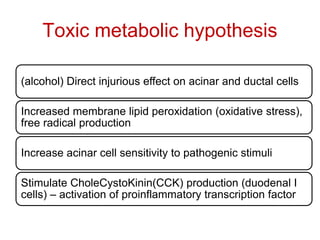
Toxic metabolic hypothesis
(alcohol) Direct injurious effect on acinar and ductal cells
Increased membrane lipid peroxidation (oxidative stress),
free radical production
Increase acinar cell sensitivity to pathogenic stimuli
Stimulate CholeCystoKinin(CCK) production (duodenal I
cells) – activation of proinflammatory transcription factor
Necrosis fibrosis hypothesis
Repeated episodes of acute pancreatitis with cellular
necrosis or apoptosis, healing replaces necrotic tissue
with fibrosis
Evidence from natural history studies - more severe and
frequent attacks
• Cystic fibrosis is assosiated with
abnormalities of HCO3 secretion, ductal
dilatation, ppt formation, pancreatic atrophy
• Seen in 50% of idiopathic CP, not common
in alcoholic CP
CFTR –
cystic fibrosis
trans-membrane
conductance
regulator
• Seen in pediatric Idiopathic CP, hereditary
Pancreatitis, Tropical Pancreatitis; but not
in chronic alcoholic pancreatitis
SPINK1 - serine
protease inhibitor
Kazal type 1
Genetic forms
• Once trypsinogen is activated to trypsin,
becomes resistant to inactivation and
activate other proenzymes leading to
episodes of acute pancreatitis– like
necrosis fibrosis theory
PRSS1 – cationic
trypsinogen gene
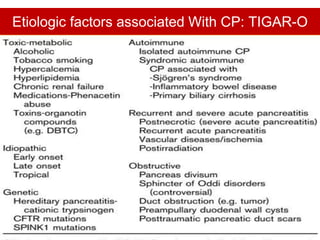
Etiologic factors associated With CP: TIGAR-O
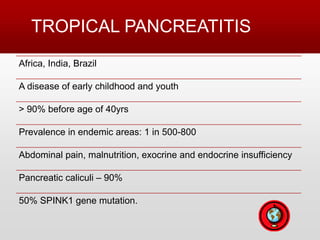
TROPICAL PANCREATITIS
Africa, India, Brazil
A disease of early childhood and youth
> 90% before age of 40yrs
Prevalence in endemic areas: 1 in 500-800
Abdominal pain, malnutrition, exocrine and endocrine insufficiency
Pancreatic caliculi – 90%
50% SPINK1 gene mutation.
AutoImmune Pancreatitis
5% of CP, more in males, middle age
12 – 50% ass. With other autoimmune diseases
abdominal pain, weight loss, jaundice
Imaging studies show focal or diffuse (sausage
shaped) enlargement
Diagnosis – clinical, imaging, IgG4, autoantibodies
Treatment – glucocorticoids 1-2m and tappering in 3-
4m
Idiopathic Pancreatitis
Early onset
• 20yr mean age, male=female
• 96% pain
• Calcification, exocrine or endocine insufficiency
develop slowly over time – 25, 26 -27.5 yrs
• CFTR, SPINK1 genes
Late onset
• Pain is less frequent 54%-75%
• Age of onset 56yrs, m=f
• 90% calcification is seen
Diabetes mellitus
1% of DM from CP
In DM - pancreas is smaller,
• abnormal duct in 40-50% ,
• abnormal pancreatic function in 40-50%
Insulin is a trophic factor for exocrine function of the
pancreas
Insulin deficiency + microangiopathy of DM lead to
pancreatic damage
DM and CP cause effect relation is not clear
• Chronic pancreatitis is a relapsing condition that
presents with abdominal pain, occurring in 95% of
cases.
• Pain can be episodic, lasting hours to days, or it can
persist for months or even years. The pain is
characteristically steady in the epigastrium, and it
frequently radiates to the back.
• Weight loss, Steatorrhea.
Clincal features
Diagnosis
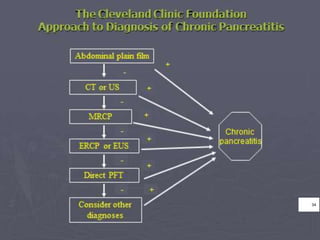
▪ No single test is adequate
▪ Tests for function
▪ Tests for structure
▪ Both are more accurate in advanced
disease .
Tests of function – hormone stimulation
• Direct Tests
• Secretin/ secretin CCK test
• Indirect Tests
• Fecal elastase
• Fecal chymotrypsin
• Serum trypsinogen (trypsin)
• Fecal fat
• Blood glucose
Tests of structure
• Plain film of the abdomen
• CT
• Ultrasonography
• MRI, particularly MRCP
• ERCP
Routine labarotory tests
Serum amylase and lipase
• May be elevated in acute exacerbations
• Also found increased in pseudocyst, ductal
stricture, internal pancreatic fistula,pancreatic
carcinoma,cholecystitis,ectopic pregnancy
Classics of Chronic pancreatitis
Pancreatic calcification
Steatorrhea
Diabetes mellitus
Found in less than a third of pts with CP
• abnormal secretin stimulations test when >60 %
affected
• Serum trypsinogen < 20ng/ml,
• Fecal elastase < 100mcg/mg stool - severe
exocrine insuf.
• Pancreatic calcifications are shown in 25-59% of patients.
• This feature is pathognomonic for chronic pancreatitis.
• Calcification is punctate or coarse, and it may have a focal, segmental, or
diffuse distribution.
chronic pancreatitis with
marked calcification of the
pancreatic parenchyma.
Plain films
The anatomic proximity of the pancreatic head and stomach antrum is
constant, and enlargement of the pancreatic head usually causes
effacement of the antrum. This finding has been termed the pad sign.
Upper gastrointestinal tract barium
study shows a reverse 3 in the
duodenum due to chronic pancreatitis.
Pancreatic carcinoma can have a
similar appearance
Upper GI tract barium series
Currently, CT is regarded as the
imaging modality of choice for the
initial evaluation of suggested
chronic pancreatitis.
The diagnostic features of:
• pancreatic enlargement,
• pancreatic calcifications,
• pancreatic ductal dilatation,
• thickening of the peripancreatic
fascia, and
• bile duct involvement
are depicted well on CT scans.
CT Findings
The sensitivity of plain film for detection of pancreatic calcifications
is about 80 %, which is higher than that of sonography but lower
than that of CT.
CT Findings
• Ultrasonography is the first
modality to be used in
patients presenting with
upper abdominal pain,
although the direct diagnosis
of chronic pancreatitis is not
always possible.
• In early disease, the pancreas
may be enlarged and
hypoechoic, with ductal
dilatation. Later, the pancreas
becomes heterogeneous,
with areas of increased
echogenicity and focal or
diffuse enlargement.
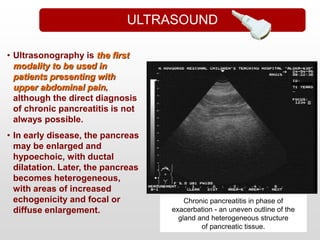
Chronic pancreatitis in phase of
exacerbation - an uneven outline of the
gland and heterogeneous structure
of pancreatic tissue.
ULTRASOUND
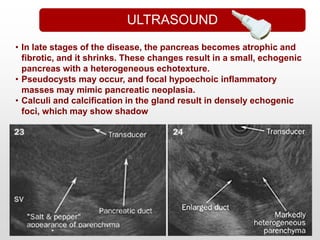
• In late stages of the disease, the pancreas becomes atrophic and
fibrotic, and it shrinks. These changes result in a small, echogenic
pancreas with a heterogeneous echotexture.
• Pseudocysts may occur, and focal hypoechoic inflammatory
masses may mimic pancreatic neoplasia.
• Calculi and calcification in the gland result in densely echogenic
foci, which may show shadow
ULTRASOUND
ERCP is the most sensitive and specific technique in the investigation of
chronic pancreatitis, although it is invasive and may cause an acute episode
of pancreatitis and ascending cholangitis.
Endoscopic retrograde cholangiopancreatography (ERCP)
ERCP of normal
pancreatic and
biliary ducts.
ERCP
Endoscopic retrograde cholangiopancreatography (ERCP)
Mild pancreatitis
may present with
minimal dilation of
the main
pancreatic duct
and some clubbing
of the side
branches of the
duct
ERCP
Chronic Pancreatitis
Endoscopic retrograde cholangiopancreatography (ERCP)
The patient with
moderately-
staged chronic
pancreatitis
shows moderate
dilation of the
main pancreatic
duct (1.5 times
the normal size)
This is
accompanied by
moderate
clubbing of the
side branches of
the main
pancreatic duct
ERCP
Chronic Pancreatitis
Endoscopic retrograde cholangiopancreatography (ERCP)
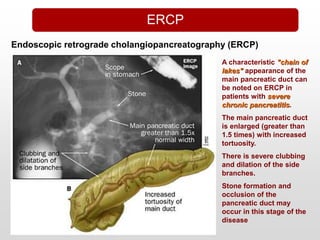
A characteristic "chain of
lakes" appearance of the
main pancreatic duct can
be noted on ERCP in
patients with severe
chronic pancreatitis.
The main pancreatic duct
is enlarged (greater than
1.5 times) with increased
tortuosity.
There is severe clubbing
and dilation of the side
branches.
Stone formation and
occlusion of the
pancreatic duct may
occur in this stage of the
disease
ERCP
Chronic Pancreatitis
MRI, particularly MRCP,
is a noninvasive
technique.
The combination of
pancreatic parenchyma
imaging sequences
with MR angiography
and secretin-enhanced
MRCP offers the
possibility of a
comprehensive
examination within a
single diagnostic
modality for evaluation
of the full range of
pancreatic diseases. (A) MRCP demonstrates a "double duct" stricture with proximal dilatation
of the common bile duct and pancreatic duct (arrow). A cystic lesion is seen
between the common bile duct and the duodenal wall. (B) Fat-suppressed
TSE T1-weighted image. Unenhanced (C) and delayed gadolinium-
enhanced (D) T1-weighted images, demonstrate diffuse enhancement of the
sheetlike mass, which corresponded to fibrotic tissue.
Groove pancreatitis
MRI
34
Treatment
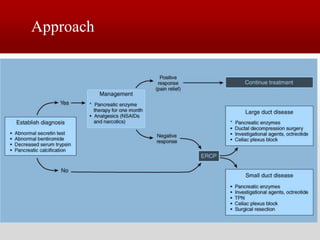
▪ Aim - Pain control and management of maldigestion
▪ Pain
▪ Avoid alcohol
▪ Low fat meals
▪ Antipain – narcotics tramadol,codeine(addiction)
▪ Surgical pain control
▪ Resection (local - - - - 95%) –causes pancreatic insufficiency
▪ Splanchinectomy, celiac ganglionectomy, nerve block
▪ Endoscopic treatment
▪ Sphinctorotomy, dilatation of strictures, caliculi removal, duct stenting
▪ Complications– acute pancreatitis, abscess, ductal damage, death
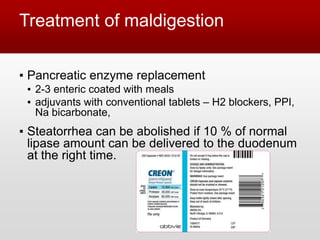
▪ Pancreatic enzymes- Non enteric coated
Pancrelipase  CREON,Ultresa.
Treatment of maldigestion
▪ Pancreatic enzyme replacement
▪ 2-3 enteric coated with meals
▪ adjuvants with conventional tablets – H2 blockers, PPI,
Na bicarbonate,
▪ Steatorrhea can be abolished if 10 % of normal
lipase amount can be delivered to the duodenum
at the right time.
Approach
Chronic Pancreatitis
Complications of chronic pancreatitis include:
• Pseudocyst formation
• Fistula formation
• Pseudoaneurysms of large arteries close to the
pancreas
• Stenosis of the common bile duct
• Splenic and/or portal venous obstruction
• Diabetes can develop in 70-90% of patients with
chronic calcific pancreatitis
Complications
Thank you

Chronic Pancreatitis

  • 1.
    Guide : DrV A KOTHIWALE Co Guide : Dr Raju Badiger Presenter : Dr Prudhvi Krishna
  • 2.
    References▪ Sleisenger and Fordtran’s- 9th edition. ▪ Harrison Principles of internal medicine – 18th edition.
  • 3.
    Chronic pancreatitis representsa continuous, prolonged, inflammatory and fibrosing process of the pancreas with irreversible morphologic changes resulting in permanent endocrine and exocrine pancreatic dysfunction. -Harrisons 18th Ed. Acute pancreatitis and chronic pancreatitis are assumed to be different disease processes, and most cases of acute pancreatitis do not result in chronic disease.
  • 4.
  • 5.
  • 6.
    PATHOPHYSIOLOGY Incompletely understood Why 10%heavy alcoholics develop chronic pancreatitis and the rest not, or limited to asymptomatic pancreatic fibrosis Alcohol is the most studied
  • 7.
    Ductal obstruction hypothesis Chronic alcoholuse acinar and ductal cell protein rich pancreatic juice, low in volume and HCO3 formation of protein precipitates – plug calcificatio n of ppt – ductal stone formation ductule obstruction parenchym al damage Pancreatic ductal stone are seen in alcoholic, tropical, hereditary, idiopathic Sleisenger and Fordtran’s - 9th edition.
  • 8.
    Toxic metabolic hypothesis (alcohol)Direct injurious effect on acinar and ductal cells Increased membrane lipid peroxidation (oxidative stress), free radical production Increase acinar cell sensitivity to pathogenic stimuli Stimulate CholeCystoKinin(CCK) production (duodenal I cells) – activation of proinflammatory transcription factor
  • 9.
    Necrosis fibrosis hypothesis Repeatedepisodes of acute pancreatitis with cellular necrosis or apoptosis, healing replaces necrotic tissue with fibrosis Evidence from natural history studies - more severe and frequent attacks
  • 10.
    • Cystic fibrosisis assosiated with abnormalities of HCO3 secretion, ductal dilatation, ppt formation, pancreatic atrophy • Seen in 50% of idiopathic CP, not common in alcoholic CP CFTR – cystic fibrosis trans-membrane conductance regulator • Seen in pediatric Idiopathic CP, hereditary Pancreatitis, Tropical Pancreatitis; but not in chronic alcoholic pancreatitis SPINK1 - serine protease inhibitor Kazal type 1 Genetic forms • Once trypsinogen is activated to trypsin, becomes resistant to inactivation and activate other proenzymes leading to episodes of acute pancreatitis– like necrosis fibrosis theory PRSS1 – cationic trypsinogen gene
  • 11.
  • 12.
    TROPICAL PANCREATITIS Africa, India,Brazil A disease of early childhood and youth > 90% before age of 40yrs Prevalence in endemic areas: 1 in 500-800 Abdominal pain, malnutrition, exocrine and endocrine insufficiency Pancreatic caliculi – 90% 50% SPINK1 gene mutation.
  • 13.
    AutoImmune Pancreatitis 5% ofCP, more in males, middle age 12 – 50% ass. With other autoimmune diseases abdominal pain, weight loss, jaundice Imaging studies show focal or diffuse (sausage shaped) enlargement Diagnosis – clinical, imaging, IgG4, autoantibodies Treatment – glucocorticoids 1-2m and tappering in 3- 4m
  • 14.
    Idiopathic Pancreatitis Early onset •20yr mean age, male=female • 96% pain • Calcification, exocrine or endocine insufficiency develop slowly over time – 25, 26 -27.5 yrs • CFTR, SPINK1 genes Late onset • Pain is less frequent 54%-75% • Age of onset 56yrs, m=f • 90% calcification is seen
  • 15.
    Diabetes mellitus 1% ofDM from CP In DM - pancreas is smaller, • abnormal duct in 40-50% , • abnormal pancreatic function in 40-50% Insulin is a trophic factor for exocrine function of the pancreas Insulin deficiency + microangiopathy of DM lead to pancreatic damage DM and CP cause effect relation is not clear
  • 16.
    • Chronic pancreatitisis a relapsing condition that presents with abdominal pain, occurring in 95% of cases. • Pain can be episodic, lasting hours to days, or it can persist for months or even years. The pain is characteristically steady in the epigastrium, and it frequently radiates to the back. • Weight loss, Steatorrhea. Clincal features
  • 17.
    Diagnosis ▪ No singletest is adequate ▪ Tests for function ▪ Tests for structure ▪ Both are more accurate in advanced disease .
  • 18.
    Tests of function– hormone stimulation • Direct Tests • Secretin/ secretin CCK test • Indirect Tests • Fecal elastase • Fecal chymotrypsin • Serum trypsinogen (trypsin) • Fecal fat • Blood glucose Tests of structure • Plain film of the abdomen • CT • Ultrasonography • MRI, particularly MRCP • ERCP
  • 20.
    Routine labarotory tests Serumamylase and lipase • May be elevated in acute exacerbations • Also found increased in pseudocyst, ductal stricture, internal pancreatic fistula,pancreatic carcinoma,cholecystitis,ectopic pregnancy
  • 21.
    Classics of Chronicpancreatitis Pancreatic calcification Steatorrhea Diabetes mellitus Found in less than a third of pts with CP • abnormal secretin stimulations test when >60 % affected • Serum trypsinogen < 20ng/ml, • Fecal elastase < 100mcg/mg stool - severe exocrine insuf.
  • 22.
    • Pancreatic calcificationsare shown in 25-59% of patients. • This feature is pathognomonic for chronic pancreatitis. • Calcification is punctate or coarse, and it may have a focal, segmental, or diffuse distribution. chronic pancreatitis with marked calcification of the pancreatic parenchyma. Plain films
  • 23.
    The anatomic proximityof the pancreatic head and stomach antrum is constant, and enlargement of the pancreatic head usually causes effacement of the antrum. This finding has been termed the pad sign. Upper gastrointestinal tract barium study shows a reverse 3 in the duodenum due to chronic pancreatitis. Pancreatic carcinoma can have a similar appearance Upper GI tract barium series
  • 24.
    Currently, CT isregarded as the imaging modality of choice for the initial evaluation of suggested chronic pancreatitis. The diagnostic features of: • pancreatic enlargement, • pancreatic calcifications, • pancreatic ductal dilatation, • thickening of the peripancreatic fascia, and • bile duct involvement are depicted well on CT scans. CT Findings
  • 25.
    The sensitivity ofplain film for detection of pancreatic calcifications is about 80 %, which is higher than that of sonography but lower than that of CT. CT Findings
  • 26.
    • Ultrasonography isthe first modality to be used in patients presenting with upper abdominal pain, although the direct diagnosis of chronic pancreatitis is not always possible. • In early disease, the pancreas may be enlarged and hypoechoic, with ductal dilatation. Later, the pancreas becomes heterogeneous, with areas of increased echogenicity and focal or diffuse enlargement. Chronic pancreatitis in phase of exacerbation - an uneven outline of the gland and heterogeneous structure of pancreatic tissue. ULTRASOUND
  • 27.
    • In latestages of the disease, the pancreas becomes atrophic and fibrotic, and it shrinks. These changes result in a small, echogenic pancreas with a heterogeneous echotexture. • Pseudocysts may occur, and focal hypoechoic inflammatory masses may mimic pancreatic neoplasia. • Calculi and calcification in the gland result in densely echogenic foci, which may show shadow ULTRASOUND
  • 28.
    ERCP is themost sensitive and specific technique in the investigation of chronic pancreatitis, although it is invasive and may cause an acute episode of pancreatitis and ascending cholangitis. Endoscopic retrograde cholangiopancreatography (ERCP) ERCP of normal pancreatic and biliary ducts. ERCP
  • 29.
    Endoscopic retrograde cholangiopancreatography(ERCP) Mild pancreatitis may present with minimal dilation of the main pancreatic duct and some clubbing of the side branches of the duct ERCP
  • 30.
    Chronic Pancreatitis Endoscopic retrogradecholangiopancreatography (ERCP) The patient with moderately- staged chronic pancreatitis shows moderate dilation of the main pancreatic duct (1.5 times the normal size) This is accompanied by moderate clubbing of the side branches of the main pancreatic duct ERCP

  • 31.
    Chronic Pancreatitis Endoscopic retrogradecholangiopancreatography (ERCP) A characteristic "chain of lakes" appearance of the main pancreatic duct can be noted on ERCP in patients with severe chronic pancreatitis. The main pancreatic duct is enlarged (greater than 1.5 times) with increased tortuosity. There is severe clubbing and dilation of the side branches. Stone formation and occlusion of the pancreatic duct may occur in this stage of the disease ERCP
  • 32.
    Chronic Pancreatitis MRI, particularlyMRCP, is a noninvasive technique. The combination of pancreatic parenchyma imaging sequences with MR angiography and secretin-enhanced MRCP offers the possibility of a comprehensive examination within a single diagnostic modality for evaluation of the full range of pancreatic diseases. (A) MRCP demonstrates a "double duct" stricture with proximal dilatation of the common bile duct and pancreatic duct (arrow). A cystic lesion is seen between the common bile duct and the duodenal wall. (B) Fat-suppressed TSE T1-weighted image. Unenhanced (C) and delayed gadolinium- enhanced (D) T1-weighted images, demonstrate diffuse enhancement of the sheetlike mass, which corresponded to fibrotic tissue. Groove pancreatitis MRI
  • 33.
  • 34.
    Treatment ▪ Aim -Pain control and management of maldigestion ▪ Pain ▪ Avoid alcohol ▪ Low fat meals ▪ Antipain – narcotics tramadol,codeine(addiction) ▪ Surgical pain control ▪ Resection (local - - - - 95%) –causes pancreatic insufficiency ▪ Splanchinectomy, celiac ganglionectomy, nerve block ▪ Endoscopic treatment ▪ Sphinctorotomy, dilatation of strictures, caliculi removal, duct stenting ▪ Complications– acute pancreatitis, abscess, ductal damage, death ▪ Pancreatic enzymes- Non enteric coated Pancrelipase  CREON,Ultresa.
  • 35.
    Treatment of maldigestion ▪Pancreatic enzyme replacement ▪ 2-3 enteric coated with meals ▪ adjuvants with conventional tablets – H2 blockers, PPI, Na bicarbonate, ▪ Steatorrhea can be abolished if 10 % of normal lipase amount can be delivered to the duodenum at the right time.
  • 36.
  • 37.
    Chronic Pancreatitis Complications ofchronic pancreatitis include: • Pseudocyst formation • Fistula formation • Pseudoaneurysms of large arteries close to the pancreas • Stenosis of the common bile duct • Splenic and/or portal venous obstruction • Diabetes can develop in 70-90% of patients with chronic calcific pancreatitis Complications
  • 38.