Dr . Sunita Mishra
Associate Professor
Dept of OBG
Kamineni Institute Of Medical Sciences
Narketpally
Dist:Nalgonda
Andhra Pradesh
DEFINITION
Jaundice is the clinical manifestation of raised bilirubin
levels in blood
Detected clinically at bilirubin concentration of 2 mg % or
more ( normal being 0.2 – 0.8 mg % )
NORMAL LIVER PHYSIOLOGY IN
PREGNANCY
 Outside pregnancy , liver receives upto 25-35 % of
cardiac output which does not change significantly
during pregnancy
 Size of the liver does not increase
 Postero-superior displacement by the enlarging uterus
PALPABLY ENLARGED LIVER IS ABNORMAL IN
PREGNANCY
Metabolic ,synthetic & excretory functions of liver
affected by increased levels of estrogen & progesterone
in pregnancy
LIVER FUNCTION TESTS IN PREGNANCY
bilirubin Unchanged or slightly
decreased
Aspartate transaminase(AST) Unchanged initially but 25%
decrease by 3rd trimester
Alanine transaminase (ALT) Unchanged initially but 25%
decrease by 3rd trimester
Gamma glutamate
transaminase (GGT )
Unchanged or slightly
decreased
Alkaline phosphatase 2-4 fold increase in 3rd
trimester
cholesterol Two fold increase
Triglycerides 2-3 fold increase
Globulin Increase in alpha & beta
globulins
MATERNAL HYPERBILIRUBINEMIA
& THE FOETUS
Elevated levels of maternal unconjugated bilirubin do
not have deleterious effect on neurodevelopmental
status of offspring
MAIN CAUSES OF JAUNDICE IN
PREGNANCY
 UNIQUE TO PREGNANCY
-Intrahepatic cholestasis of pregnancy
-Acute fatty liver of pregnancy
-HELLP syndrome
-Severe hyperemesis gravidarum
MAIN CAUSES OF JAUNDICE IN
PREGNANCY
 COINCIDENTAL TO PREGNANCY
-Viral hepatitis
-Gallstone disease(cholelithiasis)
-Congenital disorders of bilirubin metabolism
-Autoimmune hepatitis
-Drug induced – isoniazide , phenothiazine
-Hemolytic jaundice- mismatched blood transfusion ,
malaria , clostridium welchii infection
-Cirrhosis
-Neoplasia
INTRAHEPATIC CHOLESTASIS OF
PREGNANCY
OBSTETRIC CHOLESTASIS
Incidence being 1.24 % of all pregnancies in Indian
population
CLINICAL FEATURES
 Severe itching/pruritus in 3rd trimester
 Malaise & insomnia
 Dark urine, anorexia, steatorrhoea
OBSTETRIC CHOLESTASIS
LABORATORY FINDINGS
 Raised bile acids
 Moderate elevation in ALT
 Raised alkaline phosphatase
 Raised bilirubin
 Raised GGT
OBSTETRIC CHOLESTASIS
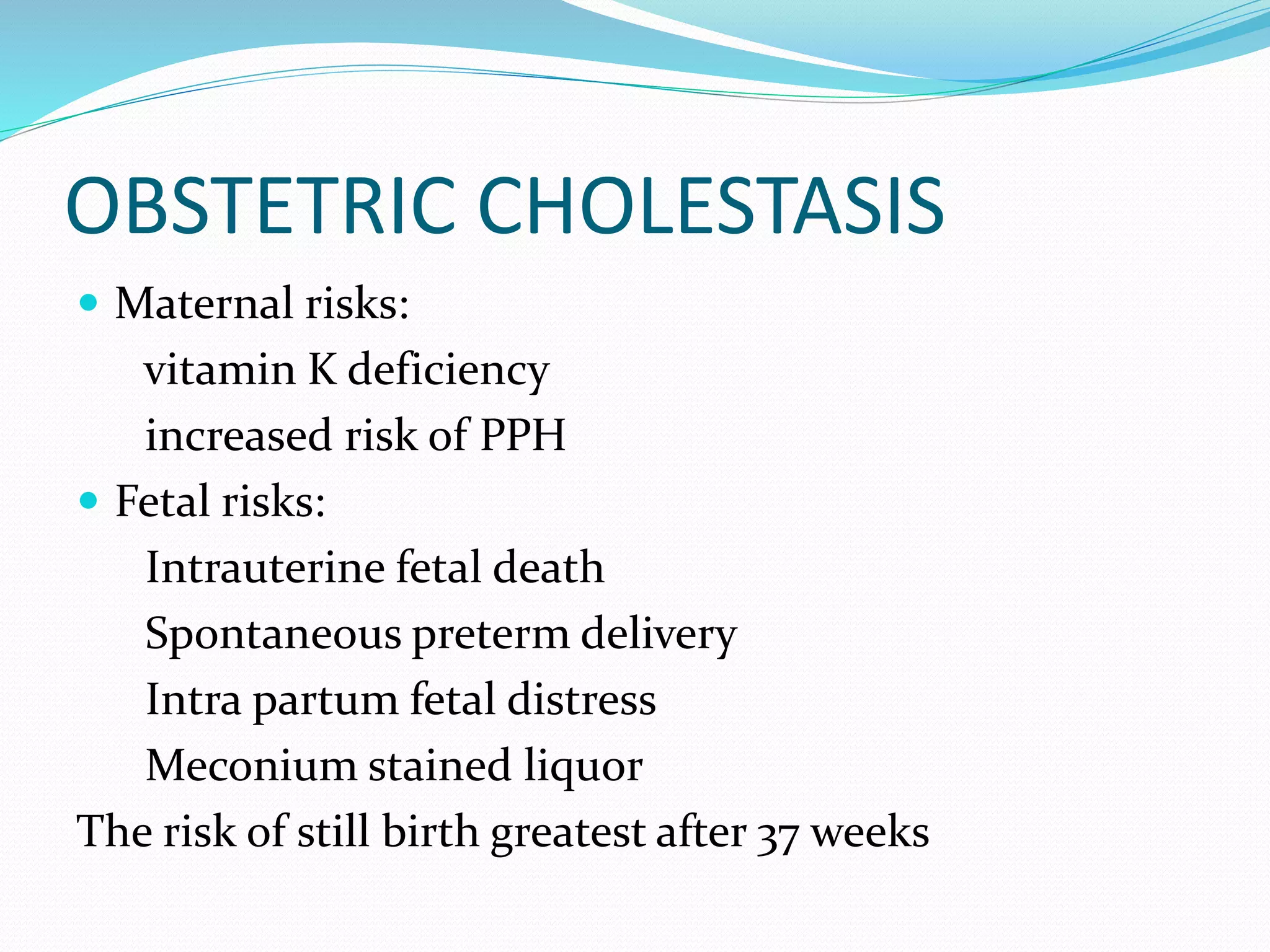
 Maternal risks:
vitamin K deficiency
increased risk of PPH
 Fetal risks:
Intrauterine fetal death
Spontaneous preterm delivery
Intra partum fetal distress
Meconium stained liquor
The risk of still birth greatest after 37 weeks
OBSTETRIC CHOLESTASIS
MANAGEMENT
 Counseling
 Fetal surveillance
DFKC , BPP
 Maternal monitoring
LFTs
bile acids
coagulation screening.
 Maternal vitamin K supplementation with an oral dose of
10mg daily.
 Pruritus is symptomatically treated
 Ursodeoxy cholic acid
OBSTETRIC CHOLESTASIS
POST NATAL MANAGEMENT
 Monitoring of biochemical resolution is essential
 If diagnosis is suspect or condition appears to be
progressive , invasive investigation in form of liver
biopsy.
 The recurrence in future pregnancies is 50%
 Woman counseled to avoid combined OC pills
ACUTE FATTY LIVER OF
PREGNANCY
 Rare complication occuring in pregnancy
 Incidence: 1 in 10000 pregnancies
 Association with
maternal obesity
male fetus (3 times more common )
multiple pregnancy.
 considerable overlap with HELLP syndrome
 AFLP may be a variant of preeclampsia.
Clinical features
 Nausea, anorexia and malaise
after 30 weeks to term.
 Severe vomiting and abdominal pain
 Jaundice within 2 weeks of onset of symptoms.
 Ascites
 signs and symptoms of liver failure
 hepatic encephalopathy,
 DIC and renal failure.
 Hypertension and proteinuria in 50% cases
 Extreme polydipsia or pseudo diabetes .
Laboratory findings
 Raised transaminases and alkaline phosphatase.
 hypoglycemia
 hyperuricemia
 Blood film leukemoid
 Gold standard for diagnosis is liver biopsy
 USG, CT or MRI. May show evidence of fat infiltration
Maternal risks
 Fulminant hepatic failure
 Hepatic encephalopathy
 Coagulopathy
 Death
Fetal risks
 Intrauterine fetal death with a perinatal mortality rate
of 15-65%
 Neonatal risks include transient derangement in LFT ‘s
and hypoglycemia.
Management
 Maternal resuscitation and stabilization
 fetal monitoring
 Urgent delivery
 Admit to intensive care unit
 Vaginal delivery probably better
 Parenteral glucose
 Neomycin and lactulose
 Multivitamin supplementation.
 In fulminant hepatic failure ,liver transplantation.
Post natal management
 If abnormal LFT’s persist beyond 6 weeks consider
alternative pathologies.
 Recurrence is 20% in subsequent pregnancies
 Close surveillance of LFT’s with use of OC pills
HYPEREMESIS GRAVIDARUM
 Onset in first trimester of severe or protracted
vomiting causing fluid and electrolyte imbalance.
 Weight loss of approximately 3 kg
 Necessitating hospital admission
 Occurs in 0.5-1% of pregnancies.
INVESTIGATIONS
 raised haematocrit & white cell count
 Hyponatraemia, hypokalaemia, hypochloraemic
metabolic alkalosis
 Serum urea is low
 elevated urea to creatinine ratio : indication of
dehydration
 LFTs serve as marker of severity
 biochemical thyrotoxicosis
 Urine analysis reveals ketonuria
 Pelvic scan to confirm a viable singleton pregnancy
MATERNAL RISKS
 anemia & peripheral neuropathy
 Wernickes encephalopathy
 Mallory –Weiss tear
 Catabolic state
 Hyponatremia
FETAL RISKS
 No increase in congenital anomalies
 Low birth weight & birth weight percentiles
 If maternal WE supervenes, risk of fetal death (40%)
MANAGEMENT
 Rehydration : normal saline or Hartmann’s solution
 Regular urine analysis to monitor ketonuria
 Antiemetics
Ondansetron in intractable cases
Intravenous hydrocortisone in severest &
prolonged forms
 Vitamin supplements
MANAGEMENT
 Antigastroesophageal refux measures :
elevation of head of bed
small frequent bland meals
alginates
H2 receptor antagonists
 Psychological support & reassurance
 Termination of pregnancy in intractable cases
HELLP SYNDROME
H – HEMOLYSIS
EL- ELEVATED LIVER ENZYMES
LP – LOW PLATELET COUNT
Incidence : 0.5 – 0.9 % of all pregnancies
10-20 % of cases with severe pre-eclampsia
C/F : 90% present with generalized malaise
epigastric pain
nausea & vomitting
headache
DIAGNOSTIC CRITERIA
Hemolysis
 abnormal peripheral smear
 Increased total bilirubin (indirect mostly) > 1.5 mg / dl
 Fall in hemoglobin unrelated to blood loss
Elevated liver enzymes
 Increased transaminases AST & ALT > 70 IU / L
 LDH > 600 IU / L
Thrombocytopenia
MANAGEMENT
 Assessment & stabilization of woman’s condition
especially coagulation dysfunction
 Fluid management
 Control of hypertension
 Prevention of seizures
 Platelet transfusion
 Evaluation of fetal well being
 Decision about delivery
Complications
 Abruptio placentae
 DIC
 Retinal detachment
 Acute renal failure
 Pulmonary edema
If not treated in a timely manner, a mother can become
critically ill or die due to liver rupture/ hemorrhage
VIRAL HEPATITIS
Viral hepatitis is the commonest cause of hepatic
dysfunction in pregnancy
Incidence being 8.8 % in 1st , 19.4 % in 2nd & 18.6% in 3rd
trimester
HEPATITIS A
 Management and prognosis similar to non-pregnant women.
 Post-exposure immunoprophylxis may not prevent viral
shedding.
 Potentially infected individuals isolated.
 Asymptomatic women in the 3rd trimester in contact with an
index case given immunoglobulin.
HEPATITIS B
Vertical transmission is the predominant route of
transmission
Prognosis:
 Complete resolution in 90% of cases within 6 months.
 Remaining 10% become chronic carriers.
 Diagnosis:
 Through detection of viral specific antigens and
antibodies.
 HbsAg indicates infectivity.
MANAGEMENT
 Symptomatic and supportive
 Monitor
hydration
uterine activity
LFTs
 Counselling, testing and vaccination of family
members and sexual contacts.
 No congenital syndrome or risk of teratogenesis.
OBSTETRIC SIGNIFICANCE
 Vertical transmision carries
90% risk of chronic active or chronic persistant
hepatitis
 Majority of infants infected at time of birth
 Antenatal detection of HbsAg mandates
preventive programme of active and passive
immunization at birth.
HEPATITIS C
 Higher risk of vertical transmission
if mother +ve for both HCV RNA & anti-HCV Ab
 No vaccines to prevent HCV infections
HEPATITIS E
 Obstetric significance: Prediliction for pregnant
women for reasons unknown
 Fulminant hepatic failure in 61%
 Infection in pregnancy in 3rd timester associated with
increased maternal mortality.
 No immunoprophylaxis available.
KEY POINTS
 obstetric cholestasis can cause fetal death after 37 wks,
as such delivery suggested at 36 wks
 non immunized pregnant women exposed to HBV
should receive active & passive immunization
HBV has high rate of vertical transmission causing
fetal & neonatal hepatitis
Hepatitis A ,C, E rarely transmitted transplacentally
Viral hepatitis is the commonest cause of jaundice in
pregnancy
KEY POINTS
Pregnancy does not alter management of hepatitis
Hepatitis is not associated with increased congenital
anomaly
All pregnant women should be screened for HBS Ag
 acute fatty liver of pregnancy needs induction of
labour
Definitive trt of pre-eclampsia & HELLP syndrome is
immediate delivery
The most serious & life threatening maternal risk is
that of hemorrhage
THANK YOU

Jaundice in pregnancy

  • 1.
    Dr . SunitaMishra Associate Professor Dept of OBG Kamineni Institute Of Medical Sciences Narketpally Dist:Nalgonda Andhra Pradesh
  • 2.
    DEFINITION Jaundice is theclinical manifestation of raised bilirubin levels in blood Detected clinically at bilirubin concentration of 2 mg % or more ( normal being 0.2 – 0.8 mg % )
  • 3.
    NORMAL LIVER PHYSIOLOGYIN PREGNANCY  Outside pregnancy , liver receives upto 25-35 % of cardiac output which does not change significantly during pregnancy  Size of the liver does not increase  Postero-superior displacement by the enlarging uterus PALPABLY ENLARGED LIVER IS ABNORMAL IN PREGNANCY Metabolic ,synthetic & excretory functions of liver affected by increased levels of estrogen & progesterone in pregnancy
  • 4.
    LIVER FUNCTION TESTSIN PREGNANCY bilirubin Unchanged or slightly decreased Aspartate transaminase(AST) Unchanged initially but 25% decrease by 3rd trimester Alanine transaminase (ALT) Unchanged initially but 25% decrease by 3rd trimester Gamma glutamate transaminase (GGT ) Unchanged or slightly decreased Alkaline phosphatase 2-4 fold increase in 3rd trimester cholesterol Two fold increase Triglycerides 2-3 fold increase Globulin Increase in alpha & beta globulins
  • 5.
    MATERNAL HYPERBILIRUBINEMIA & THEFOETUS Elevated levels of maternal unconjugated bilirubin do not have deleterious effect on neurodevelopmental status of offspring
  • 6.
    MAIN CAUSES OFJAUNDICE IN PREGNANCY  UNIQUE TO PREGNANCY -Intrahepatic cholestasis of pregnancy -Acute fatty liver of pregnancy -HELLP syndrome -Severe hyperemesis gravidarum
  • 7.
    MAIN CAUSES OFJAUNDICE IN PREGNANCY  COINCIDENTAL TO PREGNANCY -Viral hepatitis -Gallstone disease(cholelithiasis) -Congenital disorders of bilirubin metabolism -Autoimmune hepatitis -Drug induced – isoniazide , phenothiazine -Hemolytic jaundice- mismatched blood transfusion , malaria , clostridium welchii infection -Cirrhosis -Neoplasia
  • 8.
    INTRAHEPATIC CHOLESTASIS OF PREGNANCY OBSTETRICCHOLESTASIS Incidence being 1.24 % of all pregnancies in Indian population CLINICAL FEATURES  Severe itching/pruritus in 3rd trimester  Malaise & insomnia  Dark urine, anorexia, steatorrhoea
  • 9.
    OBSTETRIC CHOLESTASIS LABORATORY FINDINGS Raised bile acids  Moderate elevation in ALT  Raised alkaline phosphatase  Raised bilirubin  Raised GGT
  • 10.
    OBSTETRIC CHOLESTASIS  Maternalrisks: vitamin K deficiency increased risk of PPH  Fetal risks: Intrauterine fetal death Spontaneous preterm delivery Intra partum fetal distress Meconium stained liquor The risk of still birth greatest after 37 weeks
  • 11.
    OBSTETRIC CHOLESTASIS MANAGEMENT  Counseling Fetal surveillance DFKC , BPP  Maternal monitoring LFTs bile acids coagulation screening.  Maternal vitamin K supplementation with an oral dose of 10mg daily.  Pruritus is symptomatically treated  Ursodeoxy cholic acid
  • 12.
    OBSTETRIC CHOLESTASIS POST NATALMANAGEMENT  Monitoring of biochemical resolution is essential  If diagnosis is suspect or condition appears to be progressive , invasive investigation in form of liver biopsy.  The recurrence in future pregnancies is 50%  Woman counseled to avoid combined OC pills
  • 13.
    ACUTE FATTY LIVEROF PREGNANCY  Rare complication occuring in pregnancy  Incidence: 1 in 10000 pregnancies  Association with maternal obesity male fetus (3 times more common ) multiple pregnancy.  considerable overlap with HELLP syndrome  AFLP may be a variant of preeclampsia.
  • 14.
    Clinical features  Nausea,anorexia and malaise after 30 weeks to term.  Severe vomiting and abdominal pain  Jaundice within 2 weeks of onset of symptoms.  Ascites  signs and symptoms of liver failure  hepatic encephalopathy,  DIC and renal failure.  Hypertension and proteinuria in 50% cases  Extreme polydipsia or pseudo diabetes .
  • 15.
    Laboratory findings  Raisedtransaminases and alkaline phosphatase.  hypoglycemia  hyperuricemia  Blood film leukemoid  Gold standard for diagnosis is liver biopsy  USG, CT or MRI. May show evidence of fat infiltration
  • 16.
    Maternal risks  Fulminanthepatic failure  Hepatic encephalopathy  Coagulopathy  Death
  • 17.
    Fetal risks  Intrauterinefetal death with a perinatal mortality rate of 15-65%  Neonatal risks include transient derangement in LFT ‘s and hypoglycemia.
  • 18.
    Management  Maternal resuscitationand stabilization  fetal monitoring  Urgent delivery  Admit to intensive care unit  Vaginal delivery probably better  Parenteral glucose  Neomycin and lactulose  Multivitamin supplementation.  In fulminant hepatic failure ,liver transplantation.
  • 19.
    Post natal management If abnormal LFT’s persist beyond 6 weeks consider alternative pathologies.  Recurrence is 20% in subsequent pregnancies  Close surveillance of LFT’s with use of OC pills
  • 20.
    HYPEREMESIS GRAVIDARUM  Onsetin first trimester of severe or protracted vomiting causing fluid and electrolyte imbalance.  Weight loss of approximately 3 kg  Necessitating hospital admission  Occurs in 0.5-1% of pregnancies.
  • 21.
    INVESTIGATIONS  raised haematocrit& white cell count  Hyponatraemia, hypokalaemia, hypochloraemic metabolic alkalosis  Serum urea is low  elevated urea to creatinine ratio : indication of dehydration  LFTs serve as marker of severity  biochemical thyrotoxicosis  Urine analysis reveals ketonuria  Pelvic scan to confirm a viable singleton pregnancy
  • 22.
    MATERNAL RISKS  anemia& peripheral neuropathy  Wernickes encephalopathy  Mallory –Weiss tear  Catabolic state  Hyponatremia
  • 23.
    FETAL RISKS  Noincrease in congenital anomalies  Low birth weight & birth weight percentiles  If maternal WE supervenes, risk of fetal death (40%)
  • 24.
    MANAGEMENT  Rehydration :normal saline or Hartmann’s solution  Regular urine analysis to monitor ketonuria  Antiemetics Ondansetron in intractable cases Intravenous hydrocortisone in severest & prolonged forms  Vitamin supplements
  • 25.
    MANAGEMENT  Antigastroesophageal refuxmeasures : elevation of head of bed small frequent bland meals alginates H2 receptor antagonists  Psychological support & reassurance  Termination of pregnancy in intractable cases
  • 26.
    HELLP SYNDROME H –HEMOLYSIS EL- ELEVATED LIVER ENZYMES LP – LOW PLATELET COUNT Incidence : 0.5 – 0.9 % of all pregnancies 10-20 % of cases with severe pre-eclampsia C/F : 90% present with generalized malaise epigastric pain nausea & vomitting headache
  • 27.
    DIAGNOSTIC CRITERIA Hemolysis  abnormalperipheral smear  Increased total bilirubin (indirect mostly) > 1.5 mg / dl  Fall in hemoglobin unrelated to blood loss Elevated liver enzymes  Increased transaminases AST & ALT > 70 IU / L  LDH > 600 IU / L Thrombocytopenia
  • 28.
    MANAGEMENT  Assessment &stabilization of woman’s condition especially coagulation dysfunction  Fluid management  Control of hypertension  Prevention of seizures  Platelet transfusion  Evaluation of fetal well being  Decision about delivery
  • 29.
    Complications  Abruptio placentae DIC  Retinal detachment  Acute renal failure  Pulmonary edema If not treated in a timely manner, a mother can become critically ill or die due to liver rupture/ hemorrhage
  • 30.
    VIRAL HEPATITIS Viral hepatitisis the commonest cause of hepatic dysfunction in pregnancy Incidence being 8.8 % in 1st , 19.4 % in 2nd & 18.6% in 3rd trimester HEPATITIS A  Management and prognosis similar to non-pregnant women.  Post-exposure immunoprophylxis may not prevent viral shedding.  Potentially infected individuals isolated.  Asymptomatic women in the 3rd trimester in contact with an index case given immunoglobulin.
  • 31.
    HEPATITIS B Vertical transmissionis the predominant route of transmission Prognosis:  Complete resolution in 90% of cases within 6 months.  Remaining 10% become chronic carriers.  Diagnosis:  Through detection of viral specific antigens and antibodies.  HbsAg indicates infectivity.
  • 32.
    MANAGEMENT  Symptomatic andsupportive  Monitor hydration uterine activity LFTs  Counselling, testing and vaccination of family members and sexual contacts.  No congenital syndrome or risk of teratogenesis.
  • 33.
    OBSTETRIC SIGNIFICANCE  Verticaltransmision carries 90% risk of chronic active or chronic persistant hepatitis  Majority of infants infected at time of birth  Antenatal detection of HbsAg mandates preventive programme of active and passive immunization at birth.
  • 34.
    HEPATITIS C  Higherrisk of vertical transmission if mother +ve for both HCV RNA & anti-HCV Ab  No vaccines to prevent HCV infections
  • 35.
    HEPATITIS E  Obstetricsignificance: Prediliction for pregnant women for reasons unknown  Fulminant hepatic failure in 61%  Infection in pregnancy in 3rd timester associated with increased maternal mortality.  No immunoprophylaxis available.
  • 36.
    KEY POINTS  obstetriccholestasis can cause fetal death after 37 wks, as such delivery suggested at 36 wks  non immunized pregnant women exposed to HBV should receive active & passive immunization HBV has high rate of vertical transmission causing fetal & neonatal hepatitis Hepatitis A ,C, E rarely transmitted transplacentally Viral hepatitis is the commonest cause of jaundice in pregnancy
  • 37.
    KEY POINTS Pregnancy doesnot alter management of hepatitis Hepatitis is not associated with increased congenital anomaly All pregnant women should be screened for HBS Ag  acute fatty liver of pregnancy needs induction of labour Definitive trt of pre-eclampsia & HELLP syndrome is immediate delivery The most serious & life threatening maternal risk is that of hemorrhage
  • 38.