JAUNDICE By Dr. Osman Bukhari
 
Definition Yellow discoloration of the sclera, mucus membranes & skin from increased serum bilirubin concentration in the body fluids, detectable when serum level is above 3mg/100ml Mechanism  1-Increased production in haemolysis  2-Imparied excretion  a) Congenital non-haemolytic hyper bilirubinaemia
b) Hepatocellular jaundice : acute or chronic parenchymal liver disease c) Cholestasis  Haemolytic jaundice 1-Due to increased RBC destruction  2-Jaundice is mild & urine is dark. 3-Anaemia  4-Spleenomegaly +_ 5-Increased uncongugated bilirubin in the blood
6-Increased urobilinogen in urine in the absence of bile pigments 7-Reticulocytosis  8-Decreased haptoglobin  9-Peripheral blood macrocytosis ,  polychromasia & red cells abnormality (spherocytosis & sickles  ) 10-Bone marrow erythrocytosis with megaloblastic changes from folate deficiency 11-Decreased RBC survival
. 12-Increased serum L.D.H 13-Normal L.F.T Congenital non haemolytic hyper bilirubinaemia   Inherited disorders due to either defective bilirubin uptake, conjugation or excretion 1-Gilberts (unconjugated hyper bilirubinaemia) -Autosomal dominant   -Deficient glucuronyl transferase & defective bilirubin uptake from plasma leading to Unconjugated hyper bilirubinaemia
-Commonest variety affecting youngs -Mild jaundice which may follow recovery from viral hepatitis or precipitated by infection, fatigue or fasting  -May be asymptomatic or dyspeptic symptoms  -Normal life spam  -No evidence of haemolysis  -No treatment but occasionally Phenobarbitone
2- Crigler – Najjar (unconjugated) -Rare -Type I is A.R in neonates with absent glucuronyl transferase with rapid death from kernictorus  -Type 2 is A D in neonates with reduce glucuronyl transferase activity leading to severe jaundice & patient can survive to adult life with Phenobarbitone, photothearapy & liver transplantation
3- Dubin – Johnson (conjugated) -A.R  -Defective canalicular excretion of bilirubin -Any age -Jaundice is mild -Liver histology shows black pigmentation -Normal life span
4- Rotors (conjugated) -AD -Similar to Dubin – Johnson but no pigmentation in Liver histology
- Hepatocellular jaundice 1-Impaired bilirubin transport to the bile at any point between uptake of unconjugated bilirubin into hepatocytes & transport of conjugated bilirubin into the canaliculae 2-Cholestasis may occur from inflammatory aedema  3-Both conjugated & unconjugated hyper bilirubinanemia 4-Jaundice is variable
5-Urine is dark 6-Increased Amino transferases Cholestatic jaundice (obstruction) 1-Intra hepatic : due to failure of hepatocytes to generate bile flow or obstruction of bile flow in the bile ducts within the liver e.g. PBC, Drugs, Viral hepatitis, pregnancy, primary Sclerosing cholengitis, idiopathic  2-Extra hepatic : due obstruction of bile flow in extra hepatic bile ducts  -Choledocholithiasis
 
 
-Carcinoma (Ampullary, Pancreatic, Cholangio carcinoma & secondaries in the porta hepatis -Benign tumours  -Cystic fibrosis -parasitic infections -Traumatic biliary stricture  -Choledocal cyst  -Pancreatitis  3-Clinical features due to Cholestasis include:
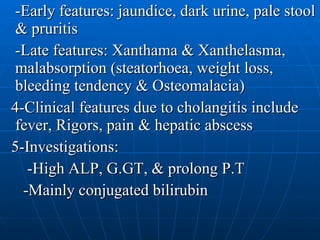
-Early features: jaundice, dark urine, pale stool & pruritis -Late features: Xanthama & Xanthelasma, malabsorption (steatorhoea, weight loss, bleeding tendency & Osteomalacia)  4-Clinical features due to cholangitis include fever, Rigors, pain & hepatic abscess  5-Investigations: -High ALP, G.GT, & prolong P.T -Mainly conjugated bilirubin
-U/S, ERCP, CT & P.T.C, Serology & liver biopsy Underlying cause of Cholestatic jaundice related to clinical features 1-Static or progressive jaundice = Carcinoma  2-Fluccuating jaundice = stone, stricture, Pancreatitis or Choledocal cyst 3-Abdominal pain = stone, Pancreatitis or Choledocal cyst 4-Cholangitis = stone, stricture or choledocal cyst
5-Abdominal scar = stone , stricture 6-Irregular hard Hepatomegly = hepatic carcinoma  7-Palpable G.B =Carcinoma below cystic duct e.g. Ca head of pancreas  8-Abdominal mass = Ca, Pancreatitis (cyst) or Choledochal cyst 9-Occult blood in stools = Ampullary tumour
Work out a case of jaundice Or Abnormal liver function tests 1-Young patient : likely to have viral hepatitis. Ask about history of drugs, alcohol & sexual behaviour  2-Elderly patient with weight loss :- Ca 3-Country of origin (HBV) + travel (HAV) 4-Abdomial pain: biliary obstruction orhepatitis  5-Duration of illness: short history with prodrome suggest HAV as a recent outbreak of jaundice
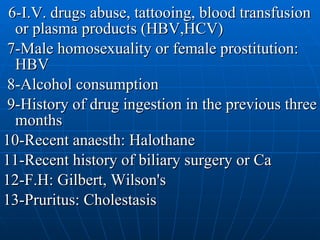
6-I.V. drugs abuse, tattooing, blood transfusion or plasma products (HBV,HCV) 7-Male homosexuality or female prostitution: HBV 8-Alcohol consumption  9-History of drug ingestion in the previous three months 10-Recent anaesth: Halothane  11-Recent history of biliary surgery or Ca 12-F.H: Gilbert, Wilson's  13-Pruritus: Cholestasis
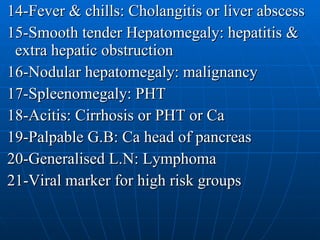
14-Fever & chills: Cholangitis or liver abscess 15-Smooth tender Hepatomegaly: hepatitis & extra hepatic obstruction  16-Nodular hepatomegaly: malignancy  17-Spleenomegaly: PHT 18-Acitis: Cirrhosis or PHT or Ca 19-Palpable G.B: Ca head of pancreas  20-Generalised L.N: Lymphoma  21-Viral marker for high risk groups
22-U/S to exclude extra hepatic Cholestasis ـــــ   dilated ducts ـــــ   level of obstruction ـــــ   cause of obstruction 23-Liver biochemistry  24-CBC & Retics  count 25-Low serum alb. & prolonged PT: chronic liver disease 26-Leucocytosis suggest bacterial infection e.g. Cholangitis or hepatic abscess
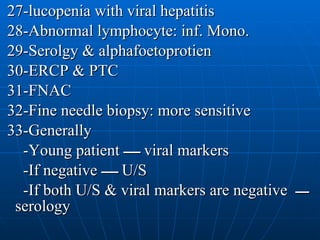
27-lucopenia with viral hepatitis  28-Abnormal lymphocyte: inf. Mono.  29-Serolgy & alphafoetoprotien 30-ERCP & PTC 31-FNAC 32-Fine needle biopsy: more sensitive  33-Generally -Young patient  ـــــ   viral markers -If negative  ـــــ   U/S -If both U/S & viral markers are negative   ــــ   serology
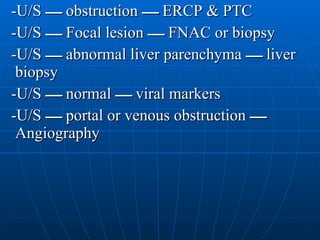
-U/S  ـــــ   obstruction  ـــــ   ERCP & PTC -U/S  ـــــ   Focal lesion  ـــــ   FNAC or biopsy -U/S  ـــــ   abnormal liver parenchyma  ـــــ   liver biopsy -U/S  ـــــ   normal  ـــــ   viral markers -U/S  ـــــ   portal or venous obstruction  ـــــ   Angiography

Jaundice

  • 1.
    JAUNDICE By Dr.Osman Bukhari
  • 2.
  • 3.
    Definition Yellow discolorationof the sclera, mucus membranes & skin from increased serum bilirubin concentration in the body fluids, detectable when serum level is above 3mg/100ml Mechanism 1-Increased production in haemolysis 2-Imparied excretion a) Congenital non-haemolytic hyper bilirubinaemia
  • 4.
    b) Hepatocellular jaundice: acute or chronic parenchymal liver disease c) Cholestasis Haemolytic jaundice 1-Due to increased RBC destruction 2-Jaundice is mild & urine is dark. 3-Anaemia 4-Spleenomegaly +_ 5-Increased uncongugated bilirubin in the blood
  • 5.
    6-Increased urobilinogen inurine in the absence of bile pigments 7-Reticulocytosis 8-Decreased haptoglobin 9-Peripheral blood macrocytosis , polychromasia & red cells abnormality (spherocytosis & sickles ) 10-Bone marrow erythrocytosis with megaloblastic changes from folate deficiency 11-Decreased RBC survival
  • 6.
    . 12-Increased serumL.D.H 13-Normal L.F.T Congenital non haemolytic hyper bilirubinaemia Inherited disorders due to either defective bilirubin uptake, conjugation or excretion 1-Gilberts (unconjugated hyper bilirubinaemia) -Autosomal dominant -Deficient glucuronyl transferase & defective bilirubin uptake from plasma leading to Unconjugated hyper bilirubinaemia
  • 7.
    -Commonest variety affectingyoungs -Mild jaundice which may follow recovery from viral hepatitis or precipitated by infection, fatigue or fasting -May be asymptomatic or dyspeptic symptoms -Normal life spam -No evidence of haemolysis -No treatment but occasionally Phenobarbitone
  • 8.
    2- Crigler –Najjar (unconjugated) -Rare -Type I is A.R in neonates with absent glucuronyl transferase with rapid death from kernictorus -Type 2 is A D in neonates with reduce glucuronyl transferase activity leading to severe jaundice & patient can survive to adult life with Phenobarbitone, photothearapy & liver transplantation
  • 9.
    3- Dubin –Johnson (conjugated) -A.R -Defective canalicular excretion of bilirubin -Any age -Jaundice is mild -Liver histology shows black pigmentation -Normal life span
  • 10.
    4- Rotors (conjugated)-AD -Similar to Dubin – Johnson but no pigmentation in Liver histology
  • 11.
    - Hepatocellular jaundice1-Impaired bilirubin transport to the bile at any point between uptake of unconjugated bilirubin into hepatocytes & transport of conjugated bilirubin into the canaliculae 2-Cholestasis may occur from inflammatory aedema 3-Both conjugated & unconjugated hyper bilirubinanemia 4-Jaundice is variable
  • 12.
    5-Urine is dark6-Increased Amino transferases Cholestatic jaundice (obstruction) 1-Intra hepatic : due to failure of hepatocytes to generate bile flow or obstruction of bile flow in the bile ducts within the liver e.g. PBC, Drugs, Viral hepatitis, pregnancy, primary Sclerosing cholengitis, idiopathic 2-Extra hepatic : due obstruction of bile flow in extra hepatic bile ducts -Choledocholithiasis
  • 13.
  • 14.
  • 15.
    -Carcinoma (Ampullary, Pancreatic,Cholangio carcinoma & secondaries in the porta hepatis -Benign tumours -Cystic fibrosis -parasitic infections -Traumatic biliary stricture -Choledocal cyst -Pancreatitis 3-Clinical features due to Cholestasis include:
  • 16.
    -Early features: jaundice,dark urine, pale stool & pruritis -Late features: Xanthama & Xanthelasma, malabsorption (steatorhoea, weight loss, bleeding tendency & Osteomalacia) 4-Clinical features due to cholangitis include fever, Rigors, pain & hepatic abscess 5-Investigations: -High ALP, G.GT, & prolong P.T -Mainly conjugated bilirubin
  • 17.
    -U/S, ERCP, CT& P.T.C, Serology & liver biopsy Underlying cause of Cholestatic jaundice related to clinical features 1-Static or progressive jaundice = Carcinoma 2-Fluccuating jaundice = stone, stricture, Pancreatitis or Choledocal cyst 3-Abdominal pain = stone, Pancreatitis or Choledocal cyst 4-Cholangitis = stone, stricture or choledocal cyst
  • 18.
    5-Abdominal scar =stone , stricture 6-Irregular hard Hepatomegly = hepatic carcinoma 7-Palpable G.B =Carcinoma below cystic duct e.g. Ca head of pancreas 8-Abdominal mass = Ca, Pancreatitis (cyst) or Choledochal cyst 9-Occult blood in stools = Ampullary tumour
  • 19.
    Work out acase of jaundice Or Abnormal liver function tests 1-Young patient : likely to have viral hepatitis. Ask about history of drugs, alcohol & sexual behaviour 2-Elderly patient with weight loss :- Ca 3-Country of origin (HBV) + travel (HAV) 4-Abdomial pain: biliary obstruction orhepatitis 5-Duration of illness: short history with prodrome suggest HAV as a recent outbreak of jaundice
  • 20.
    6-I.V. drugs abuse,tattooing, blood transfusion or plasma products (HBV,HCV) 7-Male homosexuality or female prostitution: HBV 8-Alcohol consumption 9-History of drug ingestion in the previous three months 10-Recent anaesth: Halothane 11-Recent history of biliary surgery or Ca 12-F.H: Gilbert, Wilson's 13-Pruritus: Cholestasis
  • 21.
    14-Fever & chills:Cholangitis or liver abscess 15-Smooth tender Hepatomegaly: hepatitis & extra hepatic obstruction 16-Nodular hepatomegaly: malignancy 17-Spleenomegaly: PHT 18-Acitis: Cirrhosis or PHT or Ca 19-Palpable G.B: Ca head of pancreas 20-Generalised L.N: Lymphoma 21-Viral marker for high risk groups
  • 22.
    22-U/S to excludeextra hepatic Cholestasis ـــــ dilated ducts ـــــ level of obstruction ـــــ cause of obstruction 23-Liver biochemistry 24-CBC & Retics count 25-Low serum alb. & prolonged PT: chronic liver disease 26-Leucocytosis suggest bacterial infection e.g. Cholangitis or hepatic abscess
  • 23.
    27-lucopenia with viralhepatitis 28-Abnormal lymphocyte: inf. Mono. 29-Serolgy & alphafoetoprotien 30-ERCP & PTC 31-FNAC 32-Fine needle biopsy: more sensitive 33-Generally -Young patient ـــــ viral markers -If negative ـــــ U/S -If both U/S & viral markers are negative ــــ serology
  • 24.
    -U/S ـــــ obstruction ـــــ ERCP & PTC -U/S ـــــ Focal lesion ـــــ FNAC or biopsy -U/S ـــــ abnormal liver parenchyma ـــــ liver biopsy -U/S ـــــ normal ـــــ viral markers -U/S ـــــ portal or venous obstruction ـــــ Angiography