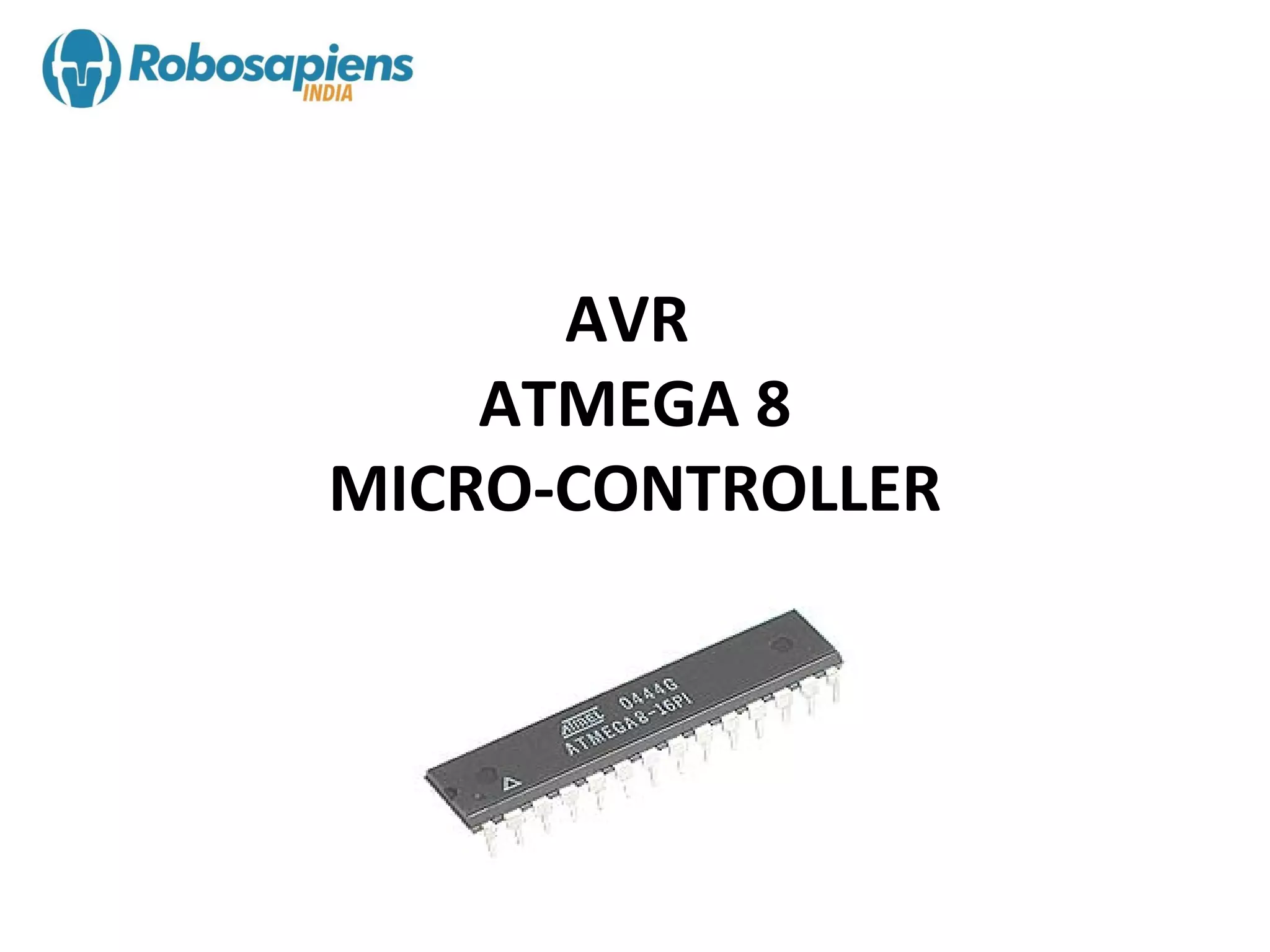
AVR
    ATMEGA 8
MICRO-CONTROLLER
INTRODUCTION
• ATmega8 is a 8-bit microcontroller based on
  the AVR RISC architecture
• By executing powerful instructions in a single
  clock cycle, the ATmega8 achieves throughput
  approaching 1 MIPS per MHz
Contd....
• In order to maximize performance and
  parallelism, the AVR uses a Harvard
  architecture- which separates memories and
  buses for program and data
• Instruction in program memory are executed
  with single level pipelining
• This concept enables instructions to be
  executed in every clock cycle
FEATURES
•   High-performance 8 bit Microcontroller
•   Up to 16 MIPS Throughput at 16 MHz
•   32 x 8 General Purpose Working Registers
•   Six ADC channels in PDIP package
•   Internal Calibrated Oscillator
TYPES OF PACKAGES
• 28-pin PDIP (Plastic Dual In-line Package)
• 32-pin TQFP (Thin Quad film Package)
MEMORY SEGMENTS
• 8K Bytes of Flash program memory
• 512 Bytes EEPROM (Electrically Erasable
  Programmable Read Only Memory)
• 1K Byte Internal RAM (Random Access
  Memory)
Contd....

• Write/Erase Cycles: 10,000 Flash/100,000
  EEPROM
• Data retention: 20 years at 85°C/100 years at
  25°C
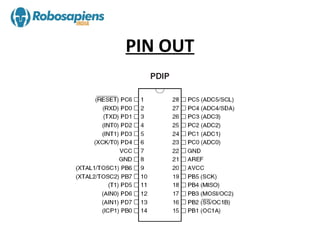
PIN OUT
PIN DESCRIPTION
• VCC Digital supply voltage
• GND Ground
• RESET A low level on this pin for longer than
  the minimum pulse length will generate a
  reset, even if the clock is not running
• AREF The analog reference pin for the A/D
  Converter
Contd....
• AVCC The supply voltage pin for the A/D
  Converter
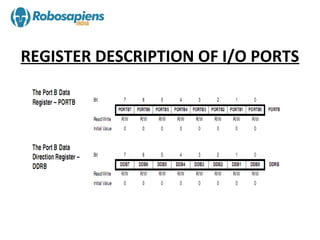
PORTS
• Three ports i.e PortB, PortC, PortD
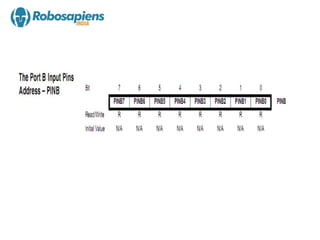
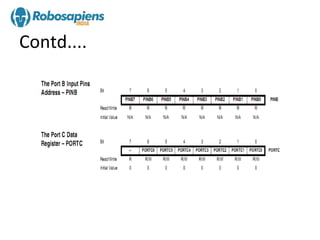
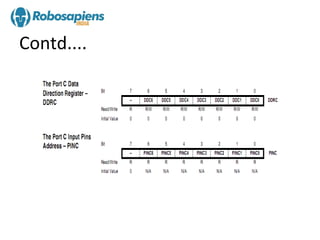
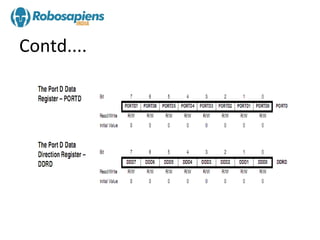
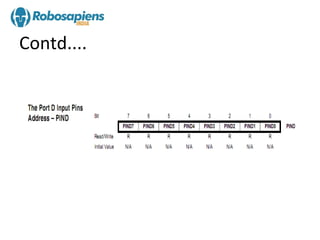
• Three registers associated with every port
 DDRx – Data Direction Register
 PINx – Port input
 PORTx- Port output


*Note – ‘x’ is subscript and could be either of B, C, D
Port B (PB7..PB0)
• Port B is an 8-bit bi-directional I/O port

• Can be used either as a input port or as output
  port ( direction must be specified in
  programming)
REGISTER DESCRIPTION OF I/O PORTS
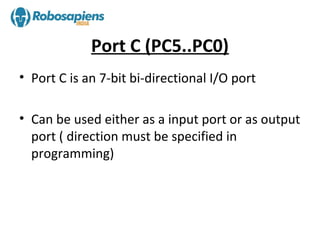
Port C (PC5..PC0)
• Port C is an 7-bit bi-directional I/O port

• Can be used either as a input port or as output
  port ( direction must be specified in
  programming)
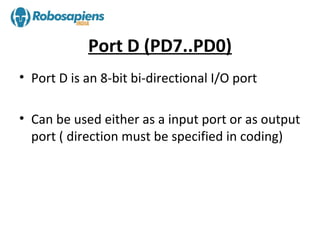
Port D (PD7..PD0)
• Port D is an 8-bit bi-directional I/O port

• Can be used either as a input port or as output
  port ( direction must be specified in coding)
Contd....
Contd....
Contd....
Contd....
Thank you…

A tmega8 basics

  • 1.
    AVR ATMEGA 8 MICRO-CONTROLLER
  • 2.
    INTRODUCTION • ATmega8 isa 8-bit microcontroller based on the AVR RISC architecture • By executing powerful instructions in a single clock cycle, the ATmega8 achieves throughput approaching 1 MIPS per MHz
  • 3.
    Contd.... • In orderto maximize performance and parallelism, the AVR uses a Harvard architecture- which separates memories and buses for program and data • Instruction in program memory are executed with single level pipelining • This concept enables instructions to be executed in every clock cycle
  • 4.
    FEATURES • High-performance 8 bit Microcontroller • Up to 16 MIPS Throughput at 16 MHz • 32 x 8 General Purpose Working Registers • Six ADC channels in PDIP package • Internal Calibrated Oscillator
  • 5.
    TYPES OF PACKAGES •28-pin PDIP (Plastic Dual In-line Package) • 32-pin TQFP (Thin Quad film Package)
  • 6.
    MEMORY SEGMENTS • 8KBytes of Flash program memory • 512 Bytes EEPROM (Electrically Erasable Programmable Read Only Memory) • 1K Byte Internal RAM (Random Access Memory)
  • 7.
    Contd.... • Write/Erase Cycles:10,000 Flash/100,000 EEPROM • Data retention: 20 years at 85°C/100 years at 25°C
  • 8.
  • 9.
    PIN DESCRIPTION • VCCDigital supply voltage • GND Ground • RESET A low level on this pin for longer than the minimum pulse length will generate a reset, even if the clock is not running • AREF The analog reference pin for the A/D Converter
  • 10.
    Contd.... • AVCC Thesupply voltage pin for the A/D Converter
  • 11.
    PORTS • Three portsi.e PortB, PortC, PortD • Three registers associated with every port  DDRx – Data Direction Register  PINx – Port input  PORTx- Port output *Note – ‘x’ is subscript and could be either of B, C, D
  • 12.
    Port B (PB7..PB0) •Port B is an 8-bit bi-directional I/O port • Can be used either as a input port or as output port ( direction must be specified in programming)
  • 13.
  • 15.
    Port C (PC5..PC0) •Port C is an 7-bit bi-directional I/O port • Can be used either as a input port or as output port ( direction must be specified in programming)
  • 16.
    Port D (PD7..PD0) •Port D is an 8-bit bi-directional I/O port • Can be used either as a input port or as output port ( direction must be specified in coding)
  • 17.
  • 18.
  • 19.
  • 20.
  • 21.