The Roman Republic
    Chapter 6, Section 1
The Origins of Rome
   Rome’s Geography
       Site of Rome chosen for its fertile soil and strategic
        location
       Located on Italian Peninsula in the center of the
        Mediterranean Sea.
       Built on seven hills along Tiber River
   The First Romans
       Latins, Greeks, and Etruscans compete for control of the
        region.
       Latins found original settlement of Rome between 1000 B.C.
        and 500 B.C.
       Etruscans native to northern Italy influence Roman
        civilization
The Early Republic
   Early Rulers
     Around 600 B.C. Etruscan kings begin to rule
      Rome.
     Kings build Rome’s first temples and public centers

     Romans overthrow cruel Etruscan kings in 509 B.C.

     Romans found a republic—a government in which
      citizens elect leaders.
The Early Republic
   Patricians and Plebeians
     Different groups struggle for power in early Roman
      Republic
     Patricians—wealthy landowning class that holds
      most of the power
     Plebeians—artisans, merchants and farmers; can
      vote, but cannot rule
           Tribunes—elected representatives who protect Plebeians’
            rights
The Early Republic
   Twelve Tables
     In 451 B.C. officials carve Roman laws on twelve
      tablets.
     Called the Twelve Tables, they become the basis for
      later Roman law.
     Laws confirm the right of all free citizens to the
      protection of the law.
     Citizenship is limited to adult male landowners.

     The Twelve Tables are hung in the Forum
The Early Republic
   Government Under the Republic
     Rome elects two consuls—one to lead the army and
      one to direct government.
     Senate—chosen from Roman upper class; makes
      foreign and domestic policy.
     Democratic assemblies elect tribunes and makes laws
      for common people.
     Dictators are leaders appointed briefly in times of
      crisis.
The Early Republic
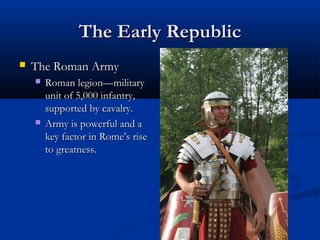
   The Roman Army
       Roman legion—military
        unit of 5,000 infantry,
        supported by cavalry.
       Army is powerful and a
        key factor in Rome’s rise
        to greatness.
Rome Spreads Its Power
   Rome Conquers Italy
     The Romans defeat the Etruscans in the north and
      the Greek city-states in the south.
     By 265 B.C., Rome controls the entire Italian
      peninsula.
     Rome treats the conquered peoples justly. This
      enables Rome to grow.
Rome Spreads Its Power
   Rome’s Commercial Network
     Rome establishes a large trading network.
     Access to the Mediterranean Sea provides many
      trade routes.
     Carthage, a powerful city-state in North Africa, soon
      rivals Rome.
Rome Spreads Its Power
   War with Carthage
       Rome and Carthage begin the Punic Wars—three wars
        between 264 through 146 B.C.
       Rome defeats Carthage and wins Sicily in the first 23-year
        war.
       Hannibal, the Carthaginian general, avenges this defeat in the
        Second Punic War.
            He attacks Italy through Spain and France, but doesn’t take Rome.
   Rome Triumphs
       Roman general Scipio defeats Hannibal in 202 B.C.
       Rome destroys Carthage and enslaves its people in the Third
        Punic War from 149-146 B.C.
Hannibal
crossing the
Alps in the
Second
Punic War

6 1 the roman republic

  • 1.
    The Roman Republic Chapter 6, Section 1
  • 2.
    The Origins ofRome  Rome’s Geography  Site of Rome chosen for its fertile soil and strategic location  Located on Italian Peninsula in the center of the Mediterranean Sea.  Built on seven hills along Tiber River  The First Romans  Latins, Greeks, and Etruscans compete for control of the region.  Latins found original settlement of Rome between 1000 B.C. and 500 B.C.  Etruscans native to northern Italy influence Roman civilization
  • 3.
    The Early Republic  Early Rulers  Around 600 B.C. Etruscan kings begin to rule Rome.  Kings build Rome’s first temples and public centers  Romans overthrow cruel Etruscan kings in 509 B.C.  Romans found a republic—a government in which citizens elect leaders.
  • 4.
    The Early Republic  Patricians and Plebeians  Different groups struggle for power in early Roman Republic  Patricians—wealthy landowning class that holds most of the power  Plebeians—artisans, merchants and farmers; can vote, but cannot rule  Tribunes—elected representatives who protect Plebeians’ rights
  • 5.
    The Early Republic  Twelve Tables  In 451 B.C. officials carve Roman laws on twelve tablets.  Called the Twelve Tables, they become the basis for later Roman law.  Laws confirm the right of all free citizens to the protection of the law.  Citizenship is limited to adult male landowners.  The Twelve Tables are hung in the Forum
  • 6.
    The Early Republic  Government Under the Republic  Rome elects two consuls—one to lead the army and one to direct government.  Senate—chosen from Roman upper class; makes foreign and domestic policy.  Democratic assemblies elect tribunes and makes laws for common people.  Dictators are leaders appointed briefly in times of crisis.
  • 7.
    The Early Republic  The Roman Army  Roman legion—military unit of 5,000 infantry, supported by cavalry.  Army is powerful and a key factor in Rome’s rise to greatness.
  • 8.
    Rome Spreads ItsPower  Rome Conquers Italy  The Romans defeat the Etruscans in the north and the Greek city-states in the south.  By 265 B.C., Rome controls the entire Italian peninsula.  Rome treats the conquered peoples justly. This enables Rome to grow.
  • 9.
    Rome Spreads ItsPower  Rome’s Commercial Network  Rome establishes a large trading network.  Access to the Mediterranean Sea provides many trade routes.  Carthage, a powerful city-state in North Africa, soon rivals Rome.
  • 10.
    Rome Spreads ItsPower  War with Carthage  Rome and Carthage begin the Punic Wars—three wars between 264 through 146 B.C.  Rome defeats Carthage and wins Sicily in the first 23-year war.  Hannibal, the Carthaginian general, avenges this defeat in the Second Punic War.  He attacks Italy through Spain and France, but doesn’t take Rome.  Rome Triumphs  Roman general Scipio defeats Hannibal in 202 B.C.  Rome destroys Carthage and enslaves its people in the Third Punic War from 149-146 B.C.
  • 11.
    Hannibal crossing the Alps inthe Second Punic War