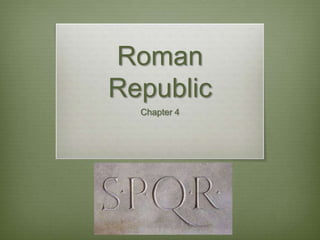
Roman
Republic
  Chapter 4
Beginnings
 Geography
   Not a hindrance as in Greece
   Land good for farming
   No rugged mountains to separate people
Beginnings
 Early Inhabitants
      Came from across Alps
      Settled in N. Italy
      Called “Latins”
      Eventually moved southward
      Settled western coast of Italy

 Portions of Italy colonized by:
      Phoenicians
      Greeks
      Etruscans
Beginnings
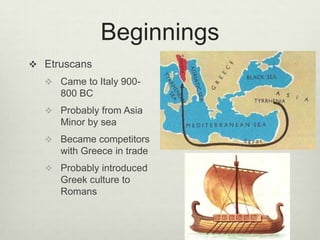
 Etruscans
   Came to Italy 900-
     800 BC
   Probably from Asia
     Minor by sea
   Became competitors
     with Greece in trade
   Probably introduced
     Greek culture to
     Romans
Etruscans
Beginnings
 Founding of Rome
Beginnings
 Founding of Rome
   Villages established near Tibet River and West Coast
     of Italy
   7 villages allied (League of 7 Hills)
      Beginning of city of Rome

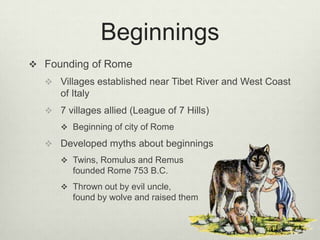
   Developed myths about beginnings
      Twins, Romulus and Remus
        founded Rome 753 B.C.
      Thrown out by evil uncle,
        found by wolve and raised them
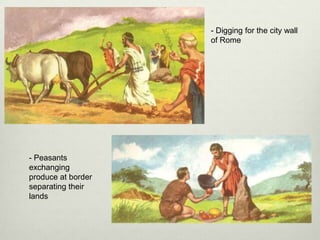
- Digging for the city wall
                    of Rome


- Peasants
exchanging
produce at border
separating their
lands
Early Society & Government
  Basic Unit of society = FAMILY
     Self sufficient and self ruled
     Father authority figure
        Religion, discipline, power of life and death

     Pride in family heritage

              Loyalty           Submit to Authority


                           Hard
                          Working


             Patriotism             Self Control
Early Society & Government

              Tribe
     Clan              Clan
  Family   Family   Family   Family
Early Society & Government


    Patricians            Plebeians
    • Wealthy             • Majority of
      landowners            people
    • Nobility based on   • Common people
      birth               • Inferior class
    • Held high           • Tradesmen,
      positions in          craftsmen,
      society               farmers
Early Society & Government

 Early government = Monarchy
   Monarch chosen by people
   Imperium – absolute authority to govern


   Monarch would advise with senate
View of Early Roman Senate
Early Roman Republic
 509 B.C. overthrew monarchy and established
   republic

                   Consuls


                Senate
              Assemblies
Consul
 ONLY Patricians

 Elected for 1 year terms

 Took care of:
    Every day government affairs
    Commanded army
    Supreme judges
Senate
 Most powerful body in government

 Served the interest of ALL people

 300 elite people appointed for life by consuls

 Took care of:
    Finances
    Pass laws
    Foreign affairs
See
    any
similarities?
Assemblies
 People could express their views

 Voted legislation submitted by consul

 Took care of:
    Declare war
    Elected high
      ranking officials
    Power to Veto
Struggles within

                        Republic
    Patricians controlled government
     Plebeians had no voice in government
     For 200 years struggled for representation

 Constant warfare with neighbors made Patricians dependent
    upon plebeians for army force
     Plebeians demanded more say in gov’t or else no more army
       participation

 Plebeians get their own assembly and gov’t. officials
     Voted resolutions  plebiscites (apply only to plebeians)
     Tribune – elected official who protected plebeian rights (rights of
       common people)
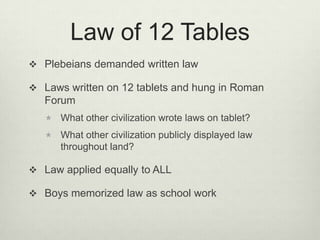
Law of 12 Tables
 Plebeians demanded written law

 Laws written on 12 tablets and hung in Roman
   Forum
    What other civilization wrote laws on tablet?
    What other civilization publicly displayed law
      throughout land?

 Law applied equally to ALL

 Boys memorized law as school work
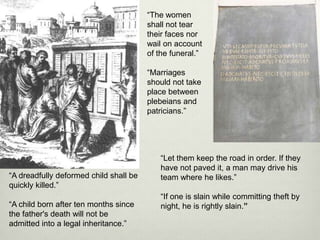
“The women
                                        shall not tear
                                        their faces nor
                                        wail on account
                                        of the funeral.”

                                        “Marriages
                                        should not take
                                        place between
                                        plebeians and
                                        patricians.”


                                           “Let them keep the road in order. If they
                                           have not paved it, a man may drive his
“A dreadfully deformed child shall be      team where he likes.”
quickly killed.”
                                           “If one is slain while committing theft by
“A child born after ten months since       night, he is rightly slain.”
the father's death will not be
admitted into a legal inheritance.”
Changes in Society
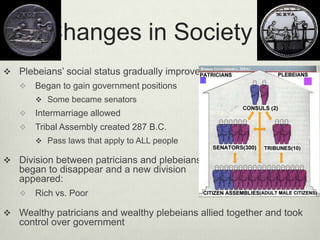
 Plebeians’ social status gradually improved
      Began to gain government positions
        Some became senators
      Intermarriage allowed
      Tribal Assembly created 287 B.C.
        Pass laws that apply to ALL people

 Division between patricians and plebeians
   began to disappear and a new division
   appeared:
      Rich vs. Poor

 Wealthy patricians and wealthy plebeians allied together and took
   control over government
The Mediterranean – Roman Sea
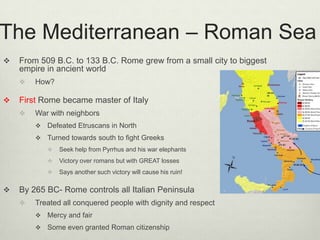
   From 509 B.C. to 133 B.C. Rome grew from a small city to biggest
    empire in ancient world
       How?

   First Rome became master of Italy
       War with neighbors
           Defeated Etruscans in North
           Turned towards south to fight Greeks
               Seek help from Pyrrhus and his war elephants
               Victory over romans but with GREAT losses
               Says another such victory will cause his ruin!

   By 265 BC- Rome controls all Italian Peninsula
       Treated all conquered people with dignity and respect
           Mercy and fair
           Some even granted Roman citizenship
Rome dominates Western
    Mediterranean
Rome dominates Western
                Mediterranean B.C. Carthage war
                            241
 First Punic War (264 B.C. – 241 B.C.)   weary, signs peace treaty
                                             Rome wins Sicily
    Fight over island of Sicily          Carthage has to pay war
                                                     loss
 Only way to win is to beat Carthage navy supremacy
    Built their own boats
    New fighting tactics
       Instead of ramming
         into boats
       Drop plank onto
         enemy boat
       Soldiers run over and
         take over
Rome dominates Western

                   Mediterranean
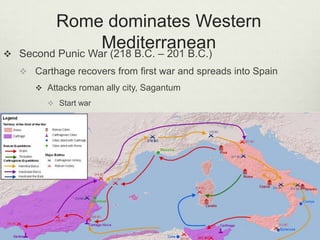
    Second Punic War (218 B.C. – 201 B.C.)
     Carthage recovers from first war and spreads into Spain
        Attacks roman ally city, Sagantum
           Start war
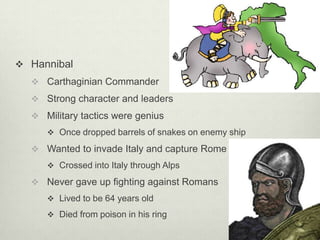
 Hannibal
   Carthaginian Commander
   Strong character and leaders
   Military tactics were genius
      Once dropped barrels of snakes on enemy ship

   Wanted to invade Italy and capture Rome
      Crossed into Italy through Alps

   Never gave up fighting against Romans
      Lived to be 64 years old

      Died from poison in his ring
Hannibal
crossing
the Alps in
the
Second
Punic War
 Battle of Cannae
    Carthage losses- 6,000
    Rome losses – 60,000


 It took Rome a whole
   generation to recover from
   this loss.
 Scipio
    Young Roman commander
    Defeated Carthaginian forces in Spain
    Moved on to attack Carthage, N. Africa
    Hannibal called home to defend Carthage
    Scipio and Romans won victory before he got home
       Battle of Zama (202 B.C.)

 Carthage had to give up all territory outside of N. Africa

 Reduce fleet to 10 vessels

 Pay Rome war damages
3rd      Punic War
 149 B.C. – 146 B.C.

 Romans fearful and jealous of Carthage prosperity

 Carthage breaks one provision of peace treaty

 Rome demands they move city ten miles inland
    This would have hurt their trade and commerce
    Carthage refuses
    Fighting begins, 3 year siege
    Rome takes city and destroys it
       Sells inhabitants into slavery
       Land becomes new roman province = Africa
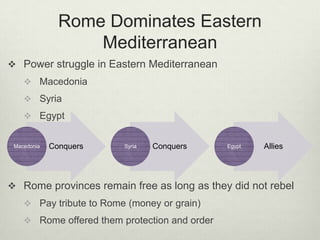
Rome Dominates Eastern
                   Mediterranean
 Power struggle in Eastern Mediterranean
     Macedonia
     Syria
     Egypt


 Macedonia   Conquers    Syria   Conquers      Egypt   Allies


 Rome provinces remain free as long as they did not rebel
     Pay tribute to Rome (money or grain)
     Rome offered them protection and order
Time for a parade!

Chapter 4 Roman Republic

  • 1.
  • 2.
    Beginnings  Geography  Not a hindrance as in Greece  Land good for farming  No rugged mountains to separate people
  • 3.
    Beginnings  Early Inhabitants  Came from across Alps  Settled in N. Italy  Called “Latins”  Eventually moved southward  Settled western coast of Italy  Portions of Italy colonized by:  Phoenicians  Greeks  Etruscans
  • 5.
    Beginnings  Etruscans  Came to Italy 900- 800 BC  Probably from Asia Minor by sea  Became competitors with Greece in trade  Probably introduced Greek culture to Romans
  • 6.
  • 7.
  • 8.
    Beginnings  Founding ofRome  Villages established near Tibet River and West Coast of Italy  7 villages allied (League of 7 Hills)  Beginning of city of Rome  Developed myths about beginnings  Twins, Romulus and Remus founded Rome 753 B.C.  Thrown out by evil uncle, found by wolve and raised them
  • 9.
    - Digging forthe city wall of Rome - Peasants exchanging produce at border separating their lands
  • 10.
    Early Society &Government  Basic Unit of society = FAMILY  Self sufficient and self ruled  Father authority figure  Religion, discipline, power of life and death  Pride in family heritage Loyalty Submit to Authority Hard Working Patriotism Self Control
  • 11.
    Early Society &Government Tribe Clan Clan Family Family Family Family
  • 12.
    Early Society &Government Patricians Plebeians • Wealthy • Majority of landowners people • Nobility based on • Common people birth • Inferior class • Held high • Tradesmen, positions in craftsmen, society farmers
  • 13.
    Early Society &Government  Early government = Monarchy  Monarch chosen by people  Imperium – absolute authority to govern  Monarch would advise with senate
  • 14.
    View of EarlyRoman Senate
  • 15.
    Early Roman Republic 509 B.C. overthrew monarchy and established republic Consuls Senate Assemblies
  • 16.
    Consul  ONLY Patricians Elected for 1 year terms  Took care of:  Every day government affairs  Commanded army  Supreme judges
  • 17.
    Senate  Most powerfulbody in government  Served the interest of ALL people  300 elite people appointed for life by consuls  Took care of:  Finances  Pass laws  Foreign affairs
  • 18.
    See any similarities?
  • 19.
    Assemblies  People couldexpress their views  Voted legislation submitted by consul  Took care of:  Declare war  Elected high ranking officials  Power to Veto
  • 20.
    Struggles within  Republic Patricians controlled government  Plebeians had no voice in government  For 200 years struggled for representation  Constant warfare with neighbors made Patricians dependent upon plebeians for army force  Plebeians demanded more say in gov’t or else no more army participation  Plebeians get their own assembly and gov’t. officials  Voted resolutions  plebiscites (apply only to plebeians)  Tribune – elected official who protected plebeian rights (rights of common people)
  • 21.
    Law of 12Tables  Plebeians demanded written law  Laws written on 12 tablets and hung in Roman Forum  What other civilization wrote laws on tablet?  What other civilization publicly displayed law throughout land?  Law applied equally to ALL  Boys memorized law as school work
  • 22.
    “The women shall not tear their faces nor wail on account of the funeral.” “Marriages should not take place between plebeians and patricians.” “Let them keep the road in order. If they have not paved it, a man may drive his “A dreadfully deformed child shall be team where he likes.” quickly killed.” “If one is slain while committing theft by “A child born after ten months since night, he is rightly slain.” the father's death will not be admitted into a legal inheritance.”
  • 23.
    Changes in Society Plebeians’ social status gradually improved  Began to gain government positions  Some became senators  Intermarriage allowed  Tribal Assembly created 287 B.C.  Pass laws that apply to ALL people  Division between patricians and plebeians began to disappear and a new division appeared:  Rich vs. Poor  Wealthy patricians and wealthy plebeians allied together and took control over government
  • 24.
    The Mediterranean –Roman Sea  From 509 B.C. to 133 B.C. Rome grew from a small city to biggest empire in ancient world  How?  First Rome became master of Italy  War with neighbors  Defeated Etruscans in North  Turned towards south to fight Greeks  Seek help from Pyrrhus and his war elephants  Victory over romans but with GREAT losses  Says another such victory will cause his ruin!  By 265 BC- Rome controls all Italian Peninsula  Treated all conquered people with dignity and respect  Mercy and fair  Some even granted Roman citizenship
  • 25.
  • 26.
    Rome dominates Western Mediterranean B.C. Carthage war 241  First Punic War (264 B.C. – 241 B.C.) weary, signs peace treaty Rome wins Sicily  Fight over island of Sicily Carthage has to pay war loss  Only way to win is to beat Carthage navy supremacy  Built their own boats  New fighting tactics  Instead of ramming into boats  Drop plank onto enemy boat  Soldiers run over and take over
  • 28.
    Rome dominates Western  Mediterranean Second Punic War (218 B.C. – 201 B.C.)  Carthage recovers from first war and spreads into Spain  Attacks roman ally city, Sagantum  Start war
  • 29.
     Hannibal  Carthaginian Commander  Strong character and leaders  Military tactics were genius  Once dropped barrels of snakes on enemy ship  Wanted to invade Italy and capture Rome  Crossed into Italy through Alps  Never gave up fighting against Romans  Lived to be 64 years old  Died from poison in his ring
  • 30.
  • 31.
     Battle ofCannae  Carthage losses- 6,000  Rome losses – 60,000  It took Rome a whole generation to recover from this loss.
  • 32.
     Scipio  Young Roman commander  Defeated Carthaginian forces in Spain  Moved on to attack Carthage, N. Africa  Hannibal called home to defend Carthage  Scipio and Romans won victory before he got home  Battle of Zama (202 B.C.)  Carthage had to give up all territory outside of N. Africa  Reduce fleet to 10 vessels  Pay Rome war damages
  • 33.
    3rd Punic War  149 B.C. – 146 B.C.  Romans fearful and jealous of Carthage prosperity  Carthage breaks one provision of peace treaty  Rome demands they move city ten miles inland  This would have hurt their trade and commerce  Carthage refuses  Fighting begins, 3 year siege  Rome takes city and destroys it  Sells inhabitants into slavery  Land becomes new roman province = Africa
  • 36.
    Rome Dominates Eastern Mediterranean  Power struggle in Eastern Mediterranean  Macedonia  Syria  Egypt Macedonia Conquers Syria Conquers Egypt Allies  Rome provinces remain free as long as they did not rebel  Pay tribute to Rome (money or grain)  Rome offered them protection and order
  • 37.
    Time for aparade!

Editor's Notes

  • #2 SPQR means : The Senate and People of RomeThe way we use USA today they used SPQR