Chapter 5.2 & 5.3
Cost, Revenue and
Profit
LINDQUIST - ECONOMICS
Total Revenue
Total amount earned by a firm from the
sale of its products
Total Revenue = price times output
Price x Amount of units sold
Marginal Revenue =Extra revenue from
the sale of one additional unit of output.
Costs
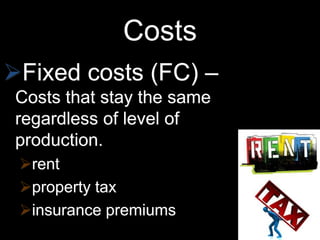
Fixed costs (FC) –
Costs that stay the same
regardless of level of
production.
rent
property tax
insurance premiums
Costs
Fixed costs
Variable costs (VC) -
costs that change with output or
Production levels change
labor
Materials/INPUTS
capital goods
Costs
Fixed cost + Variable
cost = Total Cost (TC)
Costs
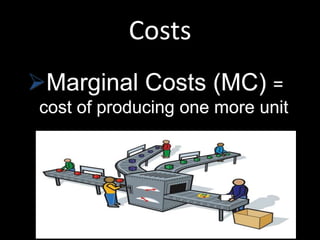
Marginal Costs (MC) =
cost of producing one more unit
E-Commerce Example
• Companies such as Amazon.com have
been able to offer a wide range of
products while keeping their overhead low.
• What helps e-commerce (Electronic
Businesses) firms to reduce cost?
– E-Comerce does not have to pay rent or keep
large inventories. Traditional stores have
MORE FIXED COSTS
Profit/Loss
Profit/Loss = Total Revenue
minus Total Cost (TR-TC)
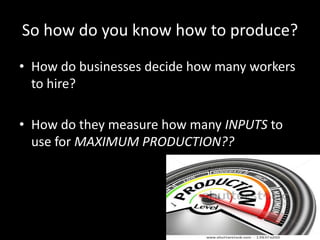
So how do you know how to produce?
• How do businesses decide how many workers
to hire?
• How do they measure how many INPUTS to
use for MAXIMUM PRODUCTION??
Businesses Decisions
• Total Product: total output or production by a
firm
• Output: Stuff the business produces
• Inputs: Stuff that was necessary to produce
the output.
• Marginal Product: Extra output due to the
addition of one more unit of input
Stages of Production
• STAGE 1: INCREASING MARGINAL
RETURNS
– Specialization of labor
• STAGE 2: DECREASING or Diminishing
Marginal Returns
– Law of diminishing returns – Stage where
output increases at a decreasing rate
• STAGE 3: NEGATIVE MARGINAL
RETURNS
– Workers in the way

Ch 5.2 and_5.3_notes

  • 1.
    Chapter 5.2 &5.3 Cost, Revenue and Profit LINDQUIST - ECONOMICS
  • 2.
    Total Revenue Total amountearned by a firm from the sale of its products Total Revenue = price times output Price x Amount of units sold Marginal Revenue =Extra revenue from the sale of one additional unit of output.
  • 3.
    Costs Fixed costs (FC)– Costs that stay the same regardless of level of production. rent property tax insurance premiums
  • 4.
    Costs Fixed costs Variable costs(VC) - costs that change with output or Production levels change labor Materials/INPUTS capital goods
  • 5.
    Costs Fixed cost +Variable cost = Total Cost (TC)
  • 6.
    Costs Marginal Costs (MC)= cost of producing one more unit
  • 7.
    E-Commerce Example • Companiessuch as Amazon.com have been able to offer a wide range of products while keeping their overhead low. • What helps e-commerce (Electronic Businesses) firms to reduce cost? – E-Comerce does not have to pay rent or keep large inventories. Traditional stores have MORE FIXED COSTS
  • 8.
    Profit/Loss Profit/Loss = TotalRevenue minus Total Cost (TR-TC)
  • 9.
    So how doyou know how to produce? • How do businesses decide how many workers to hire? • How do they measure how many INPUTS to use for MAXIMUM PRODUCTION??
  • 10.
    Businesses Decisions • TotalProduct: total output or production by a firm • Output: Stuff the business produces • Inputs: Stuff that was necessary to produce the output. • Marginal Product: Extra output due to the addition of one more unit of input
  • 11.
    Stages of Production •STAGE 1: INCREASING MARGINAL RETURNS – Specialization of labor • STAGE 2: DECREASING or Diminishing Marginal Returns – Law of diminishing returns – Stage where output increases at a decreasing rate • STAGE 3: NEGATIVE MARGINAL RETURNS – Workers in the way