Get your journals and return to your
seats. Read the blurb below:
The Epic of Gilgamesh is one of the
world’s oldest pieces of literature from
Ancient Mesopotamia. It describes the
life of a legendary king, Gilgamesh
around 2700 BC. The main theme of
the poem is death and the
understanding that death comes to all
people.
Utnapishtim said to him, to Gilgamesh:…
“A secret of the gods let me tell you.
There is a plant. Its roots go deep
Its [thorn] will prick you hand like a bramble
If you get your hands on this plant, you’ll have
eternal life”
Gilgamesh, on hearing this…bound heavy stones to his feet
They dragged him down into the abyss and he saw the plant.
He seized the plant, though it cut his hand;
He cut the heavy stones from his feet;
The sea cast him up onto its shore.
Gilgamesh said to Urshanabi the boatman:
“Urshanabi, this is the plant…by which man can get life within…
Its name is The-Old-Man-Will-Be-Made-Young.
I too will eat it, and return to what I was in my youth.”
Gilgamesh saw a pool of cool water.
He went down into it and bathed in the water.
A snake smelled the fragrance of the plant.
It came up through the water and carried the plant away.
As it turned it threw off its skin
That day Gilgamesh sat down weeping.
Over his face the tears flowed.
He took the hand of Urshanabi the Boatman.
“For whom, Urshanabi, do my arms toil?
For whom has the blood of my heart dried up?
I have not won any good for myself;
It’s the snake who has won good fortune.”
Now think about what you heard and answer
the following questions in your journals
1. Why does Gilgamesh want the plant Utnapishtim
tells him about?
2. Why does Gilgamesh weep at the end of the
passage?
3. What does a snake do in nature that makes it a
good choice as the animal who ate the plant?
4. What is it about the geography of the ancient
world that might help you understand why The
Epic of Gilgamesh is centered on death?
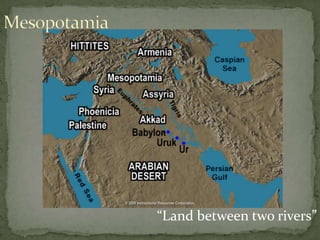
“Land between two rivers”
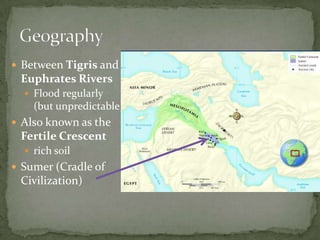
 Between Tigris and
Euphrates Rivers
 Flood regularly
(but unpredictable)
 Also known as the
Fertile Crescent
 rich soil
 Sumer (Cradle of
Civilization)
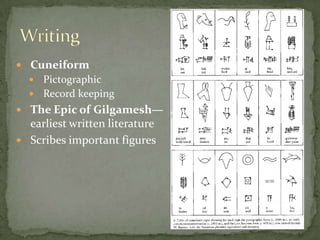
 Cuneiform
 Pictographic
 Record keeping
 The Epic of Gilgamesh—
earliest written literature
 Scribes important figures
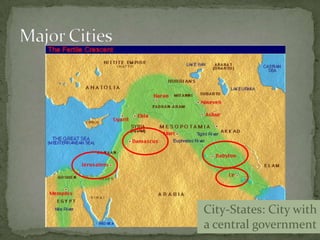
City-States: City with
a central government
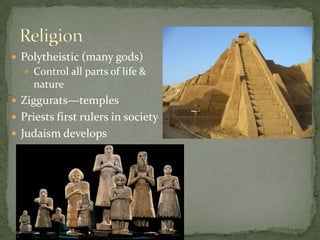
 Polytheistic (many gods)
 Control all parts of life &
nature
 Ziggurats—temples
 Priests first rulers in society
 Judaism develops
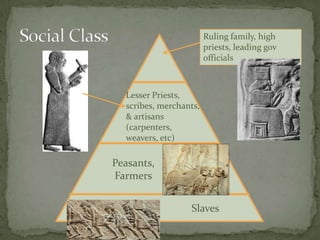
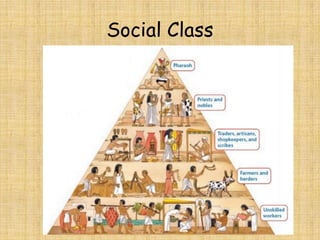
Ruling family, high
priests, leading gov
officials
Peasants,
Farmers
Slaves
Lesser Priests,
scribes, merchants,
& artisans
(carpenters,
weavers, etc)
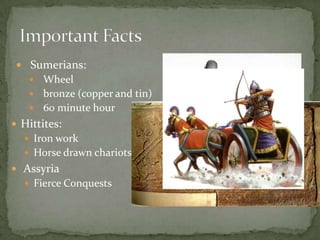
 Sumerians:
 Wheel
 bronze (copper and tin)
 60 minute hour
 Hittites:
 Iron work
 Horse drawn chariots
 Assyria
 Fierce Conquests
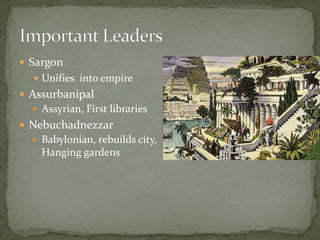
 Sargon
 Unifies into empire
 Assurbanipal
 Assyrian, First libraries
 Nebuchadnezzar
 Babylonian, rebuilds city,
Hanging gardens
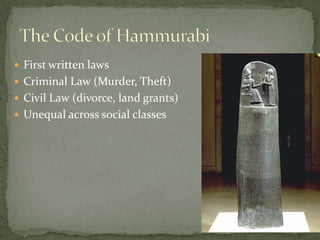
 First written laws
 Criminal Law (Murder, Theft)
 Civil Law (divorce, land grants)
 Unequal across social classes
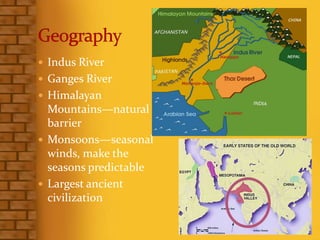
 Indus River
 Ganges River
 Himalayan
Mountains—natural
barrier
 Monsoons—seasonal
winds, make the
seasons predictable
 Largest ancient
civilization
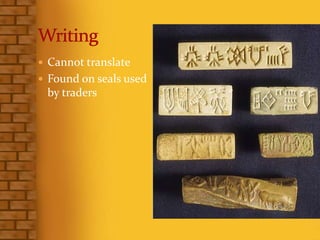
 Cannot translate
 Found on seals used
by traders
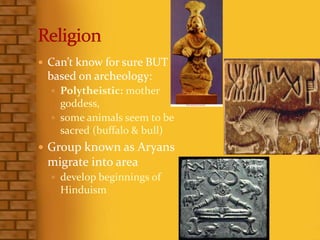
 Can’t know for sure BUT
based on archeology:
 Polytheistic: mother
goddess,
 some animals seem to be
sacred (buffalo & bull)
 Group known as Aryans
migrate into area
 develop beginnings of
Hinduism
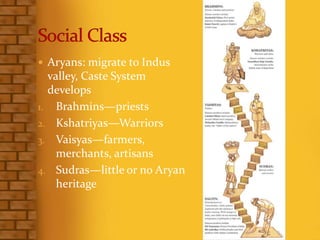
 Aryans: migrate to Indus
valley, Caste System
develops
1. Brahmins—priests
2. Kshatriyas—Warriors
3. Vaisyas—farmers,
merchants, artisans
4. Sudras—little or no Aryan
heritage
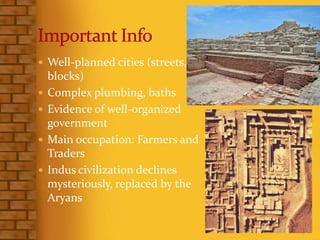
 Well-planned cities (streets,
blocks)
 Complex plumbing, baths
 Evidence of well-organized
government
 Main occupation: Farmers and
Traders
 Indus civilization declines
mysteriously, replaced by the
Aryans
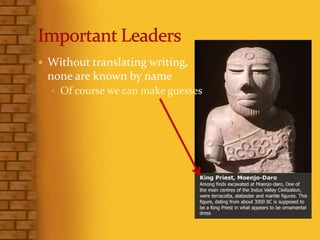
 Without translating writing,
none are known by name
 Of course we can make guesses
China
Warning:
Chinese and English are not perfect
translations, many words will be
spelled differently (sometimes very)
For Example: Zhou and Jo
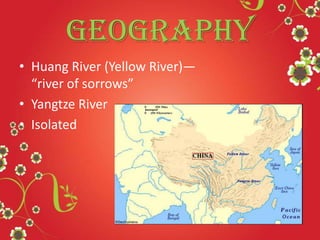
Geography
• Huang River (Yellow River)—
“river of sorrows”
• Yangtze River
• Isolated
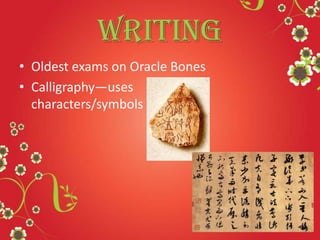
Writing
• Oldest exams on Oracle Bones
• Calligraphy—uses
characters/symbols
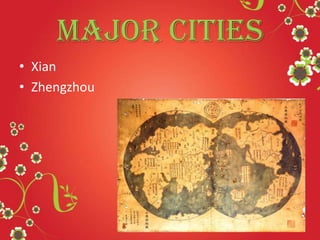
Major Cities
• Xian
• Zhengzhou
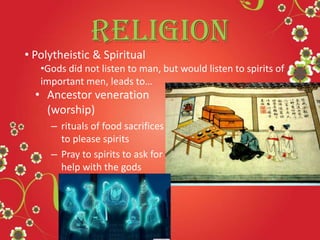
Religion
• Ancestor veneration
(worship)
– rituals of food sacrifices
to please spirits
– Pray to spirits to ask for
help with the gods
• Polytheistic & Spiritual
•Gods did not listen to man, but would listen to spirits of
important men, leads to…
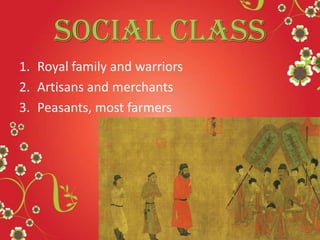
Social Class
1. Royal family and warriors
2. Artisans and merchants
3. Peasants, most farmers
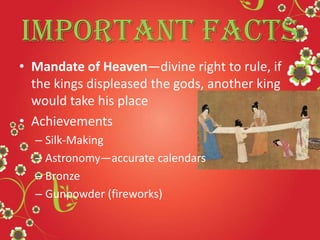
Important Facts
• Mandate of Heaven—divine right to rule, if
the kings displeased the gods, another king
would take his place
• Achievements
– Silk-Making
– Astronomy—accurate calendars
– Bronze
– Gunpowder (fireworks)
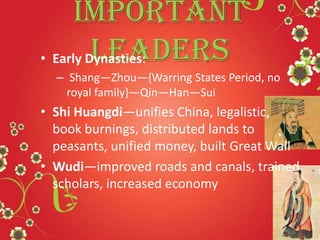
Important
Leaders• Early Dynasties:
– Shang—Zhou—{Warring States Period, no
royal family}—Qin—Han—Sui
• Shi Huangdi—unifies China, legalistic,
book burnings, distributed lands to
peasants, unified money, built Great Wall
• Wudi—improved roads and canals, trained
scholars, increased economy
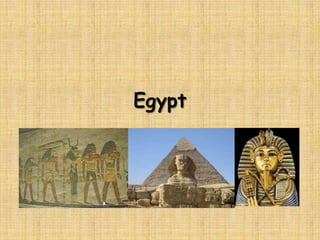
Egypt
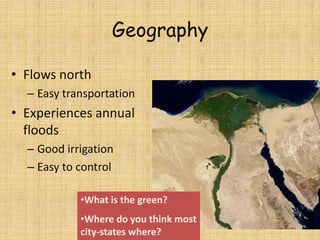
Geography
• Flows north
– Easy transportation
• Experiences annual
floods
– Good irrigation
– Easy to control
•What is the green?
•Where do you think most
city-states where?
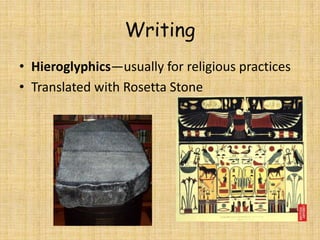
Writing
• Hieroglyphics—usually for religious practices
• Translated with Rosetta Stone
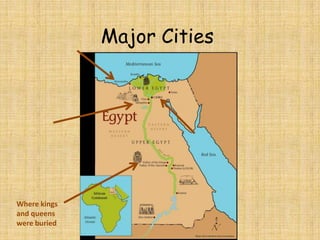
Major Cities
Where kings
and queens
were buried
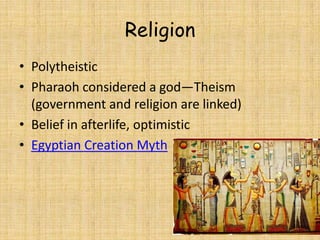
Religion
• Polytheistic
• Pharaoh considered a god—Theism
(government and religion are linked)
• Belief in afterlife, optimistic
• Egyptian Creation Myth
Social Class
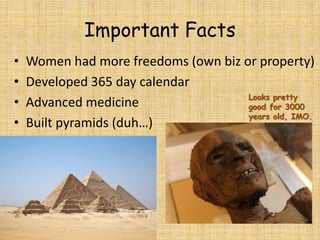
Important Facts
• Women had more freedoms (own biz or property)
• Developed 365 day calendar
• Advanced medicine
• Built pyramids (duh…)
Looks pretty
good for 3000
years old, IMO.
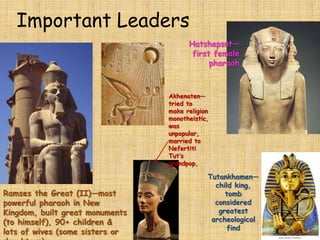
Important Leaders
Hatshepsut—
first female
pharaoh
Tutankhamen—
child king,
tomb
considered
greatest
archeological
find
Ramses the Great (II)—most
powerful pharaoh in New
Kingdom, built great monuments
(to himself), 90+ children &
lots of wives (some sisters or
Akhenaten—
tried to
make religion
monotheistic,
was
unpopular,
married to
Nefertiti
Tut’s
grandpop,

River Valley Civilizations

  • 1.
    Get your journalsand return to your seats. Read the blurb below: The Epic of Gilgamesh is one of the world’s oldest pieces of literature from Ancient Mesopotamia. It describes the life of a legendary king, Gilgamesh around 2700 BC. The main theme of the poem is death and the understanding that death comes to all people.
  • 2.
    Utnapishtim said tohim, to Gilgamesh:… “A secret of the gods let me tell you. There is a plant. Its roots go deep Its [thorn] will prick you hand like a bramble If you get your hands on this plant, you’ll have eternal life” Gilgamesh, on hearing this…bound heavy stones to his feet They dragged him down into the abyss and he saw the plant. He seized the plant, though it cut his hand; He cut the heavy stones from his feet; The sea cast him up onto its shore. Gilgamesh said to Urshanabi the boatman: “Urshanabi, this is the plant…by which man can get life within… Its name is The-Old-Man-Will-Be-Made-Young. I too will eat it, and return to what I was in my youth.”
  • 3.
    Gilgamesh saw apool of cool water. He went down into it and bathed in the water. A snake smelled the fragrance of the plant. It came up through the water and carried the plant away. As it turned it threw off its skin That day Gilgamesh sat down weeping. Over his face the tears flowed. He took the hand of Urshanabi the Boatman. “For whom, Urshanabi, do my arms toil? For whom has the blood of my heart dried up? I have not won any good for myself; It’s the snake who has won good fortune.”
  • 4.
    Now think aboutwhat you heard and answer the following questions in your journals 1. Why does Gilgamesh want the plant Utnapishtim tells him about? 2. Why does Gilgamesh weep at the end of the passage? 3. What does a snake do in nature that makes it a good choice as the animal who ate the plant? 4. What is it about the geography of the ancient world that might help you understand why The Epic of Gilgamesh is centered on death?
  • 5.
  • 6.
     Between Tigrisand Euphrates Rivers  Flood regularly (but unpredictable)  Also known as the Fertile Crescent  rich soil  Sumer (Cradle of Civilization)
  • 7.
     Cuneiform  Pictographic Record keeping  The Epic of Gilgamesh— earliest written literature  Scribes important figures
  • 8.
    City-States: City with acentral government
  • 9.
     Polytheistic (manygods)  Control all parts of life & nature  Ziggurats—temples  Priests first rulers in society  Judaism develops
  • 10.
    Ruling family, high priests,leading gov officials Peasants, Farmers Slaves Lesser Priests, scribes, merchants, & artisans (carpenters, weavers, etc)
  • 11.
     Sumerians:  Wheel bronze (copper and tin)  60 minute hour  Hittites:  Iron work  Horse drawn chariots  Assyria  Fierce Conquests
  • 12.
     Sargon  Unifiesinto empire  Assurbanipal  Assyrian, First libraries  Nebuchadnezzar  Babylonian, rebuilds city, Hanging gardens
  • 13.
     First writtenlaws  Criminal Law (Murder, Theft)  Civil Law (divorce, land grants)  Unequal across social classes
  • 15.
     Indus River Ganges River  Himalayan Mountains—natural barrier  Monsoons—seasonal winds, make the seasons predictable  Largest ancient civilization
  • 16.
     Cannot translate Found on seals used by traders
  • 18.
     Can’t knowfor sure BUT based on archeology:  Polytheistic: mother goddess,  some animals seem to be sacred (buffalo & bull)  Group known as Aryans migrate into area  develop beginnings of Hinduism
  • 19.
     Aryans: migrateto Indus valley, Caste System develops 1. Brahmins—priests 2. Kshatriyas—Warriors 3. Vaisyas—farmers, merchants, artisans 4. Sudras—little or no Aryan heritage
  • 20.
     Well-planned cities(streets, blocks)  Complex plumbing, baths  Evidence of well-organized government  Main occupation: Farmers and Traders  Indus civilization declines mysteriously, replaced by the Aryans
  • 21.
     Without translatingwriting, none are known by name  Of course we can make guesses
  • 22.
    China Warning: Chinese and Englishare not perfect translations, many words will be spelled differently (sometimes very) For Example: Zhou and Jo
  • 23.
    Geography • Huang River(Yellow River)— “river of sorrows” • Yangtze River • Isolated
  • 24.
    Writing • Oldest examson Oracle Bones • Calligraphy—uses characters/symbols
  • 25.
  • 26.
    Religion • Ancestor veneration (worship) –rituals of food sacrifices to please spirits – Pray to spirits to ask for help with the gods • Polytheistic & Spiritual •Gods did not listen to man, but would listen to spirits of important men, leads to…
  • 27.
    Social Class 1. Royalfamily and warriors 2. Artisans and merchants 3. Peasants, most farmers
  • 28.
    Important Facts • Mandateof Heaven—divine right to rule, if the kings displeased the gods, another king would take his place • Achievements – Silk-Making – Astronomy—accurate calendars – Bronze – Gunpowder (fireworks)
  • 29.
    Important Leaders• Early Dynasties: –Shang—Zhou—{Warring States Period, no royal family}—Qin—Han—Sui • Shi Huangdi—unifies China, legalistic, book burnings, distributed lands to peasants, unified money, built Great Wall • Wudi—improved roads and canals, trained scholars, increased economy
  • 30.
  • 31.
    Geography • Flows north –Easy transportation • Experiences annual floods – Good irrigation – Easy to control •What is the green? •Where do you think most city-states where?
  • 32.
    Writing • Hieroglyphics—usually forreligious practices • Translated with Rosetta Stone
  • 33.
    Major Cities Where kings andqueens were buried
  • 34.
    Religion • Polytheistic • Pharaohconsidered a god—Theism (government and religion are linked) • Belief in afterlife, optimistic • Egyptian Creation Myth
  • 35.
  • 36.
    Important Facts • Womenhad more freedoms (own biz or property) • Developed 365 day calendar • Advanced medicine • Built pyramids (duh…) Looks pretty good for 3000 years old, IMO.
  • 37.
    Important Leaders Hatshepsut— first female pharaoh Tutankhamen— childking, tomb considered greatest archeological find Ramses the Great (II)—most powerful pharaoh in New Kingdom, built great monuments (to himself), 90+ children & lots of wives (some sisters or Akhenaten— tried to make religion monotheistic, was unpopular, married to Nefertiti Tut’s grandpop,