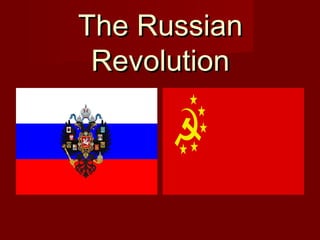
The RussianThe Russian
RevolutionRevolution
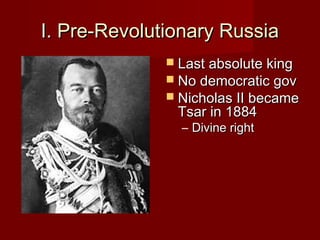
I. Pre-Revolutionary RussiaI. Pre-Revolutionary Russia
 Last absolute kingLast absolute king
 No democratic govNo democratic gov
 Nicholas II becameNicholas II became
Tsar in 1884Tsar in 1884
– Divine rightDivine right
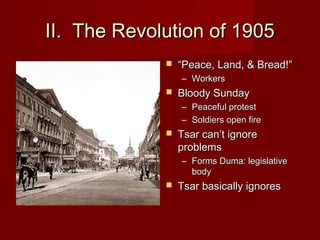
II. The Revolution of 1905II. The Revolution of 1905
 ““Peace, Land, & Bread!”Peace, Land, & Bread!”
– WorkersWorkers
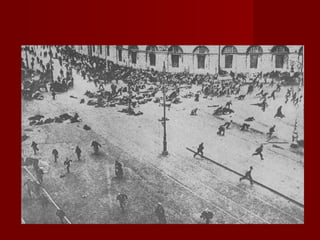
 Bloody SundayBloody Sunday
– Peaceful protestPeaceful protest
– Soldiers open fireSoldiers open fire
 Tsar can’t ignoreTsar can’t ignore
problemsproblems
– Forms Duma: legislativeForms Duma: legislative
bodybody
 Tsar basically ignoresTsar basically ignores
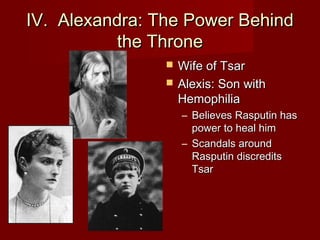
IV. Alexandra: The Power BehindIV. Alexandra: The Power Behind
the Thronethe Throne
 Wife of TsarWife of Tsar
 Alexis: Son withAlexis: Son with
HemophiliaHemophilia
– Believes Rasputin hasBelieves Rasputin has
power to heal himpower to heal him
– Scandals aroundScandals around
Rasputin discreditsRasputin discredits
TsarTsar
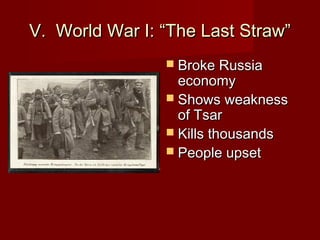
V. World War I: “The Last Straw”V. World War I: “The Last Straw”
 Broke RussiaBroke Russia
economyeconomy
 Shows weaknessShows weakness
of Tsarof Tsar
 Kills thousandsKills thousands
 People upsetPeople upset
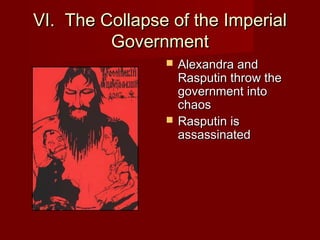
VI. The Collapse of the ImperialVI. The Collapse of the Imperial
GovernmentGovernment
 Alexandra andAlexandra and
Rasputin throw theRasputin throw the
government intogovernment into
chaoschaos
 Rasputin isRasputin is
assassinatedassassinated
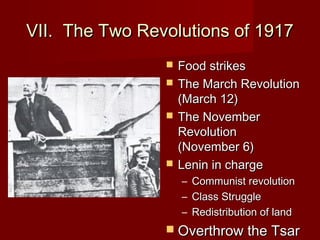
VII. The Two Revolutions of 1917VII. The Two Revolutions of 1917
 Food strikesFood strikes
 The March RevolutionThe March Revolution
(March 12)(March 12)
 The NovemberThe November
RevolutionRevolution
(November 6)(November 6)
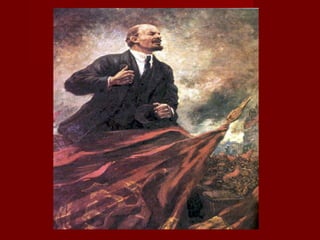
 Lenin in chargeLenin in charge
– Communist revolutionCommunist revolution
– Class StruggleClass Struggle
– Redistribution of landRedistribution of land
 Overthrow the TsarOverthrow the Tsar
October (Bolshevik) Revolution-October (Bolshevik) Revolution-
19171917
 Lead by VI Lenin “Peace, Land, andLead by VI Lenin “Peace, Land, and
Bread”Bread”
 Won support of people (especiallyWon support of people (especially
peasants)peasants)
October (Bolshevik) Revolution-October (Bolshevik) Revolution-
19171917
 Lead by VI Lenin “Peace, Land, andLead by VI Lenin “Peace, Land, and
Bread”Bread”
 Won support of people (especiallyWon support of people (especially
peasants)peasants)
19181918
 1918 March The Bolsheviks accept the1918 March The Bolsheviks accept the
peace of Brest‑Litovsk, ending WWI withpeace of Brest‑Litovsk, ending WWI with
Germany.Germany.
1919-19201919-1920
1919 White Armies (Royal and Menshevik1919 White Armies (Royal and Menshevik
troops) attack the Reds (Bolsheviks) fromtroops) attack the Reds (Bolsheviks) from
all directions.all directions.
 1920- Reds defeat Whites1920- Reds defeat Whites
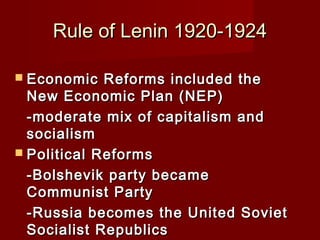
Rule of Lenin 1920-1924Rule of Lenin 1920-1924
 Economic Reforms included theEconomic Reforms included the
New Economic Plan (NEP)New Economic Plan (NEP)
-moderate mix of capitalism and-moderate mix of capitalism and
socialismsocialism
 Political ReformsPolitical Reforms
-Bolshevik party became-Bolshevik party became
Communist PartyCommunist Party
-Russia becomes the United Soviet-Russia becomes the United Soviet
Socialist RepublicsSocialist Republics
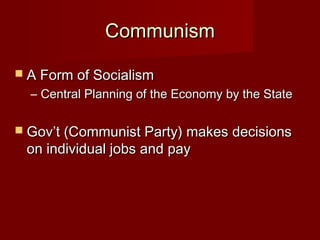
CommunismCommunism
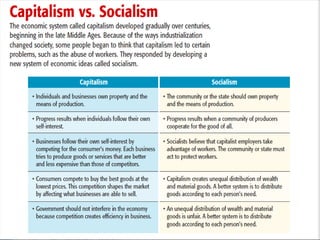
 A Form of SocialismA Form of Socialism
– Central Planning of the Economy by the StateCentral Planning of the Economy by the State
 Gov’t (Communist Party) makes decisionsGov’t (Communist Party) makes decisions
on individual jobs and payon individual jobs and pay
19241924
 Lenin DiesLenin Dies
 Power VaccuumPower Vaccuum
 Leon Trotsky vs. Joseph StalinLeon Trotsky vs. Joseph Stalin
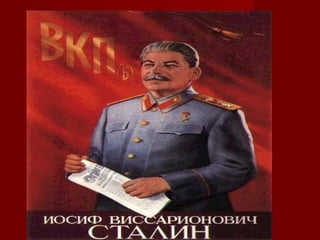
 Stalin takes controlStalin takes control
 Now must decide how he willNow must decide how he will
maintain powermaintain power
 Decides to create a totalitarianDecides to create a totalitarian
statestate
STALINSTALIN
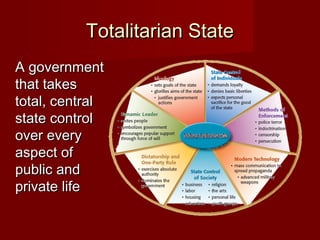
Totalitarian StateTotalitarian State
A governmentA government
that takesthat takes
total, centraltotal, central
state controlstate control
over everyover every
aspect ofaspect of
public andpublic and
private lifeprivate life
Characteristics of a TotalitarianCharacteristics of a Totalitarian
StateState
 Dictatorship-Dictatorship- Absolute AuthorityAbsolute Authority
 Dynamic Leader-Dynamic Leader- Vision for the nationVision for the nation
 State Control Over All Sectors of SocietyState Control Over All Sectors of Society
– Business, Family Life, Labor, youth groups, housing,Business, Family Life, Labor, youth groups, housing,
religion, education, the artsreligion, education, the arts
 State Control Over the IndividualState Control Over the Individual
– ObedienceObedience
– Denies basic libertiesDenies basic liberties
 Organized ViolenceOrganized Violence
– Uses force to crush oppositionUses force to crush opposition
Stalin’s Totalitarian StateStalin’s Totalitarian State
 State Control of the EconomyState Control of the Economy
– 5 year plan, collective farms5 year plan, collective farms
 Police TerrorPolice Terror
– Great Purge, crush oppositionGreat Purge, crush opposition
 Religious PersecutionReligious Persecution
– Control of the individualControl of the individual
 Propaganda (socialist realism)Propaganda (socialist realism)
– Molding peoples mindsMolding peoples minds
 EducationEducation
– Controlled by the governmentControlled by the government
Control MethodsControl Methods
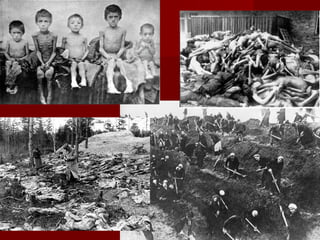
 The Great PurgeThe Great Purge: campaign of terror: campaign of terror
against enemies who threatened hisagainst enemies who threatened his
powerpower
– Killed or sent to Gulags (death camps)Killed or sent to Gulags (death camps)
 Est between 8-13 million deathsEst between 8-13 million deaths
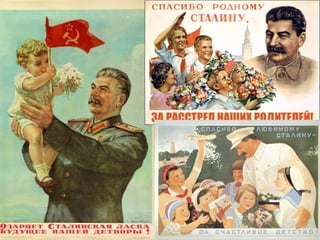
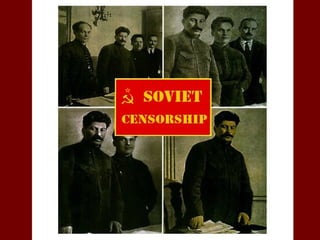
PropagandaPropaganda
 Controlled all newspapers, radio, movies,Controlled all newspapers, radio, movies,
and informationand information
 Glorified the achievements of Stalin &Glorified the achievements of Stalin &
communismcommunism
Religious PersecutionReligious Persecution
 Replace Orthodox teachings withReplace Orthodox teachings with
communist teachingscommunist teachings
 Destroyed churches & synagoguesDestroyed churches & synagogues
Industrial PoliciesIndustrial Policies
 Command EconomyCommand Economy: Government makes: Government makes
all economic decisionsall economic decisions
 Five-Year PlansFive-Year Plans: high quotas (goals) for: high quotas (goals) for
output of steel, coal, oil, & electricityoutput of steel, coal, oil, & electricity
– Limited consumer productionLimited consumer production
– People faced shortages of housing, food,People faced shortages of housing, food,
clothing, & other goodsclothing, & other goods
 Made some industrial gainsMade some industrial gains
Agricultural PoliciesAgricultural Policies
 Collective FarmsCollective Farms: Seized all private farms: Seized all private farms
and combined them into large,and combined them into large,
government owned farmsgovernment owned farms
– Hoped to boost food productionHoped to boost food production
– Resistance among “kulaks”, wealthy farmResistance among “kulaks”, wealthy farm
ownersowners
 In Ukraine, Stalin forced a famine by confiscatingIn Ukraine, Stalin forced a famine by confiscating
all food from kulaksall food from kulaks
EducationEducation
 Goal: build a stricter society that adheredGoal: build a stricter society that adhered
to creating a much more communist stateto creating a much more communist state
 Education law of 1935: allowed teachersEducation law of 1935: allowed teachers
to use strict methods of disciplineto use strict methods of discipline
 Communist History taughtCommunist History taught
 Girls allowed in schoolsGirls allowed in schools
Russian revolution ppt

Russian revolution ppt

  • 1.
  • 2.
    I. Pre-Revolutionary RussiaI.Pre-Revolutionary Russia  Last absolute kingLast absolute king  No democratic govNo democratic gov  Nicholas II becameNicholas II became Tsar in 1884Tsar in 1884 – Divine rightDivine right
  • 3.
    II. The Revolutionof 1905II. The Revolution of 1905  ““Peace, Land, & Bread!”Peace, Land, & Bread!” – WorkersWorkers  Bloody SundayBloody Sunday – Peaceful protestPeaceful protest – Soldiers open fireSoldiers open fire  Tsar can’t ignoreTsar can’t ignore problemsproblems – Forms Duma: legislativeForms Duma: legislative bodybody  Tsar basically ignoresTsar basically ignores
  • 4.
    IV. Alexandra: ThePower BehindIV. Alexandra: The Power Behind the Thronethe Throne  Wife of TsarWife of Tsar  Alexis: Son withAlexis: Son with HemophiliaHemophilia – Believes Rasputin hasBelieves Rasputin has power to heal himpower to heal him – Scandals aroundScandals around Rasputin discreditsRasputin discredits TsarTsar
  • 5.
    V. World WarI: “The Last Straw”V. World War I: “The Last Straw”  Broke RussiaBroke Russia economyeconomy  Shows weaknessShows weakness of Tsarof Tsar  Kills thousandsKills thousands  People upsetPeople upset
  • 6.
    VI. The Collapseof the ImperialVI. The Collapse of the Imperial GovernmentGovernment  Alexandra andAlexandra and Rasputin throw theRasputin throw the government intogovernment into chaoschaos  Rasputin isRasputin is assassinatedassassinated
  • 7.
    VII. The TwoRevolutions of 1917VII. The Two Revolutions of 1917  Food strikesFood strikes  The March RevolutionThe March Revolution (March 12)(March 12)  The NovemberThe November RevolutionRevolution (November 6)(November 6)  Lenin in chargeLenin in charge – Communist revolutionCommunist revolution – Class StruggleClass Struggle – Redistribution of landRedistribution of land  Overthrow the TsarOverthrow the Tsar
  • 8.
    October (Bolshevik) Revolution-October(Bolshevik) Revolution- 19171917  Lead by VI Lenin “Peace, Land, andLead by VI Lenin “Peace, Land, and Bread”Bread”  Won support of people (especiallyWon support of people (especially peasants)peasants)
  • 9.
    October (Bolshevik) Revolution-October(Bolshevik) Revolution- 19171917  Lead by VI Lenin “Peace, Land, andLead by VI Lenin “Peace, Land, and Bread”Bread”  Won support of people (especiallyWon support of people (especially peasants)peasants)
  • 11.
    19181918  1918 MarchThe Bolsheviks accept the1918 March The Bolsheviks accept the peace of Brest‑Litovsk, ending WWI withpeace of Brest‑Litovsk, ending WWI with Germany.Germany.
  • 12.
    1919-19201919-1920 1919 White Armies(Royal and Menshevik1919 White Armies (Royal and Menshevik troops) attack the Reds (Bolsheviks) fromtroops) attack the Reds (Bolsheviks) from all directions.all directions.  1920- Reds defeat Whites1920- Reds defeat Whites
  • 13.
    Rule of Lenin1920-1924Rule of Lenin 1920-1924  Economic Reforms included theEconomic Reforms included the New Economic Plan (NEP)New Economic Plan (NEP) -moderate mix of capitalism and-moderate mix of capitalism and socialismsocialism  Political ReformsPolitical Reforms -Bolshevik party became-Bolshevik party became Communist PartyCommunist Party -Russia becomes the United Soviet-Russia becomes the United Soviet Socialist RepublicsSocialist Republics
  • 15.
    CommunismCommunism  A Formof SocialismA Form of Socialism – Central Planning of the Economy by the StateCentral Planning of the Economy by the State  Gov’t (Communist Party) makes decisionsGov’t (Communist Party) makes decisions on individual jobs and payon individual jobs and pay
  • 17.
    19241924  Lenin DiesLeninDies  Power VaccuumPower Vaccuum  Leon Trotsky vs. Joseph StalinLeon Trotsky vs. Joseph Stalin  Stalin takes controlStalin takes control  Now must decide how he willNow must decide how he will maintain powermaintain power  Decides to create a totalitarianDecides to create a totalitarian statestate
  • 19.
  • 20.
    Totalitarian StateTotalitarian State AgovernmentA government that takesthat takes total, centraltotal, central state controlstate control over everyover every aspect ofaspect of public andpublic and private lifeprivate life
  • 21.
    Characteristics of aTotalitarianCharacteristics of a Totalitarian StateState  Dictatorship-Dictatorship- Absolute AuthorityAbsolute Authority  Dynamic Leader-Dynamic Leader- Vision for the nationVision for the nation  State Control Over All Sectors of SocietyState Control Over All Sectors of Society – Business, Family Life, Labor, youth groups, housing,Business, Family Life, Labor, youth groups, housing, religion, education, the artsreligion, education, the arts  State Control Over the IndividualState Control Over the Individual – ObedienceObedience – Denies basic libertiesDenies basic liberties  Organized ViolenceOrganized Violence – Uses force to crush oppositionUses force to crush opposition
  • 22.
    Stalin’s Totalitarian StateStalin’sTotalitarian State  State Control of the EconomyState Control of the Economy – 5 year plan, collective farms5 year plan, collective farms  Police TerrorPolice Terror – Great Purge, crush oppositionGreat Purge, crush opposition  Religious PersecutionReligious Persecution – Control of the individualControl of the individual  Propaganda (socialist realism)Propaganda (socialist realism) – Molding peoples mindsMolding peoples minds  EducationEducation – Controlled by the governmentControlled by the government
  • 23.
    Control MethodsControl Methods The Great PurgeThe Great Purge: campaign of terror: campaign of terror against enemies who threatened hisagainst enemies who threatened his powerpower – Killed or sent to Gulags (death camps)Killed or sent to Gulags (death camps)  Est between 8-13 million deathsEst between 8-13 million deaths
  • 25.
    PropagandaPropaganda  Controlled allnewspapers, radio, movies,Controlled all newspapers, radio, movies, and informationand information  Glorified the achievements of Stalin &Glorified the achievements of Stalin & communismcommunism
  • 27.
    Religious PersecutionReligious Persecution Replace Orthodox teachings withReplace Orthodox teachings with communist teachingscommunist teachings  Destroyed churches & synagoguesDestroyed churches & synagogues
  • 28.
    Industrial PoliciesIndustrial Policies Command EconomyCommand Economy: Government makes: Government makes all economic decisionsall economic decisions  Five-Year PlansFive-Year Plans: high quotas (goals) for: high quotas (goals) for output of steel, coal, oil, & electricityoutput of steel, coal, oil, & electricity – Limited consumer productionLimited consumer production – People faced shortages of housing, food,People faced shortages of housing, food, clothing, & other goodsclothing, & other goods  Made some industrial gainsMade some industrial gains
  • 29.
    Agricultural PoliciesAgricultural Policies Collective FarmsCollective Farms: Seized all private farms: Seized all private farms and combined them into large,and combined them into large, government owned farmsgovernment owned farms – Hoped to boost food productionHoped to boost food production – Resistance among “kulaks”, wealthy farmResistance among “kulaks”, wealthy farm ownersowners  In Ukraine, Stalin forced a famine by confiscatingIn Ukraine, Stalin forced a famine by confiscating all food from kulaksall food from kulaks
  • 30.
    EducationEducation  Goal: builda stricter society that adheredGoal: build a stricter society that adhered to creating a much more communist stateto creating a much more communist state  Education law of 1935: allowed teachersEducation law of 1935: allowed teachers to use strict methods of disciplineto use strict methods of discipline  Communist History taughtCommunist History taught  Girls allowed in schoolsGirls allowed in schools