Tiberius (14-37 CE)
 Stepson of Augustus (Augustus outlived his
  five appointed successors)
 Ruled with Augustus for last 10 years of
  Augustus’ life
   Had never held an administrative position before
 Ruled from Isle of Capri, wanted Senate to
  act without him
 Led a life of debauchery (manic depressive)
 Christ crucified during his reign
Bottom Line on Tiberius

 Bitter, little man
 Scheming
 Suspicious
 Instituted a reign of terror
 Did not abuse power,
  failed to use it!
 Crowd rejoiced at his death
Gaius [Caligula] (37-41 CE)
 Adopted grandson of Tiberius
   Great-grandson of Julius Caesar and Mark Antony
 Became ill after a few months in power and became
  insane
   Sacrificed 160,000 slaves to the gods
 Caligula is Latin for “little baby boots”
 Claimed he was a god
 Made a serious attempt to have his horse elected
  Consul
 Very cruel and unpopular – assassinated with wife
  and daughter by own guard
Bottom Line on Caligula

 Known for extravagance, cruelty and
  eccentric personality
 Engaged in openly adulterous and incestuous
  affairs
 What we know might be just rumours
Claudius (41-54 CE)
 Found cowering as Praetorians were looting
  Caligula’s palace
 Nephew of Tiberius
   Purging of family tree by previous emperors made
    him sole heir
 Though intelligent and well-educated, he was
  physically crippled and frail/weak
 Added the province of Britain (43 CE) , named
  after his son, Britannicus
 All 5 marriages ended in failure (first wife died
  on wedding night!)
 Poisoned to death (mushrooms) by fifth wife
  (also his niece) to make Nero emperor
Bottom Line on Claudius
 Physically weak
 Shrewd administrator
   Extended Roman
    citizenship in the provinces
   Founded Roman cities in
    the provinces
Nero (54-68 CE)
 Emperor at 16 and soon became a tyrant
 Murdered:
   Agrippina, his mother, in 59 CE
   Poppaea, pregnant second wife by kicking her to
    death
   Second wife’s husband
   Seneca, his teacher/advisor
   Britannicus, his step-brother
 Entered the Olympics and won through
  bribery!
Nero, continued
 64 CE – accused of setting fire to Rome
   2/3 of Rome destroyed
 Made Christians the scapegoat for the fire and
  carried out first persecutions of Christians
   Apostles Peter and Paul died in Rome
 Many Romans sacrificed in “sports” events
 Great artist: painted, sculpted, sang, acted
 68 CE – committed suicide as 3 provinces were in
  revolt and Praetorian Guard deserted him
 Last of Julius Caesar’s bloodline
Bottom Line on Nero

 Biased historical accounts leave us unable to
  tell what really happened
 Senate revolted against him, declared an
  enemy of the state
 Very extravagant – taxed the Patricians
 Poster child showing the folly of excess
Vespasian (69-79 CE)
 Senate gave imperial power to Vespasian
    after a year of civil war
   Ruled well
   Gave citizenship to people of many provinces
   Founded the Flavian dynasty
   Built Roman Colosseum
   First emperor since
    Augustus who did not
    die violently/unnaturally
Titus (79-81 CE)
 Vespasian’s son
 Famous for capture of Jerusalem
  in 70 CE
 Given a Triumphal Arch
 Emperor in 79 CE
 Ideal Emperor
   He spent lavish sums on games and
    monuments
 Gave financial aid to people who
  suffered from explosion of
  Mount Vesuvius / victims of the
  fire of Rome
Domitian (81-96 CE)
 Younger brother of Titus
 Efficient but arrogant
 Hated the Senate
 Rule became tyrannical
   Executed anyone suspected of even the mildest
    form of dissent
 Assassinated by those paid by his wife
  Domitilla in 96 CE, thus ending the Flavian
  Dynasty
Nerva (96-98 CE)

 Chosen by the Senate to rule
 Started method of imperial succession
 Took the title of Augustus and chose a Caesar
  to replace him
 Increased welfare payments to the masses
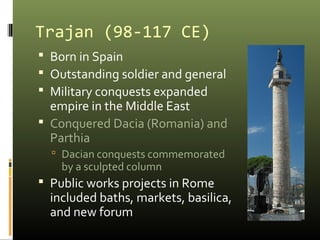
Trajan (98-117 CE)
 Born in Spain
 Outstanding soldier and general
 Military conquests expanded
  empire in the Middle East
 Conquered Dacia (Romania) and
  Parthia
   Dacian conquests commemorated
    by a sculpted column
 Public works projects in Rome
  included baths, markets, basilica,
  and new forum
Bottom Line on Trajan

 Great soldier
 Able administrator
 Travelled the Empire to help stop rebellion
Hadrian (117-138 CE)
 Succeeded his adopted father, Trajan
 Great admirer of Greek culture
 Great soldier who spent much time with his
  armies on the frontier establishing
  permanent barriers against the barbarians
 Gave up new territories in the East, except
  Dacia
 Political reformer: Senators, Equities received
  training
Hadrian, continued
 Britain conquered by Claudius
  in 43 CE
 Hadrian built a 73 mile (117 km)
  defensive wall across Britain to
  separate Romans from
  barbarians
 Wall is 20 bricks high and 2.5
  meters wide; small forts
  installed every 1,500 meters
  and lookouts every 500 meters;
  manned by 13,000 auxiliaries
  living on south side
 Wall took 3 legions 5 years to
  build
Bottom Line on Hadrian
 Great soldier
 Builder of defensive walls
  and the Pantheon (rebuilt)
 Enemy of the Jewish
  peoples
 Very versatile
   Intellect
   Artist
Marcus Aurelius (161-180
CE)
 Was co-emperor with his brother, Lucius
    Verus, until Verus’ death in 169 CE
   Spent most of his rule on the frontiers
    keeping barbarians out
   Increased size of army and taxes, yet lowered
    taxes for the poor
   Lenient towards political criminals
   Plague killed thousands during his watch; this
    caused much doubt in Rome and the Empire
Bottom Line on Aurelius
 Aurelius’ watch marked by fighting the
  “barbarians”
 Known for his Stoic philosophy, “Meditations”
   Transient nature of all things on
    earth
   Do not let emotion override reason
   Do not lament things that happen
    outside of your power to control
   The only thing you can control is
    your attitude/outlook
Diocletian (284-304 AD)
 Stabilized Empire
 Had a rule of four where everyone looked
  over various aspects of the Empire
 Secured their borders from invaders from all
  corners
 Persecuted Christians
   Destroyed religious texts, places of worship
 Changed format of gov’t, military and
  economy (larger, more organized)
 Abdicated throne due to illness
Constantine (307-337 AD)
 Involved in many civil wars to consolidate
  power
 First Christian Emperor
   Reversed persecutions through Edict of Milan
 Created the city of Constantinople
   New capital of Rome
   Becomes Byzantine Empire when Rome splits
   Constantinople is capital for over 1000 years
 Fought many Barbarian groups to keep
  Rome safe
Winner of All-Time Worst Roman
Emperor…
 Marcus Aurelius Antonius
  Heliogabalus (218-224 CE)
 Emperor at 14
 Held the hereditary rank of high
  priest to the Carthaginian and Syrian
  sun-god Ba’al
   Cattle, sheep, severed human genitalia,
    and young boys sacrificed to god Ba’al
 Homosexual
 Bore a strong desire to be a woman:
  plucked hairs from body, wore
  make-up, wanted a sex change
  operation
 Raped, married, then divorced a vestal virgin
    known as aquilia severa (the “great sewer”)
   Enjoyed pretending to be a prostitute,
    offering himself naked to passers by in the
    palace, and he prostituted himself in the
    taverns and brothels of Rome
   Rather enjoyed severe punishments for
    having been caught
   He and his mother executed and bodies
    thrown into Tiber River
   Heliogabalus’ followers fate: had genitals
    ripped off and pierced by pikes in the anus “so
    that their death fitted their lives”

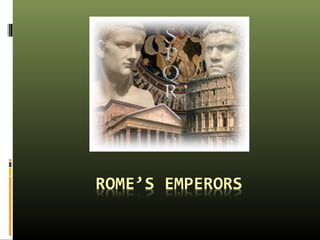
Rome’s Emperors

  • 2.
    Tiberius (14-37 CE) Stepson of Augustus (Augustus outlived his five appointed successors)  Ruled with Augustus for last 10 years of Augustus’ life  Had never held an administrative position before  Ruled from Isle of Capri, wanted Senate to act without him  Led a life of debauchery (manic depressive)  Christ crucified during his reign
  • 3.
    Bottom Line onTiberius  Bitter, little man  Scheming  Suspicious  Instituted a reign of terror  Did not abuse power, failed to use it!  Crowd rejoiced at his death
  • 4.
    Gaius [Caligula] (37-41CE)  Adopted grandson of Tiberius  Great-grandson of Julius Caesar and Mark Antony  Became ill after a few months in power and became insane  Sacrificed 160,000 slaves to the gods  Caligula is Latin for “little baby boots”  Claimed he was a god  Made a serious attempt to have his horse elected Consul  Very cruel and unpopular – assassinated with wife and daughter by own guard
  • 5.
    Bottom Line onCaligula  Known for extravagance, cruelty and eccentric personality  Engaged in openly adulterous and incestuous affairs  What we know might be just rumours
  • 6.
    Claudius (41-54 CE) Found cowering as Praetorians were looting Caligula’s palace  Nephew of Tiberius  Purging of family tree by previous emperors made him sole heir  Though intelligent and well-educated, he was physically crippled and frail/weak  Added the province of Britain (43 CE) , named after his son, Britannicus  All 5 marriages ended in failure (first wife died on wedding night!)  Poisoned to death (mushrooms) by fifth wife (also his niece) to make Nero emperor
  • 7.
    Bottom Line onClaudius  Physically weak  Shrewd administrator  Extended Roman citizenship in the provinces  Founded Roman cities in the provinces
  • 8.
    Nero (54-68 CE) Emperor at 16 and soon became a tyrant  Murdered:  Agrippina, his mother, in 59 CE  Poppaea, pregnant second wife by kicking her to death  Second wife’s husband  Seneca, his teacher/advisor  Britannicus, his step-brother  Entered the Olympics and won through bribery!
  • 9.
    Nero, continued  64CE – accused of setting fire to Rome  2/3 of Rome destroyed  Made Christians the scapegoat for the fire and carried out first persecutions of Christians  Apostles Peter and Paul died in Rome  Many Romans sacrificed in “sports” events  Great artist: painted, sculpted, sang, acted  68 CE – committed suicide as 3 provinces were in revolt and Praetorian Guard deserted him  Last of Julius Caesar’s bloodline
  • 10.
    Bottom Line onNero  Biased historical accounts leave us unable to tell what really happened  Senate revolted against him, declared an enemy of the state  Very extravagant – taxed the Patricians  Poster child showing the folly of excess
  • 11.
    Vespasian (69-79 CE) Senate gave imperial power to Vespasian after a year of civil war  Ruled well  Gave citizenship to people of many provinces  Founded the Flavian dynasty  Built Roman Colosseum  First emperor since Augustus who did not die violently/unnaturally
  • 12.
    Titus (79-81 CE) Vespasian’s son  Famous for capture of Jerusalem in 70 CE  Given a Triumphal Arch  Emperor in 79 CE  Ideal Emperor  He spent lavish sums on games and monuments  Gave financial aid to people who suffered from explosion of Mount Vesuvius / victims of the fire of Rome
  • 13.
    Domitian (81-96 CE) Younger brother of Titus  Efficient but arrogant  Hated the Senate  Rule became tyrannical  Executed anyone suspected of even the mildest form of dissent  Assassinated by those paid by his wife Domitilla in 96 CE, thus ending the Flavian Dynasty
  • 14.
    Nerva (96-98 CE) Chosen by the Senate to rule  Started method of imperial succession  Took the title of Augustus and chose a Caesar to replace him  Increased welfare payments to the masses
  • 15.
    Trajan (98-117 CE) Born in Spain  Outstanding soldier and general  Military conquests expanded empire in the Middle East  Conquered Dacia (Romania) and Parthia  Dacian conquests commemorated by a sculpted column  Public works projects in Rome included baths, markets, basilica, and new forum
  • 16.
    Bottom Line onTrajan  Great soldier  Able administrator  Travelled the Empire to help stop rebellion
  • 17.
    Hadrian (117-138 CE) Succeeded his adopted father, Trajan  Great admirer of Greek culture  Great soldier who spent much time with his armies on the frontier establishing permanent barriers against the barbarians  Gave up new territories in the East, except Dacia  Political reformer: Senators, Equities received training
  • 18.
    Hadrian, continued  Britainconquered by Claudius in 43 CE  Hadrian built a 73 mile (117 km) defensive wall across Britain to separate Romans from barbarians  Wall is 20 bricks high and 2.5 meters wide; small forts installed every 1,500 meters and lookouts every 500 meters; manned by 13,000 auxiliaries living on south side  Wall took 3 legions 5 years to build
  • 19.
    Bottom Line onHadrian  Great soldier  Builder of defensive walls and the Pantheon (rebuilt)  Enemy of the Jewish peoples  Very versatile  Intellect  Artist
  • 20.
    Marcus Aurelius (161-180 CE) Was co-emperor with his brother, Lucius Verus, until Verus’ death in 169 CE  Spent most of his rule on the frontiers keeping barbarians out  Increased size of army and taxes, yet lowered taxes for the poor  Lenient towards political criminals  Plague killed thousands during his watch; this caused much doubt in Rome and the Empire
  • 21.
    Bottom Line onAurelius  Aurelius’ watch marked by fighting the “barbarians”  Known for his Stoic philosophy, “Meditations”  Transient nature of all things on earth  Do not let emotion override reason  Do not lament things that happen outside of your power to control  The only thing you can control is your attitude/outlook
  • 22.
    Diocletian (284-304 AD) Stabilized Empire  Had a rule of four where everyone looked over various aspects of the Empire  Secured their borders from invaders from all corners  Persecuted Christians  Destroyed religious texts, places of worship  Changed format of gov’t, military and economy (larger, more organized)  Abdicated throne due to illness
  • 23.
    Constantine (307-337 AD) Involved in many civil wars to consolidate power  First Christian Emperor  Reversed persecutions through Edict of Milan  Created the city of Constantinople  New capital of Rome  Becomes Byzantine Empire when Rome splits  Constantinople is capital for over 1000 years  Fought many Barbarian groups to keep Rome safe
  • 24.
    Winner of All-TimeWorst Roman Emperor…  Marcus Aurelius Antonius Heliogabalus (218-224 CE)  Emperor at 14  Held the hereditary rank of high priest to the Carthaginian and Syrian sun-god Ba’al  Cattle, sheep, severed human genitalia, and young boys sacrificed to god Ba’al  Homosexual  Bore a strong desire to be a woman: plucked hairs from body, wore make-up, wanted a sex change operation
  • 25.
     Raped, married,then divorced a vestal virgin known as aquilia severa (the “great sewer”)  Enjoyed pretending to be a prostitute, offering himself naked to passers by in the palace, and he prostituted himself in the taverns and brothels of Rome  Rather enjoyed severe punishments for having been caught  He and his mother executed and bodies thrown into Tiber River  Heliogabalus’ followers fate: had genitals ripped off and pierced by pikes in the anus “so that their death fitted their lives”