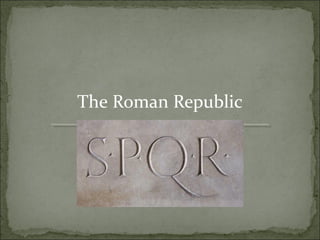
The Roman Republic
 Resulted from discontent of
  tyrannical Etruscan monarchy

 In a republic, citizens elect leaders to
  run their government.

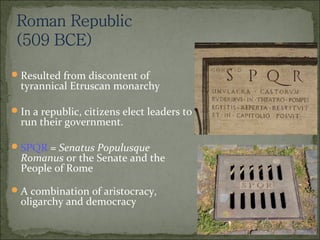
 SPQR = Senatus Populusque
  Romanus or the Senate and the
  People of Rome

 A combination of aristocracy,
  oligarchy and democracy
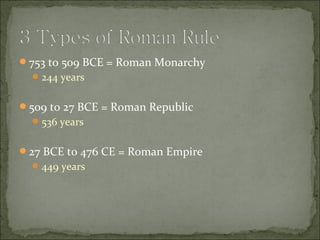
753 to 509 BCE = Roman Monarchy
   244 years


509 to 27 BCE = Roman Republic
   536 years


27 BCE to 476 CE = Roman Empire
   449 years
New Organization
Consuls = Leaders chosen to replace kings
Assembly = Ordinary citizens who elected the consuls
Senate = Rich men who advised the consuls
Although citizens elected their own representatives,
 the Republic was NOT a democracy… every citizen
 did not have equal power
   Divided into 2 classes: patricians and plebians
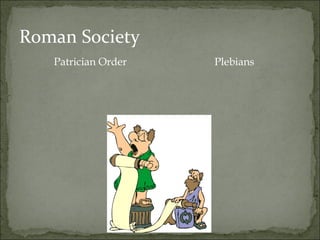
Roman Society
   Patrician Order   Plebians
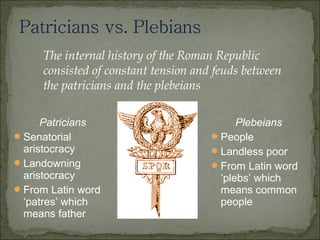
The internal history of the Roman Republic
     consisted of constant tension and feuds between
     the patricians and the plebeians

      Patricians                            Plebeians
 Senatorial                           People
  aristocracy                          Landless poor
 Landowning                           From Latin word
  aristocracy                           ‘plebs’ which
 From Latin word                       means common
  ‘patres’ which                        people
  means father
Patrician Order
Wealthiest 10% of Rome’s population
Only ones who could run for political office
 (magistrates)
Served as priests, lawyers and judges
Granted financial and legal protection to their clients
   Plebians, newcomers to Rome, ex-slaves, people who
    had left their families
Held the Roman imperium (power of law and military
 command)
Plebians
The other 90% who did the “heavy lifting” in society
   Till the land, herd livestock, work as craftsmen,
    tradesmen, and labourers
No right of appeal against decision of Patrician
 government since no laws were codified or published
Relied upon the Patricians exclusively for
 expertise/leadership
Defended Rome as soldiers
The Plebians’ Trump Card
Could engage in secession to get what they wanted
   Go on strike and refuse to defend Rome
The Plebians went on strike 5 different times
1. Read Polybius' description of the
  Roman constitution to learn more
  about the government of the republic
   Note the powers and limitations of the
    three divisions of government
   Include one direct quote for each
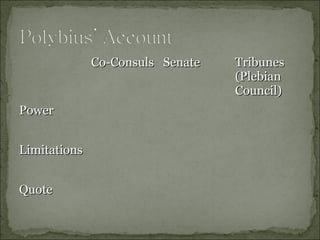
Co-Consuls Senate   Tribunes
                                  (Plebian
                                  Council)
Power


Limitations


Quote
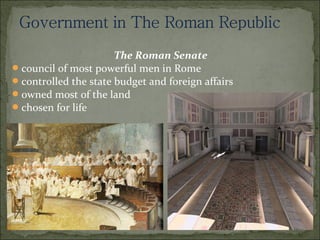
The Roman Senate
 council of most powerful men in Rome
 controlled the state budget and foreign affairs
 owned most of the land
 chosen for life
Consul
most powerful magistrates were the two consuls, or Chief
 Magistrates of State
both had the power to veto (Latin for “I forbid”) each other
 in important decisions
elected by the patricians for a term of one year
extensive legislative, judicial power
usually commanded the army


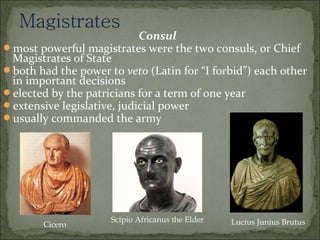
                     Scipio Africanus the Elder   Lucius Junius Brutus
        Cicero
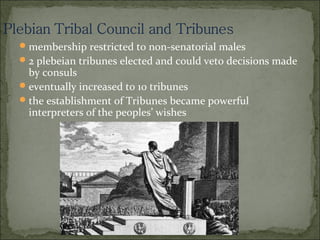
 membership restricted to non-senatorial males
 2 plebeian tribunes elected and could veto decisions made
  by consuls
 eventually increased to 10 tribunes
 the establishment of Tribunes became powerful
  interpreters of the peoples’ wishes

The Roman Republic Briefly

  • 1.
  • 2.
     Resulted fromdiscontent of tyrannical Etruscan monarchy  In a republic, citizens elect leaders to run their government.  SPQR = Senatus Populusque Romanus or the Senate and the People of Rome  A combination of aristocracy, oligarchy and democracy
  • 3.
    753 to 509BCE = Roman Monarchy  244 years 509 to 27 BCE = Roman Republic  536 years 27 BCE to 476 CE = Roman Empire  449 years
  • 4.
    New Organization Consuls =Leaders chosen to replace kings Assembly = Ordinary citizens who elected the consuls Senate = Rich men who advised the consuls Although citizens elected their own representatives, the Republic was NOT a democracy… every citizen did not have equal power  Divided into 2 classes: patricians and plebians
  • 5.
    Roman Society Patrician Order Plebians
  • 6.
    The internal historyof the Roman Republic consisted of constant tension and feuds between the patricians and the plebeians Patricians Plebeians  Senatorial  People aristocracy  Landless poor  Landowning  From Latin word aristocracy ‘plebs’ which  From Latin word means common ‘patres’ which people means father
  • 7.
    Patrician Order Wealthiest 10%of Rome’s population Only ones who could run for political office (magistrates) Served as priests, lawyers and judges Granted financial and legal protection to their clients  Plebians, newcomers to Rome, ex-slaves, people who had left their families Held the Roman imperium (power of law and military command)
  • 8.
    Plebians The other 90%who did the “heavy lifting” in society  Till the land, herd livestock, work as craftsmen, tradesmen, and labourers No right of appeal against decision of Patrician government since no laws were codified or published Relied upon the Patricians exclusively for expertise/leadership Defended Rome as soldiers
  • 9.
    The Plebians’ TrumpCard Could engage in secession to get what they wanted  Go on strike and refuse to defend Rome The Plebians went on strike 5 different times
  • 10.
    1. Read Polybius'description of the Roman constitution to learn more about the government of the republic  Note the powers and limitations of the three divisions of government  Include one direct quote for each
  • 11.
    Co-Consuls Senate Tribunes (Plebian Council) Power Limitations Quote
  • 12.
    The Roman Senate council of most powerful men in Rome  controlled the state budget and foreign affairs  owned most of the land  chosen for life
  • 13.
    Consul most powerful magistrateswere the two consuls, or Chief Magistrates of State both had the power to veto (Latin for “I forbid”) each other in important decisions elected by the patricians for a term of one year extensive legislative, judicial power usually commanded the army Scipio Africanus the Elder Lucius Junius Brutus Cicero
  • 14.
     membership restrictedto non-senatorial males  2 plebeian tribunes elected and could veto decisions made by consuls  eventually increased to 10 tribunes  the establishment of Tribunes became powerful interpreters of the peoples’ wishes

Editor's Notes

  • #3 When the last Etruscan king was thrown out of Rome in 509 B.C., Roman leaders decided to begin a very new form of government - a republic .  In a republic, citizens elect leaders to run their government.  In Rome, the leaders chosen to replace the king were called consuls .  These consuls were elected by a group of ordinary citizens known as an assembly , and the consuls were given advice by a group of rich people known as the Senate .  Although the citizens elected their own representatives, the Roman Republic was not a democracy because not every citizen had equal power. Citizens were divided into two classes, patricians and plebeians . A Roman was born into their class. As citizens, both patricians and plebeians had the right to vote.  However, only patricians had the right to hold any political, military or religious offices.  All power was in the hands of the patricians. Senate: latin for ‘old men’. Early kings took advice from Senate (latin for ‘old men’ or council of elders
  • #7 As citizens, both patricians and plebeians had the right to vote.  However, only patricians had the right to hold any political, military or religious offices.  All power was in the hands of the patricians. Patres= father; from the days before the Etruscans, each village chief had been advised by the heads of the families in the village The common people of Rome were very angry over harsh treatment by the rich and powerful people of Rome, so they had moved out of the city.  The leaders knew that their city was in serious danger unless the common people returned.  So they agreed to give the people more rights.  This struggle between the Roman leaders and the common people continued for 200 years as the common people of Rome tried to gain equal rights.
  • #13 In Rome, the leaders chosen to replace the king were called consuls .  These consuls were elected by a group of ordinary citizens known as an assembly , and the consuls were given advice by a group of rich people known as the Senate .  Although the citizens elected their own representatives, the Roman Republic was not a democracy because not every citizen had equal power. Citizens were divided into two classes, patricians and plebeians . A Roman was born into their class. Consuls= two elected rulers (they were elected by the patricians for a one year term; with each consul ruling for a month at a time at home; at war they commanded the army on alternative days -consuls appointed assistants (qoaestors) and they were later elected by the patricians. They looked after finances of RR -early on, patricians hled almost all the power in Rome as they could only vote for consuls and their assembly (Senate) could decide on laws. The Senate also advised the consuls. -pleibians were not pleased and demanded they were represented; eventually got a council of their own (concilium plebs)
  • #14 Cicero was elected Consul for the year 63 BC. His co-consul for the year, Gaius Antonius Hybrida , played a minor role. During his year in office he thwarted a conspiracy centred on assassinating him and overthrowing the Roman Republic with the help of foreign armed forces. Cicero procured a Senatus Consultum de Re Publica Defendenda (a declaration of martial law ), and he drove Catiline from the city with four vehement speeches (the Catiline Orations ), which to this day remain outstanding examples of his rhetorical style. Cicero received the honorific " Pater Patriae " for his efforts to suppress the conspiracy, but lived thereafter in fear of trial or exile for having put Roman citizens to death without trial (because during a time of martial law) Publius Cornelius Scipio Africanus (235–183 BC), also known as Scipio Africanus and Scipio the Elder , was a general in the Second Punic War and statesman of the Roman Republic . He was best known for defeating Hannibal at the final battle of the Second Punic War at Zama, a feat that earned him the agnomen Africanus , the nickname "the Roman Hannibal", as well as recognition as one of the finest commanders in military history. Brutus. Prior to the establishment of the Roman Republic, Rome had been ruled by kings. Brutus led the revolt that overthrew the last king, Lucius Tarquinius Superbus, after the rape of the noblewoman (and kinswoman of Brutus) Lucretia at the hands of Tarquin's son Sextus Tarquinius. According to Livy, Brutus had a number of grievances against the king, amongst them was the fact that Tarquin had orchestrated the murder of his brother. Brutus gained the trust of Tarquin's family by feigning slow-wittedness (in Latin brutus translates to dullard), thereby allowing the Tarquins to underestimate him as a potential threat