Ancient Greece
Big Idea 
Greece’s geography and its nearness to the 
sea strongly influenced the developed of 
trade and the growth of city-states 
Main Ideas: 
1. Geography helped shape early Greek civilization 
2. Trading cultures developed in the Minoan and 
Mycenaean civilizations 
3. The Greeks created city-states fro protection and 
security
If You were there…. 
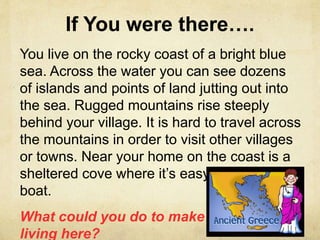
You live on the rocky coast of a bright blue 
sea. Across the water you can see dozens 
of islands and points of land jutting out into 
the sea. Rugged mountains rise steeply 
behind your village. It is hard to travel across 
the mountains in order to visit other villages 
or towns. Near your home on the coast is a 
sheltered cove where it’s easy to anchor a 
boat. 
What could you do to make a 
living here?
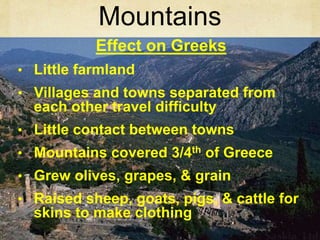
Mountains 
Effect on Greeks 
• Little farmland 
• Villages and towns separated from 
each other travel difficulty 
• Little contact between towns 
• Mountains covered 3/4th of Greece 
• Grew olives, grapes, & grain 
• Raised sheep, goats, pigs, & cattle for 
skins to make clothing
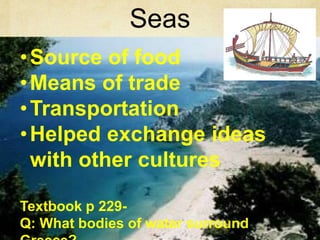
Seas 
•Source of food 
•Means of trade 
•Transportation 
•Helped exchange ideas 
with other cultures 
Textbook p 229- 
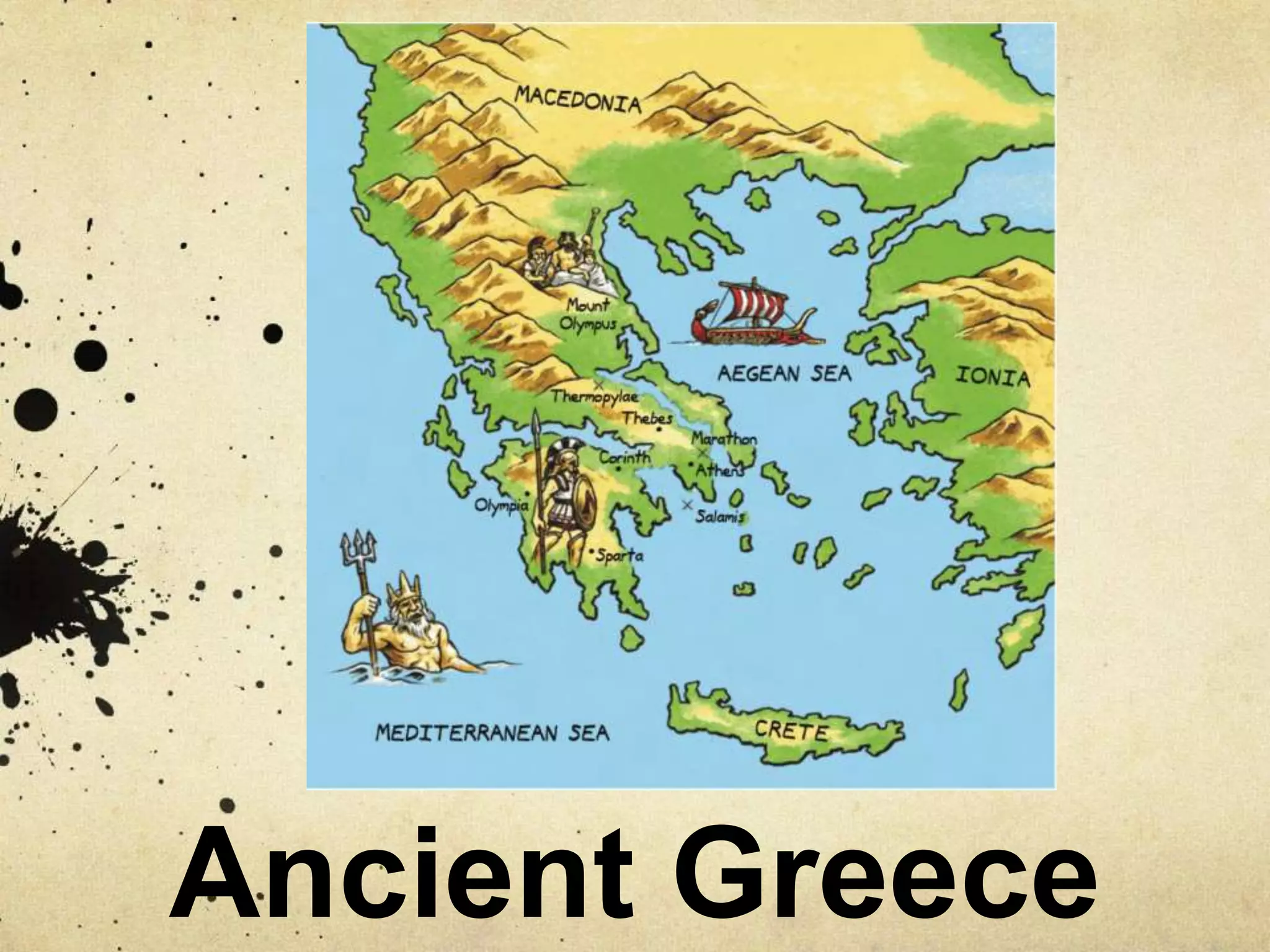
Q: What bodies of water surround 
Greece?
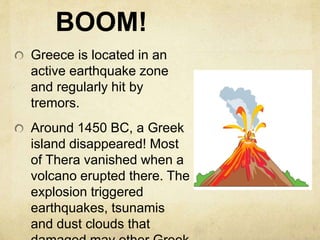
BOOM! 
Greece is located in an 
active earthquake zone 
and regularly hit by 
tremors. 
Around 1450 BC, a Greek 
island disappeared! Most 
of Thera vanished when a 
volcano erupted there. The 
explosion triggered 
earthquakes, tsunamis 
and dust clouds that 
damaged may other Greek
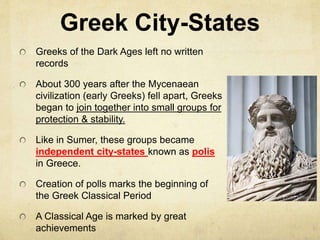
Greek City-States 
Greeks of the Dark Ages left no written 
records 
About 300 years after the Mycenaean 
civilization (early Greeks) fell apart, Greeks 
began to join together into small groups for 
protection & stability. 
Like in Sumer, these groups became 
independent city-states known as polis 
in Greece. 
Creation of polls marks the beginning of 
the Greek Classical Period 
A Classical Age is marked by great 
achievements
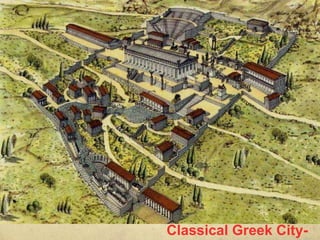
Classical Greek City-
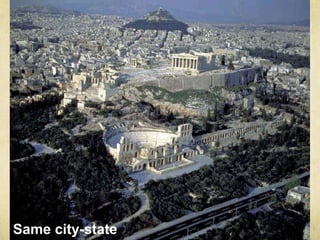
Same city-state
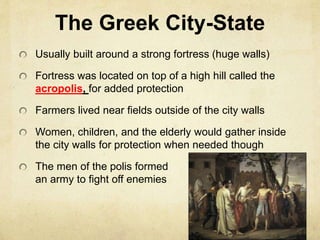
The Greek City-State 
Usually built around a strong fortress (huge walls) 
Fortress was located on top of a high hill called the 
acropolis, for added protection 
Farmers lived near fields outside of the city walls 
Women, children, and the elderly would gather inside 
the city walls for protection when needed though 
The men of the polis formed 
an army to fight off enemies
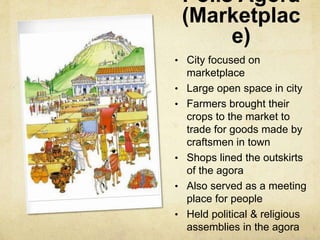
Polis Agora 
(Marketplac 
e) 
• City focused on 
marketplace 
• Large open space in city 
• Farmers brought their 
crops to the market to 
trade for goods made by 
craftsmen in town 
• Shops lined the outskirts 
of the agora 
• Also served as a meeting 
place for people 
• Held political & religious 
assemblies in the agora
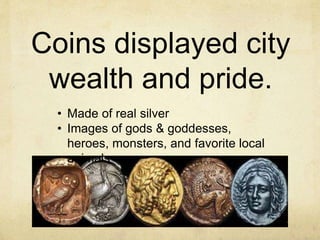
Coins displayed city 
wealth and pride. 
• Made of real silver 
• Images of gods & goddesses, 
heroes, monsters, and favorite local 
animals
Quick Check 
1.What was a city-state? 
2. What was the center of many 
cities? 
3. What were coins made of? 
4. How did the Greeks defend 
their cities?
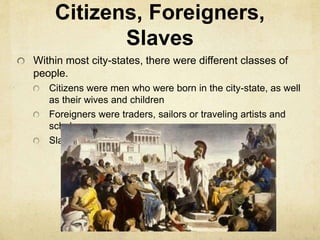
Citizens, Foreigners, 
Slaves 
Within most city-states, there were different classes of 
people. 
Citizens were men who were born in the city-state, as well 
as their wives and children 
Foreigners were traders, sailors or traveling artists and 
scholars 
Slaves belonged to their owners
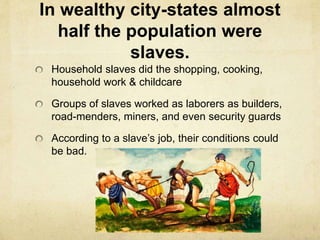
In wealthy city-states almost 
half the population were 
slaves. 
Household slaves did the shopping, cooking, 
household work & childcare 
Groups of slaves worked as laborers as builders, 
road-menders, miners, and even security guards 
According to a slave’s job, their conditions could 
be bad.
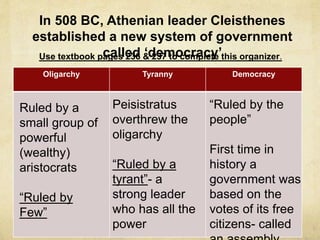
In 508 BC, Athenian leader Cleisthenes 
established a new system of government 
called ‘democracy’ 
Use textbook pages 236 & 237 to complete this organizer. 
Oligarchy Tyranny Democracy 
Ruled by a 
small group of 
powerful 
(wealthy) 
aristocrats 
“Ruled by 
Few” 
Peisistratus 
overthrew the 
oligarchy 
“Ruled by a 
tyrant”- a 
strong leader 
who has all the 
power 
“Ruled by the 
people” 
First time in 
history a 
government was 
based on the 
votes of its free 
citizens- called 
an assembly
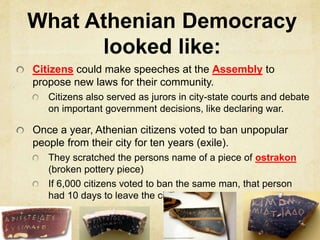
What Athenian Democracy 
looked like: 
Citizens could make speeches at the Assembly to 
propose new laws for their community. 
Citizens also served as jurors in city-state courts and debate 
on important government decisions, like declaring war. 
Once a year, Athenian citizens voted to ban unpopular 
people from their city for ten years (exile). 
They scratched the persons name of a piece of ostrakon 
(broken pottery piece) 
If 6,000 citizens voted to ban the same man, that person 
had 10 days to leave the city!
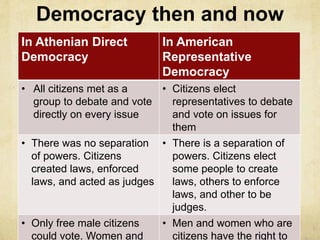
Democracy then and now 
In Athenian Direct 
Democracy 
In American 
Representative 
Democracy 
• All citizens met as a 
group to debate and vote 
directly on every issue 
• Citizens elect 
representatives to debate 
and vote on issues for 
them 
• There was no separation 
of powers. Citizens 
created laws, enforced 
laws, and acted as judges 
• There is a separation of 
powers. Citizens elect 
some people to create 
laws, others to enforce 
laws, and other to be 
judges. 
• Only free male citizens 
could vote. Women and 
• Men and women who are 
citizens have the right to
Quick Check 
1.What is democracy? 
2.Where was it 
established? 
3.What is an ostrakon? 
4.What was it used for?
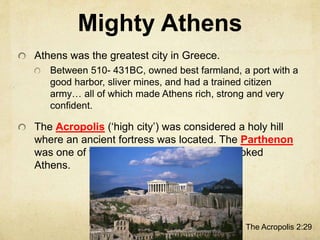
Mighty Athens 
Athens was the greatest city in Greece. 
Between 510- 431BC, owned best farmland, a port with a 
good harbor, sliver mines, and had a trained citizen 
army… all of which made Athens rich, strong and very 
confident. 
The Acropolis (‘high city’) was considered a holy hill 
where an ancient fortress was located. The Parthenon 
was one of those buildings there that overlooked 
Athens. 
The Acropolis 2:29
Delian League 
In 490 and 480 BC, armies from Persia (now Iran) 
invaded Greece. 
The Persians were defeated but the attack left Greek 
city-states felling threatened. 
The city-states joined together to make the Delian 
League- name comes from the island if Delos, where 
congress held meetings in the temple and where the 
treasury stood. 
Athens took charge of the League and build a huge 
navy and sent soldiers to “advise” the other city-states. 
By 454 BC, Athens controlled most of Greece.
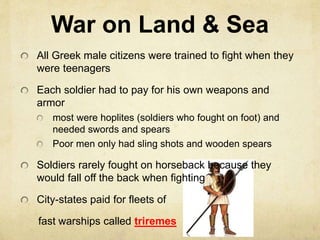
War on Land & Sea 
All Greek male citizens were trained to fight when they 
were teenagers 
Each soldier had to pay for his own weapons and 
armor 
most were hoplites (soldiers who fought on foot) and 
needed swords and spears 
Poor men only had sling shots and wooden spears 
Soldiers rarely fought on horseback because they 
would fall off the back when fighting 
City-states paid for fleets of 
fast warships called triremes
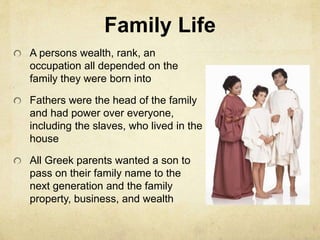
Family Life 
A persons wealth, rank, an 
occupation all depended on the 
family they were born into 
Fathers were the head of the family 
and had power over everyone, 
including the slaves, who lived in the 
house 
All Greek parents wanted a son to 
pass on their family name to the 
next generation and the family 
property, business, and wealth
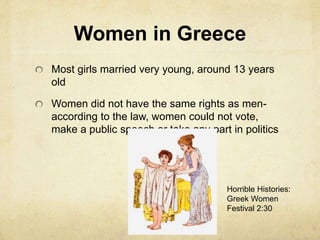
Women in Greece 
Most girls married very young, around 13 years 
old 
Women did not have the same rights as men-according 
to the law, women could not vote, 
make a public speech or take any part in politics 
Horrible Histories: 
Greek Women 
Festival 2:30
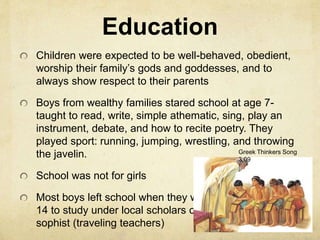
Education 
Children were expected to be well-behaved, obedient, 
worship their family’s gods and goddesses, and to 
always show respect to their parents 
Boys from wealthy families stared school at age 7- 
taught to read, write, simple athematic, sing, play an 
instrument, debate, and how to recite poetry. They 
played sport: running, jumping, wrestling, and throwing 
the javelin. 
School was not for girls 
Most boys left school when they were 
14 to study under local scholars or 
sophist (traveling teachers) 
Greek Thinkers Song 
3:09
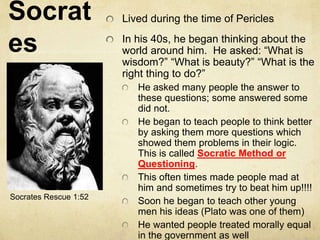
Socrat 
es 
Lived during the time of Pericles 
In his 40s, he began thinking about the 
world around him. He asked: “What is 
wisdom?” “What is beauty?” “What is the 
right thing to do?” 
He asked many people the answer to 
these questions; some answered some 
did not. 
He began to teach people to think better 
by asking them more questions which 
showed them problems in their logic. 
This is called Socratic Method or 
Questioning. 
This often times made people mad at 
him and sometimes try to beat him up!!!! 
Soon he began to teach other young 
men his ideas (Plato was one of them) 
He wanted people treated morally equal 
in the government as well 
Socrates Rescue 1:52
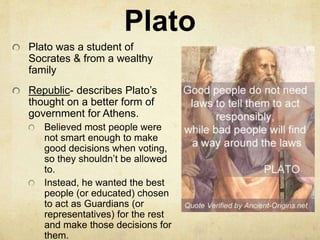
Plato 
Plato was a student of 
Socrates & from a wealthy 
family 
Republic- describes Plato’s 
thought on a better form of 
government for Athens. 
Believed most people were 
not smart enough to make 
good decisions when voting, 
so they shouldn’t be allowed 
to. 
Instead, he wanted the best 
people (or educated) chosen 
to act as Guardians (or 
representatives) for the rest 
and make those decisions for 
them.
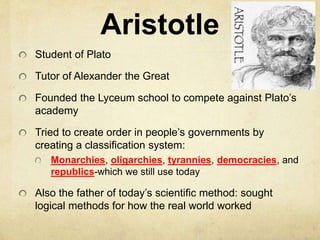
Aristotle 
Student of Plato 
Tutor of Alexander the Great 
Founded the Lyceum school to compete against Plato’s 
academy 
Tried to create order in people’s governments by 
creating a classification system: 
Monarchies, oligarchies, tyrannies, democracies, and 
republics-which we still use today 
Also the father of today’s scientific method: sought 
logical methods for how the real world worked
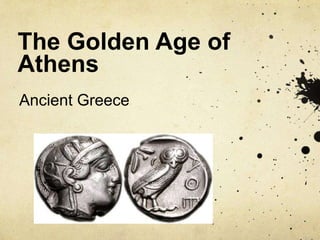
The Golden Age of 
Athens 
Ancient Greece
Big idea 
The people of Athens tried many different forms of 
government before creating a democracy. 
Main Idea: 
1. Aristocrats and tyrants ruled early Athens 
2. Athens created the world’s first democracy 
3. Ancient democracy was different than modern 
democracy
The Golden Age 
The Golden Age – a time of achievement in ancient 
Greece. 
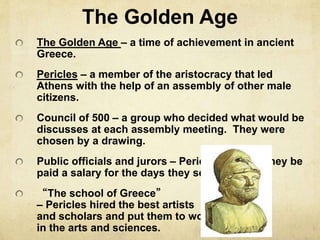
Pericles – a member of the aristocracy that led 
Athens with the help of an assembly of other male 
citizens. 
Council of 500 – a group who decided what would be 
discusses at each assembly meeting. They were 
chosen by a drawing. 
Public officials and jurors – Pericles ordered they be 
paid a salary for the days they served. 
“The school of Greece” 
– Pericles hired the best artists 
and scholars and put them to work 
in the arts and sciences.
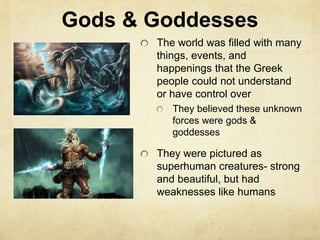
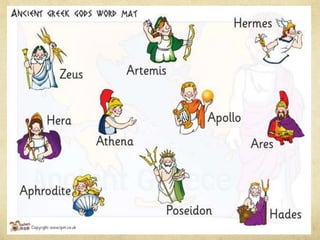
Gods & Goddesses 
The world was filled with many 
things, events, and 
happenings that the Greek 
people could not understand 
or have control over 
They believed these unknown 
forces were gods & 
goddesses 
They were pictured as 
superhuman creatures- strong 
and beautiful, but had 
weaknesses like humans
They believed in magic spirits and monsters such as 
Gargons (turned men into stone), Sirens (bird-women 
whose songs lured sailors to their death), as well as 
witchcraft and curses 
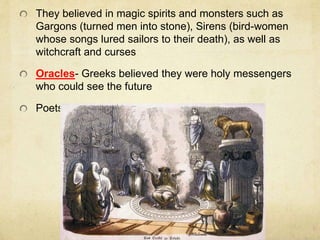
Oracles- Greeks believed they were holy messengers 
who could see the future 
Poets retold myths and legend about the gods
Temples & Festivals 
Temples/shines were built as holy homes for the gods and 
goddesses 
Each city-state had its own guardian god with many temples 
with lifelike statues of him or her 
People hoped & feared they would meet a god in the temple 
or in a forest or on a mountain top 
Mount Olympus: where they believed all the gods and 
goddesses met to make plans, feast, love, and quarrel. 
People offered prayers and sacrifices to their gods & 
goddesses 
A few drops of wine or a valuable livestock was offered 
Meat of sacrificed animals was cooked and shared with 
worshippers 
The bones and skin was burned on the alter so the smoke
Quick Check 
1.What were temples? 
2.Where did all the gods and 
goddesses go to meet? 
3.What did people offer to their 
gods and goddesses? 
4.What happened at shrines?
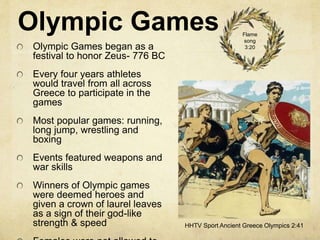
Olympic Games 
Olympic Games began as a 
festival to honor Zeus- 776 BC 
Every four years athletes 
would travel from all across 
Greece to participate in the 
games 
Most popular games: running, 
long jump, wrestling and 
boxing 
Events featured weapons and 
war skills 
Winners of Olympic games 
were deemed heroes and 
given a crown of laurel leaves 
as a sign of their god-like 
strength & speed 
Females were not allowed to 
Flame 
song 
3:20 
HHTV Sport Ancient Greece Olympics 2:41
Quick Check 
1. When were the first Olympic 
Games held? 
2. Who were the games in honor 
of? 
3. Could women go to the Olympic 
Games? 
4. What did winning athletes wear 
on their heads?
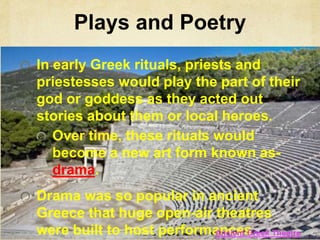
Plays and Poetry 
In early Greek rituals, priests and 
priestesses would play the part of their 
god or goddess as they acted out 
stories about them or local heroes. 
Over time, these rituals would 
become a new art form known as-drama. 
Drama was so popular in ancient 
Greece that huge open-air theatres 
were built to host performances 
Ancient Greek Theatre 
5:31
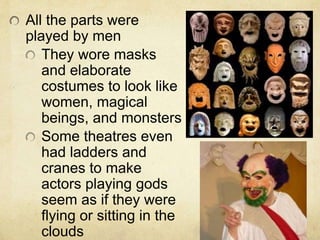
All the parts were 
played by men 
They wore masks 
and elaborate 
costumes to look like 
women, magical 
beings, and monsters 
Some theatres even 
had ladders and 
cranes to make 
actors playing gods 
seem as if they were 
flying or sitting in the 
clouds
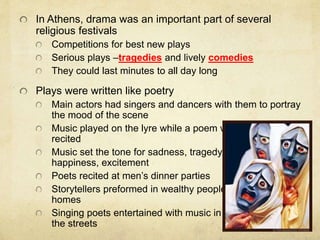
In Athens, drama was an important part of several 
religious festivals 
Competitions for best new plays 
Serious plays –tragedies and lively comedies 
They could last minutes to all day long 
Plays were written like poetry 
Main actors had singers and dancers with them to portray 
the mood of the scene 
Music played on the lyre while a poem was 
recited 
Music set the tone for sadness, tragedy, 
happiness, excitement 
Poets recited at men’s dinner parties 
Storytellers preformed in wealthy people’s 
homes 
Singing poets entertained with music in 
the streets
Scientists & Thinkers 
Rap 
3:48 
Aristarchus was the first person to understand that the 
Earth travels around the sun 
Hipparchus mapped the stars 
Thales discovered the mathematical laws about circle 
and triangles 
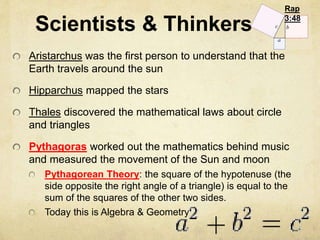
Pythagoras worked out the mathematics behind music 
and measured the movement of the Sun and moon 
Pythagorean Theory: the square of the hypotenuse (the 
side opposite the right angle of a triangle) is equal to the 
sum of the squares of the other two sides. 
Today this is Algebra & Geometry
Most ancient Greeks believed the gods brought illness as 
a punishment. But, Hippocrates, and doctors who 
followed him, tried to cur people using food, fresh air, 
exercise, and herbal medicines 
Engineers designed a clock to time speakers at the 
Athenian Assembly using water-power 
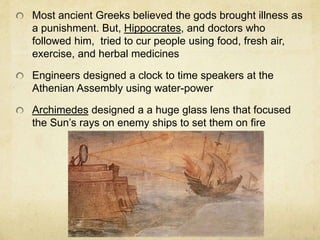
Archimedes designed a a huge glass lens that focused 
the Sun’s rays on enemy ships to set them on fire
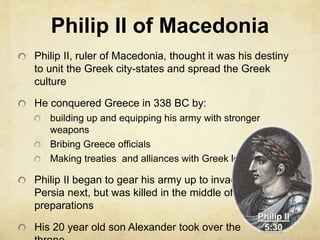
Philip II of Macedonia 
Philip II, ruler of Macedonia, thought it was his destiny 
to unit the Greek city-states and spread the Greek 
culture 
He conquered Greece in 338 BC by: 
building up and equipping his army with stronger 
weapons 
Bribing Greece officials 
Making treaties and alliances with Greek leaders 
Philip II began to gear his army up to invade 
Persia next, but was killed in the middle of his 
preparations 
His 20 year old son Alexander took over the 
throne
Alexander the Great 
Alexander was tutored by Aristotle for three years, 
teaching him literature, political science, geography, and 
biology 
Alexander used much of what he learned by incorporating 
it into his army. 
He ordered scientist to collect plant and animal samples 
from the new places he had conquered and send them 
back to Aristotle for examination. 
Alexander feared nothing. He never lost a battle. 
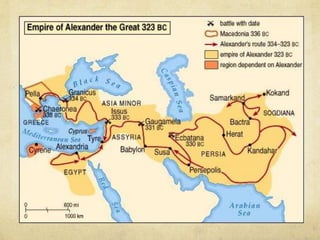
His conquests would expand his empire more than 22,00 
miles, from the Nile to the Indus River.
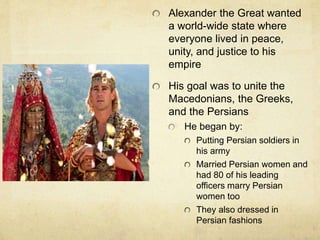
Alexander the Great wanted 
a world-wide state where 
everyone lived in peace, 
unity, and justice to his 
empire 
His goal was to unite the 
Macedonians, the Greeks, 
and the Persians 
He began by: 
Putting Persian soldiers in 
his army 
Married Persian women and 
had 80 of his leading 
officers marry Persian 
women too 
They also dressed in 
Persian fashions
Alexander follows some of the Persian 
customs 
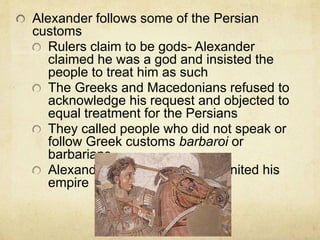
Rulers claim to be gods- Alexander 
claimed he was a god and insisted the 
people to treat him as such 
The Greeks and Macedonians refused to 
acknowledge his request and objected to 
equal treatment for the Persians 
They called people who did not speak or 
follow Greek customs barbaroi or 
barbarians. 
Alexander did not succeed in united his 
empire
Alexander's 
Achievements During his rule he founded 70 cities (16 were named 
Alexandria) 
He encouraged Greeks and Macedonians to settle 
these new cities to spread Greek culture 
Most famous city founded is Alexandria, Egypt 
Within 70 years of its founding it became a center of 
trade and learning; attracting Greeks from across the 
Mediterranean 
It had two great harbors with a lighthouse- one of the 
Seven Wonders of the Ancient World 
There was also a palace and a school with a library 
(known as the Museum)- the library had the largest 
collection of books in ancient times
End of an Empire 
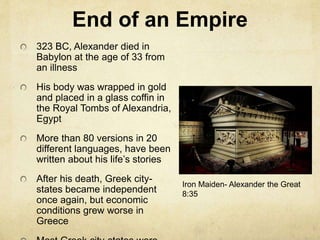
323 BC, Alexander died in 
Babylon at the age of 33 from 
an illness 
His body was wrapped in gold 
and placed in a glass coffin in 
the Royal Tombs of Alexandria, 
Egypt 
More than 80 versions in 20 
different languages, have been 
written about his life’s stories 
After his death, Greek city-states 
became independent 
once again, but economic 
conditions grew worse in 
Greece 
Most Greek city-states were 
Iron Maiden- Alexander the Great 
8:35
Hellenistic Period 
Alexander’s brief but thorough empire-building 
campaign changed the world: It spread Greek 
ideas and culture from the Eastern 
Mediterranean to Asia. Historians call this era 
the “Hellenistic period.” (The word “Hellenistic” 
comes from the word Hellazein, which means 
“to speak Greek or identify with the Greeks.”) It 
lasted from the death of Alexander in 323 B.C. 
until 31 B.C., when Roman troops conquered 
the last of the territories that the Macedonian 
king had once ruled 
- History.com
Quick Check 
1. Why was Alexander unable to achieve 
unity among the people of his empire? 
2. Why did many Greeks go to Alexandria, 
Egypt? 
3. How did the physical features of 
Alexandria, Egypt help trade? 
4. What happened to the Greek city-states 
by 146 BC?
Journal 
Activity: 
City-States 
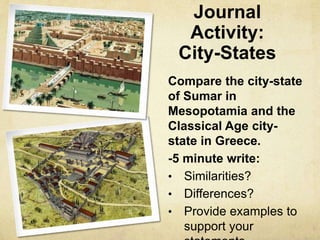
Compare the city-state 
of Sumar in 
Mesopotamia and the 
Classical Age city-state 
in Greece. 
-5 minute write: 
• Similarities? 
• Differences? 
• Provide examples to 
support your 
statements.

Ancient Greece World History

  • 1.
  • 2.
    Big Idea Greece’sgeography and its nearness to the sea strongly influenced the developed of trade and the growth of city-states Main Ideas: 1. Geography helped shape early Greek civilization 2. Trading cultures developed in the Minoan and Mycenaean civilizations 3. The Greeks created city-states fro protection and security
  • 3.
    If You werethere…. You live on the rocky coast of a bright blue sea. Across the water you can see dozens of islands and points of land jutting out into the sea. Rugged mountains rise steeply behind your village. It is hard to travel across the mountains in order to visit other villages or towns. Near your home on the coast is a sheltered cove where it’s easy to anchor a boat. What could you do to make a living here?
  • 4.
    Mountains Effect onGreeks • Little farmland • Villages and towns separated from each other travel difficulty • Little contact between towns • Mountains covered 3/4th of Greece • Grew olives, grapes, & grain • Raised sheep, goats, pigs, & cattle for skins to make clothing
  • 5.
    Seas •Source offood •Means of trade •Transportation •Helped exchange ideas with other cultures Textbook p 229- Q: What bodies of water surround Greece?
  • 6.
    BOOM! Greece islocated in an active earthquake zone and regularly hit by tremors. Around 1450 BC, a Greek island disappeared! Most of Thera vanished when a volcano erupted there. The explosion triggered earthquakes, tsunamis and dust clouds that damaged may other Greek
  • 7.
    Greek City-States Greeksof the Dark Ages left no written records About 300 years after the Mycenaean civilization (early Greeks) fell apart, Greeks began to join together into small groups for protection & stability. Like in Sumer, these groups became independent city-states known as polis in Greece. Creation of polls marks the beginning of the Greek Classical Period A Classical Age is marked by great achievements
  • 8.
  • 9.
  • 10.
    The Greek City-State Usually built around a strong fortress (huge walls) Fortress was located on top of a high hill called the acropolis, for added protection Farmers lived near fields outside of the city walls Women, children, and the elderly would gather inside the city walls for protection when needed though The men of the polis formed an army to fight off enemies
  • 11.
    Polis Agora (Marketplac e) • City focused on marketplace • Large open space in city • Farmers brought their crops to the market to trade for goods made by craftsmen in town • Shops lined the outskirts of the agora • Also served as a meeting place for people • Held political & religious assemblies in the agora
  • 12.
    Coins displayed city wealth and pride. • Made of real silver • Images of gods & goddesses, heroes, monsters, and favorite local animals
  • 13.
    Quick Check 1.Whatwas a city-state? 2. What was the center of many cities? 3. What were coins made of? 4. How did the Greeks defend their cities?
  • 14.
    Citizens, Foreigners, Slaves Within most city-states, there were different classes of people. Citizens were men who were born in the city-state, as well as their wives and children Foreigners were traders, sailors or traveling artists and scholars Slaves belonged to their owners
  • 15.
    In wealthy city-statesalmost half the population were slaves. Household slaves did the shopping, cooking, household work & childcare Groups of slaves worked as laborers as builders, road-menders, miners, and even security guards According to a slave’s job, their conditions could be bad.
  • 16.
    In 508 BC,Athenian leader Cleisthenes established a new system of government called ‘democracy’ Use textbook pages 236 & 237 to complete this organizer. Oligarchy Tyranny Democracy Ruled by a small group of powerful (wealthy) aristocrats “Ruled by Few” Peisistratus overthrew the oligarchy “Ruled by a tyrant”- a strong leader who has all the power “Ruled by the people” First time in history a government was based on the votes of its free citizens- called an assembly
  • 17.
    What Athenian Democracy looked like: Citizens could make speeches at the Assembly to propose new laws for their community. Citizens also served as jurors in city-state courts and debate on important government decisions, like declaring war. Once a year, Athenian citizens voted to ban unpopular people from their city for ten years (exile). They scratched the persons name of a piece of ostrakon (broken pottery piece) If 6,000 citizens voted to ban the same man, that person had 10 days to leave the city!
  • 18.
    Democracy then andnow In Athenian Direct Democracy In American Representative Democracy • All citizens met as a group to debate and vote directly on every issue • Citizens elect representatives to debate and vote on issues for them • There was no separation of powers. Citizens created laws, enforced laws, and acted as judges • There is a separation of powers. Citizens elect some people to create laws, others to enforce laws, and other to be judges. • Only free male citizens could vote. Women and • Men and women who are citizens have the right to
  • 19.
    Quick Check 1.Whatis democracy? 2.Where was it established? 3.What is an ostrakon? 4.What was it used for?
  • 20.
    Mighty Athens Athenswas the greatest city in Greece. Between 510- 431BC, owned best farmland, a port with a good harbor, sliver mines, and had a trained citizen army… all of which made Athens rich, strong and very confident. The Acropolis (‘high city’) was considered a holy hill where an ancient fortress was located. The Parthenon was one of those buildings there that overlooked Athens. The Acropolis 2:29
  • 21.
    Delian League In490 and 480 BC, armies from Persia (now Iran) invaded Greece. The Persians were defeated but the attack left Greek city-states felling threatened. The city-states joined together to make the Delian League- name comes from the island if Delos, where congress held meetings in the temple and where the treasury stood. Athens took charge of the League and build a huge navy and sent soldiers to “advise” the other city-states. By 454 BC, Athens controlled most of Greece.
  • 22.
    War on Land& Sea All Greek male citizens were trained to fight when they were teenagers Each soldier had to pay for his own weapons and armor most were hoplites (soldiers who fought on foot) and needed swords and spears Poor men only had sling shots and wooden spears Soldiers rarely fought on horseback because they would fall off the back when fighting City-states paid for fleets of fast warships called triremes
  • 23.
    Family Life Apersons wealth, rank, an occupation all depended on the family they were born into Fathers were the head of the family and had power over everyone, including the slaves, who lived in the house All Greek parents wanted a son to pass on their family name to the next generation and the family property, business, and wealth
  • 24.
    Women in Greece Most girls married very young, around 13 years old Women did not have the same rights as men-according to the law, women could not vote, make a public speech or take any part in politics Horrible Histories: Greek Women Festival 2:30
  • 25.
    Education Children wereexpected to be well-behaved, obedient, worship their family’s gods and goddesses, and to always show respect to their parents Boys from wealthy families stared school at age 7- taught to read, write, simple athematic, sing, play an instrument, debate, and how to recite poetry. They played sport: running, jumping, wrestling, and throwing the javelin. School was not for girls Most boys left school when they were 14 to study under local scholars or sophist (traveling teachers) Greek Thinkers Song 3:09
  • 26.
    Socrat es Livedduring the time of Pericles In his 40s, he began thinking about the world around him. He asked: “What is wisdom?” “What is beauty?” “What is the right thing to do?” He asked many people the answer to these questions; some answered some did not. He began to teach people to think better by asking them more questions which showed them problems in their logic. This is called Socratic Method or Questioning. This often times made people mad at him and sometimes try to beat him up!!!! Soon he began to teach other young men his ideas (Plato was one of them) He wanted people treated morally equal in the government as well Socrates Rescue 1:52
  • 27.
    Plato Plato wasa student of Socrates & from a wealthy family Republic- describes Plato’s thought on a better form of government for Athens. Believed most people were not smart enough to make good decisions when voting, so they shouldn’t be allowed to. Instead, he wanted the best people (or educated) chosen to act as Guardians (or representatives) for the rest and make those decisions for them.
  • 28.
    Aristotle Student ofPlato Tutor of Alexander the Great Founded the Lyceum school to compete against Plato’s academy Tried to create order in people’s governments by creating a classification system: Monarchies, oligarchies, tyrannies, democracies, and republics-which we still use today Also the father of today’s scientific method: sought logical methods for how the real world worked
  • 31.
    The Golden Ageof Athens Ancient Greece
  • 32.
    Big idea Thepeople of Athens tried many different forms of government before creating a democracy. Main Idea: 1. Aristocrats and tyrants ruled early Athens 2. Athens created the world’s first democracy 3. Ancient democracy was different than modern democracy
  • 33.
    The Golden Age The Golden Age – a time of achievement in ancient Greece. Pericles – a member of the aristocracy that led Athens with the help of an assembly of other male citizens. Council of 500 – a group who decided what would be discusses at each assembly meeting. They were chosen by a drawing. Public officials and jurors – Pericles ordered they be paid a salary for the days they served. “The school of Greece” – Pericles hired the best artists and scholars and put them to work in the arts and sciences.
  • 34.
    Gods & Goddesses The world was filled with many things, events, and happenings that the Greek people could not understand or have control over They believed these unknown forces were gods & goddesses They were pictured as superhuman creatures- strong and beautiful, but had weaknesses like humans
  • 35.
    They believed inmagic spirits and monsters such as Gargons (turned men into stone), Sirens (bird-women whose songs lured sailors to their death), as well as witchcraft and curses Oracles- Greeks believed they were holy messengers who could see the future Poets retold myths and legend about the gods
  • 37.
    Temples & Festivals Temples/shines were built as holy homes for the gods and goddesses Each city-state had its own guardian god with many temples with lifelike statues of him or her People hoped & feared they would meet a god in the temple or in a forest or on a mountain top Mount Olympus: where they believed all the gods and goddesses met to make plans, feast, love, and quarrel. People offered prayers and sacrifices to their gods & goddesses A few drops of wine or a valuable livestock was offered Meat of sacrificed animals was cooked and shared with worshippers The bones and skin was burned on the alter so the smoke
  • 38.
    Quick Check 1.Whatwere temples? 2.Where did all the gods and goddesses go to meet? 3.What did people offer to their gods and goddesses? 4.What happened at shrines?
  • 39.
    Olympic Games OlympicGames began as a festival to honor Zeus- 776 BC Every four years athletes would travel from all across Greece to participate in the games Most popular games: running, long jump, wrestling and boxing Events featured weapons and war skills Winners of Olympic games were deemed heroes and given a crown of laurel leaves as a sign of their god-like strength & speed Females were not allowed to Flame song 3:20 HHTV Sport Ancient Greece Olympics 2:41
  • 40.
    Quick Check 1.When were the first Olympic Games held? 2. Who were the games in honor of? 3. Could women go to the Olympic Games? 4. What did winning athletes wear on their heads?
  • 41.
    Plays and Poetry In early Greek rituals, priests and priestesses would play the part of their god or goddess as they acted out stories about them or local heroes. Over time, these rituals would become a new art form known as-drama. Drama was so popular in ancient Greece that huge open-air theatres were built to host performances Ancient Greek Theatre 5:31
  • 42.
    All the partswere played by men They wore masks and elaborate costumes to look like women, magical beings, and monsters Some theatres even had ladders and cranes to make actors playing gods seem as if they were flying or sitting in the clouds
  • 43.
    In Athens, dramawas an important part of several religious festivals Competitions for best new plays Serious plays –tragedies and lively comedies They could last minutes to all day long Plays were written like poetry Main actors had singers and dancers with them to portray the mood of the scene Music played on the lyre while a poem was recited Music set the tone for sadness, tragedy, happiness, excitement Poets recited at men’s dinner parties Storytellers preformed in wealthy people’s homes Singing poets entertained with music in the streets
  • 44.
    Scientists & Thinkers Rap 3:48 Aristarchus was the first person to understand that the Earth travels around the sun Hipparchus mapped the stars Thales discovered the mathematical laws about circle and triangles Pythagoras worked out the mathematics behind music and measured the movement of the Sun and moon Pythagorean Theory: the square of the hypotenuse (the side opposite the right angle of a triangle) is equal to the sum of the squares of the other two sides. Today this is Algebra & Geometry
  • 45.
    Most ancient Greeksbelieved the gods brought illness as a punishment. But, Hippocrates, and doctors who followed him, tried to cur people using food, fresh air, exercise, and herbal medicines Engineers designed a clock to time speakers at the Athenian Assembly using water-power Archimedes designed a a huge glass lens that focused the Sun’s rays on enemy ships to set them on fire
  • 46.
    Philip II ofMacedonia Philip II, ruler of Macedonia, thought it was his destiny to unit the Greek city-states and spread the Greek culture He conquered Greece in 338 BC by: building up and equipping his army with stronger weapons Bribing Greece officials Making treaties and alliances with Greek leaders Philip II began to gear his army up to invade Persia next, but was killed in the middle of his preparations His 20 year old son Alexander took over the throne
  • 47.
    Alexander the Great Alexander was tutored by Aristotle for three years, teaching him literature, political science, geography, and biology Alexander used much of what he learned by incorporating it into his army. He ordered scientist to collect plant and animal samples from the new places he had conquered and send them back to Aristotle for examination. Alexander feared nothing. He never lost a battle. His conquests would expand his empire more than 22,00 miles, from the Nile to the Indus River.
  • 49.
    Alexander the Greatwanted a world-wide state where everyone lived in peace, unity, and justice to his empire His goal was to unite the Macedonians, the Greeks, and the Persians He began by: Putting Persian soldiers in his army Married Persian women and had 80 of his leading officers marry Persian women too They also dressed in Persian fashions
  • 50.
    Alexander follows someof the Persian customs Rulers claim to be gods- Alexander claimed he was a god and insisted the people to treat him as such The Greeks and Macedonians refused to acknowledge his request and objected to equal treatment for the Persians They called people who did not speak or follow Greek customs barbaroi or barbarians. Alexander did not succeed in united his empire
  • 51.
    Alexander's Achievements Duringhis rule he founded 70 cities (16 were named Alexandria) He encouraged Greeks and Macedonians to settle these new cities to spread Greek culture Most famous city founded is Alexandria, Egypt Within 70 years of its founding it became a center of trade and learning; attracting Greeks from across the Mediterranean It had two great harbors with a lighthouse- one of the Seven Wonders of the Ancient World There was also a palace and a school with a library (known as the Museum)- the library had the largest collection of books in ancient times
  • 52.
    End of anEmpire 323 BC, Alexander died in Babylon at the age of 33 from an illness His body was wrapped in gold and placed in a glass coffin in the Royal Tombs of Alexandria, Egypt More than 80 versions in 20 different languages, have been written about his life’s stories After his death, Greek city-states became independent once again, but economic conditions grew worse in Greece Most Greek city-states were Iron Maiden- Alexander the Great 8:35
  • 53.
    Hellenistic Period Alexander’sbrief but thorough empire-building campaign changed the world: It spread Greek ideas and culture from the Eastern Mediterranean to Asia. Historians call this era the “Hellenistic period.” (The word “Hellenistic” comes from the word Hellazein, which means “to speak Greek or identify with the Greeks.”) It lasted from the death of Alexander in 323 B.C. until 31 B.C., when Roman troops conquered the last of the territories that the Macedonian king had once ruled - History.com
  • 54.
    Quick Check 1.Why was Alexander unable to achieve unity among the people of his empire? 2. Why did many Greeks go to Alexandria, Egypt? 3. How did the physical features of Alexandria, Egypt help trade? 4. What happened to the Greek city-states by 146 BC?
  • 55.
    Journal Activity: City-States Compare the city-state of Sumar in Mesopotamia and the Classical Age city-state in Greece. -5 minute write: • Similarities? • Differences? • Provide examples to support your statements.