Chapter Introduction Section 1  Rome’s Beginning   Section 2  The Roman Republic Section 3  The Fall of the Republic Section 4  The Early Empire Reading Review Chapter Assessment The Rise of Rome Click on a hyperlink to view the corresponding slides.
Chapter Objectives Explain how Rome became a republic.   Describe how Rome gained control of the Mediterranean region.   Explain how the failure of the republic led to the creation of a Roman Empire.  T he Rise of Rome Relate how military and political reforms made Rome rich and prosperous.
The  Rise of Rome
 
Get Ready to Read Section Overview This section describes the beginnings of Rome, the founding of the republic, and early conquests. Rome’s Beginnings
Get Ready to Read  (cont.) Focusing on the Main Ideas Rome’s Beginnings Geography played an important role in the rise of Roman civilization .   The Romans created a republic and conquered Italy.  By treating people fairly, they built Rome from a small city into a great power.
Get Ready to Read  (cont.) Locating Places Sicily (SIH·suh·lee)  Apennines  (A·puh· NYNZ )   Latium (LAY·shee·uhm)  Tiber River  (TY·buhr)  Etruria  (ih·TRUR·ee·uh)  Rome’s Beginnings
Get Ready to Read  (cont.) Meeting People Romulus (RAHM·yuh·luhs)  Remus (REE·muhs)  Aeneas (ih·NEE·uhs)  Latins (LA·tuhnz)  Etruscans (ih·TRUHS·kuhnz)  Tarquins (TAHR·kwihnz)  Rome’s Beginnings
Get Ready to Read  (cont.) Building Your Vocabulary republic (rih ·PUH ·blihk)  legion (LEE·juhn)  Reading Strategy Summarizing Information   Use a diagram like the one on page 262 of your textbook to show how the Etruscans affected the development of Rome. Rome’s Beginnings
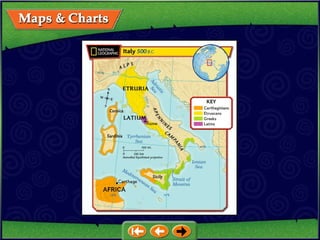
The Origins of Rome Italy is a boot-shaped country in the Mediterranean .   The Alps are mountains at Italy’s northern border, and the Apennines is a mountain range that extends through Italy from north to south.  (pages 263 – 265) The toe of the boot points toward the island of Sicily.  Italy’s terrain was easier to farm than the terrain of Greece, so Italy could support more people .   Rome’s Beginnings
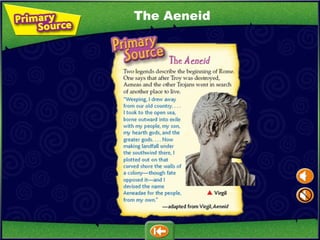
The Origins of Rome  (cont.) The Latins built the city of Rome on the plain of Latium .   Rome was located in central Italy on the Tiber River.  Rome’s Beginnings Two stories tell about Rome’s beginning:  the legend of Remus and Romulus and the tale of Aeneas and his Trojan followers .   (pages 263 – 265)
The Origins of Rome  (cont.) The Greeks and the Etruscans influenced the Roman way of life .   The Etruscans were skilled metal workers who helped shape Roman civilization.  Rome’s Beginnings The Etruscan army was the  model for the Roman army .   (pages 263 – 265)
How did the Greeks influence the Romans? The Greeks taught the Romans how to grow grapes and olives.  They also taught the Romans their alphabet.  Roman architecture, sculpture, and literature was also modeled after the Greeks. Rome’s Beginnings
The Birth of a Republic The Tarquins were leaders of the Etruscan-ruled Rome .  (pages 265 – 267) After 100 years under the Tarquins, the Romans rebelled against Etruscan rulers.   The Romans established a republic .  In a  republic,  the leader is not a king or queen but someone voted into office by citizens.   Rome’s Beginnings
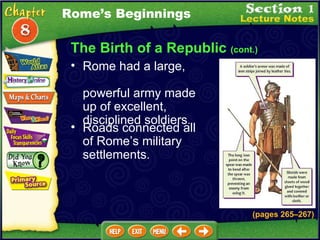
The Birth of a Republic  (cont.) Rome had a large,  powerful army made up of excellent, disciplined soldiers .  Roads connected all of Rome’s military settlements.   Rome’s Beginnings (pages 265 – 267)
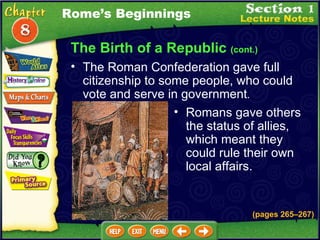
The Birth of a Republic  (cont.) The Roman Confederation gave full citizenship to some people, who could vote and serve in government .  Romans gave others the status of allies, which meant they could rule their own local affairs.   Rome’s Beginnings (pages 265 – 267)
What was the benefit of organizing soldiers into legions? Smaller bands of troops were easier to maneuver than one large army. Rome’s Beginnings
Where did the Greeks live in Italy, and how did they influence Roman civilization? Greeks colonized southern Italy and Sicily.  They passed on farming methods, sculpture, literature, and an alphabet. Rome’s Beginnings
Describe the two legends that tell of the founding of Rome.  Then describe how and when Rome was actually founded. The legend of Romulus and Remus and the Aeneas story.  Rome was probably founded by Latins in c. 700s  B.C. Rome’s Beginnings
Summarize   Describe the Roman conquest of Italy. Rome defeated remaining Latins and then Etruscans and Greeks. Rome’s Beginnings
Compare and Contrast   How did geography affect the development of civilization in Greece and Italy? Italy is less rugged than Greece, so people are not separated from each other.  Italy’s better farmland supports more people. Rome’s Beginnings
Expository Writing   Write a short essay discussing the reasons Rome was so successful in its conquest of Italy. Answers will vary. Rome’s Beginnings
Identify the rights held by Roman citizens. Rome’s Beginnings
 
The Roman Republic Get Ready to Read Section Overview This section describes the Roman Republic’s political development and the defeat of Carthage.
Get Ready to Read  (cont.) Focusing on the Main Ideas The Roman Republic Rome slowly destroyed the Carthaginian Empire and took control of the entire Mediterranean region.   Rome’s republic was shaped by a struggle between wealthy landowners and regular citizens as it gradually expanded the right to vote.
Get Ready to Read  (cont.) Cincinnatus ( SIHN ·suh·NA·tuhs)  Meeting People Hannibal (HA·nuh·buhl)  Scipio (SIH·pee· OH )  The Roman Republic Carthage (KAHR·thihj)  Locating Places Cannae (KA·nee)  Zama (ZAY·muh)
Get Ready to Read  (cont.) Building Your Vocabulary patrician (puh·TRIH·shuhn)  plebeian (plih·BEE·uhn)  consul (KAHN·suhl)  praetor (PREE·tuhr)  veto (VEE·toh)  The Roman Republic dictator (DIHK·TAY·tuhr)
Get Ready to Read  (cont.) Reading Strategy Categorizing Information  Create a chart like the one on page 268 of your textbook.  List the government officials and legislative bodies of the Roman Republic. The Roman Republic
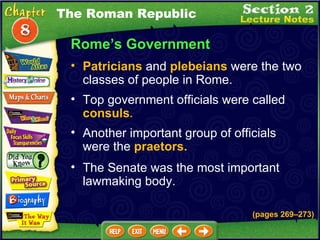
Rome’s Government Top government officials were called  consuls .   Another important group of officials were the  praetors.  Patricians  and  plebeians  were the two classes of people in Rome.   (pages 269 – 273) The Roman Republic The Senate was the most important lawmaking body.
Rome’s Government  (cont.) Plebeians challenged the class system by going on strike.   The Romans then allowed the plebeians to set up their own legislative group called the Council of the Plebes.   Another important legislative body was the Assembly of Centuries.   The Roman Republic Today, a  dictator  is an oppressive ruler. (pages 269 – 273)
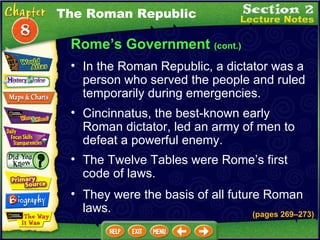
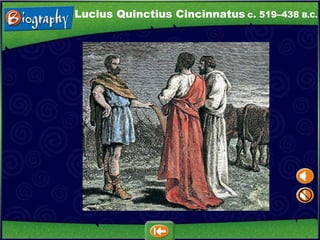
Rome’s Government  (cont.) Cincinnatus, the best-known early Roman dictator, led an army of men to defeat a powerful enemy.   The Twelve Tables were Rome’s first code of laws.   In the Roman Republic, a dictator was a person who served the people and ruled temporarily during emergencies.   The Roman Republic They were the basis of all future Roman laws. (pages 269 – 273)
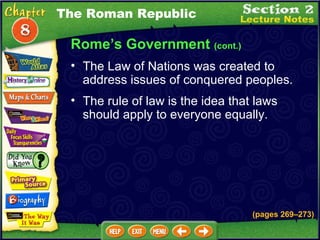
Rome’s Government  (cont.) The rule of law is the idea that laws should apply to everyone equally.   The Law of Nations was created to address issues of conquered peoples.   The Roman Republic (pages 269 – 273)
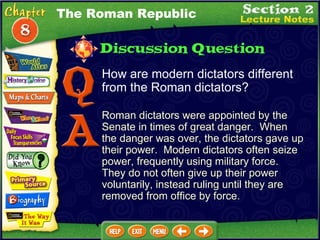
How are modern dictators different from the Roman dictators? Roman dictators were appointed by the Senate in times of great danger.  When the danger was over, the dictators gave up their power.  Modern dictators often seize power, frequently using military force.  They do not often give up their power voluntarily, instead ruling until they are removed from office by force. The Roman Republic
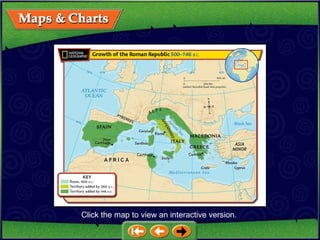
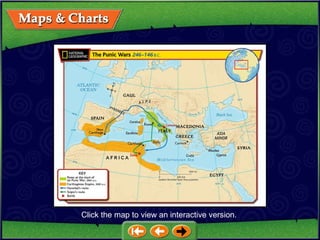
Rome Expands Carthage, a state on the coast of North Africa, was a powerful enemy of Rome.  (pages 274 – 276) The First Punic War began as a dispute between Rome and Carthage over the island of Sicily.   The war continued for 20 years before Rome won.   The Roman Republic The Second Punic War began after Carthage expanded into Spain.
Rome Expands  (cont.) Rome helped the people of Spain rebel.  Hannibal was a great Carthaginian general who fought in the Second Punic War.   At the Battle of Cannae, Hannibal’s forces overpowered the Romans.   The Roman Republic The Roman general Scipio led his forces to defeat the Carthaginians at the Battle of Zama.   (pages 274 – 276)
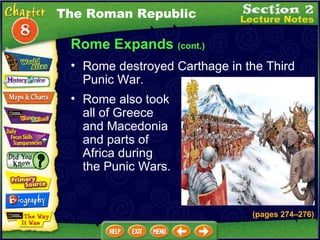
Rome Expands  (cont.) Rome destroyed Carthage in the Third Punic War.  Rome also took all of Greece and Macedonia and parts of Africa during the Punic Wars. The Roman Republic (pages 274 – 276)
Why did Rome create a navy?  Carthage was a great sea power.  To beat the Carthaginians, the Romans had to build a great naval fleet. The Roman Republic
Who were the top government officials in the Roman Republic, and what were their duties? Consuls were the top government officials, praetors, tribunes. Consuls headed armies and ran the state.  Praetors served as judges, and tribunes represented the plebeians. The Roman Republic
What does  mare nostrum  mean, and why did the Romans use the term? It means “our sea.”  The Romans controlled the Mediterranean Sea. The Roman Republic
Geography Skills   Where was Carthage located, and why did it compete with Rome?  Carthage was located on the coast of North Africa and was a trading rival of Rome. The Roman Republic
Summarize   What other conquests did Rome carry out during the period of the Punic Wars? Rome conquered Macedonia, Greece, and Asia Minor. The Roman Republic
Evaluate   Why do you think the legacy of Roman law is considered so important? Roman law led to the principles that law protects citizens’ rights, that a person is innocent until proven guilty, and that a judge must look at evidence carefully before making a decision. The Roman Republic
Persuasive Writing   Write a speech demanding equal rights for plebeians in the early republic. Answers will vary but should be based on the text. The Roman Republic
Summarize the expansion of the Roman Empire. The Roman Republic
 
The Fall of the Republic Get Ready to Read Section Overview This section describes the events that led to the end of the Roman Republic.
Get Ready to Read  (cont.) Focusing on the Main Ideas The Fall of the Republic The use of enslaved labor hurt farmers, increased poverty and corruption, and brought the army into politics .   Military hero Julius Caesar seized power and made reforms.  The Roman Republic, weakened by civil wars, became an empire under Augustus.
Locating Places Rubicon (ROO·bih· KAHN )   Actium (AK·shee·uhm)  Julius Caesar (jool·yuhs  SEE·zuhr)  Meeting People The Fall of the Republic Octavian (ahk·TAY·vee·uhn)  Antony (AN·tuh·nee)  Cicero (SIH·suh· ROH )  Augustus (aw·GUHS·tuhs)  Get Ready to Read  (cont.)
Building Your Vocabulary latifundia ( LA ·tuh·FUHN·dee·uh)  The Fall of the Republic triumvirate (try·UHM·vuh·ruht)  Reading Strategy Finding the Main Idea   Complete a chart like the one on page 277 of your textbook to identify the main ideas of Section 3 and supporting details. Get Ready to Read  (cont.)
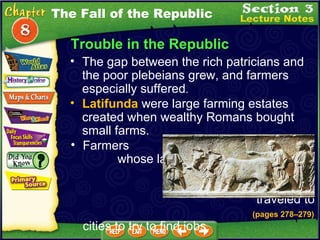
Trouble in the Republic The gap between the rich patricians and the poor plebeians grew, and farmers especially suffered .   Latifunda  were large farming estates created when wealthy Romans bought small farms.  Farmers  whose land  had been  bought  traveled to  cities to try to find jobs.  (pages 278 – 279) The Fall of the Republic
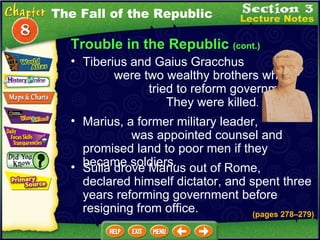
Trouble in the Republic  (cont.) Tiberius and Gaius Gracchus  were two wealthy brothers who  tried to reform government.  They were killed .   Marius, a former military leader,  was appointed counsel and promised land to poor men if they became soldiers.  Sulla drove Marius out of Rome, declared himself dictator, and spent three years reforming government before resigning from office.  The Fall of the Republic (pages 278 – 279)
What happened after Sulla stepped down from office? Men who saw Sulla gain power by using an army decided to follow the same path, and civil wars broke out. The Fall of the Republic
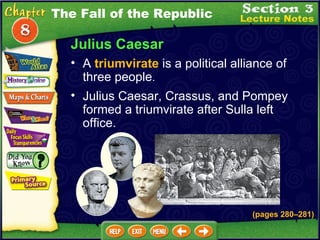
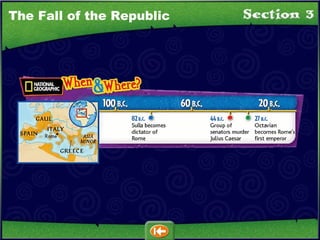
Julius Caesar Julius Caesar, Crassus, and Pompey formed a triumvirate after Sulla left office.  A  triumvirate  is a political alliance of three people .   (pages 280 – 281) The Fall of the Republic
Julius Caesar  (cont.) Caesar declared himself dictator of Rome for life and made many changes to Rome.  Julius Caesar marched on Rome and defeated Pompey’s forces after Crassus died in battle .   The Fall of the Republic The Julian calendar was created during Caesar’s rule .   (pages 280 – 281)
Julius Caesar  (cont.) This calendar was changed slightly in  A.D.  1582, but is basically still in use today.  The Fall of the Republic Caesar had many enemies as well as supporters.  His enemies plotted to kill him and succeeded on March 15, called the “Ides of March.” (pages 280 – 281)
What is the origin of the phrase “crossing the Rubicon” and what does it mean? The phrase refers to Caesar’s return to Italy.  By crossing the Rubicon, Caesar knew he would begin a civil war and that he would either be victorious or be destroyed.  Today it means passing a point of no return. The Fall of the Republic
Rome Becomes an Empire Antony and Lepidus were two of Caesar’s top generals.  Octavian was Caesar’s grandnephew, who had inherited Caesar’s wealth .   (pages 282 – 283) Octavian, Antony, and Lepidus formed the Second Triumvirate, although the triumvirate began to quarrel immediately.  Antony fell in love with Cleopatra VII and formed an alliance with her. The Fall of the Republic
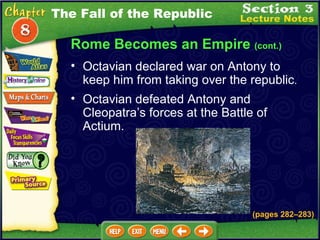
Rome Becomes an Empire  (cont.) Octavian defeated Antony and Cleopatra’s forces at the Battle of Actium.  Octavian declared war on Antony to keep him from taking over the republic .   The Fall of the Republic (pages 282 – 283)
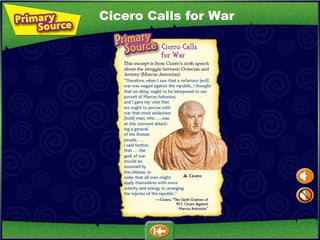
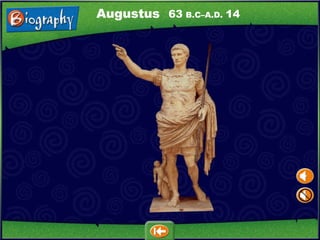
Rome Becomes an Empire  (cont.) Octavian restored the republic with some reforms and took the title Augustus, meaning “revered one.”  Cicero was a political leader, writer,  and public speaker who favored representative government and supported Octavian .   This began the Roman Empire. The Fall of the Republic (pages 282 – 283)
How was Octavian like Caesar?  How was he different? Like Caesar, Octavian declared himself ruler for life.  However, he also knew that many people favored a republic.  Octavian reformed government so that a Senate with limited power existed while he remained in charge. The Fall of the Republic
The Fall of the Republic What is a triumvirate? a political alliance of three people
The Fall of the Republic Who was Cicero, and how did he influence the writers of the United States Constitution? Cicero was a political leader whose ideas on a representative government with limited powers influenced the U.S. Constitution.
Summarize   What reforms did the Gracchus brothers suggest? The Gracchus brothers wanted the government to take back public land and give it to landless farmers.  Landholding senators opposed their proposals. The Fall of the Republic
Analyze   What was the “bread and circuses” policy, and how did Roman politicians benefit from it? The “bread and circuses” policy was the use of cheap food and free entertainment to win support from the poor. The Fall of the Republic
Analyze   What reforms did Julius Caesar put in place that increased his popularity with poor and working-class Romans? Caesar provided land for the poor and created new jobs.  He also ordered landholders to hire more free workers. The Fall of the Republic
Persuasive Writing   Imagine you are a Roman citizen.  Decide whether you would have been for or against Julius Caesar’s rise to power and his reforms.  Then write a newspaper editorial explaining your views.  Be sure to include facts to support your opinions. Your editorial should include facts to support your opinions. The Fall of the Republic
Describe the transition from the Roman Republic to the Roman Empire. The Fall of the Republic
 
Get Ready to Read Section Overview This section describes the expansion and contributions of the Roman Empire. The Early Empire
Get Ready to Read  (cont.) Focusing on the Main Ideas The Early Empire By expanding the empire and reorganizing the military and government, Augustus created  a new era of prosperity .   Rome’s system of roads, aqueducts, ports, and common currency made the empire rich and prosperous.
Get Ready to Read  (cont.) Locating Places Rhine River (RYN)   Danube River (DAN· YOOB )  Puteoli (pyu·TEE·uh· LY )  Caligula (kuh·LIH·gyuh·luh)  Meeting People Nero (NEE·roh)  Ostia (AHS·tee·uh)  Hadrian (HAY·dree·uhn)  The Early Empire
Get Ready to Read  (cont.) Building Your Vocabulary Pax Romana ( pahks  roh·MAH·nah)   aqueduct (A·kwuh· DUHKT )  currency (KUHR·uhn·see)  Reading Strategy Cause and Effect   Use a chart like the one on page 286 of your textbook to show the changes Augustus made in the Roman Empire and the effect of each change. The Early Empire
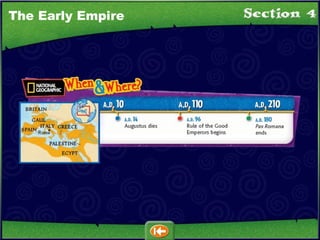
The Emperor Augustus The  Pax Romana  is the long era of peace that began with Augustus .   Augustus built a permanent, professional army and created a special guard called the Praetorian Guard, who guarded him.  (pages 287 – 288) Augustus restored Rome’s splendor and fed the hungry poor of Rome with imported grain.  The Early Empire
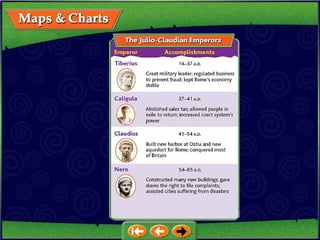
The Emperor Augustus  (cont.) Augustus appointed a proconsul, or governor, for each province, replacing politicians appointed by the Senate .   Augustus reformed the tax system by making tax collectors permanent workers, and he reformed the legal system by creating a set of laws for people who were not citizens.  The Julio-Claudian emperors were the rulers who followed Augustus:  Tiberius, Caligula, Claudius, and Nero.  The Early Empire (pages 287 – 288)
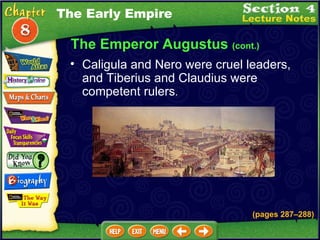
The Emperor Augustus  (cont.) Caligula and Nero were cruel leaders, and Tiberius and Claudius were competent rulers .   The Early Empire (pages 287 – 288)
What lands did Augustus conquer during his reign? Augustus’s army conquered Spain, Gaul, and lands today known as Austria, Hungary, Romania, and Bulgaria. The Early Empire
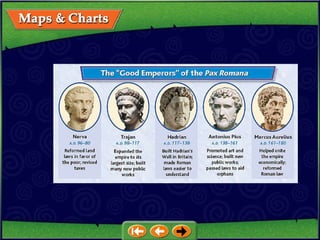
Unity and Prosperity Vespasian restored order to Rome after the chaos following Nero’s death .   (pages 290 – 294) The Jewish temple in Jerusalem was destroyed by Vespasian’s armies in the effort to put down a Jewish rebellion.  Mount Vesuvius erupted and destroyed the city of Pompeii in  A.D.  79.  The rulers known as the good emperors were Nerva, Trajan, Hadrian, Antoninus Pius, and Marcus Aurelius. The Early Empire
Unity and Prosperity  (cont.) The Roman Empire flourished under their rule .   Aqueducts  are human-made water channels for carrying water long distances.  They were created during the prosperous times of the good emperors.  The Roman Empire became one of the largest empires in history during the reign of the good emperors. The Early Empire (pages 290 – 294)
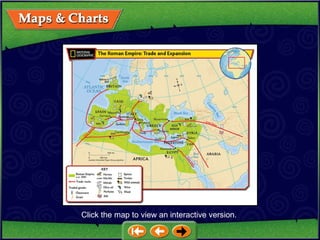
Unity and Prosperity  (cont.) The different people of the Roman Empire were united by Roman law, Roman rule, and their shared identity as Romans .   Most people were farmers who grew olives, grapes, and grain.  Other people were artisans who traded with others inside and outside the Roman Empire.  The Early Empire (pages 290 – 294)
Unity and Prosperity  (cont.) Roads and  currency — a system of money — were important to the prosperous trade that developed .   A gap existed between rich merchants, shopkeepers, and skilled workers and poor farmers and city dwellers.  The Early Empire (pages 290 – 294)
Why were aqueducts important? The aqueducts were the source of water for most people in Rome. The Early Empire
The Early Empire What was the  Pax Romana ? a period of peace and prosperity lasting 200 years
The Early Empire What products came from the farms of Italy, Gaul, and Spain? grapes and olives
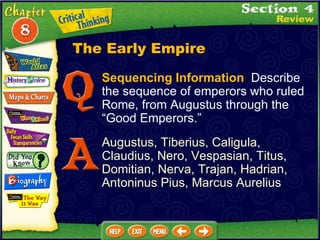
Sequencing Information   Describe the sequence of emperors who ruled Rome, from Augustus through the “Good Emperors.” Augustus, Tiberius, Caligula, Claudius, Nero, Vespasian, Titus, Domitian, Nerva, Trajan, Hadrian, Antoninus Pius, Marcus Aurelius The Early Empire
Analyze   Why was Rome’s creation of a common currency important? A common Roman currency advanced trade throughout the empire. The Early Empire
Evaluate   Who do you think was a more important leader, Julius Caesar or Augustus?  Explain. Answers will vary.  You may note that Julius Caesar conquered new territories.  Augustus became the first emperor and carried out many improvements. The Early Empire
Creative Writing   Write a short play in which several Roman citizens discuss one of the emperors mentioned in this section and his accomplishments. Plays should note accomplishments based on the text. The Early Empire
Discuss the influence of geography and the sea on Roman trade. The Early Empire
 
Section 1: Rome’s Beginnings Focusing on the Main Ideas The Rise of Rome Geography played an important role in the rise of Roman civilization.   The Romans created a republic and conquered Italy.  By treating people fairly, they built Rome from a small city into a great power.
Rome’s republic was shaped by a struggle between wealthy landowners and regular citizens as it gradually expanded the right to vote.   Rome slowly destroyed the Carthaginian Empire and took control of the entire Mediterranean region. The Rise of Rome Section 2: The Roman Republic Focusing on the Main Ideas
Focusing on the Main Ideas The use of enslaved labor hurt farmers, increased poverty and corruption, and brought the army into politics.   Military hero Julius Caesar seized power and made reforms.  Section 3: The Fall of the Republic The Roman Republic, weakened by civil wars, became an empire under Augustus. The Rise of Rome
Focusing on the Main Ideas By expanding the empire and reorganizing the military and government, Augustus created a new era of prosperity.   Section 4: The Early Empire Rome’s system of roads, aqueducts, ports, and common currency made the empire rich and prosperous. The Rise of Rome
 
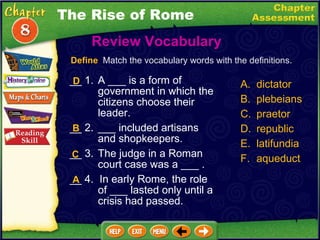
__ 1. A ___ is a form of government in which the citizens choose their leader. __ 2. ___ included artisans and shopkeepers. __ 3. The judge in a Roman court case was a ___ . __ 4.  In early Rome, the role of ___ lasted only until a crisis had passed. Review Vocabulary  A. dictator B. plebeians C. praetor D. republic latifundia aqueduct Define   Match the vocabulary words with the definitions. D B C A The Rise of Rome
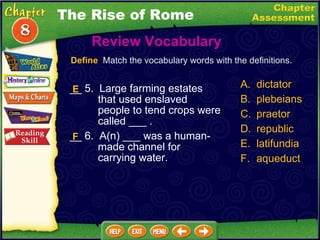
__ 5.  Large farming estates that used enslaved people to tend crops were called ___ . __ 6.  A(n) ___ was a human-made channel for carrying water. Review Vocabulary  Define   Match the vocabulary words with the definitions. E F The Rise of Rome A. dictator B. plebeians C. praetor D. republic latifundia aqueduct
Section 1 Rome’s Beginnings Describe the role geography played in the rise of Roman civilization. Rome grew because it was centrally located on the Italian peninsula, near the Mediterranean Sea. The Rise of Rome Review Main Ideas
How did treating people fairly help Rome to increase its power? Treating conquered people fairly inspired loyalty to the Roman government. The Rise of Rome Section 1 Rome’s Beginnings Review Main Ideas
How did the roles of patricians and plebeians differ in Roman society? Patricians were the upper class and plebeians were the lower class. The Rise of Rome Section 2 Roman Republic Review Main Ideas
Explain how Rome gradually defeated the Carthaginians. Rome developed a navy and eventually attacked Carthage. The Rise of Rome Section 2 Roman Republic Review Main Ideas
How did slavery weaken the Roman Republic? Slaves began to work the farms and forced farmers out of business. The Rise of Rome Section 3 The Fall of the Republic Review Main Ideas
How did Augustus change the Roman Republic? He replaced it with an empire. The Rise of Rome Section 3 The Fall of the Republic Review Main Ideas
Was Augustus a successful ruler? Why? Yes.  List Augustus’s accomplishments. The Rise of Rome Section 4 The Early Empire Review Main Ideas
How did the Roman Empire change during the  Pax Romana ? It grew larger and wealthier. The Rise of Rome Section 4 The Early Empire Review Main Ideas
Compare  In the chapter, Cincinnatus is compared to George Washington.  Think of another person or character who is similar to Cincinnatus.  Explain how they are similar. Answers will vary. The Rise of Rome
Explain  Why did Caesar fight Pompey? Answers will vary. The Rise of Rome
Predict  What do you think would have happened if Hadrian had tried to further expand the Roman Empire? Answers will vary, but you should note the fact that the empire had become so large that it was hard to defend. The Rise of Rome
 
Explore online information about the topics introduced in this chapter. Click on the  Connect  button to launch your browser and go to the  Journey Across Time  Web site.  Click on Chapter 8-Chapter Overviews to preview information about this chapter.  When you finish exploring, exit the browser program to return to this presentation.  If you experience difficulty connecting to the Web site, manually launch your Web browser and go to   http://www.jat.glencoe.com
Map s Italy 500  B.C. Growth of the Roman Republic 500 – 146   B.C. The Punic Wars 264 – 146   B.C. The Roman Empire:  Trade and Expansion   Click on a hyperlink to view the corresponding slides. Charts The Julio- Claudian  Emperors The “Good Emperors” of the  Pax   Romana
 
Click the map to view an interactive version.
 
 
At the height of their rule, the Etruscans had established three major cities:  Cere, Tarquinia, and Vulci.  Etruscan cities and culture were taken over by the Romans. Rome’s Beginnings
After the Second Punic War, Hannibal fled to lands of foreign kings to evade the Romans.  The Romans twice demanded Hannibal be turned over to them.  Hannibal finally committed suicide rather surrender to the Romans. The Roman Republic
Julius Caesar was born to a patrician family.  According to myth, Julius’ ancestor was the  goddess Venus. The Fall of the Republic
The first fire brigade, or fire department, was created by Augustus. The Early Empire
Note Taking Learn It! Reading Social Studies Did you know that when you take notes, you remember more than three-fourths of the information you recorded?  That is why it is important to learn to take careful notes as you are reading.  Read the paragraph from Section 3 on the following slide.
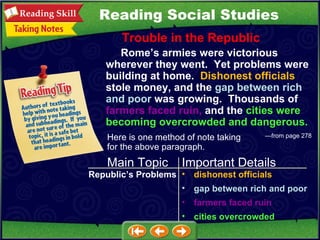
Reading Social Studies Trouble in the Republic — f rom page 278   Rome’s armies were victorious wherever they went.  Yet problems were building at home.  Dishonest officials  stole money, and the  gap between rich and poor  was growing.  Thousands of  farmers faced ruin,  and the  cities were becoming overcrowded and dangerous. Here is one method of note taking for the above paragraph. Main Topic Important Details Republic’s Problems dishonest officials gap between rich and poor farmers faced ruin cities overcrowded
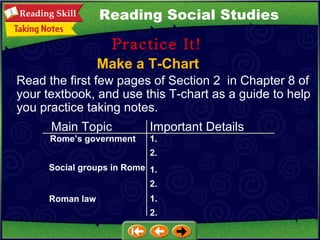
Make a T-Chart Practice It! Read the first few pages of Section 2  in Chapter 8 of your textbook, and use this T-chart as a guide to help you practice taking notes.  Reading Social Studies Main Topic Important Details Rome’s government 1. 2. Social groups in Rome 1. 2. Roman law 1. 2.
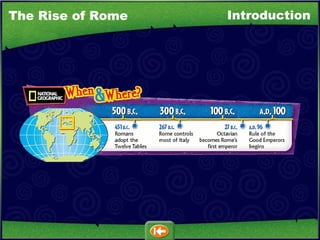
The Rise of Rome Introduction
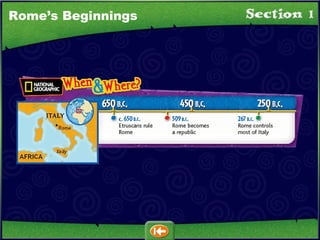
Rome’s Beginnings
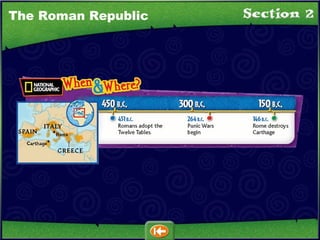
The Roman Republic
The Fall of the Republic
The Early Empire
The Aeneid
A Roman Triumph
Cicero Calls for War
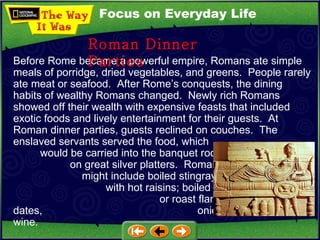
Focus on Everyday Life Before Rome became a powerful empire, Romans ate simple meals of porridge, dried vegetables, and greens.  People rarely ate meat or seafood.  After Rome’s conquests, the dining habits of wealthy Romans changed.  Newly rich Romans showed off their wealth with expensive feasts that included exotic foods and lively entertainment for their guests.  At Roman dinner parties, guests reclined on couches.  The enslaved servants served the food, which  would be carried into the banquet room  on great silver platters.  Roman dishes  might include boiled stingray garnished  with hot raisins; boiled crane with turnips;  or roast flamingo cooked with dates,  onions, honey, and wine. Roman Dinner Parties
Connecting to the Past the newly rich Romans 1. Whose eating habits changed after Rome became wealthy and powerful? 2. Describe how their eating habits changed.   Wealthy Romans ate costly feasts and entertained guests while reclining on couches.
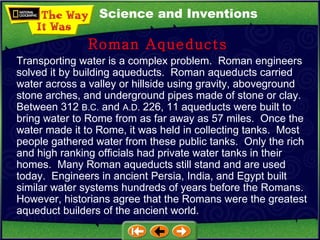
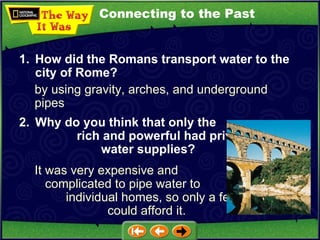
Science and Inventions Transporting water is a complex problem.  Roman engineers solved it by building aqueducts.  Roman aqueducts carried water across a valley or hillside using gravity, aboveground stone arches, and underground pipes made of stone or clay.  Between 312  B.C.  and  A.D.  226, 11 aqueducts were built to bring water to Rome from as far away as 57 miles.  Once the water made it to Rome, it was held in collecting tanks.  Most people gathered water from these public tanks.  Only the rich and high ranking officials had private water tanks in their homes.  Many Roman aqueducts still stand and are used today.  Engineers in ancient Persia, India, and Egypt built similar water systems hundreds of years before the Romans.  However, historians agree that the Romans were the greatest aqueduct builders of the ancient world. Roman Aqueducts
Connecting to the Past by using gravity, arches, and underground pipes 1. How did the Romans transport water to the city of Rome? 2. Why do you think that only the  rich and powerful had private  water supplies?   It was very expensive and  complicated to pipe water to  individual homes, so only a few  could afford it.
c. 519–438   B.C. Lucius Quinctius Cincinnatus
Augustus 63   B.C–A.D.   14
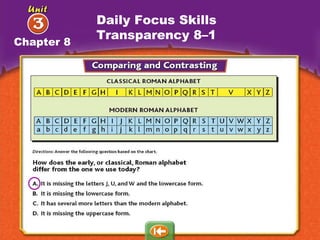
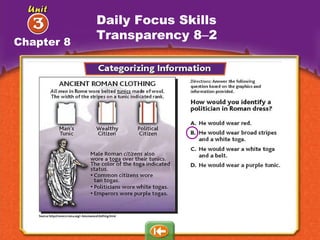
Daily Focus Skills Transparency 8–1 Chapter 8
Daily Focus Skills Transparency 8 – 2 Chapter 8
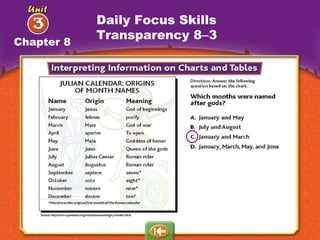
Daily Focus Skills Transparency 8 – 3 Chapter 8
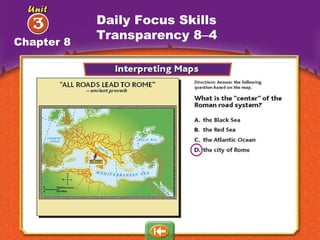
Daily Focus Skills Transparency 8 – 4 Chapter 8
Click the  Forward   button to go to the next slide. Click the  Previous   button to return to the previous slide. Click the  Menu   button to return to the Chapter Menu.  Click the  Return  button in a feature to return to the main presentation. Click the  Exit  button or press the  Escape  key [Esc] to end the  chapter slide show. Click the  Help   button to access this screen. Links to Presentation Plus! features such as the Reference Atlas, Daily Focus Transparencies, and others are located on the left side of the relevant slides. To use this Presentation Plus! product:
End of Custom Shows This slide is intentionally blank

Jat Chapter 08

  • 1.
  • 2.
    Chapter Introduction Section1 Rome’s Beginning Section 2 The Roman Republic Section 3 The Fall of the Republic Section 4 The Early Empire Reading Review Chapter Assessment The Rise of Rome Click on a hyperlink to view the corresponding slides.
  • 3.
    Chapter Objectives Explainhow Rome became a republic. Describe how Rome gained control of the Mediterranean region. Explain how the failure of the republic led to the creation of a Roman Empire. T he Rise of Rome Relate how military and political reforms made Rome rich and prosperous.
  • 4.
    The Riseof Rome
  • 5.
  • 6.
    Get Ready toRead Section Overview This section describes the beginnings of Rome, the founding of the republic, and early conquests. Rome’s Beginnings
  • 7.
    Get Ready toRead (cont.) Focusing on the Main Ideas Rome’s Beginnings Geography played an important role in the rise of Roman civilization . The Romans created a republic and conquered Italy. By treating people fairly, they built Rome from a small city into a great power.
  • 8.
    Get Ready toRead (cont.) Locating Places Sicily (SIH·suh·lee) Apennines (A·puh· NYNZ ) Latium (LAY·shee·uhm) Tiber River (TY·buhr) Etruria (ih·TRUR·ee·uh) Rome’s Beginnings
  • 9.
    Get Ready toRead (cont.) Meeting People Romulus (RAHM·yuh·luhs) Remus (REE·muhs) Aeneas (ih·NEE·uhs) Latins (LA·tuhnz) Etruscans (ih·TRUHS·kuhnz) Tarquins (TAHR·kwihnz) Rome’s Beginnings
  • 10.
    Get Ready toRead (cont.) Building Your Vocabulary republic (rih ·PUH ·blihk) legion (LEE·juhn) Reading Strategy Summarizing Information Use a diagram like the one on page 262 of your textbook to show how the Etruscans affected the development of Rome. Rome’s Beginnings
  • 11.
    The Origins ofRome Italy is a boot-shaped country in the Mediterranean . The Alps are mountains at Italy’s northern border, and the Apennines is a mountain range that extends through Italy from north to south. (pages 263 – 265) The toe of the boot points toward the island of Sicily. Italy’s terrain was easier to farm than the terrain of Greece, so Italy could support more people . Rome’s Beginnings
  • 12.
    The Origins ofRome (cont.) The Latins built the city of Rome on the plain of Latium . Rome was located in central Italy on the Tiber River. Rome’s Beginnings Two stories tell about Rome’s beginning: the legend of Remus and Romulus and the tale of Aeneas and his Trojan followers . (pages 263 – 265)
  • 13.
    The Origins ofRome (cont.) The Greeks and the Etruscans influenced the Roman way of life . The Etruscans were skilled metal workers who helped shape Roman civilization. Rome’s Beginnings The Etruscan army was the model for the Roman army . (pages 263 – 265)
  • 14.
    How did theGreeks influence the Romans? The Greeks taught the Romans how to grow grapes and olives. They also taught the Romans their alphabet. Roman architecture, sculpture, and literature was also modeled after the Greeks. Rome’s Beginnings
  • 15.
    The Birth ofa Republic The Tarquins were leaders of the Etruscan-ruled Rome . (pages 265 – 267) After 100 years under the Tarquins, the Romans rebelled against Etruscan rulers. The Romans established a republic . In a republic, the leader is not a king or queen but someone voted into office by citizens. Rome’s Beginnings
  • 16.
    The Birth ofa Republic (cont.) Rome had a large, powerful army made up of excellent, disciplined soldiers . Roads connected all of Rome’s military settlements. Rome’s Beginnings (pages 265 – 267)
  • 17.
    The Birth ofa Republic (cont.) The Roman Confederation gave full citizenship to some people, who could vote and serve in government . Romans gave others the status of allies, which meant they could rule their own local affairs. Rome’s Beginnings (pages 265 – 267)
  • 18.
    What was thebenefit of organizing soldiers into legions? Smaller bands of troops were easier to maneuver than one large army. Rome’s Beginnings
  • 19.
    Where did theGreeks live in Italy, and how did they influence Roman civilization? Greeks colonized southern Italy and Sicily. They passed on farming methods, sculpture, literature, and an alphabet. Rome’s Beginnings
  • 20.
    Describe the twolegends that tell of the founding of Rome. Then describe how and when Rome was actually founded. The legend of Romulus and Remus and the Aeneas story. Rome was probably founded by Latins in c. 700s B.C. Rome’s Beginnings
  • 21.
    Summarize Describe the Roman conquest of Italy. Rome defeated remaining Latins and then Etruscans and Greeks. Rome’s Beginnings
  • 22.
    Compare and Contrast How did geography affect the development of civilization in Greece and Italy? Italy is less rugged than Greece, so people are not separated from each other. Italy’s better farmland supports more people. Rome’s Beginnings
  • 23.
    Expository Writing Write a short essay discussing the reasons Rome was so successful in its conquest of Italy. Answers will vary. Rome’s Beginnings
  • 24.
    Identify the rightsheld by Roman citizens. Rome’s Beginnings
  • 25.
  • 26.
    The Roman RepublicGet Ready to Read Section Overview This section describes the Roman Republic’s political development and the defeat of Carthage.
  • 27.
    Get Ready toRead (cont.) Focusing on the Main Ideas The Roman Republic Rome slowly destroyed the Carthaginian Empire and took control of the entire Mediterranean region. Rome’s republic was shaped by a struggle between wealthy landowners and regular citizens as it gradually expanded the right to vote.
  • 28.
    Get Ready toRead (cont.) Cincinnatus ( SIHN ·suh·NA·tuhs) Meeting People Hannibal (HA·nuh·buhl) Scipio (SIH·pee· OH ) The Roman Republic Carthage (KAHR·thihj) Locating Places Cannae (KA·nee) Zama (ZAY·muh)
  • 29.
    Get Ready toRead (cont.) Building Your Vocabulary patrician (puh·TRIH·shuhn) plebeian (plih·BEE·uhn) consul (KAHN·suhl) praetor (PREE·tuhr) veto (VEE·toh) The Roman Republic dictator (DIHK·TAY·tuhr)
  • 30.
    Get Ready toRead (cont.) Reading Strategy Categorizing Information Create a chart like the one on page 268 of your textbook. List the government officials and legislative bodies of the Roman Republic. The Roman Republic
  • 31.
    Rome’s Government Topgovernment officials were called consuls . Another important group of officials were the praetors. Patricians and plebeians were the two classes of people in Rome. (pages 269 – 273) The Roman Republic The Senate was the most important lawmaking body.
  • 32.
    Rome’s Government (cont.) Plebeians challenged the class system by going on strike. The Romans then allowed the plebeians to set up their own legislative group called the Council of the Plebes. Another important legislative body was the Assembly of Centuries. The Roman Republic Today, a dictator is an oppressive ruler. (pages 269 – 273)
  • 33.
    Rome’s Government (cont.) Cincinnatus, the best-known early Roman dictator, led an army of men to defeat a powerful enemy. The Twelve Tables were Rome’s first code of laws. In the Roman Republic, a dictator was a person who served the people and ruled temporarily during emergencies. The Roman Republic They were the basis of all future Roman laws. (pages 269 – 273)
  • 34.
    Rome’s Government (cont.) The rule of law is the idea that laws should apply to everyone equally. The Law of Nations was created to address issues of conquered peoples. The Roman Republic (pages 269 – 273)
  • 35.
    How are moderndictators different from the Roman dictators? Roman dictators were appointed by the Senate in times of great danger. When the danger was over, the dictators gave up their power. Modern dictators often seize power, frequently using military force. They do not often give up their power voluntarily, instead ruling until they are removed from office by force. The Roman Republic
  • 36.
    Rome Expands Carthage,a state on the coast of North Africa, was a powerful enemy of Rome. (pages 274 – 276) The First Punic War began as a dispute between Rome and Carthage over the island of Sicily. The war continued for 20 years before Rome won. The Roman Republic The Second Punic War began after Carthage expanded into Spain.
  • 37.
    Rome Expands (cont.) Rome helped the people of Spain rebel. Hannibal was a great Carthaginian general who fought in the Second Punic War. At the Battle of Cannae, Hannibal’s forces overpowered the Romans. The Roman Republic The Roman general Scipio led his forces to defeat the Carthaginians at the Battle of Zama. (pages 274 – 276)
  • 38.
    Rome Expands (cont.) Rome destroyed Carthage in the Third Punic War. Rome also took all of Greece and Macedonia and parts of Africa during the Punic Wars. The Roman Republic (pages 274 – 276)
  • 39.
    Why did Romecreate a navy? Carthage was a great sea power. To beat the Carthaginians, the Romans had to build a great naval fleet. The Roman Republic
  • 40.
    Who were thetop government officials in the Roman Republic, and what were their duties? Consuls were the top government officials, praetors, tribunes. Consuls headed armies and ran the state. Praetors served as judges, and tribunes represented the plebeians. The Roman Republic
  • 41.
    What does mare nostrum mean, and why did the Romans use the term? It means “our sea.” The Romans controlled the Mediterranean Sea. The Roman Republic
  • 42.
    Geography Skills Where was Carthage located, and why did it compete with Rome? Carthage was located on the coast of North Africa and was a trading rival of Rome. The Roman Republic
  • 43.
    Summarize What other conquests did Rome carry out during the period of the Punic Wars? Rome conquered Macedonia, Greece, and Asia Minor. The Roman Republic
  • 44.
    Evaluate Why do you think the legacy of Roman law is considered so important? Roman law led to the principles that law protects citizens’ rights, that a person is innocent until proven guilty, and that a judge must look at evidence carefully before making a decision. The Roman Republic
  • 45.
    Persuasive Writing Write a speech demanding equal rights for plebeians in the early republic. Answers will vary but should be based on the text. The Roman Republic
  • 46.
    Summarize the expansionof the Roman Empire. The Roman Republic
  • 47.
  • 48.
    The Fall ofthe Republic Get Ready to Read Section Overview This section describes the events that led to the end of the Roman Republic.
  • 49.
    Get Ready toRead (cont.) Focusing on the Main Ideas The Fall of the Republic The use of enslaved labor hurt farmers, increased poverty and corruption, and brought the army into politics . Military hero Julius Caesar seized power and made reforms. The Roman Republic, weakened by civil wars, became an empire under Augustus.
  • 50.
    Locating Places Rubicon(ROO·bih· KAHN ) Actium (AK·shee·uhm) Julius Caesar (jool·yuhs SEE·zuhr) Meeting People The Fall of the Republic Octavian (ahk·TAY·vee·uhn) Antony (AN·tuh·nee) Cicero (SIH·suh· ROH ) Augustus (aw·GUHS·tuhs) Get Ready to Read (cont.)
  • 51.
    Building Your Vocabularylatifundia ( LA ·tuh·FUHN·dee·uh) The Fall of the Republic triumvirate (try·UHM·vuh·ruht) Reading Strategy Finding the Main Idea Complete a chart like the one on page 277 of your textbook to identify the main ideas of Section 3 and supporting details. Get Ready to Read (cont.)
  • 52.
    Trouble in theRepublic The gap between the rich patricians and the poor plebeians grew, and farmers especially suffered . Latifunda were large farming estates created when wealthy Romans bought small farms. Farmers whose land had been bought traveled to cities to try to find jobs. (pages 278 – 279) The Fall of the Republic
  • 53.
    Trouble in theRepublic (cont.) Tiberius and Gaius Gracchus were two wealthy brothers who tried to reform government. They were killed . Marius, a former military leader, was appointed counsel and promised land to poor men if they became soldiers. Sulla drove Marius out of Rome, declared himself dictator, and spent three years reforming government before resigning from office. The Fall of the Republic (pages 278 – 279)
  • 54.
    What happened afterSulla stepped down from office? Men who saw Sulla gain power by using an army decided to follow the same path, and civil wars broke out. The Fall of the Republic
  • 55.
    Julius Caesar JuliusCaesar, Crassus, and Pompey formed a triumvirate after Sulla left office. A triumvirate is a political alliance of three people . (pages 280 – 281) The Fall of the Republic
  • 56.
    Julius Caesar (cont.) Caesar declared himself dictator of Rome for life and made many changes to Rome. Julius Caesar marched on Rome and defeated Pompey’s forces after Crassus died in battle . The Fall of the Republic The Julian calendar was created during Caesar’s rule . (pages 280 – 281)
  • 57.
    Julius Caesar (cont.) This calendar was changed slightly in A.D. 1582, but is basically still in use today. The Fall of the Republic Caesar had many enemies as well as supporters. His enemies plotted to kill him and succeeded on March 15, called the “Ides of March.” (pages 280 – 281)
  • 58.
    What is theorigin of the phrase “crossing the Rubicon” and what does it mean? The phrase refers to Caesar’s return to Italy. By crossing the Rubicon, Caesar knew he would begin a civil war and that he would either be victorious or be destroyed. Today it means passing a point of no return. The Fall of the Republic
  • 59.
    Rome Becomes anEmpire Antony and Lepidus were two of Caesar’s top generals. Octavian was Caesar’s grandnephew, who had inherited Caesar’s wealth . (pages 282 – 283) Octavian, Antony, and Lepidus formed the Second Triumvirate, although the triumvirate began to quarrel immediately. Antony fell in love with Cleopatra VII and formed an alliance with her. The Fall of the Republic
  • 60.
    Rome Becomes anEmpire (cont.) Octavian defeated Antony and Cleopatra’s forces at the Battle of Actium. Octavian declared war on Antony to keep him from taking over the republic . The Fall of the Republic (pages 282 – 283)
  • 61.
    Rome Becomes anEmpire (cont.) Octavian restored the republic with some reforms and took the title Augustus, meaning “revered one.” Cicero was a political leader, writer, and public speaker who favored representative government and supported Octavian . This began the Roman Empire. The Fall of the Republic (pages 282 – 283)
  • 62.
    How was Octavianlike Caesar? How was he different? Like Caesar, Octavian declared himself ruler for life. However, he also knew that many people favored a republic. Octavian reformed government so that a Senate with limited power existed while he remained in charge. The Fall of the Republic
  • 63.
    The Fall ofthe Republic What is a triumvirate? a political alliance of three people
  • 64.
    The Fall ofthe Republic Who was Cicero, and how did he influence the writers of the United States Constitution? Cicero was a political leader whose ideas on a representative government with limited powers influenced the U.S. Constitution.
  • 65.
    Summarize What reforms did the Gracchus brothers suggest? The Gracchus brothers wanted the government to take back public land and give it to landless farmers. Landholding senators opposed their proposals. The Fall of the Republic
  • 66.
    Analyze What was the “bread and circuses” policy, and how did Roman politicians benefit from it? The “bread and circuses” policy was the use of cheap food and free entertainment to win support from the poor. The Fall of the Republic
  • 67.
    Analyze What reforms did Julius Caesar put in place that increased his popularity with poor and working-class Romans? Caesar provided land for the poor and created new jobs. He also ordered landholders to hire more free workers. The Fall of the Republic
  • 68.
    Persuasive Writing Imagine you are a Roman citizen. Decide whether you would have been for or against Julius Caesar’s rise to power and his reforms. Then write a newspaper editorial explaining your views. Be sure to include facts to support your opinions. Your editorial should include facts to support your opinions. The Fall of the Republic
  • 69.
    Describe the transitionfrom the Roman Republic to the Roman Empire. The Fall of the Republic
  • 70.
  • 71.
    Get Ready toRead Section Overview This section describes the expansion and contributions of the Roman Empire. The Early Empire
  • 72.
    Get Ready toRead (cont.) Focusing on the Main Ideas The Early Empire By expanding the empire and reorganizing the military and government, Augustus created a new era of prosperity . Rome’s system of roads, aqueducts, ports, and common currency made the empire rich and prosperous.
  • 73.
    Get Ready toRead (cont.) Locating Places Rhine River (RYN) Danube River (DAN· YOOB ) Puteoli (pyu·TEE·uh· LY ) Caligula (kuh·LIH·gyuh·luh) Meeting People Nero (NEE·roh) Ostia (AHS·tee·uh) Hadrian (HAY·dree·uhn) The Early Empire
  • 74.
    Get Ready toRead (cont.) Building Your Vocabulary Pax Romana ( pahks roh·MAH·nah) aqueduct (A·kwuh· DUHKT ) currency (KUHR·uhn·see) Reading Strategy Cause and Effect Use a chart like the one on page 286 of your textbook to show the changes Augustus made in the Roman Empire and the effect of each change. The Early Empire
  • 75.
    The Emperor AugustusThe Pax Romana is the long era of peace that began with Augustus . Augustus built a permanent, professional army and created a special guard called the Praetorian Guard, who guarded him. (pages 287 – 288) Augustus restored Rome’s splendor and fed the hungry poor of Rome with imported grain. The Early Empire
  • 76.
    The Emperor Augustus (cont.) Augustus appointed a proconsul, or governor, for each province, replacing politicians appointed by the Senate . Augustus reformed the tax system by making tax collectors permanent workers, and he reformed the legal system by creating a set of laws for people who were not citizens. The Julio-Claudian emperors were the rulers who followed Augustus: Tiberius, Caligula, Claudius, and Nero. The Early Empire (pages 287 – 288)
  • 77.
    The Emperor Augustus (cont.) Caligula and Nero were cruel leaders, and Tiberius and Claudius were competent rulers . The Early Empire (pages 287 – 288)
  • 78.
    What lands didAugustus conquer during his reign? Augustus’s army conquered Spain, Gaul, and lands today known as Austria, Hungary, Romania, and Bulgaria. The Early Empire
  • 79.
    Unity and ProsperityVespasian restored order to Rome after the chaos following Nero’s death . (pages 290 – 294) The Jewish temple in Jerusalem was destroyed by Vespasian’s armies in the effort to put down a Jewish rebellion. Mount Vesuvius erupted and destroyed the city of Pompeii in A.D. 79. The rulers known as the good emperors were Nerva, Trajan, Hadrian, Antoninus Pius, and Marcus Aurelius. The Early Empire
  • 80.
    Unity and Prosperity (cont.) The Roman Empire flourished under their rule . Aqueducts are human-made water channels for carrying water long distances. They were created during the prosperous times of the good emperors. The Roman Empire became one of the largest empires in history during the reign of the good emperors. The Early Empire (pages 290 – 294)
  • 81.
    Unity and Prosperity (cont.) The different people of the Roman Empire were united by Roman law, Roman rule, and their shared identity as Romans . Most people were farmers who grew olives, grapes, and grain. Other people were artisans who traded with others inside and outside the Roman Empire. The Early Empire (pages 290 – 294)
  • 82.
    Unity and Prosperity (cont.) Roads and currency — a system of money — were important to the prosperous trade that developed . A gap existed between rich merchants, shopkeepers, and skilled workers and poor farmers and city dwellers. The Early Empire (pages 290 – 294)
  • 83.
    Why were aqueductsimportant? The aqueducts were the source of water for most people in Rome. The Early Empire
  • 84.
    The Early EmpireWhat was the Pax Romana ? a period of peace and prosperity lasting 200 years
  • 85.
    The Early EmpireWhat products came from the farms of Italy, Gaul, and Spain? grapes and olives
  • 86.
    Sequencing Information Describe the sequence of emperors who ruled Rome, from Augustus through the “Good Emperors.” Augustus, Tiberius, Caligula, Claudius, Nero, Vespasian, Titus, Domitian, Nerva, Trajan, Hadrian, Antoninus Pius, Marcus Aurelius The Early Empire
  • 87.
    Analyze Why was Rome’s creation of a common currency important? A common Roman currency advanced trade throughout the empire. The Early Empire
  • 88.
    Evaluate Who do you think was a more important leader, Julius Caesar or Augustus? Explain. Answers will vary. You may note that Julius Caesar conquered new territories. Augustus became the first emperor and carried out many improvements. The Early Empire
  • 89.
    Creative Writing Write a short play in which several Roman citizens discuss one of the emperors mentioned in this section and his accomplishments. Plays should note accomplishments based on the text. The Early Empire
  • 90.
    Discuss the influenceof geography and the sea on Roman trade. The Early Empire
  • 91.
  • 92.
    Section 1: Rome’sBeginnings Focusing on the Main Ideas The Rise of Rome Geography played an important role in the rise of Roman civilization. The Romans created a republic and conquered Italy. By treating people fairly, they built Rome from a small city into a great power.
  • 93.
    Rome’s republic wasshaped by a struggle between wealthy landowners and regular citizens as it gradually expanded the right to vote. Rome slowly destroyed the Carthaginian Empire and took control of the entire Mediterranean region. The Rise of Rome Section 2: The Roman Republic Focusing on the Main Ideas
  • 94.
    Focusing on theMain Ideas The use of enslaved labor hurt farmers, increased poverty and corruption, and brought the army into politics. Military hero Julius Caesar seized power and made reforms. Section 3: The Fall of the Republic The Roman Republic, weakened by civil wars, became an empire under Augustus. The Rise of Rome
  • 95.
    Focusing on theMain Ideas By expanding the empire and reorganizing the military and government, Augustus created a new era of prosperity. Section 4: The Early Empire Rome’s system of roads, aqueducts, ports, and common currency made the empire rich and prosperous. The Rise of Rome
  • 96.
  • 97.
    __ 1. A___ is a form of government in which the citizens choose their leader. __ 2. ___ included artisans and shopkeepers. __ 3. The judge in a Roman court case was a ___ . __ 4. In early Rome, the role of ___ lasted only until a crisis had passed. Review Vocabulary A. dictator B. plebeians C. praetor D. republic latifundia aqueduct Define Match the vocabulary words with the definitions. D B C A The Rise of Rome
  • 98.
    __ 5. Large farming estates that used enslaved people to tend crops were called ___ . __ 6. A(n) ___ was a human-made channel for carrying water. Review Vocabulary Define Match the vocabulary words with the definitions. E F The Rise of Rome A. dictator B. plebeians C. praetor D. republic latifundia aqueduct
  • 99.
    Section 1 Rome’sBeginnings Describe the role geography played in the rise of Roman civilization. Rome grew because it was centrally located on the Italian peninsula, near the Mediterranean Sea. The Rise of Rome Review Main Ideas
  • 100.
    How did treatingpeople fairly help Rome to increase its power? Treating conquered people fairly inspired loyalty to the Roman government. The Rise of Rome Section 1 Rome’s Beginnings Review Main Ideas
  • 101.
    How did theroles of patricians and plebeians differ in Roman society? Patricians were the upper class and plebeians were the lower class. The Rise of Rome Section 2 Roman Republic Review Main Ideas
  • 102.
    Explain how Romegradually defeated the Carthaginians. Rome developed a navy and eventually attacked Carthage. The Rise of Rome Section 2 Roman Republic Review Main Ideas
  • 103.
    How did slaveryweaken the Roman Republic? Slaves began to work the farms and forced farmers out of business. The Rise of Rome Section 3 The Fall of the Republic Review Main Ideas
  • 104.
    How did Augustuschange the Roman Republic? He replaced it with an empire. The Rise of Rome Section 3 The Fall of the Republic Review Main Ideas
  • 105.
    Was Augustus asuccessful ruler? Why? Yes. List Augustus’s accomplishments. The Rise of Rome Section 4 The Early Empire Review Main Ideas
  • 106.
    How did theRoman Empire change during the Pax Romana ? It grew larger and wealthier. The Rise of Rome Section 4 The Early Empire Review Main Ideas
  • 107.
    Compare Inthe chapter, Cincinnatus is compared to George Washington. Think of another person or character who is similar to Cincinnatus. Explain how they are similar. Answers will vary. The Rise of Rome
  • 108.
    Explain Whydid Caesar fight Pompey? Answers will vary. The Rise of Rome
  • 109.
    Predict Whatdo you think would have happened if Hadrian had tried to further expand the Roman Empire? Answers will vary, but you should note the fact that the empire had become so large that it was hard to defend. The Rise of Rome
  • 110.
  • 111.
    Explore online informationabout the topics introduced in this chapter. Click on the Connect button to launch your browser and go to the Journey Across Time Web site. Click on Chapter 8-Chapter Overviews to preview information about this chapter. When you finish exploring, exit the browser program to return to this presentation. If you experience difficulty connecting to the Web site, manually launch your Web browser and go to http://www.jat.glencoe.com
  • 112.
    Map s Italy500 B.C. Growth of the Roman Republic 500 – 146 B.C. The Punic Wars 264 – 146 B.C. The Roman Empire: Trade and Expansion Click on a hyperlink to view the corresponding slides. Charts The Julio- Claudian Emperors The “Good Emperors” of the Pax Romana
  • 113.
  • 114.
    Click the mapto view an interactive version.
  • 115.
    Click the mapto view an interactive version.
  • 116.
    Click the mapto view an interactive version.
  • 117.
  • 118.
  • 119.
    At the heightof their rule, the Etruscans had established three major cities: Cere, Tarquinia, and Vulci. Etruscan cities and culture were taken over by the Romans. Rome’s Beginnings
  • 120.
    After the SecondPunic War, Hannibal fled to lands of foreign kings to evade the Romans. The Romans twice demanded Hannibal be turned over to them. Hannibal finally committed suicide rather surrender to the Romans. The Roman Republic
  • 121.
    Julius Caesar wasborn to a patrician family. According to myth, Julius’ ancestor was the goddess Venus. The Fall of the Republic
  • 122.
    The first firebrigade, or fire department, was created by Augustus. The Early Empire
  • 123.
    Note Taking LearnIt! Reading Social Studies Did you know that when you take notes, you remember more than three-fourths of the information you recorded? That is why it is important to learn to take careful notes as you are reading. Read the paragraph from Section 3 on the following slide.
  • 124.
    Reading Social StudiesTrouble in the Republic — f rom page 278 Rome’s armies were victorious wherever they went. Yet problems were building at home. Dishonest officials stole money, and the gap between rich and poor was growing. Thousands of farmers faced ruin, and the cities were becoming overcrowded and dangerous. Here is one method of note taking for the above paragraph. Main Topic Important Details Republic’s Problems dishonest officials gap between rich and poor farmers faced ruin cities overcrowded
  • 125.
    Make a T-ChartPractice It! Read the first few pages of Section 2 in Chapter 8 of your textbook, and use this T-chart as a guide to help you practice taking notes. Reading Social Studies Main Topic Important Details Rome’s government 1. 2. Social groups in Rome 1. 2. Roman law 1. 2.
  • 126.
    The Rise ofRome Introduction
  • 127.
  • 128.
  • 129.
    The Fall ofthe Republic
  • 130.
  • 131.
  • 132.
  • 133.
  • 134.
    Focus on EverydayLife Before Rome became a powerful empire, Romans ate simple meals of porridge, dried vegetables, and greens. People rarely ate meat or seafood. After Rome’s conquests, the dining habits of wealthy Romans changed. Newly rich Romans showed off their wealth with expensive feasts that included exotic foods and lively entertainment for their guests. At Roman dinner parties, guests reclined on couches. The enslaved servants served the food, which would be carried into the banquet room on great silver platters. Roman dishes might include boiled stingray garnished with hot raisins; boiled crane with turnips; or roast flamingo cooked with dates, onions, honey, and wine. Roman Dinner Parties
  • 135.
    Connecting to thePast the newly rich Romans 1. Whose eating habits changed after Rome became wealthy and powerful? 2. Describe how their eating habits changed. Wealthy Romans ate costly feasts and entertained guests while reclining on couches.
  • 136.
    Science and InventionsTransporting water is a complex problem. Roman engineers solved it by building aqueducts. Roman aqueducts carried water across a valley or hillside using gravity, aboveground stone arches, and underground pipes made of stone or clay. Between 312 B.C. and A.D. 226, 11 aqueducts were built to bring water to Rome from as far away as 57 miles. Once the water made it to Rome, it was held in collecting tanks. Most people gathered water from these public tanks. Only the rich and high ranking officials had private water tanks in their homes. Many Roman aqueducts still stand and are used today. Engineers in ancient Persia, India, and Egypt built similar water systems hundreds of years before the Romans. However, historians agree that the Romans were the greatest aqueduct builders of the ancient world. Roman Aqueducts
  • 137.
    Connecting to thePast by using gravity, arches, and underground pipes 1. How did the Romans transport water to the city of Rome? 2. Why do you think that only the rich and powerful had private water supplies? It was very expensive and complicated to pipe water to individual homes, so only a few could afford it.
  • 138.
    c. 519–438 B.C. Lucius Quinctius Cincinnatus
  • 139.
    Augustus 63 B.C–A.D. 14
  • 140.
    Daily Focus SkillsTransparency 8–1 Chapter 8
  • 141.
    Daily Focus SkillsTransparency 8 – 2 Chapter 8
  • 142.
    Daily Focus SkillsTransparency 8 – 3 Chapter 8
  • 143.
    Daily Focus SkillsTransparency 8 – 4 Chapter 8
  • 144.
    Click the Forward button to go to the next slide. Click the Previous button to return to the previous slide. Click the Menu button to return to the Chapter Menu. Click the Return button in a feature to return to the main presentation. Click the Exit button or press the Escape key [Esc] to end the chapter slide show. Click the Help button to access this screen. Links to Presentation Plus! features such as the Reference Atlas, Daily Focus Transparencies, and others are located on the left side of the relevant slides. To use this Presentation Plus! product:
  • 145.
    End of CustomShows This slide is intentionally blank