The Fall of the Roman
       Empire
    Chapter 6, Section 4
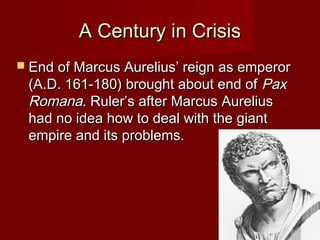
A Century in Crisis
 End of Marcus Aurelius’ reign as emperor
 (A.D. 161-180) brought about end of Pax
 Romana. Ruler’s after Marcus Aurelius
 had no idea how to deal with the giant
 empire and its problems.
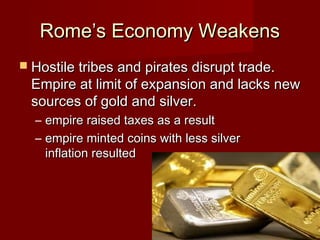
Rome’s Economy Weakens
 Hostile tribes and pirates disrupt trade.
  Empire at limit of expansion and lacks new
  sources of gold and silver.
  – empire raised taxes as a result
  – empire minted coins with less silver
    inflation resulted
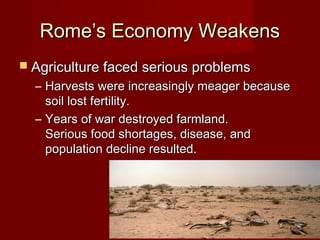
Rome’s Economy Weakens
 Agriculture faced serious problems
  – Harvests were increasingly meager because
    soil lost fertility.
  – Years of war destroyed farmland.
    Serious food shortages, disease, and
    population decline resulted.
Military and Political Turmoil
   Roman military in disarray
    –   less disciplined soldiers
    –   allegiance to commanders, not to Rome itself
    –   recruiting of mercenaries who were less loyal to
        Rome
   Less loyalty among average citizens
    – Earlier Romans cared more about the Republic.
   Later Romans lose their sense of patriotism.
Emperors Attempt Reform
   Diocletian Reforms the Empire
    –   Becomes emperor in 284.
    –   Severely limits personal freedoms.
    –   Doubles size of Roman army.
    –   Controls inflation by price fixing.
    –   Divides the empire
          Greek speaking East (takes for himself)
          Latin-speaking West (appoints a co-ruler)
    –   Kept overall control.
    –   Retired in A.D. 305, but civil war broke out.
    –   Four rivals competed for control, including the
        commander Constantine
Emperors Attempt Reform
 Constantine Moves the Capital
  – A.D. 312 Constantine gains control of the
    western part of the empire.
  – A.D. 324 he secures the eastern empire and
    the system of a single ruler.
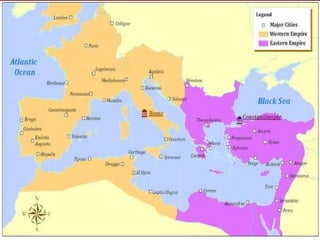
  – A.D. 330 Constantine moves the capital from
    Rome to Byzantium on the Bosporus Strait
    between Europe and Asia.
  – The center of power shifts from Rome to the
    east, Constantinople.
Western Empire Crumbles

– Germanic Invasions
   A.D. 370 the Huns move into Europe causing
    the Germanic peoples to flee into Roman territory.
   A.D. 410 Germans invade and overrun Rome itself
    and plunder it for three days.
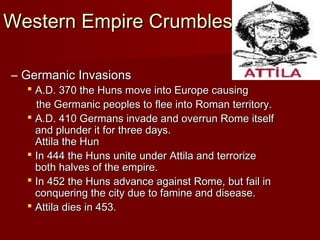
    Attila the Hun
   In 444 the Huns unite under Attila and terrorize
    both halves of the empire.
   In 452 the Huns advance against Rome, but fail in
    conquering the city due to famine and disease.
   Attila dies in 453.
The Western Empire Crumbles
  – An Empire No More
     14-year-old emperor Romulus Augustulus
      ousted by German by German forces in 426.
     Roman power in the western half of the empire
      ceases to exist.
     The eastern half of the empire comes to be
      called the Byzantine Empire, and flourishes for
      1,000 years.
     The Byzantine emperors ruled from
      Constantinople.
     The Byzantine emperors saw themselves as
      heirs to the power of Augustus Caesar.

6 4 fall-of_the_roman_empire (1)

  • 1.
    The Fall ofthe Roman Empire Chapter 6, Section 4
  • 2.
    A Century inCrisis  End of Marcus Aurelius’ reign as emperor (A.D. 161-180) brought about end of Pax Romana. Ruler’s after Marcus Aurelius had no idea how to deal with the giant empire and its problems.
  • 3.
    Rome’s Economy Weakens Hostile tribes and pirates disrupt trade. Empire at limit of expansion and lacks new sources of gold and silver. – empire raised taxes as a result – empire minted coins with less silver inflation resulted
  • 4.
    Rome’s Economy Weakens Agriculture faced serious problems – Harvests were increasingly meager because soil lost fertility. – Years of war destroyed farmland. Serious food shortages, disease, and population decline resulted.
  • 5.
    Military and PoliticalTurmoil  Roman military in disarray – less disciplined soldiers – allegiance to commanders, not to Rome itself – recruiting of mercenaries who were less loyal to Rome  Less loyalty among average citizens – Earlier Romans cared more about the Republic.  Later Romans lose their sense of patriotism.
  • 6.
    Emperors Attempt Reform  Diocletian Reforms the Empire – Becomes emperor in 284. – Severely limits personal freedoms. – Doubles size of Roman army. – Controls inflation by price fixing. – Divides the empire  Greek speaking East (takes for himself)  Latin-speaking West (appoints a co-ruler) – Kept overall control. – Retired in A.D. 305, but civil war broke out. – Four rivals competed for control, including the commander Constantine
  • 7.
    Emperors Attempt Reform Constantine Moves the Capital – A.D. 312 Constantine gains control of the western part of the empire. – A.D. 324 he secures the eastern empire and the system of a single ruler. – A.D. 330 Constantine moves the capital from Rome to Byzantium on the Bosporus Strait between Europe and Asia. – The center of power shifts from Rome to the east, Constantinople.
  • 9.
    Western Empire Crumbles –Germanic Invasions  A.D. 370 the Huns move into Europe causing the Germanic peoples to flee into Roman territory.  A.D. 410 Germans invade and overrun Rome itself and plunder it for three days. Attila the Hun  In 444 the Huns unite under Attila and terrorize both halves of the empire.  In 452 the Huns advance against Rome, but fail in conquering the city due to famine and disease.  Attila dies in 453.
  • 10.
    The Western EmpireCrumbles – An Empire No More  14-year-old emperor Romulus Augustulus ousted by German by German forces in 426.  Roman power in the western half of the empire ceases to exist.  The eastern half of the empire comes to be called the Byzantine Empire, and flourishes for 1,000 years.  The Byzantine emperors ruled from Constantinople.  The Byzantine emperors saw themselves as heirs to the power of Augustus Caesar.