Early Civilizations in
Africa
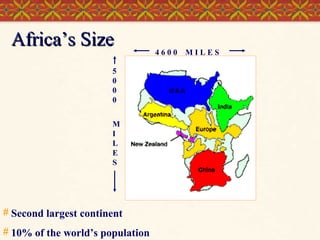
Africa’s Size
5
0
0
0
M
I
L
E
S

# Second largest continent
# 10% of the world’s population

4600

MILES
©2004 Wadsworth, a division of Thomson Learning, Inc. Thomson Learning™ is a trademark used herein under license.

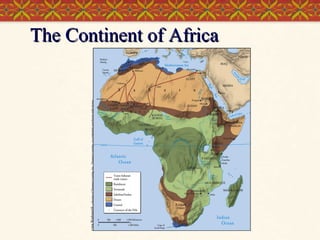
The Continent of Africa
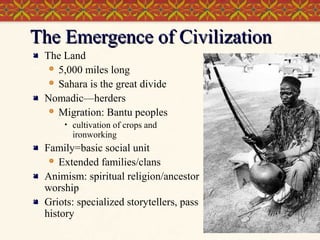
The Emergence of Civilization




The Land
 5,000 miles long
 Sahara is the great divide
Nomadic—herders
 Migration: Bantu peoples
• cultivation of crops and

ironworking






Family=basic social unit
 Extended families/clans
Animism: spiritual religion/ancestor
worship
Griots: specialized storytellers, pass
history
©2004 Wadsworth , a division of Thomson Learning, Inc. Thomson Learning™ is a trademark used herein under license.

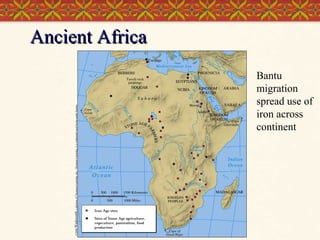
Ancient Africa
Bantu
migration
spread use of
iron across
continent
Axum




Axum
 trading state, goods from South Asia to the
Mediterranean
 Prosperous
 Control of ivory trade
 Had written language
Followed Coptic Christianity
 Mixes Christian beliefs and African traditions
 Would be renamed Ethiopia
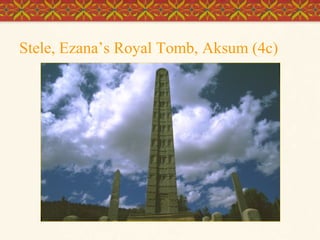
Stele, Ezana’s Royal Tomb, Aksum (4c)
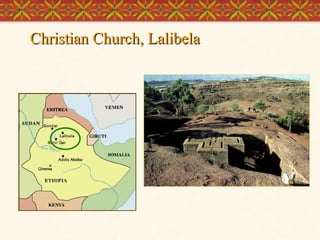
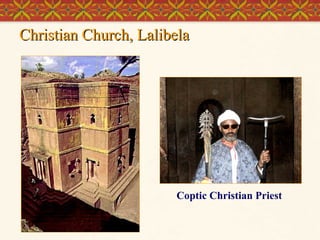
Christian Church, Lalibela

Coptic Christian Priest
The States of West Africa

Expansion of Islam




Ghana






Arabic
Gold-Salt Trade
Very wealthy
Kings did not convert to Islam, people did

Mali



Gold trade
Mansa Musa (1312-1337), encouraged Islam, built
university in Timbuktu
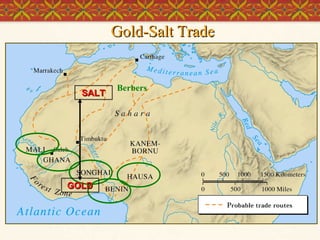
Gold-Salt Trade

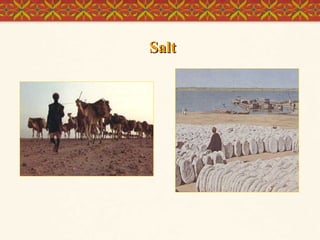
SALT

GOLD

Berbers
Ghana Empire [4c-11c]

Gold “Money”, Ghana/Ivory Coast
Salt
King of Ghana

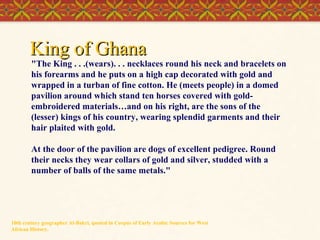
"The King . . .(wears). . . necklaces round his neck and bracelets on
his forearms and he puts on a high cap decorated with gold and
wrapped in a turban of fine cotton. He (meets people) in a domed
pavilion around which stand ten horses covered with goldembroidered materials…and on his right, are the sons of the
(lesser) kings of his country, wearing splendid garments and their
hair plaited with gold.
At the door of the pavilion are dogs of excellent pedigree. Round
their necks they wear collars of gold and silver, studded with a
number of balls of the same metals."

10th century geographer Al-Bakri, quoted in Corpus of Early Arabic Sources for West
African History.
Mali Empire [13c-15c]

SALT

GOLD
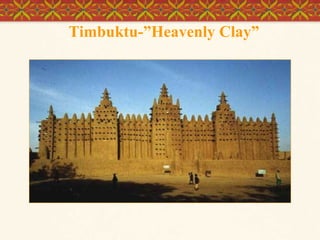
Timbuktu-”Heavenly Clay”
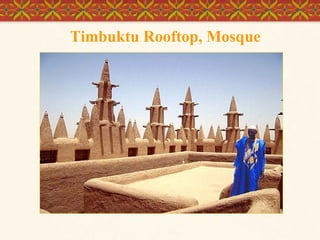
Timbuktu Rooftop, Mosque
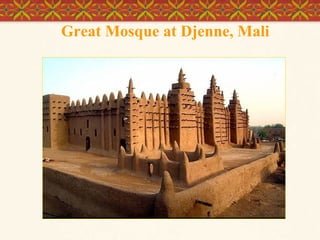
Great Mosque at Djenne, Mali
Mansa Musa [r. 1312-1337]
East Africa




Self-governing city-states
 Trade with the interior, Indian Ocean, China,
and along the coast
 Ex: Zanzibar
Mixed African-Arab culture
 Mixed culture and language called Swahili
Swahili-Speaking Areas of E. Africa

SWAHILI [“the coast’] = Bantu + some Arabic
Stateless Societies in Southern Africa





From the basin of the Congo River to the Cape of
Good Hope
Stateless society: power is not in a government
Progress made with regional trade
Zimbabwe (Sacred House, Great Stone House)




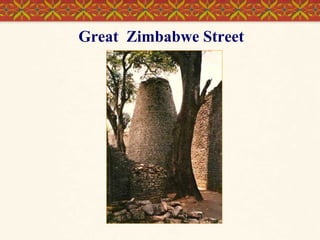
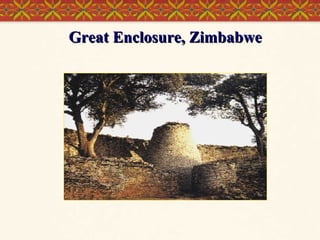
Capital known as Great Zimbabwe
Benefited from trade between interior and coast
Evidence of great wealth, but Great Zimbabwe
abandoned
Great Zimbabwe [1200-1450]
Great Zimbabwe Street
Great Enclosure, Zimbabwe
African Culture

Painting and Sculpture




Music and Dance







Often served religious purposes
Wide variety of instruments
Integration of voice and instrument
Music produced for social rituals and educational purposes

Architecture







Rock paintings, wood carving, pottery, metalwork

Pyramid
Stone pillars
Stone buildings
Sometimes reflected Moorish styles

Literature




Written works did not exist in the early traditional period
Professional storytellers, bards
Importance of women in passing down oral traditions

8 Africa

  • 1.
  • 2.
    Africa’s Size 5 0 0 0 M I L E S # Secondlargest continent # 10% of the world’s population 4600 MILES
  • 3.
    ©2004 Wadsworth, adivision of Thomson Learning, Inc. Thomson Learning™ is a trademark used herein under license. The Continent of Africa
  • 4.
    The Emergence ofCivilization   The Land  5,000 miles long  Sahara is the great divide Nomadic—herders  Migration: Bantu peoples • cultivation of crops and ironworking    Family=basic social unit  Extended families/clans Animism: spiritual religion/ancestor worship Griots: specialized storytellers, pass history
  • 5.
    ©2004 Wadsworth ,a division of Thomson Learning, Inc. Thomson Learning™ is a trademark used herein under license. Ancient Africa Bantu migration spread use of iron across continent
  • 6.
    Axum   Axum  trading state,goods from South Asia to the Mediterranean  Prosperous  Control of ivory trade  Had written language Followed Coptic Christianity  Mixes Christian beliefs and African traditions  Would be renamed Ethiopia
  • 7.
    Stele, Ezana’s RoyalTomb, Aksum (4c)
  • 8.
  • 9.
  • 10.
    The States ofWest Africa  Expansion of Islam   Ghana     Arabic Gold-Salt Trade Very wealthy Kings did not convert to Islam, people did Mali   Gold trade Mansa Musa (1312-1337), encouraged Islam, built university in Timbuktu
  • 11.
  • 12.
    Ghana Empire [4c-11c] Gold“Money”, Ghana/Ivory Coast
  • 13.
  • 14.
    King of Ghana "TheKing . . .(wears). . . necklaces round his neck and bracelets on his forearms and he puts on a high cap decorated with gold and wrapped in a turban of fine cotton. He (meets people) in a domed pavilion around which stand ten horses covered with goldembroidered materials…and on his right, are the sons of the (lesser) kings of his country, wearing splendid garments and their hair plaited with gold. At the door of the pavilion are dogs of excellent pedigree. Round their necks they wear collars of gold and silver, studded with a number of balls of the same metals." 10th century geographer Al-Bakri, quoted in Corpus of Early Arabic Sources for West African History.
  • 15.
  • 16.
  • 17.
  • 18.
    Great Mosque atDjenne, Mali
  • 19.
    Mansa Musa [r.1312-1337]
  • 20.
    East Africa   Self-governing city-states Trade with the interior, Indian Ocean, China, and along the coast  Ex: Zanzibar Mixed African-Arab culture  Mixed culture and language called Swahili
  • 21.
    Swahili-Speaking Areas ofE. Africa SWAHILI [“the coast’] = Bantu + some Arabic
  • 22.
    Stateless Societies inSouthern Africa     From the basin of the Congo River to the Cape of Good Hope Stateless society: power is not in a government Progress made with regional trade Zimbabwe (Sacred House, Great Stone House)    Capital known as Great Zimbabwe Benefited from trade between interior and coast Evidence of great wealth, but Great Zimbabwe abandoned
  • 23.
  • 24.
  • 25.
  • 26.
    African Culture  Painting andSculpture   Music and Dance      Often served religious purposes Wide variety of instruments Integration of voice and instrument Music produced for social rituals and educational purposes Architecture      Rock paintings, wood carving, pottery, metalwork Pyramid Stone pillars Stone buildings Sometimes reflected Moorish styles Literature    Written works did not exist in the early traditional period Professional storytellers, bards Importance of women in passing down oral traditions