E. Napp
The Phoenicians
E. Napp
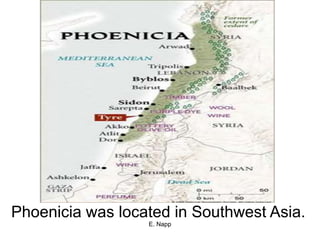
Phoenicia was located in Southwest Asia.
E. Napp
Phoenicians
• The Phoenicians were a Semitic-speaking
people.
• They settled in small city-states in present-
day Lebanon.
• There were few natural resources in their
land. So, they turned to the seas.
E. Napp
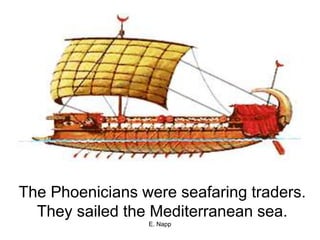
The Phoenicians were seafaring traders.
They sailed the Mediterranean sea.
E. Napp
Phoenician Traders
• By 900 B.C., the Phoenicians dominated
Mediterranean trade.
• The Phoenicians were able to build a
civilization without relying on agriculture.
• Income generated by trade allowed the
Phoenicians to build permanent
settlements.
E. Napp
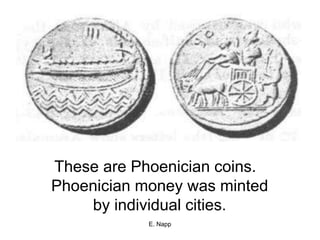
These are Phoenician coins.
Phoenician money was minted
by individual cities.
E. Napp
The World’s First Alphabet
• The Phoenicians invented the world’s first
alphabet.
• Each of the twenty-two Phoenician
alphabet symbols represented a different
sound.
• The Greeks adopted the Phoenician
alphabet. From the Phoenician and Greek
alphabets come our alphabet.
E. Napp
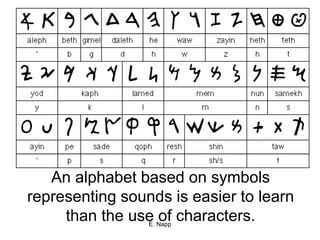
An alphabet based on symbols
representing sounds is easier to learn
than the use of characters.
E. Napp
Phoenician Colonies
• The Phoenicians established trading
colonies throughout the Mediterranean
region.
• A colony is a region controlled by a distant
country.
• Carthage was a famous Phoenician
trading colony in North Africa.
E. Napp
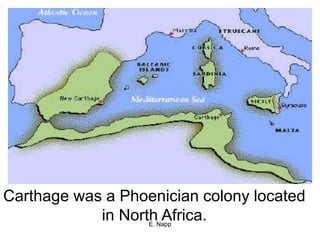
Carthage was a Phoenician colony located
in North Africa.
E. Napp
Phoenician Purple
• The Phoenicians made their own purple
dye.
• The Phoenicians had a monopoly on the
market for purple.
• The Phoenicians crushed shellfish to
make their purple dye.
E. Napp
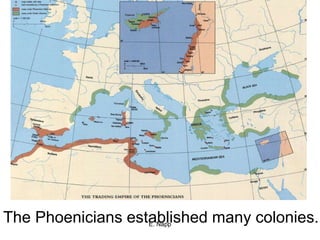
The Phoenicians established many colonies.
E. Napp
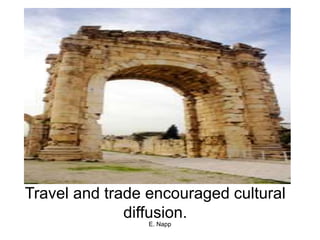
Travel and trade encouraged cultural
diffusion.

The Phoenicians

  • 1.
  • 2.
    E. Napp Phoenicia waslocated in Southwest Asia.
  • 3.
    E. Napp Phoenicians • ThePhoenicians were a Semitic-speaking people. • They settled in small city-states in present- day Lebanon. • There were few natural resources in their land. So, they turned to the seas.
  • 4.
    E. Napp The Phoenicianswere seafaring traders. They sailed the Mediterranean sea.
  • 5.
    E. Napp Phoenician Traders •By 900 B.C., the Phoenicians dominated Mediterranean trade. • The Phoenicians were able to build a civilization without relying on agriculture. • Income generated by trade allowed the Phoenicians to build permanent settlements.
  • 6.
    E. Napp These arePhoenician coins. Phoenician money was minted by individual cities.
  • 7.
    E. Napp The World’sFirst Alphabet • The Phoenicians invented the world’s first alphabet. • Each of the twenty-two Phoenician alphabet symbols represented a different sound. • The Greeks adopted the Phoenician alphabet. From the Phoenician and Greek alphabets come our alphabet.
  • 8.
    E. Napp An alphabetbased on symbols representing sounds is easier to learn than the use of characters.
  • 9.
    E. Napp Phoenician Colonies •The Phoenicians established trading colonies throughout the Mediterranean region. • A colony is a region controlled by a distant country. • Carthage was a famous Phoenician trading colony in North Africa.
  • 10.
    E. Napp Carthage wasa Phoenician colony located in North Africa.
  • 11.
    E. Napp Phoenician Purple •The Phoenicians made their own purple dye. • The Phoenicians had a monopoly on the market for purple. • The Phoenicians crushed shellfish to make their purple dye.
  • 12.
    E. Napp The Phoeniciansestablished many colonies.
  • 13.
    E. Napp Travel andtrade encouraged cultural diffusion.