Light
In this unit:
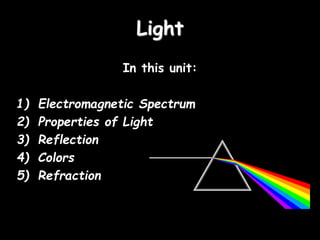
1) Electromagnetic Spectrum
2) Properties of Light
3) Reflection
4) Colors
5) Refraction
Part 1
Electromagnetic Spectrum
and Visible Light
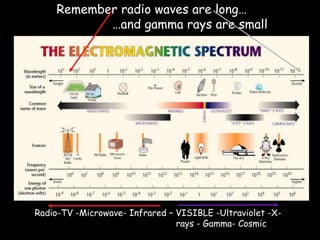
Remember radio waves are long…
…and gamma rays are small
Radio-TV -Microwave- Infrared – VISIBLE -Ultraviolet -X-
rays - Gamma- Cosmic
*Electromagnetic Radiation
Electromagnetic radiation can be described in terms
of a stream of photons. Each photon is traveling in
a wave-like pattern, moving at the speed of light
and carrying some amount of energy.
The only difference amongst radio waves, visible
light, and gamma-rays is the amount of energy of
the photons. Radio waves have photons with low
energies. Microwaves have a little more energy
than radio waves. Infrared has still more energy.
As we move down the chart we see visible, ultraviolet,
X-rays, and gamma-rays whose photon energies
gradually increase.
Gamma and Cosmic rays have the highest energy
waves.
*Slide info from NSTA 2004 conference
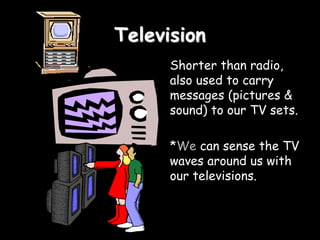
Television
Shorter than radio,
also used to carry
messages (pictures &
sound) to our TV sets.
*We can sense the TV
waves around us with
our televisions.
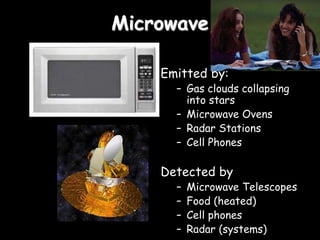
Microwave
Emitted by:
– Gas clouds collapsing
into stars
– Microwave Ovens
– Radar Stations
– Cell Phones
Detected by
– Microwave Telescopes
– Food (heated)
– Cell phones
– Radar (systems)
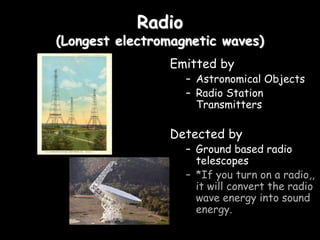
Radio
(Longest electromagnetic waves)
Emitted by
– Astronomical Objects
– Radio Station
Transmitters
Detected by
– Ground based radio
telescopes
– *If you turn on a radio,,
it will convert the radio
wave energy into sound
energy.
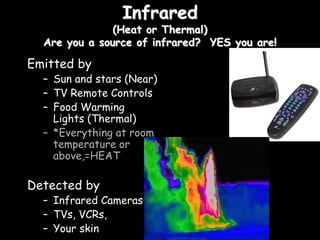
Infrared
(Heat or Thermal)
Are you a source of infrared? YES you are!
Emitted by
– Sun and stars (Near)
– TV Remote Controls
– Food Warming
Lights (Thermal)
– *Everything at room
temperature or
above,=HEAT
Detected by
– Infrared Cameras
– TVs, VCRs,
– Your skin
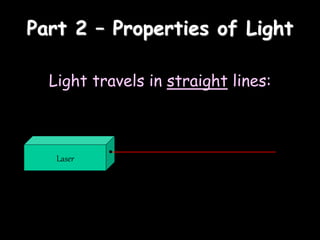
Part 2 – Properties of Light
Light travels in straight lines:
Laser
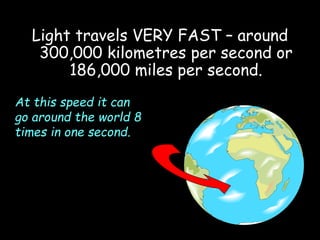
Light travels VERY FAST – around
300,000 kilometres per second or
186,000 miles per second.
At this speed it can
go around the world 8
times in one second.
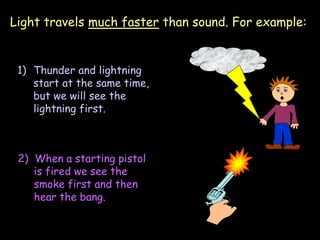
Light travels much faster than sound. For example:
1) Thunder and lightning
start at the same time,
but we will see the
lightning first.
2) When a starting pistol
is fired we see the
smoke first and then
hear the bang.
Luminous and non-luminous objects
A luminous object is one that produces light.
A non-luminous object is one that reflects light.
Luminous objects Reflectors
Shadows
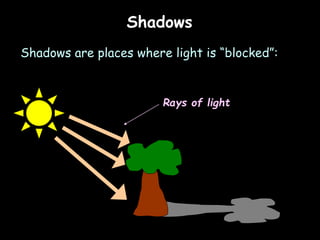
Shadows are places where light is “blocked”:
Rays of light
Properties of Light summary
1) Light travels in straight lines
2) Light travels much faster than sound
3) We see things because they reflect light
into our eyes
4) Shadows are formed when light is blocked
by an object
Part 3 - Reflection
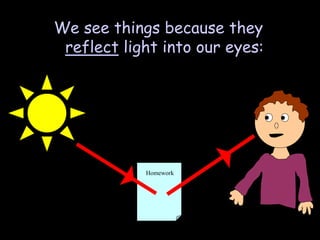
We see things because they
reflect light into our eyes:
Homework
Vocabulary
Reflection: the bouncing of light from a
surface
Refraction: the bending of light as it passes
through one material to another
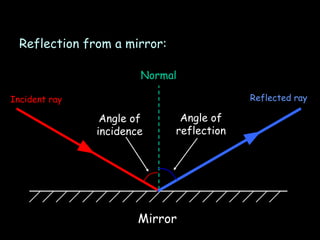
Reflection from a mirror:
Incident ray
Normal
Reflected ray
Angle of
incidence
Angle of
reflection
Mirror
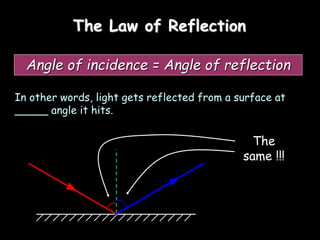
The Law of Reflection
Angle of incidence = Angle of reflection
In other words, light gets reflected from a surface at
_____ angle it hits.
The
same !!!
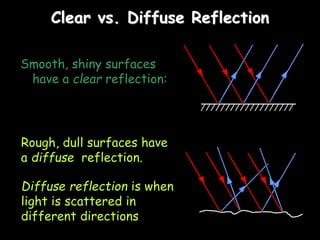
Clear vs. Diffuse Reflection
Smooth, shiny surfaces
have a clear reflection:
Rough, dull surfaces have
a diffuse reflection.
Diffuse reflection is when
light is scattered in
different directions
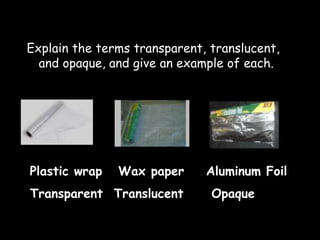
Explain the terms transparent, translucent,
and opaque, and give an example of each.
Plastic wrap Wax paper Aluminum Foil
Transparent Translucent Opaque
Vocabulary
Transparent: materials that allow all light to
pass through
Translucent: letting light through but
scattering it
Opaque: materials that do not let light
through
Transmit: to send (as in sound or light). It
also means light passing through an object.
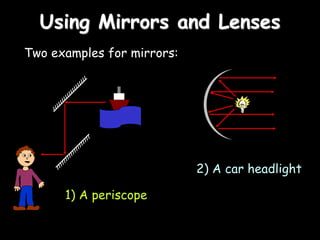
Using Mirrors and Lenses
Two examples for mirrors:
1) A periscope
2) A car headlight
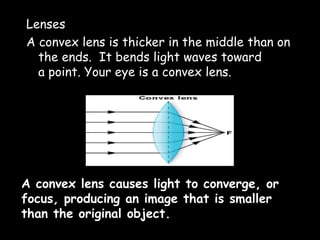
Lenses
A convex lens is thicker in the middle than on
the ends. It bends light waves toward
a point. Your eye is a convex lens.
A convex lens causes light to converge, or
focus, producing an image that is smaller
than the original object.
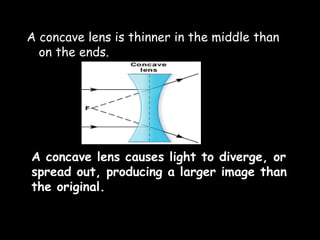
A concave lens is thinner in the middle than
on the ends.
A concave lens causes light to diverge, or
spread out, producing a larger image than
the original.
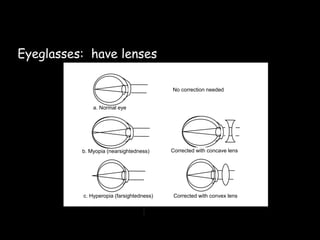
Eyeglasses: have lenses
c. Hyperopia (farsightedness)
a. Normal eye
b. Myopia (nearsightedness) Corrected with concave lens
Corrected with convex lens
No correction needed
Part 4 - Colors
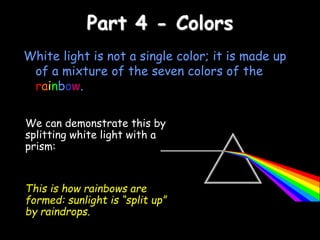
White light is not a single color; it is made up
of a mixture of the seven colors of the
rainbow.
We can demonstrate this by
splitting white light with a
prism:
This is how rainbows are
formed: sunlight is “split up”
by raindrops.
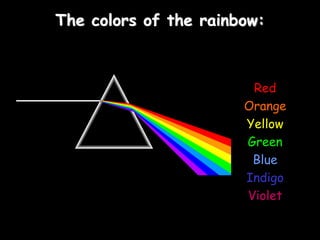
The colors of the rainbow:
Red
Orange
Yellow
Green
Blue
Indigo
Violet
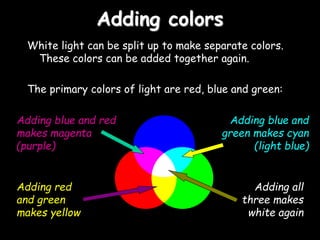
Adding colors
White light can be split up to make separate colors.
These colors can be added together again.
The primary colors of light are red, blue and green:
Adding blue and red
makes magenta
(purple)
Adding blue and
green makes cyan
(light blue)
Adding all
three makes
white again
Adding red
and green
makes yellow
Seeing color
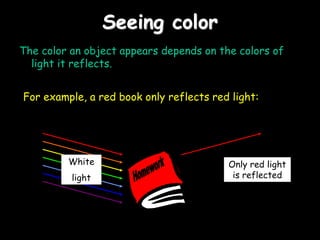
The color an object appears depends on the colors of
light it reflects.
For example, a red book only reflects red light:
White
light
Only red light
is reflected
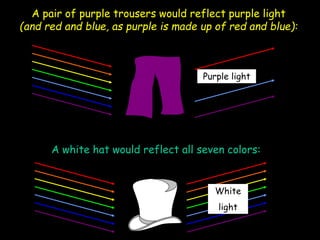
A white hat would reflect all seven colors:
A pair of purple trousers would reflect purple light
(and red and blue, as purple is made up of red and blue):
Purple light
White
light
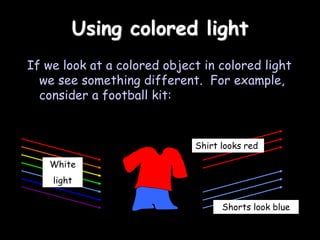
Using colored light
If we look at a colored object in colored light
we see something different. For example,
consider a football kit:
White
light
Shorts look blue
Shirt looks red
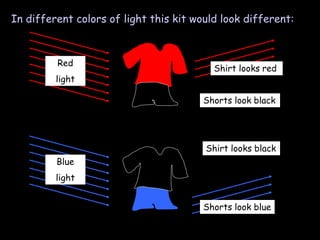
In different colors of light this kit would look different:
Red
light
Shirt looks red
Shorts look black
Blue
light
Shirt looks black
Shorts look blue
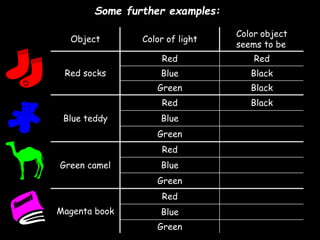
Some further examples:
Object Color of light
Color object
seems to be
Red socks
Red Red
Blue Black
Green Black
Blue teddy
Red Black
Blue
Green
Green camel
Red
Blue
Green
Magenta book
Red
Blue
Green
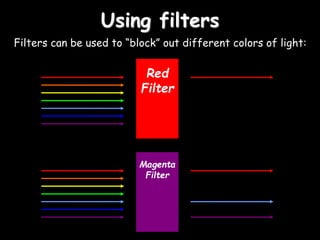
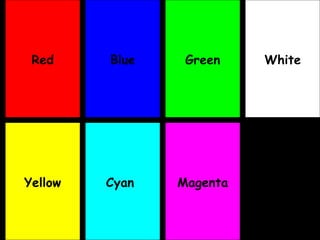
Using filters
Filters can be used to “block” out different colors of light:
Red
Filter
Magenta
Filter
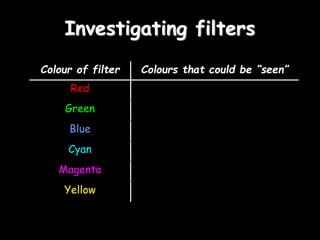
Investigating filters
Colour of filter Colours that could be “seen”
Red
Green
Blue
Cyan
Magenta
Yellow
Red
Magenta
White
Yellow
Blue Green
Cyan
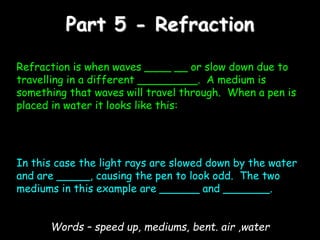
Part 5 - Refraction
Refraction is when waves ____ __ or slow down due to
travelling in a different _________. A medium is
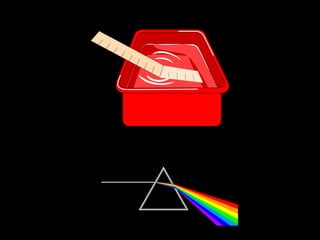
something that waves will travel through. When a pen is
placed in water it looks like this:
In this case the light rays are slowed down by the water
and are _____, causing the pen to look odd. The two
mediums in this example are ______ and _______.
Words – speed up, mediums, bent. air ,water
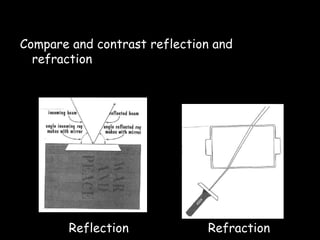
Compare and contrast reflection and
refraction
Reflection Refraction

electromagnetic spectrum and light ppt.pptx

  • 1.
    Light In this unit: 1)Electromagnetic Spectrum 2) Properties of Light 3) Reflection 4) Colors 5) Refraction
  • 2.
  • 3.
    Remember radio wavesare long… …and gamma rays are small Radio-TV -Microwave- Infrared – VISIBLE -Ultraviolet -X- rays - Gamma- Cosmic
  • 4.
    *Electromagnetic Radiation Electromagnetic radiationcan be described in terms of a stream of photons. Each photon is traveling in a wave-like pattern, moving at the speed of light and carrying some amount of energy. The only difference amongst radio waves, visible light, and gamma-rays is the amount of energy of the photons. Radio waves have photons with low energies. Microwaves have a little more energy than radio waves. Infrared has still more energy. As we move down the chart we see visible, ultraviolet, X-rays, and gamma-rays whose photon energies gradually increase. Gamma and Cosmic rays have the highest energy waves. *Slide info from NSTA 2004 conference
  • 5.
    Television Shorter than radio, alsoused to carry messages (pictures & sound) to our TV sets. *We can sense the TV waves around us with our televisions.
  • 6.
    Microwave Emitted by: – Gasclouds collapsing into stars – Microwave Ovens – Radar Stations – Cell Phones Detected by – Microwave Telescopes – Food (heated) – Cell phones – Radar (systems)
  • 7.
    Radio (Longest electromagnetic waves) Emittedby – Astronomical Objects – Radio Station Transmitters Detected by – Ground based radio telescopes – *If you turn on a radio,, it will convert the radio wave energy into sound energy.
  • 8.
    Infrared (Heat or Thermal) Areyou a source of infrared? YES you are! Emitted by – Sun and stars (Near) – TV Remote Controls – Food Warming Lights (Thermal) – *Everything at room temperature or above,=HEAT Detected by – Infrared Cameras – TVs, VCRs, – Your skin
  • 9.
    Part 2 –Properties of Light Light travels in straight lines: Laser
  • 10.
    Light travels VERYFAST – around 300,000 kilometres per second or 186,000 miles per second. At this speed it can go around the world 8 times in one second.
  • 11.
    Light travels muchfaster than sound. For example: 1) Thunder and lightning start at the same time, but we will see the lightning first. 2) When a starting pistol is fired we see the smoke first and then hear the bang.
  • 12.
    Luminous and non-luminousobjects A luminous object is one that produces light. A non-luminous object is one that reflects light. Luminous objects Reflectors
  • 13.
    Shadows Shadows are placeswhere light is “blocked”: Rays of light
  • 14.
    Properties of Lightsummary 1) Light travels in straight lines 2) Light travels much faster than sound 3) We see things because they reflect light into our eyes 4) Shadows are formed when light is blocked by an object
  • 15.
    Part 3 -Reflection
  • 16.
    We see thingsbecause they reflect light into our eyes: Homework
  • 17.
    Vocabulary Reflection: the bouncingof light from a surface Refraction: the bending of light as it passes through one material to another
  • 18.
    Reflection from amirror: Incident ray Normal Reflected ray Angle of incidence Angle of reflection Mirror
  • 19.
    The Law ofReflection Angle of incidence = Angle of reflection In other words, light gets reflected from a surface at _____ angle it hits. The same !!!
  • 20.
    Clear vs. DiffuseReflection Smooth, shiny surfaces have a clear reflection: Rough, dull surfaces have a diffuse reflection. Diffuse reflection is when light is scattered in different directions
  • 21.
    Explain the termstransparent, translucent, and opaque, and give an example of each. Plastic wrap Wax paper Aluminum Foil Transparent Translucent Opaque
  • 22.
    Vocabulary Transparent: materials thatallow all light to pass through Translucent: letting light through but scattering it Opaque: materials that do not let light through Transmit: to send (as in sound or light). It also means light passing through an object.
  • 23.
    Using Mirrors andLenses Two examples for mirrors: 1) A periscope 2) A car headlight
  • 24.
    Lenses A convex lensis thicker in the middle than on the ends. It bends light waves toward a point. Your eye is a convex lens. A convex lens causes light to converge, or focus, producing an image that is smaller than the original object.
  • 25.
    A concave lensis thinner in the middle than on the ends. A concave lens causes light to diverge, or spread out, producing a larger image than the original.
  • 26.
    Eyeglasses: have lenses c.Hyperopia (farsightedness) a. Normal eye b. Myopia (nearsightedness) Corrected with concave lens Corrected with convex lens No correction needed
  • 27.
    Part 4 -Colors White light is not a single color; it is made up of a mixture of the seven colors of the rainbow. We can demonstrate this by splitting white light with a prism: This is how rainbows are formed: sunlight is “split up” by raindrops.
  • 28.
    The colors ofthe rainbow: Red Orange Yellow Green Blue Indigo Violet
  • 29.
    Adding colors White lightcan be split up to make separate colors. These colors can be added together again. The primary colors of light are red, blue and green: Adding blue and red makes magenta (purple) Adding blue and green makes cyan (light blue) Adding all three makes white again Adding red and green makes yellow
  • 30.
    Seeing color The coloran object appears depends on the colors of light it reflects. For example, a red book only reflects red light: White light Only red light is reflected
  • 31.
    A white hatwould reflect all seven colors: A pair of purple trousers would reflect purple light (and red and blue, as purple is made up of red and blue): Purple light White light
  • 32.
    Using colored light Ifwe look at a colored object in colored light we see something different. For example, consider a football kit: White light Shorts look blue Shirt looks red
  • 33.
    In different colorsof light this kit would look different: Red light Shirt looks red Shorts look black Blue light Shirt looks black Shorts look blue
  • 34.
    Some further examples: ObjectColor of light Color object seems to be Red socks Red Red Blue Black Green Black Blue teddy Red Black Blue Green Green camel Red Blue Green Magenta book Red Blue Green
  • 35.
    Using filters Filters canbe used to “block” out different colors of light: Red Filter Magenta Filter
  • 36.
    Investigating filters Colour offilter Colours that could be “seen” Red Green Blue Cyan Magenta Yellow
  • 37.
  • 38.
    Part 5 -Refraction Refraction is when waves ____ __ or slow down due to travelling in a different _________. A medium is something that waves will travel through. When a pen is placed in water it looks like this: In this case the light rays are slowed down by the water and are _____, causing the pen to look odd. The two mediums in this example are ______ and _______. Words – speed up, mediums, bent. air ,water
  • 40.
    Compare and contrastreflection and refraction Reflection Refraction