tele - at or over a distance; distant
phone - sound
Telephones
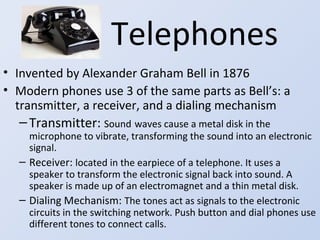
• Invented by Alexander Graham Bell in 1876
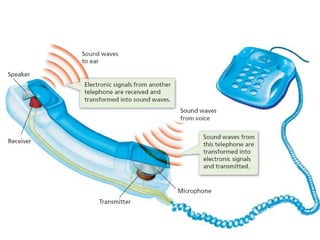
• Modern phones use 3 of the same parts as Bell’s: a
  transmitter, a receiver, and a dialing mechanism
  – Transmitter: Sound waves cause a metal disk in the
    microphone to vibrate, transforming the sound into an electronic
    signal.
  – Receiver: located in the earpiece of a telephone. It uses a
    speaker to transform the electronic signal back into sound. A
    speaker is made up of an electromagnet and a thin metal disk.
  – Dialing Mechanism: The tones act as signals to the electronic
    circuits in the switching network. Push button and dial phones use
    different tones to connect calls.
How do
 telephones
    work?


• http://www.youtube.com/watch?
• Analog Sound Recording: When you play a record, a
  needle runs along a spiral groove. The wavy pattern
  of the groove varies the same way as the sound
  waves. The needle’s movement moves a tiny
  magnet that induces an electric current.
• Digital Sound Recording: CDs contain microscopic
  holes, called pits. The level areas between the pits
  are called flats. The arrangement of pits and flats is
  a code. Each piece of this code represents the
  sound at one instant.
– a wave that consists of moving, or changing electric and
      magnetic fields.
• Electronic signals can be carried over long distances by
  electromagnetic waves.
• If a magnetic field is changing, a changing electric field will
  form. The changing electric field that is formed then
  produces a changing magnetic field. The electric and
  magnetic fields will keep producing each other over and
  over again.
http://www.youtube.com/wat
ch?
feature=player_detailpage&v=
cfXzwh3KadE#t=17s
Waves are described in terms of amplitude
and frequency. The amplitude is the height
from the center line to a crest or trough.
The frequency of a wave is the number of
waves passing a given point each second.
Electromagnetic Spectrum: Radio Waves
http://www.youtube.com/watch?
  feature=player_detailpage&v=al7sFP4C2
  TY#t=17s
The Electromagnetic Spectrum Song
http://www.youtube.com/watch?
  v=bjOGNVH3D4Y
Amplitude and Frequency Modulation
Radio

• Transmission: Begins at a radio station, sound is
  transformed into an electronic signal. This current is
  an analog signal that represents the sound waves.
  The signal is then sent to a transmitter which
  amplifies the signal and combines it with a carrier
  wave.
• Reception: Radio antennas receive electromagnetic
  waves from the radio station. The carrier wave has
  a specific frequency. Your radio amplifies the audio
  signal and separates it from the carrier wave.
      http://www.youtube.com/watch?v=gLMC5R5Me9c
Television

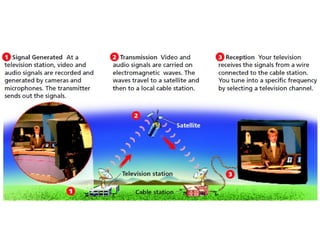
• Transmission: The signals are usually sent from
  transmitting antennas. Communications satellites are
  also used to relay television signals. A communications
  satellite orbits Earth, always staying above the same
  point on the ground. These satellites receive signals
  from one part of the planet and transmit them to
  another.
• Reception: Each television contains a receiver that
  accepts video and audio signals. The carrier wave for
  each television station is at a specific frequency. You
  tune in the frequency by selecting a channel. Your
  television amplifies the signal and separates it from the
  carrier wave.
1. What are the three main parts
   of the phone?
2. How is sound transmitted and
   received during a phone call?
3. What are electromagnetic
   waves?
4. How is information transmitted
   to radios and television?

6thgrade ch.4sec.2electroniccommunication

  • 2.
    tele - ator over a distance; distant phone - sound
  • 3.
    Telephones • Invented byAlexander Graham Bell in 1876 • Modern phones use 3 of the same parts as Bell’s: a transmitter, a receiver, and a dialing mechanism – Transmitter: Sound waves cause a metal disk in the microphone to vibrate, transforming the sound into an electronic signal. – Receiver: located in the earpiece of a telephone. It uses a speaker to transform the electronic signal back into sound. A speaker is made up of an electromagnet and a thin metal disk. – Dialing Mechanism: The tones act as signals to the electronic circuits in the switching network. Push button and dial phones use different tones to connect calls.
  • 5.
    How do telephones work? • http://www.youtube.com/watch?
  • 6.
    • Analog SoundRecording: When you play a record, a needle runs along a spiral groove. The wavy pattern of the groove varies the same way as the sound waves. The needle’s movement moves a tiny magnet that induces an electric current. • Digital Sound Recording: CDs contain microscopic holes, called pits. The level areas between the pits are called flats. The arrangement of pits and flats is a code. Each piece of this code represents the sound at one instant.
  • 8.
    – a wavethat consists of moving, or changing electric and magnetic fields. • Electronic signals can be carried over long distances by electromagnetic waves. • If a magnetic field is changing, a changing electric field will form. The changing electric field that is formed then produces a changing magnetic field. The electric and magnetic fields will keep producing each other over and over again. http://www.youtube.com/wat ch? feature=player_detailpage&v= cfXzwh3KadE#t=17s
  • 9.
    Waves are describedin terms of amplitude and frequency. The amplitude is the height from the center line to a crest or trough. The frequency of a wave is the number of waves passing a given point each second. Electromagnetic Spectrum: Radio Waves http://www.youtube.com/watch? feature=player_detailpage&v=al7sFP4C2 TY#t=17s The Electromagnetic Spectrum Song http://www.youtube.com/watch? v=bjOGNVH3D4Y
  • 10.
  • 11.
    Radio • Transmission: Beginsat a radio station, sound is transformed into an electronic signal. This current is an analog signal that represents the sound waves. The signal is then sent to a transmitter which amplifies the signal and combines it with a carrier wave. • Reception: Radio antennas receive electromagnetic waves from the radio station. The carrier wave has a specific frequency. Your radio amplifies the audio signal and separates it from the carrier wave. http://www.youtube.com/watch?v=gLMC5R5Me9c
  • 12.
    Television • Transmission: Thesignals are usually sent from transmitting antennas. Communications satellites are also used to relay television signals. A communications satellite orbits Earth, always staying above the same point on the ground. These satellites receive signals from one part of the planet and transmit them to another. • Reception: Each television contains a receiver that accepts video and audio signals. The carrier wave for each television station is at a specific frequency. You tune in the frequency by selecting a channel. Your television amplifies the signal and separates it from the carrier wave.
  • 14.
    1. What arethe three main parts of the phone? 2. How is sound transmitted and received during a phone call? 3. What are electromagnetic waves? 4. How is information transmitted to radios and television?

Editor's Notes

  • #4 Modern telephone equipment can also transform the electronic signals to a pattern of light that travels through optical fibers. the strength of the magnetic field around the electromagnet varies as well. This causes the disk to vibrate in a pattern that matches the electronic signal. These vibrations produce sound waves, which represent the voice on the other telephone. A dial telephone sends a series of pulses or clicks to the switching network. A push-button device sends different tones. The tones act as signals to the electronic circuits in the switching network. Today, push-button devices have become standard on almost all telephones.
  • #7 The current produced by the needle is an analog signal representing the original sounds played by the musicians. The signal varies continuously as it copies the information stored on the record. The analog signal is fed into an amplifier and then into a speaker, which changes the signal back into sound. When the CD spins, a beam of light scans the pits and flats. The light reflects from the flats but not from the pits. This causes the reflected light to form a pattern of tiny flashes of light. The flashes are then transformed into pulses of electric current, or a digital signal. The digital signal is fed into an amplifier and then a speaker, where it is changed back into sound.
  • #12 Voices or music on an AM or FM radio station are electronic signals carried by an electromagnetic wave.
  • #13 Electromagnetic waves can be used to carry images as well as sound. The transmission of the images and sounds on television is very similar to that of radio sounds.
  • #15 1. Transmitter: Sound waves cause a metal disk in the microphone to vibrate, transforming the sound into an electronic signal. Receiver: located in the earpiece of a telephone. It uses a speaker to transform the electronic signal back into sound. A speaker is made up of an electromagnet and a thin metal disk. Dialing Mechanism: The tones act as signals to the electronic circuits in the switching network. Push button and dial phones use different tones to connect calls. 3. a wave that consists of moving, or changing electric and magnetic fields. 4.