By Khan Imran
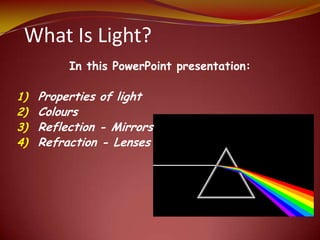
What Is Light?
In this PowerPoint presentation:
1) Properties of light
2) Colours
3) Reflection - Mirrors
4) Refraction - Lenses
Properties of Light
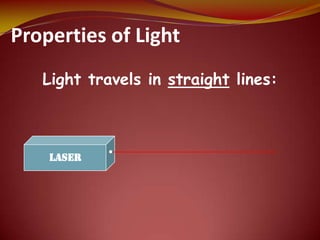
Light travels in straight lines:
Laser
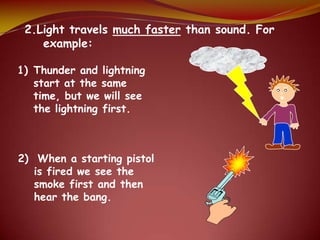
2.Light travels much faster than sound. For
example:
1) Thunder and lightning
start at the same
time, but we will see
the lightning first.
2) When a starting pistol
is fired we see the
smoke first and then
hear the bang.
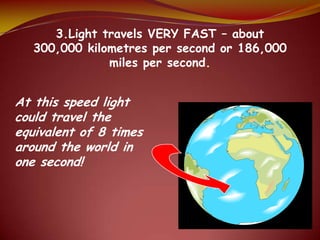
3.Light travels VERY FAST – about
300,000 kilometres per second or 186,000
miles per second.
At this speed light
could travel the
equivalent of 8 times
around the world in
one second!
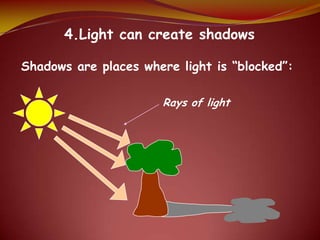
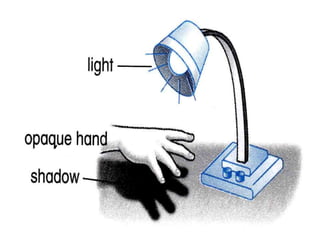
4.Light can create shadows
Shadows are places where light is “blocked”:
Rays of light
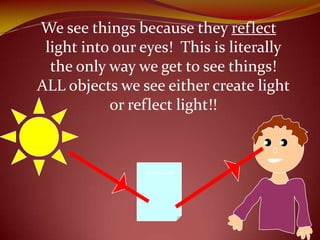
We see things because they reflect
light into our eyes! This is literally
the only way we get to see things!
ALL objects we see either create light
or reflect light!!
Homework
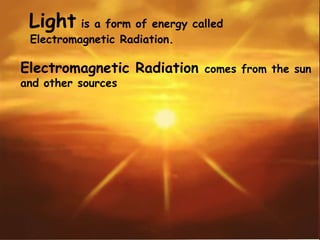
Light is a form of energy called
Electromagnetic Radiation.
Electromagnetic Radiation comes from the sun
and other sources
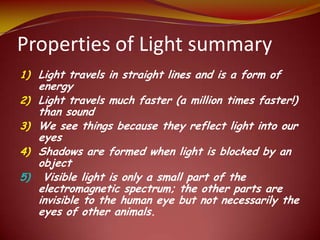
Properties of Light summary
1) Light travels in straight lines and is a form of
energy
2) Light travels much faster (a million times faster!)
than sound
3) We see things because they reflect light into our
eyes
4) Shadows are formed when light is blocked by an
object
5) Visible light is only a small part of the
electromagnetic spectrum; the other parts are
invisible to the human eye but not necessarily the
eyes of other animals.
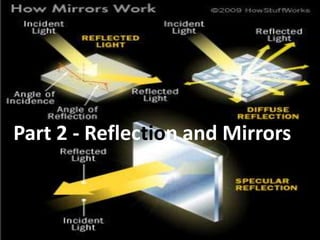
Part 2 - Reflection and Mirrors
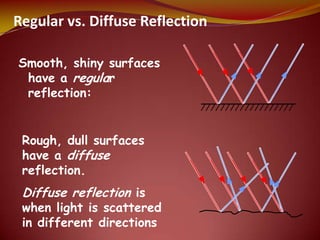
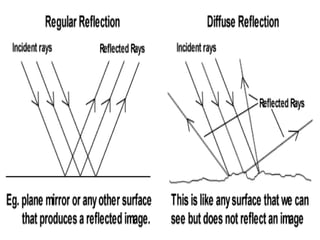
Regular vs. Diffuse Reflection
Smooth, shiny surfaces
have a regular
reflection:
Rough, dull surfaces
have a diffuse
reflection.
Diffuse reflection is
when light is scattered
in different directions
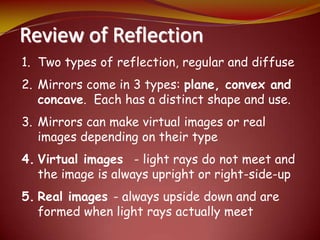
Review of Reflection
1. Two types of reflection, regular and diffuse
2. Mirrors come in 3 types: plane, convex and
concave. Each has a distinct shape and use.
3. Mirrors can make virtual images or real
images depending on their type
4. Virtual images - light rays do not meet and
the image is always upright or right-side-up
5. Real images - always upside down and are
formed when light rays actually meet
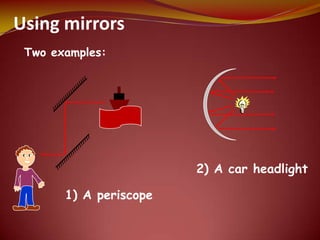
Using mirrors
Two examples:
1) A periscope
2) A car headlight
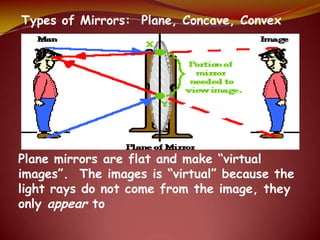
Types of Mirrors: Plane, Concave, Convex
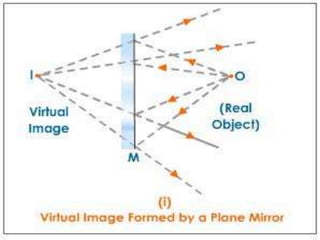
Plane mirrors are flat and make “virtual
images”. The images is “virtual” because the
light rays do not come from the image, they
only appear to
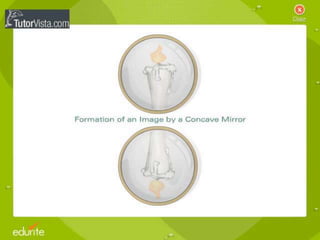
Concave Mirrors are curved inward - just
remember, you go “in” to a cave, and “in”
to a concave mirror!
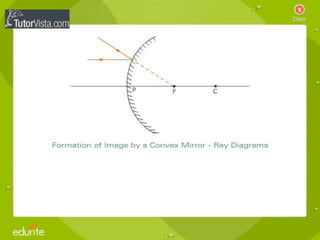
Convex mirrors are mirrors that curve outward
Convex mirrors are used for
security purposes, in cars
etc. They allow us to see a
wide view. The images they
make are virtual
Refraction
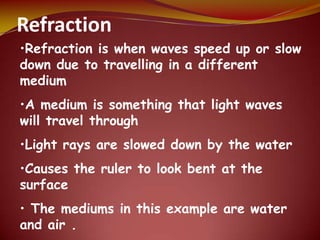
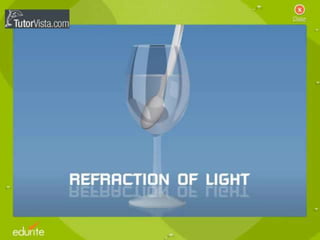
•Refraction is when waves speed up or slow
down due to travelling in a different
medium
•A medium is something that light waves
will travel through
•Light rays are slowed down by the water
•Causes the ruler to look bent at the
surface
• The mediums in this example are water
and air .
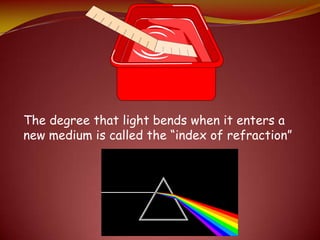
The degree that light bends when it enters a
new medium is called the “index of refraction”
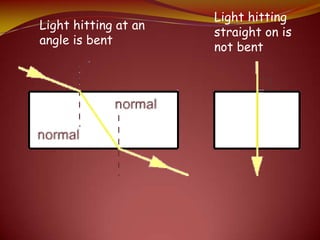
Light hitting at an
angle is bent
Light hitting
straight on is
not bent
Review of Refraction
1. Light rays slow down when they enter a
new medium
2. Refraction can cause light rays to change
their direction
3. All transparent materials have their own
“index of refraction”
4. Light is refracted when it passes through
lenses and this creates images
Color
Part 3 - Color In this section of the PowerPoint
you will learn about color and how we can mix
colors to create other colors. We will also
learn how light helps us to see various colors
around us.
Colour
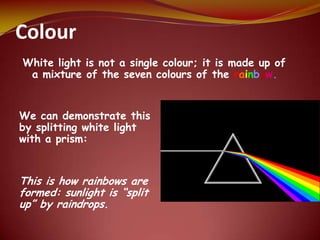
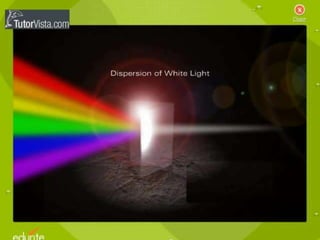
White light is not a single colour; it is made up of
a mixture of the seven colours of the rainbow.
We can demonstrate this
by splitting white light
with a prism:
This is how rainbows are
formed: sunlight is “split
up” by raindrops.
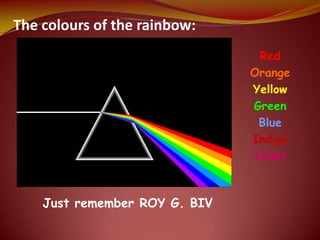
The colours of the rainbow:
Red
Orange
Yellow
Green
Blue
Indigo
Violet
Just remember ROY G. BIV
Adding colours of light
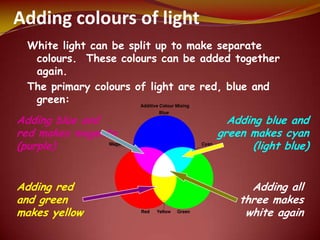
White light can be split up to make separate
colours. These colours can be added together
again.
The primary colours of light are red, blue and
green:
Adding blue and
red makes magenta
(purple)
Adding blue and
green makes cyan
(light blue)
Adding all
three makes
white again
Adding red
and green
makes yellow
Seeing colour
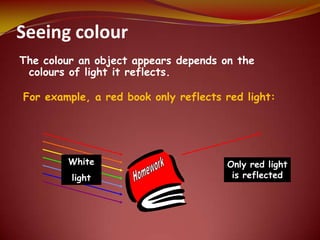
The colour an object appears depends on the
colours of light it reflects.
For example, a red book only reflects red light:
White
light
Only red light
is reflected
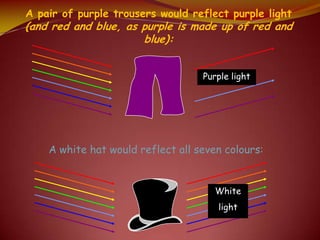
A white hat would reflect all seven colours:
A pair of purple trousers would reflect purple light
(and red and blue, as purple is made up of red and
blue):
Purple light
White
light
light-140209104259-phpapp02.pdf

light-140209104259-phpapp02.pdf

  • 1.
  • 3.
    What Is Light? Inthis PowerPoint presentation: 1) Properties of light 2) Colours 3) Reflection - Mirrors 4) Refraction - Lenses
  • 4.
    Properties of Light Lighttravels in straight lines: Laser
  • 6.
    2.Light travels muchfaster than sound. For example: 1) Thunder and lightning start at the same time, but we will see the lightning first. 2) When a starting pistol is fired we see the smoke first and then hear the bang.
  • 8.
    3.Light travels VERYFAST – about 300,000 kilometres per second or 186,000 miles per second. At this speed light could travel the equivalent of 8 times around the world in one second!
  • 10.
    4.Light can createshadows Shadows are places where light is “blocked”: Rays of light
  • 12.
    We see thingsbecause they reflect light into our eyes! This is literally the only way we get to see things! ALL objects we see either create light or reflect light!! Homework
  • 13.
    Light is aform of energy called Electromagnetic Radiation. Electromagnetic Radiation comes from the sun and other sources
  • 14.
    Properties of Lightsummary 1) Light travels in straight lines and is a form of energy 2) Light travels much faster (a million times faster!) than sound 3) We see things because they reflect light into our eyes 4) Shadows are formed when light is blocked by an object 5) Visible light is only a small part of the electromagnetic spectrum; the other parts are invisible to the human eye but not necessarily the eyes of other animals.
  • 15.
    Part 2 -Reflection and Mirrors
  • 16.
    Regular vs. DiffuseReflection Smooth, shiny surfaces have a regular reflection: Rough, dull surfaces have a diffuse reflection. Diffuse reflection is when light is scattered in different directions
  • 18.
    Review of Reflection 1.Two types of reflection, regular and diffuse 2. Mirrors come in 3 types: plane, convex and concave. Each has a distinct shape and use. 3. Mirrors can make virtual images or real images depending on their type 4. Virtual images - light rays do not meet and the image is always upright or right-side-up 5. Real images - always upside down and are formed when light rays actually meet
  • 19.
    Using mirrors Two examples: 1)A periscope 2) A car headlight
  • 20.
    Types of Mirrors:Plane, Concave, Convex Plane mirrors are flat and make “virtual images”. The images is “virtual” because the light rays do not come from the image, they only appear to
  • 22.
    Concave Mirrors arecurved inward - just remember, you go “in” to a cave, and “in” to a concave mirror!
  • 24.
    Convex mirrors aremirrors that curve outward Convex mirrors are used for security purposes, in cars etc. They allow us to see a wide view. The images they make are virtual
  • 26.
    Refraction •Refraction is whenwaves speed up or slow down due to travelling in a different medium •A medium is something that light waves will travel through •Light rays are slowed down by the water •Causes the ruler to look bent at the surface • The mediums in this example are water and air .
  • 27.
    The degree thatlight bends when it enters a new medium is called the “index of refraction”
  • 28.
    Light hitting atan angle is bent Light hitting straight on is not bent
  • 29.
    Review of Refraction 1.Light rays slow down when they enter a new medium 2. Refraction can cause light rays to change their direction 3. All transparent materials have their own “index of refraction” 4. Light is refracted when it passes through lenses and this creates images
  • 31.
    Color Part 3 -Color In this section of the PowerPoint you will learn about color and how we can mix colors to create other colors. We will also learn how light helps us to see various colors around us.
  • 32.
    Colour White light isnot a single colour; it is made up of a mixture of the seven colours of the rainbow. We can demonstrate this by splitting white light with a prism: This is how rainbows are formed: sunlight is “split up” by raindrops.
  • 33.
    The colours ofthe rainbow: Red Orange Yellow Green Blue Indigo Violet Just remember ROY G. BIV
  • 35.
    Adding colours oflight White light can be split up to make separate colours. These colours can be added together again. The primary colours of light are red, blue and green: Adding blue and red makes magenta (purple) Adding blue and green makes cyan (light blue) Adding all three makes white again Adding red and green makes yellow
  • 36.
    Seeing colour The colouran object appears depends on the colours of light it reflects. For example, a red book only reflects red light: White light Only red light is reflected
  • 37.
    A white hatwould reflect all seven colours: A pair of purple trousers would reflect purple light (and red and blue, as purple is made up of red and blue): Purple light White light