SOUND
Mrs. Solita M. De Leon
How does sound propagate?
Activity 1
My own sounding box
In this activity, you should be able to construct a
sounding box to
1. demonstrate how sound is produced; and
2. identify factors that affect the pitch and
loudness of the sound produced.
Procedure
1.Cut and design your shoe box as shown in the
figure below.
2. Put the rubber bands around the box. Make
sure that the rubber bands are almost equally
spaced and that the rubber bands are
arranged according to increasing thickness
from the lower end to the other end of the
box.
3. Use your finger to pluck each rubber band.
Listen to the sound produced.
Q1. What physical signs did you observe when
you plucked each band. Did you hear any
sound? What produced the sound?
Q2. How different are the sounds produced by
each band with different thickness?
4. This time use the fingers of one hand to
stretch one of the elastics. Pluck the
elastic with the fingers of the other hand and
observe.
Q3. Are there changes in the note when you
plucked the stretched band?
5. Repeat step 4 with the other elastic bands.
Q4. Arrange the elastics in sequence from the
highest note to the lowest note produced.
Sound
• is a form of energy produced & transmitted
by vibrating matter
How is sound produced?
• Sounds are caused by vibrations.
• Vibrations are considered as a disturbance
that travels through a medium.
• This vibratory motion causes energy to
transfer to our ears and is interpreted by our
brain.
Vibration
- Very fast, repeated backward and forward
movement of particles of matter
- For example, the vibration of the tuning fork creates pure
sound.
- The hammer hits the nail and the particles vibrate making
noise.
Sound . . .
• Sound waves are examples of longitudinal
waves.
• They are also known as mechanical waves
since sound waves need medium in order to
propagate.
Waves transport energy without
moving matter
Watch the 3 red dots
You will see them
vibrate, but not move
with the wave to the
end.
All the particles are
vibrating but stay
fixed
`
• As air molecules collide with those nearby,
they cause other air molecules to move back
and forth.
• In this way, energy is transferred from one
place to another.
The Speed of Sound
Sound waves and the
States of Matter
The Speed of Sound
• Sound waves can travel through other
materials besides air.
• As a sound wave travels through a material,
the particles in the material collide with each
other.
• In a solid, molecules are closer together than
in liquids or gases, so collisions between
molecules occur more rapidly than in liquids
or gases.
Sound also travels faster in liquids than in
gases because molecules are still more tightly
packed. In fresh water, sound waves travel 4
times faster than in air!
Speed of Sound
Speed of Sound
Factors Affecting Speed of Sound
(1) Atmospheric pressure
(2) relative humidity
(3) atmospheric temperature.
• High atmospheric pressure, relative humidity
and atmospheric temperature lead to faster
moving sound.
Why sound travels faster in hot
air?
• The temperature of the material that sound
waves are traveling through also affects the
speed of sound.
• As a substance heats up, its molecules move
faster, so they collide more frequently.
• The more frequent the collisions are, the faster
the speed of sound is in the material.
Check Your Understanding
1. Which of the following objects will produce
sound?
a. soft objects
b. radio stations
c. vibrating objects
d. objects under pressure
Check Your Understanding
2. A sound wave is a _____________.
a. longitudinal wave
b. transverse wave
c. standing wave
d. shock wave
Check Your Understanding
3. Which of the following is not capable of
transmitting sound?
a. air
b. water
c. steel
d. a vacuum
Check Your Understanding
4. Which of the following would most likely
transmit sound best?
a. Steel in cabinet
b. Water in the ocean
c. Air in your classroom
d. Water in a swimming pool
Check Your Understanding
5. In which of the following does sound travel
fastest?
a. gases
b. liquids
c. solids
d. air
Sound cannot travel in a vacuum.
• Remember that sound is a mechanical wave
which needs medium in order to propagate.
• If no matter exists, there will be no sound.
• In the outer space, sound would not be
transmitted.
Properties and characteristics of
sound
Properties and characteristics of
sound
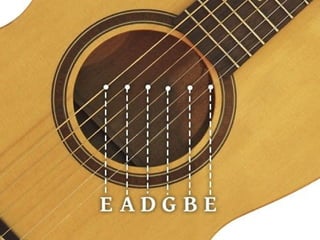
• Strum each guitar string without holding the
frets. (String #0 is the lower most string while
string #6 is the uppermost string.
Pitch
• The highness or lowness of sound is known as
the pitch of a sound.
1. Which string vibrates fastest when
strummed?
String #0
2. Which string vibrates slowest when
strummed?
String No. 6
3. Which string has the highest frequency?
String No. 0
• Which string has the highest pitch?
String No. 0
• Which has the lowest frequency?
String No. 6
• Which string has the lowest pitch?
String No. 6
• How would you relate pitch and frequency?
The higher the frequency, the higher the
pitch.
1.1. Lengthening of the stringLengthening of the string
– The shorter the length of theThe shorter the length of the
string, the higher the magnitudestring, the higher the magnitude
of the pitch.of the pitch.
1.1. Thickness of stringThickness of string
– As the diameter of a stringAs the diameter of a string
decreases the pitch of the sounddecreases the pitch of the sound
wave increaseswave increases
What are the different factorsWhat are the different factors
affecting the pitch of a sound?affecting the pitch of a sound?
How is frequency andHow is frequency and
pitch related?pitch related?
The greater the frequency ofThe greater the frequency of
sound wave, the higher thesound wave, the higher the
pitch of sound wavepitch of sound wave
produced.produced.
Characteristics of soundCharacteristics of sound
wave:wave:
1.1. LoudnessLoudness
• Loudness of soundLoudness of sound
largely depends on thelargely depends on the
intensity of sound.intensity of sound.
• The greater theThe greater the
amplitude, the louderamplitude, the louder
the sound producedthe sound produced
2. Pitch and frequency.2. Pitch and frequency.
•Pitch refers to the highnessPitch refers to the highness
or lowness of soundor lowness of sound
•The pitch sound depends onThe pitch sound depends on
the frequencythe frequency
•The greater the frequency,The greater the frequency,
the higher the pitch ofthe higher the pitch of
soundsound
3. Intensity3. Intensity
• The measure of theThe measure of the
energy per unit timeenergy per unit time
transmitted through atransmitted through a
unit area by the soundunit area by the sound
wave.wave.
• Intensity levels areIntensity levels are
expressed in decibelsexpressed in decibels
(dB)(dB)
The Human Ear
Major Parts of the Ear
1. the outer ear
2. the middle ear and
3. the inner ear
Parts of the ear
• The outer ear called the pinna collects
the sound waves and focuses them into
the ear canal.
• This canal transmits the sound waves to
the eardrum.
Parts of the ear
• The ear canal is the eardrum membrane
or the tympanum.
• It separates the outer and the middle
ears physically.
Parts of the ear
• Air vibrations set the eardrum membrane in
motion that causes the three smallest bones
(hammer, anvil and stirrup) to move.
• These three bones convert the small-
amplitude vibration of the eardrum into large
amplitude oscillations.
• These oscillations are transferred to the inner
ear through the oval window.
Parts of the ear
• Behind the oval window is a snail-shell shaped
liquid –filled organ called the cochlea.
• The large-amplitude oscillations create waves
that travel in liquid.
• These sounds are converted into electrical
impulses, which are sent to the brain by the
auditory nerve.
• The brain, interprets these signals as words,
music or noise.
• Audio frequency rangeAudio frequency range
- Frequency rangingFrequency ranging 20 Hz to 20 000 Hz20 Hz to 20 000 Hz
- Sounds thatSounds that human earhuman ear can hear is ancan hear is an
example.example.
• INFRASONICSINFRASONICS
• -Frequency below-Frequency below 20 Hz.20 Hz.
• ULTRASONICSULTRASONICS
• -Frequency above 20 000 Hz-Frequency above 20 000 Hz
Ultrasonic and Infrasonic
Frequencies
• Vibrational frequencies beyond 20 000
Hz is called ultrasonic frequencies
• extremely low frequencies are known as
infrasonic frequencies.
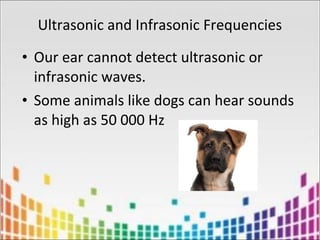
• Our ear cannot detect ultrasonic or
infrasonic waves.
• Some animals like dogs can hear sounds
as high as 50 000 Hz
Ultrasonic and Infrasonic Frequencies
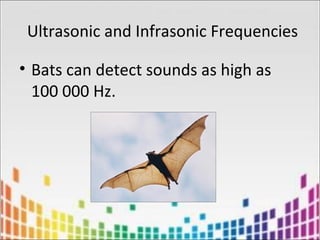
• Bats can detect sounds as high as
100 000 Hz.
Applications of Sound Waves
• We can see images of your baby brother or
sister when the OBGyne asks your mommy or
nanay to undergo ultrasound.
Applications of Sound Waves
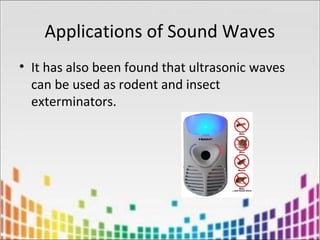
• It has also been found that ultrasonic waves
can be used as rodent and insect
exterminators.
Check Your Understanding
1. Which of the following best describes a high
frequency sound? It has _____________.
a. low pitch
b. high pitch
c. low energy
d. A and C
Check Your Understanding
2. Compared to a thin string of the same length
and tightness a thick string produces sounds
of ____________.
a. the same pitch
b. lower pitch
c. higher pitch
d. lower then higher pitch
Check Your Understanding
3. The unit for sound intensity is the
a. Deciibel
b. Seconds
c. Hertz
d. meters
Check Your Understanding
4. The part of the ear where sound is converted
to electrical energy and sent to the brain
a. Tympanum
b. Ear canal
c. Cochlea
d. anvil
Check Your Understanding
5. Which of the following frequencies can be
heard by the human ear?
a. 35,000 Hz
b. 30,000 Hz
c. 18,000 Hz
d. 45,000 Hz
The End

Sound

  • 1.
  • 2.
    How does soundpropagate?
  • 3.
    Activity 1 My ownsounding box In this activity, you should be able to construct a sounding box to 1. demonstrate how sound is produced; and 2. identify factors that affect the pitch and loudness of the sound produced.
  • 4.
    Procedure 1.Cut and designyour shoe box as shown in the figure below.
  • 5.
    2. Put therubber bands around the box. Make sure that the rubber bands are almost equally spaced and that the rubber bands are arranged according to increasing thickness from the lower end to the other end of the box. 3. Use your finger to pluck each rubber band. Listen to the sound produced.
  • 6.
    Q1. What physicalsigns did you observe when you plucked each band. Did you hear any sound? What produced the sound? Q2. How different are the sounds produced by each band with different thickness?
  • 7.
    4. This timeuse the fingers of one hand to stretch one of the elastics. Pluck the elastic with the fingers of the other hand and observe. Q3. Are there changes in the note when you plucked the stretched band?
  • 8.
    5. Repeat step4 with the other elastic bands. Q4. Arrange the elastics in sequence from the highest note to the lowest note produced.
  • 9.
    Sound • is aform of energy produced & transmitted by vibrating matter
  • 10.
    How is soundproduced? • Sounds are caused by vibrations. • Vibrations are considered as a disturbance that travels through a medium. • This vibratory motion causes energy to transfer to our ears and is interpreted by our brain.
  • 11.
    Vibration - Very fast,repeated backward and forward movement of particles of matter - For example, the vibration of the tuning fork creates pure sound. - The hammer hits the nail and the particles vibrate making noise.
  • 12.
    Sound . .. • Sound waves are examples of longitudinal waves. • They are also known as mechanical waves since sound waves need medium in order to propagate.
  • 13.
    Waves transport energywithout moving matter Watch the 3 red dots You will see them vibrate, but not move with the wave to the end. All the particles are vibrating but stay fixed
  • 14.
    ` • As airmolecules collide with those nearby, they cause other air molecules to move back and forth. • In this way, energy is transferred from one place to another.
  • 15.
  • 16.
    Sound waves andthe States of Matter
  • 17.
    The Speed ofSound • Sound waves can travel through other materials besides air. • As a sound wave travels through a material, the particles in the material collide with each other. • In a solid, molecules are closer together than in liquids or gases, so collisions between molecules occur more rapidly than in liquids or gases.
  • 18.
    Sound also travelsfaster in liquids than in gases because molecules are still more tightly packed. In fresh water, sound waves travel 4 times faster than in air! Speed of Sound
  • 19.
  • 20.
    Factors Affecting Speedof Sound (1) Atmospheric pressure (2) relative humidity (3) atmospheric temperature. • High atmospheric pressure, relative humidity and atmospheric temperature lead to faster moving sound.
  • 21.
    Why sound travelsfaster in hot air? • The temperature of the material that sound waves are traveling through also affects the speed of sound. • As a substance heats up, its molecules move faster, so they collide more frequently. • The more frequent the collisions are, the faster the speed of sound is in the material.
  • 22.
    Check Your Understanding 1.Which of the following objects will produce sound? a. soft objects b. radio stations c. vibrating objects d. objects under pressure
  • 23.
    Check Your Understanding 2.A sound wave is a _____________. a. longitudinal wave b. transverse wave c. standing wave d. shock wave
  • 24.
    Check Your Understanding 3.Which of the following is not capable of transmitting sound? a. air b. water c. steel d. a vacuum
  • 25.
    Check Your Understanding 4.Which of the following would most likely transmit sound best? a. Steel in cabinet b. Water in the ocean c. Air in your classroom d. Water in a swimming pool
  • 26.
    Check Your Understanding 5.In which of the following does sound travel fastest? a. gases b. liquids c. solids d. air
  • 27.
    Sound cannot travelin a vacuum. • Remember that sound is a mechanical wave which needs medium in order to propagate. • If no matter exists, there will be no sound. • In the outer space, sound would not be transmitted.
  • 28.
  • 31.
    Properties and characteristicsof sound • Strum each guitar string without holding the frets. (String #0 is the lower most string while string #6 is the uppermost string.
  • 33.
    Pitch • The highnessor lowness of sound is known as the pitch of a sound.
  • 34.
    1. Which stringvibrates fastest when strummed? String #0 2. Which string vibrates slowest when strummed? String No. 6 3. Which string has the highest frequency? String No. 0
  • 35.
    • Which stringhas the highest pitch? String No. 0 • Which has the lowest frequency? String No. 6 • Which string has the lowest pitch? String No. 6 • How would you relate pitch and frequency? The higher the frequency, the higher the pitch.
  • 36.
    1.1. Lengthening ofthe stringLengthening of the string – The shorter the length of theThe shorter the length of the string, the higher the magnitudestring, the higher the magnitude of the pitch.of the pitch. 1.1. Thickness of stringThickness of string – As the diameter of a stringAs the diameter of a string decreases the pitch of the sounddecreases the pitch of the sound wave increaseswave increases What are the different factorsWhat are the different factors affecting the pitch of a sound?affecting the pitch of a sound?
  • 37.
    How is frequencyandHow is frequency and pitch related?pitch related? The greater the frequency ofThe greater the frequency of sound wave, the higher thesound wave, the higher the pitch of sound wavepitch of sound wave produced.produced.
  • 38.
    Characteristics of soundCharacteristicsof sound wave:wave: 1.1. LoudnessLoudness • Loudness of soundLoudness of sound largely depends on thelargely depends on the intensity of sound.intensity of sound. • The greater theThe greater the amplitude, the louderamplitude, the louder the sound producedthe sound produced
  • 39.
    2. Pitch andfrequency.2. Pitch and frequency. •Pitch refers to the highnessPitch refers to the highness or lowness of soundor lowness of sound •The pitch sound depends onThe pitch sound depends on the frequencythe frequency •The greater the frequency,The greater the frequency, the higher the pitch ofthe higher the pitch of soundsound
  • 40.
    3. Intensity3. Intensity •The measure of theThe measure of the energy per unit timeenergy per unit time transmitted through atransmitted through a unit area by the soundunit area by the sound wave.wave. • Intensity levels areIntensity levels are expressed in decibelsexpressed in decibels (dB)(dB)
  • 41.
  • 42.
    Major Parts ofthe Ear 1. the outer ear 2. the middle ear and 3. the inner ear
  • 43.
    Parts of theear • The outer ear called the pinna collects the sound waves and focuses them into the ear canal. • This canal transmits the sound waves to the eardrum.
  • 44.
    Parts of theear • The ear canal is the eardrum membrane or the tympanum. • It separates the outer and the middle ears physically.
  • 45.
    Parts of theear • Air vibrations set the eardrum membrane in motion that causes the three smallest bones (hammer, anvil and stirrup) to move. • These three bones convert the small- amplitude vibration of the eardrum into large amplitude oscillations. • These oscillations are transferred to the inner ear through the oval window.
  • 46.
    Parts of theear • Behind the oval window is a snail-shell shaped liquid –filled organ called the cochlea. • The large-amplitude oscillations create waves that travel in liquid. • These sounds are converted into electrical impulses, which are sent to the brain by the auditory nerve. • The brain, interprets these signals as words, music or noise.
  • 47.
    • Audio frequencyrangeAudio frequency range - Frequency rangingFrequency ranging 20 Hz to 20 000 Hz20 Hz to 20 000 Hz - Sounds thatSounds that human earhuman ear can hear is ancan hear is an example.example. • INFRASONICSINFRASONICS • -Frequency below-Frequency below 20 Hz.20 Hz. • ULTRASONICSULTRASONICS • -Frequency above 20 000 Hz-Frequency above 20 000 Hz
  • 48.
    Ultrasonic and Infrasonic Frequencies •Vibrational frequencies beyond 20 000 Hz is called ultrasonic frequencies • extremely low frequencies are known as infrasonic frequencies.
  • 49.
    • Our earcannot detect ultrasonic or infrasonic waves. • Some animals like dogs can hear sounds as high as 50 000 Hz Ultrasonic and Infrasonic Frequencies
  • 50.
    Ultrasonic and InfrasonicFrequencies • Bats can detect sounds as high as 100 000 Hz.
  • 51.
    Applications of SoundWaves • We can see images of your baby brother or sister when the OBGyne asks your mommy or nanay to undergo ultrasound.
  • 52.
    Applications of SoundWaves • It has also been found that ultrasonic waves can be used as rodent and insect exterminators.
  • 53.
    Check Your Understanding 1.Which of the following best describes a high frequency sound? It has _____________. a. low pitch b. high pitch c. low energy d. A and C
  • 54.
    Check Your Understanding 2.Compared to a thin string of the same length and tightness a thick string produces sounds of ____________. a. the same pitch b. lower pitch c. higher pitch d. lower then higher pitch
  • 55.
    Check Your Understanding 3.The unit for sound intensity is the a. Deciibel b. Seconds c. Hertz d. meters
  • 56.
    Check Your Understanding 4.The part of the ear where sound is converted to electrical energy and sent to the brain a. Tympanum b. Ear canal c. Cochlea d. anvil
  • 57.
    Check Your Understanding 5.Which of the following frequencies can be heard by the human ear? a. 35,000 Hz b. 30,000 Hz c. 18,000 Hz d. 45,000 Hz
  • 58.