Properties of Light
Properties of Light
•
•
•
•
•
•
•
•
•

Effects of Materials on Light
Reflection
Refraction
Dispersion
Total Internal Reflection
Interference
Diffraction
Scattering of Light
Polarization
Effects of Materials on Light
Materials can be classified based on how it
responds to light incident on them:
1. Opaque materials – absorb light; do
not let light to pass through
2. Transparent materials – allow light to
easily pass through them
3. Translucent materials – allow light to
pass through but distorts the light
during the passage
Reflection
Light follows the Law of Reflection: “The
angle of incidence is equal to the angle of
reflection.”
Light can bounce off materials in two ways:
1. Diffuse reflection – reflected rays go in
different directions; happens in roughtextured or uneven surfaces
2. Regular/Specular reflection – reflected
rays go in one directions; happens in
smooth and shiny surfaces; image can be
seen
Refraction
Light bends/refracts when it changes speed.

This usually happens when the light travels
from one medium to the next.
Simple rule of thumb in refraction:
• If light slows down, it will refract towards
the normal line.
• If light speeds up, it will refract away from
the normal line.
Refraction
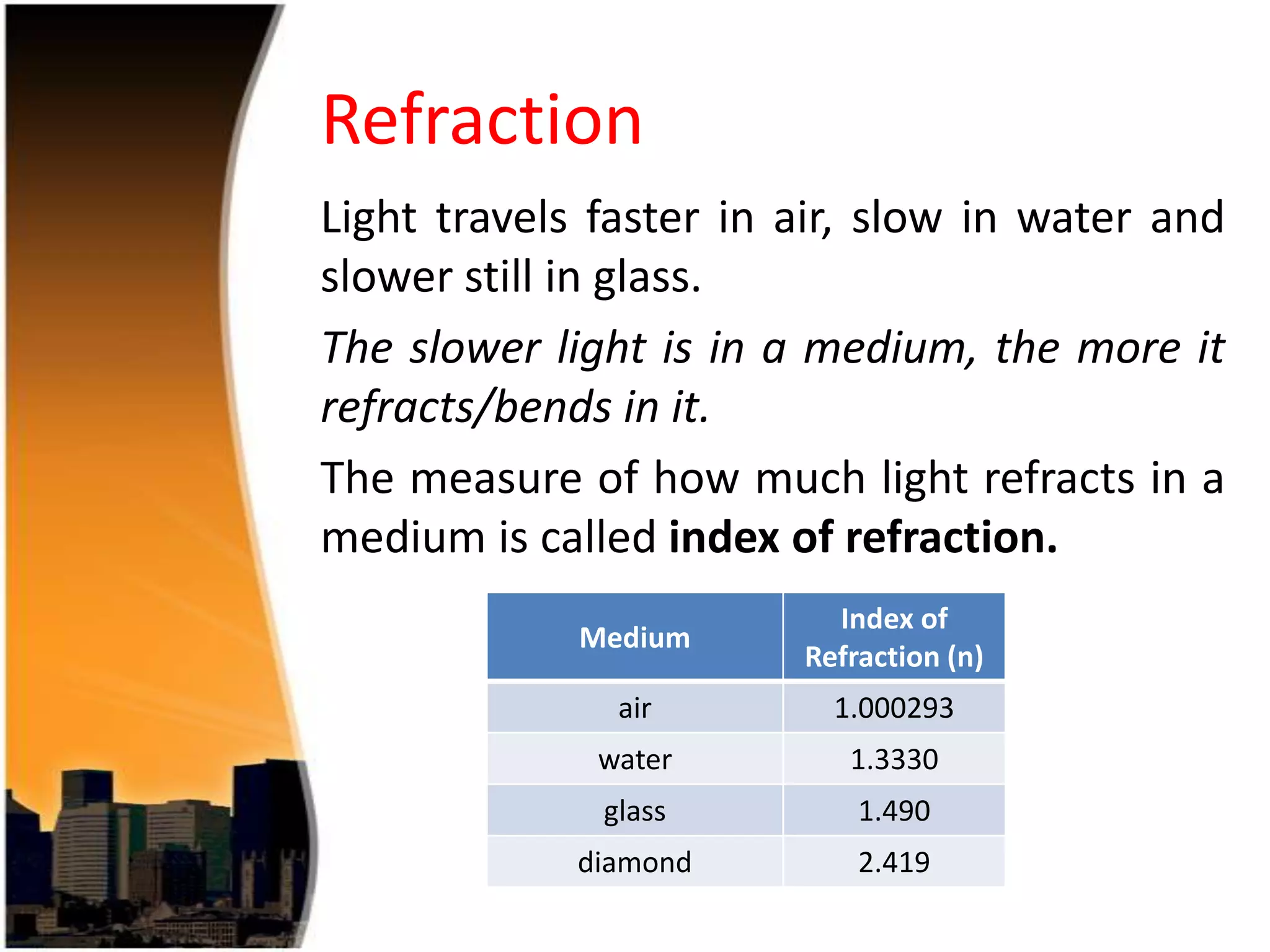
Light travels faster in air, slow in water and
slower still in glass.
The slower light is in a medium, the more it
refracts/bends in it.
The measure of how much light refracts in a
medium is called index of refraction.
Medium

Index of
Refraction (n)

air

1.000293

water

1.3330

glass

1.490

diamond

2.419
Refraction
Light follows the Law of Reflection: “The
angle of incidence is equal to the angle of
reflection.”
Light can bounce off materials in two ways:
1. Diffuse reflection – reflected rays go in
different directions; happens in roughtextured or uneven surfaces
2. Regular/Specular reflection – reflected
rays go in one directions; happens in
smooth and shiny surfaces; image can be
seen
Refraction
Light follows the Law of Reflection: “The
angle of incidence is equal to the angle of
reflection.”
Light can bounce off materials in two ways:
1. Diffuse reflection – reflected rays go in
different directions; happens in roughtextured or uneven surfaces
2. Regular/Specular reflection – reflected
rays go in one directions; happens in
smooth and shiny surfaces; image can be
seen
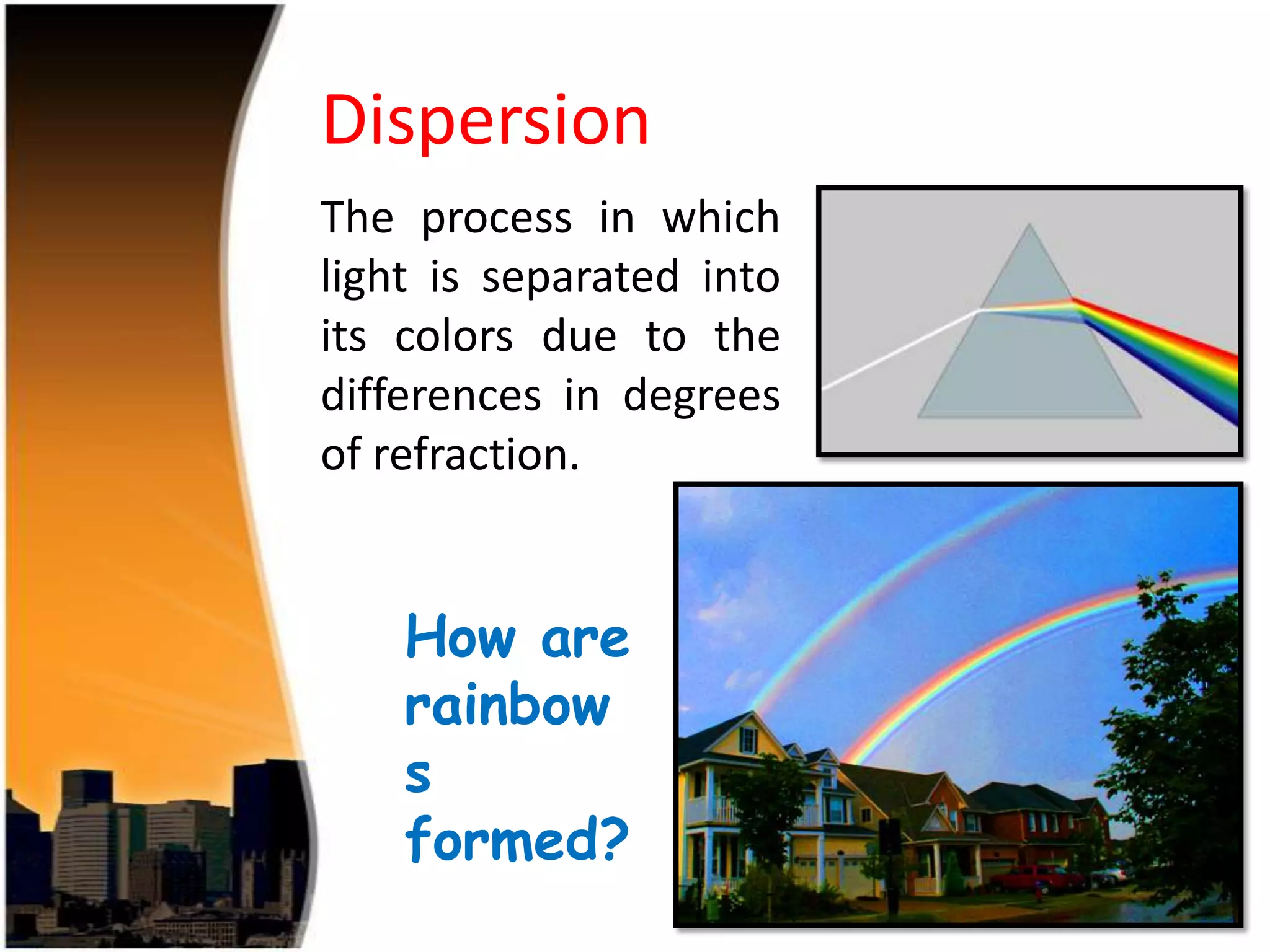
Dispersion
The process in which
light is separated into
its colors due to the
differences in degrees
of refraction.

How are
rainbow
s
formed?
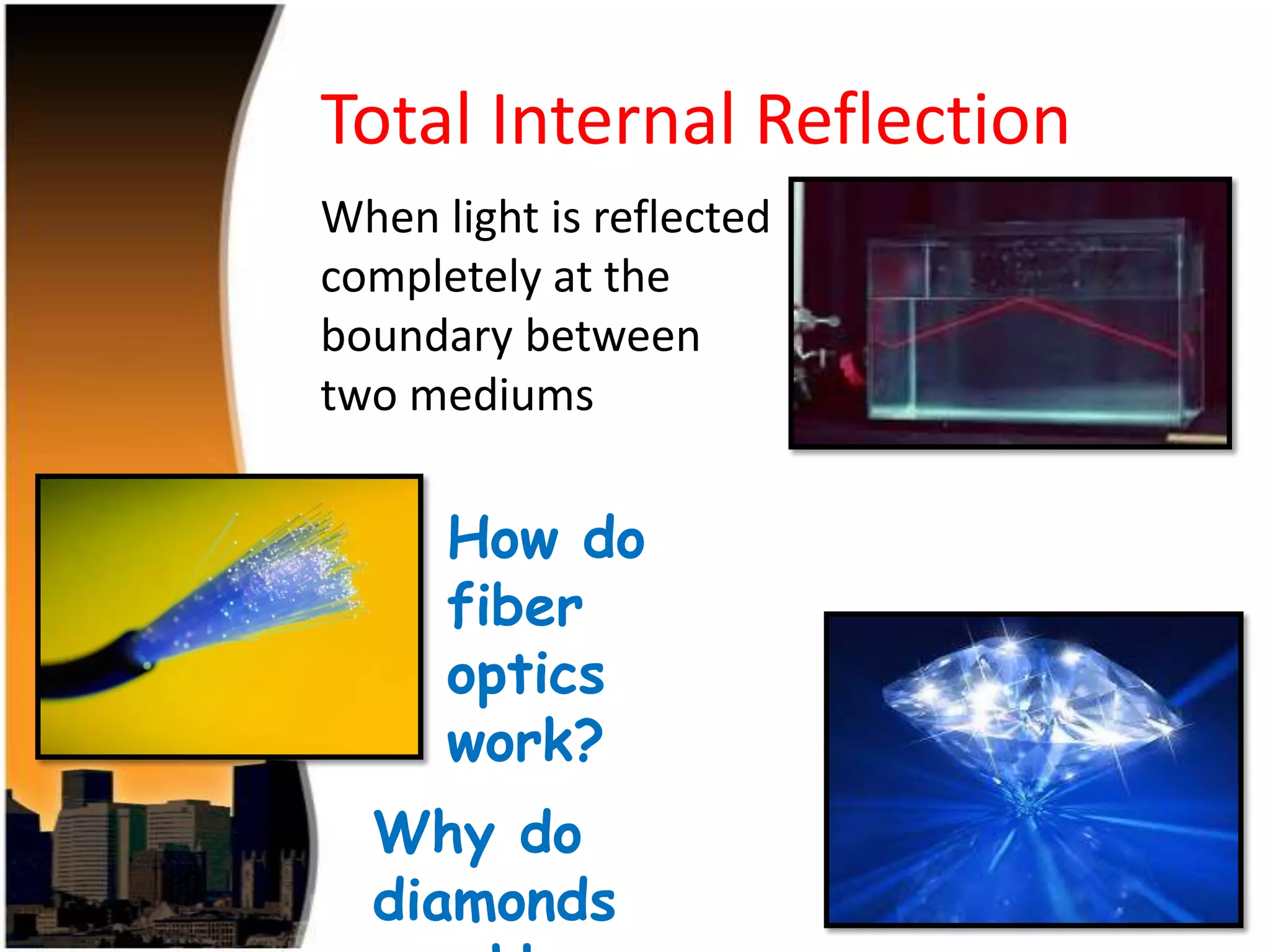
Total Internal Reflection
When light is reflected
completely at the
boundary between
two mediums

How do
fiber
optics
work?
Why do
diamonds
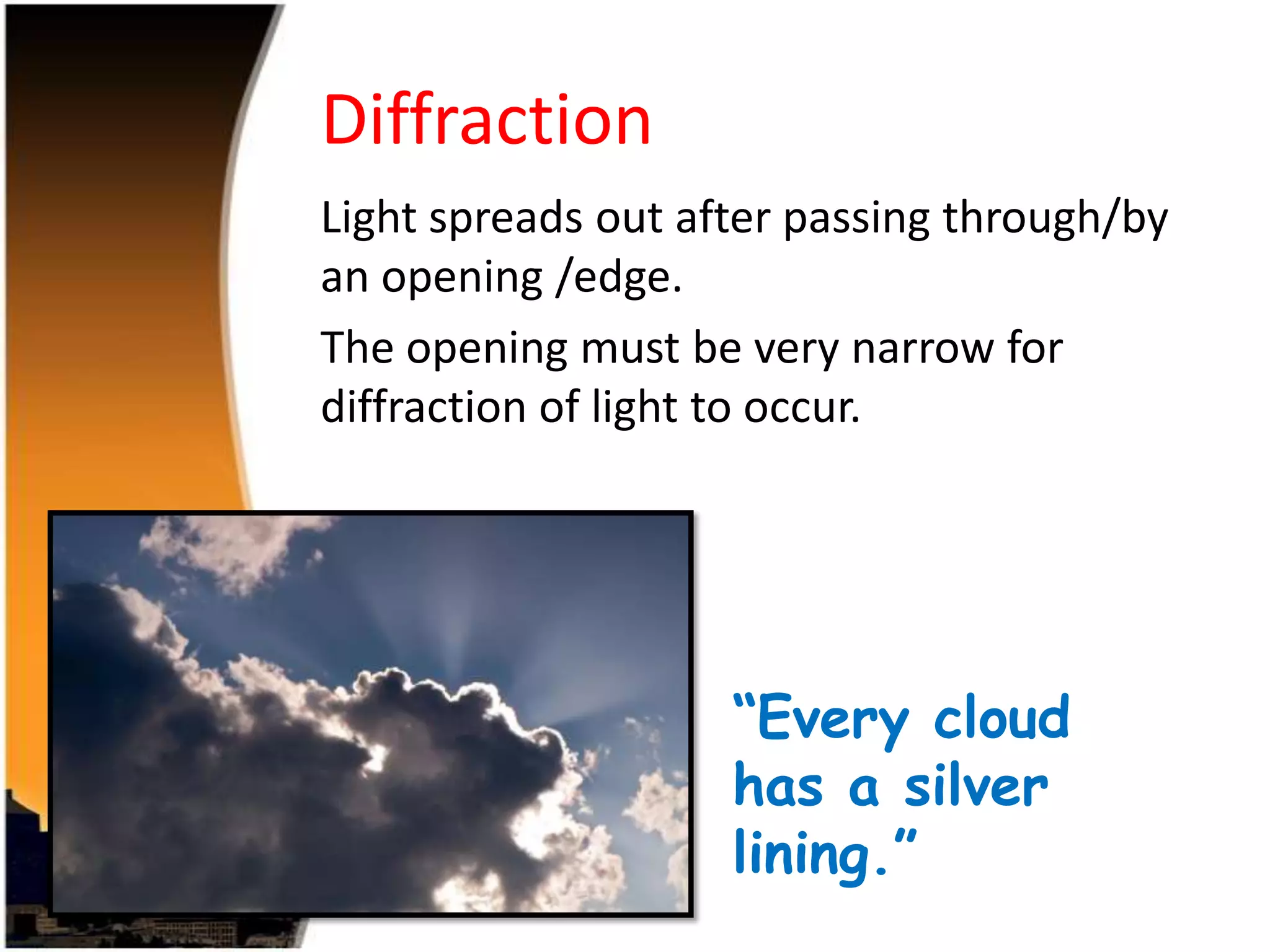
Diffraction
Light spreads out after passing through/by
an opening /edge.
The opening must be very narrow for
diffraction of light to occur.

“Every cloud
has a silver
lining.”
Interference
Light can superimpose and have either
constructive interference or destructive
interference.
Reflection
• Reflection - Light bounces off the surfaces
like mirrors such that the angle of
incidence is equal to the angle of
reflection.
• Refraction - Refraction is defined as the
bending of light as it passes through
materials of different optical density
• Interference - When two light waves meet
or coincide, it can create either
constructive or destructive interference
based on how the crests & troughs of the
waves meet.
Wave Properties (Light)
• Diffraction - This is defined as the
bending of light waves around
obstacles in its path.
Example, when a light wave passes
through a barrier with a small
opening, it acts as a single point
source from where light emerges
and spreads in all direction.
So, is light a wave or a particle?
• Light has a dual nature.
• Depending on the phenomenon or behavior in
question, light can be treated either as a wave
or as a particle.
• To examine this wave-particle duality, we will
examine two experimental proofs.
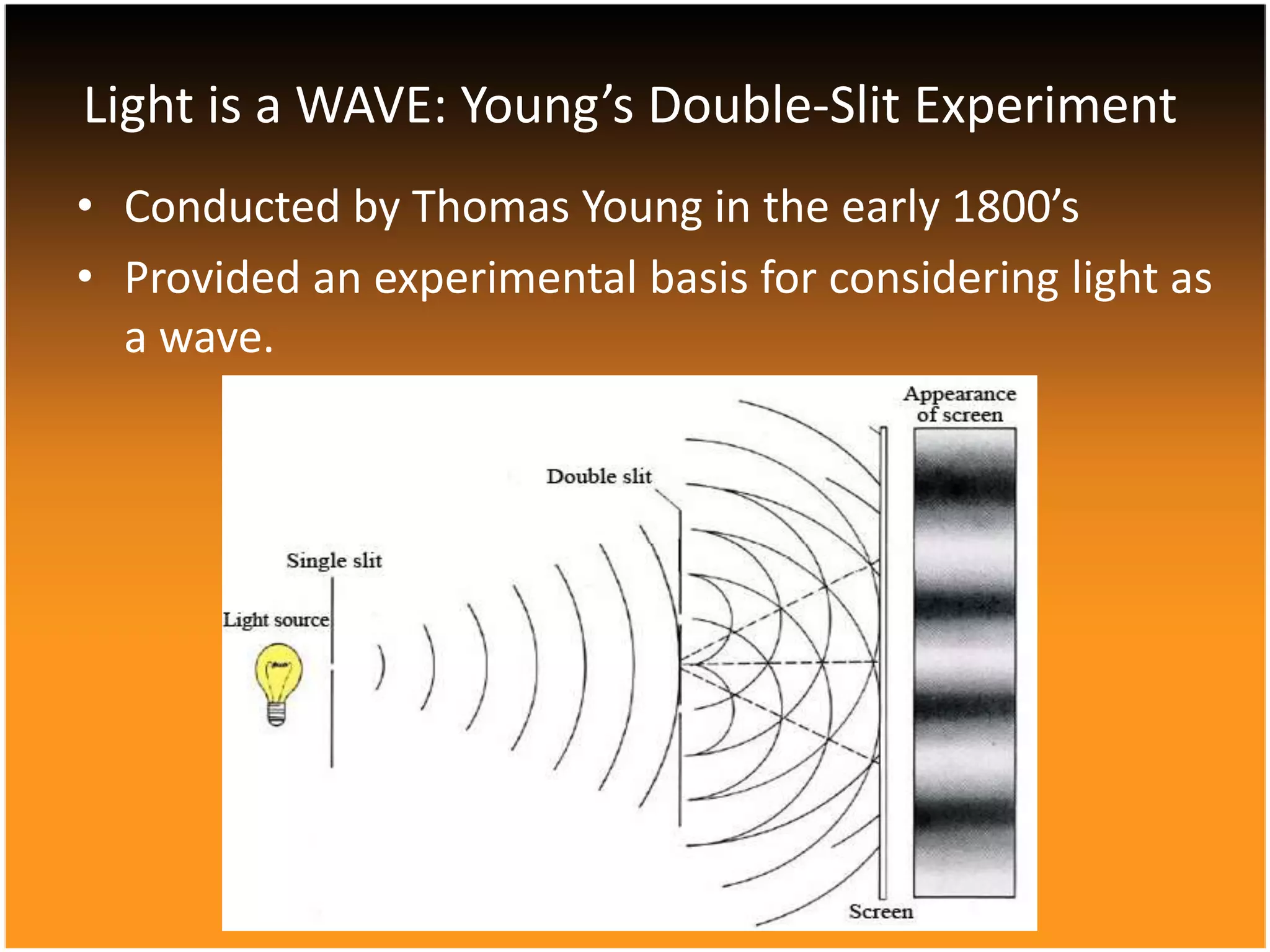
Light is a WAVE: Young’s Double-Slit Experiment
• Conducted by Thomas Young in the early 1800’s
• Provided an experimental basis for considering light as
a wave.
Key Points of Young’s Experiment
• The individual slits acted as individual sources
which light passes through and spreads.
(Isn’t this like water waves?)
• Light exhibits interference which is a wave
property.
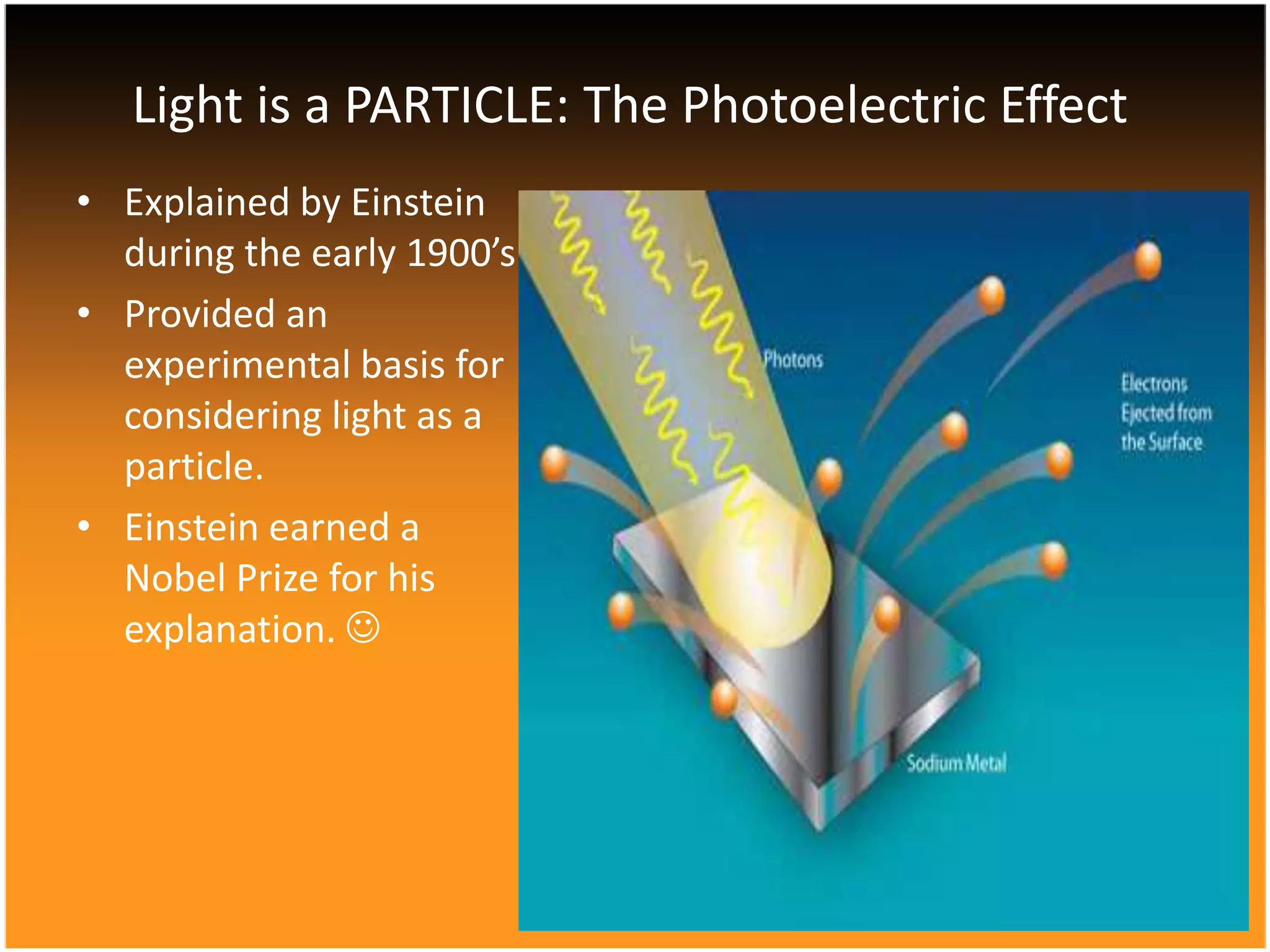
Light is a PARTICLE: The Photoelectric Effect
• Explained by Einstein
during the early 1900’s
• Provided an
experimental basis for
considering light as a
particle.
• Einstein earned a
Nobel Prize for his
explanation. 
Key Points of Photoelectric effect
• Higher energy light knocks off electrons at higher
energy.
• The number of ejected electrons is directly related to
the intensity (brightness) of light. This means
brighter lights emit more photons.
• Light is a particle since it is capable of ‘knocking off’
electrons. Further, unlike waves, increasing the
brightness does not increase the energy of the
knocked off electrons.

10 properties of light

  • 1.
  • 2.
    Properties of Light • • • • • • • • • Effectsof Materials on Light Reflection Refraction Dispersion Total Internal Reflection Interference Diffraction Scattering of Light Polarization
  • 3.
    Effects of Materialson Light Materials can be classified based on how it responds to light incident on them: 1. Opaque materials – absorb light; do not let light to pass through 2. Transparent materials – allow light to easily pass through them 3. Translucent materials – allow light to pass through but distorts the light during the passage
  • 4.
    Reflection Light follows theLaw of Reflection: “The angle of incidence is equal to the angle of reflection.” Light can bounce off materials in two ways: 1. Diffuse reflection – reflected rays go in different directions; happens in roughtextured or uneven surfaces 2. Regular/Specular reflection – reflected rays go in one directions; happens in smooth and shiny surfaces; image can be seen
  • 5.
    Refraction Light bends/refracts whenit changes speed. This usually happens when the light travels from one medium to the next. Simple rule of thumb in refraction: • If light slows down, it will refract towards the normal line. • If light speeds up, it will refract away from the normal line.
  • 6.
    Refraction Light travels fasterin air, slow in water and slower still in glass. The slower light is in a medium, the more it refracts/bends in it. The measure of how much light refracts in a medium is called index of refraction. Medium Index of Refraction (n) air 1.000293 water 1.3330 glass 1.490 diamond 2.419
  • 7.
    Refraction Light follows theLaw of Reflection: “The angle of incidence is equal to the angle of reflection.” Light can bounce off materials in two ways: 1. Diffuse reflection – reflected rays go in different directions; happens in roughtextured or uneven surfaces 2. Regular/Specular reflection – reflected rays go in one directions; happens in smooth and shiny surfaces; image can be seen
  • 8.
    Refraction Light follows theLaw of Reflection: “The angle of incidence is equal to the angle of reflection.” Light can bounce off materials in two ways: 1. Diffuse reflection – reflected rays go in different directions; happens in roughtextured or uneven surfaces 2. Regular/Specular reflection – reflected rays go in one directions; happens in smooth and shiny surfaces; image can be seen
  • 9.
    Dispersion The process inwhich light is separated into its colors due to the differences in degrees of refraction. How are rainbow s formed?
  • 10.
    Total Internal Reflection Whenlight is reflected completely at the boundary between two mediums How do fiber optics work? Why do diamonds
  • 11.
    Diffraction Light spreads outafter passing through/by an opening /edge. The opening must be very narrow for diffraction of light to occur. “Every cloud has a silver lining.”
  • 12.
    Interference Light can superimposeand have either constructive interference or destructive interference.
  • 14.
    Reflection • Reflection -Light bounces off the surfaces like mirrors such that the angle of incidence is equal to the angle of reflection. • Refraction - Refraction is defined as the bending of light as it passes through materials of different optical density • Interference - When two light waves meet or coincide, it can create either constructive or destructive interference based on how the crests & troughs of the waves meet.
  • 15.
    Wave Properties (Light) •Diffraction - This is defined as the bending of light waves around obstacles in its path. Example, when a light wave passes through a barrier with a small opening, it acts as a single point source from where light emerges and spreads in all direction.
  • 16.
    So, is lighta wave or a particle? • Light has a dual nature. • Depending on the phenomenon or behavior in question, light can be treated either as a wave or as a particle. • To examine this wave-particle duality, we will examine two experimental proofs.
  • 17.
    Light is aWAVE: Young’s Double-Slit Experiment • Conducted by Thomas Young in the early 1800’s • Provided an experimental basis for considering light as a wave.
  • 18.
    Key Points ofYoung’s Experiment • The individual slits acted as individual sources which light passes through and spreads. (Isn’t this like water waves?) • Light exhibits interference which is a wave property.
  • 19.
    Light is aPARTICLE: The Photoelectric Effect • Explained by Einstein during the early 1900’s • Provided an experimental basis for considering light as a particle. • Einstein earned a Nobel Prize for his explanation. 
  • 20.
    Key Points ofPhotoelectric effect • Higher energy light knocks off electrons at higher energy. • The number of ejected electrons is directly related to the intensity (brightness) of light. This means brighter lights emit more photons. • Light is a particle since it is capable of ‘knocking off’ electrons. Further, unlike waves, increasing the brightness does not increase the energy of the knocked off electrons.