Heat
By the end of this presentation you
will be able to:
• Describe heat energy, its’ units and explain how
it converts to other forms
• Explain how heat affects expansion and
contraction of materials
• Explain conduction, convection and radiation
• Differentiate between heat energy and
temperature
Key Words
Heat
Radiation
Convection
Conduction
Cold
Conductor
Temperature
Transfer
Heat can be converted to other
forms of energy
• Sunlight (heat) is used by plants for
Photosynthesis (to make food), it is
converted to chemical energy.
• Oil and gas are burned in power stations
to produce heat energy, this is used to turn
turbines which produce electricity
(electrical energy)
What is Heat?
• Form of energy because it can change
and move things.
- Measured in JOULES (J)
How is heat produced?
• The movement of particles/molecules
produces heat
• Particles move about more and take up
more room if heated – this is why things
expand if heated
• It is also why substances change form
when heated
solids liquids gases
Heat Transfer
• Heat always moves from a warmer place
to a cooler place.
• Hot objects in a cooler room will cool to
room temperature.e.g: tea, coffee
• Cold objects in a warmer room will heat up
to room temperature.e.g: butter, ice
Transfer of Thermal Energy
T H E M E T H R E E : T H E R M A L P H Y S I C S
C h a p t e r 7
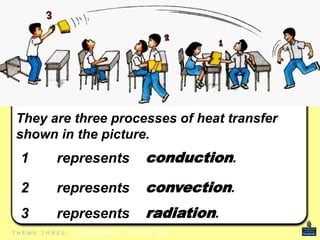
They are three processes of heat transfer
shown in the picture.
1 represents
2 represents
3 represents
conduction.
convection.
radiation.
Conduction
• Transfer of heat is through a SOLID by
being passed from one particle to the next
• Particles at the warm end move faster and
this then causes the next particles to move
faster and so on. e.g: poker in fire
spoon in tea
• In this way heat in an object travels from:
the HOT end the cold end
Conduction
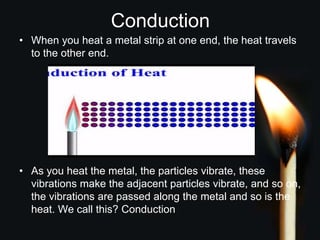
• When you heat a metal strip at one end, the heat travels
to the other end.
• As you heat the metal, the particles vibrate, these
vibrations make the adjacent particles vibrate, and so on,
the vibrations are passed along the metal and so is the
heat. We call this? Conduction
Convection
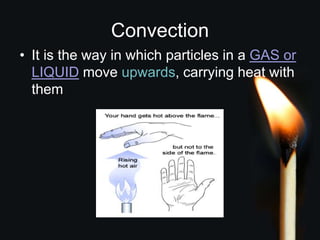
• It is the way in which particles in a GAS or
LIQUID move upwards, carrying heat with
them
Convection
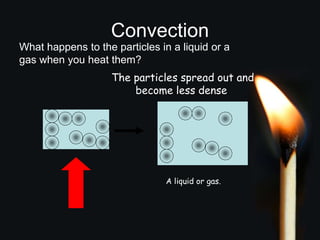
What happens to the particles in a liquid or a
gas when you heat them?
The particles spread out and
become less dense.
A liquid or gas.
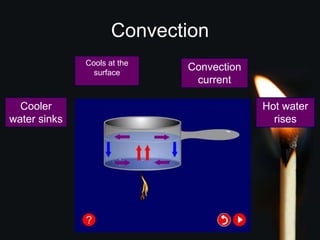
Convection
Hot water
rises
Cooler
water sinks
Convection
current
Cools at the
surface
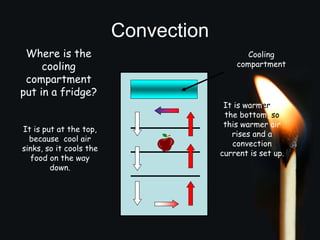
Convection
Where is the
cooling
compartment
put in a fridge?
Cooling
compartment
It is put at the top,
because cool air
sinks, so it cools the
food on the way
down.
It is warmer at
the bottom, so
this warmer air
rises and a
convection
current is set up.
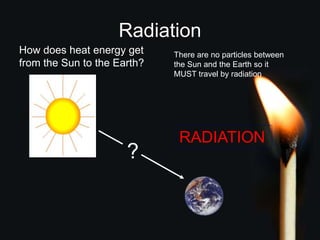
Radiation
How does heat energy get
from the Sun to the Earth?
There are no particles between
the Sun and the Earth so it
MUST travel by radiation
?
RADIATION
Radiation
• The transfer of heat in rays, from a hot
object, without needing a medium to pass
through
• It travels in all directions from a hot object
Temperature and heat are the SAME???!!
• The temperature of an object tells us how
HOT it is
• Measured in degrees Celsius - °C
• It is NOT the same as heat energy
although the two quantities are related.
e.g. a beaker of water at 60 °C is
hotter than a bath of water at 40 °C BUT
the bath contains more joules of heat
energy
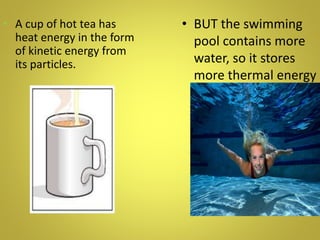
• BUT the swimming
pool contains more
water, so it stores
more thermal energy
or heat.
• A cup of hot tea has
heat energy in the form
of kinetic energy from
its particles.
Heating and Cooling
• If an object has become hotter,
it means that it has gained heat energy.
• If an object cools down, it means it has
lost energy
Heating and Cooling cont…
• Heat energy always moves from:
• HOT object COOLER object
e.g. Cup of water at 20 °C in a room at 30°C -
gains heat energy and heats up – its
temperature rises
Cup of water at 20 °C in a room at 10°C
loses heat energy and cools down – its
temperature will fall.
Expansion V Contraction
• The reason materials expand when heated
is because the heat gives the molecules
energy and as a result they begin to move,
leaving them further apart and hence the
material expands
• Cooling has the opposite effect, the
particles move closer together causing the
molecules to contract
• One exception: water expands when
cooled
1. Which of the following is not a
method of heat transfer?
A. Radiation
B. Insulation
C. Conduction
D. Convection
1. Which of the following is not a
method of heat transfer?
A. Radiation
B. Insulation
C. Conduction
D. Convection
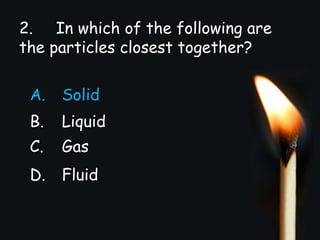
2. In which of the following are
the particles closest together?
A. Solid
B. Liquid
C. Gas
D. Fluid
2. In which of the following are
the particles closest together?
A. Solid
B. Liquid
C. Gas
D. Fluid
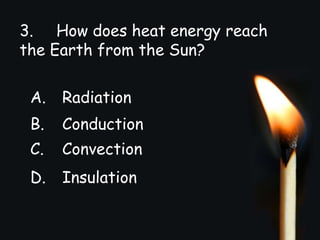
3. How does heat energy reach
the Earth from the Sun?
A. Radiation
B. Conduction
C. Convection
D. Insulation
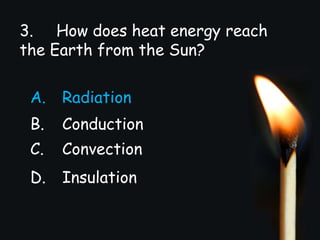
3. How does heat energy reach
the Earth from the Sun?
A. Radiation
B. Conduction
C. Convection
D. Insulation
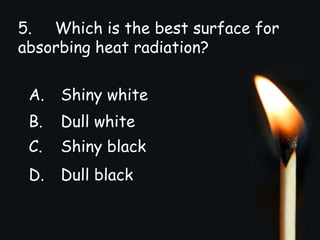
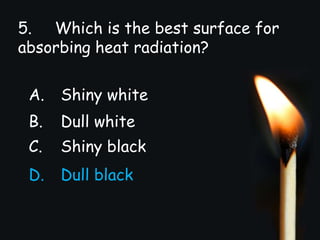
5. Which is the best surface for
absorbing heat radiation?
A. Shiny white
B. Dull white
C. Shiny black
D. Dull black
5. Which is the best surface for
absorbing heat radiation?
A. Shiny white
B. Dull white
C. Shiny black
D. Dull black
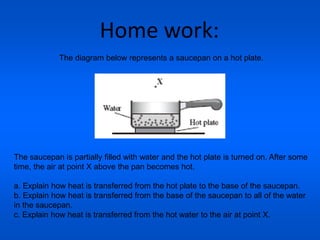
The diagram below represents a saucepan on a hot plate.
The saucepan is partially filled with water and the hot plate is turned on. After some
time, the air at point X above the pan becomes hot.
a. Explain how heat is transferred from the hot plate to the base of the saucepan.
b. Explain how heat is transferred from the base of the saucepan to all of the water
in the saucepan.
c. Explain how heat is transferred from the hot water to the air at point X.
Home work:
Thank You
Thank you for giving me constructive feedback.

Heat energy

  • 1.
  • 2.
    By the endof this presentation you will be able to: • Describe heat energy, its’ units and explain how it converts to other forms • Explain how heat affects expansion and contraction of materials • Explain conduction, convection and radiation • Differentiate between heat energy and temperature
  • 3.
  • 4.
    Heat can beconverted to other forms of energy • Sunlight (heat) is used by plants for Photosynthesis (to make food), it is converted to chemical energy. • Oil and gas are burned in power stations to produce heat energy, this is used to turn turbines which produce electricity (electrical energy)
  • 5.
    What is Heat? •Form of energy because it can change and move things. - Measured in JOULES (J)
  • 6.
    How is heatproduced? • The movement of particles/molecules produces heat • Particles move about more and take up more room if heated – this is why things expand if heated • It is also why substances change form when heated solids liquids gases
  • 7.
    Heat Transfer • Heatalways moves from a warmer place to a cooler place. • Hot objects in a cooler room will cool to room temperature.e.g: tea, coffee • Cold objects in a warmer room will heat up to room temperature.e.g: butter, ice
  • 8.
    Transfer of ThermalEnergy T H E M E T H R E E : T H E R M A L P H Y S I C S C h a p t e r 7 They are three processes of heat transfer shown in the picture. 1 represents 2 represents 3 represents conduction. convection. radiation.
  • 9.
    Conduction • Transfer ofheat is through a SOLID by being passed from one particle to the next • Particles at the warm end move faster and this then causes the next particles to move faster and so on. e.g: poker in fire spoon in tea • In this way heat in an object travels from: the HOT end the cold end
  • 10.
    Conduction • When youheat a metal strip at one end, the heat travels to the other end. • As you heat the metal, the particles vibrate, these vibrations make the adjacent particles vibrate, and so on, the vibrations are passed along the metal and so is the heat. We call this? Conduction
  • 11.
    Convection • It isthe way in which particles in a GAS or LIQUID move upwards, carrying heat with them
  • 12.
    Convection What happens tothe particles in a liquid or a gas when you heat them? The particles spread out and become less dense. A liquid or gas.
  • 13.
  • 14.
    Convection Where is the cooling compartment putin a fridge? Cooling compartment It is put at the top, because cool air sinks, so it cools the food on the way down. It is warmer at the bottom, so this warmer air rises and a convection current is set up.
  • 15.
    Radiation How does heatenergy get from the Sun to the Earth? There are no particles between the Sun and the Earth so it MUST travel by radiation ? RADIATION
  • 16.
    Radiation • The transferof heat in rays, from a hot object, without needing a medium to pass through • It travels in all directions from a hot object
  • 17.
    Temperature and heatare the SAME???!! • The temperature of an object tells us how HOT it is • Measured in degrees Celsius - °C • It is NOT the same as heat energy although the two quantities are related. e.g. a beaker of water at 60 °C is hotter than a bath of water at 40 °C BUT the bath contains more joules of heat energy
  • 18.
    • BUT theswimming pool contains more water, so it stores more thermal energy or heat. • A cup of hot tea has heat energy in the form of kinetic energy from its particles.
  • 19.
    Heating and Cooling •If an object has become hotter, it means that it has gained heat energy. • If an object cools down, it means it has lost energy
  • 20.
    Heating and Coolingcont… • Heat energy always moves from: • HOT object COOLER object e.g. Cup of water at 20 °C in a room at 30°C - gains heat energy and heats up – its temperature rises Cup of water at 20 °C in a room at 10°C loses heat energy and cools down – its temperature will fall.
  • 21.
    Expansion V Contraction •The reason materials expand when heated is because the heat gives the molecules energy and as a result they begin to move, leaving them further apart and hence the material expands • Cooling has the opposite effect, the particles move closer together causing the molecules to contract • One exception: water expands when cooled
  • 23.
    1. Which ofthe following is not a method of heat transfer? A. Radiation B. Insulation C. Conduction D. Convection
  • 24.
    1. Which ofthe following is not a method of heat transfer? A. Radiation B. Insulation C. Conduction D. Convection
  • 25.
    2. In whichof the following are the particles closest together? A. Solid B. Liquid C. Gas D. Fluid
  • 26.
    2. In whichof the following are the particles closest together? A. Solid B. Liquid C. Gas D. Fluid
  • 27.
    3. How doesheat energy reach the Earth from the Sun? A. Radiation B. Conduction C. Convection D. Insulation
  • 28.
    3. How doesheat energy reach the Earth from the Sun? A. Radiation B. Conduction C. Convection D. Insulation
  • 29.
    5. Which isthe best surface for absorbing heat radiation? A. Shiny white B. Dull white C. Shiny black D. Dull black
  • 30.
    5. Which isthe best surface for absorbing heat radiation? A. Shiny white B. Dull white C. Shiny black D. Dull black
  • 31.
    The diagram belowrepresents a saucepan on a hot plate. The saucepan is partially filled with water and the hot plate is turned on. After some time, the air at point X above the pan becomes hot. a. Explain how heat is transferred from the hot plate to the base of the saucepan. b. Explain how heat is transferred from the base of the saucepan to all of the water in the saucepan. c. Explain how heat is transferred from the hot water to the air at point X. Home work:
  • 32.
    Thank You Thank youfor giving me constructive feedback.