To View the presentation as a slideshow with effects  select   “View”   on the menu bar and click on   “Slide Show.” To advance through the presentation, click the right-arrow key or the space bar . From the resources slide, click on any resource to see a presentation for that resource. From the Chapter menu screen click on any lesson to go directly to that lesson’s presentation. You may exit the slide show at any time by pressing  the   Esc  key . How to Use This Presentation
Resources Chapter Presentation Image Bank Math Focus Bellringers Standards Assessment Visual Concepts
Table of Contents Section 1  The Electromagnetic Spectrum   Section 2  Interactions of Light with Matter Section 3  Refraction Chapter 3 Light and Living Things
Bellringer Describe the weather conditions necessary to produce a rainbow. Why do you  think rainbows form? Write your responses in your  science journal. Section 1  The Electromagnetic  Spectrum  Chapter 3
What You Will Learn Light is an electromagnetic wave Visible light is a small part of a very broad electromagnetic spectrum. White light is a mixture of many wavelengths of visible light. Infrared waves and ultraviolet light affect living things. Chapter 3 Section 1  The Electromagnetic  Spectrum
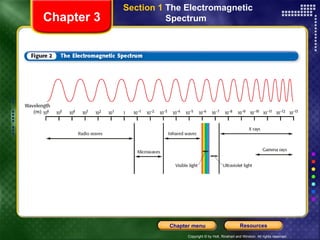
Visible light, infrared waves, and ultraviolet light are small parts of a large electromagnetic spectrum. An  electromagnetic wave  (EM wave) is a wave that consists of changing electric and magnetic fields. Light is an electromagnetic wave. Chapter 3 Section 1  The Electromagnetic  Spectrum  6a:  Visible light is a small band  in the broad electromagnetic spectrum.
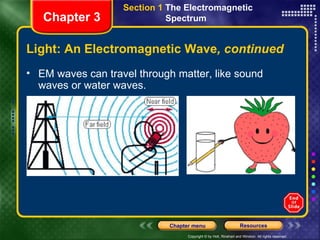
Light: An Electromagnetic Wave , continued EM waves can travel through matter, like sound waves or water waves. Chapter 3 Section 1  The Electromagnetic  Spectrum
Electromagnetic Waves Light and Living Things Chapter 3
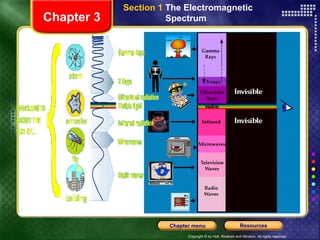
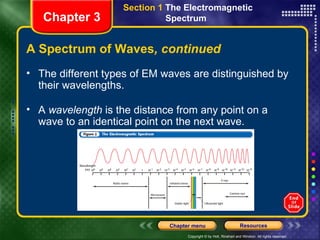
A Spectrum of Waves The entire range of electromagnetic waves is called the  electromagnetic spectrum. Visible light, ultraviolet light, and infrared waves are portions of the EM spectrum that are important to living things. Other EM waves in the EM spectrum include radio waves and X-rays. Chapter 3 Section 1  The Electromagnetic  Spectrum
Section 1  The Electromagnetic  Spectrum  Chapter 3
A Spectrum of Waves , continued The different types of EM waves are distinguished by their wavelengths. A  wavelength  is the distance from any point on a wave to an identical point on the next wave. Chapter 3 Section 1  The Electromagnetic  Spectrum
Infrared Waves Warmer objects give off more infrared waves than cooler objects do . Infrared waves from the sun keep the temperatures on Earth suitable for life.  It’s the heat you feel from the sun. Slower wavelengths than visible light. Chapter 3 Section 1  The Electromagnetic  Spectrum
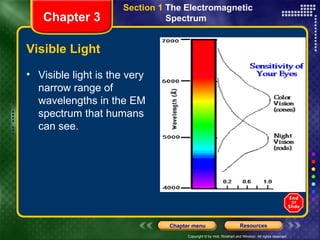
Visible Light Visible light is the very narrow range of wavelengths in the EM spectrum that humans can see.  Chapter 3 Section 1  The Electromagnetic  Spectrum
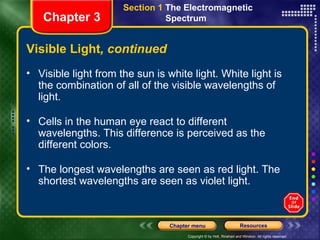
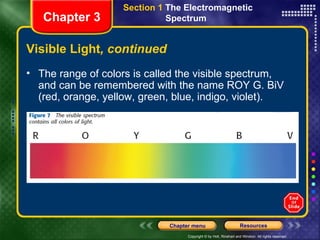
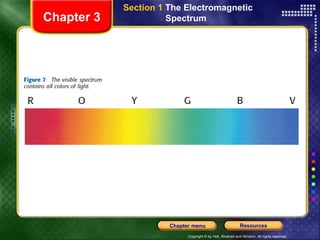
Visible light from the sun is white light. White light is the combination of all of the visible wavelengths of light. Cells in the human eye react to different wavelengths. This difference is perceived as the different colors.  The longest wavelengths are seen as red light. The shortest wavelengths are seen as violet light. Visible Light , continued Chapter 3 Section 1  The Electromagnetic  Spectrum
Visible Light , continued The range of colors is called the visible spectrum, and can be remembered with the name ROY G. BiV (red, orange, yellow, green, blue, indigo, violet). Chapter 3 Section 1  The Electromagnetic  Spectrum
Ultraviolet Light Ultraviolet light has shorter wavelengths than visible light.  Ultraviolet light affects your body in both bad and good ways. Ultraviolet light can cause sunburn, skin cancer, wrinkles, and damage to the eyes. Chapter 3 Section 1  The Electromagnetic  Spectrum
Ultraviolet Light , continued On the good side, skin cells produce vitamin D when exposed to ultraviolet light. Vitamin D helps the intestines absorb calcium.  Special ultraviolet lamps are used to kill bacteria on food and surgical tools. Chapter 3 Section 1  The Electromagnetic  Spectrum
Bellringer How do mirrors work? What do mirrors do to light waves? Write your answers in your  science journal. Section 2  Interactions of Light  with Matter Chapter 3
What You Will Learn Light travels in straight lines if the material that the light travels through does not change. The angle of reflection of a light beam is equal to the angle of incidence. An object can be seen if light emitted by or reflected by it is detected by the eye. Light can be reflected, absorbed, scattered, or transmitted by matter. Chapter 3 Section 2  Interactions of Light  with Matter
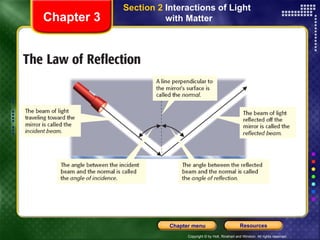
Reflection Light interacts with matter during reflection, absorption, scattering, and transmission. Light travels in a straight line unless the material it is traveling through changes. One way to change the direction of light is by reflection. Reflection  is the bouncing back of light rays when they hit an object. Chapter 3 Section 2  Interactions of Light  with Matter
The  law of reflection  states that the angle of incidence is equal to the angle of reflection. This means light will bounce off an object at the same angle it strikes the object. Reflection , continued Chapter 3 Section 2  Interactions of Light  with Matter
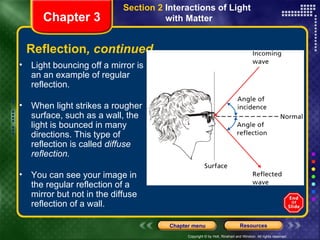
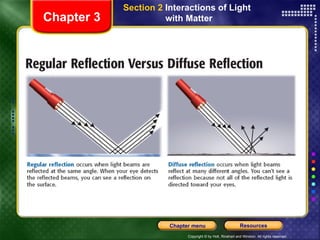
Light bouncing off a mirror is an an example of regular reflection. When light strikes a rougher surface, such as a wall, the light is bounced in many directions. This type of reflection is called  diffuse reflection. You can see your image in the regular reflection of a mirror but not in the diffuse reflection of a wall. Reflection , continued Chapter 3 Section 2  Interactions of Light  with Matter
Section 2  Interactions of Light  with Matter Chapter 3
Light and Matter Light interacts with all matter in one or more of the following ways: reflection, absorption, and transmission. Reflections allows you to see objects. Absorption can cause objects to feel warmer as energy is transferred from the light. Transmission  is the passing of light through matter.  Chapter 3 Section 2  Interactions of Light  with Matter
Light and Matter , continued Light is transmitted easily through  transparent  matter. Air, glass, and water that are pure are transparent. Light is transmitted through but also scattered by  translucent  matter. Frosted glass and wax paper are translucent. Matter that does not transmit any light is  opaque . You cannot see through opaque   matter. Chapter 3 Section 2  Interactions of Light  with Matter
Opaque, Translucent, Transparent Light and Living Things Click below to watch the Visual Concept. You may stop the video at any time by pressing  the   Esc  key. Visual Concept Chapter 3
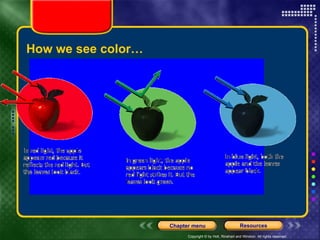
Colors and Objects When white light strikes a colored opaque object, some wavelengths (colors) are absorbed, and some are reflected.  You see only the colors (wavelengths) that are reflected. A berry looks red because it reflects red light and absorbs the other colors of light. Black objects absorb all colors of light, and white objects reflect all colors of light. Chapter 3 Section 2  Interactions of Light  with Matter
Color Movie
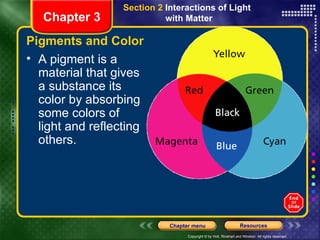
Pigments and Color A pigment is a material that gives a substance its color by absorbing some colors of light and reflecting others.  Chapter 3 Section 2  Interactions of Light  with Matter
How we see color…
Bellringer Can light bend? What happens when light passes through water? Write your responses in your  science journal. Section 3  Refraction Chapter 3
What You Will Learn Light is refracted when the medium it travels in changes. Convex and concave lenses refract light to form images. Human eyes, magnifying glasses, cameras, telescopes, and microscopes have lenses that form images. Chapter 3 Section 3  Refraction
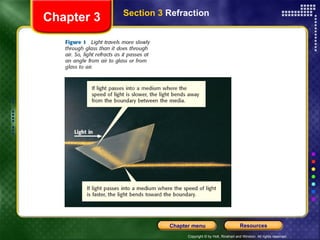
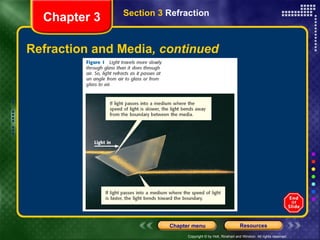
Refraction and Media Light can be bent, or refracted, by matter. Lenses refract light to form images. Refraction  is the bending of a wave as it passes at an angle from one medium to another. A  medium  (plural,  media ) is a substance through which a wave can travel. Air, water, and glass are three media. Chapter 3 Section 3  Refraction
Light can also be refracted when the density of a medium changes.  For example, the density of air above a hot road is less than the surrounding air. This makes objects seem to shimmer or wobble due to refraction. Refraction can cause optical illusions, because our brains assume the light is traveling in a straight line. Refraction and Media , continued Chapter 3 Section 3  Refraction
Refraction and Media , continued Chapter 3 Section 3  Refraction
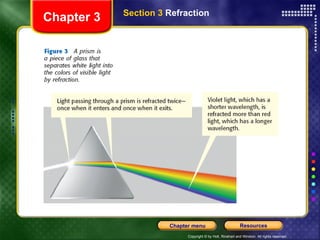
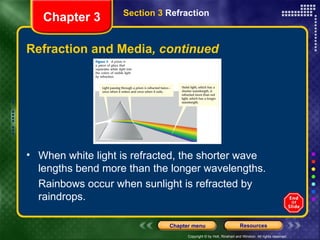
Refraction and Media , continued When white light is refracted, the shorter wave lengths bend more than the longer wavelengths. Rainbows occur when sunlight is refracted by raindrops. Chapter 3 Section 3  Refraction
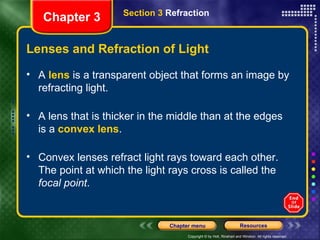
Lenses and Refraction of Light A  lens  is a transparent object that forms an image by refracting light. A lens that is thicker in the middle than at the edges is a  convex lens . Convex lenses refract light rays toward each other. The point at which the light rays cross is called the  focal point .  Chapter 3 Section 3  Refraction
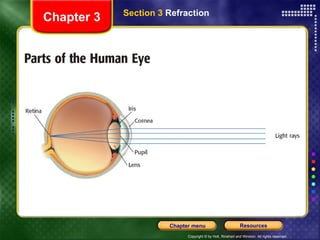
The lens of the human eye is a convex lens. It focuses light on the retina at the back of the eye. A magnifying glass is also a convex lens.  Depending on how close a convex lens is to an object, it can form an image that is larger or smaller than the object. Lenses and Refraction of Light , continued Chapter 3 Section 3  Refraction
Lenses and Refraction of Light , continued Like humans, many animal eyes also contain convex lenses. Concave lenses  are thinner in the middle than at the edges. They only form virtual images, which are always smaller than the object.  Concave lenses cause light rays to refract away from each other. Chapter 3 Section 3  Refraction
Comparing Real and Virtual Images Light and Living Things Click below to watch the Visual Concept. You may stop the video at any time by pressing  the   Esc  key. Visual Concept Chapter 3
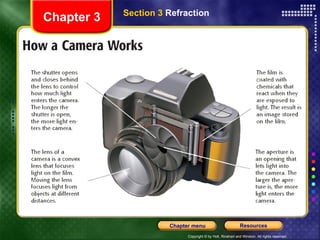
Optical Instruments and Refraction Optical instruments can help you make observations of objects that are very small or very far away. Many contain both concave and convex lenses.  The way a camera works is similar to the way your eye works. Light enters the lens and is focused at the back of the camera. Chapter 3 Section 3  Refraction
Section 3  Refraction Chapter 3
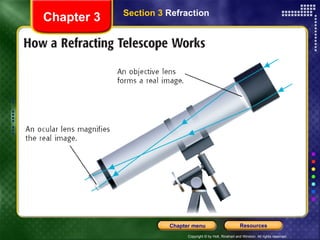
Telescopes are used to see images of large, distant objects. A telescope that uses lenses to focus light is called a  refracting telescope . A simple refracting telescope has two convex lenses. The objective lens is pointed at the object, and an eyepiece lens, or ocular, magnifies the image.  Optical Instruments and Refraction , continued Chapter 3 Section 3  Refraction
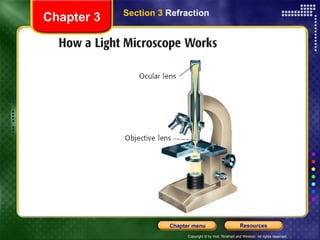
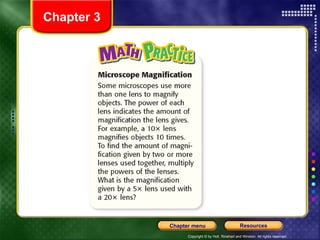
Optical Instruments and Refraction , continued A light microscope is similar to a refracting telescope, with lenses configured to magnify small, close objects. Chapter 3 Section 3  Refraction
Section 3  Refraction Chapter 3
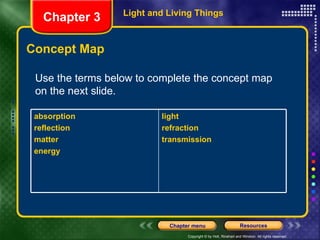
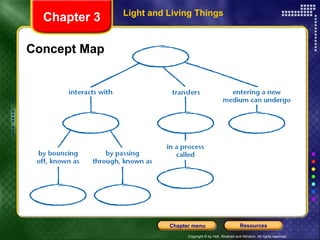
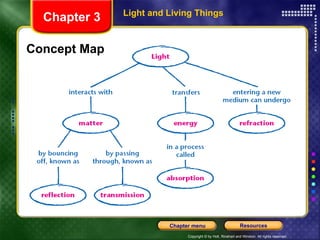
Concept Map Chapter 3 Light and Living Things Use the terms below to complete the concept map on the next slide. light refraction transmission absorption  reflection matter energy
Light and Living Things Chapter 3 Concept Map
End of Chapter 3 Show Light and Living Things  Chapter 3
1.  Which of the following words means “that can be seen,”? A. visible B. audible C. palpable D. sensible Chapter 3 Standards Assessment
2.  Which of the following sets of words best completes the following sentence: Light is ____ the eye. A. detects with B. detected for C. detected by D. detecting in Chapter 3 Standards Assessment
3.  Which of the following sets of words best completes the following sentence: Light can be ____ matter. A. transmitted with B. transmits  in C. transmits by D. transmitted through Chapter 3 Standards Assessment
4.  Which of the following words is closest in meaning to the word  react ? A. repeat B. renovate C. respond D. remove Chapter 3 Standards Assessment
4. Which of the following words is closest in meaning to the word  react ? A. repeat B. renovate C. respond D. remove Chapter 3 Standards Assessment
5.  Which of the following best describes the relationship between infrared waves, ultraviolet light, and visible light? A. Infrared waves are found on the electromagnetic  spectrum, while ultraviolet and visible light are not. B. Infrared waves have the longest wavelength,  followed by visible light and ultraviolet light. C. Infrared waves and visible light are visible to the  human eye, while ultraviolet light is not. D. Infrared waves consist of changing electric and  magnetic fields, while ultraviolet light and visible  light do not. Chapter 3 Standards Assessment
5. Which of the following best describes the relationship between infrared waves, ultraviolet light, and visible light? A. Infrared waves are found on the electromagnetic  spectrum, while ultraviolet and visible light are not. B. Infrared waves have the longest wavelength,  followed by visible light and ultraviolet light. C. Infrared waves and visible light are visible to the  human eye, while ultraviolet light is not. D. Infrared waves consist of changing electric and  magnetic fields, while ultraviolet light and visible  light do not. Chapter 3 Standards Assessment
6.  Your eyes detect a burning candle in a candleholder. Your eyes see the candle flame because it emits light. Why do your eyes see the opaque candleholder? A. It is luminous. B. It is illuminated. C. It absorbs light. D. It transmits light. Chapter 3 Standards Assessment
6. Your eyes detect a burning candle in a candleholder. Your eyes see the candle flame because it emits light. Why do your eyes see the opaque candleholder? A. It is luminous. B. It is illuminated. C. It absorbs light. D. It transmits light. Chapter 3 Standards Assessment
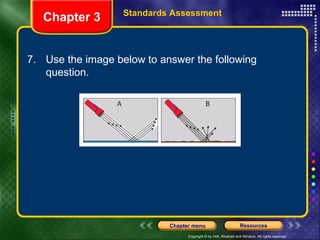
7. Use the image below to answer the following question. Chapter 3 Standards Assessment
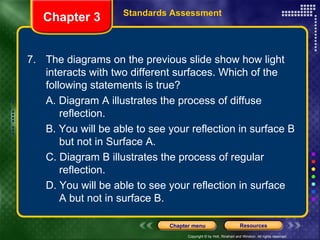
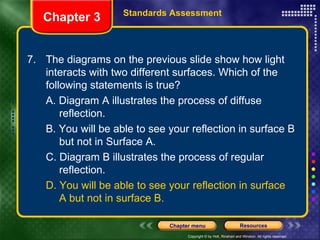
7.  The diagrams on the previous slide show how light interacts with two different surfaces. Which of the following statements is true? A. Diagram A illustrates the process of diffuse  reflection. B. You will be able to see your reflection in surface B  but not in Surface A. C. Diagram B illustrates the process of regular  reflection. D. You will be able to see your reflection in surface  A but not in surface B. Chapter 3 Standards Assessment
7. The diagrams on the previous slide show how light interacts with two different surfaces. Which of the following statements is true? A. Diagram A illustrates the process of diffuse  reflection. B. You will be able to see your reflection in surface B  but not in Surface A. C. Diagram B illustrates the process of regular  reflection. D. You will be able to see your reflection in surface  A but not in surface B. Chapter 3 Standards Assessment
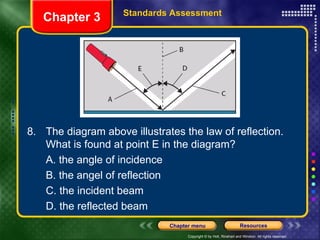
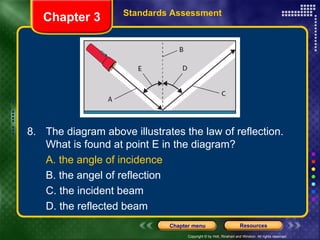
8. The diagram above illustrates the law of reflection. What is found at point E in the diagram? A. the angle of incidence B. the angel of reflection C. the incident beam D. the reflected beam Chapter 3 Standards Assessment
9. What happens to white light during refraction? A. It appears to be closer than it actually is. B. It absorbs the pigment of the medium it passes  through. C. It separates into different wavelengths or  colors. D. It is refracted at the same angle as the angle of  incidence. Chapter 3 Standards Assessment
10. What part of a camera is most like the retina in the human eye? A. the lens B. the film C. the shutter D. the aperture Chapter 3 Standards Assessment
11. What happens when white light shines through a translucent, red, glass window? A. All colors of light except red are transmitted  through the glass. B. Red light is transmitted through and reflected  by the glass. C. Red light is absorbed by the glass. D. All colors of light except red are reflected by  the glass. Chapter 3 Standards Assessment
12. While you are conducting an experiment, your lab partner burns himself on a candle flame. After such an accident, you should A. take your partner to the bathroom and wash  the burn with soap. B. perform first aid by rinsing the burned area  with warm water. C. tell your teacher, even if the burn seems like a  minor injury. D. continue with your lab and tell no one about  what has happened. Chapter 3 Standards Assessment
13. Corals and producers live in the neritic zones of an ocean. Whales and squid live in the oceanic zone. Bacteria and worms live in the benthic zone. Which of the following factors most determines the types of organisms that live at each level? A. the strength of underwater currents and daily  tides B. the amount of fresh water that falls as  precipitation C. the number of predators living in the oceanic  zone D. the depth to which sunlight can penetrate the  water Chapter 3 Standards Assessment
14. If sunlight could not reach Earth’s surface, which of the following would happen first? A. Producers would die. B. Consumers would die. C. Scavengers would die. D. Decomposers would die. Chapter 3 Standards Assessment
Chapter 3
Chapter 3 Section 1  The Electromagnetic  Spectrum
Chapter 3 Section 3  Refraction

Light

  • 1.
    To View thepresentation as a slideshow with effects select “View” on the menu bar and click on “Slide Show.” To advance through the presentation, click the right-arrow key or the space bar . From the resources slide, click on any resource to see a presentation for that resource. From the Chapter menu screen click on any lesson to go directly to that lesson’s presentation. You may exit the slide show at any time by pressing the Esc key . How to Use This Presentation
  • 2.
    Resources Chapter PresentationImage Bank Math Focus Bellringers Standards Assessment Visual Concepts
  • 3.
    Table of ContentsSection 1 The Electromagnetic Spectrum Section 2 Interactions of Light with Matter Section 3 Refraction Chapter 3 Light and Living Things
  • 4.
    Bellringer Describe theweather conditions necessary to produce a rainbow. Why do you think rainbows form? Write your responses in your science journal. Section 1 The Electromagnetic Spectrum Chapter 3
  • 5.
    What You WillLearn Light is an electromagnetic wave Visible light is a small part of a very broad electromagnetic spectrum. White light is a mixture of many wavelengths of visible light. Infrared waves and ultraviolet light affect living things. Chapter 3 Section 1 The Electromagnetic Spectrum
  • 6.
    Visible light, infraredwaves, and ultraviolet light are small parts of a large electromagnetic spectrum. An electromagnetic wave (EM wave) is a wave that consists of changing electric and magnetic fields. Light is an electromagnetic wave. Chapter 3 Section 1 The Electromagnetic Spectrum 6a: Visible light is a small band in the broad electromagnetic spectrum.
  • 7.
    Light: An ElectromagneticWave , continued EM waves can travel through matter, like sound waves or water waves. Chapter 3 Section 1 The Electromagnetic Spectrum
  • 8.
    Electromagnetic Waves Lightand Living Things Chapter 3
  • 9.
    A Spectrum ofWaves The entire range of electromagnetic waves is called the electromagnetic spectrum. Visible light, ultraviolet light, and infrared waves are portions of the EM spectrum that are important to living things. Other EM waves in the EM spectrum include radio waves and X-rays. Chapter 3 Section 1 The Electromagnetic Spectrum
  • 10.
    Section 1 The Electromagnetic Spectrum Chapter 3
  • 11.
    A Spectrum ofWaves , continued The different types of EM waves are distinguished by their wavelengths. A wavelength is the distance from any point on a wave to an identical point on the next wave. Chapter 3 Section 1 The Electromagnetic Spectrum
  • 12.
    Infrared Waves Warmerobjects give off more infrared waves than cooler objects do . Infrared waves from the sun keep the temperatures on Earth suitable for life. It’s the heat you feel from the sun. Slower wavelengths than visible light. Chapter 3 Section 1 The Electromagnetic Spectrum
  • 13.
    Visible Light Visiblelight is the very narrow range of wavelengths in the EM spectrum that humans can see. Chapter 3 Section 1 The Electromagnetic Spectrum
  • 14.
    Visible light fromthe sun is white light. White light is the combination of all of the visible wavelengths of light. Cells in the human eye react to different wavelengths. This difference is perceived as the different colors. The longest wavelengths are seen as red light. The shortest wavelengths are seen as violet light. Visible Light , continued Chapter 3 Section 1 The Electromagnetic Spectrum
  • 15.
    Visible Light ,continued The range of colors is called the visible spectrum, and can be remembered with the name ROY G. BiV (red, orange, yellow, green, blue, indigo, violet). Chapter 3 Section 1 The Electromagnetic Spectrum
  • 16.
    Ultraviolet Light Ultravioletlight has shorter wavelengths than visible light. Ultraviolet light affects your body in both bad and good ways. Ultraviolet light can cause sunburn, skin cancer, wrinkles, and damage to the eyes. Chapter 3 Section 1 The Electromagnetic Spectrum
  • 17.
    Ultraviolet Light ,continued On the good side, skin cells produce vitamin D when exposed to ultraviolet light. Vitamin D helps the intestines absorb calcium. Special ultraviolet lamps are used to kill bacteria on food and surgical tools. Chapter 3 Section 1 The Electromagnetic Spectrum
  • 18.
    Bellringer How domirrors work? What do mirrors do to light waves? Write your answers in your science journal. Section 2 Interactions of Light with Matter Chapter 3
  • 19.
    What You WillLearn Light travels in straight lines if the material that the light travels through does not change. The angle of reflection of a light beam is equal to the angle of incidence. An object can be seen if light emitted by or reflected by it is detected by the eye. Light can be reflected, absorbed, scattered, or transmitted by matter. Chapter 3 Section 2 Interactions of Light with Matter
  • 20.
    Reflection Light interactswith matter during reflection, absorption, scattering, and transmission. Light travels in a straight line unless the material it is traveling through changes. One way to change the direction of light is by reflection. Reflection is the bouncing back of light rays when they hit an object. Chapter 3 Section 2 Interactions of Light with Matter
  • 21.
    The lawof reflection states that the angle of incidence is equal to the angle of reflection. This means light will bounce off an object at the same angle it strikes the object. Reflection , continued Chapter 3 Section 2 Interactions of Light with Matter
  • 22.
    Light bouncing offa mirror is an an example of regular reflection. When light strikes a rougher surface, such as a wall, the light is bounced in many directions. This type of reflection is called diffuse reflection. You can see your image in the regular reflection of a mirror but not in the diffuse reflection of a wall. Reflection , continued Chapter 3 Section 2 Interactions of Light with Matter
  • 23.
    Section 2 Interactions of Light with Matter Chapter 3
  • 24.
    Section 2 Interactions of Light with Matter Chapter 3
  • 25.
    Light and MatterLight interacts with all matter in one or more of the following ways: reflection, absorption, and transmission. Reflections allows you to see objects. Absorption can cause objects to feel warmer as energy is transferred from the light. Transmission is the passing of light through matter. Chapter 3 Section 2 Interactions of Light with Matter
  • 26.
    Light and Matter, continued Light is transmitted easily through transparent matter. Air, glass, and water that are pure are transparent. Light is transmitted through but also scattered by translucent matter. Frosted glass and wax paper are translucent. Matter that does not transmit any light is opaque . You cannot see through opaque matter. Chapter 3 Section 2 Interactions of Light with Matter
  • 27.
    Opaque, Translucent, TransparentLight and Living Things Click below to watch the Visual Concept. You may stop the video at any time by pressing the Esc key. Visual Concept Chapter 3
  • 28.
    Colors and ObjectsWhen white light strikes a colored opaque object, some wavelengths (colors) are absorbed, and some are reflected. You see only the colors (wavelengths) that are reflected. A berry looks red because it reflects red light and absorbs the other colors of light. Black objects absorb all colors of light, and white objects reflect all colors of light. Chapter 3 Section 2 Interactions of Light with Matter
  • 29.
  • 30.
    Pigments and ColorA pigment is a material that gives a substance its color by absorbing some colors of light and reflecting others. Chapter 3 Section 2 Interactions of Light with Matter
  • 31.
    How we seecolor…
  • 32.
    Bellringer Can lightbend? What happens when light passes through water? Write your responses in your science journal. Section 3 Refraction Chapter 3
  • 33.
    What You WillLearn Light is refracted when the medium it travels in changes. Convex and concave lenses refract light to form images. Human eyes, magnifying glasses, cameras, telescopes, and microscopes have lenses that form images. Chapter 3 Section 3 Refraction
  • 34.
    Refraction and MediaLight can be bent, or refracted, by matter. Lenses refract light to form images. Refraction is the bending of a wave as it passes at an angle from one medium to another. A medium (plural, media ) is a substance through which a wave can travel. Air, water, and glass are three media. Chapter 3 Section 3 Refraction
  • 35.
    Light can alsobe refracted when the density of a medium changes. For example, the density of air above a hot road is less than the surrounding air. This makes objects seem to shimmer or wobble due to refraction. Refraction can cause optical illusions, because our brains assume the light is traveling in a straight line. Refraction and Media , continued Chapter 3 Section 3 Refraction
  • 36.
    Refraction and Media, continued Chapter 3 Section 3 Refraction
  • 37.
    Refraction and Media, continued When white light is refracted, the shorter wave lengths bend more than the longer wavelengths. Rainbows occur when sunlight is refracted by raindrops. Chapter 3 Section 3 Refraction
  • 38.
    Lenses and Refractionof Light A lens is a transparent object that forms an image by refracting light. A lens that is thicker in the middle than at the edges is a convex lens . Convex lenses refract light rays toward each other. The point at which the light rays cross is called the focal point . Chapter 3 Section 3 Refraction
  • 39.
    The lens ofthe human eye is a convex lens. It focuses light on the retina at the back of the eye. A magnifying glass is also a convex lens. Depending on how close a convex lens is to an object, it can form an image that is larger or smaller than the object. Lenses and Refraction of Light , continued Chapter 3 Section 3 Refraction
  • 40.
    Lenses and Refractionof Light , continued Like humans, many animal eyes also contain convex lenses. Concave lenses are thinner in the middle than at the edges. They only form virtual images, which are always smaller than the object. Concave lenses cause light rays to refract away from each other. Chapter 3 Section 3 Refraction
  • 41.
    Comparing Real andVirtual Images Light and Living Things Click below to watch the Visual Concept. You may stop the video at any time by pressing the Esc key. Visual Concept Chapter 3
  • 42.
    Optical Instruments andRefraction Optical instruments can help you make observations of objects that are very small or very far away. Many contain both concave and convex lenses. The way a camera works is similar to the way your eye works. Light enters the lens and is focused at the back of the camera. Chapter 3 Section 3 Refraction
  • 43.
    Section 3 Refraction Chapter 3
  • 44.
    Section 3 Refraction Chapter 3
  • 45.
    Telescopes are usedto see images of large, distant objects. A telescope that uses lenses to focus light is called a refracting telescope . A simple refracting telescope has two convex lenses. The objective lens is pointed at the object, and an eyepiece lens, or ocular, magnifies the image. Optical Instruments and Refraction , continued Chapter 3 Section 3 Refraction
  • 46.
    Optical Instruments andRefraction , continued A light microscope is similar to a refracting telescope, with lenses configured to magnify small, close objects. Chapter 3 Section 3 Refraction
  • 47.
    Section 3 Refraction Chapter 3
  • 48.
    Section 3 Refraction Chapter 3
  • 49.
    Concept Map Chapter3 Light and Living Things Use the terms below to complete the concept map on the next slide. light refraction transmission absorption reflection matter energy
  • 50.
    Light and LivingThings Chapter 3 Concept Map
  • 51.
    Light and LivingThings Chapter 3 Concept Map
  • 52.
    End of Chapter3 Show Light and Living Things Chapter 3
  • 53.
    1. Whichof the following words means “that can be seen,”? A. visible B. audible C. palpable D. sensible Chapter 3 Standards Assessment
  • 54.
    1. Whichof the following words means “that can be seen,”? A. visible B. audible C. palpable D. sensible Chapter 3 Standards Assessment
  • 55.
    2. Whichof the following sets of words best completes the following sentence: Light is ____ the eye. A. detects with B. detected for C. detected by D. detecting in Chapter 3 Standards Assessment
  • 56.
    2. Whichof the following sets of words best completes the following sentence: Light is ____ the eye. A. detects with B. detected for C. detected by D. detecting in Chapter 3 Standards Assessment
  • 57.
    3. Whichof the following sets of words best completes the following sentence: Light can be ____ matter. A. transmitted with B. transmits in C. transmits by D. transmitted through Chapter 3 Standards Assessment
  • 58.
    3. Whichof the following sets of words best completes the following sentence: Light can be ____ matter. A. transmitted with B. transmits in C. transmits by D. transmitted through Chapter 3 Standards Assessment
  • 59.
    4. Whichof the following words is closest in meaning to the word react ? A. repeat B. renovate C. respond D. remove Chapter 3 Standards Assessment
  • 60.
    4. Which ofthe following words is closest in meaning to the word react ? A. repeat B. renovate C. respond D. remove Chapter 3 Standards Assessment
  • 61.
    5. Whichof the following best describes the relationship between infrared waves, ultraviolet light, and visible light? A. Infrared waves are found on the electromagnetic spectrum, while ultraviolet and visible light are not. B. Infrared waves have the longest wavelength, followed by visible light and ultraviolet light. C. Infrared waves and visible light are visible to the human eye, while ultraviolet light is not. D. Infrared waves consist of changing electric and magnetic fields, while ultraviolet light and visible light do not. Chapter 3 Standards Assessment
  • 62.
    5. Which ofthe following best describes the relationship between infrared waves, ultraviolet light, and visible light? A. Infrared waves are found on the electromagnetic spectrum, while ultraviolet and visible light are not. B. Infrared waves have the longest wavelength, followed by visible light and ultraviolet light. C. Infrared waves and visible light are visible to the human eye, while ultraviolet light is not. D. Infrared waves consist of changing electric and magnetic fields, while ultraviolet light and visible light do not. Chapter 3 Standards Assessment
  • 63.
    6. Youreyes detect a burning candle in a candleholder. Your eyes see the candle flame because it emits light. Why do your eyes see the opaque candleholder? A. It is luminous. B. It is illuminated. C. It absorbs light. D. It transmits light. Chapter 3 Standards Assessment
  • 64.
    6. Your eyesdetect a burning candle in a candleholder. Your eyes see the candle flame because it emits light. Why do your eyes see the opaque candleholder? A. It is luminous. B. It is illuminated. C. It absorbs light. D. It transmits light. Chapter 3 Standards Assessment
  • 65.
    7. Use theimage below to answer the following question. Chapter 3 Standards Assessment
  • 66.
    7. Thediagrams on the previous slide show how light interacts with two different surfaces. Which of the following statements is true? A. Diagram A illustrates the process of diffuse reflection. B. You will be able to see your reflection in surface B but not in Surface A. C. Diagram B illustrates the process of regular reflection. D. You will be able to see your reflection in surface A but not in surface B. Chapter 3 Standards Assessment
  • 67.
    7. The diagramson the previous slide show how light interacts with two different surfaces. Which of the following statements is true? A. Diagram A illustrates the process of diffuse reflection. B. You will be able to see your reflection in surface B but not in Surface A. C. Diagram B illustrates the process of regular reflection. D. You will be able to see your reflection in surface A but not in surface B. Chapter 3 Standards Assessment
  • 68.
    8. The diagramabove illustrates the law of reflection. What is found at point E in the diagram? A. the angle of incidence B. the angel of reflection C. the incident beam D. the reflected beam Chapter 3 Standards Assessment
  • 69.
    8. The diagramabove illustrates the law of reflection. What is found at point E in the diagram? A. the angle of incidence B. the angel of reflection C. the incident beam D. the reflected beam Chapter 3 Standards Assessment
  • 70.
    9. What happensto white light during refraction? A. It appears to be closer than it actually is. B. It absorbs the pigment of the medium it passes through. C. It separates into different wavelengths or colors. D. It is refracted at the same angle as the angle of incidence. Chapter 3 Standards Assessment
  • 71.
    9. What happensto white light during refraction? A. It appears to be closer than it actually is. B. It absorbs the pigment of the medium it passes through. C. It separates into different wavelengths or colors. D. It is refracted at the same angle as the angle of incidence. Chapter 3 Standards Assessment
  • 72.
    10. What partof a camera is most like the retina in the human eye? A. the lens B. the film C. the shutter D. the aperture Chapter 3 Standards Assessment
  • 73.
    10. What partof a camera is most like the retina in the human eye? A. the lens B. the film C. the shutter D. the aperture Chapter 3 Standards Assessment
  • 74.
    11. What happenswhen white light shines through a translucent, red, glass window? A. All colors of light except red are transmitted through the glass. B. Red light is transmitted through and reflected by the glass. C. Red light is absorbed by the glass. D. All colors of light except red are reflected by the glass. Chapter 3 Standards Assessment
  • 75.
    11. What happenswhen white light shines through a translucent, red, glass window? A. All colors of light except red are transmitted through the glass. B. Red light is transmitted through and reflected by the glass. C. Red light is absorbed by the glass. D. All colors of light except red are reflected by the glass. Chapter 3 Standards Assessment
  • 76.
    12. While youare conducting an experiment, your lab partner burns himself on a candle flame. After such an accident, you should A. take your partner to the bathroom and wash the burn with soap. B. perform first aid by rinsing the burned area with warm water. C. tell your teacher, even if the burn seems like a minor injury. D. continue with your lab and tell no one about what has happened. Chapter 3 Standards Assessment
  • 77.
    12. While youare conducting an experiment, your lab partner burns himself on a candle flame. After such an accident, you should A. take your partner to the bathroom and wash the burn with soap. B. perform first aid by rinsing the burned area with warm water. C. tell your teacher, even if the burn seems like a minor injury. D. continue with your lab and tell no one about what has happened. Chapter 3 Standards Assessment
  • 78.
    13. Corals andproducers live in the neritic zones of an ocean. Whales and squid live in the oceanic zone. Bacteria and worms live in the benthic zone. Which of the following factors most determines the types of organisms that live at each level? A. the strength of underwater currents and daily tides B. the amount of fresh water that falls as precipitation C. the number of predators living in the oceanic zone D. the depth to which sunlight can penetrate the water Chapter 3 Standards Assessment
  • 79.
    13. Corals andproducers live in the neritic zones of an ocean. Whales and squid live in the oceanic zone. Bacteria and worms live in the benthic zone. Which of the following factors most determines the types of organisms that live at each level? A. the strength of underwater currents and daily tides B. the amount of fresh water that falls as precipitation C. the number of predators living in the oceanic zone D. the depth to which sunlight can penetrate the water Chapter 3 Standards Assessment
  • 80.
    14. If sunlightcould not reach Earth’s surface, which of the following would happen first? A. Producers would die. B. Consumers would die. C. Scavengers would die. D. Decomposers would die. Chapter 3 Standards Assessment
  • 81.
    14. If sunlightcould not reach Earth’s surface, which of the following would happen first? A. Producers would die. B. Consumers would die. C. Scavengers would die. D. Decomposers would die. Chapter 3 Standards Assessment
  • 82.
  • 83.
    Chapter 3 Section1 The Electromagnetic Spectrum
  • 84.
    Chapter 3 Section1 The Electromagnetic Spectrum
  • 85.
    Chapter 3 Section3 Refraction
  • 86.
    Chapter 3 Section3 Refraction