Physics Lesson Note
For Grade 10
“YourKidsOurKids!” “ልጆችዎ ልጆቻችን ናቸው”
(+251(0)116-607203+251(0)911-469878*3628www.Safari-academy.comAddisAbaba,Ethiopia
Electromagnetic Waves and
Geometrical Optics
- Electromagnetic waves are a form of energy that
propagates through space produced by the interaction
of electric and magnetic fields.
- Light is one form of electromagnetic wave
that helps us to see things around us.
- The study of light and how it interacts with
materials is called optics.
- When dealing with light rays and the shape
of materials and the angles at which light
rays form with the materials is referred to
as geometrical optics.
- By the end of this unit, you should be able to:
 describe the propagation of EM waves.
 state sources of EM waves.
- Waves transfer energy from one place to another
without transferring matter. The energy is passed
along from particle to particle as they collide with
their neighbors.
 Depending on propagation(the way how waves
travel), waves are categorized into mechanical
waves and electromagnetic (EM) waves.
a. Mechanical waves are the types of waves that
- use matter(solid, liquid or gas) to move or transfer
energy.
- can’t travel in empty space (vacuum).
Examples: sound wave, water wave, seismic wave,
wave on strings.
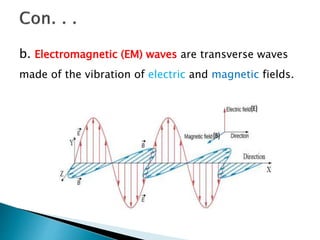
b. Electromagnetic (EM) waves are transverse waves
made of the vibration of electric and magnetic fields.
Examples: Radio wave, Micro wave, infrared wave,
visible light , ultraviolet ray, X-ray, Gamma ray etc.
- EM waves are waves that can travel through
materials (solids, liquids and gases) and vacuum.
- All EM waves are transverse waves, i.e the
direction of oscillation is perpendicular to the
direction of propagation of waves.
- (For longitudinal waves, the direction of oscillation is
parallel to the direction of propagation of the waves).
All EM waves have their own frequency and
wavelength.
- Frequency(f) is he number of times the electric and
magnetic parts vibrate each second.
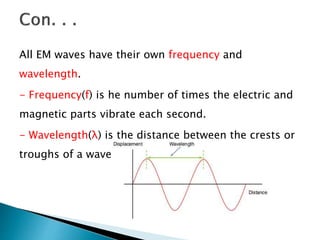
- Wavelength(λ) is the distance between the crests or
troughs of a wave.
- The Sun emits EM waves that travel through space and reach
the earth. The energy carried by EM waves is called radiant
energy.
- Almost 92 % of the radiant energy that reaches the Earth from
the Sun is carried by infrared and visible light waves.
- A small amount of the radiant energy that reaches Earth is
carried by ultraviolet waves.
Exercise
1. Do EM waves need a medium to travel through?
2. Describe the properties of EM waves.
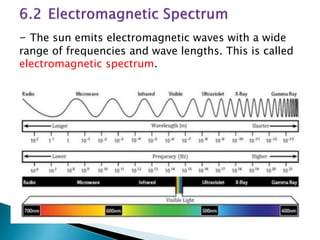
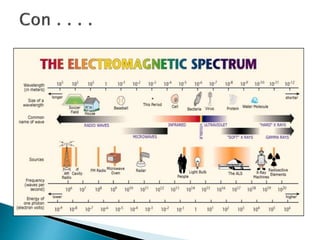
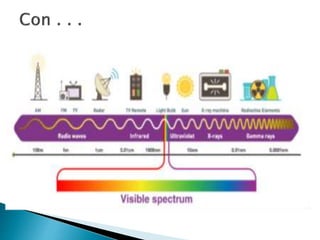
- The sun emits electromagnetic waves with a wide
range of frequencies and wave lengths. This is called
electromagnetic spectrum.
- All the electromagnetic waves differ from each
other by their own frequency, wavelength and
energy.
- Waves with low frequency and long wavelength have
low energy.
- Waves with high frequency and short wavelength
have high energy.
- The following are examples of EM waves.
Radio wave, Micro wave, infrared wave, visible light ,
ultraviolet ray, X-ray, Gamma ray.
1. Radio waves
- have the lowest frequency and longest wavelengths in
the electromagnetic spectrum.
- used mainly for communications purpose like radio
and television broadcasting.
- wireless communication technologies like Wi-Fi and
Bluetooth.
→ Large amount of radio waves are believed to cause
cancer, leukemia and other disorders.
2. Microwaves
- have higher frequencies and shorter wavelengths than
radio waves.
- are used to cook food using microwave ovens.
 In telecommunications (cell phones), and radar systems.
- are also used by traffic speed cameras and for
radar which is used by aircraft, ships and weather
forecasters.
3. Infrared waves
- Infrared waves have wavelengths longer than those of visible
light but shorter than microwaves.
- are given off by hot objects like stars, lamps,
flames.
- are used in remote controls for TVs and video
recorders.
- are used in infrared cameras.
4. Visible Light
- It is the portion of the electromagnetic spectrum
that is visible to the human eye.
- Our eyes can detect only a tiny part of the EM
spectrum, called visible light from a wavelength range
of about 700-400nm.
- Our eyes are sensitive to this range of wavelengths.
- Helps us to see things around us.
.
5. Ultraviolet rays
- are produced by special lamps and very hot bodies.
- are absorbed in ozone layer.
- can be used to kill microbes. Hospitals use UV
lamps to sterilize surgical equipment.
- food and drug companies also use UV lamps to
sterilize their products.
→ are the waves that can cause sunburn if you are
exposed to sunlight for too long time.
6. X-rays
- X-rays have even shorter wavelengths and higher
frequencies than UV radiation.
- have high-energy photons and can penetrate
through soft tissues in the human body.
- used by doctors, X-ray radiography to see the
internal body to see bone fractures.
- are also used in airport security checks.
- are given off by stars.
→ X-rays can cause cell damage and cancers. This is
why Radiographers in hospitals stand behind a shield
when they X-ray their patients.
7. Gamma rays
- Gamma rays have the highest frequencies and
shortest wavelengths in the electromagnetic
spectrum.
- carry a large amount of energy.
- are given off by stars and by some radioactive
substances.
- pass through most materials and are quite difficult
to stop. You need lead or concrete in order to
block them out.
- are used to sterilize foods.
Exercise
1. Mention some sources of EM waves.
2. Arrange the following types of EM radiation:
infrared, X-rays, ultraviolet, visible, gamma based on
a. increasing frequency,
b. increasing wave length and
c. Increasing energy
3. Discuss on the use of each type of EM spectrum.
4. Describe the disadvantages of each type of EM
spectrum.
- Light is a form of EM wave and can travels
through vacuum with the speed of C ≈ 3 × 10⁸
m/s.
- When light travels through matter(air, liquids and
solids) , it interacts with the atoms and molecules
in the material and slows down.
- The speed(v) , frequency(f) and wave length(λ) of
light are related as follows:
C = f λ
- As the frequency of an EM wave increases, its
wavelength decreases.
Examples
1. Find the frequency of red light, with a wavelength
of 700nm.
2. An FM radio station in Addis broadcasts
electromagnetic radiation frequency of 120MHz.
Calculate the wavelength of this radiation.
3. Calculate the frequency of an EM wave with a
wavelength of 400 nm.
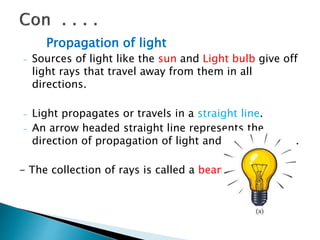
Propagation of light
- Sources of light like the sun and Light bulb give off
light rays that travel away from them in all
directions.
- Light propagates or travels in a straight line.
- An arrow headed straight line represents the
direction of propagation of light and is called a ray.
- The collection of rays is called a beam.
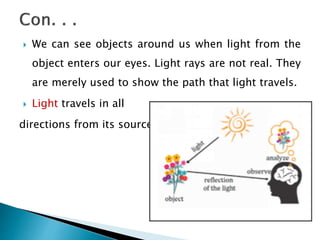
 We can see objects around us when light from the
object enters our eyes. Light rays are not real. They
are merely used to show the path that light travels.
 Light travels in all
directions from its source.
Exercises
1.Give evidence to support the statement: "Light
travels in straight lines".
2. Explain how an EM wave propagates.
3. Do EM waves need a medium to travel through?
4. What is the speed of light in vacuum? Does the
speed of light change as it enters to matter?
Reflection of light
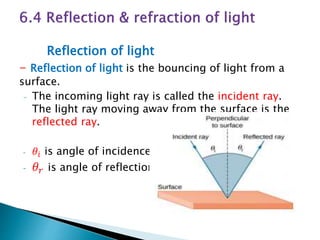
- Reflection of light is the bouncing of light from a
surface.
- The incoming light ray is called the incident ray.
The light ray moving away from the surface is the
reflected ray.
- 𝜃𝑖 is angle of incidence
- 𝜃𝑟 is angle of reflection
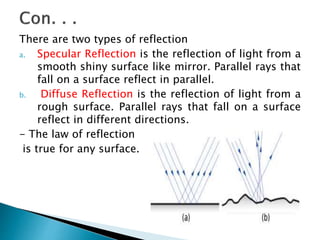
There are two types of reflection
a. Specular Reflection is the reflection of light from a
smooth shiny surface like mirror. Parallel rays that
fall on a surface reflect in parallel.
b. Diffuse Reflection is the reflection of light from a
rough surface. Parallel rays that fall on a surface
reflect in different directions.
- The law of reflection
is true for any surface.
- The following are the law of reflection,
i. θi = θr
ii. The incident ray, the normal line and the reflected
ray lie in the same plane.
Refraction of light
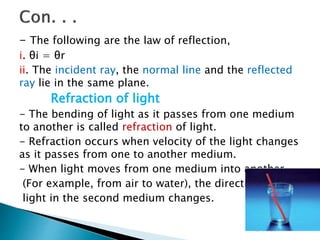
- The bending of light as it passes from one medium
to another is called refraction of light.
- Refraction occurs when velocity of the light changes
as it passes from one to another medium.
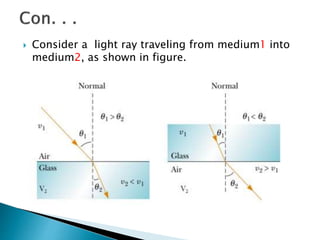
- When light moves from one medium into another
(For example, from air to water), the direction of
light in the second medium changes.
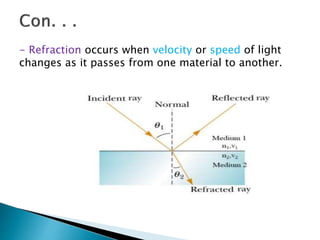
- Refraction occurs when velocity or speed of light
changes as it passes from one material to another.
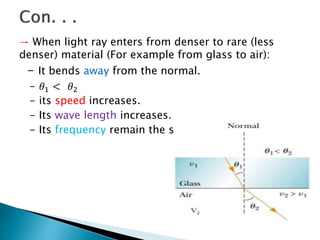
→ When light ray enters from denser to rare (less
denser) material (For example from glass to air):
- It bends away from the normal.
- 𝜃1 < 𝜃2
- its speed increases.
- Its wave length increases.
- Its frequency remain the same.
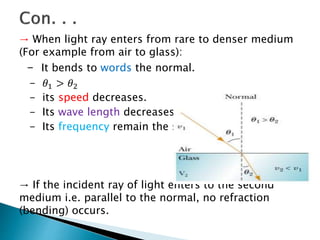
→ When light ray enters from rare to denser medium
(For example from air to glass):
- It bends to words the normal.
- 𝜃1 > 𝜃2
- its speed decreases.
- Its wave length decreases.
- Its frequency remain the same.
→ If the incident ray of light enters to the second
medium i.e. parallel to the normal, no refraction
(bending) occurs.
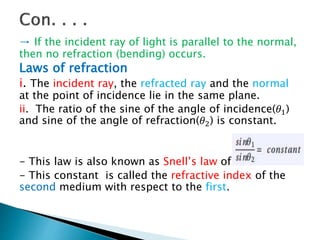
→ If the incident ray of light is parallel to the normal,
then no refraction (bending) occurs.
Laws of refraction
i. The incident ray, the refracted ray and the normal
at the point of incidence lie in the same plane.
ii. The ratio of the sine of the angle of incidence(𝜃1)
and sine of the angle of refraction(𝜃2) is constant.
- This law is also known as Snell’s law of refraction.
- This constant is called the refractive index of the
second medium with respect to the first.
The refractive index of a material is the
measure of how difficult it is for light to
passes through a material.
The speed of light and the degree of bending
of the light depends on the refractive index of
material through which the light passes.
 Consider a light ray traveling from medium1 into
medium2, as shown in figure.
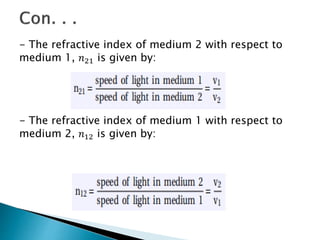
- The refractive index of medium 2 with respect to
medium 1, 𝑛21 is given by:
- The refractive index of medium 1 with respect to
medium 2, 𝑛12 is given by:
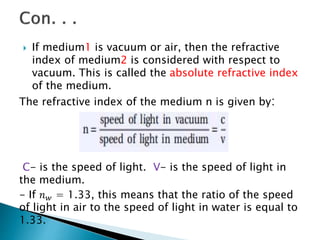
 If medium1 is vacuum or air, then the refractive
index of medium2 is considered with respect to
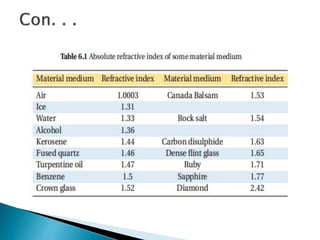
vacuum. This is called the absolute refractive index
of the medium.
The refractive index of the medium n is given by:
C- is the speed of light. V- is the speed of light in
the medium.
- If 𝑛𝑤 = 1.33, this means that the ratio of the speed
of light in air to the speed of light in water is equal to
1.33.
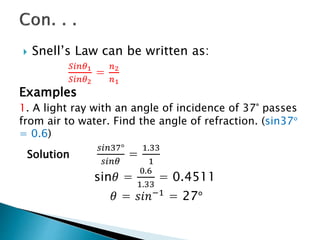
 Snell’s Law can be written as:
𝑆𝑖𝑛𝜃1
𝑆𝑖𝑛𝜃2
=
𝑛2
𝑛1
Examples
1. A light ray with an angle of incidence of 37° passes
from air to water. Find the angle of refraction. (sin37°
= 0.6)
Solution
𝑠𝑖𝑛37°
𝑠𝑖𝑛𝜃
=
1.33
1
sin𝜃 =
0.6
1.33
= 0.4511
𝜃 = 𝑠𝑖𝑛−1 = 27°
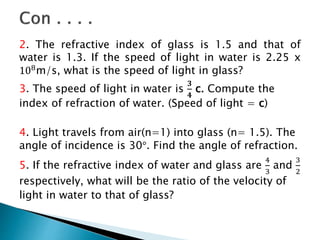
2. The refractive index of glass is 1.5 and that of
water is 1.3. If the speed of light in water is 2.25 x
108m/s, what is the speed of light in glass?
3. The speed of light in water is
𝟑
𝟒
c. Compute the
index of refraction of water. (Speed of light = c)
4. Light travels from air(n=1) into glass (n= 1.5). The
angle of incidence is 30°. Find the angle of refraction.
5. If the refractive index of water and glass are
4
3
and
3
2
respectively, what will be the ratio of the velocity of
light in water to that of glass?
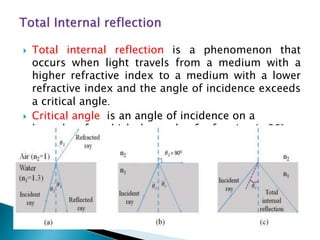
 Total internal reflection is a phenomenon that
occurs when light travels from a medium with a
higher refractive index to a medium with a lower
refractive index and the angle of incidence exceeds
a critical angle.
 Critical angle is an angle of incidence on a
boundary for which the angle of refraction is 90°.
 When the angle of incidence exceeds the critical
angle, there is no refracted light; the incident light
is reflected back into the medium. This
phenomenon is called total internal reflection.
→ For total internal reflection to occur, the following
two conditions must be satisfied.
i. Light must travel from an optically denser medium
to an optically rarer medium.
ii. The angle of incidence in the denser medium must
be greater than the critical angle.
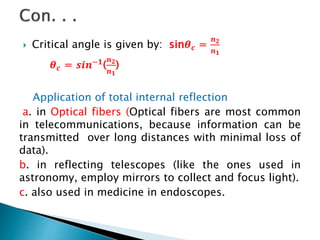
 Critical angle is given by: sin𝜽𝒄 =
𝒏𝟐
𝒏𝟏
𝜽𝒄 = 𝒔𝒊𝒏−𝟏
(
𝒏𝟐
𝒏𝟏
)
Application of total internal reflection
a. in Optical fibers (Optical fibers are most common
in telecommunications, because information can be
transmitted over long distances with minimal loss of
data).
b. in reflecting telescopes (like the ones used in
astronomy, employ mirrors to collect and focus light).
c. also used in medicine in endoscopes.
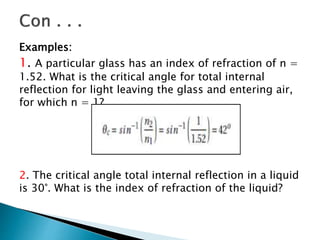
Examples:
1. A particular glass has an index of refraction of n =
1.52. What is the critical angle for total internal
reflection for light leaving the glass and entering air,
for which n = 1?
2. The critical angle total internal reflection in a liquid
is 30°. What is the index of refraction of the liquid?
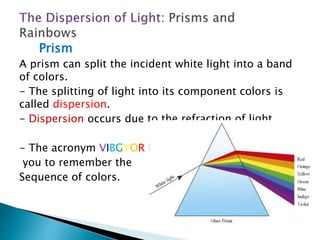
Prism
A prism can split the incident white light into a band
of colors.
- The splitting of light into its component colors is
called dispersion.
- Dispersion occurs due to the refraction of light.
- The acronym VIBGYOR helps
you to remember the
Sequence of colors.
 The band of the colored components of a light
beam is called its spectrum.
 The red light refracts the least while the violet
refracts the most.
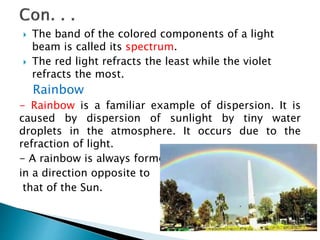
Rainbow
- Rainbow is a familiar example of dispersion. It is
caused by dispersion of sunlight by tiny water
droplets in the atmosphere. It occurs due to the
refraction of light.
- A rainbow is always formed
in a direction opposite to
that of the Sun.
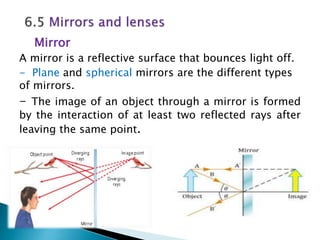
Mirror
A mirror is a reflective surface that bounces light off.
- Plane and spherical mirrors are the different types
of mirrors.
- The image of an object through a mirror is formed
by the interaction of at least two reflected rays after
leaving the same point.
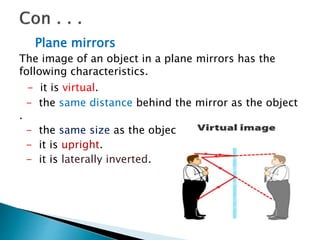
Plane mirrors
The image of an object in a plane mirrors has the
following characteristics.
- it is virtual.
- the same distance behind the mirror as the object
.
- the same size as the object.
- it is upright.
- it is laterally inverted.
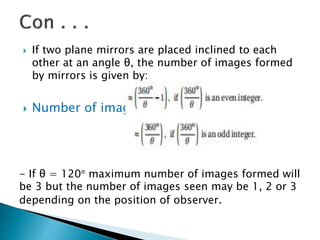
 If two plane mirrors are placed inclined to each
other at an angle θ, the number of images formed
by mirrors is given by:
 Number of images
- If θ = 120° maximum number of images formed will
be 3 but the number of images seen may be 1, 2 or 3
depending on the position of observer.
Uses of plane mirrors:
- in looking glasses.
- in construction of kaleidoscope, telescope and
periscope etc.
- as deflector of light etc.
Spherical Mirrors
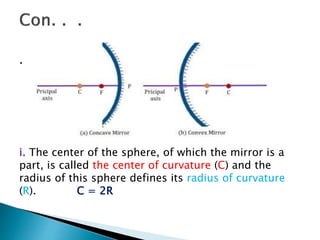
Concave and convex are spherical mirrors.
a. Concave mirror has a surface that is curved inward
causes light rays to converge.
b. Convex mirror has a surface that curves outward
which cause light rays to diverge.
.
i. The center of the sphere, of which the mirror is a
part, is called the center of curvature (C) and the
radius of this sphere defines its radius of curvature
(R). C = 2R
ii. The middle point of a mirror is called its pole(P).
iii. The circular outline (or periphery) of the mirror is
called its aperture. Aperture is a measure of the size
of the mirror.
iv. Principal focus (F) is the point at which all light
rays converges or diverge.
v. The distance between the pole and the principal
focus is focal length (f).
● Concave mirrors are used
- in torches.
- in vehicles headlights to get powerful parallel
beams of light.
- as shaving mirrors to see a larger image of the
face.
- For dentists to see large images of the teeth of
patients.
- Large concave mirrors are used to concentrate
sunlight to produce heat in solar furnaces.
● Convex mirrors are used
- in supermarkets to see round the corners.
- commonly as rear-view (wing) mirrors in vehicles
enabling the driver to see traffic behind him/her to
.
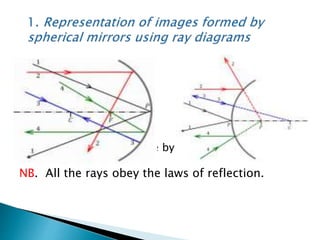
- Rays used to form image by concave and concave
mirrors.
NB. All the rays obey the laws of reflection.
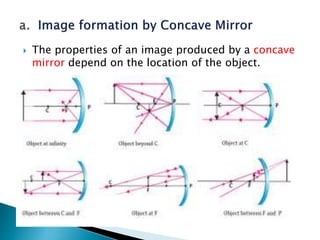
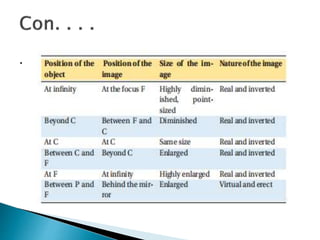
 The properties of an image produced by a concave
mirror depend on the location of the object.
.
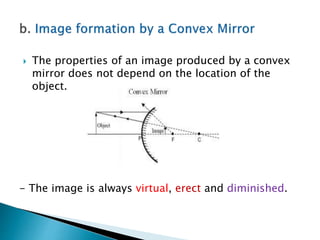
 The properties of an image produced by a convex
mirror does not depend on the location of the
object.
- The image is always virtual, erect and diminished.
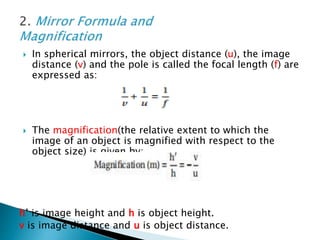
 In spherical mirrors, the object distance (u), the image
distance (v) and the pole is called the focal length (f) are
expressed as:
 The magnification(the relative extent to which the
image of an object is magnified with respect to the
object size) is given by:
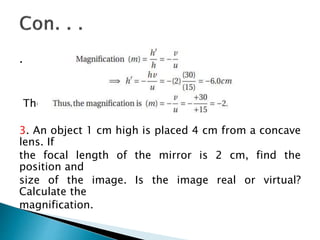
h’ is image height and h is object height.
v is image distance and u is object distance.
.
Examples
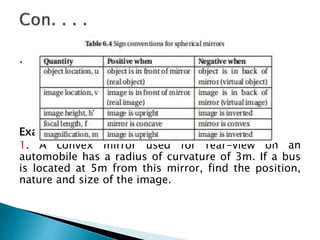
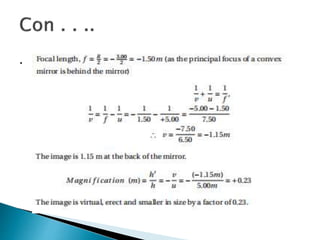
1. A convex mirror used for rear-view on an
automobile has a radius of curvature of 3m. If a bus
is located at 5m from this mirror, find the position,
nature and size of the image.
.
2. An object, 6.0 cm in size, is placed at 30 cm in
front of a concave mirror of focal length 15cm. At
what distance from the mirror should a screen be
placed in order to obtain a sharp image? Find the
nature and the size of the image.
3. A 4cm light bulb is placed a distance of 40cm from
a concave mirror having a focal length of 20cm. Find
the image distance and the image size.
4. A concave mirror has a focal length of 5cm. What is
the position of the image if the image is inverted and
four times smaller than the object?
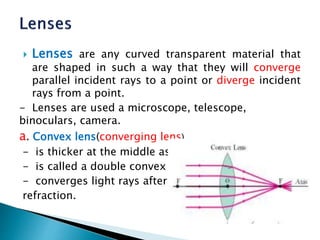
 Lenses are any curved transparent material that
are shaped in such a way that they will converge
parallel incident rays to a point or diverge incident
rays from a point.
- Lenses are used a microscope, telescope,
binoculars, camera.
a. Convex lens(converging lens)
- is thicker at the middle as compared to the edges.
- is called a double convex lens.
- converges light rays after
refraction.
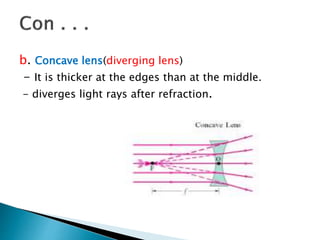
b. Concave lens(diverging lens)
- It is thicker at the edges than at the middle.
- diverges light rays after refraction.
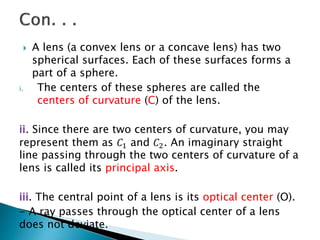
 A lens (a convex lens or a concave lens) has two
spherical surfaces. Each of these surfaces forms a
part of a sphere.
i. The centers of these spheres are called the
centers of curvature (C) of the lens.
ii. Since there are two centers of curvature, you may
represent them as 𝐶1 and 𝐶2. An imaginary straight
line passing through the two centers of curvature of a
lens is called its principal axis.
iii. The central point of a lens is its optical center (O).
- A ray passes through the optical center of a lens
does not deviate.
.
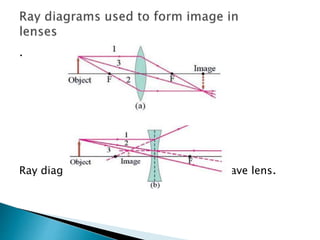
Ray diagram for (a) Convex lens (b) Concave lens.
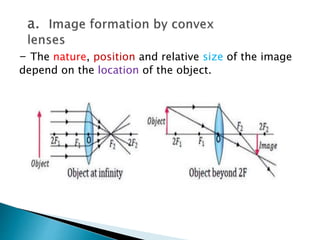
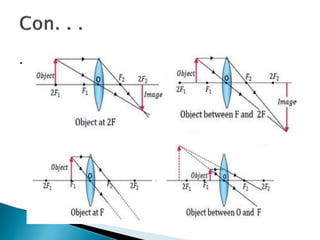
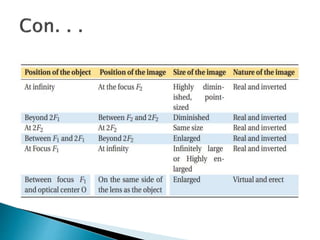
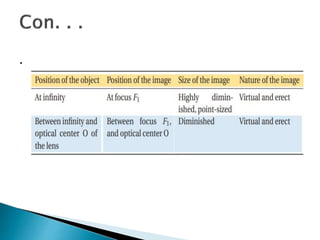
- The nature, position and relative size of the image
depend on the location of the object.
.
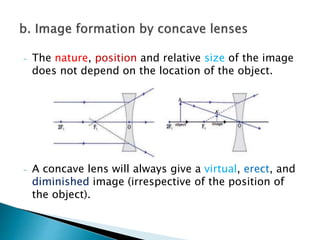
- The nature, position and relative size of the image
does not depend on the location of the object.
- A concave lens will always give a virtual, erect, and
diminished image (irrespective of the position of
the object).
.
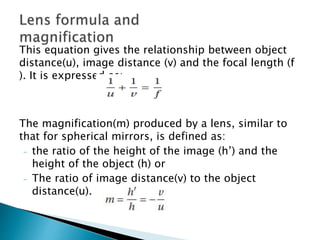
This equation gives the relationship between object
distance(u), image distance (v) and the focal length (f
). It is expressed as:
The magnification(m) produced by a lens, similar to
that for spherical mirrors, is defined as:
- the ratio of the height of the image (h’) and the
height of the object (h) or
- The ratio of image distance(v) to the object
distance(u).
Examples
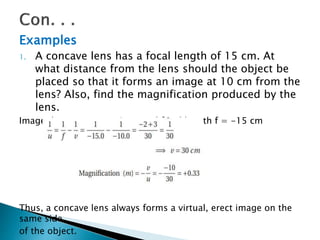
1. A concave lens has a focal length of 15 cm. At
what distance from the lens should the object be
placed so that it forms an image at 10 cm from the
lens? Also, find the magnification produced by the
lens.
Image distance v = - 10 cm and focal length f = -15 cm
Thus, a concave lens always forms a virtual, erect image on the
same side
of the object.
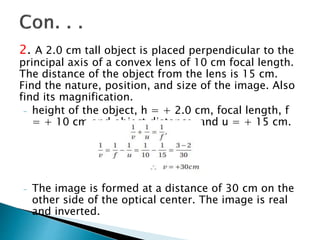
2. A 2.0 cm tall object is placed perpendicular to the
principal axis of a convex lens of 10 cm focal length.
The distance of the object from the lens is 15 cm.
Find the nature, position, and size of the image. Also
find its magnification.
- height of the object, h = + 2.0 cm, focal length, f
= + 10 cm and object distance, and u = + 15 cm.
- The image is formed at a distance of 30 cm on the
other side of the optical center. The image is real
and inverted.
.
The image is two times enlarged.
3. An object 1 cm high is placed 4 cm from a concave
lens. If
the focal length of the mirror is 2 cm, find the
position and
size of the image. Is the image real or virtual?
Calculate the
magnification.
4. A convex lens produces three times magnified
(enlarged) real image of an object placed 10 cm in
front of it. Where is the image located?
5. An object 6 cm high is 10 cm from a concave lens.
The image formed is 3 cm high. Find the focal length
of the lens and the distance of the image from the
lens.
6. An object is 20 cm from a concave lens. The virtual
image formed is three times smaller than the object.
Find the focal length of the lens.
 By the end of this section, you should be
able to:
- describe the human eye in relation to
lenses.
- list simple optical instrument in use in your
locality.
- explain the physics behind the operation of
optical instruments.
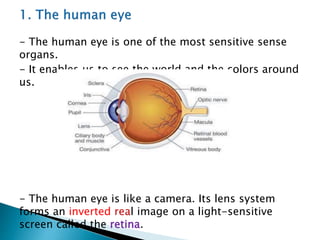
- The human eye is one of the most sensitive sense
organs.
- It enables us to see the world and the colors around
us.
- The human eye is like a camera. Its lens system
forms an inverted real image on a light-sensitive
screen called the retina.
- The retina has an enormous number of light
sensitive cells. These sensitive cells get
activated upon illumination and generate
electrical signals. These signals are sent to
the brain via the optic nerves. The brain
interprets and processes these signals that
enable you to perceive the objects.
- The eyeball is approximately spherical in
shape with a diameter of about 2.3 cm.
- The light rays enter the eye through outer
surface of the cornea by refraction.
- Most of the refraction of the light rays entering the
eye occurs at the outer surface of the cornea.
- The pupil regulates and controls the amount of light
entering the eye.
Power of accommodation
 The ability of the eye’s lens to adjust its focal length
is called accommodation.
 The eye lens is composed of a fibrous, jelly-like
material. The change in the curvature of the eye lens
can change its focal length.
● When you are looking at objects closer to the
eye,
- the ciliary muscles contracts
- the lens becomes thicker.
- its focal length of the eye’s lensdecreases.
This enables us to see nearby objects clearly.
● When you are looking at objects distant to the
eye,
- the muscles relaxed.
- The lens becomes thin.
- the focal length of the eye’s lens increases.
This enables us to see distant objects clearly.
- If you try to read a printed page by holding it
very close to your eyes, you may see the image
being blurred or feel strain in the eye.
- A normal eye can see objects clearly that are
between
25 cm and infinity.
- The minimum distance, at which objects can be
seen most clearly without strain, is called the
least distance of distinct vision. It is also called
the near point of the eye.
Sometimes, the eye may gradually lose its
power of accommodation. In such conditions,
the person cannot see the objects clearly.
The vision becomes blurred due to the
refractive defects of the eye.
There are mainly three common defects of
vision.
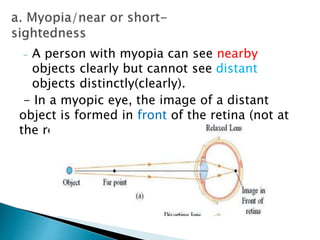
- A person with myopia can see nearby
objects clearly but cannot see distant
objects distinctly(clearly).
- In a myopic eye, the image of a distant
object is formed in front of the retina (not at
the retina).
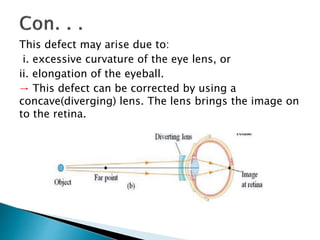
This defect may arise due to:
i. excessive curvature of the eye lens, or
ii. elongation of the eyeball.
→ This defect can be corrected by using a
concave(diverging) lens. The lens brings the image on
to the retina.
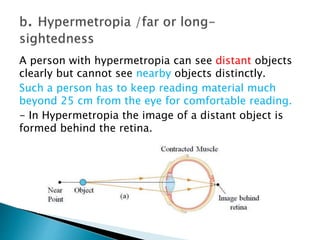
A person with hypermetropia can see distant objects
clearly but cannot see nearby objects distinctly.
Such a person has to keep reading material much
beyond 25 cm from the eye for comfortable reading.
- In Hypermetropia the image of a distant object is
formed behind the retina.
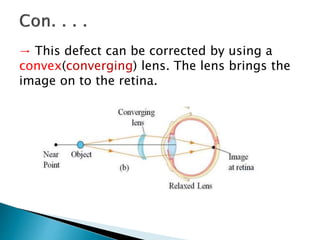
→ This defect can be corrected by using a
convex(converging) lens. The lens brings the
image on to the retina.
- The power in accommodation of the eye usually
decreases with age.
- This arises due to the gradual weakening of the
ciliary muscles and diminishing flexibility of the eye
lens.
- For most people, the near point gradually recedes.
Without corrective eye glasses, they have difficulty
seeing nearby objects comfortably and clearly. This
defect is called presbyopia.
- Sometimes, a person may suffer from both myopia
and hypermetropia. Such people often require bi-
focal lenses (a lens containing both concave and
convex lenses).
- Nowadays, it is possible to correct the refractive
defects
- A number of optical devices and
instruments have been designed utilizing the
reflecting and refracting properties of mirrors
and lenses.
Examples:
Periscope, kaleidoscope, binoculars, camera,
telescopes, and microscopes.
- Our eye is one of the most important optical
devices that nature has endowed us with.
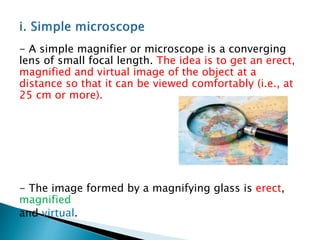
- A simple magnifier or microscope is a converging
lens of small focal length. The idea is to get an erect,
magnified and virtual image of the object at a
distance so that it can be viewed comfortably (i.e., at
25 cm or more).
- The image formed by a magnifying glass is erect,
magnified
and virtual.
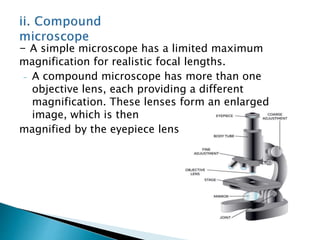
- A simple microscope has a limited maximum
magnification for realistic focal lengths.
- A compound microscope has more than one
objective lens, each providing a different
magnification. These lenses form an enlarged
image, which is then
magnified by the eyepiece lens.
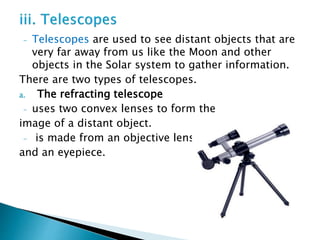
- Telescopes are used to see distant objects that are
very far away from us like the Moon and other
objects in the Solar system to gather information.
There are two types of telescopes.
a. The refracting telescope
- uses two convex lenses to form the
image of a distant object.
- is made from an objective lens
and an eyepiece.
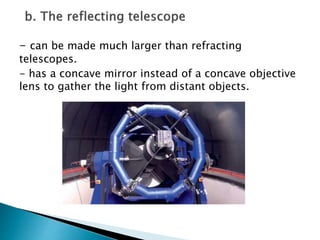
- can be made much larger than refracting
telescopes.
- has a concave mirror instead of a concave objective
lens to gather the light from distant objects.
By the end of this section, you should be able to:
• list the primary colors of light;
• describe the relation between primary color and
human vision.
- You are able to "see" an object when light from the
object enters your eyes.
- Different wavelengths of light(visible light) are
perceived as different colors.
For example, light with a wavelength of about 400 nm
is seen as violet, and light with a wavelength of about
700 nm is seen as red.
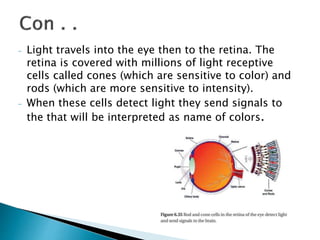
- Light travels into the eye then to the retina. The
retina is covered with millions of light receptive
cells called cones (which are sensitive to color) and
rods (which are more sensitive to intensity).
- When these cells detect light they send signals to
the that will be interpreted as name of colors.
- Light receptors within the eye transmit messages to
the brain which produces the familiar sensations of
color.
 We are able to perceive all colors because there are
three sets of cones in our eyes:
- one is most sensitive to red light.
- the another is most sensitive to green light.
- the third that is most sensitive to blue light.
→ The colors of red, green, and blue light are
primary colors because they are fundamental to
human vision.
→ All other colors of the visible light spectrum can be
produced by adding different combinations of the
three colors.
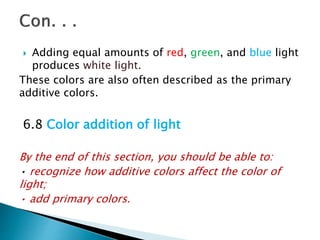
 Adding equal amounts of red, green, and blue light
produces white light.
These colors are also often described as the primary
additive colors.
6.8 Color addition of light
By the end of this section, you should be able to:
• recognize how additive colors affect the color of
light;
• add primary colors.
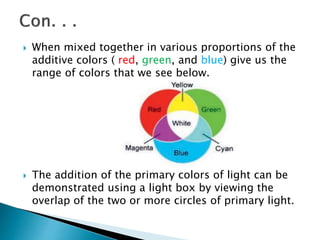
 When mixed together in various proportions of the
additive colors ( red, green, and blue) give us the
range of colors that we see below.
 The addition of the primary colors of light can be
demonstrated using a light box by viewing the
overlap of the two or more circles of primary light.
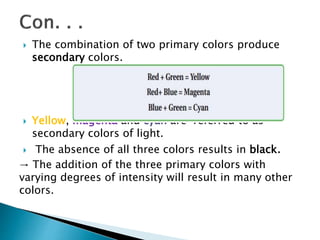
 The combination of two primary colors produce
secondary colors.
 Yellow, magenta and cyan are referred to as
secondary colors of light.
 The absence of all three colors results in black.
→ The addition of the three primary colors with
varying degrees of intensity will result in many other
colors.
 Some applications of color addition
principle are:
- color television
- color computer monitors
- on-stage lighting at the theaters
- digital projector.
Each of these applications involves the mixing or
addition of colors of light to produce a desired
appearance.
By the end of this section, you should be able to:
• describe color subtraction of light using filters.
- A black objects absorbs all colors where as a white
object reflects all colors.
- A blue objects reflects blue and absorbs all other
colors.
→ The subtractive primary colors are obtained by
subtracting one of the three additive primary colors
from white light.
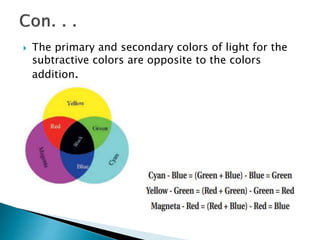
 The primary and secondary colors of light for the
subtractive colors are opposite to the colors
addition.
 Yellow, magenta and cyan are considered as the
subtractive primary colors while red, green and
blue are the secondary subtractive colors.
Commentary colors
- Complimentary colors are the colors that are
absorbed by the subtractive primaries.
- Cyan’s complement is red.
- Magenta’s complement is green.
- Yellow’s compliment is blue.
Pigments are substances which give an object its
color by absorbing certain frequencies of light and
reflecting other frequencies.
- For example, a red pigment absorbs all colors of
light except red which it reflects. Paints and inks
contain pigments which give the paints and inks
different colors.
A filter is also defined as a substance or device that
prevents certain things from passing through it while
allowing certain other things to pass.
Color filters allow only certain colors of light to pass
through them by absorbing all the rest.
Example:
- When white light shines on a red filter ,the
orange, yellow, green, blue, and violet
components of the light are absorbed by the
filter allowing only the red component of the
light to pass through to the other side of the
filter.
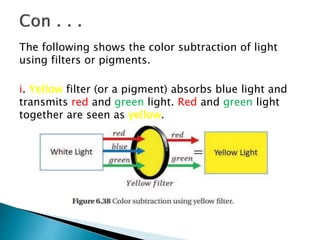
The following shows the color subtraction of light
using filters or pigments.
i. Yellow filter (or a pigment) absorbs blue light and
transmits red and green light. Red and green light
together are seen as yellow.
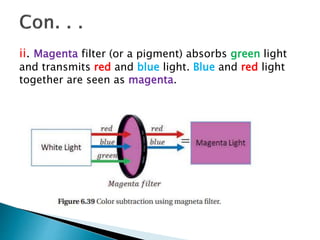
ii. Magenta filter (or a pigment) absorbs green light
and transmits red and blue light. Blue and red light
together are seen as magenta.
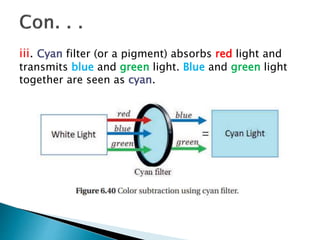
iii. Cyan filter (or a pigment) absorbs red light and
transmits blue and green light. Blue and green light
together are seen as cyan.
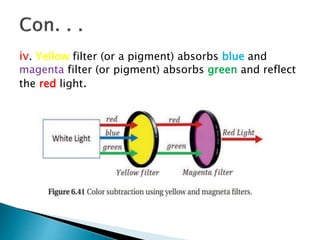
iv. Yellow filter (or a pigment) absorbs blue and
magenta filter (or pigment) absorbs green and reflect
the red light.
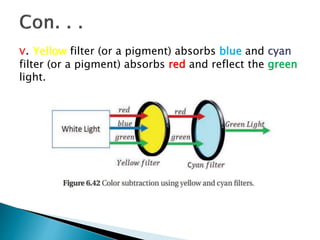
v. Yellow filter (or a pigment) absorbs blue and cyan
filter (or a pigment) absorbs red and reflect the green
light.
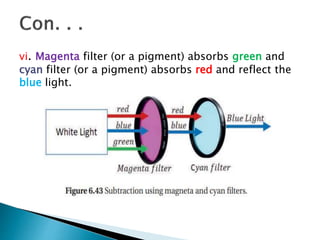
vi. Magenta filter (or a pigment) absorbs green and
cyan filter (or a pigment) absorbs red and reflect the
blue light.

2024 Physics Lesson Note for Grade 10 (Unit 6 ).pptx

  • 1.
    Physics Lesson Note ForGrade 10 “YourKidsOurKids!” “ልጆችዎ ልጆቻችን ናቸው” (+251(0)116-607203+251(0)911-469878*3628www.Safari-academy.comAddisAbaba,Ethiopia
  • 2.
    Electromagnetic Waves and GeometricalOptics - Electromagnetic waves are a form of energy that propagates through space produced by the interaction of electric and magnetic fields. - Light is one form of electromagnetic wave that helps us to see things around us.
  • 3.
    - The studyof light and how it interacts with materials is called optics. - When dealing with light rays and the shape of materials and the angles at which light rays form with the materials is referred to as geometrical optics.
  • 4.
    - By theend of this unit, you should be able to:  describe the propagation of EM waves.  state sources of EM waves. - Waves transfer energy from one place to another without transferring matter. The energy is passed along from particle to particle as they collide with their neighbors.
  • 5.
     Depending onpropagation(the way how waves travel), waves are categorized into mechanical waves and electromagnetic (EM) waves. a. Mechanical waves are the types of waves that - use matter(solid, liquid or gas) to move or transfer energy. - can’t travel in empty space (vacuum). Examples: sound wave, water wave, seismic wave, wave on strings.
  • 6.
    b. Electromagnetic (EM)waves are transverse waves made of the vibration of electric and magnetic fields.
  • 7.
    Examples: Radio wave,Micro wave, infrared wave, visible light , ultraviolet ray, X-ray, Gamma ray etc. - EM waves are waves that can travel through materials (solids, liquids and gases) and vacuum. - All EM waves are transverse waves, i.e the direction of oscillation is perpendicular to the direction of propagation of waves. - (For longitudinal waves, the direction of oscillation is parallel to the direction of propagation of the waves).
  • 8.
    All EM waveshave their own frequency and wavelength. - Frequency(f) is he number of times the electric and magnetic parts vibrate each second. - Wavelength(λ) is the distance between the crests or troughs of a wave.
  • 9.
    - The Sunemits EM waves that travel through space and reach the earth. The energy carried by EM waves is called radiant energy. - Almost 92 % of the radiant energy that reaches the Earth from the Sun is carried by infrared and visible light waves. - A small amount of the radiant energy that reaches Earth is carried by ultraviolet waves. Exercise 1. Do EM waves need a medium to travel through? 2. Describe the properties of EM waves.
  • 10.
    - The sunemits electromagnetic waves with a wide range of frequencies and wave lengths. This is called electromagnetic spectrum.
  • 12.
    - All theelectromagnetic waves differ from each other by their own frequency, wavelength and energy. - Waves with low frequency and long wavelength have low energy. - Waves with high frequency and short wavelength have high energy. - The following are examples of EM waves. Radio wave, Micro wave, infrared wave, visible light , ultraviolet ray, X-ray, Gamma ray.
  • 13.
    1. Radio waves -have the lowest frequency and longest wavelengths in the electromagnetic spectrum. - used mainly for communications purpose like radio and television broadcasting. - wireless communication technologies like Wi-Fi and Bluetooth. → Large amount of radio waves are believed to cause cancer, leukemia and other disorders.
  • 14.
    2. Microwaves - havehigher frequencies and shorter wavelengths than radio waves. - are used to cook food using microwave ovens.  In telecommunications (cell phones), and radar systems. - are also used by traffic speed cameras and for radar which is used by aircraft, ships and weather forecasters.
  • 15.
    3. Infrared waves -Infrared waves have wavelengths longer than those of visible light but shorter than microwaves. - are given off by hot objects like stars, lamps, flames. - are used in remote controls for TVs and video recorders. - are used in infrared cameras.
  • 16.
    4. Visible Light -It is the portion of the electromagnetic spectrum that is visible to the human eye. - Our eyes can detect only a tiny part of the EM spectrum, called visible light from a wavelength range of about 700-400nm. - Our eyes are sensitive to this range of wavelengths. - Helps us to see things around us.
  • 17.
  • 18.
    5. Ultraviolet rays -are produced by special lamps and very hot bodies. - are absorbed in ozone layer. - can be used to kill microbes. Hospitals use UV lamps to sterilize surgical equipment. - food and drug companies also use UV lamps to sterilize their products. → are the waves that can cause sunburn if you are exposed to sunlight for too long time.
  • 19.
    6. X-rays - X-rayshave even shorter wavelengths and higher frequencies than UV radiation. - have high-energy photons and can penetrate through soft tissues in the human body. - used by doctors, X-ray radiography to see the internal body to see bone fractures. - are also used in airport security checks. - are given off by stars. → X-rays can cause cell damage and cancers. This is why Radiographers in hospitals stand behind a shield when they X-ray their patients.
  • 20.
    7. Gamma rays -Gamma rays have the highest frequencies and shortest wavelengths in the electromagnetic spectrum. - carry a large amount of energy. - are given off by stars and by some radioactive substances. - pass through most materials and are quite difficult to stop. You need lead or concrete in order to block them out. - are used to sterilize foods.
  • 21.
    Exercise 1. Mention somesources of EM waves. 2. Arrange the following types of EM radiation: infrared, X-rays, ultraviolet, visible, gamma based on a. increasing frequency, b. increasing wave length and c. Increasing energy 3. Discuss on the use of each type of EM spectrum. 4. Describe the disadvantages of each type of EM spectrum.
  • 22.
    - Light isa form of EM wave and can travels through vacuum with the speed of C ≈ 3 × 10⁸ m/s. - When light travels through matter(air, liquids and solids) , it interacts with the atoms and molecules in the material and slows down. - The speed(v) , frequency(f) and wave length(λ) of light are related as follows: C = f λ - As the frequency of an EM wave increases, its wavelength decreases.
  • 23.
    Examples 1. Find thefrequency of red light, with a wavelength of 700nm. 2. An FM radio station in Addis broadcasts electromagnetic radiation frequency of 120MHz. Calculate the wavelength of this radiation. 3. Calculate the frequency of an EM wave with a wavelength of 400 nm.
  • 24.
    Propagation of light -Sources of light like the sun and Light bulb give off light rays that travel away from them in all directions. - Light propagates or travels in a straight line. - An arrow headed straight line represents the direction of propagation of light and is called a ray. - The collection of rays is called a beam.
  • 25.
     We cansee objects around us when light from the object enters our eyes. Light rays are not real. They are merely used to show the path that light travels.  Light travels in all directions from its source.
  • 26.
    Exercises 1.Give evidence tosupport the statement: "Light travels in straight lines". 2. Explain how an EM wave propagates. 3. Do EM waves need a medium to travel through? 4. What is the speed of light in vacuum? Does the speed of light change as it enters to matter?
  • 27.
    Reflection of light -Reflection of light is the bouncing of light from a surface. - The incoming light ray is called the incident ray. The light ray moving away from the surface is the reflected ray. - 𝜃𝑖 is angle of incidence - 𝜃𝑟 is angle of reflection
  • 28.
    There are twotypes of reflection a. Specular Reflection is the reflection of light from a smooth shiny surface like mirror. Parallel rays that fall on a surface reflect in parallel. b. Diffuse Reflection is the reflection of light from a rough surface. Parallel rays that fall on a surface reflect in different directions. - The law of reflection is true for any surface.
  • 29.
    - The followingare the law of reflection, i. θi = θr ii. The incident ray, the normal line and the reflected ray lie in the same plane. Refraction of light - The bending of light as it passes from one medium to another is called refraction of light. - Refraction occurs when velocity of the light changes as it passes from one to another medium. - When light moves from one medium into another (For example, from air to water), the direction of light in the second medium changes.
  • 30.
    - Refraction occurswhen velocity or speed of light changes as it passes from one material to another.
  • 31.
    → When lightray enters from denser to rare (less denser) material (For example from glass to air): - It bends away from the normal. - 𝜃1 < 𝜃2 - its speed increases. - Its wave length increases. - Its frequency remain the same.
  • 32.
    → When lightray enters from rare to denser medium (For example from air to glass): - It bends to words the normal. - 𝜃1 > 𝜃2 - its speed decreases. - Its wave length decreases. - Its frequency remain the same. → If the incident ray of light enters to the second medium i.e. parallel to the normal, no refraction (bending) occurs.
  • 33.
    → If theincident ray of light is parallel to the normal, then no refraction (bending) occurs. Laws of refraction i. The incident ray, the refracted ray and the normal at the point of incidence lie in the same plane. ii. The ratio of the sine of the angle of incidence(𝜃1) and sine of the angle of refraction(𝜃2) is constant. - This law is also known as Snell’s law of refraction. - This constant is called the refractive index of the second medium with respect to the first.
  • 34.
    The refractive indexof a material is the measure of how difficult it is for light to passes through a material. The speed of light and the degree of bending of the light depends on the refractive index of material through which the light passes.
  • 35.
     Consider alight ray traveling from medium1 into medium2, as shown in figure.
  • 36.
    - The refractiveindex of medium 2 with respect to medium 1, 𝑛21 is given by: - The refractive index of medium 1 with respect to medium 2, 𝑛12 is given by:
  • 37.
     If medium1is vacuum or air, then the refractive index of medium2 is considered with respect to vacuum. This is called the absolute refractive index of the medium. The refractive index of the medium n is given by: C- is the speed of light. V- is the speed of light in the medium. - If 𝑛𝑤 = 1.33, this means that the ratio of the speed of light in air to the speed of light in water is equal to 1.33.
  • 39.
     Snell’s Lawcan be written as: 𝑆𝑖𝑛𝜃1 𝑆𝑖𝑛𝜃2 = 𝑛2 𝑛1 Examples 1. A light ray with an angle of incidence of 37° passes from air to water. Find the angle of refraction. (sin37° = 0.6) Solution 𝑠𝑖𝑛37° 𝑠𝑖𝑛𝜃 = 1.33 1 sin𝜃 = 0.6 1.33 = 0.4511 𝜃 = 𝑠𝑖𝑛−1 = 27°
  • 40.
    2. The refractiveindex of glass is 1.5 and that of water is 1.3. If the speed of light in water is 2.25 x 10⁸m/s, what is the speed of light in glass? 3. The speed of light in water is 𝟑 𝟒 c. Compute the index of refraction of water. (Speed of light = c) 4. Light travels from air(n=1) into glass (n= 1.5). The angle of incidence is 30°. Find the angle of refraction. 5. If the refractive index of water and glass are 4 3 and 3 2 respectively, what will be the ratio of the velocity of light in water to that of glass?
  • 41.
     Total internalreflection is a phenomenon that occurs when light travels from a medium with a higher refractive index to a medium with a lower refractive index and the angle of incidence exceeds a critical angle.  Critical angle is an angle of incidence on a boundary for which the angle of refraction is 90°.
  • 42.
     When theangle of incidence exceeds the critical angle, there is no refracted light; the incident light is reflected back into the medium. This phenomenon is called total internal reflection. → For total internal reflection to occur, the following two conditions must be satisfied. i. Light must travel from an optically denser medium to an optically rarer medium. ii. The angle of incidence in the denser medium must be greater than the critical angle.
  • 43.
     Critical angleis given by: sin𝜽𝒄 = 𝒏𝟐 𝒏𝟏 𝜽𝒄 = 𝒔𝒊𝒏−𝟏 ( 𝒏𝟐 𝒏𝟏 ) Application of total internal reflection a. in Optical fibers (Optical fibers are most common in telecommunications, because information can be transmitted over long distances with minimal loss of data). b. in reflecting telescopes (like the ones used in astronomy, employ mirrors to collect and focus light). c. also used in medicine in endoscopes.
  • 44.
    Examples: 1. A particularglass has an index of refraction of n = 1.52. What is the critical angle for total internal reflection for light leaving the glass and entering air, for which n = 1? 2. The critical angle total internal reflection in a liquid is 30°. What is the index of refraction of the liquid?
  • 45.
    Prism A prism cansplit the incident white light into a band of colors. - The splitting of light into its component colors is called dispersion. - Dispersion occurs due to the refraction of light. - The acronym VIBGYOR helps you to remember the Sequence of colors.
  • 46.
     The bandof the colored components of a light beam is called its spectrum.  The red light refracts the least while the violet refracts the most. Rainbow - Rainbow is a familiar example of dispersion. It is caused by dispersion of sunlight by tiny water droplets in the atmosphere. It occurs due to the refraction of light. - A rainbow is always formed in a direction opposite to that of the Sun.
  • 47.
    Mirror A mirror isa reflective surface that bounces light off. - Plane and spherical mirrors are the different types of mirrors. - The image of an object through a mirror is formed by the interaction of at least two reflected rays after leaving the same point.
  • 48.
    Plane mirrors The imageof an object in a plane mirrors has the following characteristics. - it is virtual. - the same distance behind the mirror as the object . - the same size as the object. - it is upright. - it is laterally inverted.
  • 49.
     If twoplane mirrors are placed inclined to each other at an angle θ, the number of images formed by mirrors is given by:  Number of images - If θ = 120° maximum number of images formed will be 3 but the number of images seen may be 1, 2 or 3 depending on the position of observer.
  • 50.
    Uses of planemirrors: - in looking glasses. - in construction of kaleidoscope, telescope and periscope etc. - as deflector of light etc. Spherical Mirrors Concave and convex are spherical mirrors. a. Concave mirror has a surface that is curved inward causes light rays to converge. b. Convex mirror has a surface that curves outward which cause light rays to diverge.
  • 51.
    . i. The centerof the sphere, of which the mirror is a part, is called the center of curvature (C) and the radius of this sphere defines its radius of curvature (R). C = 2R
  • 52.
    ii. The middlepoint of a mirror is called its pole(P). iii. The circular outline (or periphery) of the mirror is called its aperture. Aperture is a measure of the size of the mirror. iv. Principal focus (F) is the point at which all light rays converges or diverge. v. The distance between the pole and the principal focus is focal length (f).
  • 53.
    ● Concave mirrorsare used - in torches. - in vehicles headlights to get powerful parallel beams of light. - as shaving mirrors to see a larger image of the face. - For dentists to see large images of the teeth of patients. - Large concave mirrors are used to concentrate sunlight to produce heat in solar furnaces. ● Convex mirrors are used - in supermarkets to see round the corners. - commonly as rear-view (wing) mirrors in vehicles enabling the driver to see traffic behind him/her to
  • 54.
    . - Rays usedto form image by concave and concave mirrors. NB. All the rays obey the laws of reflection.
  • 55.
     The propertiesof an image produced by a concave mirror depend on the location of the object.
  • 56.
  • 57.
     The propertiesof an image produced by a convex mirror does not depend on the location of the object. - The image is always virtual, erect and diminished.
  • 58.
     In sphericalmirrors, the object distance (u), the image distance (v) and the pole is called the focal length (f) are expressed as:  The magnification(the relative extent to which the image of an object is magnified with respect to the object size) is given by: h’ is image height and h is object height. v is image distance and u is object distance.
  • 59.
    . Examples 1. A convexmirror used for rear-view on an automobile has a radius of curvature of 3m. If a bus is located at 5m from this mirror, find the position, nature and size of the image.
  • 60.
  • 61.
    2. An object,6.0 cm in size, is placed at 30 cm in front of a concave mirror of focal length 15cm. At what distance from the mirror should a screen be placed in order to obtain a sharp image? Find the nature and the size of the image. 3. A 4cm light bulb is placed a distance of 40cm from a concave mirror having a focal length of 20cm. Find the image distance and the image size. 4. A concave mirror has a focal length of 5cm. What is the position of the image if the image is inverted and four times smaller than the object?
  • 62.
     Lenses areany curved transparent material that are shaped in such a way that they will converge parallel incident rays to a point or diverge incident rays from a point. - Lenses are used a microscope, telescope, binoculars, camera. a. Convex lens(converging lens) - is thicker at the middle as compared to the edges. - is called a double convex lens. - converges light rays after refraction.
  • 63.
    b. Concave lens(diverginglens) - It is thicker at the edges than at the middle. - diverges light rays after refraction.
  • 64.
     A lens(a convex lens or a concave lens) has two spherical surfaces. Each of these surfaces forms a part of a sphere. i. The centers of these spheres are called the centers of curvature (C) of the lens. ii. Since there are two centers of curvature, you may represent them as 𝐶1 and 𝐶2. An imaginary straight line passing through the two centers of curvature of a lens is called its principal axis. iii. The central point of a lens is its optical center (O). - A ray passes through the optical center of a lens does not deviate.
  • 65.
    . Ray diagram for(a) Convex lens (b) Concave lens.
  • 66.
    - The nature,position and relative size of the image depend on the location of the object.
  • 67.
  • 69.
    - The nature,position and relative size of the image does not depend on the location of the object. - A concave lens will always give a virtual, erect, and diminished image (irrespective of the position of the object).
  • 70.
  • 71.
    This equation givesthe relationship between object distance(u), image distance (v) and the focal length (f ). It is expressed as: The magnification(m) produced by a lens, similar to that for spherical mirrors, is defined as: - the ratio of the height of the image (h’) and the height of the object (h) or - The ratio of image distance(v) to the object distance(u).
  • 72.
    Examples 1. A concavelens has a focal length of 15 cm. At what distance from the lens should the object be placed so that it forms an image at 10 cm from the lens? Also, find the magnification produced by the lens. Image distance v = - 10 cm and focal length f = -15 cm Thus, a concave lens always forms a virtual, erect image on the same side of the object.
  • 73.
    2. A 2.0cm tall object is placed perpendicular to the principal axis of a convex lens of 10 cm focal length. The distance of the object from the lens is 15 cm. Find the nature, position, and size of the image. Also find its magnification. - height of the object, h = + 2.0 cm, focal length, f = + 10 cm and object distance, and u = + 15 cm. - The image is formed at a distance of 30 cm on the other side of the optical center. The image is real and inverted.
  • 74.
    . The image istwo times enlarged. 3. An object 1 cm high is placed 4 cm from a concave lens. If the focal length of the mirror is 2 cm, find the position and size of the image. Is the image real or virtual? Calculate the magnification.
  • 75.
    4. A convexlens produces three times magnified (enlarged) real image of an object placed 10 cm in front of it. Where is the image located? 5. An object 6 cm high is 10 cm from a concave lens. The image formed is 3 cm high. Find the focal length of the lens and the distance of the image from the lens. 6. An object is 20 cm from a concave lens. The virtual image formed is three times smaller than the object. Find the focal length of the lens.
  • 76.
     By theend of this section, you should be able to: - describe the human eye in relation to lenses. - list simple optical instrument in use in your locality. - explain the physics behind the operation of optical instruments.
  • 77.
    - The humaneye is one of the most sensitive sense organs. - It enables us to see the world and the colors around us. - The human eye is like a camera. Its lens system forms an inverted real image on a light-sensitive screen called the retina.
  • 78.
    - The retinahas an enormous number of light sensitive cells. These sensitive cells get activated upon illumination and generate electrical signals. These signals are sent to the brain via the optic nerves. The brain interprets and processes these signals that enable you to perceive the objects. - The eyeball is approximately spherical in shape with a diameter of about 2.3 cm. - The light rays enter the eye through outer surface of the cornea by refraction.
  • 79.
    - Most ofthe refraction of the light rays entering the eye occurs at the outer surface of the cornea. - The pupil regulates and controls the amount of light entering the eye. Power of accommodation  The ability of the eye’s lens to adjust its focal length is called accommodation.  The eye lens is composed of a fibrous, jelly-like material. The change in the curvature of the eye lens can change its focal length.
  • 80.
    ● When youare looking at objects closer to the eye, - the ciliary muscles contracts - the lens becomes thicker. - its focal length of the eye’s lensdecreases. This enables us to see nearby objects clearly. ● When you are looking at objects distant to the eye, - the muscles relaxed. - The lens becomes thin. - the focal length of the eye’s lens increases. This enables us to see distant objects clearly.
  • 81.
    - If youtry to read a printed page by holding it very close to your eyes, you may see the image being blurred or feel strain in the eye. - A normal eye can see objects clearly that are between 25 cm and infinity. - The minimum distance, at which objects can be seen most clearly without strain, is called the least distance of distinct vision. It is also called the near point of the eye.
  • 82.
    Sometimes, the eyemay gradually lose its power of accommodation. In such conditions, the person cannot see the objects clearly. The vision becomes blurred due to the refractive defects of the eye. There are mainly three common defects of vision.
  • 83.
    - A personwith myopia can see nearby objects clearly but cannot see distant objects distinctly(clearly). - In a myopic eye, the image of a distant object is formed in front of the retina (not at the retina).
  • 84.
    This defect mayarise due to: i. excessive curvature of the eye lens, or ii. elongation of the eyeball. → This defect can be corrected by using a concave(diverging) lens. The lens brings the image on to the retina.
  • 85.
    A person withhypermetropia can see distant objects clearly but cannot see nearby objects distinctly. Such a person has to keep reading material much beyond 25 cm from the eye for comfortable reading. - In Hypermetropia the image of a distant object is formed behind the retina.
  • 86.
    → This defectcan be corrected by using a convex(converging) lens. The lens brings the image on to the retina.
  • 87.
    - The powerin accommodation of the eye usually decreases with age. - This arises due to the gradual weakening of the ciliary muscles and diminishing flexibility of the eye lens. - For most people, the near point gradually recedes. Without corrective eye glasses, they have difficulty seeing nearby objects comfortably and clearly. This defect is called presbyopia. - Sometimes, a person may suffer from both myopia and hypermetropia. Such people often require bi- focal lenses (a lens containing both concave and convex lenses). - Nowadays, it is possible to correct the refractive defects
  • 88.
    - A numberof optical devices and instruments have been designed utilizing the reflecting and refracting properties of mirrors and lenses. Examples: Periscope, kaleidoscope, binoculars, camera, telescopes, and microscopes. - Our eye is one of the most important optical devices that nature has endowed us with.
  • 89.
    - A simplemagnifier or microscope is a converging lens of small focal length. The idea is to get an erect, magnified and virtual image of the object at a distance so that it can be viewed comfortably (i.e., at 25 cm or more). - The image formed by a magnifying glass is erect, magnified and virtual.
  • 90.
    - A simplemicroscope has a limited maximum magnification for realistic focal lengths. - A compound microscope has more than one objective lens, each providing a different magnification. These lenses form an enlarged image, which is then magnified by the eyepiece lens.
  • 91.
    - Telescopes areused to see distant objects that are very far away from us like the Moon and other objects in the Solar system to gather information. There are two types of telescopes. a. The refracting telescope - uses two convex lenses to form the image of a distant object. - is made from an objective lens and an eyepiece.
  • 92.
    - can bemade much larger than refracting telescopes. - has a concave mirror instead of a concave objective lens to gather the light from distant objects.
  • 93.
    By the endof this section, you should be able to: • list the primary colors of light; • describe the relation between primary color and human vision. - You are able to "see" an object when light from the object enters your eyes. - Different wavelengths of light(visible light) are perceived as different colors. For example, light with a wavelength of about 400 nm is seen as violet, and light with a wavelength of about 700 nm is seen as red.
  • 94.
    - Light travelsinto the eye then to the retina. The retina is covered with millions of light receptive cells called cones (which are sensitive to color) and rods (which are more sensitive to intensity). - When these cells detect light they send signals to the that will be interpreted as name of colors.
  • 95.
    - Light receptorswithin the eye transmit messages to the brain which produces the familiar sensations of color.  We are able to perceive all colors because there are three sets of cones in our eyes: - one is most sensitive to red light. - the another is most sensitive to green light. - the third that is most sensitive to blue light. → The colors of red, green, and blue light are primary colors because they are fundamental to human vision. → All other colors of the visible light spectrum can be produced by adding different combinations of the three colors.
  • 96.
     Adding equalamounts of red, green, and blue light produces white light. These colors are also often described as the primary additive colors. 6.8 Color addition of light By the end of this section, you should be able to: • recognize how additive colors affect the color of light; • add primary colors.
  • 97.
     When mixedtogether in various proportions of the additive colors ( red, green, and blue) give us the range of colors that we see below.  The addition of the primary colors of light can be demonstrated using a light box by viewing the overlap of the two or more circles of primary light.
  • 98.
     The combinationof two primary colors produce secondary colors.  Yellow, magenta and cyan are referred to as secondary colors of light.  The absence of all three colors results in black. → The addition of the three primary colors with varying degrees of intensity will result in many other colors.
  • 99.
     Some applicationsof color addition principle are: - color television - color computer monitors - on-stage lighting at the theaters - digital projector. Each of these applications involves the mixing or addition of colors of light to produce a desired appearance.
  • 100.
    By the endof this section, you should be able to: • describe color subtraction of light using filters. - A black objects absorbs all colors where as a white object reflects all colors. - A blue objects reflects blue and absorbs all other colors. → The subtractive primary colors are obtained by subtracting one of the three additive primary colors from white light.
  • 101.
     The primaryand secondary colors of light for the subtractive colors are opposite to the colors addition.
  • 102.
     Yellow, magentaand cyan are considered as the subtractive primary colors while red, green and blue are the secondary subtractive colors. Commentary colors - Complimentary colors are the colors that are absorbed by the subtractive primaries. - Cyan’s complement is red. - Magenta’s complement is green. - Yellow’s compliment is blue.
  • 103.
    Pigments are substanceswhich give an object its color by absorbing certain frequencies of light and reflecting other frequencies. - For example, a red pigment absorbs all colors of light except red which it reflects. Paints and inks contain pigments which give the paints and inks different colors. A filter is also defined as a substance or device that prevents certain things from passing through it while allowing certain other things to pass. Color filters allow only certain colors of light to pass through them by absorbing all the rest.
  • 104.
    Example: - When whitelight shines on a red filter ,the orange, yellow, green, blue, and violet components of the light are absorbed by the filter allowing only the red component of the light to pass through to the other side of the filter.
  • 105.
    The following showsthe color subtraction of light using filters or pigments. i. Yellow filter (or a pigment) absorbs blue light and transmits red and green light. Red and green light together are seen as yellow.
  • 106.
    ii. Magenta filter(or a pigment) absorbs green light and transmits red and blue light. Blue and red light together are seen as magenta.
  • 107.
    iii. Cyan filter(or a pigment) absorbs red light and transmits blue and green light. Blue and green light together are seen as cyan.
  • 108.
    iv. Yellow filter(or a pigment) absorbs blue and magenta filter (or pigment) absorbs green and reflect the red light.
  • 109.
    v. Yellow filter(or a pigment) absorbs blue and cyan filter (or a pigment) absorbs red and reflect the green light.
  • 110.
    vi. Magenta filter(or a pigment) absorbs green and cyan filter (or a pigment) absorbs red and reflect the blue light.