BY
M.SUDHEER REDDY
AGENDA
 INTRODUCTION

 TYPES OF IDS

 NETWORK INTRUSION DETECTION SYSTEM

 HOW DOES IT PROTECT THE SENSITIVE SYSTEM

 WORKING OF NIDS

 DIFFERENCES BETWEEN NIDS AND FIREWALL
MISUSE DETECTION SYSTEMS

NEW ARCHITECTURE

IMPLEMENTED APPROACHES

 ADVANTAGES AND DISADVANTAGES

 CONCLUSION
INTRODUCTION
 An intrusion is somebody attempting to break into or
 misuse your system.

 An intrusion detection system (IDS) is a device (or
 application) that monitors network and/or system
 activities for malicious activities or policy violations.
TYPES OF INTRUSION DETECTION
SYSTEM
  Intrusion Detection Systems are categorized into two
  types
          a) Network intrusion detection system(NIDS)
           b) Host based intrusion detection system(HIDS)
NETWORK INTRUSION
DETECTION SYSTEM (NIDS)
   A network-based IDS or NIDS resides on a computer or
   appliance connected to a segment of an organization's
   network and monitors network traffic on that network.
   In a network-based intrusion-detection system
   (NIDS), the sensors are located at choke points in
   network to be monitored, often in the dematerialized
   zone (DMZ) or at network borders.
HOW DOES NIDS PROTECT
 SENSITIVE MATERIALS
 A Network Intrusion Detection System (NIDS)
 performs the same function as a sophisticated alarm
 system.
 NIDS observes and alerts. It will not affect network
 performance. NIDS maintains a database – updated
 daily – that contains a history, nearly a decade’s worth
 of documented attack attempts, detecting similarities.
WORKING OF NIDS
 HUBS:
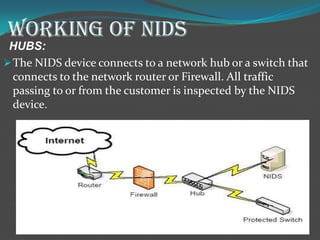
 The NIDS device connects to a network hub or a switch that
  connects to the network router or Firewall. All traffic
  passing to or from the customer is inspected by the NIDS
  device.
TAP:
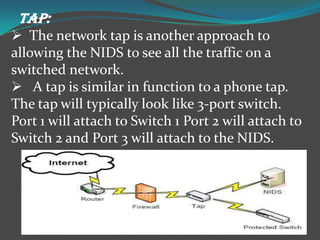
 The network tap is another approach to
allowing the NIDS to see all the traffic on a
switched network.
 A tap is similar in function to a phone tap.
The tap will typically look like 3-port switch.
Port 1 will attach to Switch 1 Port 2 will attach to
Switch 2 and Port 3 will attach to the NIDS.
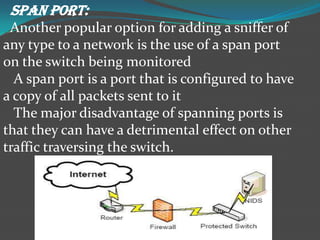
SPAN PORT:
 Another popular option for adding a sniffer of
any type to a network is the use of a span port
on the switch being monitored
  A span port is a port that is configured to have
a copy of all packets sent to it
  The major disadvantage of spanning ports is
that they can have a detrimental effect on other
traffic traversing the switch.
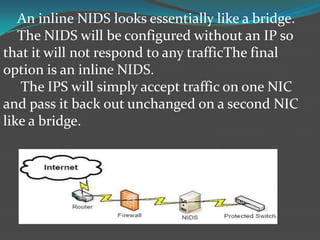
An inline NIDS looks essentially like a bridge.
   The NIDS will be configured without an IP so
that it will not respond to any trafficThe final
option is an inline NIDS.
   The IPS will simply accept traffic on one NIC
and pass it back out unchanged on a second NIC
like a bridge.
TYPES OF DETECTION METHODS:
  Two types of detection methods are:
       a) Anomaly Detection model
       b) Signature detection model
 ANOMALY DETECTION MODEL:
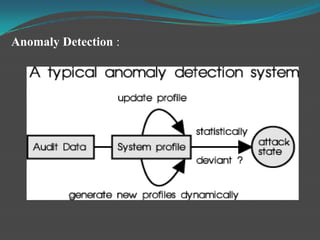
  IDS methodology is an approach called anomaly
  detection or behavior-based detection.
  This model works by establishing accepted baselines
  or rules and noting exceptional differences
 If an ids looks only at network packet headers for
  differences it is called as protocol anomaly detection.
 This model triggers off when the following events occur
         a) Unusual user account activity
         b) Excessive file and object accesses
         c) High cpu utilization
         d) Inappropriate protocol use
         e) Unusual login frequency
         f) High number of sessions
         g) Unusual content
Anomaly Detection :
Advantages:
 Analyzes ongoing traffic, activity, transactions,
and behavior for anomalies.
 Potential to detect previously unknown types of
attacks.
 Catalogs the differences between baseline
behavior and ongoing activity.
Disadvantages:
 Prone to false positives.
 Heavy processing overhead.
 Vulnerable to attack while creating time
consuming, statistically significant baselines.
Signature detection model:
     The defined patterns of code are called as signatures
  and often treated as a rule when included in ids.
     Signature-based IDS use a database of traffic and
  activity patterns related to known attacks. The patterns
  are called attack signatures.
     These signatures and rules can be collected together
  into larger sets called signature databases or rule sets.
 Advantages:
    Examines ongoing activity and matches against patterns
  of previously observed attacks.
   Works extremely well against previously observed
  attacks.
 Disadvantages:
    Signature databases must be constantly updated.
    Must compare and match activities against large
  collections of attack signatures.
    Specific signature definitions may miss variations on
  known attacks.
    May impose noticeable performance drags on systems.
Misuse Detection:

                Expert Systems

                Keystroke monitoring

                 Model Based Intrusion Detection
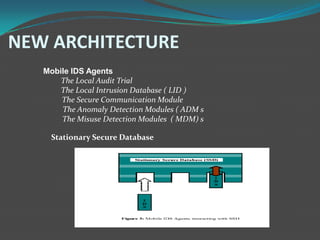
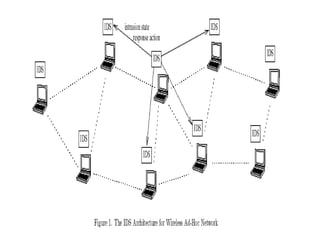
NEW ARCHITECTURE
   Mobile IDS Agents
       The Local Audit Trial
       The Local Intrusion Database ( LID )
       The Secure Communication Module
       The Anomaly Detection Modules ( ADM s
       The Misuse Detection Modules ( MDM) s

     Stationary Secure Database
IMPLEMENTED APPROACHES
       IEEE 802.11
          a) Open System Authentication.
          b) Shared Key Authentication.
       Secure key generation and distribution
       Mitigating Routing Misbehavior:( Sergio
       Marti et al. [19])
ADVANTAGES:
 Monitors an entire network with only a few well-placed
  nodes
 Mostly passive devices
 Low Overhead and limited number of resources are used
  even in the large network.
 Easy to secure against attack
 Mostly undetectable to attackers or intruders because
  they are completely hidden in the network.
 Easy to install
 NIDS can be used in the present networks without
  interrupting conventional network operations.
DISADVANTAGES:
 May not be able to monitor and analyze all traffic on
  large, busy networks
 Vulnerable to attacks launched during peak traffic periods
  on large busy networks
 Not able to monitor switch-based (high-speed) networks
  effectively
 Typically unable to analyze encrypted data or not suitable
  for encrypted traffic.
 Does not always report success or failure of attempted
  attacks
 Require active manual involvement by network
  administrators or security administrators.
CONCLUSION:
 As NIDS technologies continue to evolve, they will more
 closely resemble their real-world counterparts. In the
 future, NIDS, firewalls, VPNs, and related security
 technologies will all come to interoperate to a much higher
 degree. The current generation of IDS (HIDS and NIDS) is
 quite effective already; as they continue to improve they will
 become the backbone of the more flexible security systems
 we expect to see in the not-too-distant future.
QUERIES…????
Intrusion detection system

Intrusion detection system

  • 1.
  • 3.
    AGENDA INTRODUCTION TYPESOF IDS NETWORK INTRUSION DETECTION SYSTEM HOW DOES IT PROTECT THE SENSITIVE SYSTEM WORKING OF NIDS DIFFERENCES BETWEEN NIDS AND FIREWALL
  • 4.
    MISUSE DETECTION SYSTEMS NEWARCHITECTURE IMPLEMENTED APPROACHES ADVANTAGES AND DISADVANTAGES CONCLUSION
  • 5.
    INTRODUCTION  An intrusionis somebody attempting to break into or misuse your system.  An intrusion detection system (IDS) is a device (or application) that monitors network and/or system activities for malicious activities or policy violations.
  • 6.
    TYPES OF INTRUSIONDETECTION SYSTEM  Intrusion Detection Systems are categorized into two types a) Network intrusion detection system(NIDS) b) Host based intrusion detection system(HIDS)
  • 7.
    NETWORK INTRUSION DETECTION SYSTEM(NIDS)  A network-based IDS or NIDS resides on a computer or appliance connected to a segment of an organization's network and monitors network traffic on that network.  In a network-based intrusion-detection system (NIDS), the sensors are located at choke points in network to be monitored, often in the dematerialized zone (DMZ) or at network borders.
  • 8.
    HOW DOES NIDSPROTECT SENSITIVE MATERIALS  A Network Intrusion Detection System (NIDS) performs the same function as a sophisticated alarm system.  NIDS observes and alerts. It will not affect network performance. NIDS maintains a database – updated daily – that contains a history, nearly a decade’s worth of documented attack attempts, detecting similarities.
  • 9.
    WORKING OF NIDS HUBS:  The NIDS device connects to a network hub or a switch that connects to the network router or Firewall. All traffic passing to or from the customer is inspected by the NIDS device.
  • 10.
    TAP:  The networktap is another approach to allowing the NIDS to see all the traffic on a switched network.  A tap is similar in function to a phone tap. The tap will typically look like 3-port switch. Port 1 will attach to Switch 1 Port 2 will attach to Switch 2 and Port 3 will attach to the NIDS.
  • 11.
    SPAN PORT: Anotherpopular option for adding a sniffer of any type to a network is the use of a span port on the switch being monitored A span port is a port that is configured to have a copy of all packets sent to it The major disadvantage of spanning ports is that they can have a detrimental effect on other traffic traversing the switch.
  • 12.
    An inline NIDSlooks essentially like a bridge. The NIDS will be configured without an IP so that it will not respond to any trafficThe final option is an inline NIDS. The IPS will simply accept traffic on one NIC and pass it back out unchanged on a second NIC like a bridge.
  • 13.
    TYPES OF DETECTIONMETHODS:  Two types of detection methods are: a) Anomaly Detection model b) Signature detection model ANOMALY DETECTION MODEL:  IDS methodology is an approach called anomaly detection or behavior-based detection.  This model works by establishing accepted baselines or rules and noting exceptional differences
  • 14.
     If anids looks only at network packet headers for differences it is called as protocol anomaly detection. This model triggers off when the following events occur a) Unusual user account activity b) Excessive file and object accesses c) High cpu utilization d) Inappropriate protocol use e) Unusual login frequency f) High number of sessions g) Unusual content
  • 15.
  • 16.
    Advantages:  Analyzes ongoingtraffic, activity, transactions, and behavior for anomalies.  Potential to detect previously unknown types of attacks.  Catalogs the differences between baseline behavior and ongoing activity. Disadvantages:  Prone to false positives.  Heavy processing overhead.  Vulnerable to attack while creating time consuming, statistically significant baselines.
  • 17.
    Signature detection model:  The defined patterns of code are called as signatures and often treated as a rule when included in ids.  Signature-based IDS use a database of traffic and activity patterns related to known attacks. The patterns are called attack signatures.  These signatures and rules can be collected together into larger sets called signature databases or rule sets.
  • 18.
     Advantages: Examines ongoing activity and matches against patterns of previously observed attacks. Works extremely well against previously observed attacks.  Disadvantages: Signature databases must be constantly updated. Must compare and match activities against large collections of attack signatures. Specific signature definitions may miss variations on known attacks. May impose noticeable performance drags on systems.
  • 19.
    Misuse Detection:  Expert Systems Keystroke monitoring  Model Based Intrusion Detection
  • 20.
    NEW ARCHITECTURE Mobile IDS Agents The Local Audit Trial The Local Intrusion Database ( LID ) The Secure Communication Module The Anomaly Detection Modules ( ADM s The Misuse Detection Modules ( MDM) s Stationary Secure Database
  • 22.
    IMPLEMENTED APPROACHES IEEE 802.11 a) Open System Authentication. b) Shared Key Authentication. Secure key generation and distribution Mitigating Routing Misbehavior:( Sergio Marti et al. [19])
  • 23.
    ADVANTAGES:  Monitors anentire network with only a few well-placed nodes  Mostly passive devices  Low Overhead and limited number of resources are used even in the large network.  Easy to secure against attack  Mostly undetectable to attackers or intruders because they are completely hidden in the network.  Easy to install  NIDS can be used in the present networks without interrupting conventional network operations.
  • 24.
    DISADVANTAGES:  May notbe able to monitor and analyze all traffic on large, busy networks  Vulnerable to attacks launched during peak traffic periods on large busy networks  Not able to monitor switch-based (high-speed) networks effectively  Typically unable to analyze encrypted data or not suitable for encrypted traffic.  Does not always report success or failure of attempted attacks  Require active manual involvement by network administrators or security administrators.
  • 25.
    CONCLUSION:  As NIDStechnologies continue to evolve, they will more closely resemble their real-world counterparts. In the future, NIDS, firewalls, VPNs, and related security technologies will all come to interoperate to a much higher degree. The current generation of IDS (HIDS and NIDS) is quite effective already; as they continue to improve they will become the backbone of the more flexible security systems we expect to see in the not-too-distant future.
  • 26.