
Presented by:
Nazir Ahmad
Enroll No.: 110215
Contents

i.      Introduction
ii.     Process Model
iii.    Terminology
iv.     Detection Methodologies
v.      Basic components and the Architecture
vi.     Types of IDS
vii.    Efficiency Metrics
viii.   References
Introduction


An Intrusion Detection System is a device or software
application that monitors network or system activities
for malicious activities or policy violations and
produces reports to management station
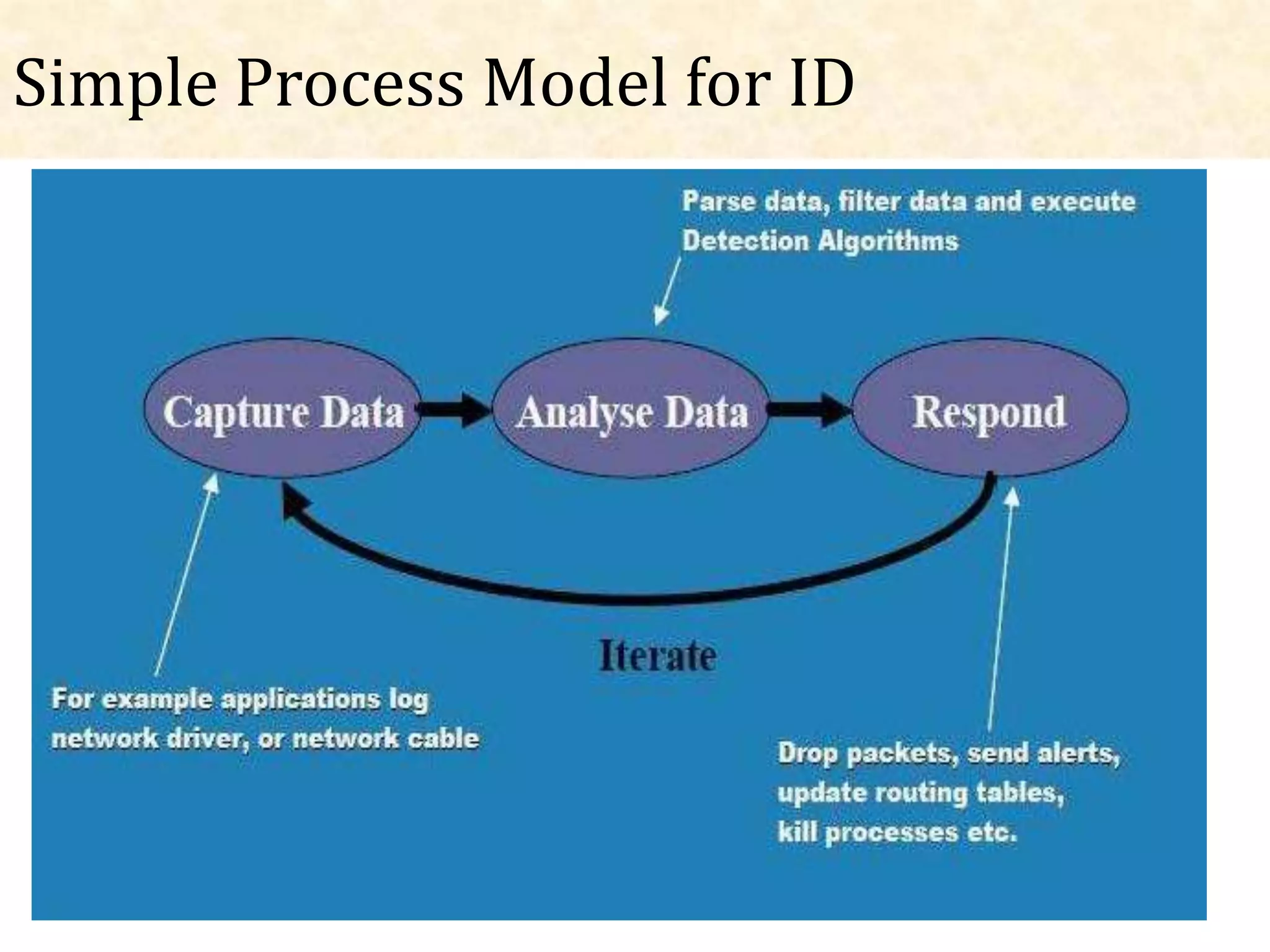
Simple Process Model for ID
Terminology
• Alert/Alarm: A signal suggesting that a system has
been or is being attacked.
• True Positive: A legitimate attack which triggers an
IDS to produce an alarm.
• False Positive: An event signaling an IDS to
produce an alarm when no attack has taken place.
• False Negative: A failure of an IDS to detect an
actual attack.
• True Negative: When no attack has taken place and
no alarm is raised.
Detection Methodologies


IDS generally use two primary classes of
Methodologies to Detect an intrusion

1. Signature -based Detection

2. Behavior-based Detection
Signature-based ID

o A signature is a pattern that corresponds to a
known threat. Signature-based detection is the
process of comparing signatures against observed
events to identify possible incidents.

o Also known as Misuse Intrusion Detection and
knowledge base Intrusion Detection.
Behavior-based ID


o Behavior-based     intrusion-detection   techniques
assume that an intrusion can be detected by
observing a deviation from the normal or expected
behavior of the system or the users.

o Also called as Anomaly-based Intrusion Detection.
Components of a typical IDS
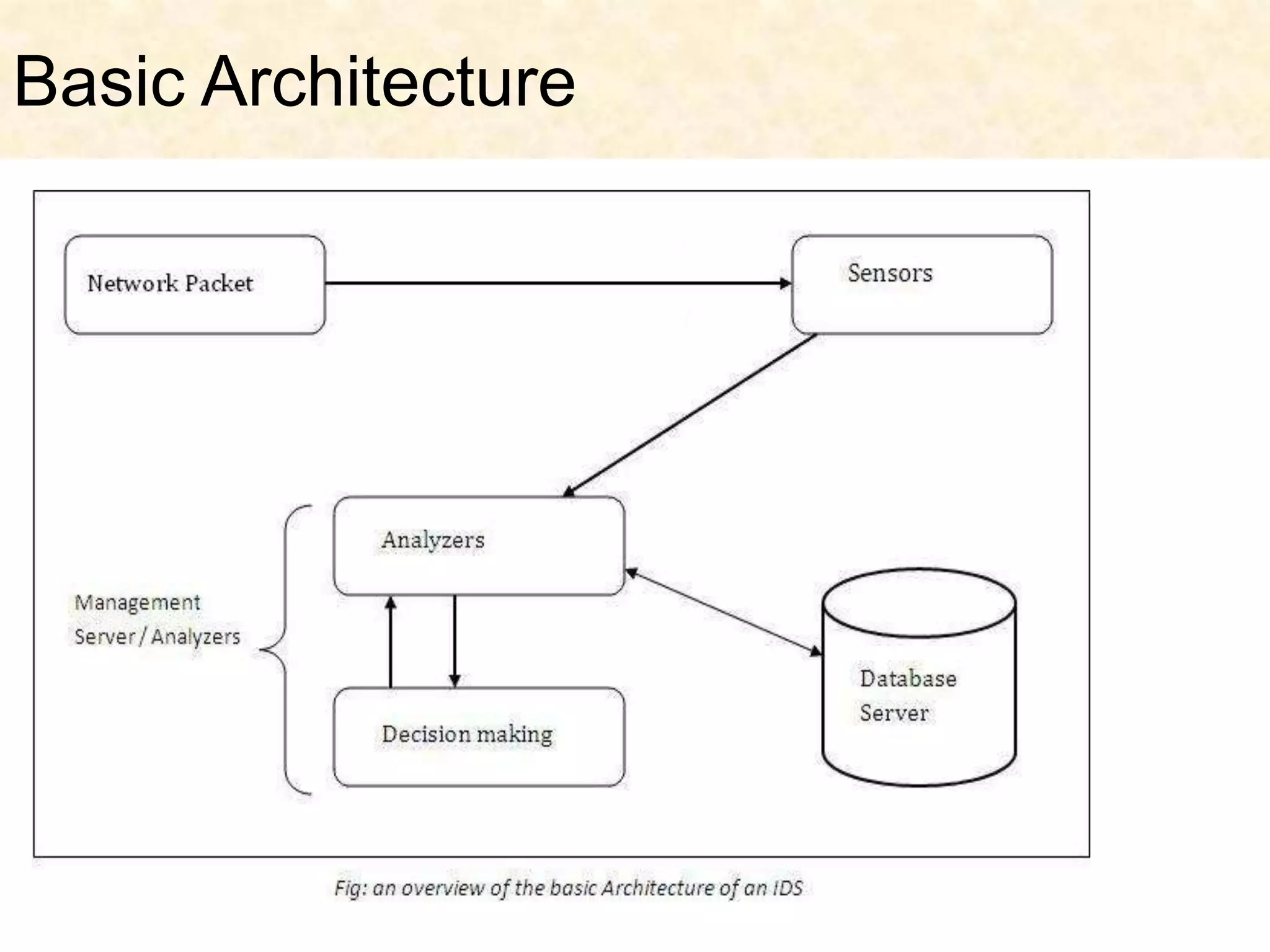
 Components: Sensors, Analyzers, Database Server
 and User Interface.
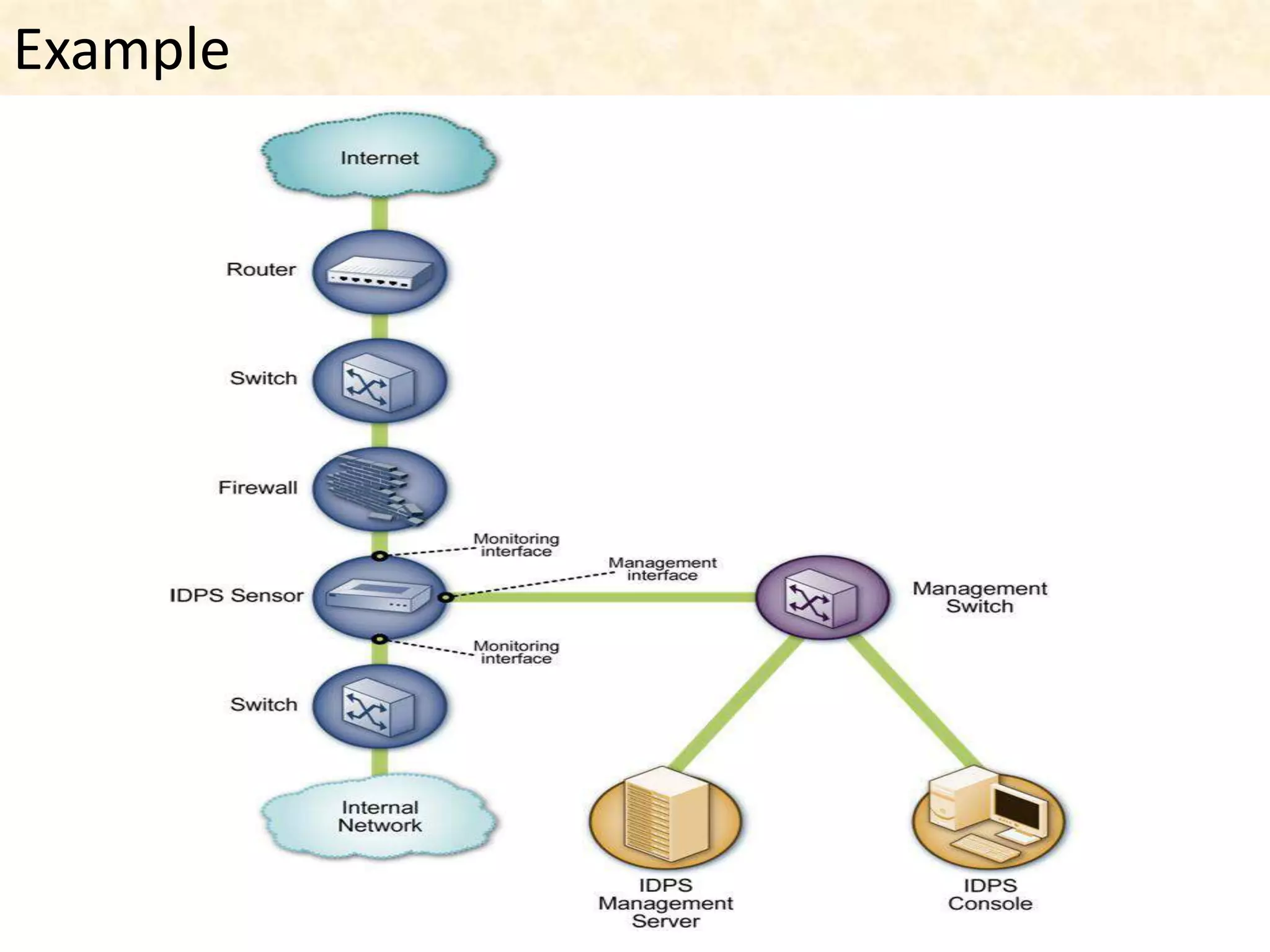
 • Sensor or Agent: sensors are responsible for
 collection of data. They continuously monitor the
 activity. The term “sensor” is typically used for IDSs
 that monitor the networks and network behavior
 analysis technologies. The term “agent” is used for
 host-based IDSs .
 • Analyzers: it receives information from the sensors and
 analyses them to determine if an intrusion has occurred.
IDS components contd……
 • Database Server: A database server is a
 repository for event information recorded by sensors,
 agents, and/or Analyzers.

 • User Interface/Console: A console is a program
 that provides an interface for the IDS’s users and
 administrators. Console software is typically installed
 onto standard desktop or laptop computers.
Basic Architecture
Example
Types of IDS

• Host Intrusion Detection System (HIDS), which
monitors the characteristics of a single host and the
events occurring within that host for suspicious
activity.


•Network      Intrusion Detection (NIDS), which
identifies intrusions by examining network traffic and
monitors multiple hosts.
Efficiency of IDS
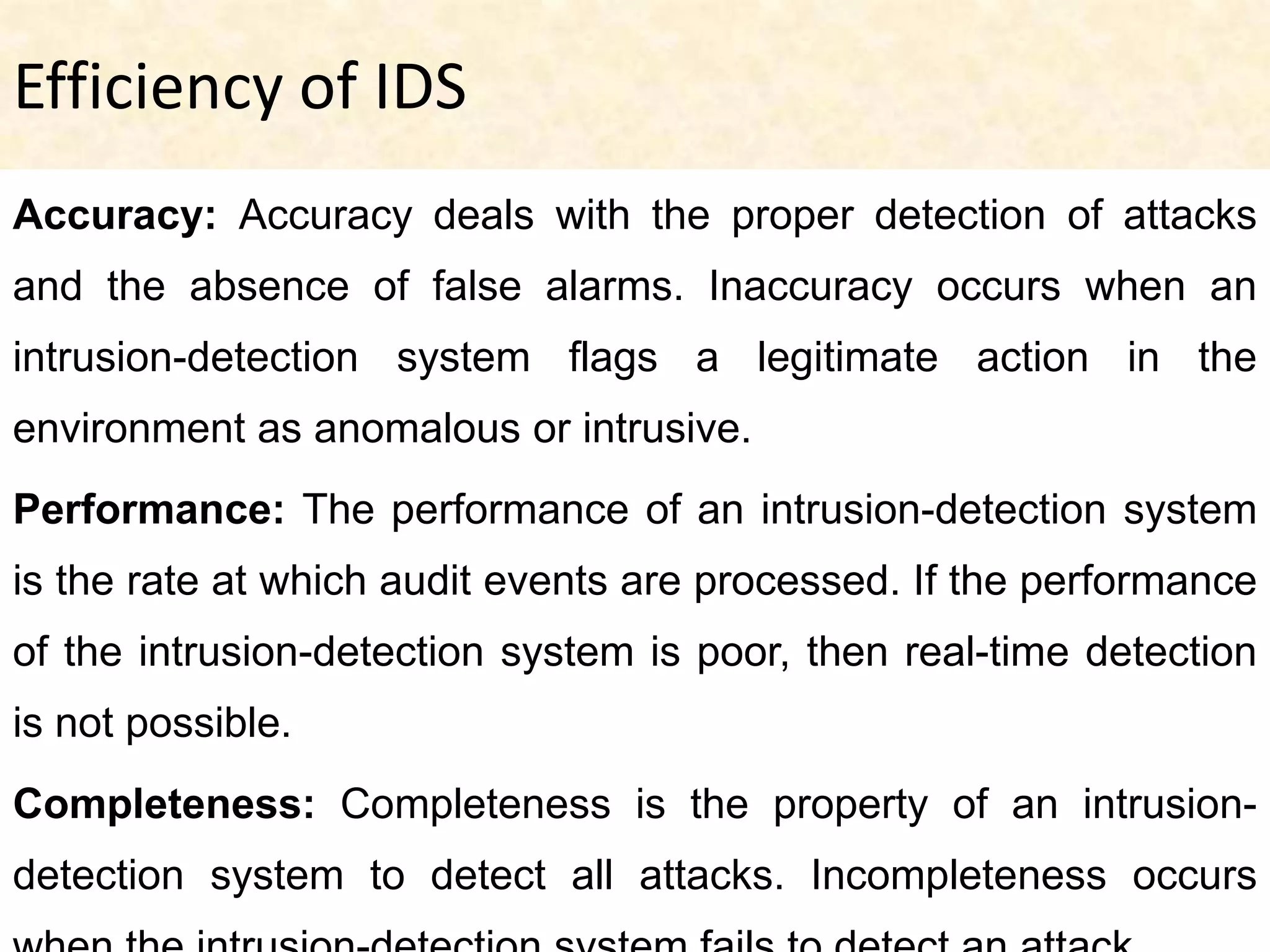
Accuracy: Accuracy deals with the proper detection of attacks
and the absence of false alarms. Inaccuracy occurs when an
intrusion-detection system flags a legitimate action in the
environment as anomalous or intrusive.
Performance: The performance of an intrusion-detection system
is the rate at which audit events are processed. If the performance
of the intrusion-detection system is poor, then real-time detection
is not possible.
Completeness: Completeness is the property of an intrusion-
detection system to detect all attacks. Incompleteness occurs
References
i.   Books/papers
•Guide to Intrusion Detection and Prevention Systems (IDPS), NIST
Special Publications USA, Karen Scarfone and Peter Mell
•An Introduction to Intrusion-Detection Systems, IBM Research and Zurich
Research Laboratory, Herve Debar
• An overview to Software Architecture in Intrusion Detection System,
Department of Computer Engineering I.A.U. Booshehr Branch Iran,
Mehdi Bahrami and Mohammad Bahrami.
•Next Generation Intrusion Detection Systems, McAfee Network Security
Technologies Group, Dr. Fengmin Gong
ii. Internet
•    www.wikipedia.org
•    www.intursiondetectionsystem.org
•    www.sans.org

Intrusion detection systems

  • 1.
  • 2.
    Contents i. Introduction ii. Process Model iii. Terminology iv. Detection Methodologies v. Basic components and the Architecture vi. Types of IDS vii. Efficiency Metrics viii. References
  • 3.
    Introduction An Intrusion DetectionSystem is a device or software application that monitors network or system activities for malicious activities or policy violations and produces reports to management station
  • 4.
  • 5.
    Terminology • Alert/Alarm: Asignal suggesting that a system has been or is being attacked. • True Positive: A legitimate attack which triggers an IDS to produce an alarm. • False Positive: An event signaling an IDS to produce an alarm when no attack has taken place. • False Negative: A failure of an IDS to detect an actual attack. • True Negative: When no attack has taken place and no alarm is raised.
  • 6.
    Detection Methodologies IDS generallyuse two primary classes of Methodologies to Detect an intrusion 1. Signature -based Detection 2. Behavior-based Detection
  • 7.
    Signature-based ID o Asignature is a pattern that corresponds to a known threat. Signature-based detection is the process of comparing signatures against observed events to identify possible incidents. o Also known as Misuse Intrusion Detection and knowledge base Intrusion Detection.
  • 8.
    Behavior-based ID o Behavior-based intrusion-detection techniques assume that an intrusion can be detected by observing a deviation from the normal or expected behavior of the system or the users. o Also called as Anomaly-based Intrusion Detection.
  • 9.
    Components of atypical IDS Components: Sensors, Analyzers, Database Server and User Interface. • Sensor or Agent: sensors are responsible for collection of data. They continuously monitor the activity. The term “sensor” is typically used for IDSs that monitor the networks and network behavior analysis technologies. The term “agent” is used for host-based IDSs . • Analyzers: it receives information from the sensors and analyses them to determine if an intrusion has occurred.
  • 10.
    IDS components contd…… • Database Server: A database server is a repository for event information recorded by sensors, agents, and/or Analyzers. • User Interface/Console: A console is a program that provides an interface for the IDS’s users and administrators. Console software is typically installed onto standard desktop or laptop computers.
  • 11.
  • 12.
  • 13.
    Types of IDS •Host Intrusion Detection System (HIDS), which monitors the characteristics of a single host and the events occurring within that host for suspicious activity. •Network Intrusion Detection (NIDS), which identifies intrusions by examining network traffic and monitors multiple hosts.
  • 14.
    Efficiency of IDS Accuracy:Accuracy deals with the proper detection of attacks and the absence of false alarms. Inaccuracy occurs when an intrusion-detection system flags a legitimate action in the environment as anomalous or intrusive. Performance: The performance of an intrusion-detection system is the rate at which audit events are processed. If the performance of the intrusion-detection system is poor, then real-time detection is not possible. Completeness: Completeness is the property of an intrusion- detection system to detect all attacks. Incompleteness occurs
  • 15.
    References i. Books/papers •Guide to Intrusion Detection and Prevention Systems (IDPS), NIST Special Publications USA, Karen Scarfone and Peter Mell •An Introduction to Intrusion-Detection Systems, IBM Research and Zurich Research Laboratory, Herve Debar • An overview to Software Architecture in Intrusion Detection System, Department of Computer Engineering I.A.U. Booshehr Branch Iran, Mehdi Bahrami and Mohammad Bahrami. •Next Generation Intrusion Detection Systems, McAfee Network Security Technologies Group, Dr. Fengmin Gong ii. Internet • www.wikipedia.org • www.intursiondetectionsystem.org • www.sans.org