SYSTEM HACKING
MR. RAJASEKAR RAMALINGAM
FACULTY - DEPARTMENT OF IT
COLLEGE OF APPLIED SCIENCES – SUR
SULTANATE OF OMAN
VRRSEKAR@YAHOO.COM
CONTENT
1. Steps before hacking a System
 Footprinting
 Scanning
 Enumeration
2. System Hacking stage
3. Goals for System Hacking
4. System Hacking Methodology
5. System Hacking Steps
6. Password Cracking
7. Privilege escalation
8. Executing Applications
9. Hiding Files
10. Covering tracks
2
SYSTEMHACKING
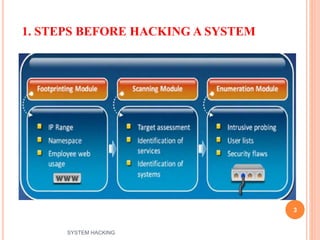
1. STEPS BEFORE HACKING A SYSTEM
3
SYSTEM HACKING
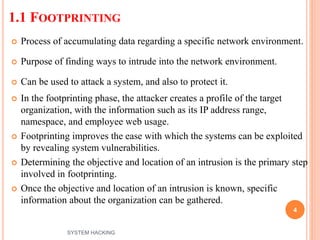
1.1 FOOTPRINTING
 Process of accumulating data regarding a specific network environment.
 Purpose of finding ways to intrude into the network environment.
 Can be used to attack a system, and also to protect it.
 In the footprinting phase, the attacker creates a profile of the target
organization, with the information such as its IP address range,
namespace, and employee web usage.
 Footprinting improves the ease with which the systems can be exploited
by revealing system vulnerabilities.
 Determining the objective and location of an intrusion is the primary step
involved in footprinting.
 Once the objective and location of an intrusion is known, specific
information about the organization can be gathered.
4
SYSTEM HACKING
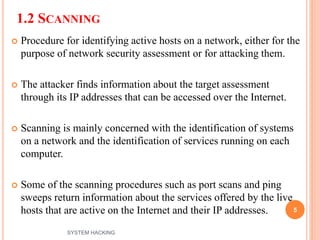
1.2 SCANNING
 Procedure for identifying active hosts on a network, either for the
purpose of network security assessment or for attacking them.
 The attacker finds information about the target assessment
through its IP addresses that can be accessed over the Internet.
 Scanning is mainly concerned with the identification of systems
on a network and the identification of services running on each
computer.
 Some of the scanning procedures such as port scans and ping
sweeps return information about the services offered by the live
hosts that are active on the Internet and their IP addresses. 5
SYSTEM HACKING
1.3 ENUMERATION
 Enumeration is the method of intrusive probing into the target
assessment through which attackers gather information such as
network user lists, routing tables, and Simple Network
Management Protocol (SNMP) data.
 The attacker's objective is to identify valid user accounts or groups
where he or she can remain inconspicuous once the system has
been compromised.
 Enumeration involves making active connections to the target
system or subjecting it to direct queries.
6
SYSTEM HACKING
2. SYSTEM HACKING STAGE
 Every criminal commits a crime to achieve certain goal.
 Likewise, an attacker can also have certain goals behind
performing attacks on a system.
 The following may be some of the goals of attackers in
committing attacks on a system.
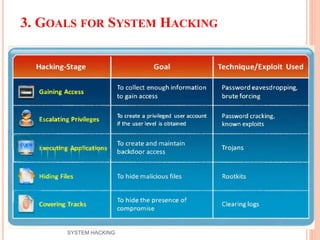
 The table shows the goal of an attacker at different hacking
stages and the technique used to achieve that goal.
7
SYSTEM HACKING
3. GOALS FOR SYSTEM HACKING
8
SYSTEM HACKING
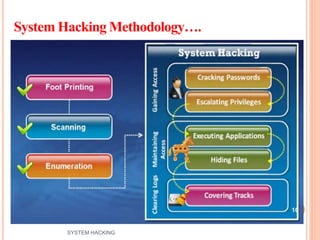
4. SYSTEM HACKING METHODOLOGY
 Before hacking a system, an attacker uses footprinting, scanning,
and enumeration techniques to detect the target area of the attack
and the vulnerabilities that prove to be doorways for the attacker.
 Once the attacker gains all the necessary information, he or she
starts hacking.
 The following diagram depicts the hacking methodology followed
by ethical / Unethical hackers:
9
SYSTEM HACKING
System Hacking Methodology….
10
SYSTEM HACKING
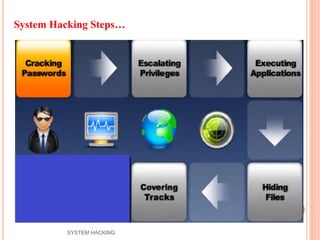
5. SYSTEM HACKING STEPS
 System hacking cannot be accomplished at a single go.
 Various steps that include
 Cracking passwords
 Escalating privileges
 Executing applications
 Hiding files
 Covering tracks
 Discuss these steps one by one thoroughly, to determine how the
attacker hacks the system.
11
SYSTEM HACKING
System Hacking Steps…
12
SYSTEM HACKING
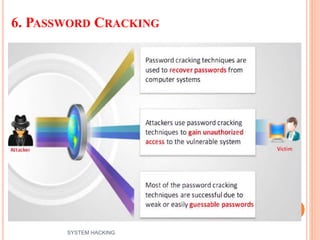
6. PASSWORD CRACKING
13
SYSTEM HACKING
PASSWORD CRACKING …
 Process of recovering passwords from the data that has been transmitted
by a computer system or stored in it.
 Helps a user to recover a forgotten or lost password, as a preventive
measure by the system administrators.
 Can also be used to gain unauthorized access to a system.
 Many hacking attempts start with password cracking attempts.
 Most attackers use password cracking techniques to gain unauthorized
access to the vulnerable system.
 Passwords may be cracked manually or with automated tools.
 Programs designed for cracking passwords are the functions of the
number of possible passwords per second that can be checked.
 Most of the passwords cracking techniques are successful due to weak or
easily guessable passwords. 14
SYSTEM HACKING
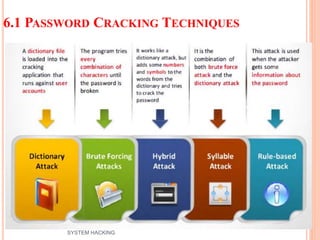
6.1 PASSWORD CRACKING TECHNIQUES
15
SYSTEM HACKING
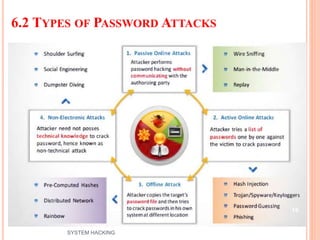
6.2 TYPES OF PASSWORD ATTACKS
16
SYSTEM HACKING
6.3 PASSWORD CRACKING TOOLS
17
SYSTEM HACKING
7. PRIVILEGE ESCALATION
 An attacker can gain access to the network using a non-admin
user account, and the next step would be to gain administrative
privileges.
 Attacker performs privilege escalation attack which takes
advantage of design flaw, programming errors, bugs, and
configuration oversights in the OS and software application to
gain administrative access to the network and its associated
applications.
 These privileges allows attacker to view private information ,
delete files, or install malicious programs such as viruses,
Trojans, worms, etc.
18
SYSTEM HACKING
PRIVILEGE ESCALATION…
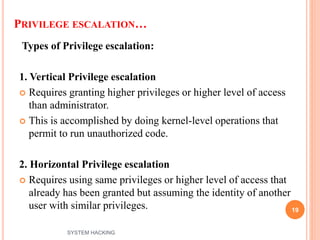
Types of Privilege escalation:
1. Vertical Privilege escalation
 Requires granting higher privileges or higher level of access
than administrator.
 This is accomplished by doing kernel-level operations that
permit to run unauthorized code.
2. Horizontal Privilege escalation
 Requires using same privileges or higher level of access that
already has been granted but assuming the identity of another
user with similar privileges. 19
SYSTEM HACKING
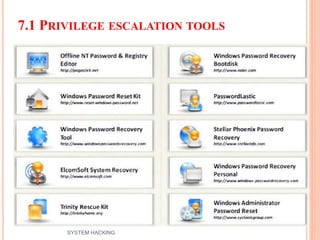
7.1 PRIVILEGE ESCALATION TOOLS
20
SYSTEM HACKING
8. EXECUTING APPLICATIONS
21
• Attackers execute malicious applications in this stage.
• This is called “Owning” the system.
• Executing applications is done after the attacker gains the
administrative privileges.
• The attacker may try to execute some of his or her own
malicious programs remotely on the victim's machine to gather
information that leads to exploitation or loss of privacy, gain
unauthorized access to system resources, crack passwords,
capture screenshots, install a backdoor to maintain easy access,
etc.
SYSTEM HACKING
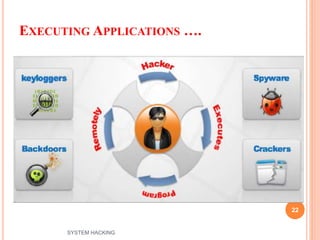
EXECUTING APPLICATIONS ….
22
SYSTEM HACKING
 The malicious programs that the attacker executes on victim's machine maybe:
 Backdoors: Programming designed to deny or disrupt operation, gather
information that leads to exploitation or loss of privacy, gain unauthorized access
to system resources.
 Crackers: Piece of software or program designed for the purpose of cracking the
code or passwords.
 Keyloggers: This can be hardware or a software type. In either case the
objective is to record each and every key stroke made on the computer keyboard.
 Spyware: Spy software may capture the screen shots and send them to a
specified location defined by the hacker. The attacker has to maintain the access
to the victim's computer until his or her purpose is fulfilled.
 After deriving all the requisite information from the victim’s computer, the
attacker installs several back doors to maintain easy access to the victim’s
computer in the future.
23
SYSTEM HACKING
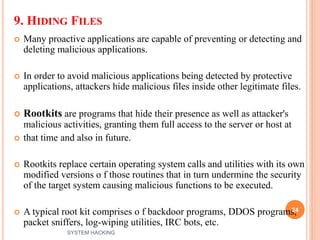
9. HIDING FILES
 Many proactive applications are capable of preventing or detecting and
deleting malicious applications.
 In order to avoid malicious applications being detected by protective
applications, attackers hide malicious files inside other legitimate files.
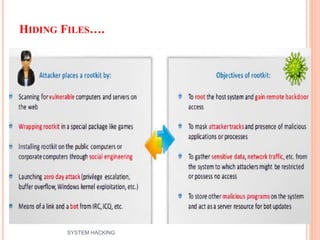
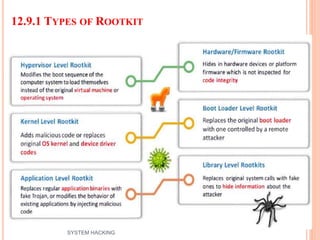
 Rootkits are programs that hide their presence as well as attacker's
malicious activities, granting them full access to the server or host at
 that time and also in future.
 Rootkits replace certain operating system calls and utilities with its own
modified versions o f those routines that in turn undermine the security
of the target system causing malicious functions to be executed.
 A typical root kit comprises o f backdoor programs, DDOS programs,
packet sniffers, log-wiping utilities, IRC bots, etc.
24
SYSTEM HACKING
HIDING FILES….
25
SYSTEM HACKING
12.9.1 TYPES OF ROOTKIT
26
SYSTEM HACKING
12.10 COVERING TRACKS
27
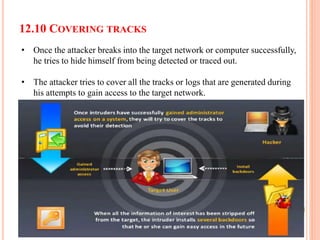
• Once the attacker breaks into the target network or computer successfully,
he tries to hide himself from being detected or traced out.
• The attacker tries to cover all the tracks or logs that are generated during
his attempts to gain access to the target network.
SYSTEM HACKING
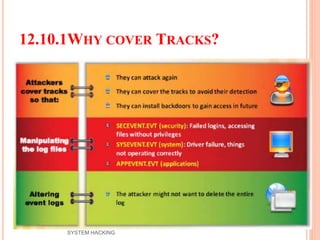
12.10.1WHY COVER TRACKS?
28
SYSTEM HACKING

System hacking

  • 1.
    SYSTEM HACKING MR. RAJASEKARRAMALINGAM FACULTY - DEPARTMENT OF IT COLLEGE OF APPLIED SCIENCES – SUR SULTANATE OF OMAN VRRSEKAR@YAHOO.COM
  • 2.
    CONTENT 1. Steps beforehacking a System  Footprinting  Scanning  Enumeration 2. System Hacking stage 3. Goals for System Hacking 4. System Hacking Methodology 5. System Hacking Steps 6. Password Cracking 7. Privilege escalation 8. Executing Applications 9. Hiding Files 10. Covering tracks 2 SYSTEMHACKING
  • 3.
    1. STEPS BEFOREHACKING A SYSTEM 3 SYSTEM HACKING
  • 4.
    1.1 FOOTPRINTING  Processof accumulating data regarding a specific network environment.  Purpose of finding ways to intrude into the network environment.  Can be used to attack a system, and also to protect it.  In the footprinting phase, the attacker creates a profile of the target organization, with the information such as its IP address range, namespace, and employee web usage.  Footprinting improves the ease with which the systems can be exploited by revealing system vulnerabilities.  Determining the objective and location of an intrusion is the primary step involved in footprinting.  Once the objective and location of an intrusion is known, specific information about the organization can be gathered. 4 SYSTEM HACKING
  • 5.
    1.2 SCANNING  Procedurefor identifying active hosts on a network, either for the purpose of network security assessment or for attacking them.  The attacker finds information about the target assessment through its IP addresses that can be accessed over the Internet.  Scanning is mainly concerned with the identification of systems on a network and the identification of services running on each computer.  Some of the scanning procedures such as port scans and ping sweeps return information about the services offered by the live hosts that are active on the Internet and their IP addresses. 5 SYSTEM HACKING
  • 6.
    1.3 ENUMERATION  Enumerationis the method of intrusive probing into the target assessment through which attackers gather information such as network user lists, routing tables, and Simple Network Management Protocol (SNMP) data.  The attacker's objective is to identify valid user accounts or groups where he or she can remain inconspicuous once the system has been compromised.  Enumeration involves making active connections to the target system or subjecting it to direct queries. 6 SYSTEM HACKING
  • 7.
    2. SYSTEM HACKINGSTAGE  Every criminal commits a crime to achieve certain goal.  Likewise, an attacker can also have certain goals behind performing attacks on a system.  The following may be some of the goals of attackers in committing attacks on a system.  The table shows the goal of an attacker at different hacking stages and the technique used to achieve that goal. 7 SYSTEM HACKING
  • 8.
    3. GOALS FORSYSTEM HACKING 8 SYSTEM HACKING
  • 9.
    4. SYSTEM HACKINGMETHODOLOGY  Before hacking a system, an attacker uses footprinting, scanning, and enumeration techniques to detect the target area of the attack and the vulnerabilities that prove to be doorways for the attacker.  Once the attacker gains all the necessary information, he or she starts hacking.  The following diagram depicts the hacking methodology followed by ethical / Unethical hackers: 9 SYSTEM HACKING
  • 10.
  • 11.
    5. SYSTEM HACKINGSTEPS  System hacking cannot be accomplished at a single go.  Various steps that include  Cracking passwords  Escalating privileges  Executing applications  Hiding files  Covering tracks  Discuss these steps one by one thoroughly, to determine how the attacker hacks the system. 11 SYSTEM HACKING
  • 12.
  • 13.
  • 14.
    PASSWORD CRACKING … Process of recovering passwords from the data that has been transmitted by a computer system or stored in it.  Helps a user to recover a forgotten or lost password, as a preventive measure by the system administrators.  Can also be used to gain unauthorized access to a system.  Many hacking attempts start with password cracking attempts.  Most attackers use password cracking techniques to gain unauthorized access to the vulnerable system.  Passwords may be cracked manually or with automated tools.  Programs designed for cracking passwords are the functions of the number of possible passwords per second that can be checked.  Most of the passwords cracking techniques are successful due to weak or easily guessable passwords. 14 SYSTEM HACKING
  • 15.
    6.1 PASSWORD CRACKINGTECHNIQUES 15 SYSTEM HACKING
  • 16.
    6.2 TYPES OFPASSWORD ATTACKS 16 SYSTEM HACKING
  • 17.
    6.3 PASSWORD CRACKINGTOOLS 17 SYSTEM HACKING
  • 18.
    7. PRIVILEGE ESCALATION An attacker can gain access to the network using a non-admin user account, and the next step would be to gain administrative privileges.  Attacker performs privilege escalation attack which takes advantage of design flaw, programming errors, bugs, and configuration oversights in the OS and software application to gain administrative access to the network and its associated applications.  These privileges allows attacker to view private information , delete files, or install malicious programs such as viruses, Trojans, worms, etc. 18 SYSTEM HACKING
  • 19.
    PRIVILEGE ESCALATION… Types ofPrivilege escalation: 1. Vertical Privilege escalation  Requires granting higher privileges or higher level of access than administrator.  This is accomplished by doing kernel-level operations that permit to run unauthorized code. 2. Horizontal Privilege escalation  Requires using same privileges or higher level of access that already has been granted but assuming the identity of another user with similar privileges. 19 SYSTEM HACKING
  • 20.
    7.1 PRIVILEGE ESCALATIONTOOLS 20 SYSTEM HACKING
  • 21.
    8. EXECUTING APPLICATIONS 21 •Attackers execute malicious applications in this stage. • This is called “Owning” the system. • Executing applications is done after the attacker gains the administrative privileges. • The attacker may try to execute some of his or her own malicious programs remotely on the victim's machine to gather information that leads to exploitation or loss of privacy, gain unauthorized access to system resources, crack passwords, capture screenshots, install a backdoor to maintain easy access, etc. SYSTEM HACKING
  • 22.
  • 23.
     The maliciousprograms that the attacker executes on victim's machine maybe:  Backdoors: Programming designed to deny or disrupt operation, gather information that leads to exploitation or loss of privacy, gain unauthorized access to system resources.  Crackers: Piece of software or program designed for the purpose of cracking the code or passwords.  Keyloggers: This can be hardware or a software type. In either case the objective is to record each and every key stroke made on the computer keyboard.  Spyware: Spy software may capture the screen shots and send them to a specified location defined by the hacker. The attacker has to maintain the access to the victim's computer until his or her purpose is fulfilled.  After deriving all the requisite information from the victim’s computer, the attacker installs several back doors to maintain easy access to the victim’s computer in the future. 23 SYSTEM HACKING
  • 24.
    9. HIDING FILES Many proactive applications are capable of preventing or detecting and deleting malicious applications.  In order to avoid malicious applications being detected by protective applications, attackers hide malicious files inside other legitimate files.  Rootkits are programs that hide their presence as well as attacker's malicious activities, granting them full access to the server or host at  that time and also in future.  Rootkits replace certain operating system calls and utilities with its own modified versions o f those routines that in turn undermine the security of the target system causing malicious functions to be executed.  A typical root kit comprises o f backdoor programs, DDOS programs, packet sniffers, log-wiping utilities, IRC bots, etc. 24 SYSTEM HACKING
  • 25.
  • 26.
    12.9.1 TYPES OFROOTKIT 26 SYSTEM HACKING
  • 27.
    12.10 COVERING TRACKS 27 •Once the attacker breaks into the target network or computer successfully, he tries to hide himself from being detected or traced out. • The attacker tries to cover all the tracks or logs that are generated during his attempts to gain access to the target network. SYSTEM HACKING
  • 28.