1
INTRUSION DETECTION
ITSY3104 COMPUTER SECURITY - A - LECTURE 8 - Intrusion Detection
Mr. RAJASEKAR RAMALINGAM
Department of IT, College of Applied
Sciences, Sur.
Sultanate of Oman.
http://vrrsekar.wixsite.com/raja
Based on
William Stallings, Lawrie Brown,
Computer Security: Principles and
Practice, Third Edition
CONTENT
8.1 Intruders
8.2 Classes of intruders
8.3 Examples of Intrusion
8.4 Security Intrusion & Detection
8.5 Intrusion Techniques
8.6 Intrusion Detection Systems
8.7 IDS Principles
8.8 IDS Requirements
8.9 Host-Based IDS
8.10 Network-Based IDS
8.11 Intrusion Detection Exchange Format
8.12 Honeypot
ITSY3104 COMPUTER SECURITY - A - LECTURE 8 - Intrusion Detection 2
8.1 INTRUDERS
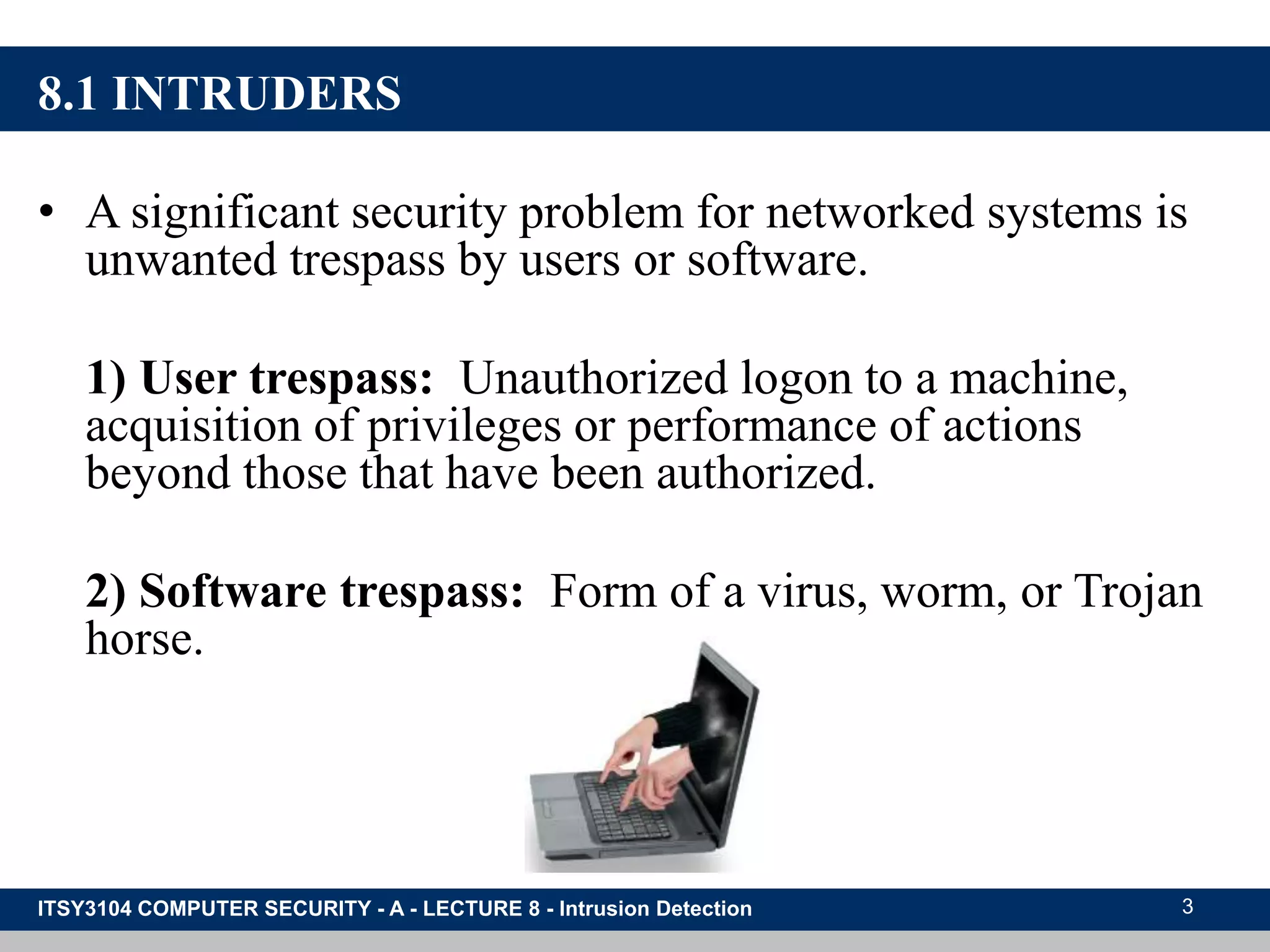
• A significant security problem for networked systems is
unwanted trespass by users or software.
1) User trespass: Unauthorized logon to a machine,
acquisition of privileges or performance of actions
beyond those that have been authorized.
2) Software trespass: Form of a virus, worm, or Trojan
horse.
ITSY3104 COMPUTER SECURITY - A - LECTURE 8 - Intrusion Detection 3
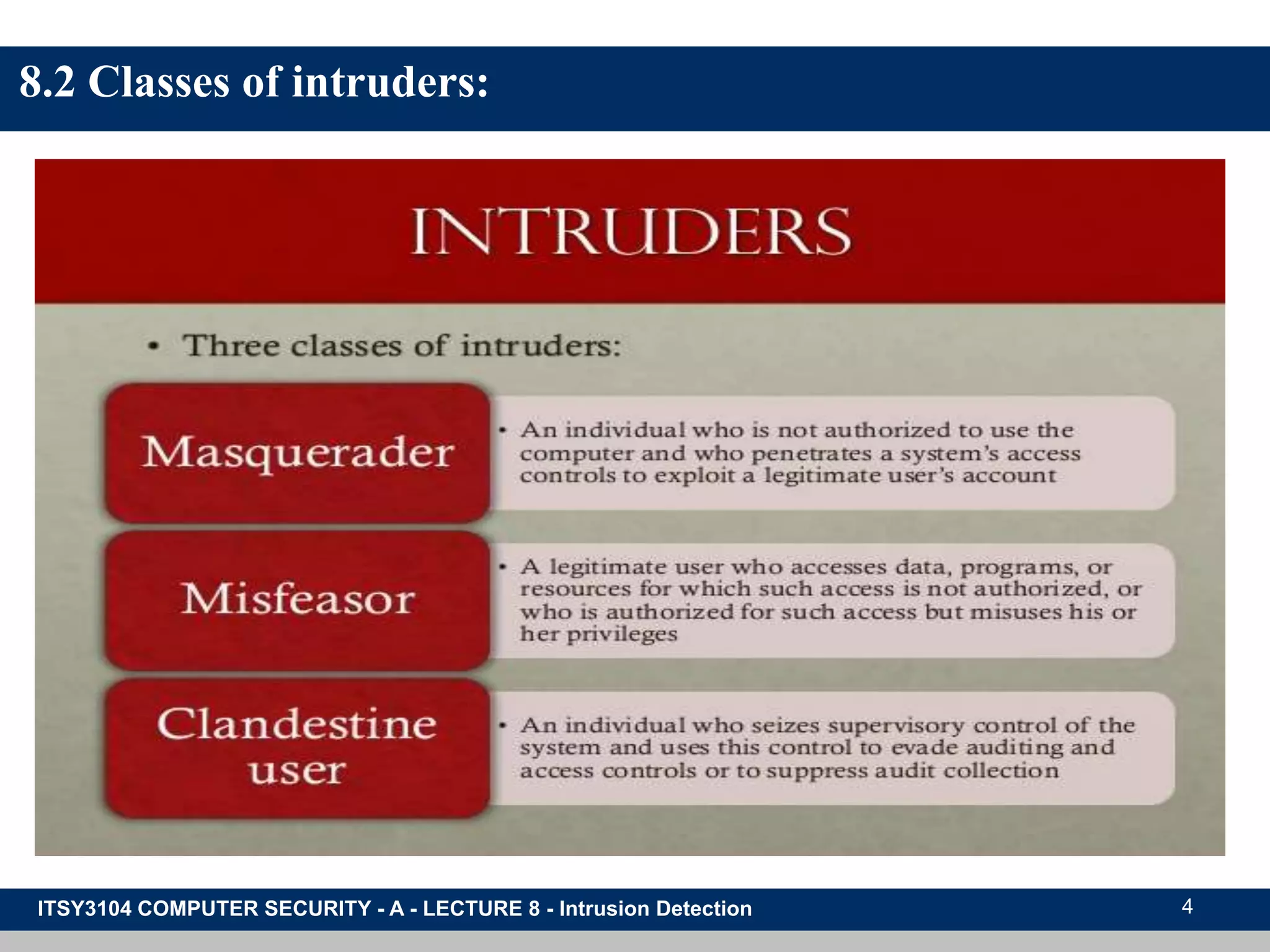
8.2 Classes of intruders:
ITSY3104 COMPUTER SECURITY - A - LECTURE 8 - Intrusion Detection 4
8.3 Examples of Intrusion
• Remote root compromise
• Web server defacement
• Guessing / cracking passwords
• Copying viewing sensitive data / databases
• Running a packet sniffer
• Distributing pirated software
• Using an unsecured modem to access net
• Impersonating a user to reset password
• Using an unattended workstation
ITSY3104 COMPUTER SECURITY - A - LECTURE 8 - Intrusion Detection 5
8.4 Security Intrusion & Detection
1) Security Intrusion
A security event, or combination of multiple security
events, that constitutes a security incident in which an
intruder gains, or attempts to gain, access to a system
(or system resource) without having authorization to
do so.
2) Intrusion Detection
A security service that monitors and analyzes system
events for the purpose of finding, and providing real-
time or near real-time warning of attempts to access
system resources in an unauthorized manner.
ITSY3104 COMPUTER SECURITY - A - LECTURE 8 - Intrusion Detection 6
8.5 Intrusion Techniques
• Objective is to gain access to or increase privileges on
a system.
• Most initial attacks use system or software
vulnerabilities that allow a user to execute code
– To opens a back door into the system. E.g., buffer
overflow.
– To gain protected information. E.g., password.
• Intruder behavior patterns
– Hacker
– Criminal Enterprise
– Internal threat
ITSY3104 COMPUTER SECURITY - A - LECTURE 8 - Intrusion Detection 7
8.5.1 Hackers
• Motivated by thrill of access and status
– Hacking community is a strong meritocracy.
– Status is determined by level of competence.
1
• Select the target using IP lookup tools such as NSLookup, Dig, and others
2
• Map network for accessible services using tools such as NMAP
3
• Identify potentially vulnerable services (in this case, pcAnywhere)
4
• Brute force (guess) pcAnywhere password
5
• Install remote administration tool called DameWare
6
• Wait for administrator to log on and capture his password
7
• Use that password to access remainder of network
ITSY3104 COMPUTER SECURITY - A - LECTURE 8 - Intrusion Detection 8
8.5.2 Criminal Enterprise
• Organized groups of hackers now a threat
– Corporation / government / loosely affiliated gangs
– Typically young
– Common target is a credit cards on e-commerce server
Criminal Enterprise - Patterns of Behavior
Act quickly and precisely to make their activities harder
to detect
Exploit perimeter via vulnerable ports
Use Trojan horses (hidden software) to leave back
doors for re-entry
Use sniffers to capture passwords
Do not stick around until noticed
ITSY3104 COMPUTER SECURITY - A - LECTURE 8 - Intrusion Detection 9
8.5.3 Insider Attacks
• Among most difficult to detect and prevent
• Employees have access & systems knowledge
Internal Threat - Patterns of Behavior
Create network
accounts for
themselves and
their friends
Access accounts
and applications
they wouldn't
normally use for
their daily jobs
E-mail former and
prospective
employers
Conduct furtive
instant-messaging
chats
Visit web sites that
cater to
disgruntled
employees, such as
f'dcompany.com
Perform large
downloads and file
copying
Access the
network during
off hours
ITSY3104 COMPUTER SECURITY - A - LECTURE 8 - Intrusion Detection 10
8.6 Intrusion Detection Systems
• Classify intrusion detection systems (IDSs) as:
– Host-based IDS: monitor single host activity
– Network-based IDS: monitor network traffic
• Logical components:
– Sensors - collect data
– Analyzers - determine if intrusion has occurred
– User interface - manage / direct / view IDS
ITSY3104 COMPUTER SECURITY - A - LECTURE 8 - Intrusion Detection 11
8.7 IDS Principles
• Assume intruder behavior differs from legitimate
users
– Expect overlap as shown
– Observe deviations
from past history
– Problems of:
• False positives
• False negatives
• Must compromise
ITSY3104 COMPUTER SECURITY - A - LECTURE 8 - Intrusion Detection 12
8.8 IDS Requirements
run continually be fault tolerant resist subversion
impose a minimal
overhead on system
configured
according to system
security policies
adapt to changes in
systems and users
scale to monitor
large numbers of
systems
provide graceful
degradation of
service
allow dynamic
reconfiguration
ITSY3104 COMPUTER SECURITY - A - LECTURE 8 - Intrusion Detection 13
8.9 Host-Based IDS
• Specialized software to monitor system activity to detect
suspicious behavior
– primary purpose is to detect intrusions, log suspicious
events, and send alerts
– can detect both external and internal intrusions
• Two approaches, often used in combination:
– anomaly detection - defines normal/expected behavior
• Threshold detection
• Profile based
– signature detection - defines proper behavior
ITSY3104 COMPUTER SECURITY - A - LECTURE 8 - Intrusion Detection 14
8.9.1 Anomaly Detection
• Threshold detection
– Checks excessive event occurrences over time
– Alone a crude and ineffective intruder detector
– Must determine both thresholds and time intervals
• Profile based
– Characterize past behavior of users / groups
– Then detect significant deviations
– Based on analysis of audit records
• Gather metrics: counter, guage, interval timer, resource utilization
• Analyze: mean and standard deviation, multivariate, markov process,
time series, operational model
ITSY3104 COMPUTER SECURITY - A - LECTURE 8 - Intrusion Detection 15
8.9.2 Signature Detection
• Observe events on system and applying a set of rules
to decide if intruder
• Approaches:
– Rule-based anomaly detection
• Analyze historical audit records for expected
behavior, then match with current behavior
– Rule-based penetration identification
• Rules identify known penetrations / weaknesses
• Often by analyzing attack scripts from Internet
• Supplemented with rules from security experts
ITSY3104 COMPUTER SECURITY - A - LECTURE 8 - Intrusion Detection 16
8.10 Network-Based IDS
• Network-based IDS (NIDS)
– Monitor traffic at selected points on a network
– In (near) real time to detect intrusion patterns
– May examine network, transport and/or
application level protocol activity directed
toward systems
• Comprises a number of sensors
– Inline (possibly as part of other net device)
– Passive (monitors copy of traffic)
ITSY3104 COMPUTER SECURITY - A - LECTURE 8 - Intrusion Detection 17
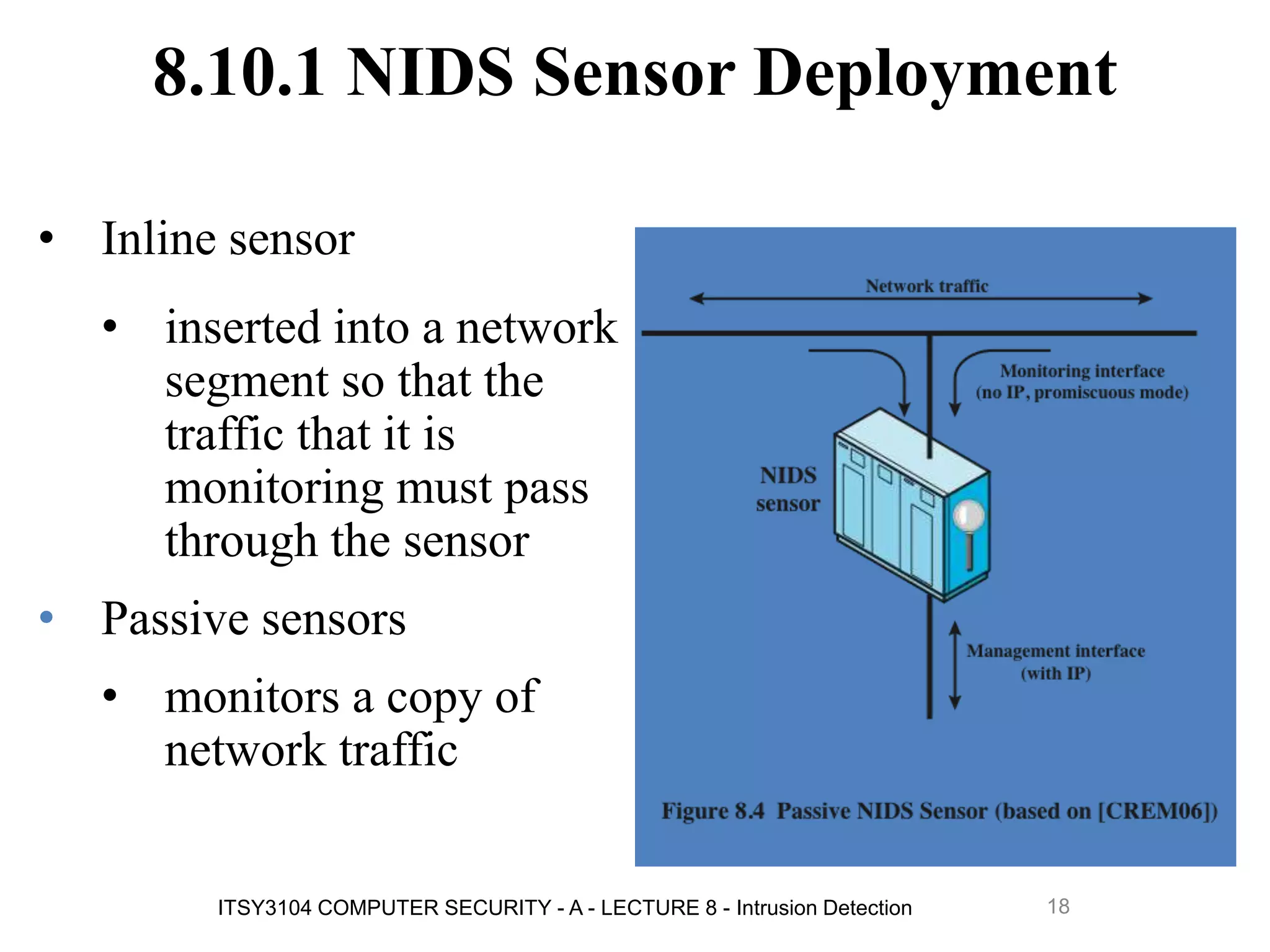
8.10.1 NIDS Sensor Deployment
• Inline sensor
• inserted into a network
segment so that the
traffic that it is
monitoring must pass
through the sensor
• Passive sensors
• monitors a copy of
network traffic
ITSY3104 COMPUTER SECURITY - A - LECTURE 8 - Intrusion Detection 18
• Sensor placement:
ITSY3104 COMPUTER SECURITY - A - LECTURE 8 - Intrusion Detection 19
8.10.2 NIDS - Intrusion Detection Techniques
• Signature detection
– At application, transport, network layers; unexpected
application services, policy violations
• Anomaly detection
– of denial of service attacks, scanning, worms
• When potential violation detected sensor sends an
alert and logs information
– Used by analysis module to refine intrusion detection
parameters and algorithms
– By security admin to improve protection
ITSY3104 COMPUTER SECURITY - A - LECTURE 8 - Intrusion Detection 20
8.11 Intrusion Detection Exchange Format
ITSY3104 COMPUTER SECURITY - A - LECTURE 8 - Intrusion Detection 21
8.12 Honeypot
• Decoy systems designed to:
– lure a potential attacker away from critical systems
– collect information about the attacker’s activity
– encourage the attacker to stay on the system long enough for administrators to
respond
• filled with fabricated information that a legitimate user of the system
wouldn’t access
• resource that has no production value
– incoming communication is most likely a probe, scan, or attack
– outbound communication suggests that the system has probably been
compromised
• once hackers are within the network, administrators can observe
their behavior to figure out defensesITSY3104 COMPUTER SECURITY - A - LECTURE 8 - Intrusion Detection 22
Honeypot Classifications
• Low interaction honeypot
– Consists of a software package that emulates particular
IT services or systems well enough to provide a
realistic initial interaction,
• but does not execute a full version of those services
or systems
– Provides a less realistic target
– Often sufficient for use as a component of a distributed
IDS to warn of imminent attack
ITSY3104 COMPUTER SECURITY - A - LECTURE 8 - Intrusion Detection 23
• High interaction honeypot
– A real system, with a full operating system, services and
applications,
• which are instrumented and deployed where they can be
accessed by attackers
– Is a more realistic target that may occupy an attacker for an
extended period
– However, it requires significantly more resources
– If compromised could be used to initiate attacks on other
systems
ITSY3104 COMPUTER SECURITY - A - LECTURE 8 - Intrusion Detection 24
Honeypot Deployment
ITSY3104 COMPUTER SECURITY - A - LECTURE 8 - Intrusion Detection 25

Intrusion detection

  • 1.
    1 INTRUSION DETECTION ITSY3104 COMPUTERSECURITY - A - LECTURE 8 - Intrusion Detection Mr. RAJASEKAR RAMALINGAM Department of IT, College of Applied Sciences, Sur. Sultanate of Oman. http://vrrsekar.wixsite.com/raja Based on William Stallings, Lawrie Brown, Computer Security: Principles and Practice, Third Edition
  • 2.
    CONTENT 8.1 Intruders 8.2 Classesof intruders 8.3 Examples of Intrusion 8.4 Security Intrusion & Detection 8.5 Intrusion Techniques 8.6 Intrusion Detection Systems 8.7 IDS Principles 8.8 IDS Requirements 8.9 Host-Based IDS 8.10 Network-Based IDS 8.11 Intrusion Detection Exchange Format 8.12 Honeypot ITSY3104 COMPUTER SECURITY - A - LECTURE 8 - Intrusion Detection 2
  • 3.
    8.1 INTRUDERS • Asignificant security problem for networked systems is unwanted trespass by users or software. 1) User trespass: Unauthorized logon to a machine, acquisition of privileges or performance of actions beyond those that have been authorized. 2) Software trespass: Form of a virus, worm, or Trojan horse. ITSY3104 COMPUTER SECURITY - A - LECTURE 8 - Intrusion Detection 3
  • 4.
    8.2 Classes ofintruders: ITSY3104 COMPUTER SECURITY - A - LECTURE 8 - Intrusion Detection 4
  • 5.
    8.3 Examples ofIntrusion • Remote root compromise • Web server defacement • Guessing / cracking passwords • Copying viewing sensitive data / databases • Running a packet sniffer • Distributing pirated software • Using an unsecured modem to access net • Impersonating a user to reset password • Using an unattended workstation ITSY3104 COMPUTER SECURITY - A - LECTURE 8 - Intrusion Detection 5
  • 6.
    8.4 Security Intrusion& Detection 1) Security Intrusion A security event, or combination of multiple security events, that constitutes a security incident in which an intruder gains, or attempts to gain, access to a system (or system resource) without having authorization to do so. 2) Intrusion Detection A security service that monitors and analyzes system events for the purpose of finding, and providing real- time or near real-time warning of attempts to access system resources in an unauthorized manner. ITSY3104 COMPUTER SECURITY - A - LECTURE 8 - Intrusion Detection 6
  • 7.
    8.5 Intrusion Techniques •Objective is to gain access to or increase privileges on a system. • Most initial attacks use system or software vulnerabilities that allow a user to execute code – To opens a back door into the system. E.g., buffer overflow. – To gain protected information. E.g., password. • Intruder behavior patterns – Hacker – Criminal Enterprise – Internal threat ITSY3104 COMPUTER SECURITY - A - LECTURE 8 - Intrusion Detection 7
  • 8.
    8.5.1 Hackers • Motivatedby thrill of access and status – Hacking community is a strong meritocracy. – Status is determined by level of competence. 1 • Select the target using IP lookup tools such as NSLookup, Dig, and others 2 • Map network for accessible services using tools such as NMAP 3 • Identify potentially vulnerable services (in this case, pcAnywhere) 4 • Brute force (guess) pcAnywhere password 5 • Install remote administration tool called DameWare 6 • Wait for administrator to log on and capture his password 7 • Use that password to access remainder of network ITSY3104 COMPUTER SECURITY - A - LECTURE 8 - Intrusion Detection 8
  • 9.
    8.5.2 Criminal Enterprise •Organized groups of hackers now a threat – Corporation / government / loosely affiliated gangs – Typically young – Common target is a credit cards on e-commerce server Criminal Enterprise - Patterns of Behavior Act quickly and precisely to make their activities harder to detect Exploit perimeter via vulnerable ports Use Trojan horses (hidden software) to leave back doors for re-entry Use sniffers to capture passwords Do not stick around until noticed ITSY3104 COMPUTER SECURITY - A - LECTURE 8 - Intrusion Detection 9
  • 10.
    8.5.3 Insider Attacks •Among most difficult to detect and prevent • Employees have access & systems knowledge Internal Threat - Patterns of Behavior Create network accounts for themselves and their friends Access accounts and applications they wouldn't normally use for their daily jobs E-mail former and prospective employers Conduct furtive instant-messaging chats Visit web sites that cater to disgruntled employees, such as f'dcompany.com Perform large downloads and file copying Access the network during off hours ITSY3104 COMPUTER SECURITY - A - LECTURE 8 - Intrusion Detection 10
  • 11.
    8.6 Intrusion DetectionSystems • Classify intrusion detection systems (IDSs) as: – Host-based IDS: monitor single host activity – Network-based IDS: monitor network traffic • Logical components: – Sensors - collect data – Analyzers - determine if intrusion has occurred – User interface - manage / direct / view IDS ITSY3104 COMPUTER SECURITY - A - LECTURE 8 - Intrusion Detection 11
  • 12.
    8.7 IDS Principles •Assume intruder behavior differs from legitimate users – Expect overlap as shown – Observe deviations from past history – Problems of: • False positives • False negatives • Must compromise ITSY3104 COMPUTER SECURITY - A - LECTURE 8 - Intrusion Detection 12
  • 13.
    8.8 IDS Requirements runcontinually be fault tolerant resist subversion impose a minimal overhead on system configured according to system security policies adapt to changes in systems and users scale to monitor large numbers of systems provide graceful degradation of service allow dynamic reconfiguration ITSY3104 COMPUTER SECURITY - A - LECTURE 8 - Intrusion Detection 13
  • 14.
    8.9 Host-Based IDS •Specialized software to monitor system activity to detect suspicious behavior – primary purpose is to detect intrusions, log suspicious events, and send alerts – can detect both external and internal intrusions • Two approaches, often used in combination: – anomaly detection - defines normal/expected behavior • Threshold detection • Profile based – signature detection - defines proper behavior ITSY3104 COMPUTER SECURITY - A - LECTURE 8 - Intrusion Detection 14
  • 15.
    8.9.1 Anomaly Detection •Threshold detection – Checks excessive event occurrences over time – Alone a crude and ineffective intruder detector – Must determine both thresholds and time intervals • Profile based – Characterize past behavior of users / groups – Then detect significant deviations – Based on analysis of audit records • Gather metrics: counter, guage, interval timer, resource utilization • Analyze: mean and standard deviation, multivariate, markov process, time series, operational model ITSY3104 COMPUTER SECURITY - A - LECTURE 8 - Intrusion Detection 15
  • 16.
    8.9.2 Signature Detection •Observe events on system and applying a set of rules to decide if intruder • Approaches: – Rule-based anomaly detection • Analyze historical audit records for expected behavior, then match with current behavior – Rule-based penetration identification • Rules identify known penetrations / weaknesses • Often by analyzing attack scripts from Internet • Supplemented with rules from security experts ITSY3104 COMPUTER SECURITY - A - LECTURE 8 - Intrusion Detection 16
  • 17.
    8.10 Network-Based IDS •Network-based IDS (NIDS) – Monitor traffic at selected points on a network – In (near) real time to detect intrusion patterns – May examine network, transport and/or application level protocol activity directed toward systems • Comprises a number of sensors – Inline (possibly as part of other net device) – Passive (monitors copy of traffic) ITSY3104 COMPUTER SECURITY - A - LECTURE 8 - Intrusion Detection 17
  • 18.
    8.10.1 NIDS SensorDeployment • Inline sensor • inserted into a network segment so that the traffic that it is monitoring must pass through the sensor • Passive sensors • monitors a copy of network traffic ITSY3104 COMPUTER SECURITY - A - LECTURE 8 - Intrusion Detection 18
  • 19.
    • Sensor placement: ITSY3104COMPUTER SECURITY - A - LECTURE 8 - Intrusion Detection 19
  • 20.
    8.10.2 NIDS -Intrusion Detection Techniques • Signature detection – At application, transport, network layers; unexpected application services, policy violations • Anomaly detection – of denial of service attacks, scanning, worms • When potential violation detected sensor sends an alert and logs information – Used by analysis module to refine intrusion detection parameters and algorithms – By security admin to improve protection ITSY3104 COMPUTER SECURITY - A - LECTURE 8 - Intrusion Detection 20
  • 21.
    8.11 Intrusion DetectionExchange Format ITSY3104 COMPUTER SECURITY - A - LECTURE 8 - Intrusion Detection 21
  • 22.
    8.12 Honeypot • Decoysystems designed to: – lure a potential attacker away from critical systems – collect information about the attacker’s activity – encourage the attacker to stay on the system long enough for administrators to respond • filled with fabricated information that a legitimate user of the system wouldn’t access • resource that has no production value – incoming communication is most likely a probe, scan, or attack – outbound communication suggests that the system has probably been compromised • once hackers are within the network, administrators can observe their behavior to figure out defensesITSY3104 COMPUTER SECURITY - A - LECTURE 8 - Intrusion Detection 22
  • 23.
    Honeypot Classifications • Lowinteraction honeypot – Consists of a software package that emulates particular IT services or systems well enough to provide a realistic initial interaction, • but does not execute a full version of those services or systems – Provides a less realistic target – Often sufficient for use as a component of a distributed IDS to warn of imminent attack ITSY3104 COMPUTER SECURITY - A - LECTURE 8 - Intrusion Detection 23
  • 24.
    • High interactionhoneypot – A real system, with a full operating system, services and applications, • which are instrumented and deployed where they can be accessed by attackers – Is a more realistic target that may occupy an attacker for an extended period – However, it requires significantly more resources – If compromised could be used to initiate attacks on other systems ITSY3104 COMPUTER SECURITY - A - LECTURE 8 - Intrusion Detection 24
  • 25.
    Honeypot Deployment ITSY3104 COMPUTERSECURITY - A - LECTURE 8 - Intrusion Detection 25