1
Intrusion Detection Systems
PRESENTED BYPRESENTED BY
Mohit Chandra BelwalMohit Chandra Belwal
2
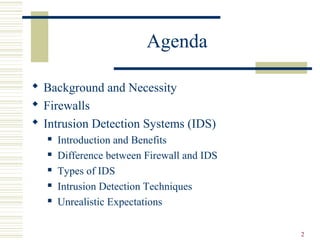
Agenda
 Background and Necessity
 Firewalls
 Intrusion Detection Systems (IDS)
 Introduction and Benefits
 Difference between Firewall and IDS
 Types of IDS
 Intrusion Detection Techniques
 Unrealistic Expectations
3
Historical Facts
 May 1996, 10 major agencies, comprising 98% of Federal
Budget were attacked with 64%64% of attack success rate
 Feb 2000, DOSDOS attacks against world’s largest commercial
web sites including yahoo.com and amazon.com.
 July 2001, Code RedCode Red virus sweeps across the whole world
infecting 150,000150,000 computers in just 1414 hours.
 Sept 2001, NIMDANIMDA virus expands itself to computers all
across US, lasts for days and attacks over 80,00080,000 computers
4
Points to Ponder
 Typical businesses spend only about 0.15% of annual sales
on the security needs of their corporate network [1]
This amount is even less than most of these companiesThis amount is even less than most of these companies
spend on coffee for the staffspend on coffee for the staff
 60% of firms do not have a clue about how much these
security breaches are costing them [2]
Approximately 70 percent of all cyber attacks onApproximately 70 percent of all cyber attacks on
enterprise systems are believed to beenterprise systems are believed to be
perpetrated by trusted insidersperpetrated by trusted insiders
5
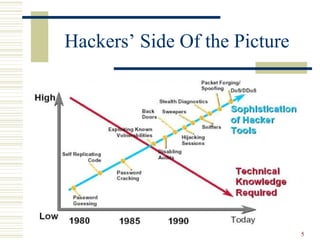
Hackers’ Side Of the Picture
6
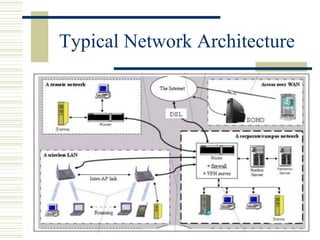
Typical Network Architecture
7
First Line of Defense:
The Firewall
 Primary means of securing a private network against
penetration from a public network
 An access control device, performing perimeter security by
deciding which packets are allowed or denied, and which
must be modified before passing
 Core of enterprise’s comprehensive security policy
 Can monitor all traffic entering and leaving the private
network, and alert the IT staff to any attempts to circumvent
security or patterns of inappropriate use
8
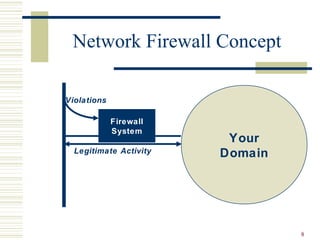
Network Firewall Concept
Firewall
System
Your
DomainLegitimate Activity
Violations
9
Types Of Firewall
 Basic Router Security;Basic Router Security; includes Access control Lists (ACLs) and
Network Address Translation (NAT)
 Packet Filtering;Packet Filtering; includes inspection of data packets based on header
information, source and destination addresses and ports and message
protocol type etc
 Stateful Inspections;Stateful Inspections; includes packet inspections based on sessions
and tracking of individual connections. Packets are allowed to pass only
if associated with a valid session initiated from within the network.
 Application Level Gateways;Application Level Gateways; (Proxy servers) protect specific
network services by restricting the features and commands that can be
accessed from outside the network. Presents reduced feature sets to
external users
10
Introduction to IDS
 IDSs prepare for and deal with attacks by collecting
information from a variety of system and network sources,
then analyzing the symptoms of security problems
 IDSs serve three essential security functions; monitormonitor, detectdetect
and respondrespond to unauthorized activity
 IDS can also response automatically (in real-time) to a
security breach event such as logging off a user, disabling a
user account and launching of some scripts
11
Some of the benefits of IDS
 monitors the operation of firewalls, routers, key management servers
and files critical to other security mechanisms
 allows administrator to tune, organize and comprehend often
incomprehensible operating system audit trails and other logs
 can make the security management of systems by non-expert staff
possible by providing nice user friendly interface
 comes with extensive attack signature database against which
information from the customers system can be matched
 can recognize and report alterations to data files
12
FIREWALLS VS IDSs
13
FIREWALL VS IDS (cont)
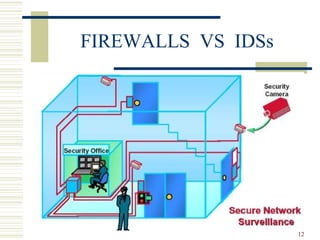
 Firewall cannot detect security breaches associated with
traffic that does not pass through it. Only IDS is aware of
traffic in the internal network
 Not all access to the Internet occurs through the firewall.
 Firewall does not inspect the content of the permitted traffic
 Firewall is more likely to be attacked more often than IDS
 Firewall is usually helpless against tunneling attacks
 IDS is capable of monitoring messages from other pieces of
security infrastructure
14
TYPES OF IDS
1. HOST – BASED (HIDS)
2. NETWORK – BASED (NIDS)
3. HYBRID
15
HIDS
 works in switched network environments
 operates in encrypted environments
 detects and collects the most relevant information in
the quickest possible manner
 tracks behavior changes associated with misuse.
 requires the use of the resources of a host server –
disk space, RAM and CPU time
 Does not protect entire infrastructure
16
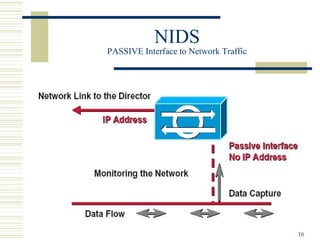
NIDS
PASSIVE Interface to Network Traffic
17
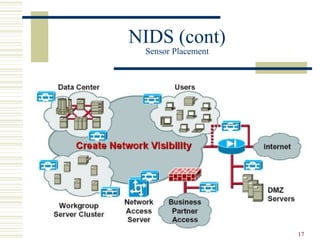
NIDS (cont)
Sensor Placement
18
NIDS (cont)
Advantages
 NIDS uses a passive interface to capture network packets for
analyzing.
 NIDS sensors placed around the globe can be configured to
report back to a central site, enabling a small team of
security experts to support a large enterprise.
 NIDS systems scale well for network protection because the
number of actual workstations, servers, or user systems on
the network is not critical – the amount of traffic is what
matters
 Most network-based IDSs are OS-Independent
 Provide better security against DOS attacks
19
NIDS (cont)
Disadvantages
 Cannot scan protocols or content if network traffic is
encrypted
 Intrusion detection becomes more difficult on modern
switched networks
 Current network-based monitoring approaches cannot
efficiently handle high-speed networks
 Most of Network-based systems are based on predefined
attack signatures--signatures that will always be a step
behind the latest underground exploits
20
HYBRID
 Although the two types of Intrusion Detection Systems
differ significantly from each other, but they also
complement each other.
 Such a system can target activity at any or all levels
 It is easier to see patterns of attacks over time and across the
network space
 No proven industry standards with regards to
interoperability of intrusion detection components
 Hybrid systems are difficult to manage and deploy
21
INTRUSION DETECTION
TECHNIQUES
 MISUSE DETECTION (SIGNATUREMISUSE DETECTION (SIGNATURE
ANALYSIS)ANALYSIS)
1. PATTERN MATCHING
2. STATEFUL PATTERN MATCHING
3. PROTOCOL DECODE BASED ANALYSIS
4. HEURISTIC BASED ANALYSIS
 TARGET MONITORINGTARGET MONITORING
22
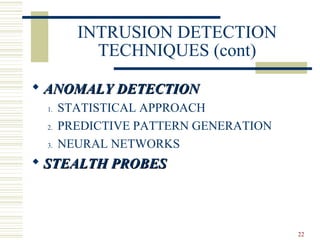
INTRUSION DETECTION
TECHNIQUES (cont)
 ANOMALY DETECTIONANOMALY DETECTION
1. STATISTICAL APPROACH
2. PREDICTIVE PATTERN GENERATION
3. NEURAL NETWORKS
 STEALTH PROBESSTEALTH PROBES
23
IDS is not a SILVER BULLETSILVER BULLET
 cannot conduct investigations of attacks without
human intervention
 cannot intuit the contents of your organizational
security policy
 cannot compensate for weaknesses in network
protocols
 cannot compensate for weak identification and
authentication mechanisms
 capable of monitoring network traffic but to a
certain extent of traffic level
24
Bibliography
[1] “Inoculating The Network”
By Mathias Thurman
EBSCO HOST Research Databases
[2] National Strategy To Secure Cyberspace
Draft September 2002
www.securecyberspace.gov
[3] An Introduction to Intrusion Detection / Assessment
By Rebecca Bace
http://www.icsalabs.com
[4] White paper on “The Science Of Intrusion Detection System
– Attack Identification”
http://www.cisco.com

Intrusion Detection System

  • 1.
    1 Intrusion Detection Systems PRESENTEDBYPRESENTED BY Mohit Chandra BelwalMohit Chandra Belwal
  • 2.
    2 Agenda  Background andNecessity  Firewalls  Intrusion Detection Systems (IDS)  Introduction and Benefits  Difference between Firewall and IDS  Types of IDS  Intrusion Detection Techniques  Unrealistic Expectations
  • 3.
    3 Historical Facts  May1996, 10 major agencies, comprising 98% of Federal Budget were attacked with 64%64% of attack success rate  Feb 2000, DOSDOS attacks against world’s largest commercial web sites including yahoo.com and amazon.com.  July 2001, Code RedCode Red virus sweeps across the whole world infecting 150,000150,000 computers in just 1414 hours.  Sept 2001, NIMDANIMDA virus expands itself to computers all across US, lasts for days and attacks over 80,00080,000 computers
  • 4.
    4 Points to Ponder Typical businesses spend only about 0.15% of annual sales on the security needs of their corporate network [1] This amount is even less than most of these companiesThis amount is even less than most of these companies spend on coffee for the staffspend on coffee for the staff  60% of firms do not have a clue about how much these security breaches are costing them [2] Approximately 70 percent of all cyber attacks onApproximately 70 percent of all cyber attacks on enterprise systems are believed to beenterprise systems are believed to be perpetrated by trusted insidersperpetrated by trusted insiders
  • 5.
  • 6.
  • 7.
    7 First Line ofDefense: The Firewall  Primary means of securing a private network against penetration from a public network  An access control device, performing perimeter security by deciding which packets are allowed or denied, and which must be modified before passing  Core of enterprise’s comprehensive security policy  Can monitor all traffic entering and leaving the private network, and alert the IT staff to any attempts to circumvent security or patterns of inappropriate use
  • 8.
  • 9.
    9 Types Of Firewall Basic Router Security;Basic Router Security; includes Access control Lists (ACLs) and Network Address Translation (NAT)  Packet Filtering;Packet Filtering; includes inspection of data packets based on header information, source and destination addresses and ports and message protocol type etc  Stateful Inspections;Stateful Inspections; includes packet inspections based on sessions and tracking of individual connections. Packets are allowed to pass only if associated with a valid session initiated from within the network.  Application Level Gateways;Application Level Gateways; (Proxy servers) protect specific network services by restricting the features and commands that can be accessed from outside the network. Presents reduced feature sets to external users
  • 10.
    10 Introduction to IDS IDSs prepare for and deal with attacks by collecting information from a variety of system and network sources, then analyzing the symptoms of security problems  IDSs serve three essential security functions; monitormonitor, detectdetect and respondrespond to unauthorized activity  IDS can also response automatically (in real-time) to a security breach event such as logging off a user, disabling a user account and launching of some scripts
  • 11.
    11 Some of thebenefits of IDS  monitors the operation of firewalls, routers, key management servers and files critical to other security mechanisms  allows administrator to tune, organize and comprehend often incomprehensible operating system audit trails and other logs  can make the security management of systems by non-expert staff possible by providing nice user friendly interface  comes with extensive attack signature database against which information from the customers system can be matched  can recognize and report alterations to data files
  • 12.
  • 13.
    13 FIREWALL VS IDS(cont)  Firewall cannot detect security breaches associated with traffic that does not pass through it. Only IDS is aware of traffic in the internal network  Not all access to the Internet occurs through the firewall.  Firewall does not inspect the content of the permitted traffic  Firewall is more likely to be attacked more often than IDS  Firewall is usually helpless against tunneling attacks  IDS is capable of monitoring messages from other pieces of security infrastructure
  • 14.
    14 TYPES OF IDS 1.HOST – BASED (HIDS) 2. NETWORK – BASED (NIDS) 3. HYBRID
  • 15.
    15 HIDS  works inswitched network environments  operates in encrypted environments  detects and collects the most relevant information in the quickest possible manner  tracks behavior changes associated with misuse.  requires the use of the resources of a host server – disk space, RAM and CPU time  Does not protect entire infrastructure
  • 16.
  • 17.
  • 18.
    18 NIDS (cont) Advantages  NIDSuses a passive interface to capture network packets for analyzing.  NIDS sensors placed around the globe can be configured to report back to a central site, enabling a small team of security experts to support a large enterprise.  NIDS systems scale well for network protection because the number of actual workstations, servers, or user systems on the network is not critical – the amount of traffic is what matters  Most network-based IDSs are OS-Independent  Provide better security against DOS attacks
  • 19.
    19 NIDS (cont) Disadvantages  Cannotscan protocols or content if network traffic is encrypted  Intrusion detection becomes more difficult on modern switched networks  Current network-based monitoring approaches cannot efficiently handle high-speed networks  Most of Network-based systems are based on predefined attack signatures--signatures that will always be a step behind the latest underground exploits
  • 20.
    20 HYBRID  Although thetwo types of Intrusion Detection Systems differ significantly from each other, but they also complement each other.  Such a system can target activity at any or all levels  It is easier to see patterns of attacks over time and across the network space  No proven industry standards with regards to interoperability of intrusion detection components  Hybrid systems are difficult to manage and deploy
  • 21.
    21 INTRUSION DETECTION TECHNIQUES  MISUSEDETECTION (SIGNATUREMISUSE DETECTION (SIGNATURE ANALYSIS)ANALYSIS) 1. PATTERN MATCHING 2. STATEFUL PATTERN MATCHING 3. PROTOCOL DECODE BASED ANALYSIS 4. HEURISTIC BASED ANALYSIS  TARGET MONITORINGTARGET MONITORING
  • 22.
    22 INTRUSION DETECTION TECHNIQUES (cont) ANOMALY DETECTIONANOMALY DETECTION 1. STATISTICAL APPROACH 2. PREDICTIVE PATTERN GENERATION 3. NEURAL NETWORKS  STEALTH PROBESSTEALTH PROBES
  • 23.
    23 IDS is nota SILVER BULLETSILVER BULLET  cannot conduct investigations of attacks without human intervention  cannot intuit the contents of your organizational security policy  cannot compensate for weaknesses in network protocols  cannot compensate for weak identification and authentication mechanisms  capable of monitoring network traffic but to a certain extent of traffic level
  • 24.
    24 Bibliography [1] “Inoculating TheNetwork” By Mathias Thurman EBSCO HOST Research Databases [2] National Strategy To Secure Cyberspace Draft September 2002 www.securecyberspace.gov [3] An Introduction to Intrusion Detection / Assessment By Rebecca Bace http://www.icsalabs.com [4] White paper on “The Science Of Intrusion Detection System – Attack Identification” http://www.cisco.com