ANCILLARY BOTANY
PLANT DIVERSITY
4-2
PTERIDOPHYTES
-SELAGINELLA
BOTRVMSBKCAPK
SELAGINELLA
POINTS TO REMEMBER
⚫ Commonly called Spike Moss.
⚫ Plant body is Diploid Sporophyte.
⚫ Perennial Herb.
⚫ Presence of Unbranched Root like Structures called Rhizophores.
⚫ Rhizophore is Monarch
⚫ Have Two Sub-Genus called Homoeophyllum and Heterophyllum.
⚫ Leaves are Ligulate.
⚫ Leaf has Ligule.
⚫ Stele is Protostele
⚫ Sporangia are Eusporangiate type.
⚫ Selaginella is Heterosporous Pteridophytes.
⚫ Selaginella is Ligulate Pteridophytes.
BOTRVMSBKCAPK
SELAGINELLA
SYSTEMATIC POSITION
SYSTEMATIC POSITION
▪ DIVISION : LYCOPHYTA
▪ CLASS : LIGULOPSIDA
▪ ORDER : SELAGINELLA
▪ FAMILY : SELAGINELLACEAE
▪ GENUS : SELAGINELLA
▪ SPECIES : 700
BOTRVMSBKCAPK
SELAGINELLA
STRUCTURE OF PLANT BODY
STRUCTURE OF SELAGINELLA or
STRUCTURE OF PLANT BODY of SELAGINELLA or
STRUCTURE OF SPOROPHYTIC BODY OF SELAGINELLA
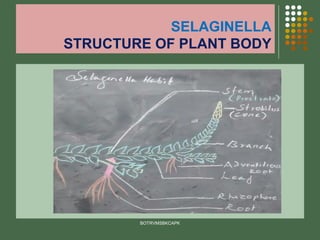
⚫ Selaginella is commonly called Spike Moss.
⚫ It is Live in Moist and Shady Places of Forest.
⚫ The Plant Body is Diploid Sporophyte.
⚫ The Sporophyte is Perennial Herb consists of
▪ Root
▪ Stem
▪ Leaves
▪ Rhizophores and
▪ Cones
BOTRVMSBKCAPK
SELAGINELLA
STRUCTURE OF PLANT BODY
BOTRVMSBKCAPK
SELAGINELLA
STRUCTURE OF PLANT BODY
BOTRVMSBKCAPK
ROOT
• It is Adventitious
Root System.
• It is used for
Fixation and
Absorption.
STEM
• Stem is Erect or
Prostrate and
Herbaceous.
• Branches are
Dichotomous
SELAGINELLA
STRUCTURE OF PLANT BODY
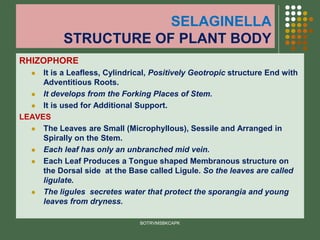
RHIZOPHORE
⚫ It is a Leafless, Cylindrical, Positively Geotropic structure End with
Adventitious Roots.
⚫ It develops from the Forking Places of Stem.
⚫ It is used for Additional Support.
LEAVES
⚫ The Leaves are Small (Microphyllous), Sessile and Arranged in
Spirally on the Stem.
⚫ Each leaf has only an unbranched mid vein.
⚫ Each Leaf Produces a Tongue shaped Membranous structure on
the Dorsal side at the Base called Ligule. So the leaves are called
ligulate.
⚫ The ligules secretes water that protect the sporangia and young
leaves from dryness.
BOTRVMSBKCAPK
SELAGINELLA
STRUCTURE OF PLANT BODY
BOTRVMSBKCAPK
CONES or STROBILI
• Cones are Spore Producing
Reproductive Structures formed at the
Tip of Branches.
• Each cone or strobilus contains many
Sporophylls.
• Each Sporophyll has Spore producing
special structure called Sporangium.
SELAGINELLA
INTERNAL STRUCTURE OF STEM
INTERNAL STRUCTURE OF
SELAGINELLA STEM
The Transverse Section
(T.S) of Selaginella stem shows
Epidermis
Cortex and
Stele.
EPIDERMIS
• It is an Outer Most
Multicellular Unilayer.
• Cuticle is Present.
• Stomata are Absent.
• It Gives Protection to the
Internal Tissues.
BOTRVMSBKCAPK
SELAGINELLA
INTERNAL STRUCTURE OF STEM
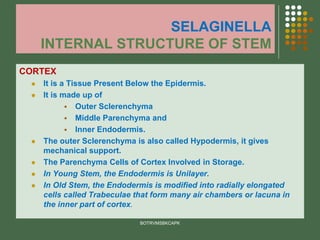
CORTEX
⚫ It is a Tissue Present Below the Epidermis.
⚫ It is made up of
▪ Outer Sclerenchyma
▪ Middle Parenchyma and
▪ Inner Endodermis.
⚫ The outer Sclerenchyma is also called Hypodermis, it gives
mechanical support.
⚫ The Parenchyma Cells of Cortex Involved in Storage.
⚫ In Young Stem, the Endodermis is Unilayer.
⚫ In Old Stem, the Endodermis is modified into radially elongated
cells called Trabeculae that form many air chambers or lacuna in
the inner part of cortex.
BOTRVMSBKCAPK
SELAGINELLA
INTERNAL STRUCTURE OF STEM
STELE
⚫ It is an innermost conductive tissue.
⚫ Stele is Protostele that is xylem is surrounded by phloem.
⚫ Stele may be
▪ Monostelic - presence of one stele
▪ Distelic - presence of two steles
▪ Tristelic - presence of three steles
⚫ Stele consists of
▪ Pericycle and
▪ Vascular tissue.
⚫ Pericycle is a multicellular Unilayer and it encloses the vascular
tissue
⚫ Vascular Tissue consists of
▪ Xylem and
▪ Phloem
BOTRVMSBKCAPK
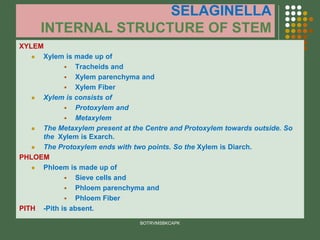
XYLEM
⚫ Xylem is made up of
▪ Tracheids and
▪ Xylem parenchyma and
▪ Xylem Fiber
⚫ Xylem is consists of
▪ Protoxylem and
▪ Metaxylem
⚫ The Metaxylem present at the Centre and Protoxylem towards outside. So
the Xylem is Exarch.
⚫ The Protoxylem ends with two points. So the Xylem is Diarch.
PHLOEM
⚫ Phloem is made up of
▪ Sieve cells and
▪ Phloem parenchyma and
▪ Phloem Fiber
PITH -Pith is absent.
SELAGINELLA
INTERNAL STRUCTURE OF STEM
BOTRVMSBKCAPK
SELAGINELLA
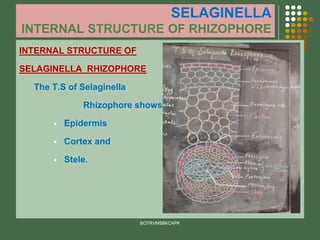
INTERNAL STRUCTURE OF RHIZOPHORE
INTERNAL STRUCTURE OF
SELAGINELLA RHIZOPHORE
The T.S of Selaginella
Rhizophore shows
▪ Epidermis
▪ Cortex and
▪ Stele.
BOTRVMSBKCAPK
SELAGINELLA
INTERNAL STRUCTURE OF RHIZOPHORE
EPIDERMIS
⚫ It is an Outer Most Multicellular Unilayer.
⚫ Cuticle is Present.
⚫ Stomata are Absent.
⚫ It gives Protection to the internal tissue.
CORTEX
⚫ It is a tissue present below the epidermis.
⚫ It is made up of
▪ Outer Sclerenchyma
▪ Middle Parenchyma and
▪ Inner Endodermis.
⚫ The Inner Most Cells of cortex are arranged in a layer is
called Endodermis.
BOTRVMSBKCAPK
SELAGINELLA
INTERNAL STRUCTURE OF RHIZOPHORE
STELE
⚫ It is an innermost conductive tissue.
⚫ Stele is Protostele that is xylem is surrounded by phloem.
⚫ It consists of
▪ Pericycle and
▪ Vascular Tissue
⚫ Pericycle is multicellular Unilayer that enclose the vascular
tissue.
⚫ Vascular Tissue is consists of
▪ Xylem and
▪ Phloem
⚫ Xylem is Exarch & Monarch
BOTRVMSBKCAPK
SELAGINELLA
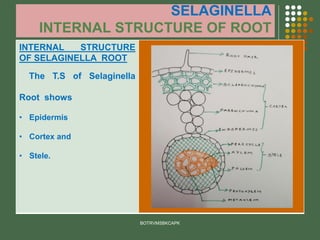
INTERNAL STRUCTURE OF ROOT
INTERNAL STRUCTURE
OF SELAGINELLA ROOT
The T.S of Selaginella
Root shows
• Epidermis
• Cortex and
• Stele.
BOTRVMSBKCAPK
SELAGINELLA
INTERNAL STRUCTURE OF ROOT
EPIDERMIS
⚫ It is an outer most multicellular Unilayer.
⚫ Some Epidermal cells Extent outsides to form Unicellular Root
Hairs.
⚫ Root Hairs are involved in absorption
⚫ It gives protection to the internal tissue.
CORTEX
⚫ It is a tissue present below the epidermis.
⚫ It is made up of
⚫ Outer Sclerenchyma
⚫ Middle Parenchyma and
⚫ Inner Endodermis.
⚫ The inner most cells of cortex are arranged in a layer is called
endodermis.
BOTRVMSBKCAPK
SELAGINELLA
INTERNAL STRUCTURE OF ROOT
STELE
⚫ It is an innermost conductive tissue.
⚫ Stele is Protostele that is xylem is surrounded by phloem.
⚫ It consists of
▪ Pericycle and
▪ Vascular Tissue
⚫ Pericycle is multicellular unilayer that enclose the vascular tissue.
⚫ Vascular Tissue is consists of
▪ Xylem and
▪ Phloem
⚫ Xylem is Exarch & Monarch
BOTRVMSBKCAPK
SELAGINELLA
INTERNAL STRUCTURE OF LEAF
.
BOTRVMSBKCAPK
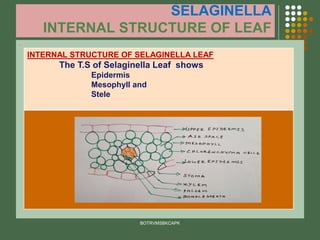
INTERNAL STRUCTURE OF SELAGINELLA LEAF
The T.S of Selaginella Leaf shows
Epidermis
Mesophyll and
Stele
SELAGINELLA
INTERNAL STRUCTURE OF LEAF
EPIDERMIS
⚫ It is an outer most multicellular unilayer.
⚫ It is of two types
▪ Upper Epidermis and
▪ Lower Epidermis
⚫ Cuticle is present.
⚫ Stomata are present in the lower epidermis.
⚫ The epidermal cells contains chloroplast
⚫ It gives protection to the internal tissue and also involved in
photosynthesis
BOTRVMSBKCAPK
SELAGINELLA
INTERNAL STRUCTURE OF LEAF
MESOPHYLL
⚫ It is a tissue present between upper and lower epidermis.
⚫ It is made up of Chlorenchyma Cells with many air spaces.
⚫ It is involved in photosynthesis.
STELE
⚫ It is an innermost conductive tissue.
⚫ Stele is Protostele that is xylem is surrounded by phloem.
⚫ It consists of
▪ Bundle sheath and
▪ Vascular Tissue
⚫ Bundle sheath is multicellular unilayer and it encloses the vascular
tissue.
⚫ Vascular Tissue is consists of
▪ Xylem and
▪ Phloem
BOTRVMSBKCAPK
SELAGINELLA
REPRODUCTION
REPRODUCTION
Selaginella Reproduced by
▪ Vegetative Reproduction and
▪ Asexual Reproduction
VEGETATIVE REPRODUCTION
It takes place by
▪ Adventitious Branches
▪ Tubers and
▪ Bulbils
BOTRVMSBKCAPK
SELAGINELLA
REPRODUCTION
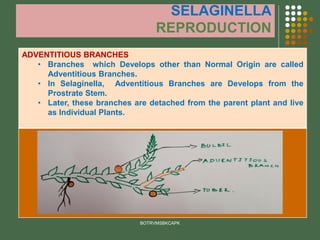
ADVENTITIOUS BRANCHES
• Branches which Develops other than Normal Origin are called
Adventitious Branches.
• In Selaginella, Adventitious Branches are Develops from the
Prostrate Stem.
• Later, these branches are detached from the parent plant and live
as Individual Plants.
BOTRVMSBKCAPK
SELAGINELLA
REPRODUCTION
TUBERS
⚫ Enlarged underground structures due to the storage of food are
called Tubers.
⚫ Tubers are develops on the Root or Underground branches of
Selaginella
⚫ During unfavorable season, when the aerial parts die, the tubers
are retain under the soil in dormant condition
⚫ Later, in favorable season the tubers germinate into new plants.
BULBILS
⚫ The Aerial Resting Buds are called Bulbils.
⚫ Bulbils are develops on the aerial branches
⚫ Later, these buds detached and grown in to new plants.
BOTRVMSBKCAPK
SELAGINELLA
REPRODUCTION -ASEXUAL REPRODUCTION
ASEXUAL REPRODUCTION
⚫ The Plant Body of Selaginella is a Diploid Sporophyte
⚫ It reproduces asexually by spores through the special structure
called Cones or Strobili
⚫ Selaginella is a Heterospores, it Produces Two Types of Spores
namely
▪ Microspores and
▪ Megaspores.
⚫
BOTRVMSBKCAPK
SELAGINELLA
REPRODUCTION -ASEXUAL REPRODUCTION
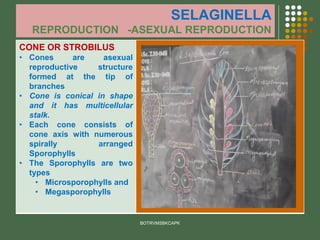
CONE OR STROBILUS
• Cones are asexual
reproductive structure
formed at the tip of
branches
• Cone is conical in shape
and it has multicellular
stalk.
• Each cone consists of
cone axis with numerous
spirally arranged
Sporophylls
• The Sporophylls are two
types
• Microsporophylls and
• Megasporophylls
BOTRVMSBKCAPK
SELAGINELLA
REPRODUCTION -ASEXUAL REPRODUCTION
.
BOTRVMSBKCAPK
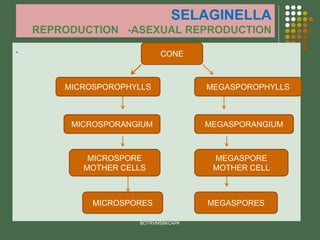
CONE
MICROSPOROPHYLLS MEGASPOROPHYLLS
MICROSPORE
MOTHER CELLS
MEGASPORE
MOTHER CELL
MEGASPORANGIUM
MICROSPORANGIUM
MICROSPORES MEGASPORES
SELAGINELLA
REPRODUCTION -ASEXUAL REPRODUCTION
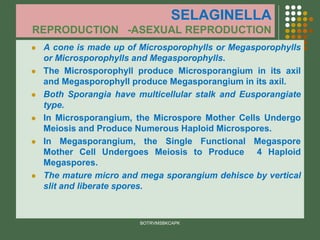
⚫ A cone is made up of Microsporophylls or Megasporophylls
or Microsporophylls and Megasporophylls.
⚫ The Microsporophyll produce Microsporangium in its axil
and Megasporophyll produce Megasporangium in its axil.
⚫ Both Sporangia have multicellular stalk and Eusporangiate
type.
⚫ In Microsporangium, the Microspore Mother Cells Undergo
Meiosis and Produce Numerous Haploid Microspores.
⚫ In Megasporangium, the Single Functional Megaspore
Mother Cell Undergoes Meiosis to Produce 4 Haploid
Megaspores.
⚫ The mature micro and mega sporangium dehisce by vertical
slit and liberate spores.
BOTRVMSBKCAPK
SELAGINELLAL REPRODUCTION
-ASEXUAL REPRODUCTION
MICROSPORES
⚫ The Microspores is Small, Spherical and Unicellular.
⚫ Microspore Consists of
▪ Spore Wall and
▪ Protoplasm.
⚫ The Protoplasm Contains Dense Cytoplasm and a Haploid Nucleus.
MEGASPORES
⚫ The Megaspore is Big, Spherical and Unicellular.
⚫ Megaspore Consists of
▪ Spore Wall and
▪ Protoplasm.
⚫ Protoplasm Contains Dense Cytoplasm and a Haploid Nucleus with
large vacuole present below the nucleus.
BOTRVMSBKCAPK
SELAGINELLA
GAMETOPHYTIC BODY -REPRODUCTION
GAMETOPHYTIC BODY
⚫ The Gametophytic Body of Selaginella is Small and Haploid
⚫ The Gametophytic Body of Selaginella is Dioecious that is
the Male and Female Gametophytes are Separated
REPRODUCTION OF GAMETOPHYTIC BODY OF SELAGINELLA
Gametophytic body Reproduce by
▪ Sexual Reproduction
SEXUAL REPRODUCTION
⚫ Sexual Reproduction is Oogamous type.
BOTRVMSBKCAPK
SELAGINELLA
GAMETOPHYTIC BODY -REPRODUCTION
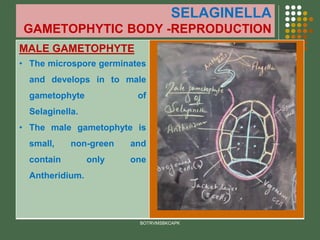
MALE GAMETOPHYTE
• The microspore germinates
and develops in to male
gametophyte of
Selaginella.
• The male gametophyte is
small, non-green and
contain only one
Antheridium.
BOTRVMSBKCAPK
SELAGINELLA
GAMETOPHYTIC BODY -REPRODUCTION
GERMINATION OF MICROSPORE
⚫ The microspore is a first cell of male gametophyte
⚫ The microspore divides to form two cells namely
▪ Prothallial Cell and
▪ Antheridial Cell
⚫ The Prothallial Cell is a Vegetative Cell of Male Gametophyte.
⚫ The Antheridial Cell divides and gives rise to Male Sex Organ called
Antheridium.
⚫ The Antheridial Cell divides repeatedly to form 12 cells in which
central 4 are primary Androgonial Cells and outer 8 are Jacket
Layer cells of Antheridium
BOTRVMSBKCAPK
SELAGINELLA
GAMETOPHYTIC BODY -REPRODUCTION
GERMINATION OF MICROSPORE
⚫ The mature Male Gametophyte is made up of
▪ One Prothallial cell
▪ Four Androgonial cells and
▪ Eight Jacket cells
⚫ Usually the microspores are liberated in 13-Celled condition from
the microsporangium
⚫ The Development of Male Gametophyte Starts inside the
Microspore which presents inside the Microsporangium up to 13-
Celled stage and then Released from Microsporangium.
⚫ The further Development of Male Gametophyte takes place on the
Soil.
BOTRVMSBKCAPK
SELAGINELLA
GAMETOPHYTIC BODY -REPRODUCTION
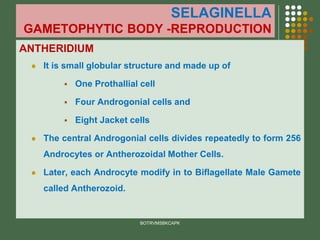
ANTHERIDIUM
⚫ It is small globular structure and made up of
▪ One Prothallial cell
▪ Four Androgonial cells and
▪ Eight Jacket cells
⚫ The central Androgonial cells divides repeatedly to form 256
Androcytes or Antherozoidal Mother Cells.
⚫ Later, each Androcyte modify in to Biflagellate Male Gamete
called Antherozoid.
BOTRVMSBKCAPK
SELAGINELLA
GAMETOPHYTIC BODY -REPRODUCTION
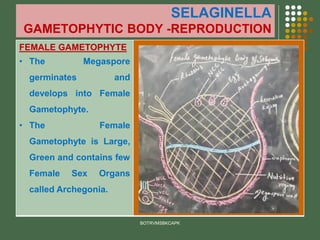
FEMALE GAMETOPHYTE
• The Megaspore
germinates and
develops into Female
Gametophyte.
• The Female
Gametophyte is Large,
Green and contains few
Female Sex Organs
called Archegonia.
BOTRVMSBKCAPK
SELAGINELLA
GAMETOPHYTIC BODY -REPRODUCTION
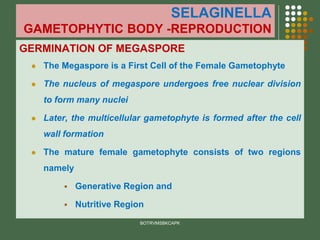
GERMINATION OF MEGASPORE
⚫ The Megaspore is a First Cell of the Female Gametophyte
⚫ The nucleus of megaspore undergoes free nuclear division
to form many nuclei
⚫ Later, the multicellular gametophyte is formed after the cell
wall formation
⚫ The mature female gametophyte consists of two regions
namely
▪ Generative Region and
▪ Nutritive Region
BOTRVMSBKCAPK
SELAGINELLA
GAMETOPHYTIC BODY -REPRODUCTION
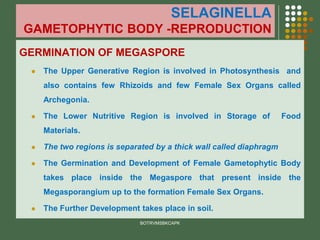
GERMINATION OF MEGASPORE
⚫ The Upper Generative Region is involved in Photosynthesis and
also contains few Rhizoids and few Female Sex Organs called
Archegonia.
⚫ The Lower Nutritive Region is involved in Storage of Food
Materials.
⚫ The two regions is separated by a thick wall called diaphragm
⚫ The Germination and Development of Female Gametophytic Body
takes place inside the Megaspore that present inside the
Megasporangium up to the formation Female Sex Organs.
⚫ The Further Development takes place in soil.
BOTRVMSBKCAPK
SELAGINELLA
GAMETOPHYTIC BODY -REPRODUCTION
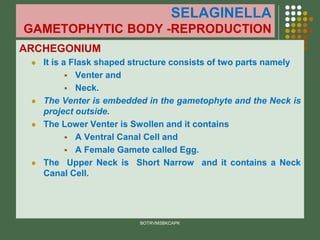
ARCHEGONIUM
⚫ It is a Flask shaped structure consists of two parts namely
▪ Venter and
▪ Neck.
⚫ The Venter is embedded in the gametophyte and the Neck is
project outside.
⚫ The Lower Venter is Swollen and it contains
▪ A Ventral Canal Cell and
▪ A Female Gamete called Egg.
⚫ The Upper Neck is Short Narrow and it contains a Neck
Canal Cell.
BOTRVMSBKCAPK
SELAGINELLA
GAMETOPHYTIC BODY -REPRODUCTION
FERTILIZATION
⚫ Water is Essential for Fertilization
⚫ At maturity, the Neck Canal Cell and a Venter Canal Cell are
disorganise to form mucilage mass.
⚫ The mucilage mass absorb water and ooze out to form a passage
for the entry of male gametes.
⚫ Many male gametes Antherozoids are enter in to Archegonium and
any one fuse with the female gamete Egg to form Diploid Zygote.
⚫ Later, the Zygote develops in to multicellular Embryo.
BOTRVMSBKCAPK
SELAGINELLA
GAMETOPHYTIC BODY -REPRODUCTION
.
BOTRVMSBKCAPK
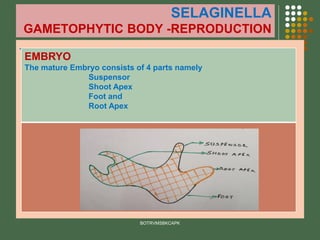
EMBRYO
The mature Embryo consists of 4 parts namely
Suspensor
Shoot Apex
Foot and
Root Apex
SELAGINELLA
GAMETOPHYTIC BODY -REPRODUCTION
⚫ The suspensor keeps the embryo with in the female gametophyte.
⚫ The foot provides nourishment from the gametophyte to the embryo
⚫ The primary root that grows down wards and fixing the embryo in to
the soil
⚫ The shoot apex that develops in to the young Sporophytic plant
⚫ Finally, the embryo develops in to diploid Sporophytic body of
Selaginella.
BOTRVMSBKCAPK
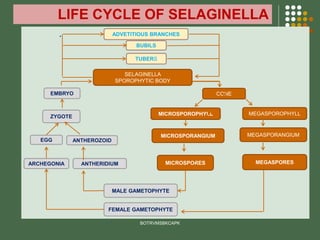
LIFE CYCLE OF SELAGINELLA
LIFE CYCLE
⚫ The Life Cycle of Selaginella is Alternations of Generation
and it consists of Two Bodies namely
▪ Sporophytic Body and
▪ Gametophytic Body
⚫ In which spores producing Sporophytic Body and gametes
producing Gametophytic Body are Depends each other and
Alternate with one another.
BOTRVMSBKCAPK
LIFE CYCLE OF SELAGINELLA
.
BOTRVMSBKCAPK
SELAGINELLA
SPOROPHYTIC BODY
MEGASPORANGIUM
MICROSPOROPHYLL
CONE
MEGASPOROPHYLL
MICROSPORES MEGASPORES
MICROSPORANGIUM
EMBRYO
MALE GAMETOPHYTE
FEMALE GAMETOPHYTE
ANTHERIDIUM
ARCHEGONIA
ZYGOTE
EGG ANTHEROZOID
ADVETITIOUS BRANCHES
BUBILS
TUBERS