CHAPTER 4 :
REPRODUCTION & GROWTH


4.5 – SEXUAL REPRODUCTION IN FLOWERING PLANTS
LEARNING OUTCOMES
• Identify male & female structure in a flower;
• Describe the formation of pollen grains;
• Describe the formation of the embryo sac in the
  ovule;
• Describe the formation of pollen tube;
• Describe the formation of zygote;
• Describe the formation of triploid nucleus;
• Conceptualise double fertilisation;
• Relate the structure of a fruit to the flower parts;
• Explain the importance of double fertilisation for
  the survival of flowering plants.
TH E G E N E R A L S TR U C TU R E
        O F A F L O WE R
• FLOWER = a modified shoot which is the
  reproductive structure of angiosperms.
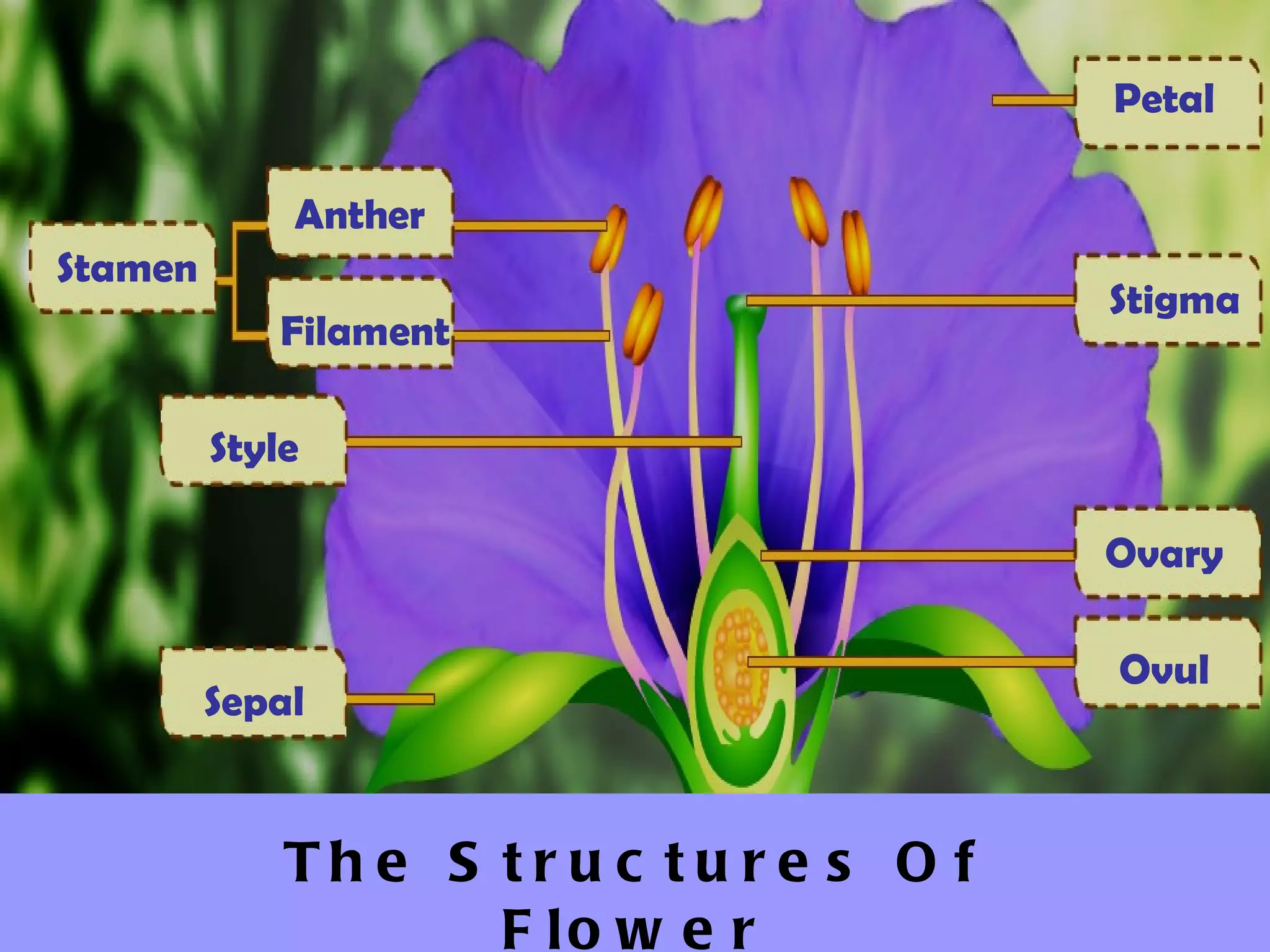
Petal

             Anther
Stamen
                                        Stigma
            Filament

         Style

                                        Ovary

                                        Ovul
         Sepal


             Th e S tru c tu re s O f
                    F lo w e r
• Each part of the flower serves a certain
  function :
  – the pedicel supports the flower in the best
    position for pollination;
  – The petals are usually big & brightly
    coloured to attract insects @ birds for
    pollination;
  – The sepals protect the flower when it is still
    a bud.
• The male structure = stamen
  (consists of a filament & an
  anther).

• The anther functions in
  producing pollen grains & is
  supported by the filament.

• The male gametes are found in
  the pollen grain.
• The female structure = pistil
  (consists of stigma, style & ovary).

• Inside the ovary, one @ more
  ovules can be found.

• The female gametes @ egg cell is
  found in the ovule.

• Pollen grain are received by the
  stigma.
THE FORMATION OF POLLEN
          GRAINS
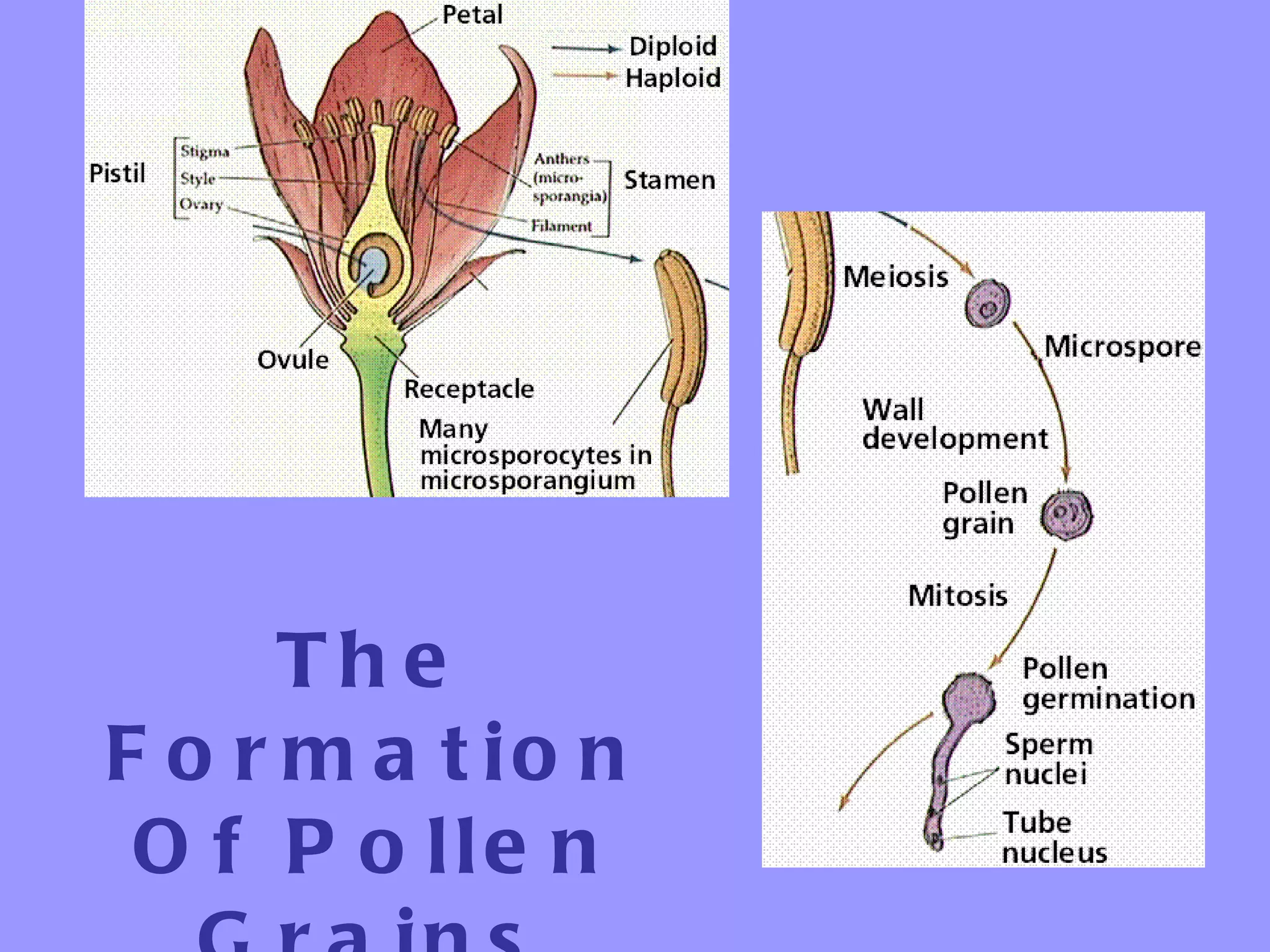
• Are formed in the anther.

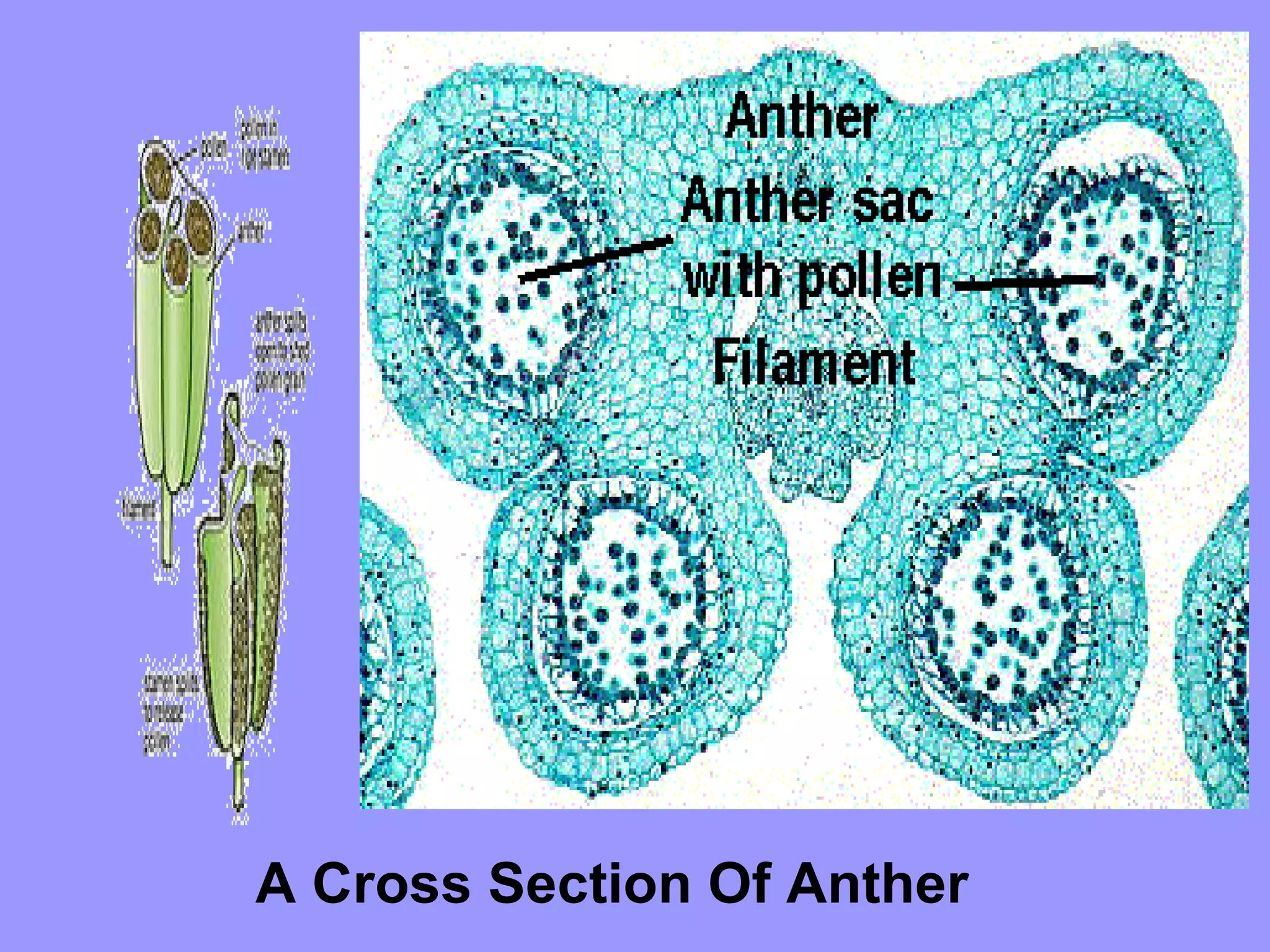
• Each anther contains 4 chambers called
  pollen sacs in which pollen grains are
  formed.

• The tapetum provides nourishment to
  the developing pollen grains.
A Cross Section Of Anther
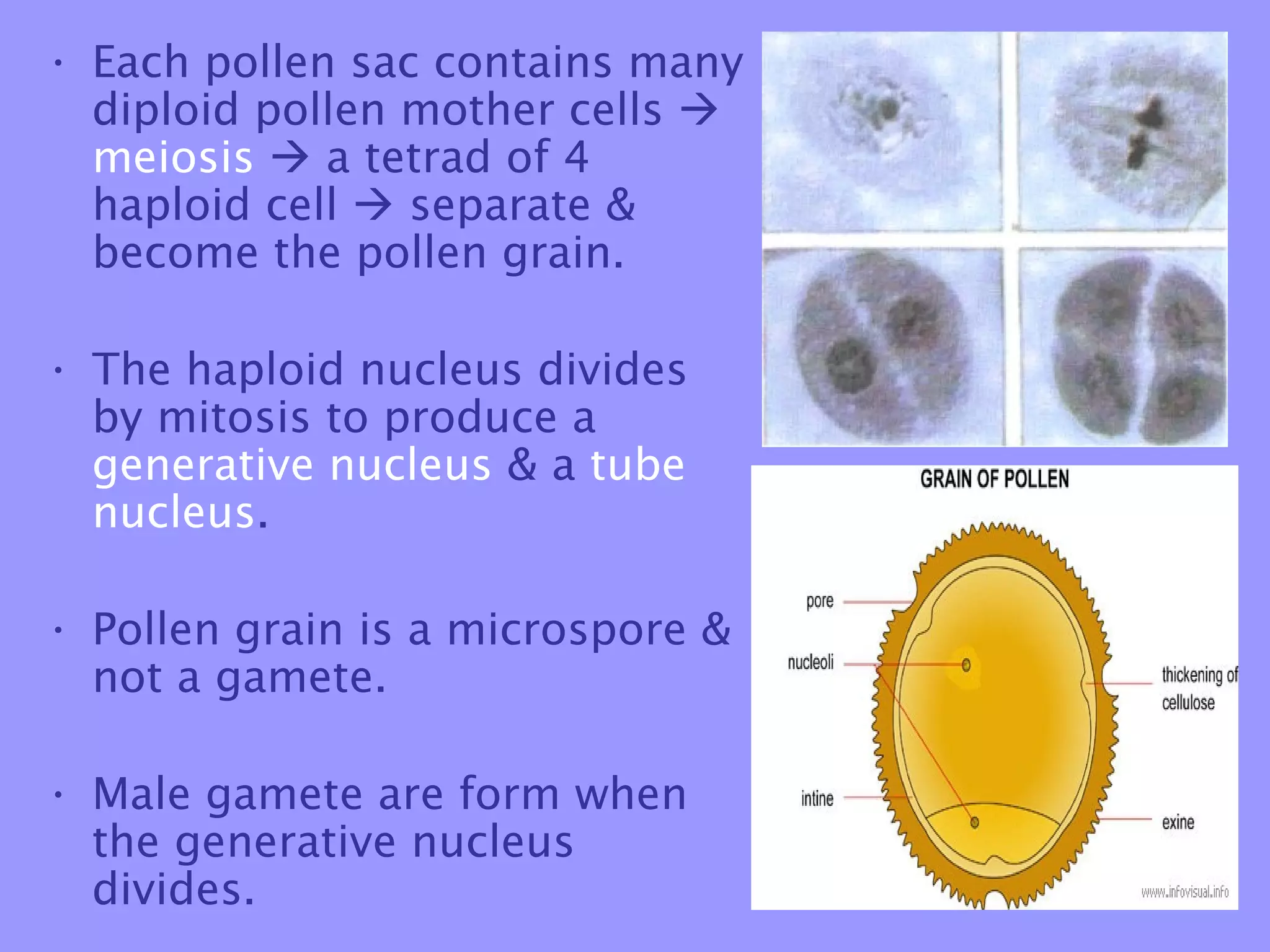
• Each pollen sac contains many
  diploid pollen mother cells 
  meiosis  a tetrad of 4
  haploid cell  separate &
  become the pollen grain.

• The haploid nucleus divides
  by mitosis to produce a
  generative nucleus & a tube
  nucleus.

• Pollen grain is a microspore &
  not a gamete.

• Male gamete are form when
  the generative nucleus
  divides.
Th e
F o r m a t io n
 O f P o lle n
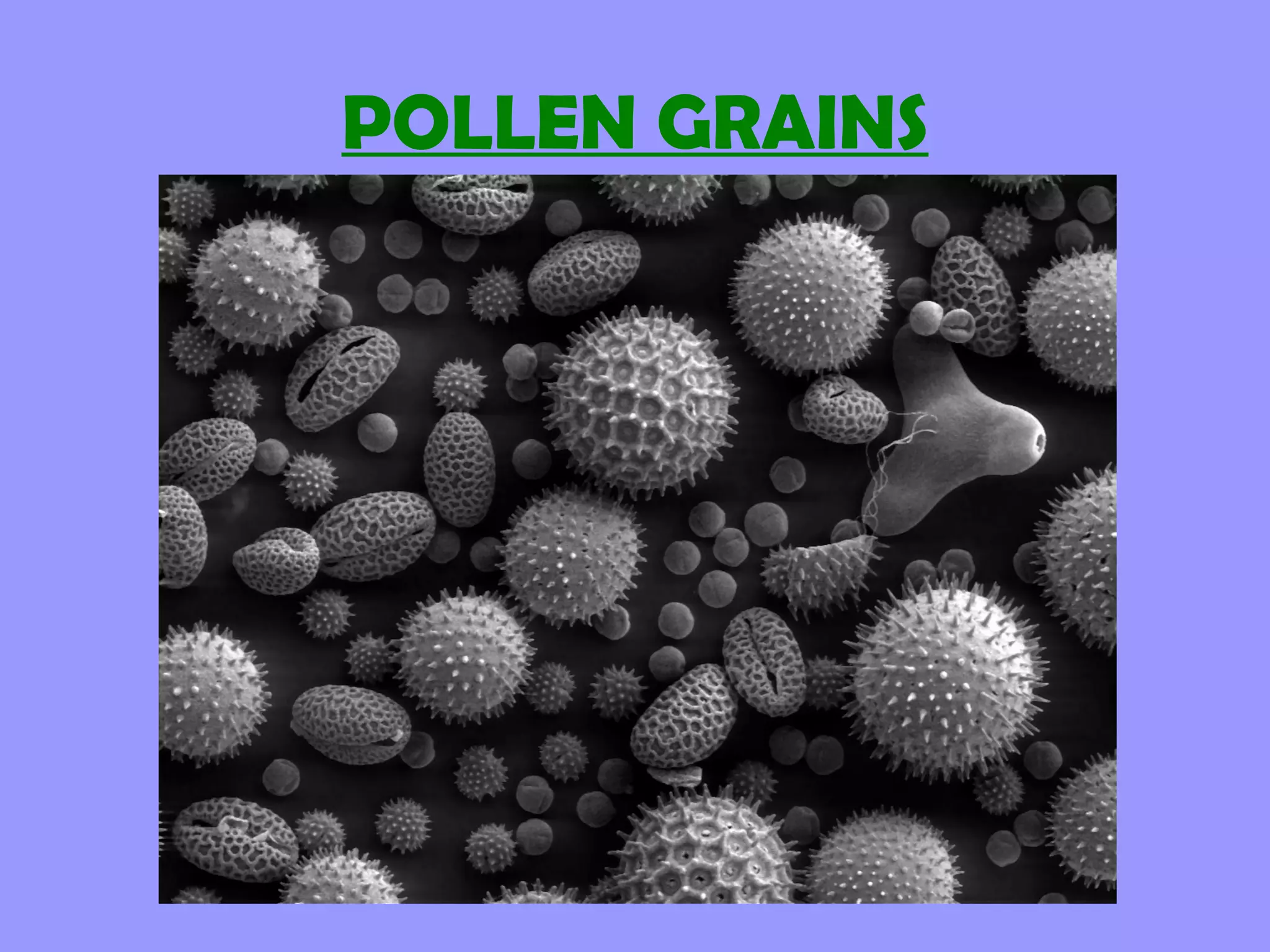
POLLEN GRAINS
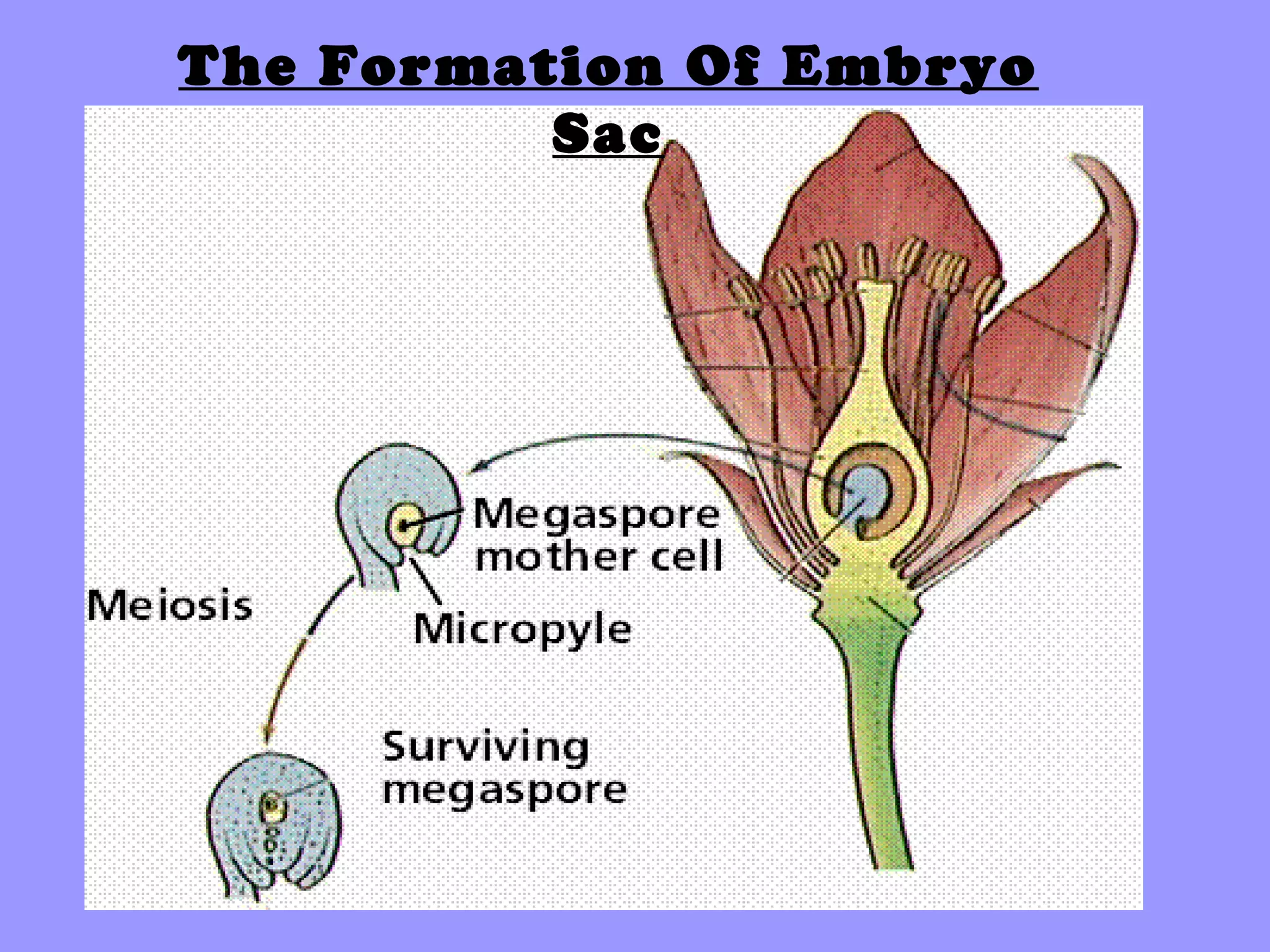
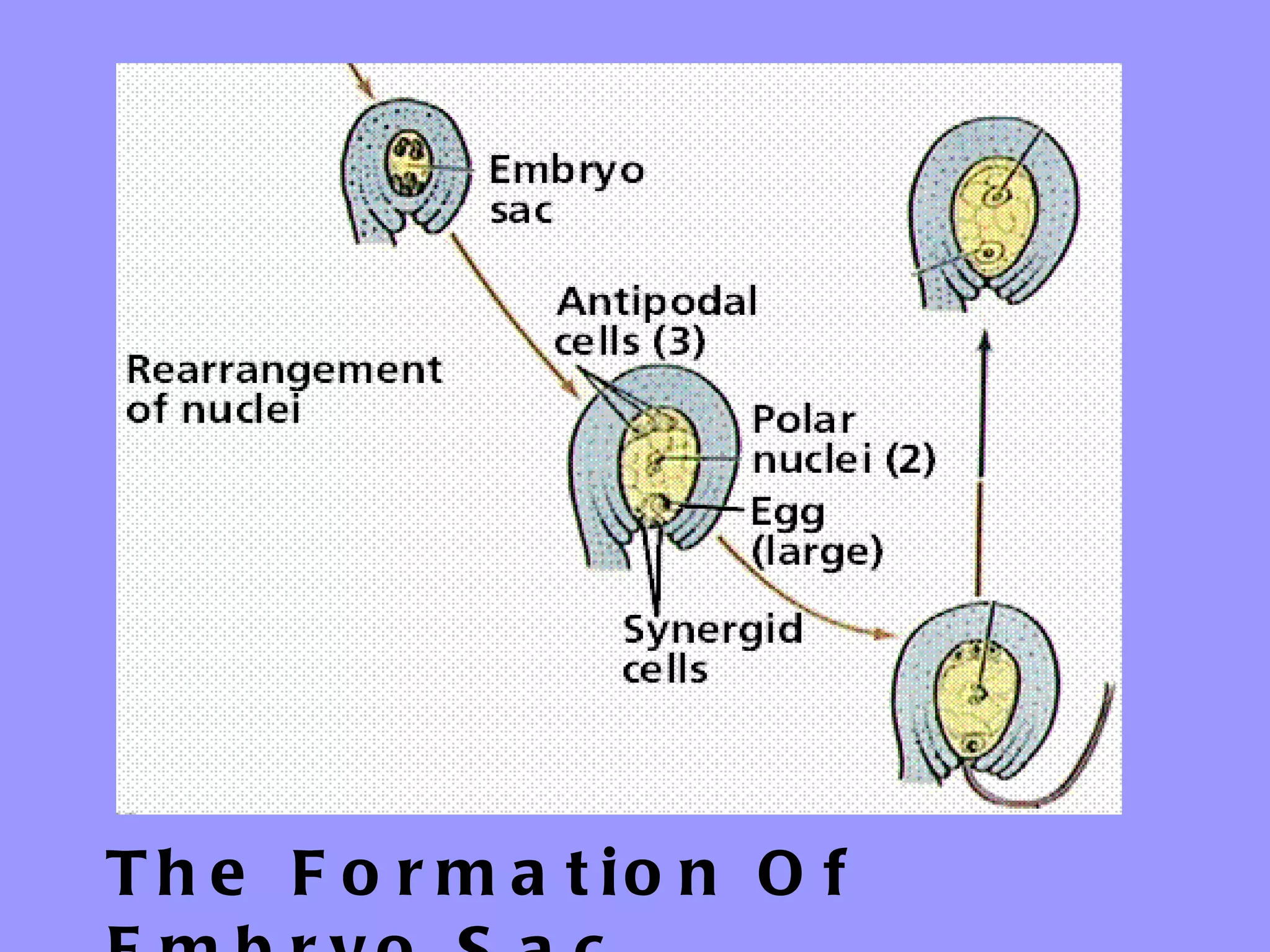
THE FORMATION OF EMBRYO SAC
• Embryo sac = a structure containing the egg
  cell found in the ovule.

• Initially, the ovule contains similar diploid
  cells, nucellus  one of the cells enlarges to
  become the embryo sac mother cell.

• Embryo sac mother cell  meiosis  4
  haploid cells, 3 disintegrate.
• The remaining cell (which represents the
  young embryo sac) will undergo mitosis thrice
  to produce 8 nuclei.

• 2 of the nuclei will move to the middle of the
  embryo sac  polar nuclei.

• Other 6 nuclei are enveloped with cytoplasm
  & become cells 3 antipodal cells, 2
  synergids, 1 egg cell  mature embryo
  (megaspore containing the female gamete)
• Only the egg cell & the 2 polar nuclei are
  important in fertilisation  the other will
  disintegrate.

• The ovule becomes enveloped by 2
  layers of integuments, leaving a small
  opening (micropyle)  connected to the
  ovary by funicle.  megaspore (embryo
  sac containing the female gamete).
The Formation Of Embryo
          Sac
T h e F o r m a t io n O f
THE FORMATION OF POLLEN
            TUBE
• POLLINATION = the transfer of pollen from the
  stamens to the stigma
• Self-pollination / cross pollination

• The stigma secretes a sugary liquid which
  stimulates germination.

• The pollen germinates  a pollen tube is
  produces through the tissues of the style into
  an ovule.

• The generative nucleus divides by mitosis to
  produce 2 male nuclei.
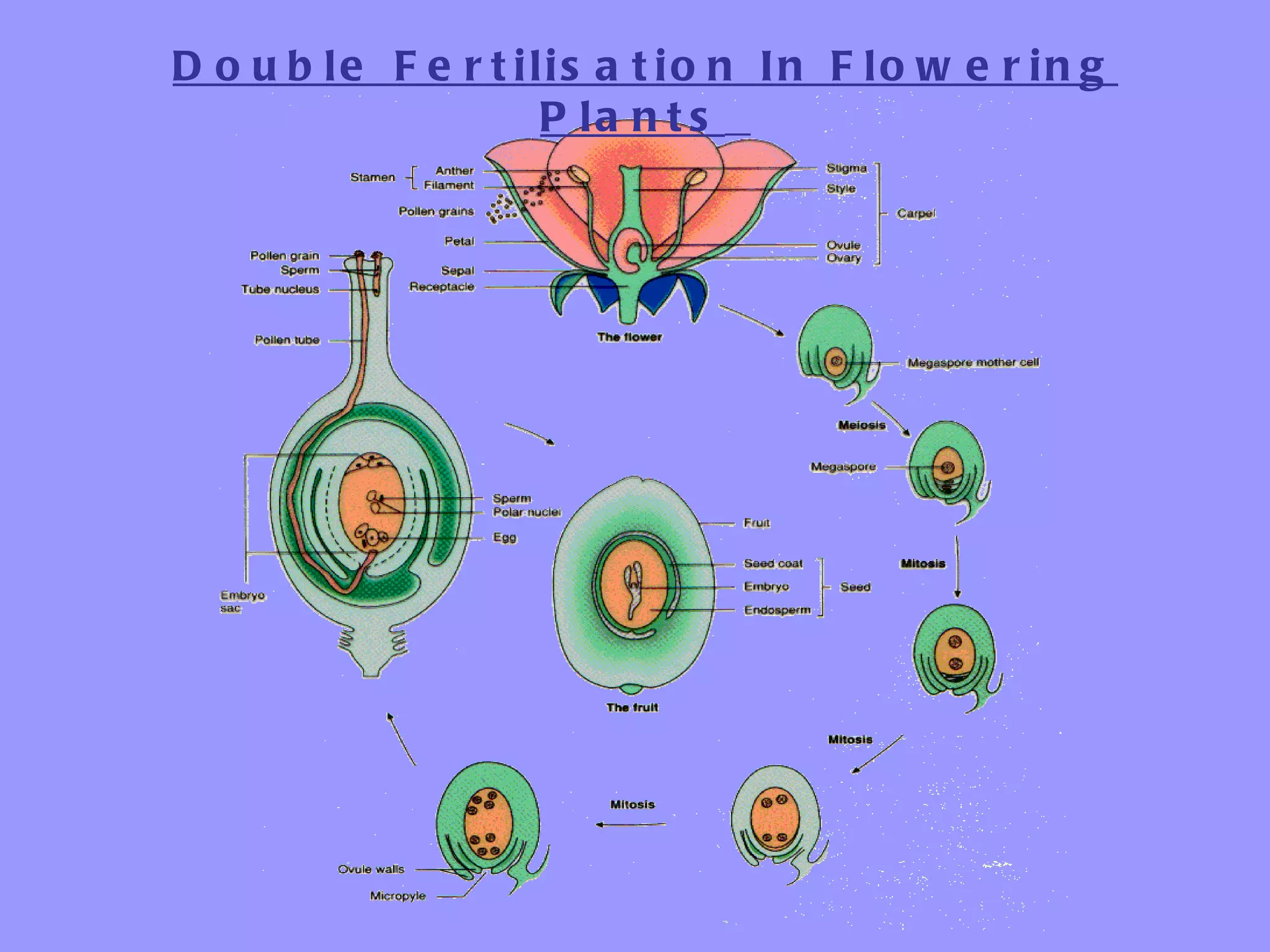
FERTILISATION
• When the pollen tube arrives at the embryo
  sac, the tube nucleus disintegrates.

• 1 of the male nuclei fuses with egg cell to form
  a diploid zygote  develops into embryo
  which consist of the radicle, plumule, & 1 @ 2
  cotyledons.

• The other male nucleus fuses with the 2 polar
  nuclei to form a triploid nucleus (3n) 
  endosperm (store food for the developing
  embryo).
• The ovary becomes a fruit  pericarp & the
  ovules become seeds.

• The outer integument becomes the seed coat
  @ testa (to protect the seed)

• The inner integument becomes tegmen, a
  thin membrane underneath the testa.

• All parts of the flower wither away.
PERI CARP                    M  ODE OF FRUI T
                                        DI SPERSAL
       F l e s h y,          Eat e n b y an i mal s 
    s uccul e nt ;                s e e d s ar e t h e n
        ed i bl e            d i s c ar d e d , f ar f r o m
  Ho o k / s p i n e s          S t i tchkes ptar efnutr. o f
                                                o
                                 p as s i n g an i mal s
W n g - s h ap e d ; d r y
 i                            Eas i l y c ar r i e d b y
       & l i gh t ;                    wi n d .
 f e at h e r y h ai r s
 Fi b r ou s t i s s u e      Car r i e d b y wat e r .
   wi t h man y ai r
Un e ve s p ac e s n g o f
         n d r yi             Se e d s d i s pe rs e d by
    f r u i t wal l          e x p l o s i ve me c h an i s m
 c au s i n g s u d d e n
D o u b le F e r t ilis a t io n In F lo w e r in g
                     P la n t s
THE IMPORTANCE OF DOUBLE
  FERTILISATION FOR THE SURVIVAL OF
          FLOWERING PLANTS
• Double fertilisation is important for two
  reasons :
    • By formation of the 3n nucleus  endosperm,
      the parent plants provide an important nutrient
      store for the developing plant.

    • It is ensure that the nutritive tissue formed is
      not wasted because it will be used by the growing
      embryo  the endosperm only develops if the
      ovum has been fertilised.
• The provision of food for the embryo is
  important for the survival of flowering plants.

• The presence of food enables the embryo to
  live for a long period of time even when
  conditions are unfavourable such as dry & cold
  conditions.

• When favourable  the food in the endosperm
  will be broken down into simple molecules
  such as sugar, amino acids, glycerol & fatty
  acids  absorbed by the embryo to build
  tissues for germination.
DON’T FORGET
    TO DO
CHECKPOINT 4.5
  (page 147).
PLEASE MAKE A
  REVISION!!!

4[1].5 FORM 5

  • 1.
    CHAPTER 4 : REPRODUCTION& GROWTH 4.5 – SEXUAL REPRODUCTION IN FLOWERING PLANTS
  • 2.
    LEARNING OUTCOMES • Identifymale & female structure in a flower; • Describe the formation of pollen grains; • Describe the formation of the embryo sac in the ovule; • Describe the formation of pollen tube; • Describe the formation of zygote; • Describe the formation of triploid nucleus; • Conceptualise double fertilisation; • Relate the structure of a fruit to the flower parts; • Explain the importance of double fertilisation for the survival of flowering plants.
  • 3.
    TH E GE N E R A L S TR U C TU R E O F A F L O WE R • FLOWER = a modified shoot which is the reproductive structure of angiosperms.
  • 4.
    Petal Anther Stamen Stigma Filament Style Ovary Ovul Sepal Th e S tru c tu re s O f F lo w e r
  • 5.
    • Each partof the flower serves a certain function : – the pedicel supports the flower in the best position for pollination; – The petals are usually big & brightly coloured to attract insects @ birds for pollination; – The sepals protect the flower when it is still a bud.
  • 6.
    • The malestructure = stamen (consists of a filament & an anther). • The anther functions in producing pollen grains & is supported by the filament. • The male gametes are found in the pollen grain.
  • 7.
    • The femalestructure = pistil (consists of stigma, style & ovary). • Inside the ovary, one @ more ovules can be found. • The female gametes @ egg cell is found in the ovule. • Pollen grain are received by the stigma.
  • 8.
    THE FORMATION OFPOLLEN GRAINS • Are formed in the anther. • Each anther contains 4 chambers called pollen sacs in which pollen grains are formed. • The tapetum provides nourishment to the developing pollen grains.
  • 9.
    A Cross SectionOf Anther
  • 10.
    • Each pollensac contains many diploid pollen mother cells  meiosis  a tetrad of 4 haploid cell  separate & become the pollen grain. • The haploid nucleus divides by mitosis to produce a generative nucleus & a tube nucleus. • Pollen grain is a microspore & not a gamete. • Male gamete are form when the generative nucleus divides.
  • 11.
    Th e F or m a t io n O f P o lle n
  • 12.
  • 13.
    THE FORMATION OFEMBRYO SAC • Embryo sac = a structure containing the egg cell found in the ovule. • Initially, the ovule contains similar diploid cells, nucellus  one of the cells enlarges to become the embryo sac mother cell. • Embryo sac mother cell  meiosis  4 haploid cells, 3 disintegrate.
  • 14.
    • The remainingcell (which represents the young embryo sac) will undergo mitosis thrice to produce 8 nuclei. • 2 of the nuclei will move to the middle of the embryo sac  polar nuclei. • Other 6 nuclei are enveloped with cytoplasm & become cells 3 antipodal cells, 2 synergids, 1 egg cell  mature embryo (megaspore containing the female gamete)
  • 15.
    • Only theegg cell & the 2 polar nuclei are important in fertilisation  the other will disintegrate. • The ovule becomes enveloped by 2 layers of integuments, leaving a small opening (micropyle)  connected to the ovary by funicle.  megaspore (embryo sac containing the female gamete).
  • 16.
    The Formation OfEmbryo Sac
  • 17.
    T h eF o r m a t io n O f
  • 18.
    THE FORMATION OFPOLLEN TUBE • POLLINATION = the transfer of pollen from the stamens to the stigma • Self-pollination / cross pollination • The stigma secretes a sugary liquid which stimulates germination. • The pollen germinates  a pollen tube is produces through the tissues of the style into an ovule. • The generative nucleus divides by mitosis to produce 2 male nuclei.
  • 19.
    FERTILISATION • When thepollen tube arrives at the embryo sac, the tube nucleus disintegrates. • 1 of the male nuclei fuses with egg cell to form a diploid zygote  develops into embryo which consist of the radicle, plumule, & 1 @ 2 cotyledons. • The other male nucleus fuses with the 2 polar nuclei to form a triploid nucleus (3n)  endosperm (store food for the developing embryo).
  • 20.
    • The ovarybecomes a fruit  pericarp & the ovules become seeds. • The outer integument becomes the seed coat @ testa (to protect the seed) • The inner integument becomes tegmen, a thin membrane underneath the testa. • All parts of the flower wither away.
  • 21.
    PERI CARP M ODE OF FRUI T DI SPERSAL F l e s h y, Eat e n b y an i mal s  s uccul e nt ; s e e d s ar e t h e n ed i bl e d i s c ar d e d , f ar f r o m Ho o k / s p i n e s S t i tchkes ptar efnutr. o f o p as s i n g an i mal s W n g - s h ap e d ; d r y i Eas i l y c ar r i e d b y & l i gh t ; wi n d . f e at h e r y h ai r s Fi b r ou s t i s s u e Car r i e d b y wat e r . wi t h man y ai r Un e ve s p ac e s n g o f n d r yi Se e d s d i s pe rs e d by f r u i t wal l e x p l o s i ve me c h an i s m c au s i n g s u d d e n
  • 22.
    D o ub le F e r t ilis a t io n In F lo w e r in g P la n t s
  • 23.
    THE IMPORTANCE OFDOUBLE FERTILISATION FOR THE SURVIVAL OF FLOWERING PLANTS • Double fertilisation is important for two reasons : • By formation of the 3n nucleus  endosperm, the parent plants provide an important nutrient store for the developing plant. • It is ensure that the nutritive tissue formed is not wasted because it will be used by the growing embryo  the endosperm only develops if the ovum has been fertilised.
  • 24.
    • The provisionof food for the embryo is important for the survival of flowering plants. • The presence of food enables the embryo to live for a long period of time even when conditions are unfavourable such as dry & cold conditions. • When favourable  the food in the endosperm will be broken down into simple molecules such as sugar, amino acids, glycerol & fatty acids  absorbed by the embryo to build tissues for germination.
  • 25.
    DON’T FORGET TO DO CHECKPOINT 4.5 (page 147). PLEASE MAKE A REVISION!!!