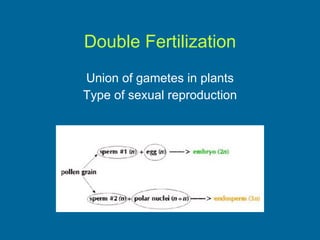
Double Fertilization This process involves the joining of a female gametophyte (embryo sac) with two male gametes (sperm).  The union in flowering plants of two sperm nuclei. One sperm nucleus unites with the egg to form the diploid zygote, from which the embryo develops, and the other unites with two polar nuclei to form the triploid, primary endosperm nucleus.
 
Plant  Reproduction
Introduction A flower has a set of adaptations Petals have modified  leaves Entire flower is a highly modified  branch Flower shape, scent, color attracts  insects , thereby ensuring the  reproduction  of the plant
 
Flower Function To produce seeds for reproduction
Terminology Whorl Arrangement of three or more leaves, petals, or other organs radiating from the plant Non-essential  flower parts  Not directly involved in reproduction Essential flower parts Directly involved in reproduction
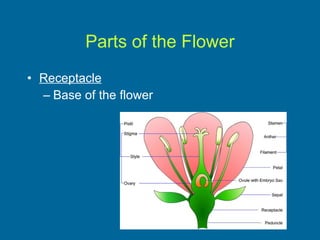
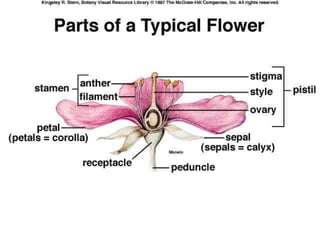
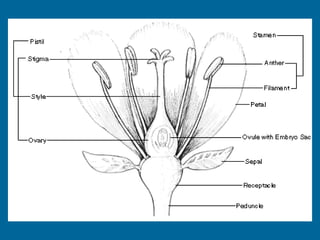
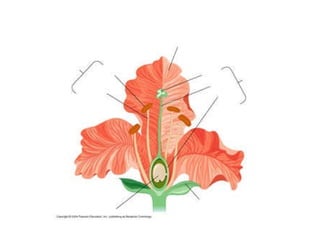
Parts of the Flower Receptacle Base of the flower
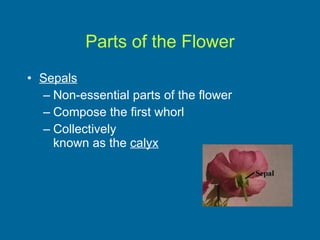
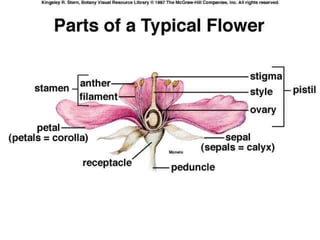
Parts of the Flower Sepals Non-essential parts of the flower Compose the first whorl Collectively  known as the  calyx
 
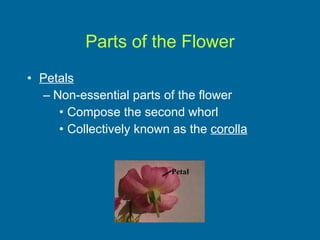
Parts of the Flower Petals Non-essential parts of the flower Compose the second whorl Collectively known as the  corolla
 
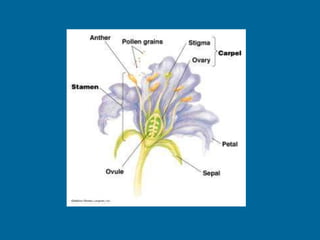
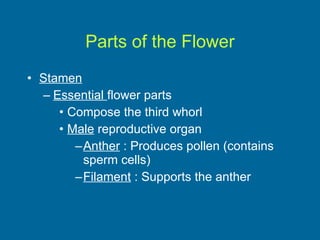
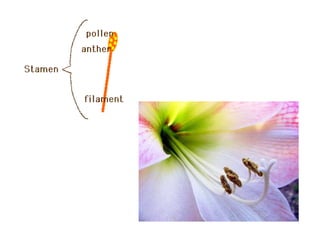
Parts of the Flower Stamen Essential  flower parts Compose the third whorl Male  reproductive organ Anther  : Produces pollen (contains sperm cells) Filament  : Supports the anther
 
 
Parts of the Flower Carpels Essential flower parts Compose the last, fourth whorl Usually fused to make a single  pistil Female  reproductive organ
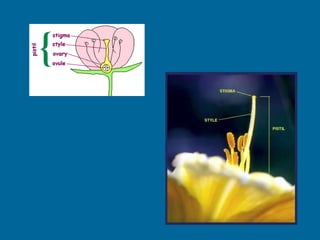
Parts of the flower Female reproductive organ Ovary  : Swollen base of the pistil (contains ovules, which contain egg cells) Style : Stalk of the pistil Stigma : Tip of the pistil, sticky to capture falling pollen


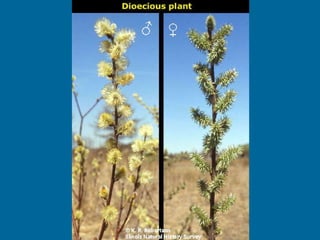
Types of Flowers Perfect Has both pistils and  stamens in the same flower Have all 4 whorls of modified leaves  Imperfect Has either pistil or stamens in the same flower Missing one or more flower parts  Two types Monoecious Dioecious
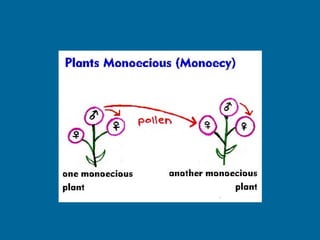
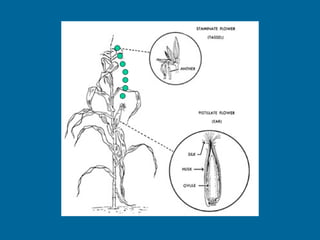
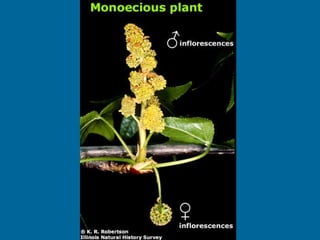
Imperfect Flowers Monoecious “ Same house” Separate male and female flowers on the same plant Example Corn


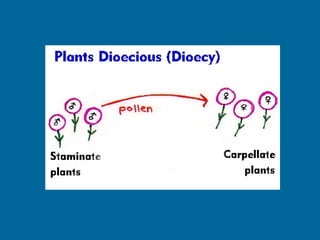
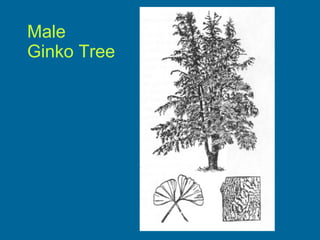
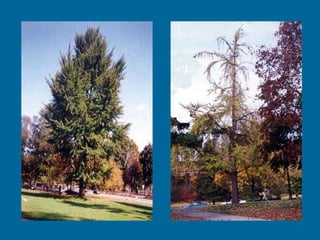
Imperfect Flowers Dioecious “ Two houses” Flowers are all male or all female on the same plant Example Ginko tree Most are male Female produces seeds with foul odor
 
Male  Ginko Tree


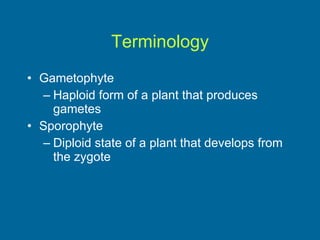
Terminology Gametophyte Haploid form of a plant that produces gametes Sporophyte Diploid state of a plant that develops from the zygote
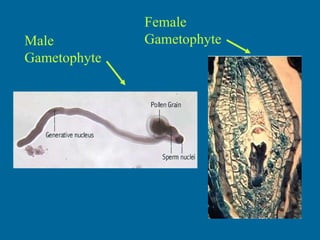
Sexual Activity in Flowers It's the flower's job to produce the male and female gametophytes Male gametophyte - 2 cells (pollen grain) Female gametophyte - 7 cells (embryo sac)
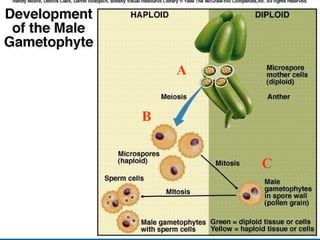
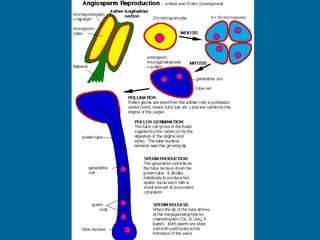
Male Gametophyte Formation Microsporangia or microspore mother cell  Diploid  Found in a pollen sac of the anther  Undergoes meiosis  Produces 4 microspores (haploid)  Each microspore undergoes mitosis to produce microgametophytes (pollen grains each with two cells)
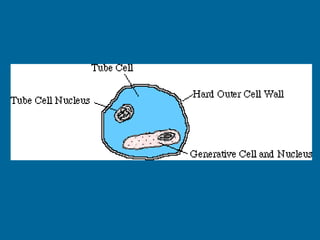
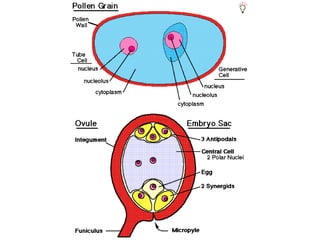
Male Gametophyte Formation Pollen grain Hard bumpy outer cell wall  Contains 2 cells Tube cell  Forms the pollen tube Generative cell Suspended in the tube cell Undergoes mitosis to produce two sperm cells
 
A B C
 
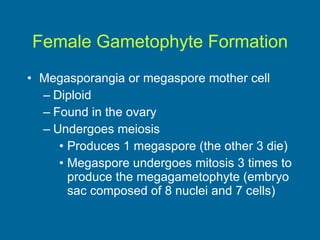
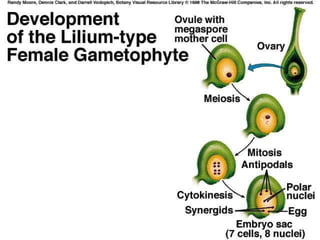
Female Gametophyte Formation Megasporangia or megaspore mother cell  Diploid  Found in the ovary  Undergoes meiosis  Produces 1 megaspore (the other 3 die) Megaspore undergoes mitosis 3 times to produce the megagametophyte (embryo sac composed of 8 nuclei and 7 cells)
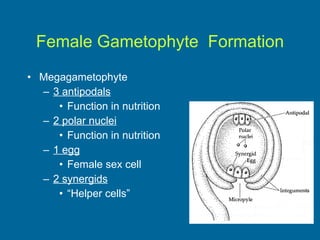
Female Gametophyte  Formation Megagametophyte 3 antipodals Function in nutrition 2 polar nuclei Function in nutrition 1 egg Female sex cell 2 synergids “ Helper cells”
 
Male Gametophyte Female Gametophyte
 
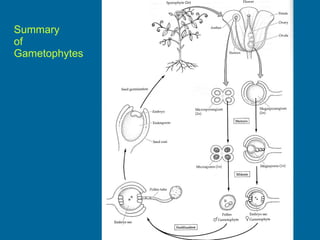
Summary  of  Gametophytes
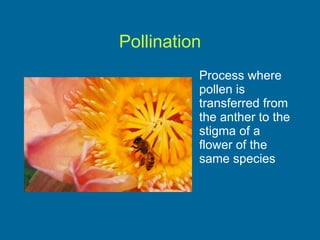
Pollination Process where pollen is transferred from the anther to the stigma of a flower of the same species
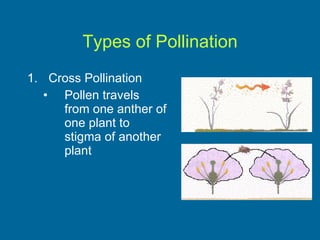
Types of Pollination Cross Pollination Pollen travels from one anther of one plant to stigma of another plant
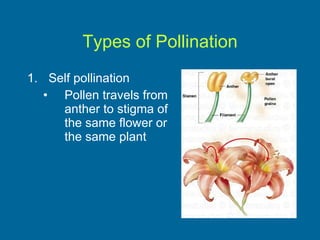
Types of Pollination Self pollination Pollen travels from anther to stigma of the same flower or the same plant
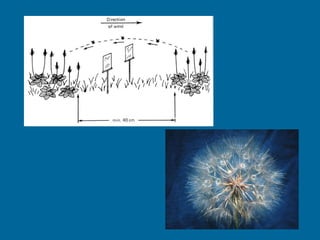
Methods of Pollination Wind pollination Depends on: The release of  a lot  of pollen Sufficient  wind Flower needs to be within  traveling distance
 
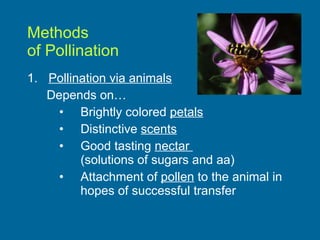
Methods  of Pollination Pollination via animals Depends on… Brightly colored  petals Distinctive  scents Good tasting  nectar  (solutions of sugars and aa) Attachment of  pollen  to the animal in hopes of successful transfer
Double Fertilization Union of gametes in plants Type of sexual reproduction
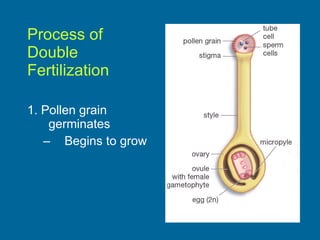
Process of  Double  Fertilization 1. Pollen grain  germinates Begins to grow
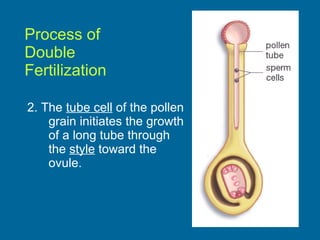
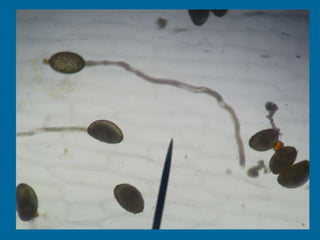
Process of  Double  Fertilization 2. The  tube cell  of the pollen grain initiates the growth of a long tube through the  style  toward the ovule.
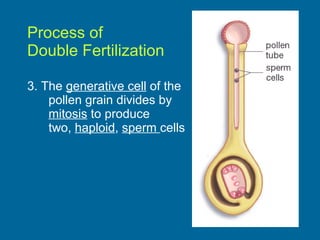
Process of  Double Fertilization 3. The  generative cell  of the pollen grain divides by  mitosis  to produce  two,  haploid ,  sperm  cells
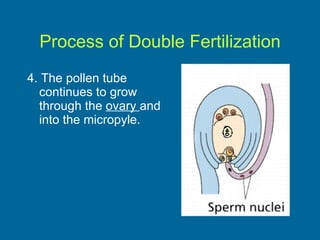
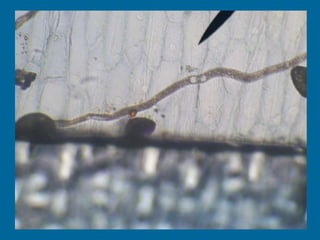
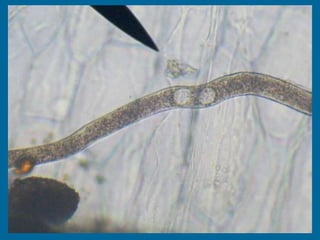
Process of Double Fertilization 4. The pollen tube continues to grow through the  ovary  and into the micropyle.


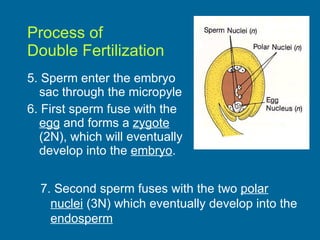
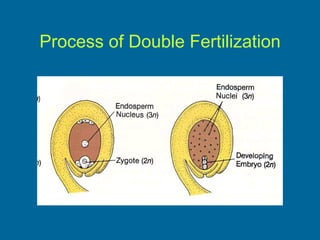
Process of  Double Fertilization 5. Sperm enter the embryo sac through the micropyle 6. First sperm fuse with the  egg  and forms a  zygote  (2N), which will eventually develop into the  embryo . 7. Second sperm fuses with the two  polar nuclei  (3N) which eventually develop into the  endosperm
Process of Double Fertilization
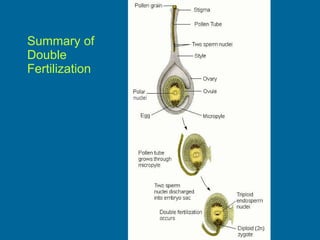
Summary of  Double  Fertilization
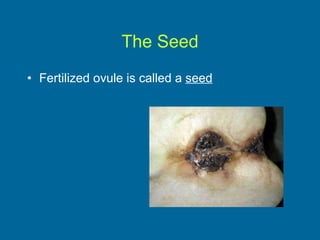
The Seed Fertilized ovule is called a  seed
 
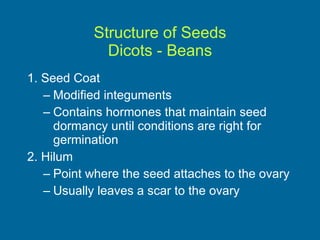
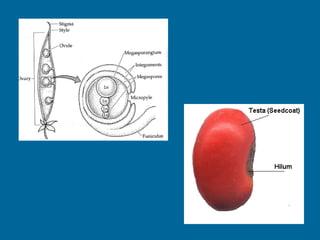
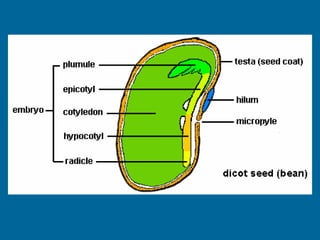
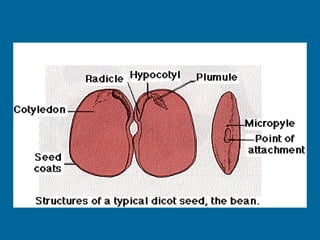
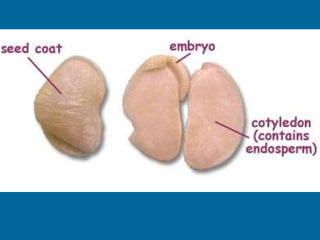
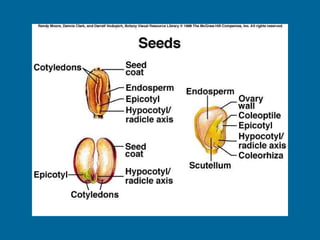
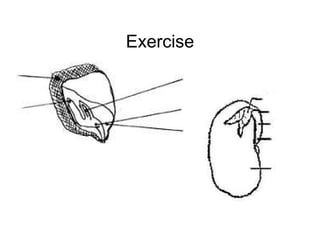
Structure of Seeds Dicots - Beans 1. Seed Coat Modified integuments Contains hormones that maintain seed dormancy until conditions are right for germination 2. Hilum Point where the seed attaches to the ovary Usually leaves a scar to the ovary
 
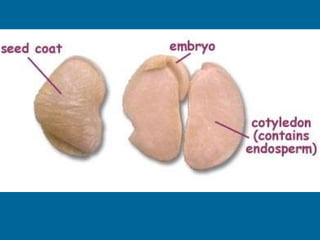
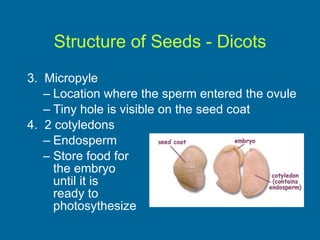
Structure of Seeds - Dicots 3.  Micropyle Location where the sperm entered the ovule Tiny hole is visible on the seed coat 4.  2 cotyledons Endosperm Store food for  the embryo  until it is  ready to  photosythesize
 
 
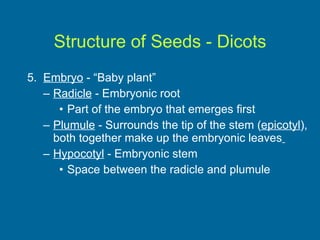
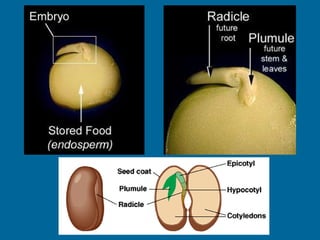
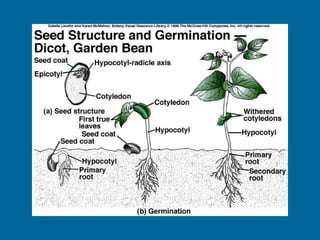
Structure of Seeds - Dicots 5.  Embryo  - “Baby plant” Radicle  - Embryonic root Part of the embryo that emerges first Plumule  - Surrounds the tip of the stem ( epicotyl ),  both together make up the embryonic leaves   Hypocotyl  - Embryonic stem Space between the radicle and plumule
 
 
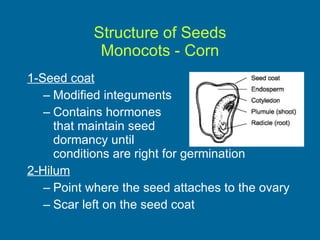
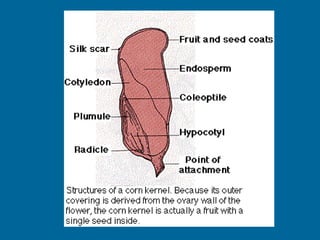
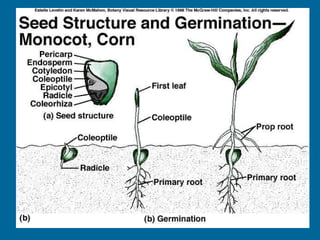
Structure of Seeds Monocots - Corn 1-Seed coat Modified integuments Contains hormones  that maintain seed  dormancy until  conditions are right for germination 2-Hilum Point where the seed attaches to the ovary Scar left on the seed coat
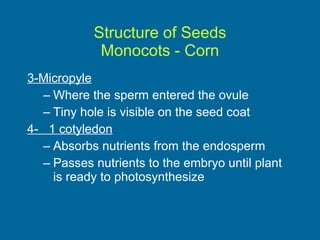
Structure of Seeds Monocots - Corn 3-Micropyle Where the sperm entered the ovule Tiny hole is visible on the seed coat 4-  1 cotyledon Absorbs nutrients from the endosperm Passes nutrients to the embryo until plant is ready to photosynthesize
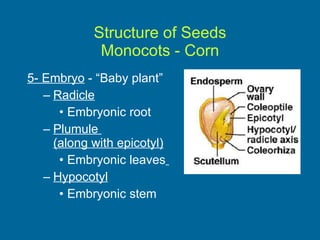
Structure of Seeds Monocots - Corn 5- Embryo  - “Baby plant” Radicle Embryonic root Plumule  (along with epicotyl) Embryonic leaves   Hypocotyl Embryonic stem
 
 
Exercise
Types of Fruit Definition Ovary is called the  fruit
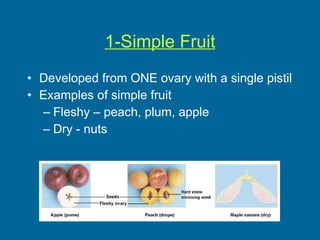
1-Simple Fruit Developed from ONE ovary with a single pistil Examples of simple fruit Fleshy – peach, plum, apple Dry - nuts
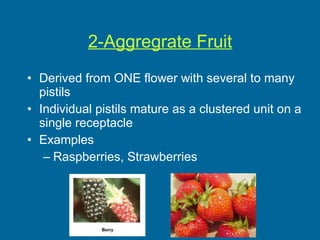
2-Aggregrate Fruit Derived from ONE flower with several to many pistils Individual pistils mature as a clustered unit on a single receptacle Examples Raspberries, Strawberries
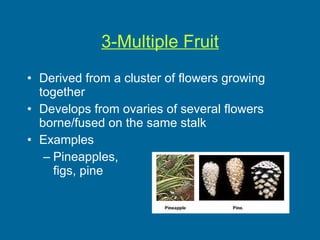
3-Multiple Fruit Derived from a cluster of flowers growing together Develops from ovaries of several flowers borne/fused on the same stalk Examples Pineapples,  figs, pine
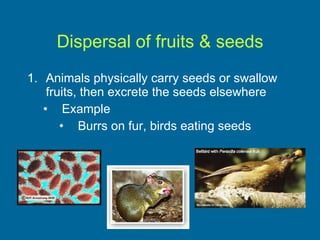
Dispersal of fruits & seeds Animals physically carry seeds or swallow fruits, then excrete the seeds elsewhere Example Burrs on fur, birds eating seeds
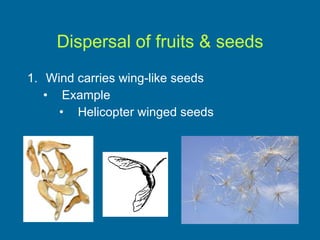
Dispersal of fruits & seeds Wind carries wing-like seeds Example Helicopter winged seeds
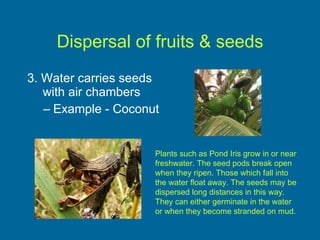
Dispersal of fruits & seeds 3. Water carries seeds   with air chambers Example - Coconut Plants such as Pond Iris grow in or near freshwater. The seed pods break open when they ripen. Those which fall into the water float away. The seeds may be dispersed long distances in this way. They can either germinate in the water or when they become stranded on mud.
 
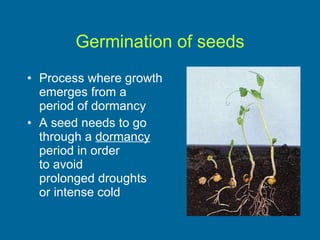
Germination of seeds Process where growth  emerges from a  period of dormancy A seed needs to go  through a  dormancy   period in order  to avoid  prolonged droughts  or intense cold
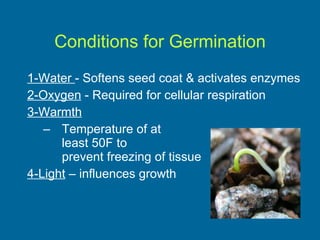
Conditions for Germination 1-Water  - Softens seed coat & activates enzymes 2-Oxygen  - Required for cellular respiration 3-Warmth Temperature of at  least 50F to  prevent freezing of tissue 4-Light  – influences growth
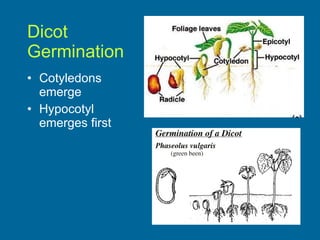
Process of Germination 1-Emergence of  radicle , which ruptures the  seed coat 2-The shoot begins to grow 3-  Embyronic  leaves begin to  photosynthesize 4- Seedling continues to grow from  meristematic regions  and matures in to a plant
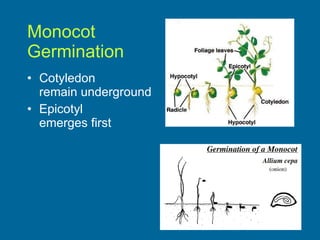
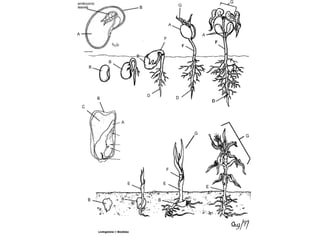
Monocot  Germination Cotyledon  remain underground Epicotyl  emerges first
 
Dicot  Germination Cotyledons  emerge Hypocotyl  emerges first
 
 
Asexual Reproduction Vegetative Propagation Formation of new individuals from the cell(s) of a single parent. Very common in plants; less so in animals All plant organs have been used, but stems are the most common
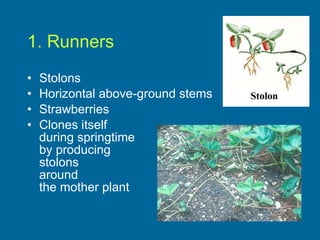
1. Runners Stolons Horizontal above-ground stems  Strawberries Clones itself  during springtime  by producing  stolons  around  the mother plant
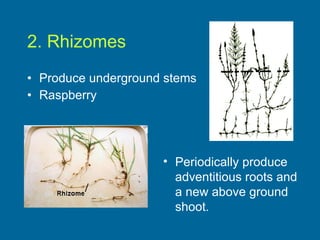
2. Rhizomes Produce underground stems   Raspberry Periodically produce  adventitious roots and  a new above ground shoot. 
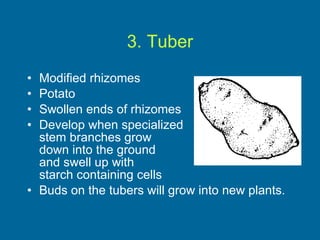
3. Tuber M odified rhizomes   Potato Swollen ends of rhizomes Develop when specialized  stem branches grow  down into the ground  and swell up with  starch containing cells Buds on the tubers will grow into new plants.
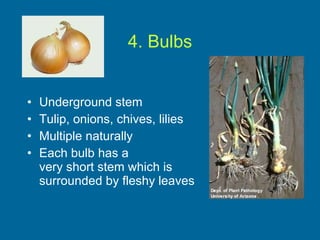
4. Bulbs Underground stem  Tulip,  onions, chives, lilies  Multiple naturally Each bulb has a  very short stem which is  surrounded by fleshy leaves
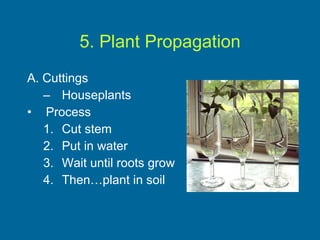
5. Plant Propagation A. Cuttings Houseplants Process Cut stem Put in water Wait until roots grow Then…plant in soil
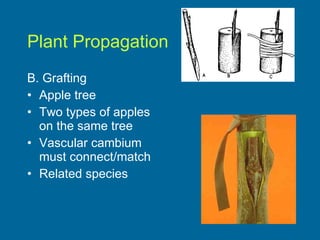
Plant Propagation B. Grafting Apple tree Two types of apples  on the same tree Vascular cambium  must connect/match Related species
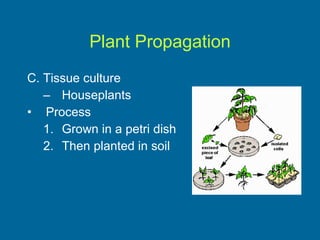
Plant Propagation C. Tissue culture Houseplants Process Grown in a petri dish Then planted in soil

Blue Packet Notes

  • 1.
    Double Fertilization Thisprocess involves the joining of a female gametophyte (embryo sac) with two male gametes (sperm). The union in flowering plants of two sperm nuclei. One sperm nucleus unites with the egg to form the diploid zygote, from which the embryo develops, and the other unites with two polar nuclei to form the triploid, primary endosperm nucleus.
  • 2.
  • 3.
  • 4.
    Introduction A flowerhas a set of adaptations Petals have modified leaves Entire flower is a highly modified branch Flower shape, scent, color attracts insects , thereby ensuring the reproduction of the plant
  • 5.
  • 6.
    Flower Function Toproduce seeds for reproduction
  • 7.
    Terminology Whorl Arrangementof three or more leaves, petals, or other organs radiating from the plant Non-essential flower parts Not directly involved in reproduction Essential flower parts Directly involved in reproduction
  • 8.
    Parts of theFlower Receptacle Base of the flower
  • 9.
    Parts of theFlower Sepals Non-essential parts of the flower Compose the first whorl Collectively known as the calyx
  • 10.
  • 11.
    Parts of theFlower Petals Non-essential parts of the flower Compose the second whorl Collectively known as the corolla
  • 12.
  • 13.
    Parts of theFlower Stamen Essential flower parts Compose the third whorl Male reproductive organ Anther : Produces pollen (contains sperm cells) Filament : Supports the anther
  • 14.
  • 15.
  • 16.
    Parts of theFlower Carpels Essential flower parts Compose the last, fourth whorl Usually fused to make a single pistil Female reproductive organ
  • 17.
    Parts of theflower Female reproductive organ Ovary : Swollen base of the pistil (contains ovules, which contain egg cells) Style : Stalk of the pistil Stigma : Tip of the pistil, sticky to capture falling pollen
  • 18.
  • 19.
  • 20.
  • 21.
    Types of FlowersPerfect Has both pistils and stamens in the same flower Have all 4 whorls of modified leaves Imperfect Has either pistil or stamens in the same flower Missing one or more flower parts Two types Monoecious Dioecious
  • 22.
    Imperfect Flowers Monoecious“ Same house” Separate male and female flowers on the same plant Example Corn
  • 23.
  • 24.
  • 25.
  • 26.
    Imperfect Flowers Dioecious“ Two houses” Flowers are all male or all female on the same plant Example Ginko tree Most are male Female produces seeds with foul odor
  • 27.
  • 28.
  • 29.
  • 30.
  • 31.
  • 32.
    Terminology Gametophyte Haploidform of a plant that produces gametes Sporophyte Diploid state of a plant that develops from the zygote
  • 33.
    Sexual Activity inFlowers It's the flower's job to produce the male and female gametophytes Male gametophyte - 2 cells (pollen grain) Female gametophyte - 7 cells (embryo sac)
  • 34.
    Male Gametophyte FormationMicrosporangia or microspore mother cell Diploid Found in a pollen sac of the anther Undergoes meiosis Produces 4 microspores (haploid) Each microspore undergoes mitosis to produce microgametophytes (pollen grains each with two cells)
  • 35.
    Male Gametophyte FormationPollen grain Hard bumpy outer cell wall Contains 2 cells Tube cell Forms the pollen tube Generative cell Suspended in the tube cell Undergoes mitosis to produce two sperm cells
  • 36.
  • 37.
  • 38.
  • 39.
    Female Gametophyte FormationMegasporangia or megaspore mother cell Diploid Found in the ovary Undergoes meiosis Produces 1 megaspore (the other 3 die) Megaspore undergoes mitosis 3 times to produce the megagametophyte (embryo sac composed of 8 nuclei and 7 cells)
  • 40.
    Female Gametophyte Formation Megagametophyte 3 antipodals Function in nutrition 2 polar nuclei Function in nutrition 1 egg Female sex cell 2 synergids “ Helper cells”
  • 41.
  • 42.
  • 43.
  • 44.
    Summary of Gametophytes
  • 45.
    Pollination Process wherepollen is transferred from the anther to the stigma of a flower of the same species
  • 46.
    Types of PollinationCross Pollination Pollen travels from one anther of one plant to stigma of another plant
  • 47.
    Types of PollinationSelf pollination Pollen travels from anther to stigma of the same flower or the same plant
  • 48.
    Methods of PollinationWind pollination Depends on: The release of a lot of pollen Sufficient wind Flower needs to be within traveling distance
  • 49.
  • 50.
    Methods ofPollination Pollination via animals Depends on… Brightly colored petals Distinctive scents Good tasting nectar (solutions of sugars and aa) Attachment of pollen to the animal in hopes of successful transfer
  • 51.
    Double Fertilization Unionof gametes in plants Type of sexual reproduction
  • 52.
    Process of Double Fertilization 1. Pollen grain germinates Begins to grow
  • 53.
    Process of Double Fertilization 2. The tube cell of the pollen grain initiates the growth of a long tube through the style toward the ovule.
  • 54.
    Process of Double Fertilization 3. The generative cell of the pollen grain divides by mitosis to produce two, haploid , sperm cells
  • 55.
    Process of DoubleFertilization 4. The pollen tube continues to grow through the ovary and into the micropyle.
  • 56.
  • 57.
  • 58.
  • 59.
    Process of Double Fertilization 5. Sperm enter the embryo sac through the micropyle 6. First sperm fuse with the egg and forms a zygote (2N), which will eventually develop into the embryo . 7. Second sperm fuses with the two polar nuclei (3N) which eventually develop into the endosperm
  • 60.
    Process of DoubleFertilization
  • 61.
    Summary of Double Fertilization
  • 62.
    The Seed Fertilizedovule is called a seed
  • 63.
  • 64.
    Structure of SeedsDicots - Beans 1. Seed Coat Modified integuments Contains hormones that maintain seed dormancy until conditions are right for germination 2. Hilum Point where the seed attaches to the ovary Usually leaves a scar to the ovary
  • 65.
  • 66.
    Structure of Seeds- Dicots 3. Micropyle Location where the sperm entered the ovule Tiny hole is visible on the seed coat 4. 2 cotyledons Endosperm Store food for the embryo until it is ready to photosythesize
  • 67.
  • 68.
  • 69.
    Structure of Seeds- Dicots 5. Embryo - “Baby plant” Radicle - Embryonic root Part of the embryo that emerges first Plumule - Surrounds the tip of the stem ( epicotyl ), both together make up the embryonic leaves Hypocotyl - Embryonic stem Space between the radicle and plumule
  • 70.
  • 71.
  • 72.
    Structure of SeedsMonocots - Corn 1-Seed coat Modified integuments Contains hormones that maintain seed dormancy until conditions are right for germination 2-Hilum Point where the seed attaches to the ovary Scar left on the seed coat
  • 73.
    Structure of SeedsMonocots - Corn 3-Micropyle Where the sperm entered the ovule Tiny hole is visible on the seed coat 4- 1 cotyledon Absorbs nutrients from the endosperm Passes nutrients to the embryo until plant is ready to photosynthesize
  • 74.
    Structure of SeedsMonocots - Corn 5- Embryo - “Baby plant” Radicle Embryonic root Plumule (along with epicotyl) Embryonic leaves Hypocotyl Embryonic stem
  • 75.
  • 76.
  • 77.
  • 78.
    Types of FruitDefinition Ovary is called the fruit
  • 79.
    1-Simple Fruit Developedfrom ONE ovary with a single pistil Examples of simple fruit Fleshy – peach, plum, apple Dry - nuts
  • 80.
    2-Aggregrate Fruit Derivedfrom ONE flower with several to many pistils Individual pistils mature as a clustered unit on a single receptacle Examples Raspberries, Strawberries
  • 81.
    3-Multiple Fruit Derivedfrom a cluster of flowers growing together Develops from ovaries of several flowers borne/fused on the same stalk Examples Pineapples, figs, pine
  • 82.
    Dispersal of fruits& seeds Animals physically carry seeds or swallow fruits, then excrete the seeds elsewhere Example Burrs on fur, birds eating seeds
  • 83.
    Dispersal of fruits& seeds Wind carries wing-like seeds Example Helicopter winged seeds
  • 84.
    Dispersal of fruits& seeds 3. Water carries seeds with air chambers Example - Coconut Plants such as Pond Iris grow in or near freshwater. The seed pods break open when they ripen. Those which fall into the water float away. The seeds may be dispersed long distances in this way. They can either germinate in the water or when they become stranded on mud.
  • 85.
  • 86.
    Germination of seedsProcess where growth emerges from a period of dormancy A seed needs to go through a dormancy period in order to avoid prolonged droughts or intense cold
  • 87.
    Conditions for Germination1-Water - Softens seed coat & activates enzymes 2-Oxygen - Required for cellular respiration 3-Warmth Temperature of at least 50F to prevent freezing of tissue 4-Light – influences growth
  • 88.
    Process of Germination1-Emergence of radicle , which ruptures the seed coat 2-The shoot begins to grow 3- Embyronic leaves begin to photosynthesize 4- Seedling continues to grow from meristematic regions and matures in to a plant
  • 89.
    Monocot GerminationCotyledon remain underground Epicotyl emerges first
  • 90.
  • 91.
    Dicot GerminationCotyledons emerge Hypocotyl emerges first
  • 92.
  • 93.
  • 94.
    Asexual Reproduction VegetativePropagation Formation of new individuals from the cell(s) of a single parent. Very common in plants; less so in animals All plant organs have been used, but stems are the most common
  • 95.
    1. Runners StolonsHorizontal above-ground stems Strawberries Clones itself during springtime by producing stolons around the mother plant
  • 96.
    2. Rhizomes Produceunderground stems Raspberry Periodically produce adventitious roots and a new above ground shoot. 
  • 97.
    3. Tuber Modified rhizomes Potato Swollen ends of rhizomes Develop when specialized stem branches grow down into the ground and swell up with starch containing cells Buds on the tubers will grow into new plants.
  • 98.
    4. Bulbs Undergroundstem Tulip, onions, chives, lilies Multiple naturally Each bulb has a very short stem which is surrounded by fleshy leaves
  • 99.
    5. Plant PropagationA. Cuttings Houseplants Process Cut stem Put in water Wait until roots grow Then…plant in soil
  • 100.
    Plant Propagation B.Grafting Apple tree Two types of apples on the same tree Vascular cambium must connect/match Related species
  • 101.
    Plant Propagation C.Tissue culture Houseplants Process Grown in a petri dish Then planted in soil