LEARNING
        OUTCOMES
 To state what menstruation is,
 To relate menstruation to the
  menstrual cycle,
 To state the importance of the
  menstrual cycle,
 To state the hormones involved in
  the menstrual cycle
 D is ch arge of u nfe rtilis e d ovu m , u te ru s lining
  (e nd om e triu m wall) and b lood th rou gh vagina.

 Th e b re akd own of th e lining of th e u te ru s wall & its
  d is ch arge th rou gh th e vagina with s om e b lood ,
  ce lls , tis s u e flu id & gland u lar s e cre tions .

 G irls e xp e rie nce m e ns tru ation
  wh e n re ach p u b e rty.
• Af t e r me n s t r u at i o n , t h e
  t h i c k e n i n g o f e n d o me t r i u m
  b e g i n s ag ai n  Me n s t r u al
  c yc l e .

• Th e f i r s t d ay o f yo u r
  me n s t r u al p e r i o d i s
  c o n s i d e r e d D ay 1 o f yo u r
  c yc l e .
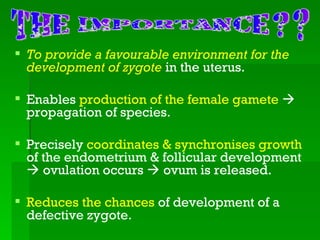
 To provide a favourable environment for the
  development of zygote in the uterus.

 Enables production of the female gamete 
  propagation of species.

 Precisely coordinates & synchronises growth
  of the endometrium & follicular development
   ovulation occurs  ovum is released.

 Reduces the chances of development of a
  defective zygote.
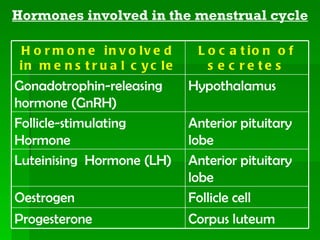
Hormones involved in the menstrual cycle

 H o r m o n e in v o lv e d      L o c a t io n o f
 in m e n s t r u a l c y c le      s e c re te s
Gonadotrophin-releasing          Hypothalamus
hormone (GnRH)
Follicle-stimulating             Anterior pituitary
Hormone                          lobe
Luteinising Hormone (LH)         Anterior pituitary
                                 lobe
Oestrogen                        Follicle cell
Progesterone                     Corpus luteum
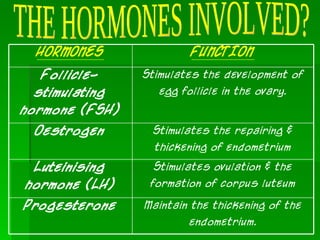
HORMONES              FUNCTION
   Follicle-    Stimulates the development of
  stimulating      egg follicle in the ovary.
hormone (FSH)
  Oestrogen       Stimulates the repairing &
                  thickening of endometrium
 Luteinising      Stimulates ovulation & the
hormone (LH)     formation of corpus luteum
Progesterone    Maintain the thickening of the
                        endometrium.
L E A R N IN G
       O U TC O M E S
 To relate hormonal levels to the
  development of follicles, the process of
  ovulation, & the formation of the corpus
  luteum,
 To relate hormonal levels to changes in
  thickness of the endometrium,
 Explain the role of hormones in
  regulating the menstrual cycle,
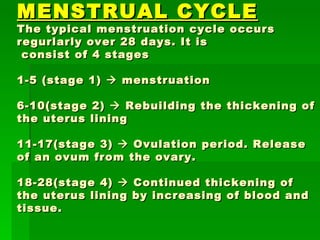
MENSTRUAL CYCLE
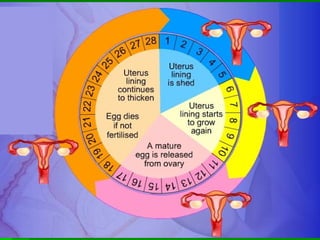
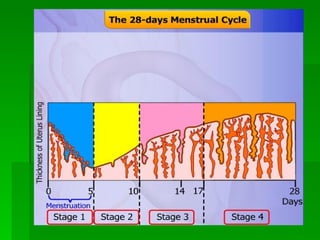
The typical menstruation cycle occurs
regurlarly over 28 days. It is
 consist of 4 stages

1-5 (stage 1)  menstruation

6-10(stage 2)  Rebuilding the thickening of
the uterus lining

11-17(stage 3)  Ovulation period. Release
of an ovum from the ovary.

18-28(stage 4)     Continued thickening of
the uterus lining   by increasing of blood and
tissue.
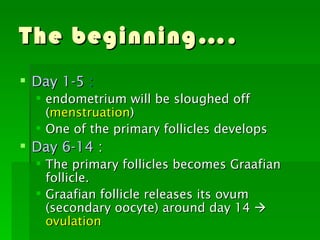
The beginning….
 Day 1-5 :
   endometrium will be sloughed off
    (menstruation)
   One of the primary follicles develops
 Day 6-14 :
   The primary follicles becomes Graafian
    follicle.
   Graafian follicle releases its ovum
    (secondary oocyte) around day 14 
    ovulation
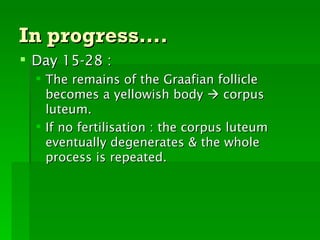
In progress….
 Day 15-28 :
   The remains of the Graafian follicle
    becomes a yellowish body  corpus
    luteum.
   If no fertilisation : the corpus luteum
    eventually degenerates & the whole
    process is repeated.
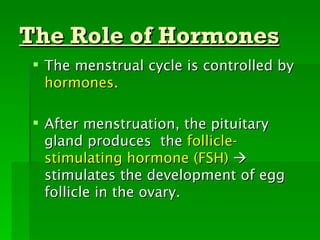
The Role of Hormones
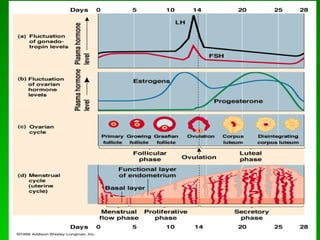
  The menstrual cycle is controlled by
   hormones.

  After menstruation, the pituitary
   gland produces the follicle-
   stimulating hormone (FSH) 
   stimulates the development of egg
   follicle in the ovary.
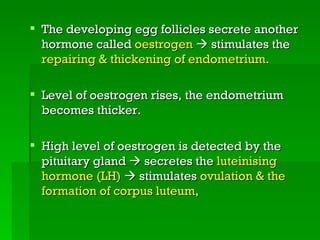
 The developing egg follicles secrete another
  hormone called oestrogen  stimulates the
  repairing & thickening of endometrium.

 Level of oestrogen rises, the endometrium
  becomes thicker.

 High level of oestrogen is detected by the
  pituitary gland  secretes the luteinising
  hormone (LH)  stimulates ovulation & the
  formation of corpus luteum,
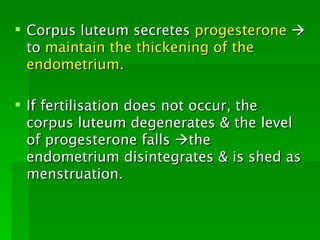
 Corpus luteum secretes progesterone 
  to maintain the thickening of the
  endometrium.

 If fertilisation does not occur, the
  corpus luteum degenerates & the level
  of progesterone falls the
  endometrium disintegrates & is shed as
  menstruation.
L E A R N IN G
       O U TC O M E S
 To state what premenstrual syndrome (PMS) is,
 To state the menopause is.
P re me ns            trua l
      S yn d r o m e          (PMS )
 A few days before menstruation.

 Caused by changes in the levels of oestrogen
  & progesterone  leads to accumulation of
  salt & water in the body tissues  causes
  discomfort.

 Emotional disturbances, nervousness,
  irritability, headache, appetite changes &
  depression.

 Disappears soon after menstruation begins.
Menopause
 The time in a woman’s life when the ovaries
  cease to produce ova & menstruation stops 
  the woman is no longer able to bear any
  children.

 Between 45-55 years.

 Her ovaries become less receptive to FSH & LH
  & follicular development slows down  the
  level of oestrogen & progesterone fall as well.
 Causes the production of ova & the
  thickening of endometrium decreased 
  menopause occurs gradually.

     The menstrual cycle becomes longer
     Menstruation occurs less frequently.
     Eventually, it stops altogether.


 Due to the low level of oestrogen, some
  women who have undergone menopause may
  suffer from some health & emotional
  problems.
   Headache, giddiness
   Nausea
   Abdominal pain
   Frequent urination
   Hot flushes & night sweat
   Dry skin
   Anxiety
   Insomnia
   Inflammation of the joints
   Decreased concentration & memory power
 Women who have undergone
  menopause are at a higher risk of
  contracting cancer of the uterus,
  osteoporosis & heart diseases 
  medical check-up at least once a year.

 Hormone replacement therapy  can
  slow down the symptoms (pills @ skin
  patches)

4[1].2 FORM 5

  • 2.
    LEARNING OUTCOMES  To state what menstruation is,  To relate menstruation to the menstrual cycle,  To state the importance of the menstrual cycle,  To state the hormones involved in the menstrual cycle
  • 3.
     D isch arge of u nfe rtilis e d ovu m , u te ru s lining (e nd om e triu m wall) and b lood th rou gh vagina.  Th e b re akd own of th e lining of th e u te ru s wall & its d is ch arge th rou gh th e vagina with s om e b lood , ce lls , tis s u e flu id & gland u lar s e cre tions .  G irls e xp e rie nce m e ns tru ation wh e n re ach p u b e rty.
  • 4.
    • Af te r me n s t r u at i o n , t h e t h i c k e n i n g o f e n d o me t r i u m b e g i n s ag ai n  Me n s t r u al c yc l e . • Th e f i r s t d ay o f yo u r me n s t r u al p e r i o d i s c o n s i d e r e d D ay 1 o f yo u r c yc l e .
  • 5.
     To providea favourable environment for the development of zygote in the uterus.  Enables production of the female gamete  propagation of species.  Precisely coordinates & synchronises growth of the endometrium & follicular development  ovulation occurs  ovum is released.  Reduces the chances of development of a defective zygote.
  • 6.
    Hormones involved inthe menstrual cycle H o r m o n e in v o lv e d L o c a t io n o f in m e n s t r u a l c y c le s e c re te s Gonadotrophin-releasing Hypothalamus hormone (GnRH) Follicle-stimulating Anterior pituitary Hormone lobe Luteinising Hormone (LH) Anterior pituitary lobe Oestrogen Follicle cell Progesterone Corpus luteum
  • 7.
    HORMONES FUNCTION Follicle- Stimulates the development of stimulating egg follicle in the ovary. hormone (FSH) Oestrogen Stimulates the repairing & thickening of endometrium Luteinising Stimulates ovulation & the hormone (LH) formation of corpus luteum Progesterone Maintain the thickening of the endometrium.
  • 8.
    L E AR N IN G O U TC O M E S  To relate hormonal levels to the development of follicles, the process of ovulation, & the formation of the corpus luteum,  To relate hormonal levels to changes in thickness of the endometrium,  Explain the role of hormones in regulating the menstrual cycle,
  • 10.
    MENSTRUAL CYCLE The typicalmenstruation cycle occurs regurlarly over 28 days. It is consist of 4 stages 1-5 (stage 1)  menstruation 6-10(stage 2)  Rebuilding the thickening of the uterus lining 11-17(stage 3)  Ovulation period. Release of an ovum from the ovary. 18-28(stage 4)  Continued thickening of the uterus lining by increasing of blood and tissue.
  • 11.
    The beginning….  Day1-5 :  endometrium will be sloughed off (menstruation)  One of the primary follicles develops  Day 6-14 :  The primary follicles becomes Graafian follicle.  Graafian follicle releases its ovum (secondary oocyte) around day 14  ovulation
  • 12.
    In progress….  Day15-28 :  The remains of the Graafian follicle becomes a yellowish body  corpus luteum.  If no fertilisation : the corpus luteum eventually degenerates & the whole process is repeated.
  • 14.
    The Role ofHormones  The menstrual cycle is controlled by hormones.  After menstruation, the pituitary gland produces the follicle- stimulating hormone (FSH)  stimulates the development of egg follicle in the ovary.
  • 15.
     The developingegg follicles secrete another hormone called oestrogen  stimulates the repairing & thickening of endometrium.  Level of oestrogen rises, the endometrium becomes thicker.  High level of oestrogen is detected by the pituitary gland  secretes the luteinising hormone (LH)  stimulates ovulation & the formation of corpus luteum,
  • 16.
     Corpus luteumsecretes progesterone  to maintain the thickening of the endometrium.  If fertilisation does not occur, the corpus luteum degenerates & the level of progesterone falls the endometrium disintegrates & is shed as menstruation.
  • 19.
    L E AR N IN G O U TC O M E S  To state what premenstrual syndrome (PMS) is,  To state the menopause is.
  • 20.
    P re mens trua l S yn d r o m e (PMS )  A few days before menstruation.  Caused by changes in the levels of oestrogen & progesterone  leads to accumulation of salt & water in the body tissues  causes discomfort.  Emotional disturbances, nervousness, irritability, headache, appetite changes & depression.  Disappears soon after menstruation begins.
  • 21.
    Menopause  The timein a woman’s life when the ovaries cease to produce ova & menstruation stops  the woman is no longer able to bear any children.  Between 45-55 years.  Her ovaries become less receptive to FSH & LH & follicular development slows down  the level of oestrogen & progesterone fall as well.
  • 22.
     Causes theproduction of ova & the thickening of endometrium decreased  menopause occurs gradually.  The menstrual cycle becomes longer  Menstruation occurs less frequently.  Eventually, it stops altogether.  Due to the low level of oestrogen, some women who have undergone menopause may suffer from some health & emotional problems.
  • 23.
    Headache, giddiness  Nausea  Abdominal pain  Frequent urination  Hot flushes & night sweat  Dry skin  Anxiety  Insomnia  Inflammation of the joints  Decreased concentration & memory power
  • 24.
     Women whohave undergone menopause are at a higher risk of contracting cancer of the uterus, osteoporosis & heart diseases  medical check-up at least once a year.  Hormone replacement therapy  can slow down the symptoms (pills @ skin patches)