LEARNING
           OUTCOMES
• To state another function of the
  circulatory system
• To identify the three lines of defence
  mechanism
• To describe phagocytosis
• To state the meaning of antigen &
  antibody
WHY DO WE NEED THE
 BODY’S DEFENCE
 MECHANISM?

• To defend the body against
  disease-causing
  microorganism (pathogens)
• Pathogens are bacteria,
  viruses & parasites
• Transmitted by air,
  contaminated food & water,
  animal (vector) &
  contaminated needles. Also
  by contact.
MAIN LINES OF DEFENCE
• Non-Specific
  Defence : First line
  defence & Second
  line defence
• Specific Defence :
  Third line defence
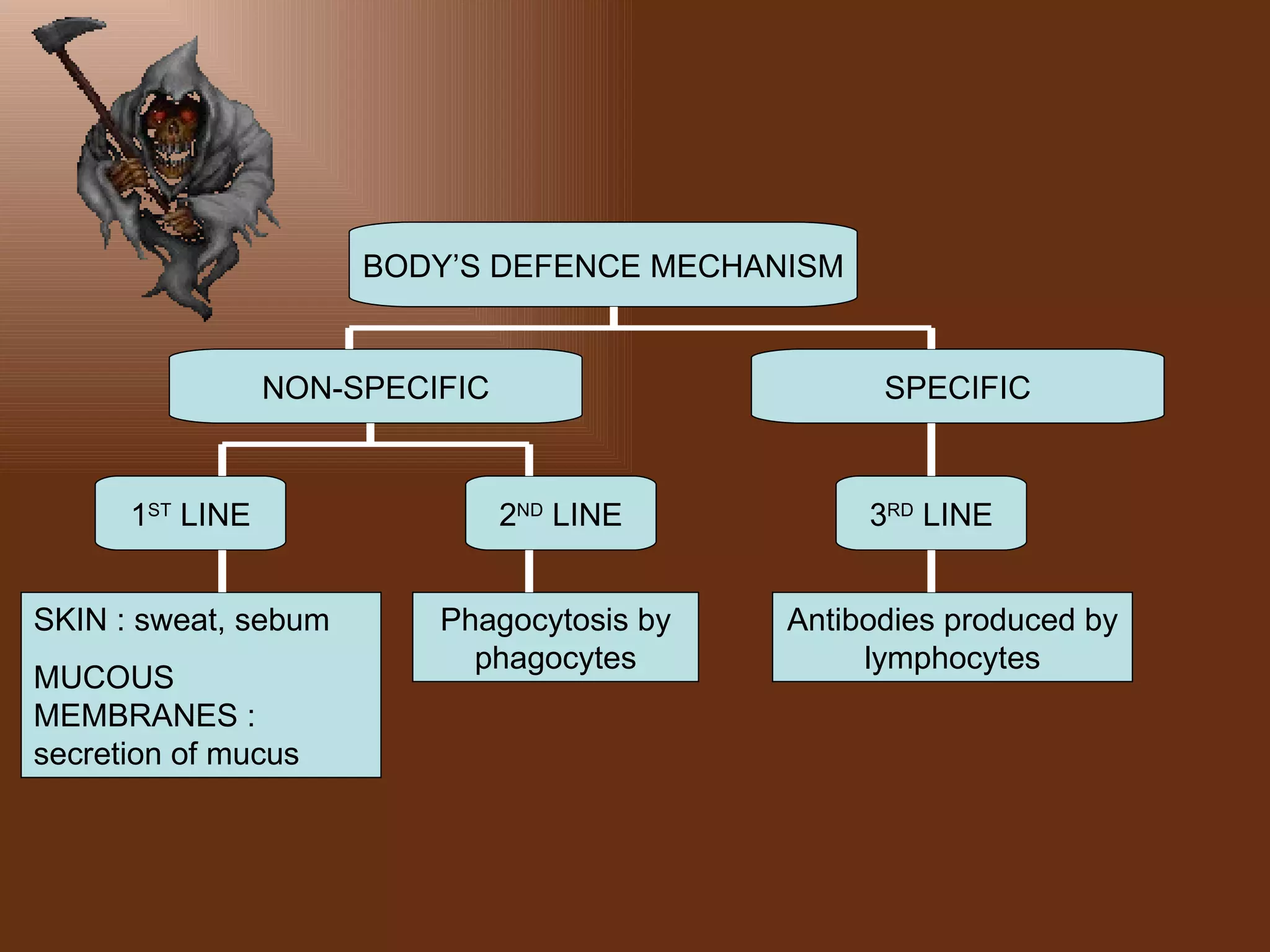
BODY’S DEFENCE MECHANISM


                 NON-SPECIFIC                     SPECIFIC


      1ST LINE                  2ND LINE         3RD LINE


SKIN : sweat, sebum       Phagocytosis by   Antibodies produced by
                            phagocytes           lymphocytes
MUCOUS
MEMBRANES :
secretion of mucus
FIRST LINE of
           DEFENCE
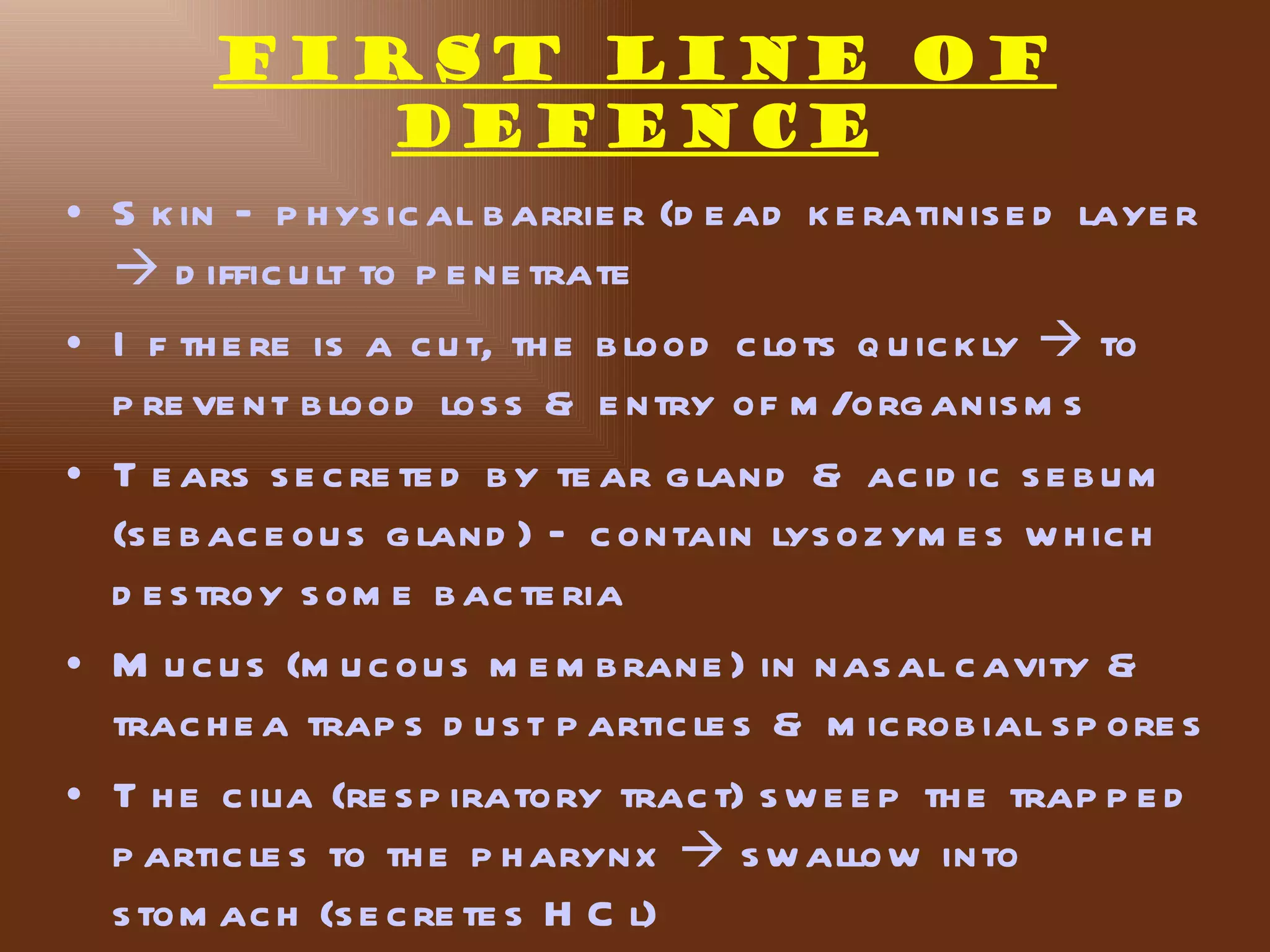
• S k in – p h ys ic al b arrie r (d e ad k e ratinis e d laye r
   d iffic u lt to p e ne trate
• I f th e re is a c u t, th e b lood c lots q u ic k ly  to
  p re ve nt b lood los s & e ntry of m /org anis m s
• T e ars s e c re te d b y te ar g land & ac id ic s e b u m
  (s e b ac e ou s g land ) – c ontain lys oz ym e s w h ic h
  d e s troy s om e b ac te ria
• M u c u s (m u c ou s m e m b rane ) in nas al c avity &
  trac h e a trap s d u s t p artic le s & m ic rob ial s p ore s
• T h e c ilia (re s p iratory trac t) s w e e p th e trap p e d
  p artic le s to th e p h arynx  s w allow into
  s tom ac h (s e c re te s H C l)
S E C OND LINE of DE FE NC E
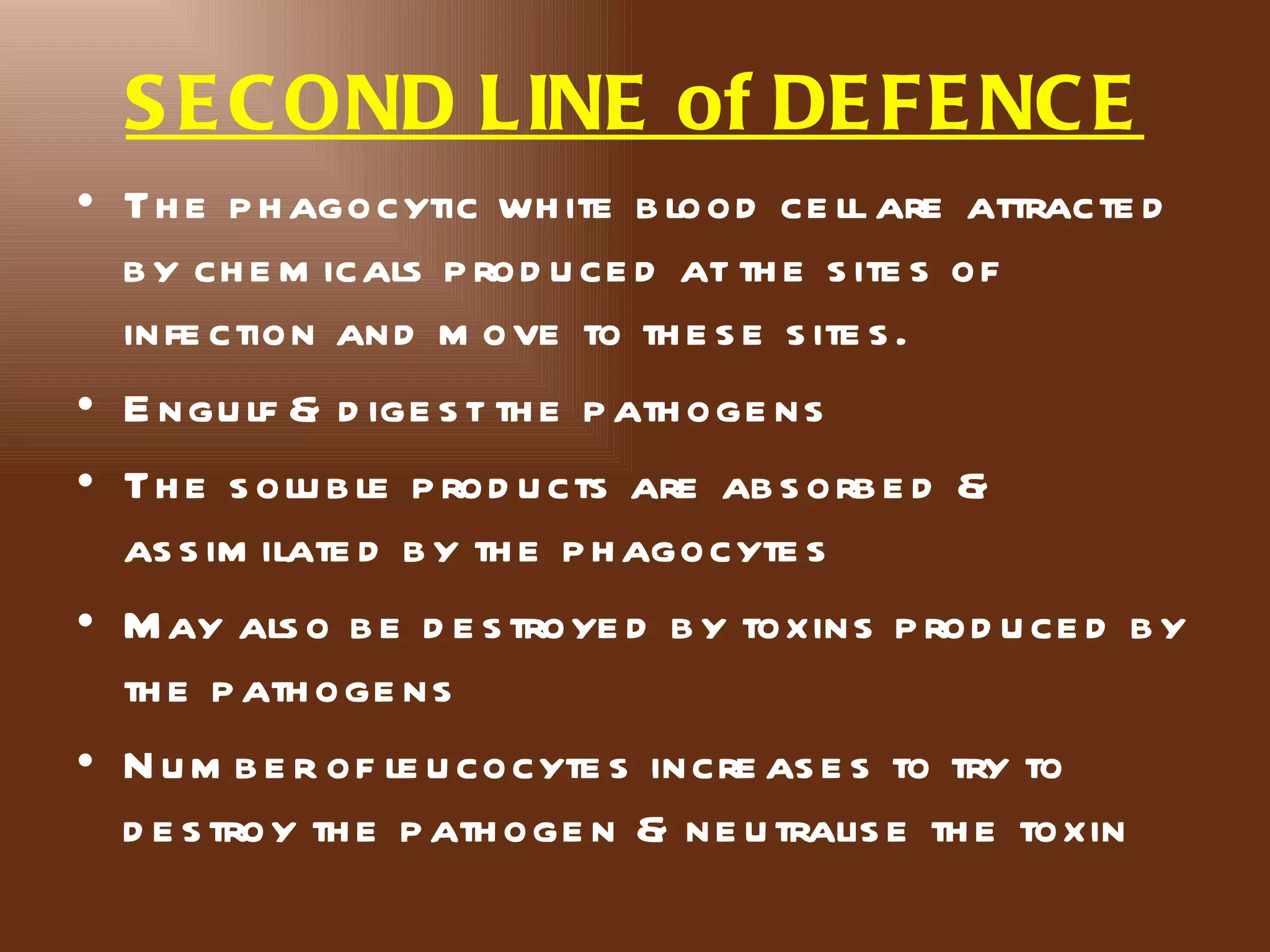
• Th e p h agocytic wh ite b lood ce ll are attracte d
  b y ch e m icals p rod u ce d at th e s ite s of
  infe ction and m ove to th e s e s ite s .
• E ngu lf & d ige s t th e p ath oge ns
• Th e s olu b le p rod u cts are ab s orb e d &
  as s im ilate d b y th e p h agocyte s
• M ay als o b e d e s troye d b y toxins p rod u ce d b y
  th e p ath oge ns
• N u m b e r of le u cocyte s incre as e s to try to
  d e s troy th e p ath oge n & ne u tralis e th e toxin
THIRD LINE of ME C HA NIS M
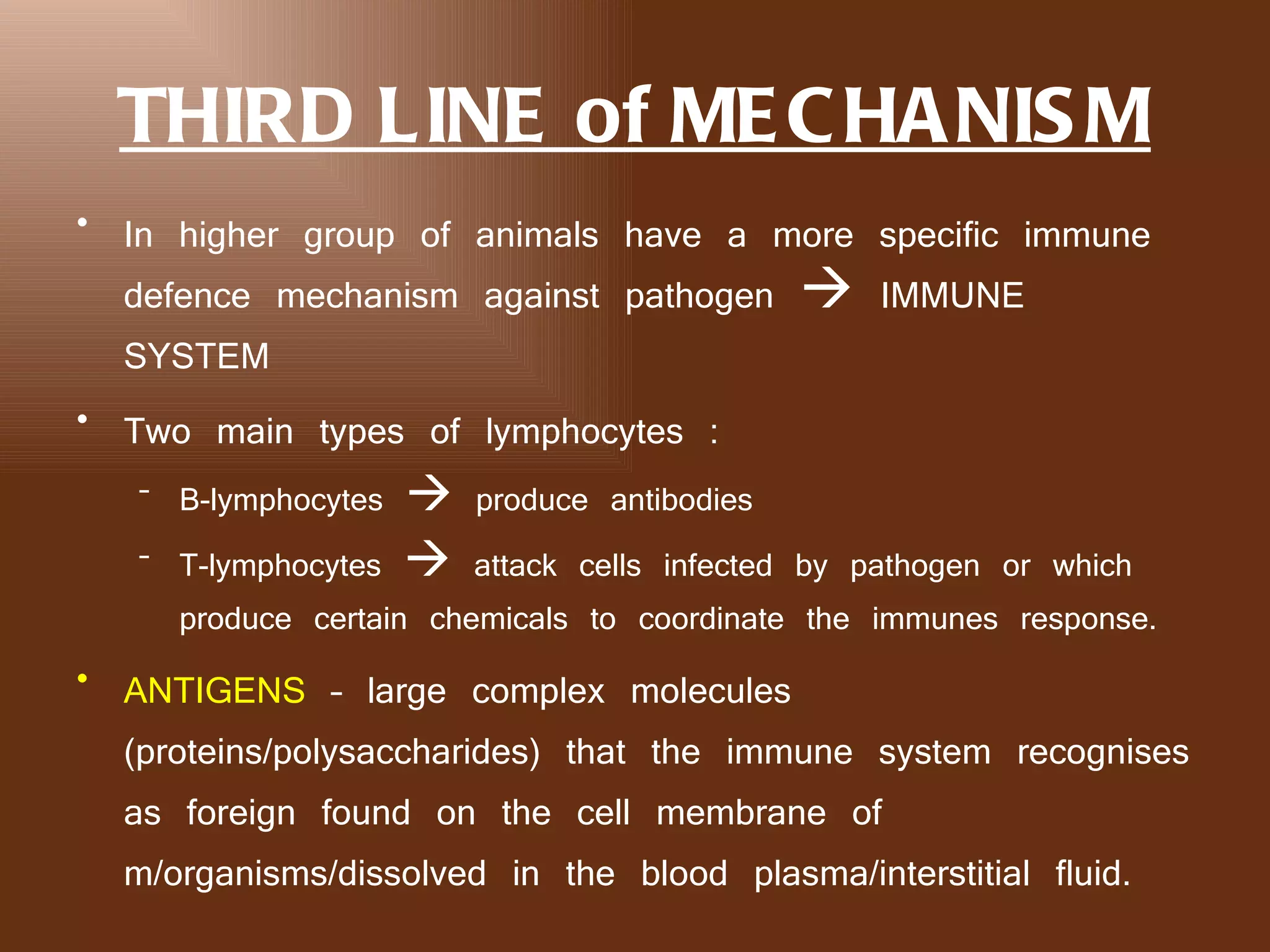
• In higher group of animals have a more specific immune
  defence mechanism against pathogen  IMMUNE
  SYSTEM
• Two main types of lymphocytes :
   – B-lymphocytes  produce antibodies
   – T-lymphocytes  attack cells infected by pathogen or which
     produce certain chemicals to coordinate the immunes response.
• ANTIGENS – large complex molecules
  (proteins/polysaccharides) that the immune system recognises
  as foreign found on the cell membrane of
  m/organisms/dissolved in the blood plasma/interstitial fluid.
THIRD LINE of ME C HA NIS M
            (cont…)
• ANTIBODIES – A protein produced by
  lymphocytes in response to the entry of an
  antigen into the body.
• IMMUNE RESPONSE – interaction
  between antibody & antigen which result
  in the antigen being eliminated from the
  body
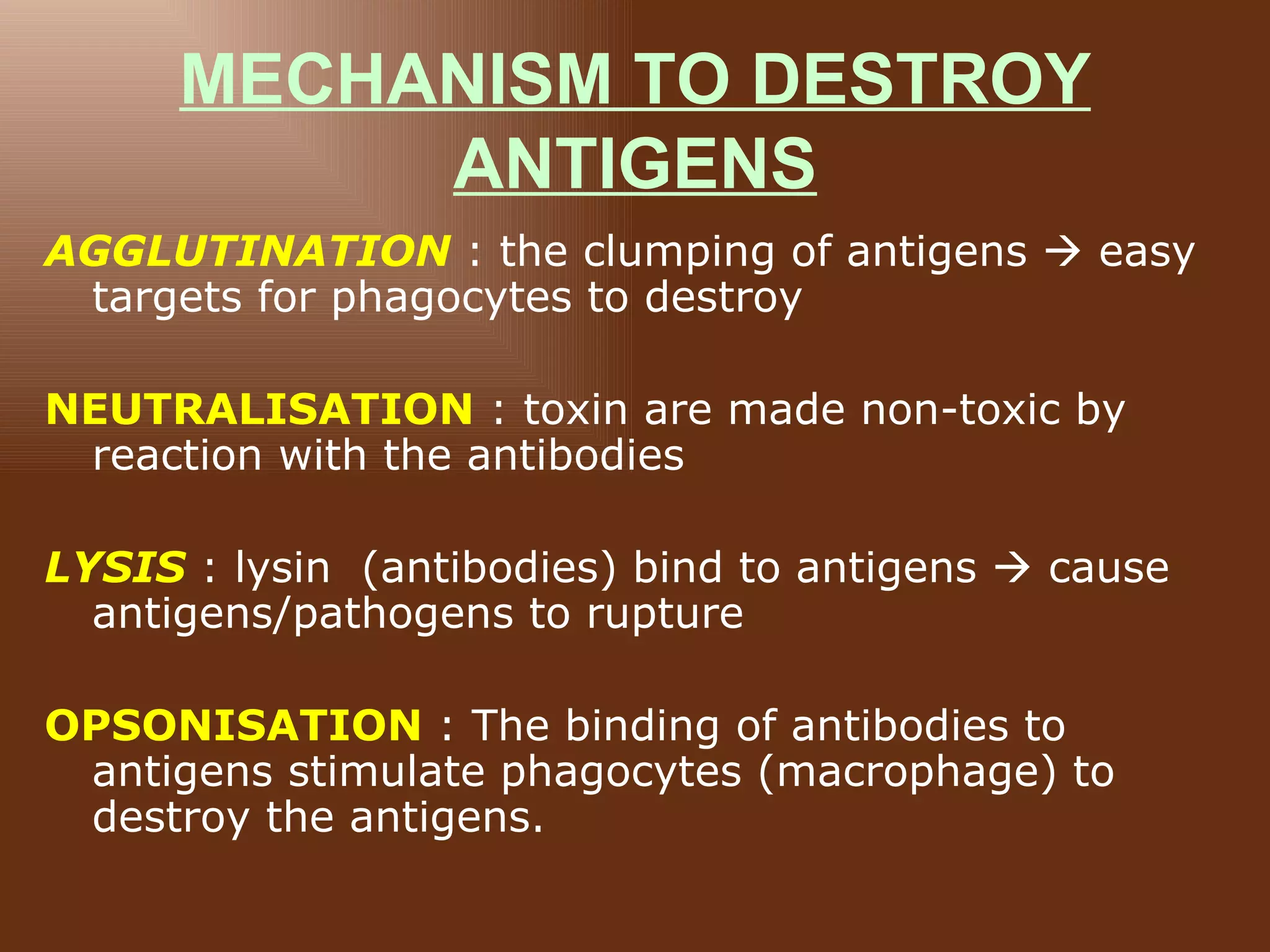
MECHANISM TO DESTROY
           ANTIGENS
AGGLUTINATION : the clumping of antigens  easy
 targets for phagocytes to destroy

NEUTRALISATION : toxin are made non-toxic by
 reaction with the antibodies

LYSIS : lysin (antibodies) bind to antigens  cause
  antigens/pathogens to rupture

OPSONISATION : The binding of antibodies to
 antigens stimulate phagocytes (macrophage) to
 destroy the antigens.
• IMMUNITY : The state in which the body
  is resistant to infection by a disease-causing
  pathogens @ the ability of an animal or
  plant to resist infection by pathogens
• IMMUNISATION : The process of
  inducing immunity by administering a
  vaccine
• VACCINE : A preparation of weakened,
  dead or non-virulent forms of a pathogen
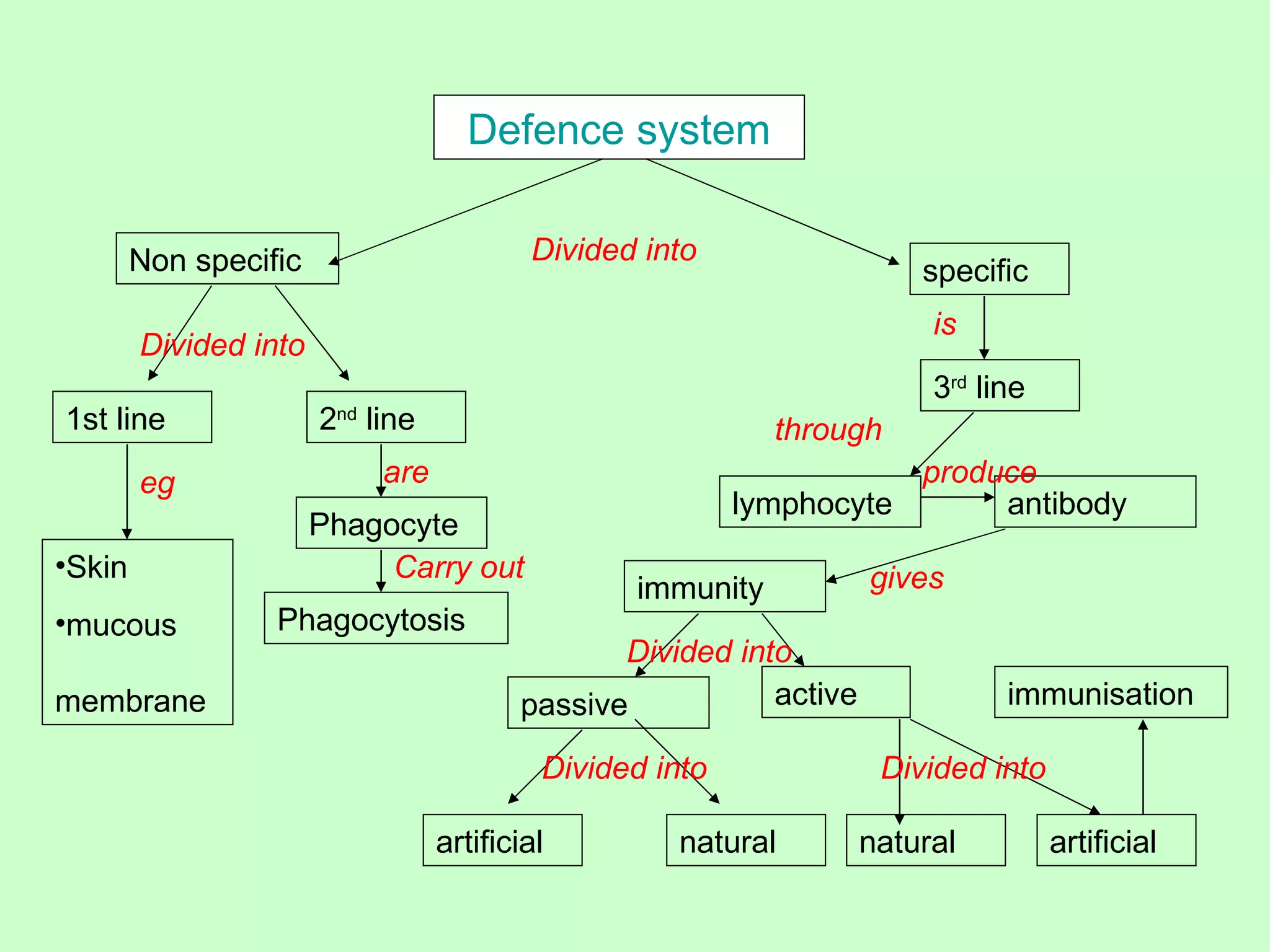
Defence system


        Non specific                      Divided into
                                                                        specific
                                                                         is
        Divided into
                                                                         3rd line
1st line               2nd line                             through
        eg                  are                                      produce
                                                          lymphocyte      antibody
                       Phagocyte
•Skin                       Carry out                               gives
                                                 immunity
•mucous           Phagocytosis
                                                Divided into
membrane                                 passive           active              immunisation

                                           Divided into              Divided into

                                  artificial        natural         natural         artificial
V A R IO U S T YP E S O F
        IM M U N IT Y
• ACTIVE IMMUNITY : when an
  individual’s own immune system
  produces its own antibodies to defend
  against specific antigens

• Natural Active Immunity : after
  recovered from certain disease
  (examples : mumps, measles & chicken
  pox)
• Artificial Active Immunity : can b e
  e s tab lis h e d u p on im m u nis ation or
  vaccination. (m u m p s , ru b e lla,
  m e as le s & p oliom ye litis )
V A R IO U S T YP E S o f
         IM M U N IT Y
• PASSIVE IMMUNITY : when an
  individual is given the antibodies
  required to defend against the pathogen

• Natural Passive Immunity : when
  antibodies produced by the mother are
  passed across the placenta to the foetus
  during development or in early infancy
  through breast milk (breast feeding).
  Colostrum (1st formed milk) – rich in
  antibodies
• Artificial Passive Immunity : ready-made
  antibody or serum is injected into the
  individual. Prepared from cows or horses.
  (rabies, hepatitis, tetanus & snakebites)
Ooo…sleeping in Biology
         class ek?
     So stubborn la.
Let me ‘teach’ U first before
Mr. FAZLI become angry!!!
                                 Waa….mama!
                                Help me…. I don’t
                                want to fall asleep
                                   in the class
                                    anymore!!!
                                   I SWEAR!!!

Sub 1[1].5 form 5

  • 2.
    LEARNING OUTCOMES • To state another function of the circulatory system • To identify the three lines of defence mechanism • To describe phagocytosis • To state the meaning of antigen & antibody
  • 3.
    WHY DO WENEED THE BODY’S DEFENCE MECHANISM? • To defend the body against disease-causing microorganism (pathogens) • Pathogens are bacteria, viruses & parasites • Transmitted by air, contaminated food & water, animal (vector) & contaminated needles. Also by contact.
  • 4.
    MAIN LINES OFDEFENCE • Non-Specific Defence : First line defence & Second line defence • Specific Defence : Third line defence
  • 5.
    BODY’S DEFENCE MECHANISM NON-SPECIFIC SPECIFIC 1ST LINE 2ND LINE 3RD LINE SKIN : sweat, sebum Phagocytosis by Antibodies produced by phagocytes lymphocytes MUCOUS MEMBRANES : secretion of mucus
  • 6.
    FIRST LINE of DEFENCE • S k in – p h ys ic al b arrie r (d e ad k e ratinis e d laye r  d iffic u lt to p e ne trate • I f th e re is a c u t, th e b lood c lots q u ic k ly  to p re ve nt b lood los s & e ntry of m /org anis m s • T e ars s e c re te d b y te ar g land & ac id ic s e b u m (s e b ac e ou s g land ) – c ontain lys oz ym e s w h ic h d e s troy s om e b ac te ria • M u c u s (m u c ou s m e m b rane ) in nas al c avity & trac h e a trap s d u s t p artic le s & m ic rob ial s p ore s • T h e c ilia (re s p iratory trac t) s w e e p th e trap p e d p artic le s to th e p h arynx  s w allow into s tom ac h (s e c re te s H C l)
  • 7.
    S E COND LINE of DE FE NC E • Th e p h agocytic wh ite b lood ce ll are attracte d b y ch e m icals p rod u ce d at th e s ite s of infe ction and m ove to th e s e s ite s . • E ngu lf & d ige s t th e p ath oge ns • Th e s olu b le p rod u cts are ab s orb e d & as s im ilate d b y th e p h agocyte s • M ay als o b e d e s troye d b y toxins p rod u ce d b y th e p ath oge ns • N u m b e r of le u cocyte s incre as e s to try to d e s troy th e p ath oge n & ne u tralis e th e toxin
  • 8.
    THIRD LINE ofME C HA NIS M • In higher group of animals have a more specific immune defence mechanism against pathogen  IMMUNE SYSTEM • Two main types of lymphocytes : – B-lymphocytes  produce antibodies – T-lymphocytes  attack cells infected by pathogen or which produce certain chemicals to coordinate the immunes response. • ANTIGENS – large complex molecules (proteins/polysaccharides) that the immune system recognises as foreign found on the cell membrane of m/organisms/dissolved in the blood plasma/interstitial fluid.
  • 9.
    THIRD LINE ofME C HA NIS M (cont…) • ANTIBODIES – A protein produced by lymphocytes in response to the entry of an antigen into the body. • IMMUNE RESPONSE – interaction between antibody & antigen which result in the antigen being eliminated from the body
  • 10.
    MECHANISM TO DESTROY ANTIGENS AGGLUTINATION : the clumping of antigens  easy targets for phagocytes to destroy NEUTRALISATION : toxin are made non-toxic by reaction with the antibodies LYSIS : lysin (antibodies) bind to antigens  cause antigens/pathogens to rupture OPSONISATION : The binding of antibodies to antigens stimulate phagocytes (macrophage) to destroy the antigens.
  • 11.
    • IMMUNITY :The state in which the body is resistant to infection by a disease-causing pathogens @ the ability of an animal or plant to resist infection by pathogens • IMMUNISATION : The process of inducing immunity by administering a vaccine • VACCINE : A preparation of weakened, dead or non-virulent forms of a pathogen
  • 12.
    Defence system Non specific Divided into specific is Divided into 3rd line 1st line 2nd line through eg are produce lymphocyte antibody Phagocyte •Skin Carry out gives immunity •mucous Phagocytosis Divided into membrane passive active immunisation Divided into Divided into artificial natural natural artificial
  • 13.
    V A RIO U S T YP E S O F IM M U N IT Y • ACTIVE IMMUNITY : when an individual’s own immune system produces its own antibodies to defend against specific antigens • Natural Active Immunity : after recovered from certain disease (examples : mumps, measles & chicken pox)
  • 14.
    • Artificial ActiveImmunity : can b e e s tab lis h e d u p on im m u nis ation or vaccination. (m u m p s , ru b e lla, m e as le s & p oliom ye litis )
  • 15.
    V A RIO U S T YP E S o f IM M U N IT Y • PASSIVE IMMUNITY : when an individual is given the antibodies required to defend against the pathogen • Natural Passive Immunity : when antibodies produced by the mother are passed across the placenta to the foetus during development or in early infancy through breast milk (breast feeding). Colostrum (1st formed milk) – rich in antibodies
  • 16.
    • Artificial PassiveImmunity : ready-made antibody or serum is injected into the individual. Prepared from cows or horses. (rabies, hepatitis, tetanus & snakebites)
  • 17.
    Ooo…sleeping in Biology class ek? So stubborn la. Let me ‘teach’ U first before Mr. FAZLI become angry!!! Waa….mama! Help me…. I don’t want to fall asleep in the class anymore!!! I SWEAR!!!