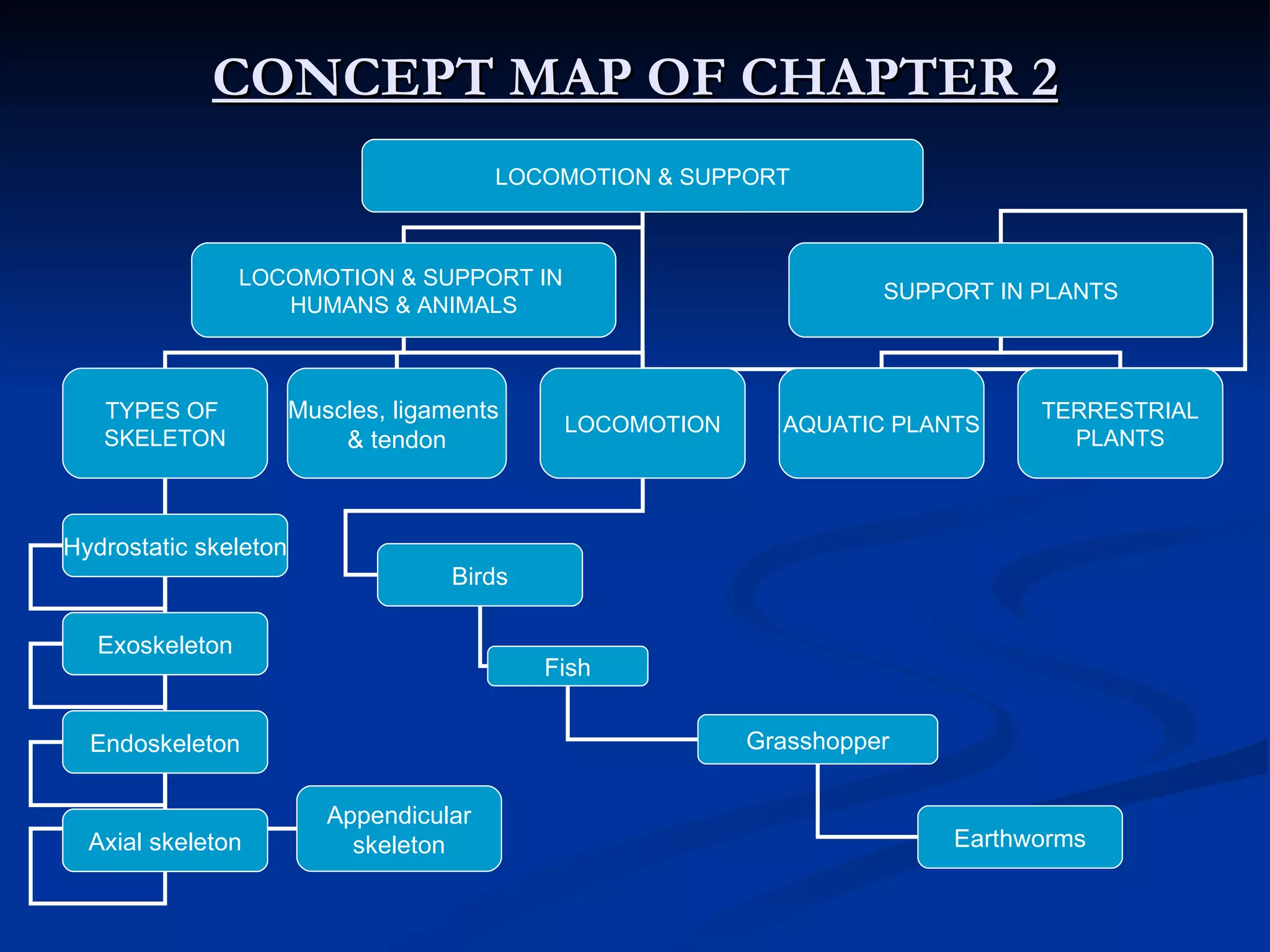
CONCEPT MAP OF CHAPTER 2
                                         LOCOMOTION & SUPPORT


                 LOCOMOTION & SUPPORT IN
                                                                    SUPPORT IN PLANTS
                    HUMANS & ANIMALS


   TYPES OF            Muscles, ligaments                                      TERRESTRIAL
                                             LOCOMOTION     AQUATIC PLANTS
   SKELETON                & tendon                                              PLANTS


Hydrostatic skeleton
                                    Birds

   Exoskeleton
                                            Fish


  Endoskeleton                                            Grasshopper


                          Appendicular
  Axial skeleton            skeleton                                     Earthworms
LEARNING
             OUTCOMES
   To explain the necessity for support and
    locomotion in humans and animals,

   To describe problems that could be faced by
    humans and animals in support and
    locomotion,

   To explain how problems in support and
    locomotion are overcome in humans and
    animals,

   To name the bones that make up the axial
    skeleton and appendicular skeleton of the
    human body
The Necessity for Support &
Locomotion in Humans & Animals

WHY DO HUMANS & ANIMALS
      NEED SUPPORT?
   1. To find the food
   2. To find partner for mating
   3. To protect/escape from their
     predator
   4. To shelter from bad environment
The Necessity for Support &
    Locomotion in Humans & Animals
   Without support, animals & humans
    would not be able to maintain their body
    shape  their body collapse under the
    weight of their own tissues.

   Support are provided by some form of
    skeleton.
       Hydrostatic   skeleton
       Exoskeleton
       endoskeleton
HYDROSTATIC
           SKELETON
   A fluid-filled internal body cavity in
    which the fluid is held under pressure 
    maintaining the body shape & providing
    support for internal organ

   The cavity is surrounded by muscles
    arranged in layers.

   The body shape of the animal changes as
    these muscles contract & relax.
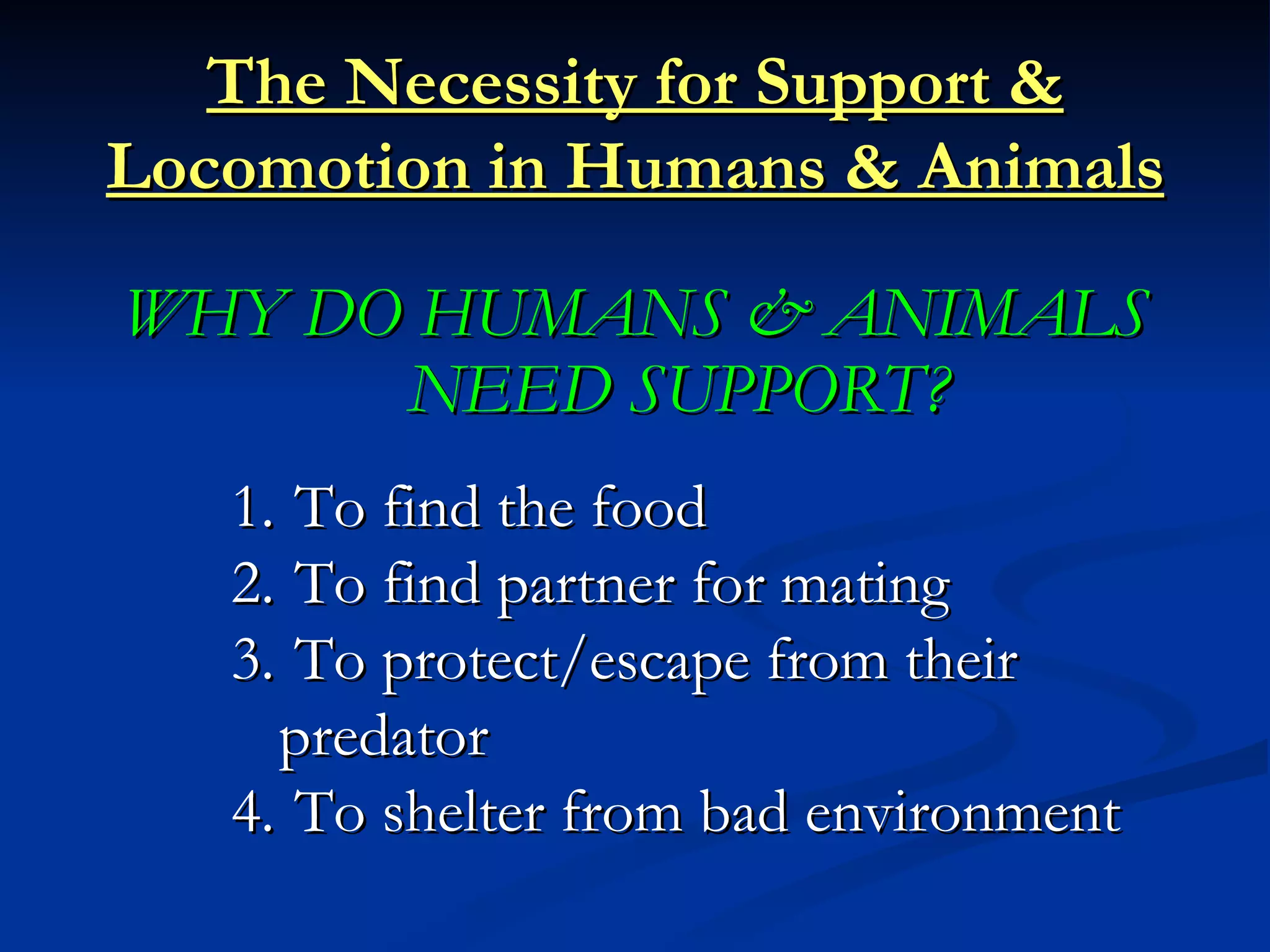
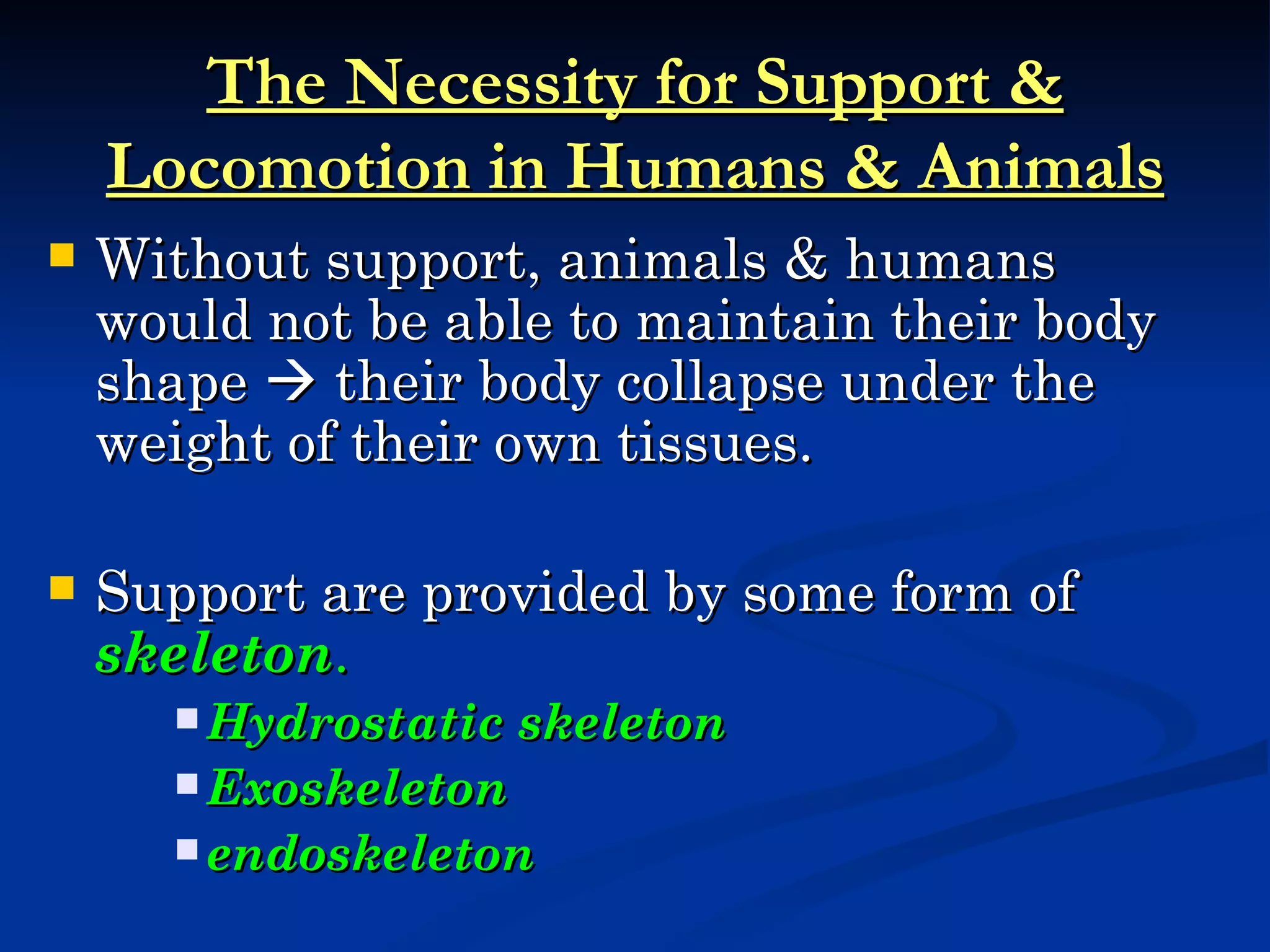
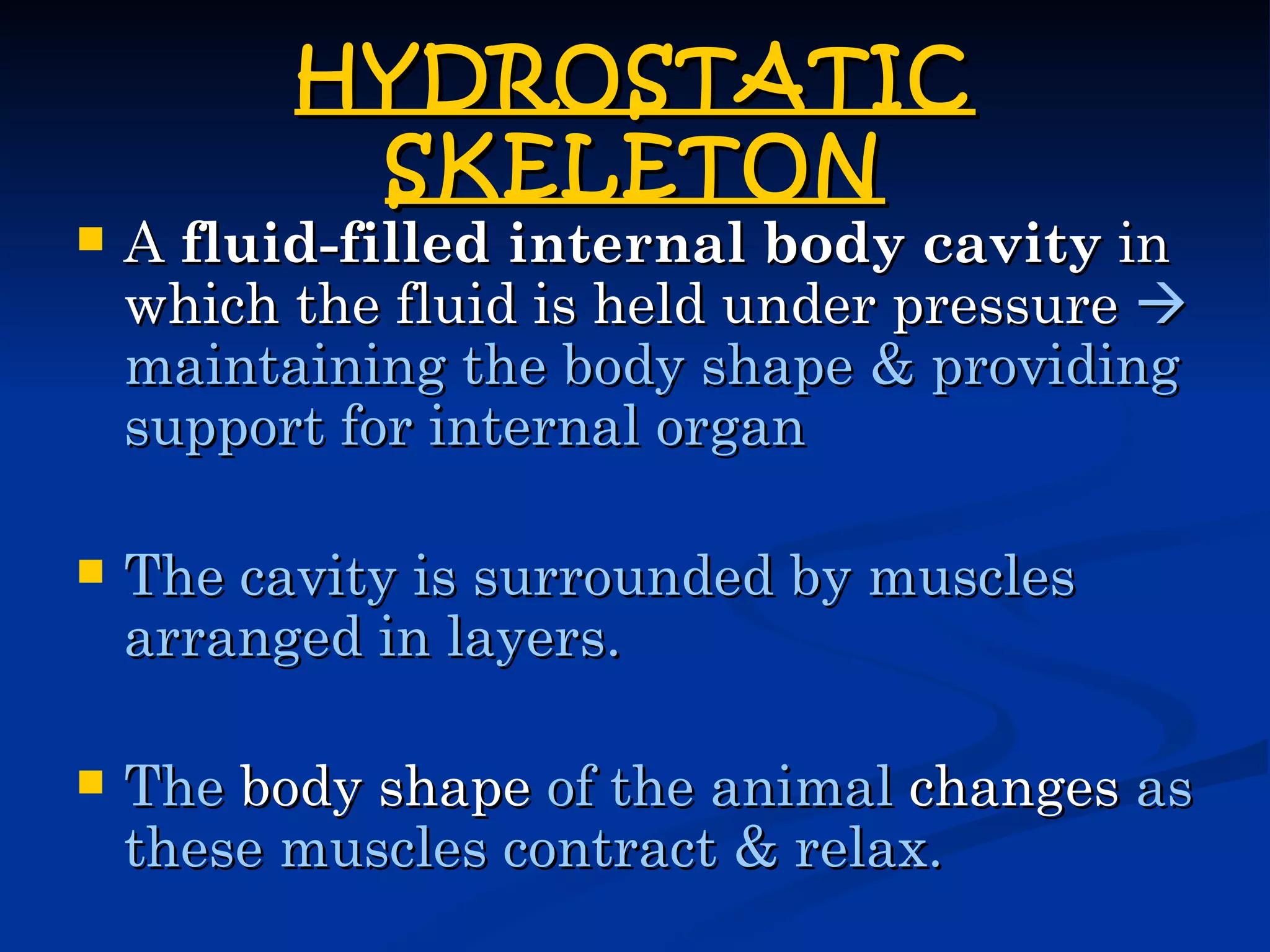
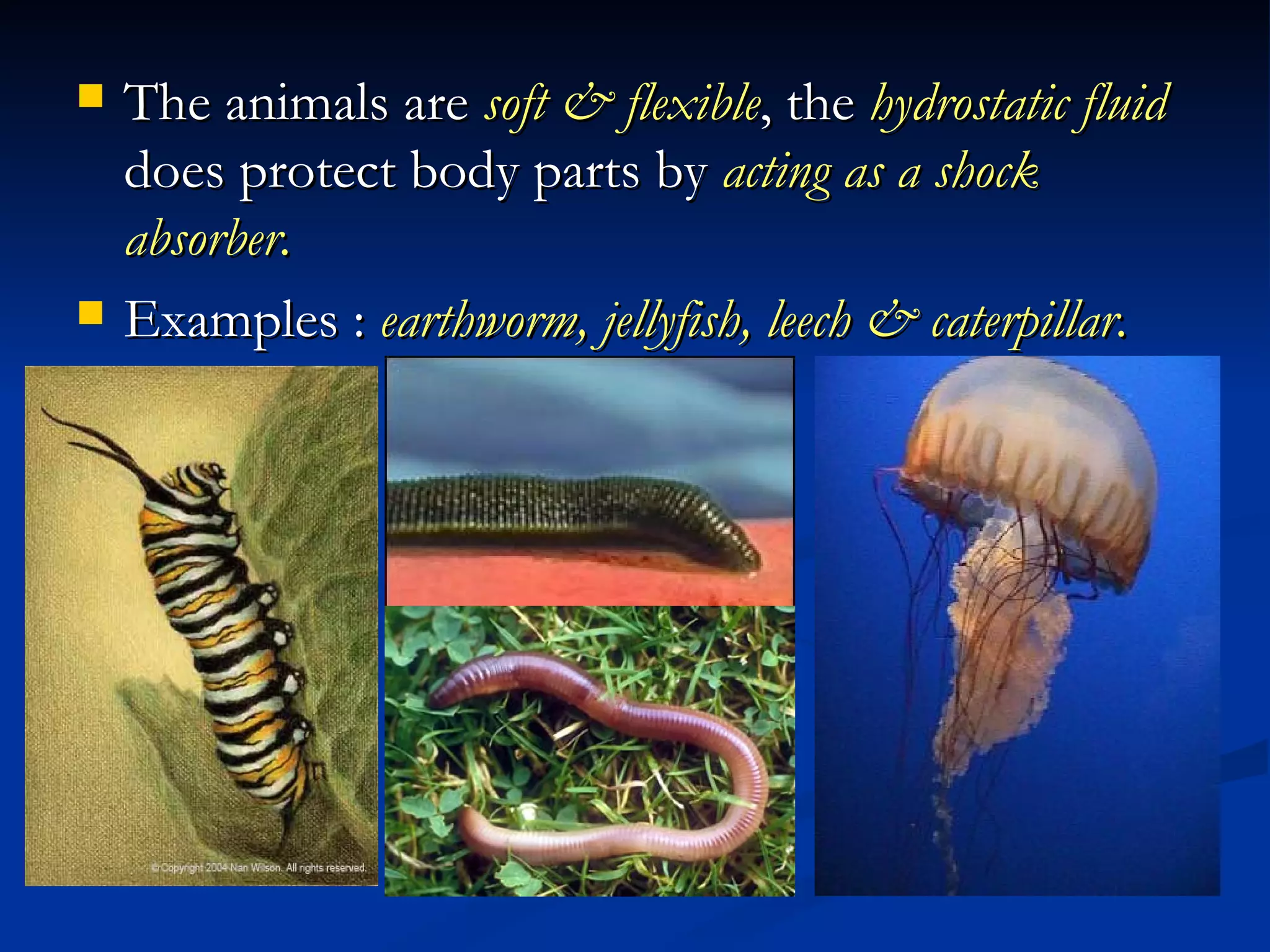
   The animals are soft & flexible, the hydrostatic fluid
    does protect body parts by acting as a shock
    absorber.
   Examples : earthworm, jellyfish, leech & caterpillar.
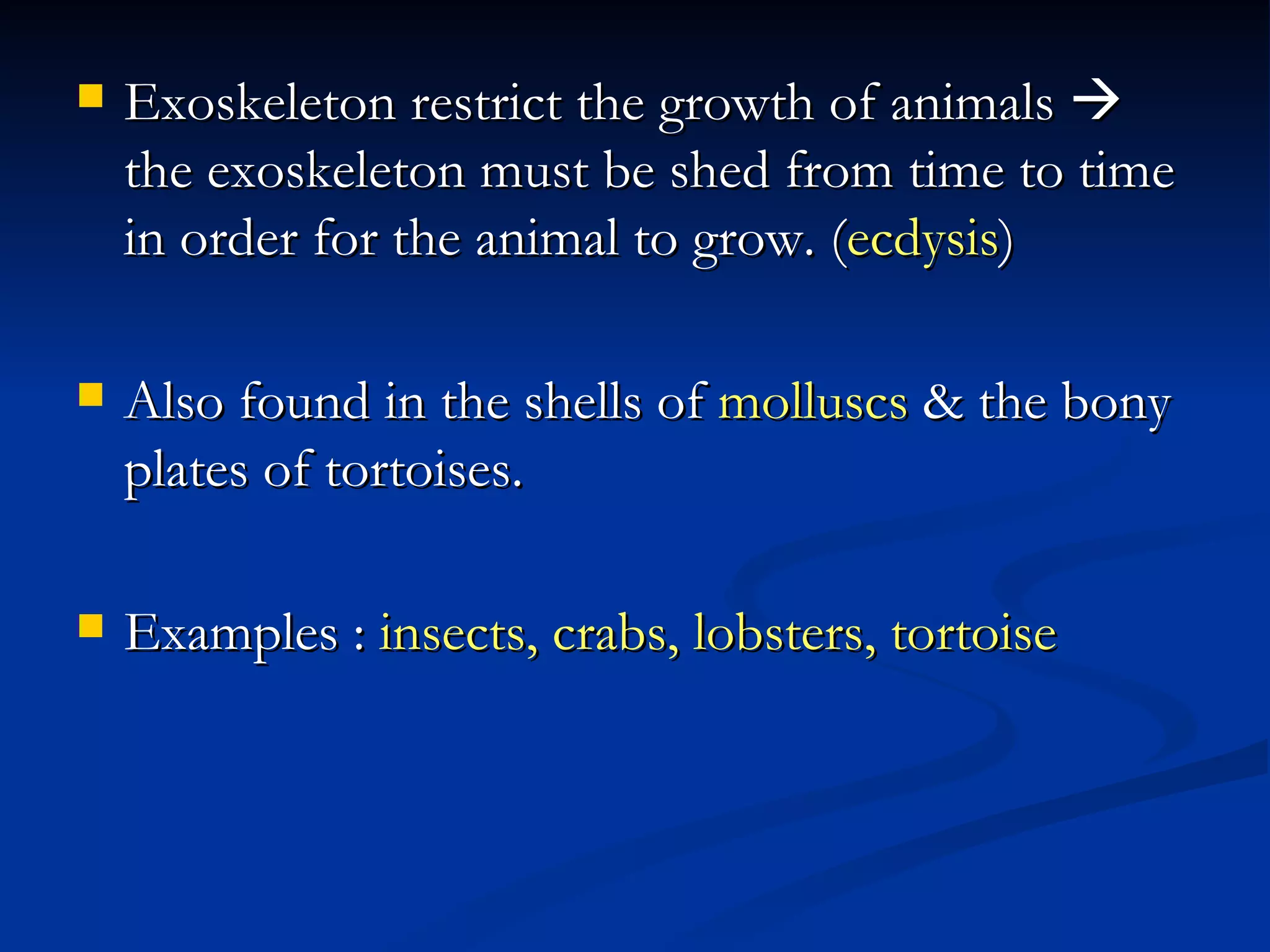
EXOSKELETON
   A rigid outer covering usually made up
    of protein, chitins &/@ calcium salt.

   Insects – the cuticle (covered with wax
    to prevent water loss from the body),
    cover the body’s surface.

   The exoskeleton is jointed / hinged =
    certain points of the skeleton are flexible
    & can bend  enabling the movement.
   Exoskeleton restrict the growth of animals 
    the exoskeleton must be shed from time to time
    in order for the animal to grow. (ecdysis)

   Also found in the shells of molluscs & the bony
    plates of tortoises.

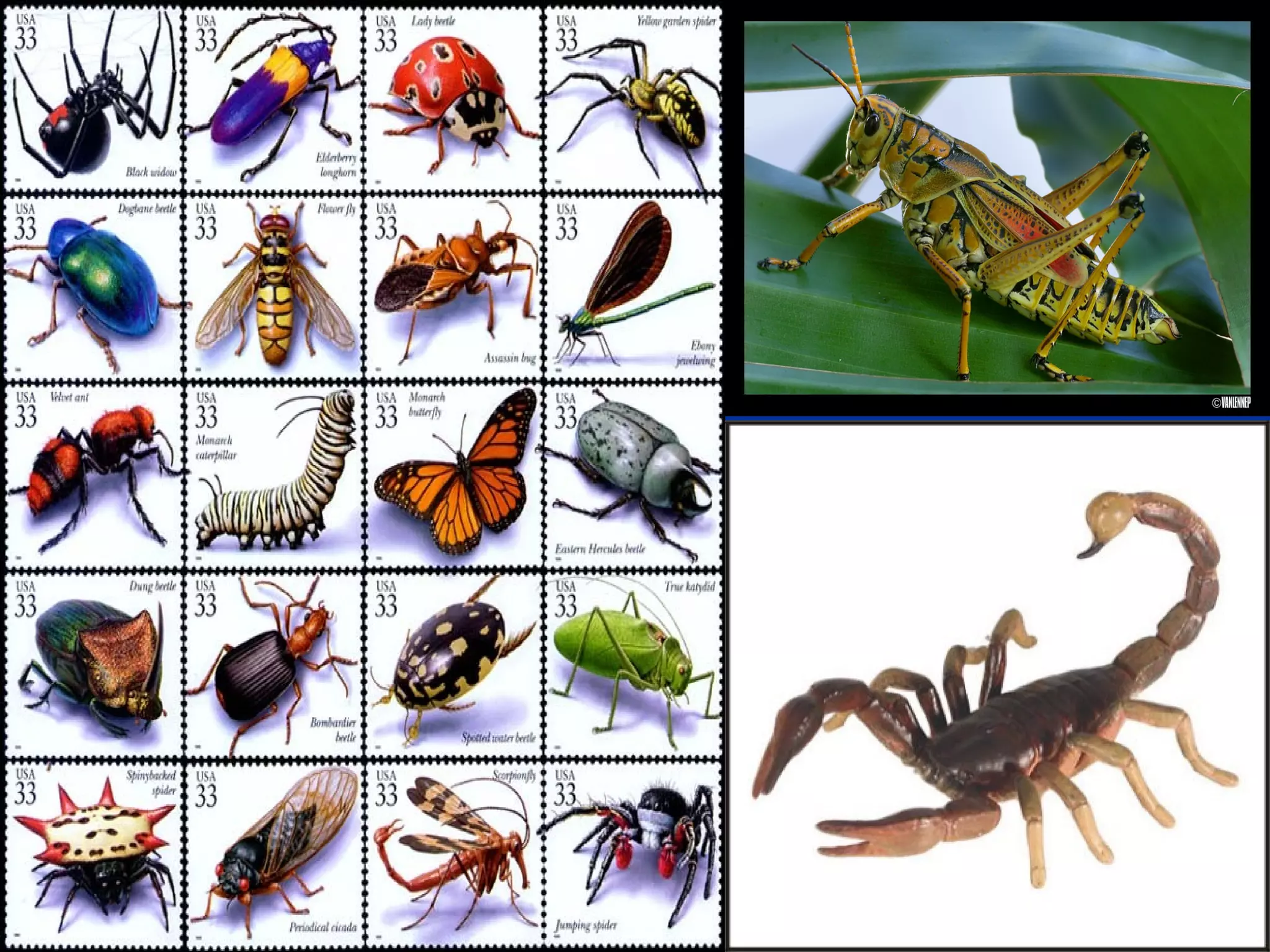
   Examples : insects, crabs, lobsters, tortoise
ENDOSKELETON
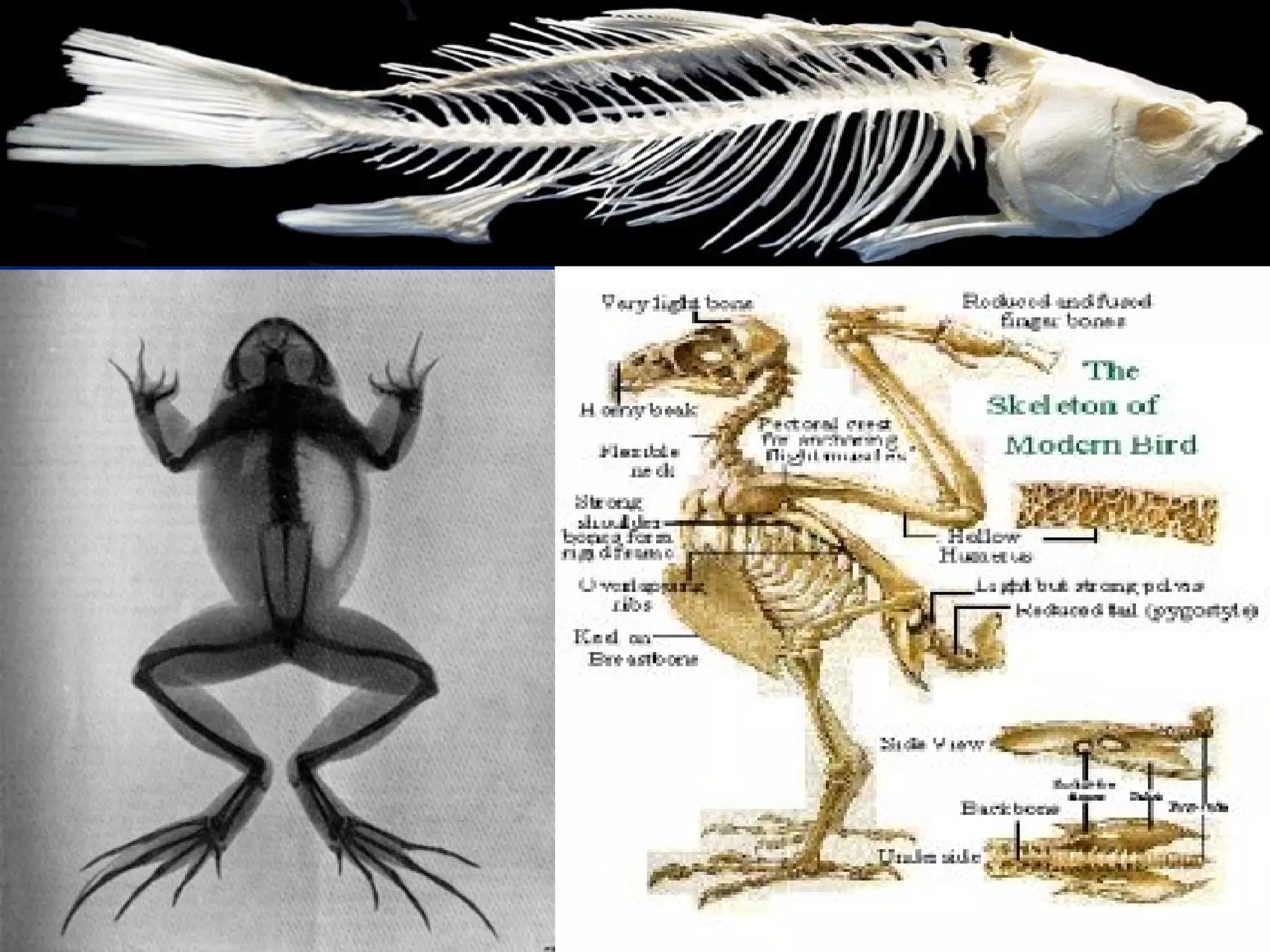
   Found in the bodies of all vertebrates including
    fish, amphibians & birds.

   Consist of hard skeleton of bones & cartilage
    found inside the body – made up of calcium &
    phosphate.

   Works with the muscular system to perform
    movement & locomotion. It support the body &
    protects the organs.
The Necessity for Support &
Locomotion in Humans & Animals
   The functions of skeleton :
       Provide shape & support
       Enables movement (locomotion)
       Protects internal organs
       Stores calcium & phosphate ions
       Produces blood cells
       A firm base for the attachment of
        muscles
The Necessity for Support &
    Locomotion in Humans & Animals
Problems that could be faced by humans
 and animals in support and locomotion,
        gravitational force, friction & resistance when moving
           around
   Aspect need to be considered when describing the
    locomotion of an animal :-
        Stability – when it moves, it is temporarily unstable, but
         its stability will be restored when it stops.
        Support – must have enough support from its body’s
         skeleton
        Propulsion – must be propelled in order to move
HOW TO OVERCOME THE
           PROBLEMS?
   RESISTANCE & FRICTION – by
    streamlining their bodies.

   GRAVITATIONAL FORCE – most animals
    have their own supporting structures (fins –
    fishes, wings – birds & strong limbs – tetrapods
    & humans)  provide the propulsive force to
    overcome the problem
   The skeletal system together with its
    muscles are designed specially to overcome
    the problems associated with support &
    locomotion of humans & animals.

   To initiate locomotion, the force required
    is generated by contraction of muscles,
    whereas the movement is transmitted by
    the skeleton.
THE HUMAN SKELETAL SYSTEM
   The adult human skeleton consist of 206 bones.

   Divided into two main parts : the axial skeleton &
    the appendicular skeleton.

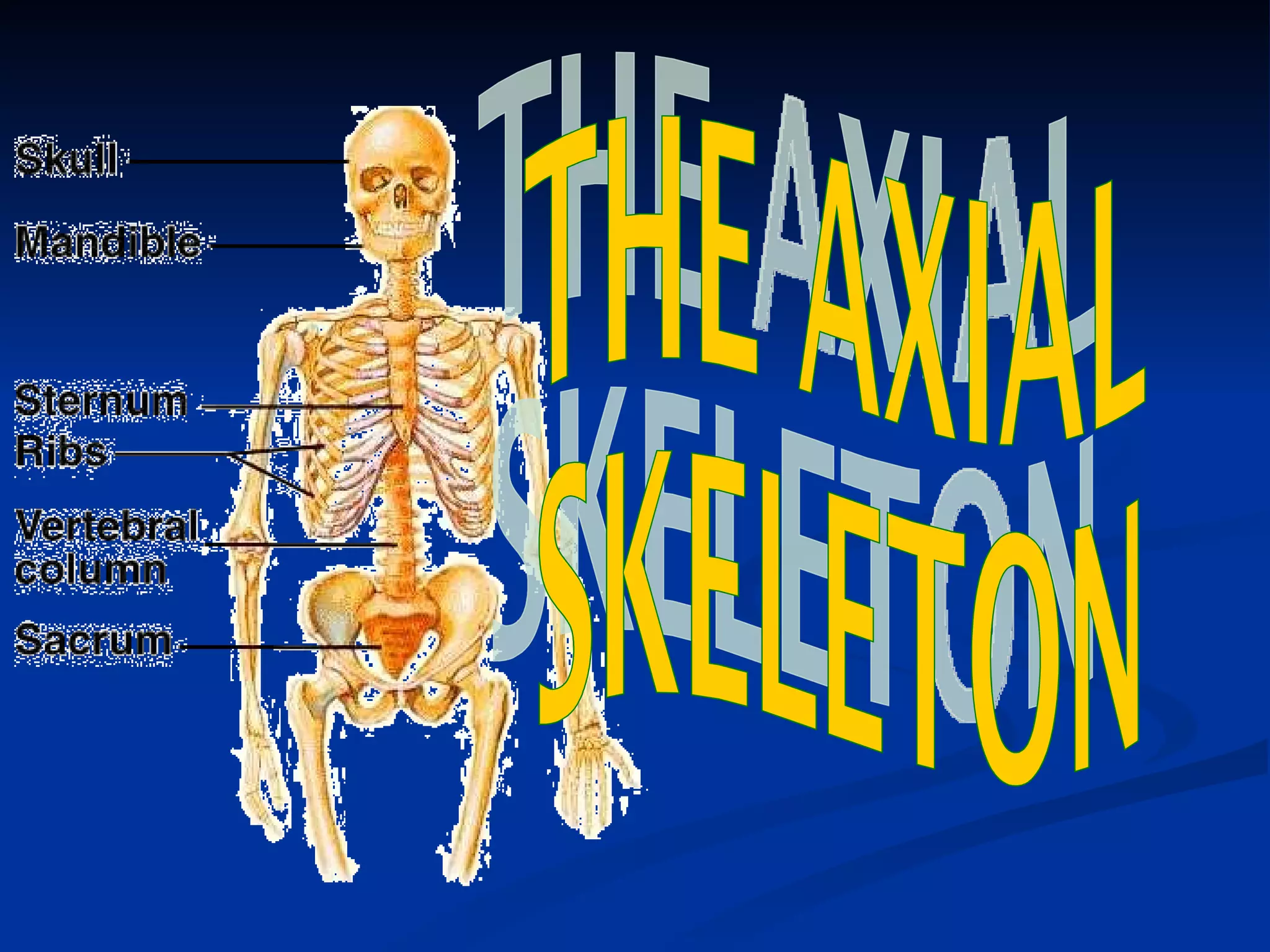
   The axial skeleton : made up of the bones that
    form the vertical axis of the body.

   It supports & protects the organs of the head,
    neck & trunk. (skull, vertebral column, rib cage)
   The appendicular skeleton : made up of the
    bones that are attached to the axial
    skeleton.

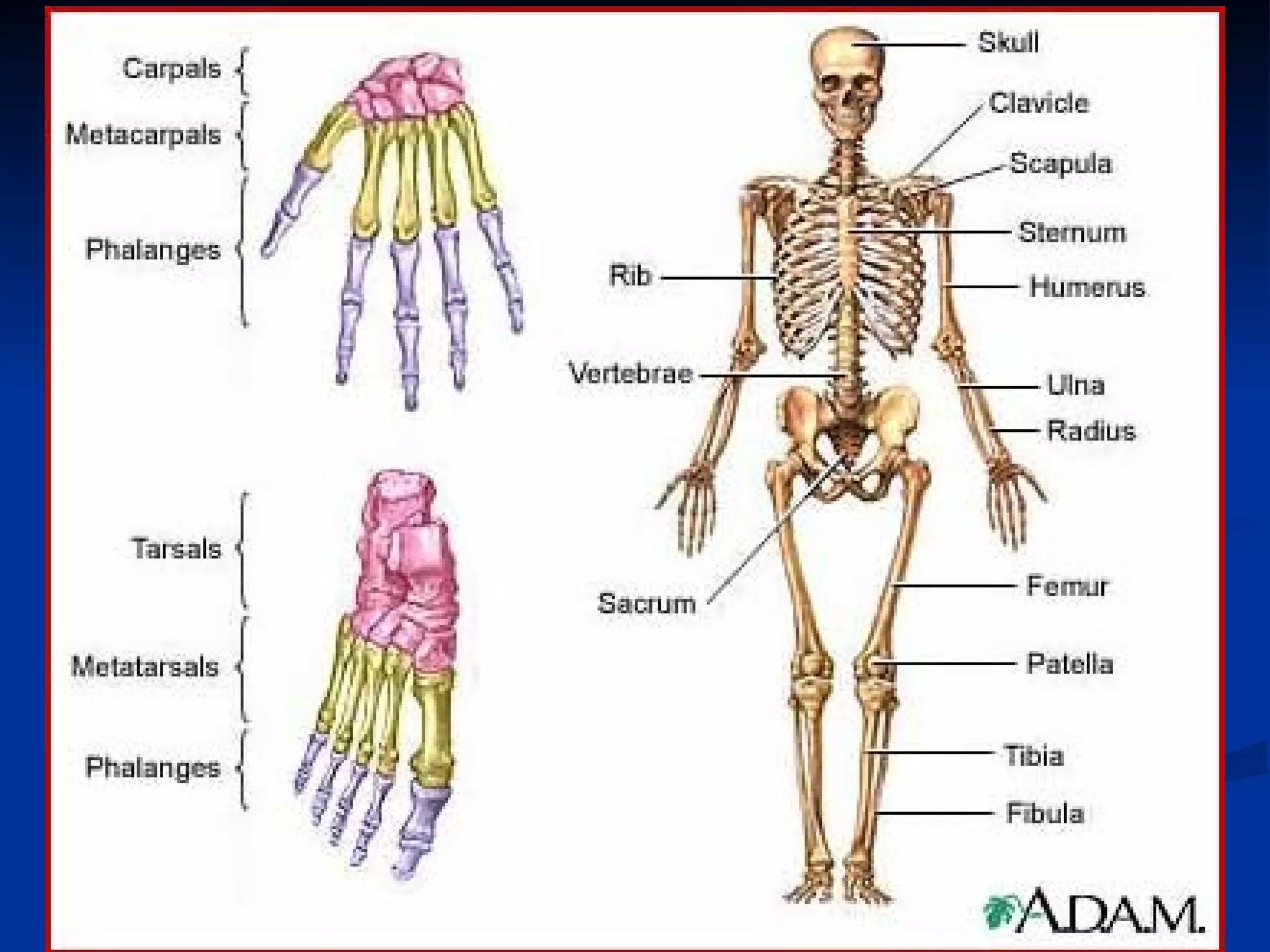
   Include bones of the limbs, the pectoral
    girdle & the pelvic girdle.
FUNCTION OF THE SKELETON
   PROTECTION – the skull protects the brain,
    the vertebral column protects the spinal cord &
    the rib cage protects internal organs such as the
    heart.

   SUPPORT – act as a framework to support the
    soft body parts, to maintain the upright position
    & to keep the body stable.
FUNCTION OF THE SKELETON
   MOVEMENT – bones interact with the
    skeletal muscle.

   BLOOD CELL FORMATION – most of the
    blood cells are formed in the bone marrow of
    the long bones.

   MINERAL STORAGE – bones act as a
    reservoir for calcium & phosphorus.
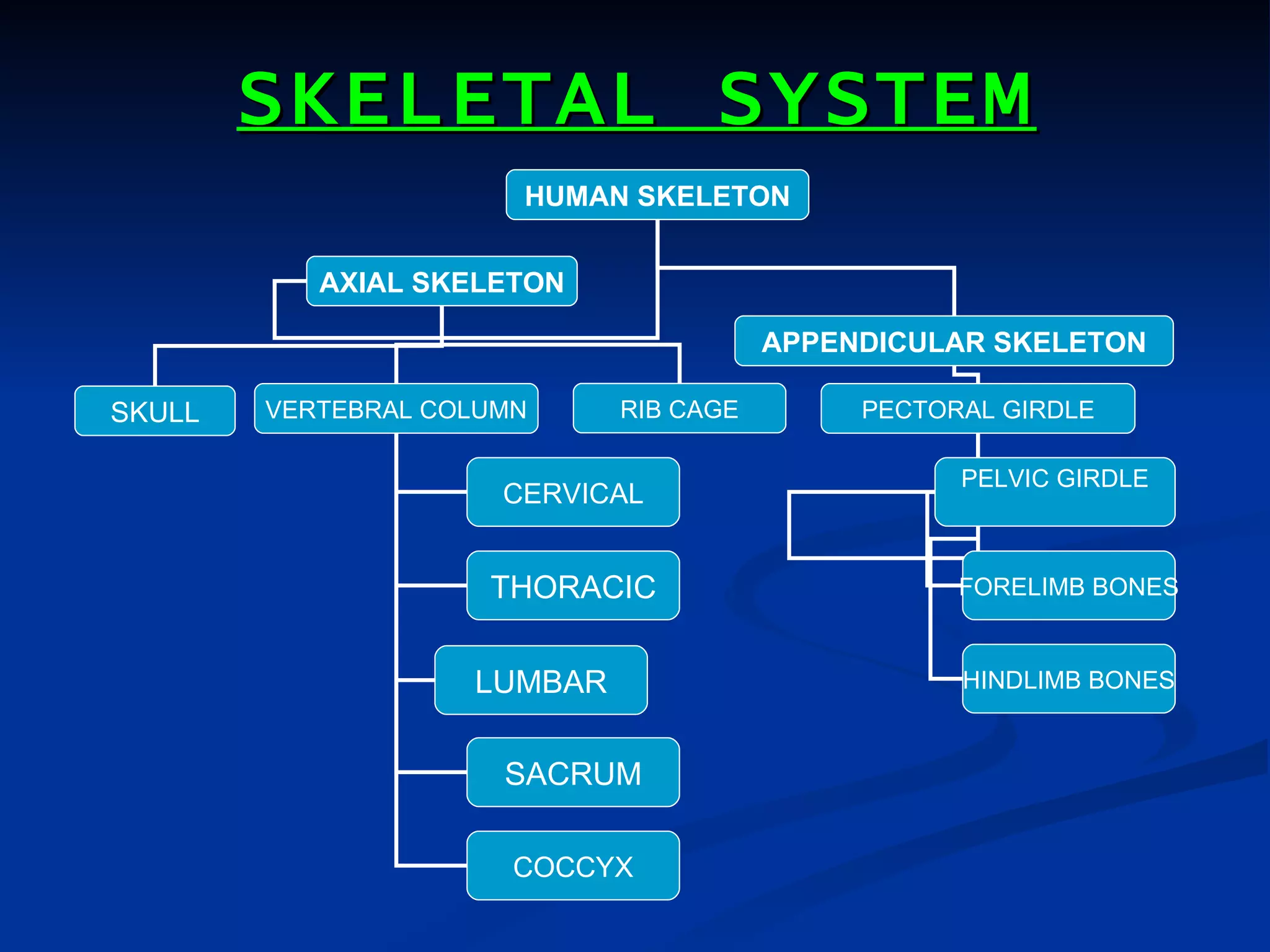
SKELETAL SYSTEM
                       HUMAN SKELETON


           AXIAL SKELETON

                                        APPENDICULAR SKELETON

SKULL   VERTEBRAL COLUMN     RIB CAGE        PECTORAL GIRDLE

                                                   PELVIC GIRDLE
                      CERVICAL


                     THORACIC                      FORELIMB BONES


                    LUMBAR                         HINDLIMB BONES


                      SACRUM

                       COCCYX
THE SKULL
   Made up of 8 cranial bones & 14 facial bones
    including the upper jaw & the lower jaw.

   The facial bones also provide support &
    protect the entrances to the respiratory
    system.
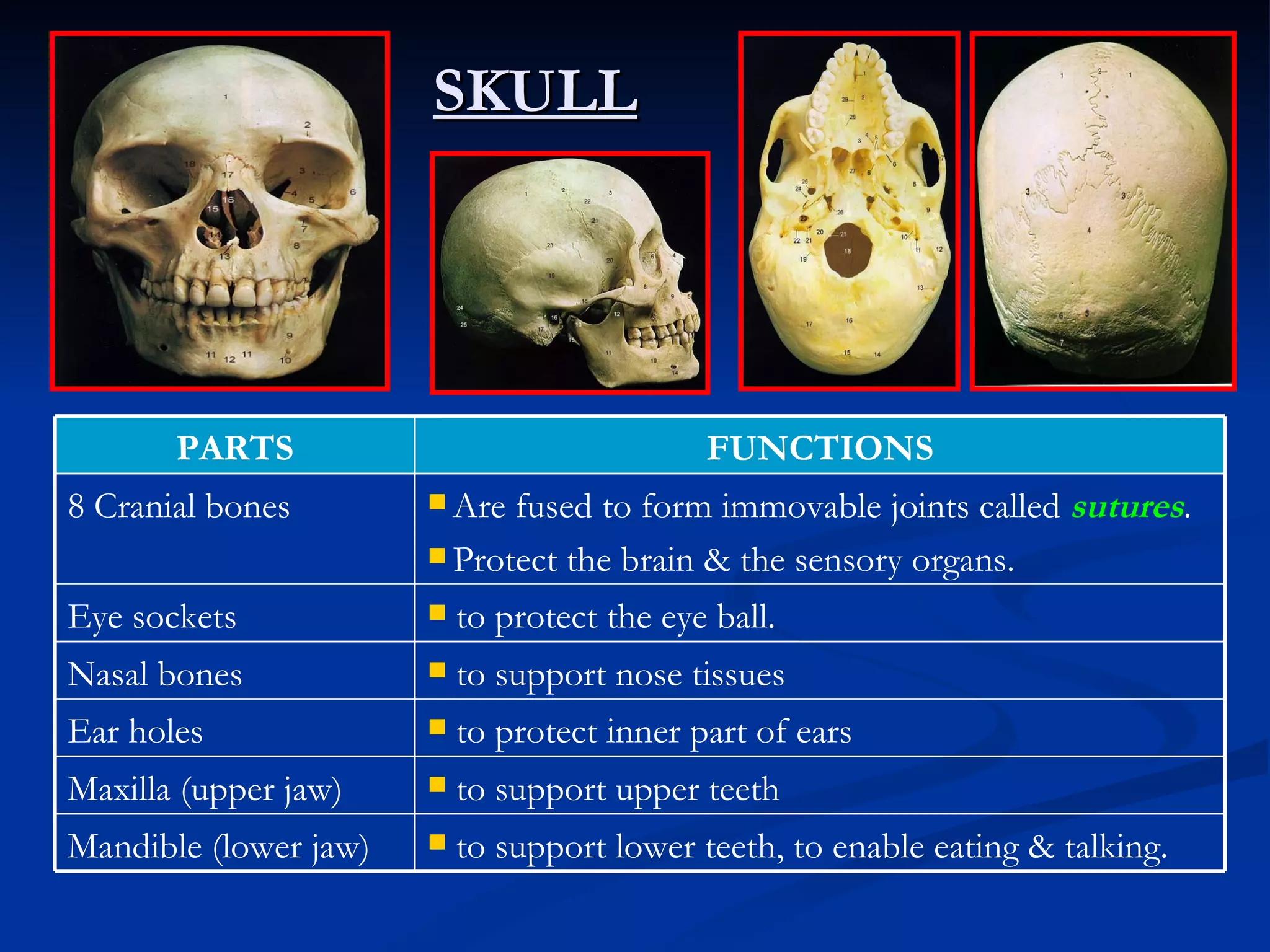
SKULL


       PARTS                                 FUNCTIONS
8 Cranial bones         Are fused to form immovable joints called sutures.
                        Protect the brain & the sensory organs.

Eye sockets               to protect the eye ball.
Nasal bones               to support nose tissues
Ear holes                 to protect inner part of ears
Maxilla (upper jaw)       to support upper teeth
Mandible (lower jaw)      to support lower teeth, to enable eating & talking.
VERTEBRAL COLUMN
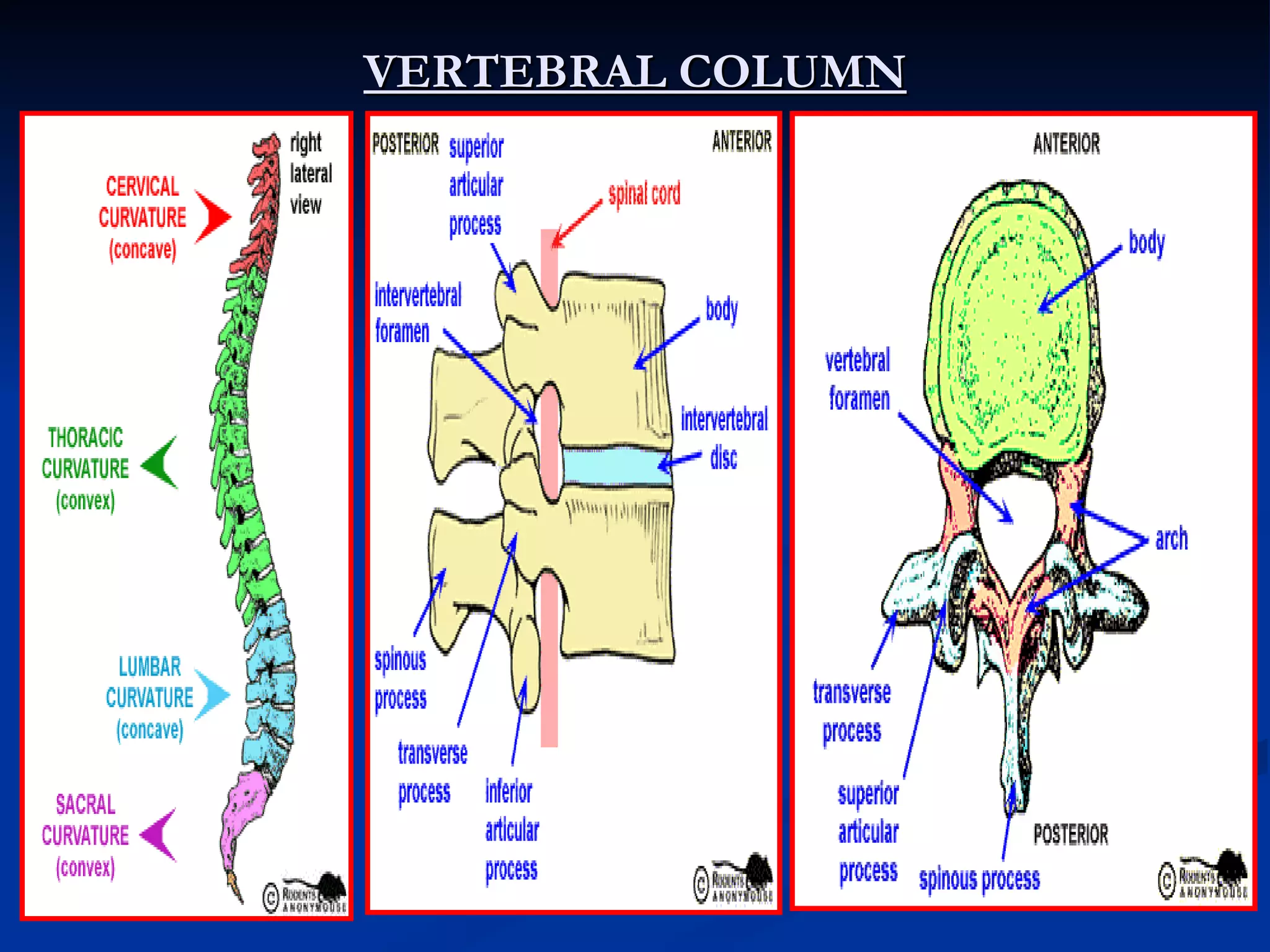
   Known as the spine/ backbone.

   Extends from the base of the skull to the pelvic
    girdle.

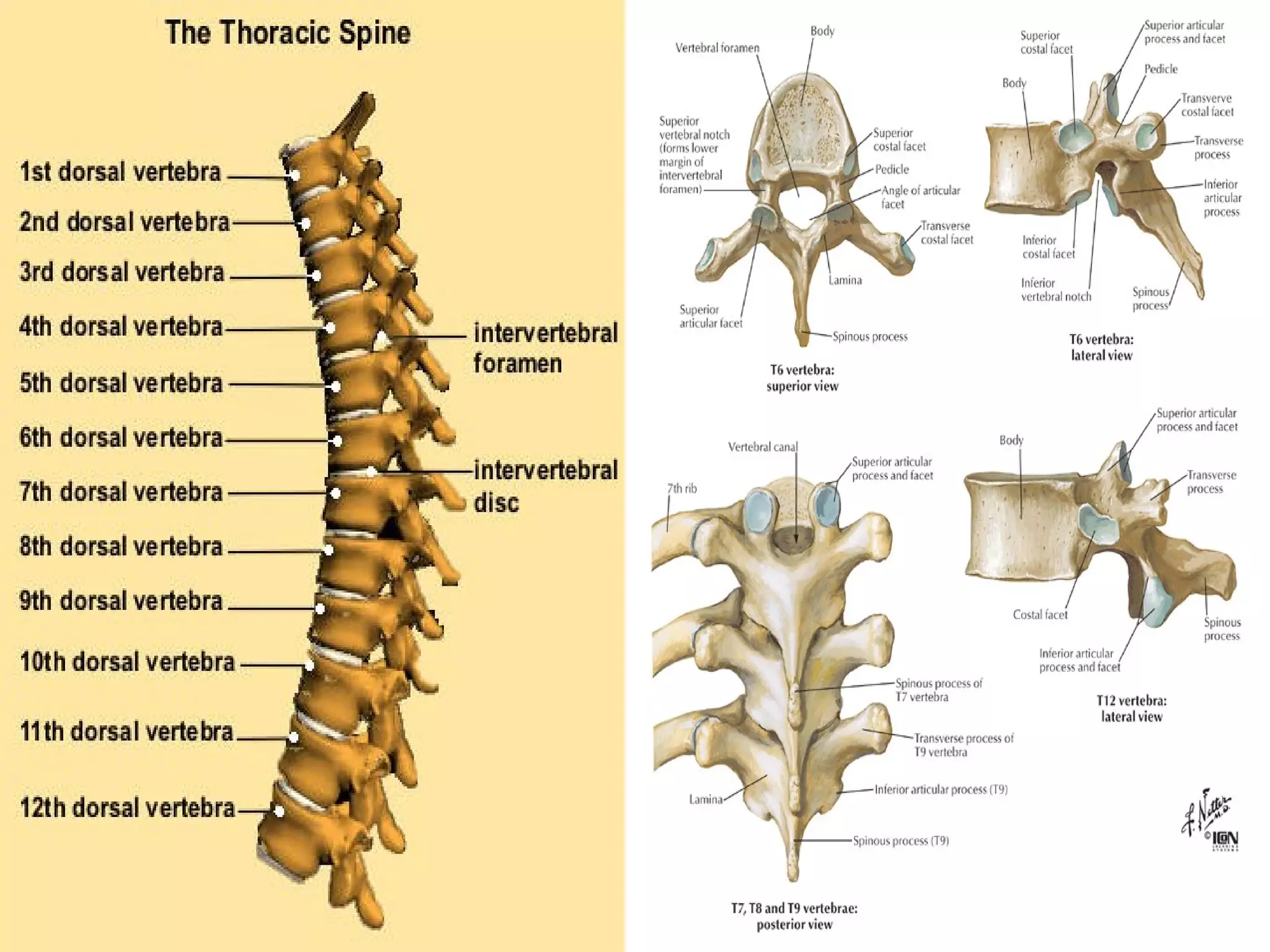
   Made up of 33 vertebrae separated from each other
    by discs of cartilage (intervertebral discs) which
    absorb shocks & serve as flex point.

   This S-shaped column supports & balances the body
    in a vertical plane & protects the spinal cord,
    supports the skull & provides a base for the
    attachment of muscles to the back.
VERTEBRAL COLUMN
   The vertebrae differ in structure & function in
    different regions of the vertebral column.

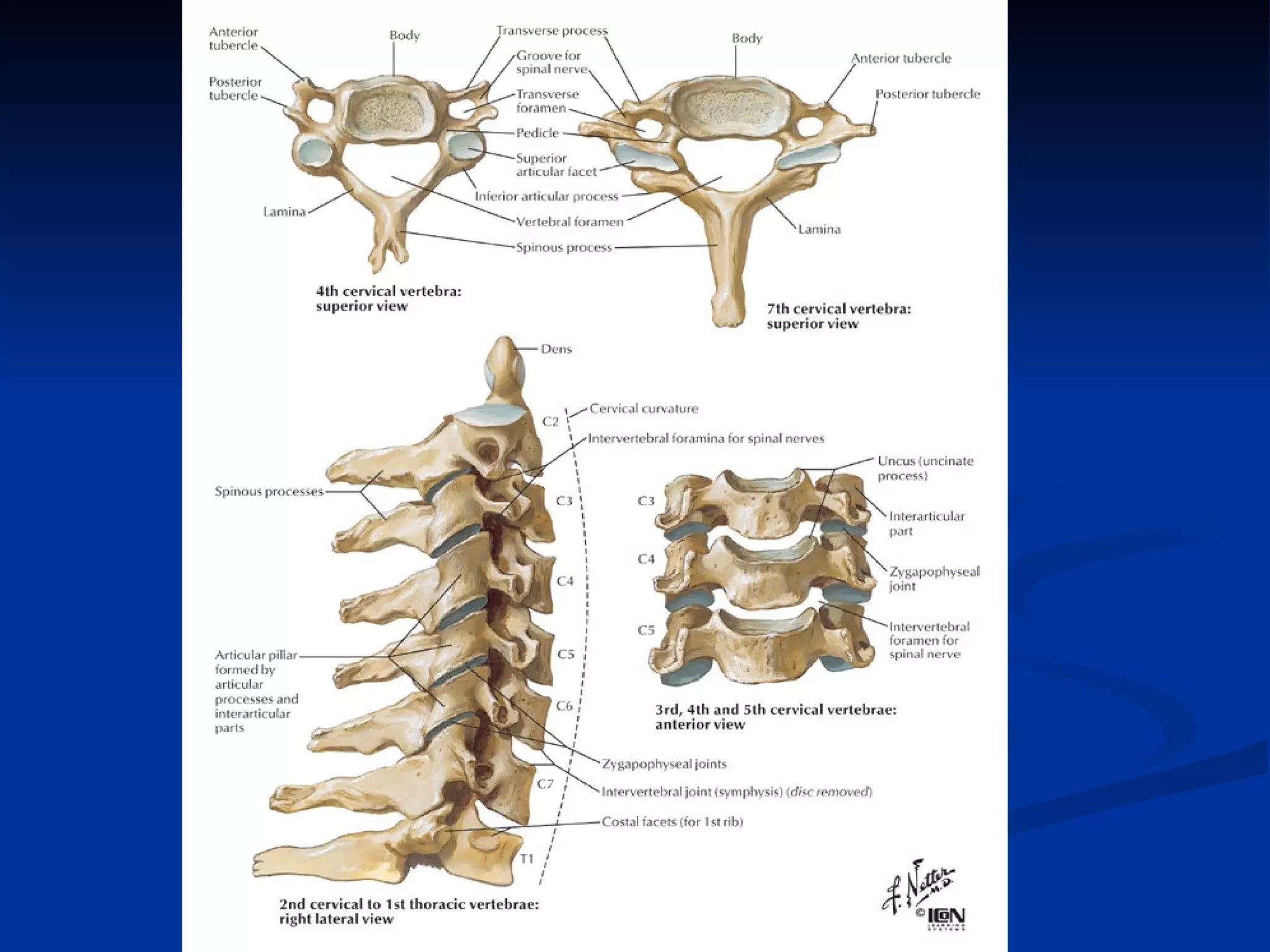
   A vertebra typically consists of a main body (the
    centrum), a neural arch & transverse processes.
VERTEBRAL COLUMN
VERTEBRAL COLUMN
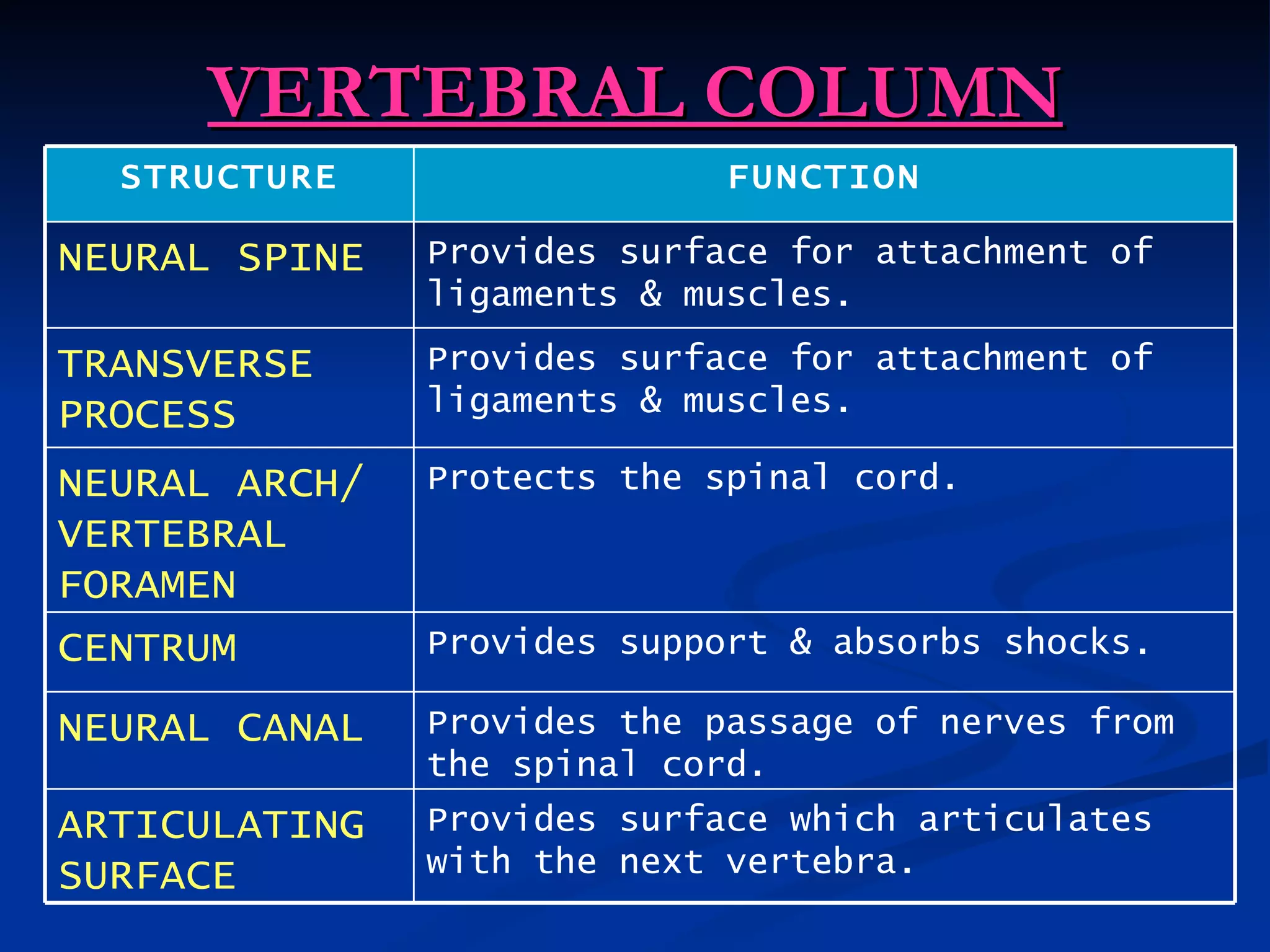
  STRUCTURE                  FUNCTION

NEURAL SPINE   Provides surface for attachment of
               ligaments & muscles.

TRANSVERSE     Provides surface for attachment of
PROCESS        ligaments & muscles.

NEURAL ARCH/   Protects the spinal cord.
VERTEBRAL
FORAMEN
CENTRUM        Provides support & absorbs shocks.

NEURAL CANAL   Provides the passage of nerves from
               the spinal cord.
ARTICULATING   Provides surface which articulates
SURFACE        with the next vertebra.
TYPES OF VERTEBRAE
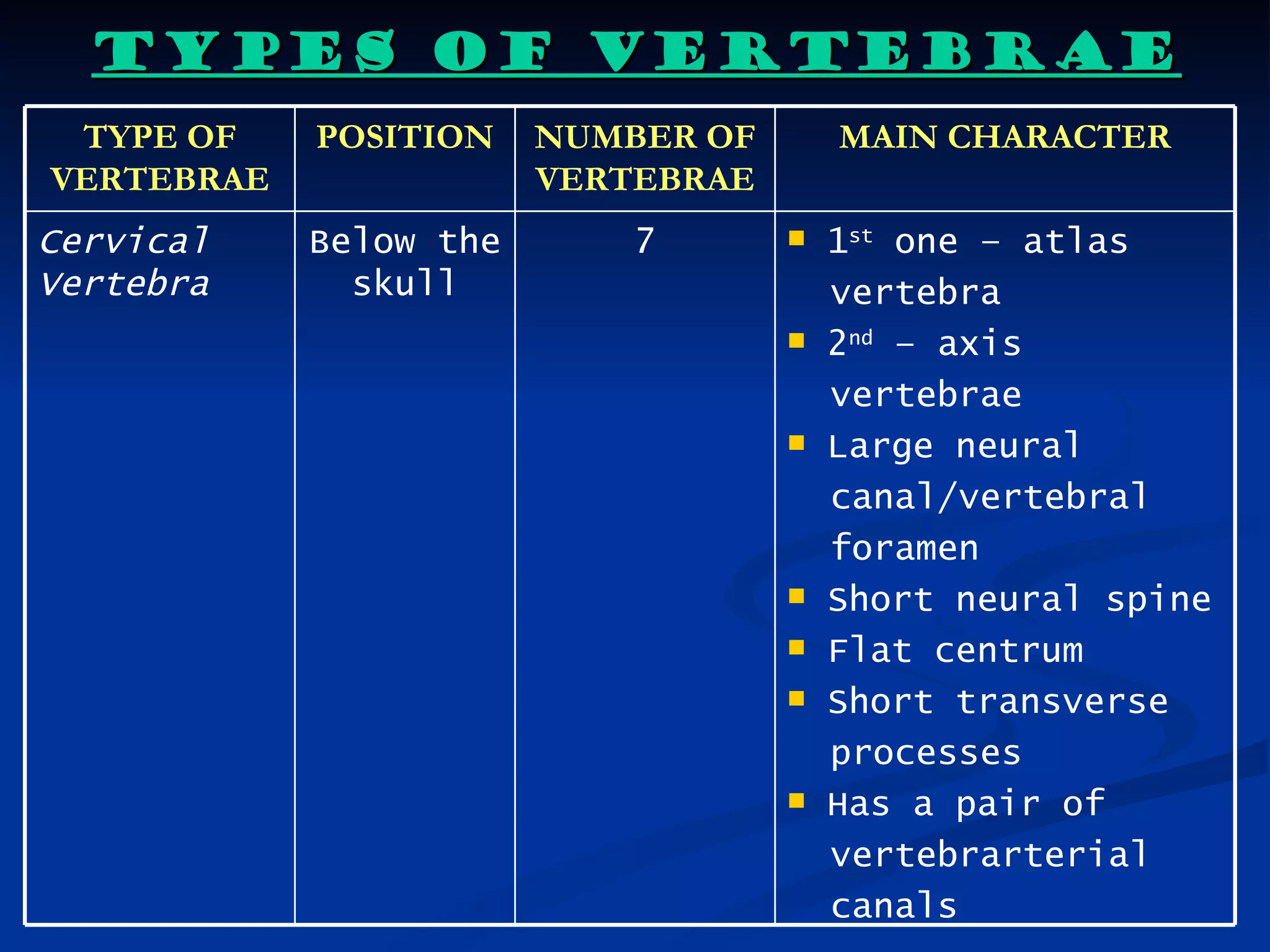
 TYPE OF    POSITION    NUMBER OF       MAIN CHARACTER
VERTEBRAE               VERTEBRAE
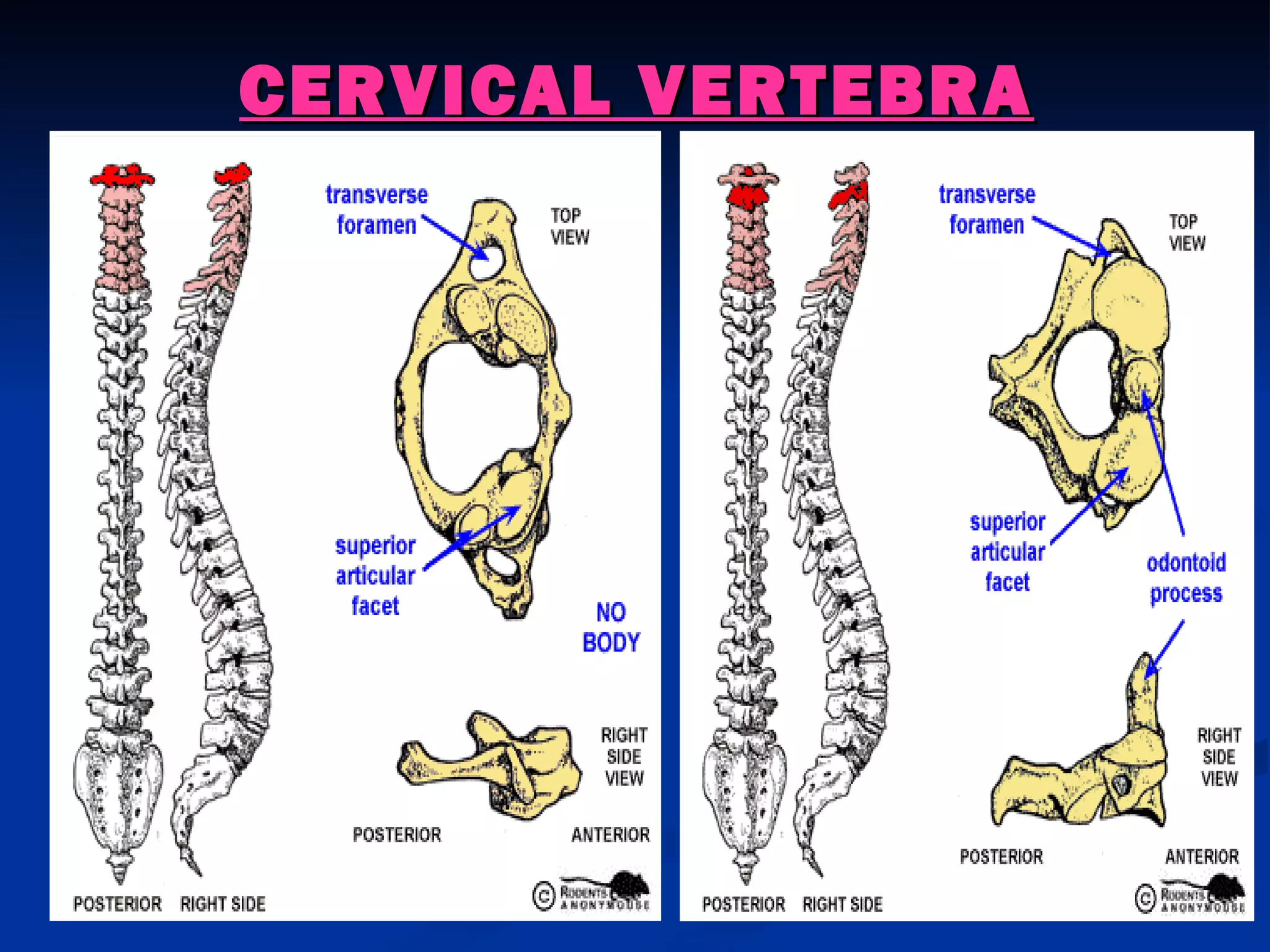
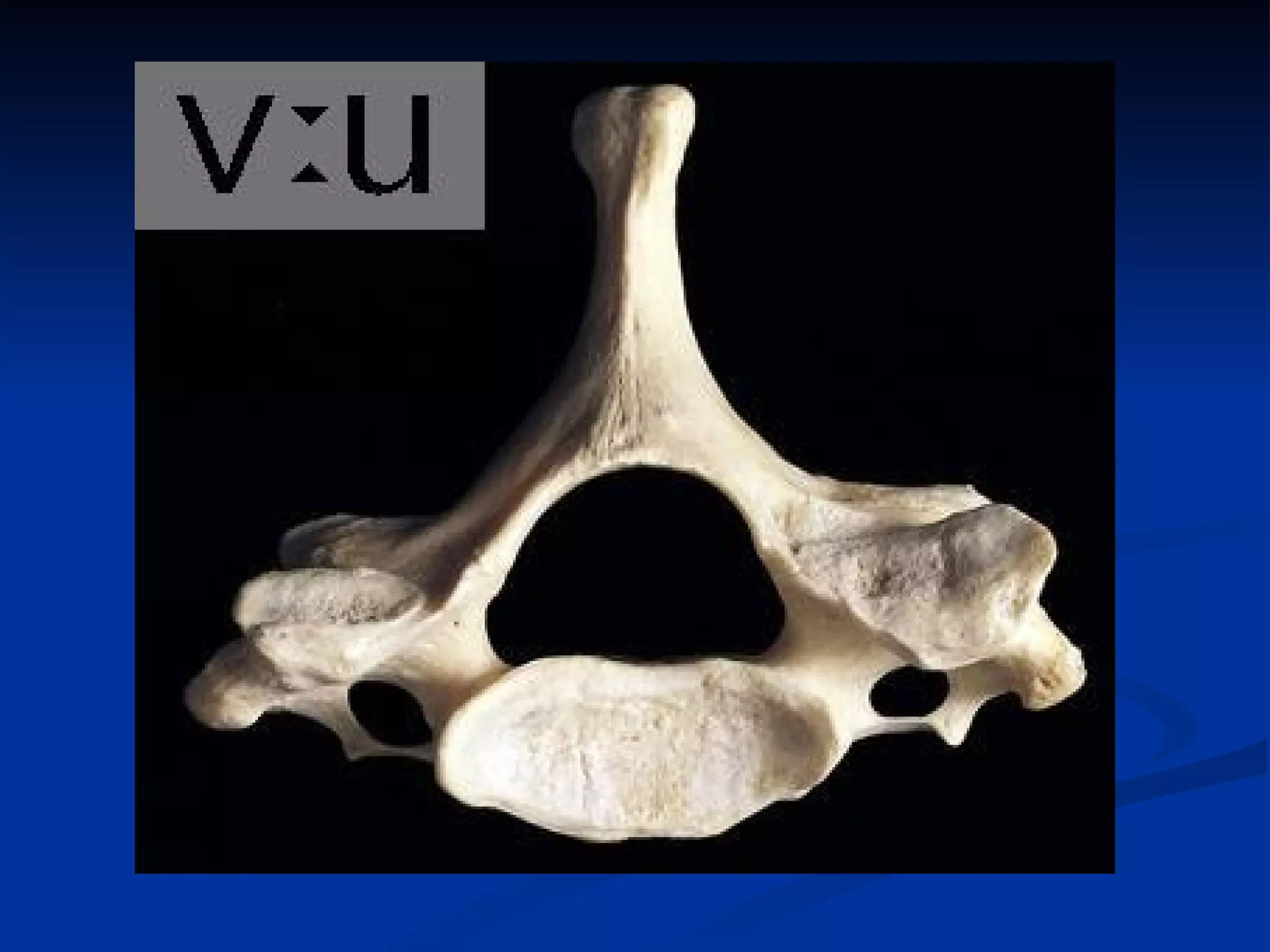
Cervical    Below the       7          1st one – atlas
Vertebra      skull                     vertebra
                                       2nd – axis
                                        vertebrae
                                       Large neural
                                        canal/vertebral
                                        foramen
                                       Short neural spine
                                       Flat centrum
                                       Short transverse
                                        processes
                                       Has a pair of
                                        vertebrarterial
                                        canals
CERVICAL VERTEBRA
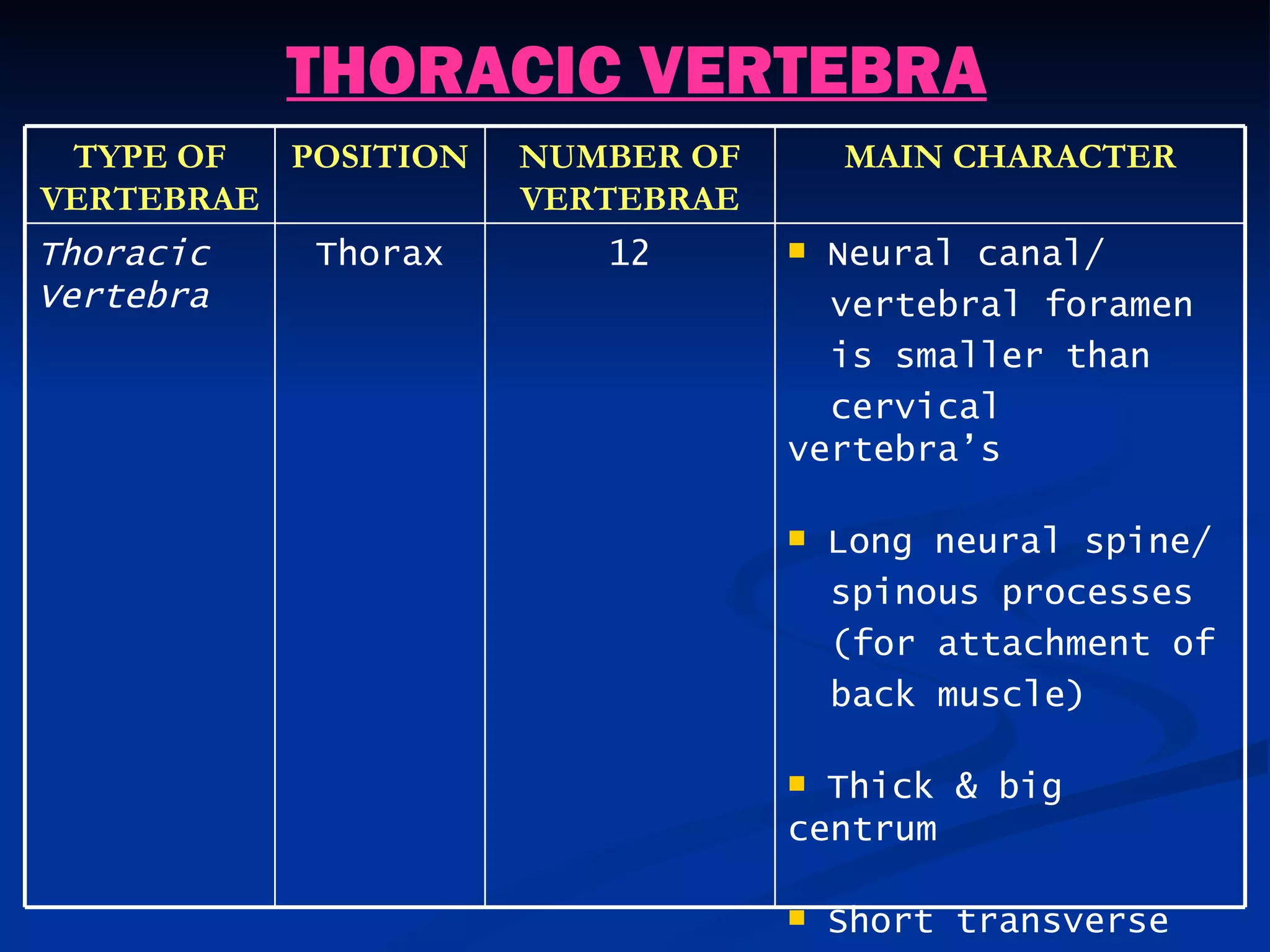
THORACIC VERTEBRA
 TYPE OF  POSITION   NUMBER OF       MAIN CHARACTER
VERTEBRAE            VERTEBRAE
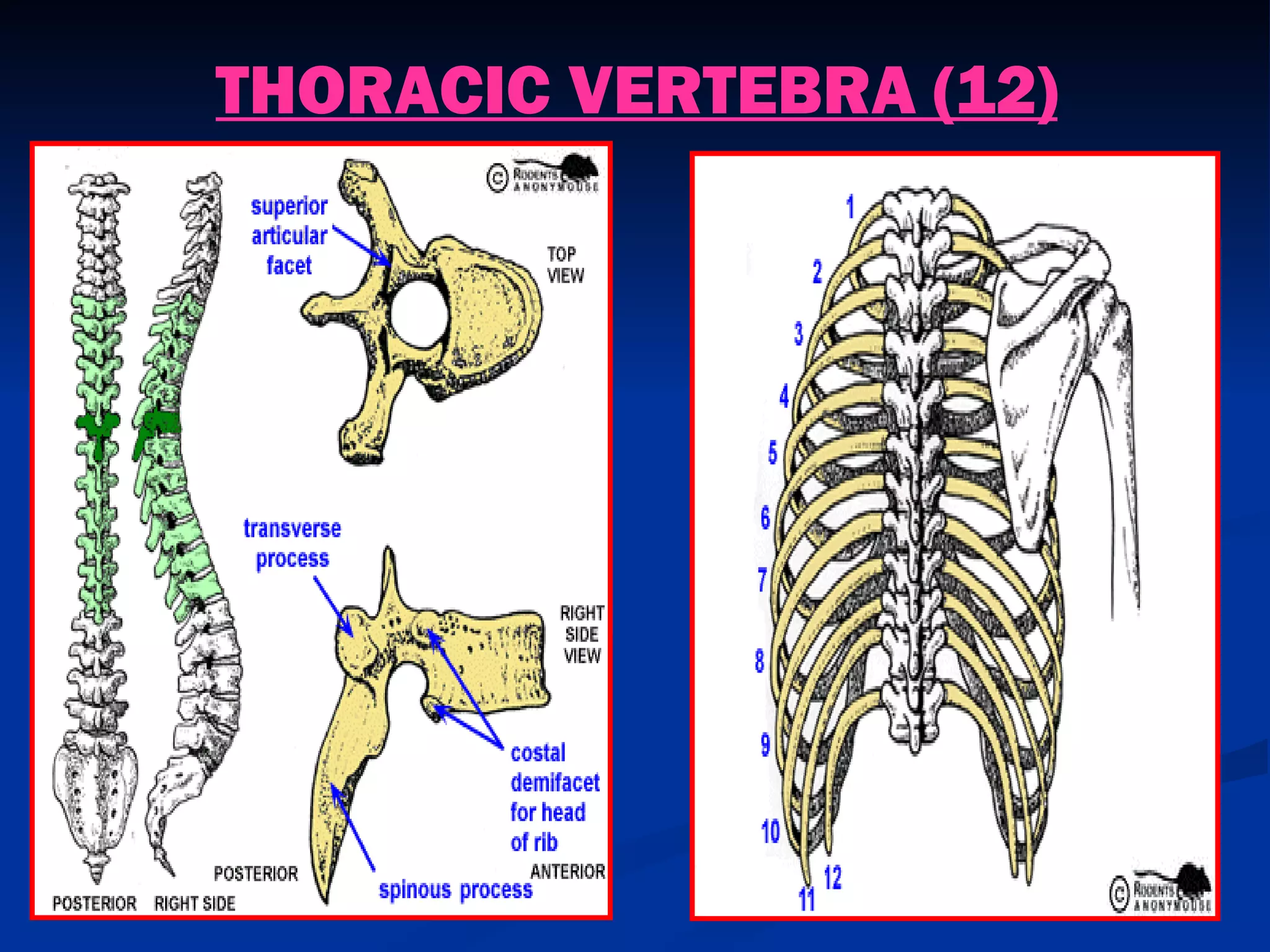
Thoracic   Thorax       12        Neural canal/
Vertebra                           vertebral foramen
                                   is smaller than
                                   cervical
                                 vertebra’s

                                    Long neural spine/
                                     spinous processes
                                     (for attachment of
                                     back muscle)

                                  Thick & big
                                 centrum

                                    Short transverse
THORACIC VERTEBRA (12)
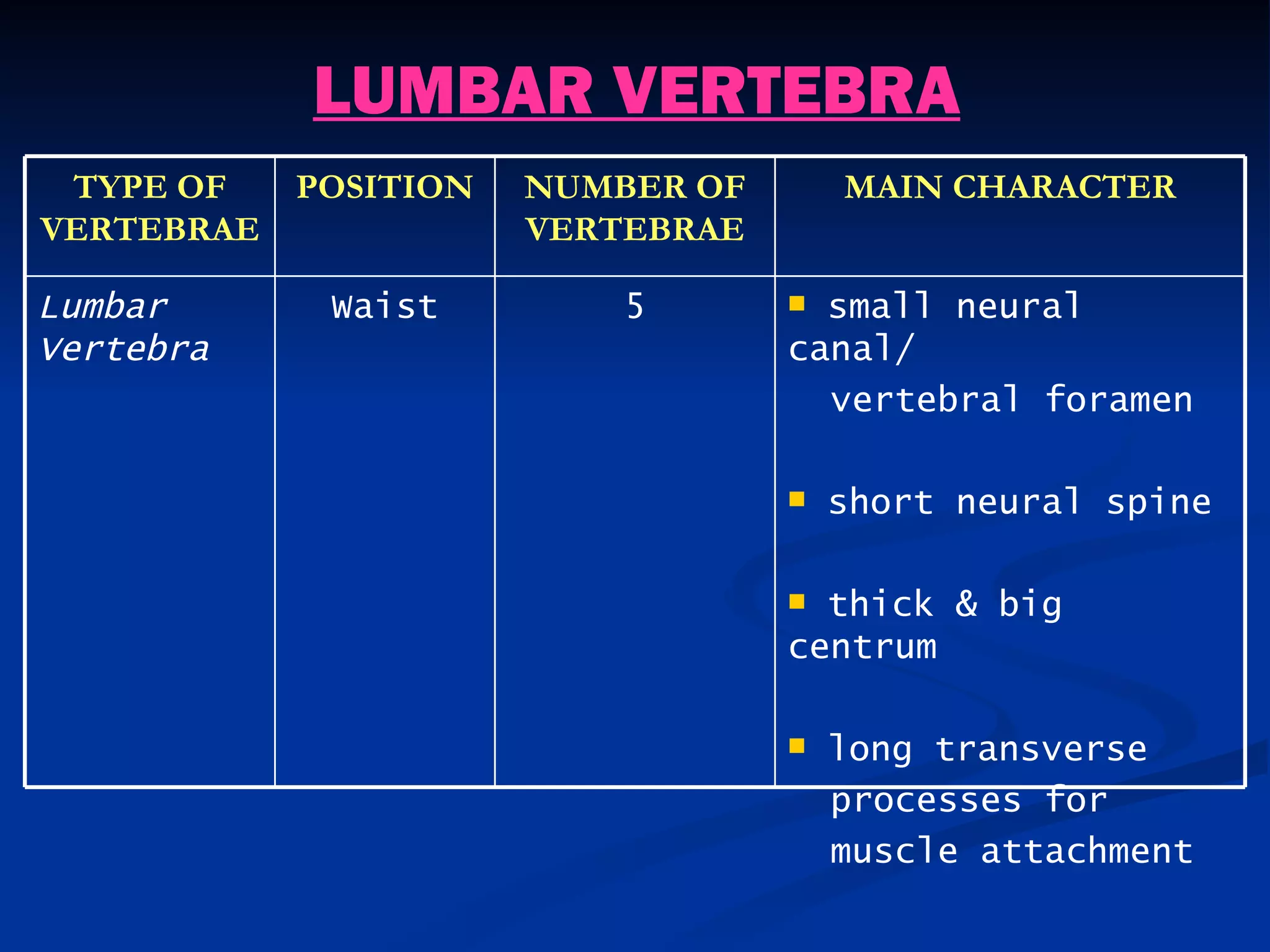
LUMBAR VERTEBRA
 TYPE OF    POSITION   NUMBER OF       MAIN CHARACTER
VERTEBRAE              VERTEBRAE

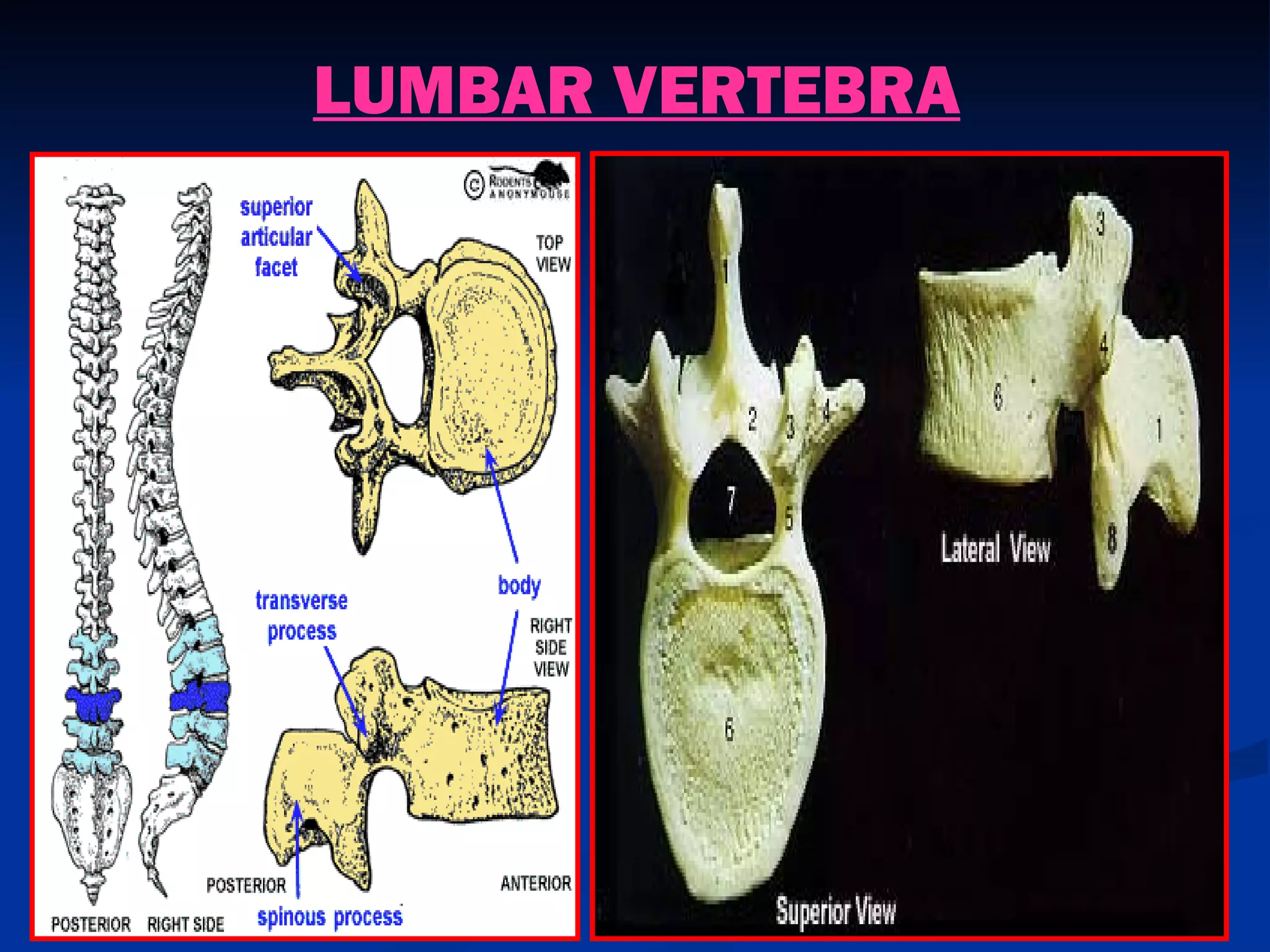
Lumbar       Waist         5        small neural
Vertebra                           canal/
                                     vertebral foramen

                                      short neural spine

                                    thick & big
                                   centrum

                                      long transverse
                                       processes for
                                       muscle attachment
LUMBAR VERTEBRA
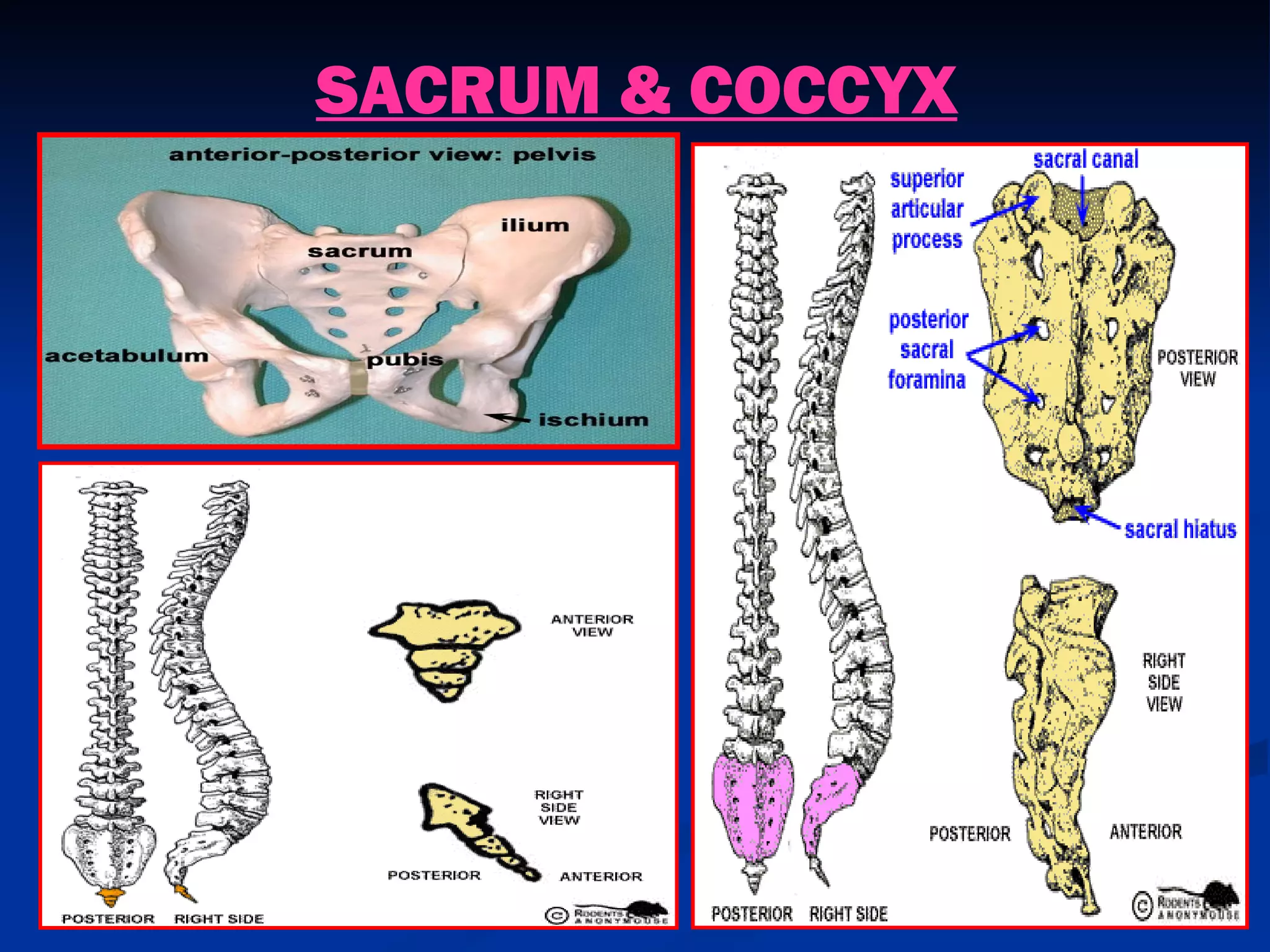
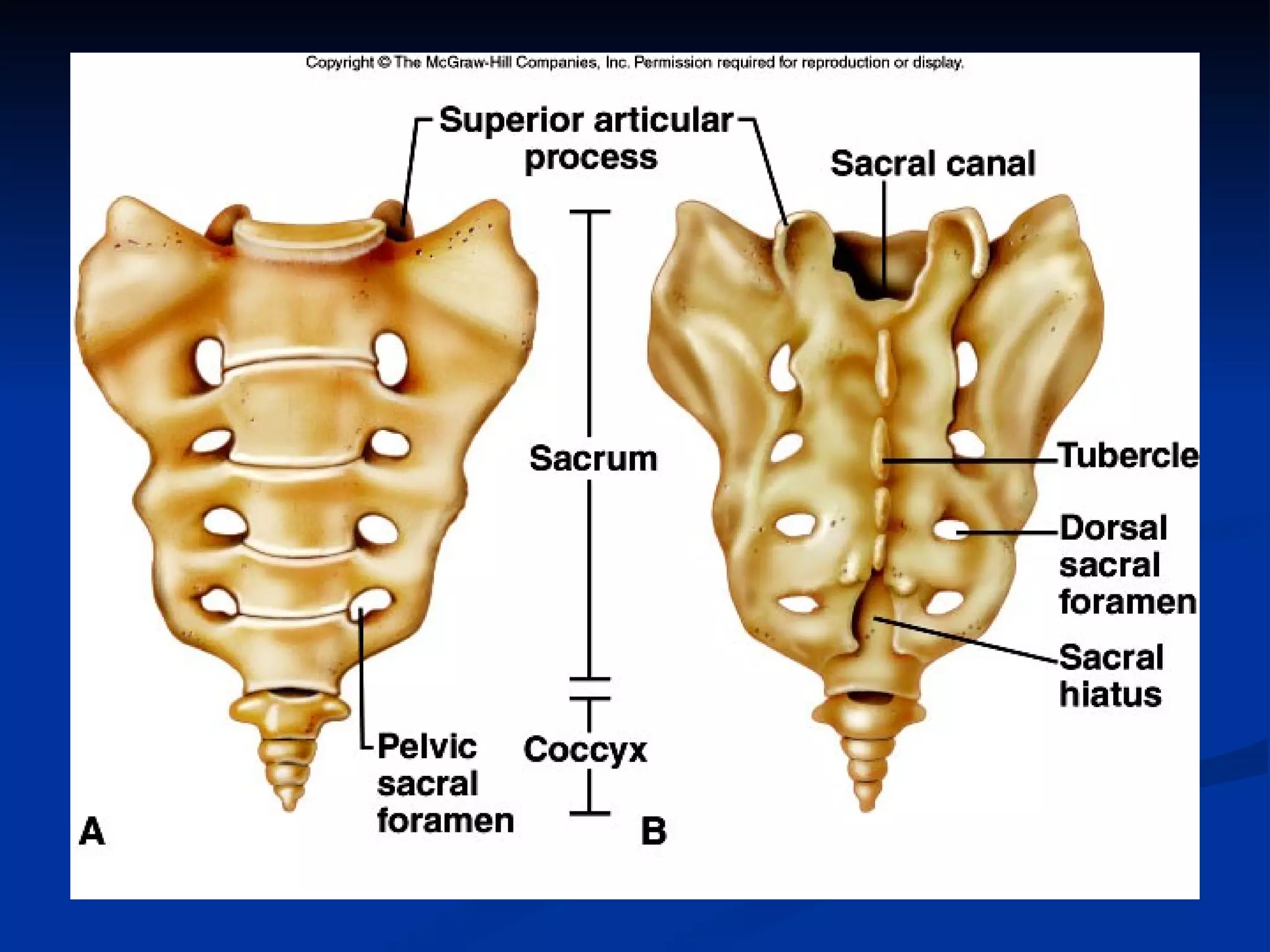
SACRUM & COCCYX
 TYPE OF    POSITION   NUMBER OF       MAIN CHARACTER
VERTEBRAE              VERTEBRAE

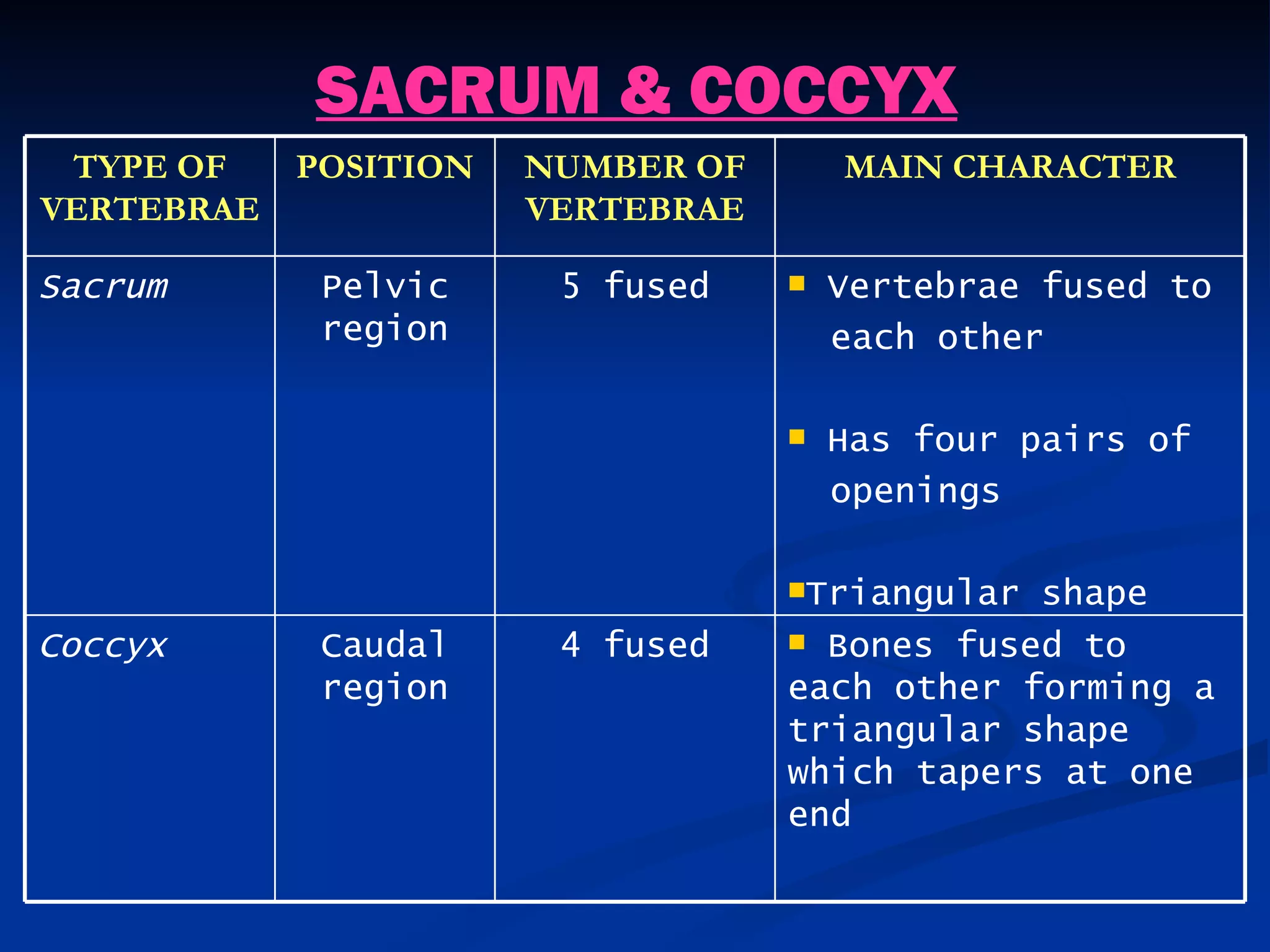
Sacrum       Pelvic     5 fused       Vertebrae fused to
             region                    each other

                                      Has four pairs of
                                       openings

                                   Triangular shape
Coccyx       Caudal     4 fused     Bones fused to
             region                each other forming a
                                   triangular shape
                                   which tapers at one
                                   end
SACRUM & COCCYX
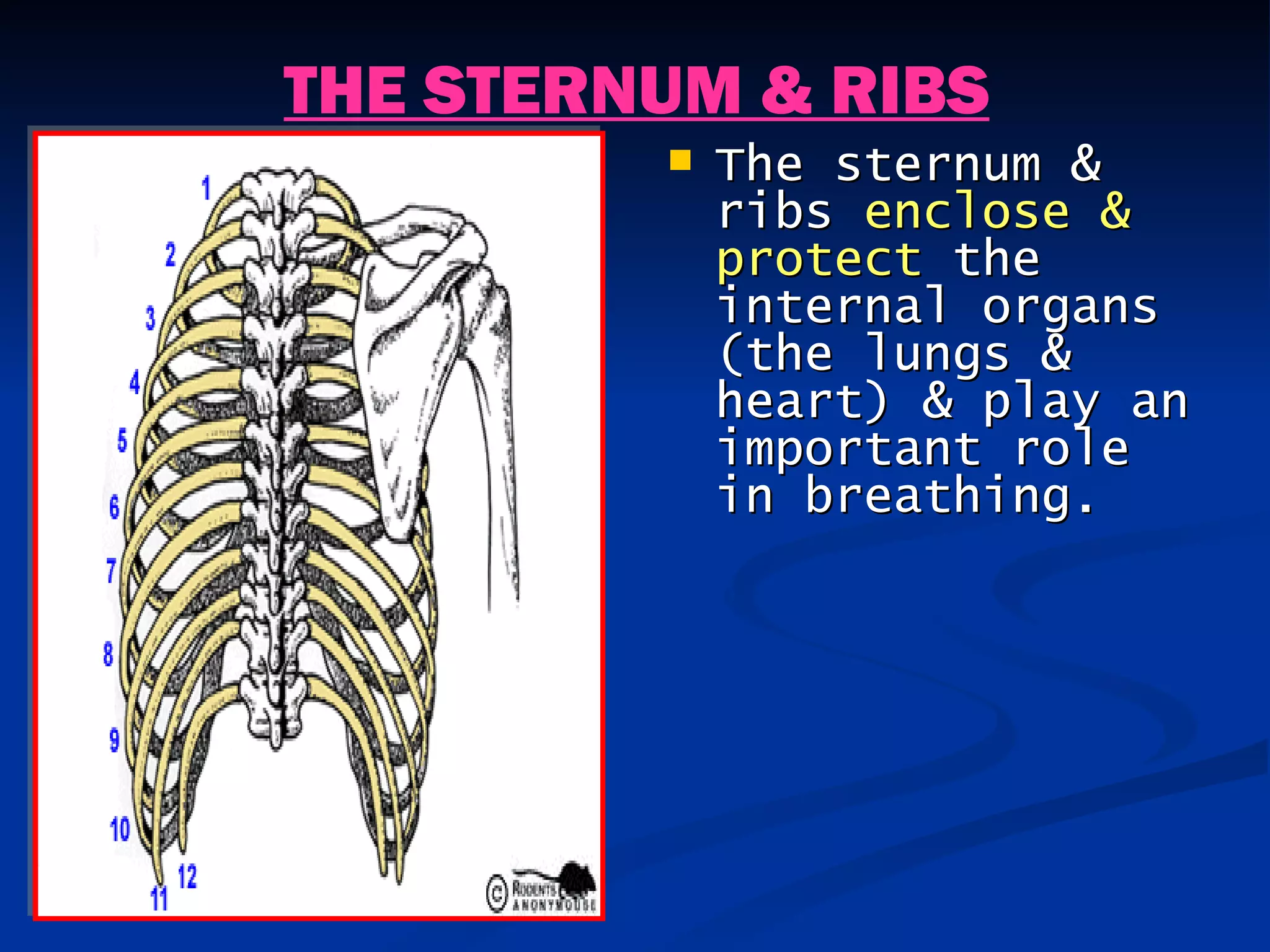
THE STERNUM & RIBS
           The rib cage consists
            of 12 pairs of ribs
            with the thoracic
            vertebrae at the back
            portion of the body &
            join to the sternum
            in the front portion.

           Movement of the rib
            cage are brought
            about by intercostal
            muscles between the
            ribs.
THE STERNUM & RIBS
            The sternum &
             ribs enclose &
             protect the
             internal organs
             (the lungs &
             heart) & play an
             important role
             in breathing.
PECTORAL GIRDLE
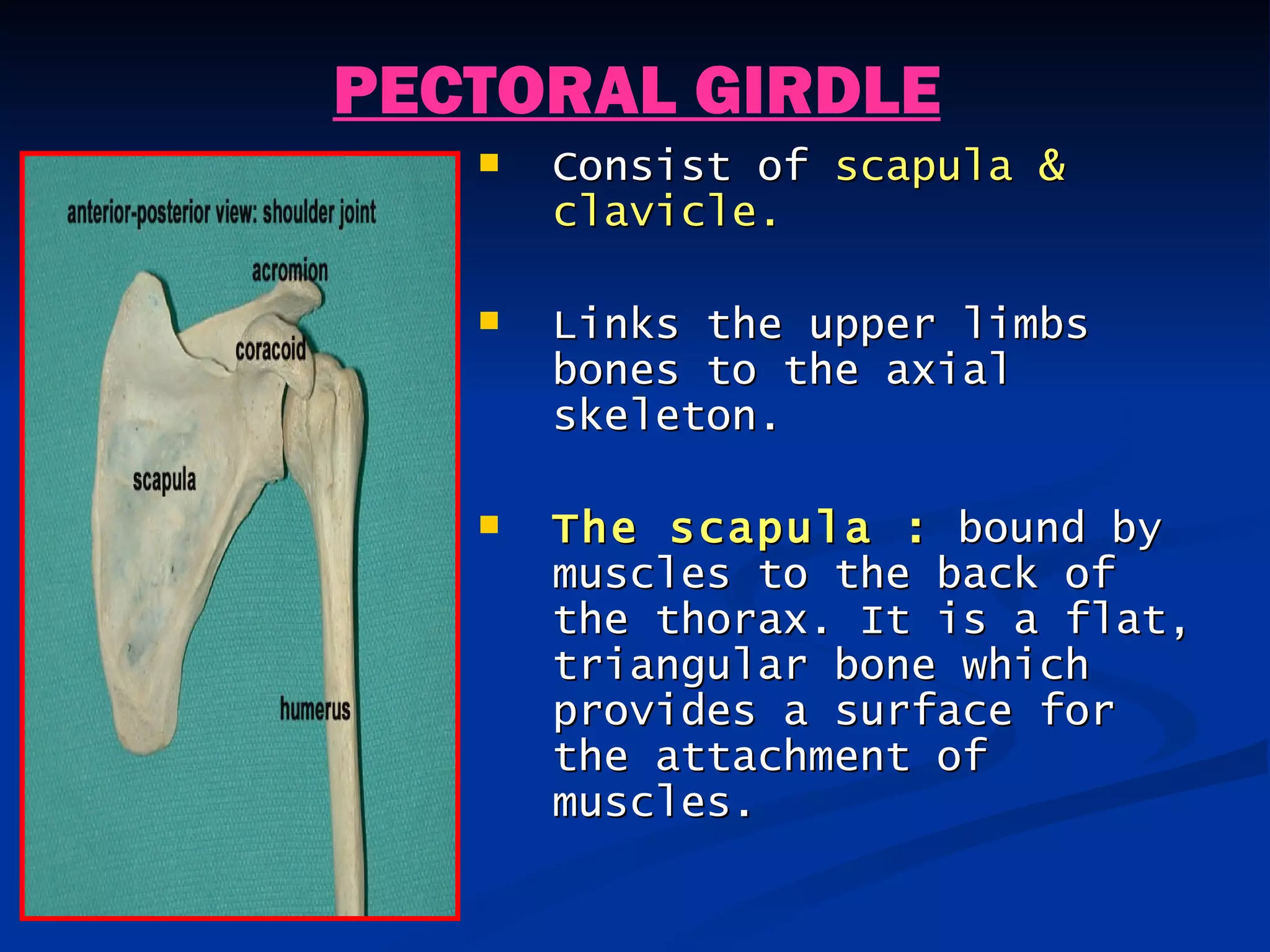
      Consist of scapula &
       clavicle.

      Links the upper limbs
       bones to the axial
       skeleton.

      The scapula : bound by
       muscles to the back of
       the thorax. It is a flat,
       triangular bone which
       provides a surface for
       the attachment of
       muscles.
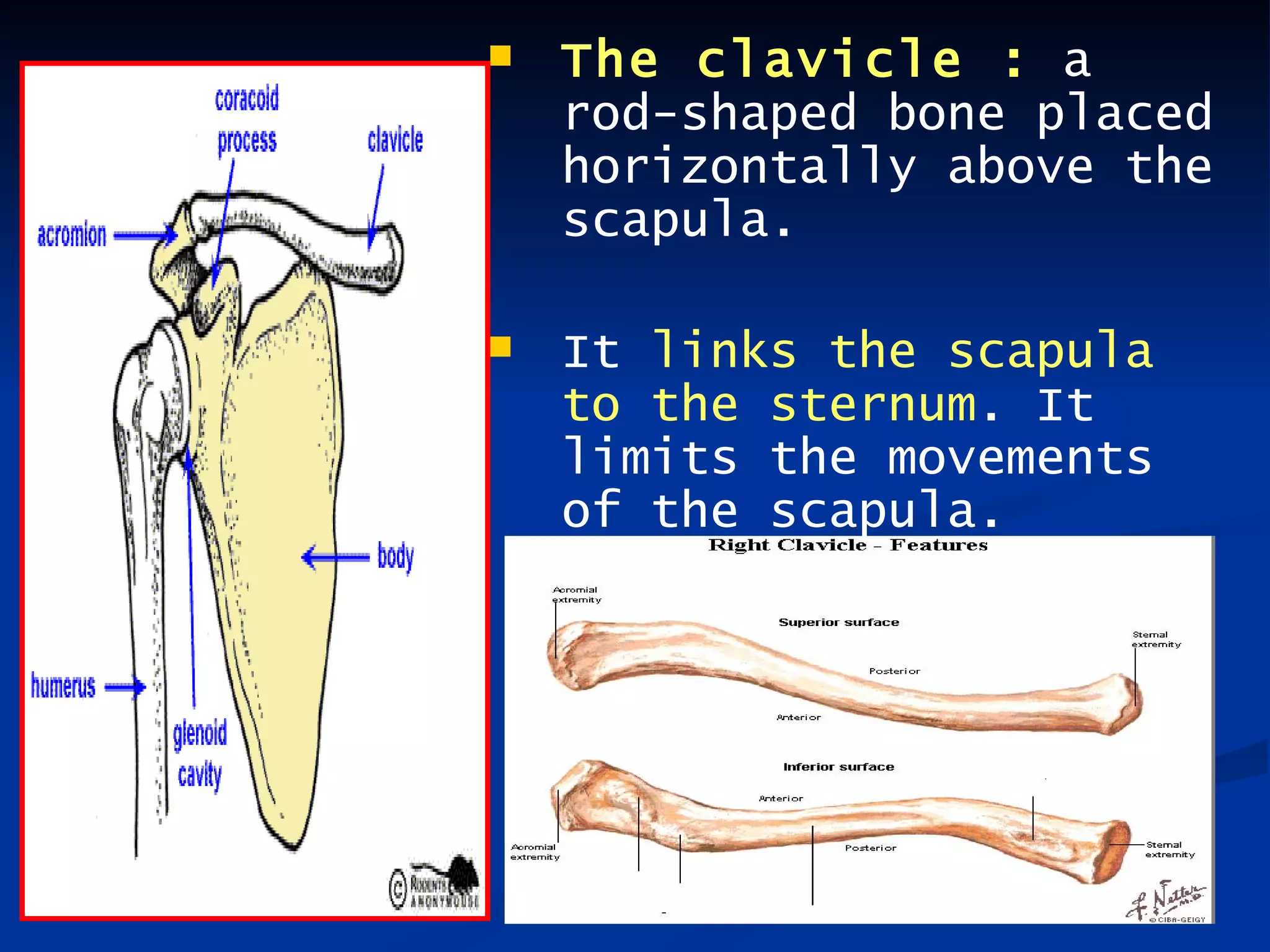
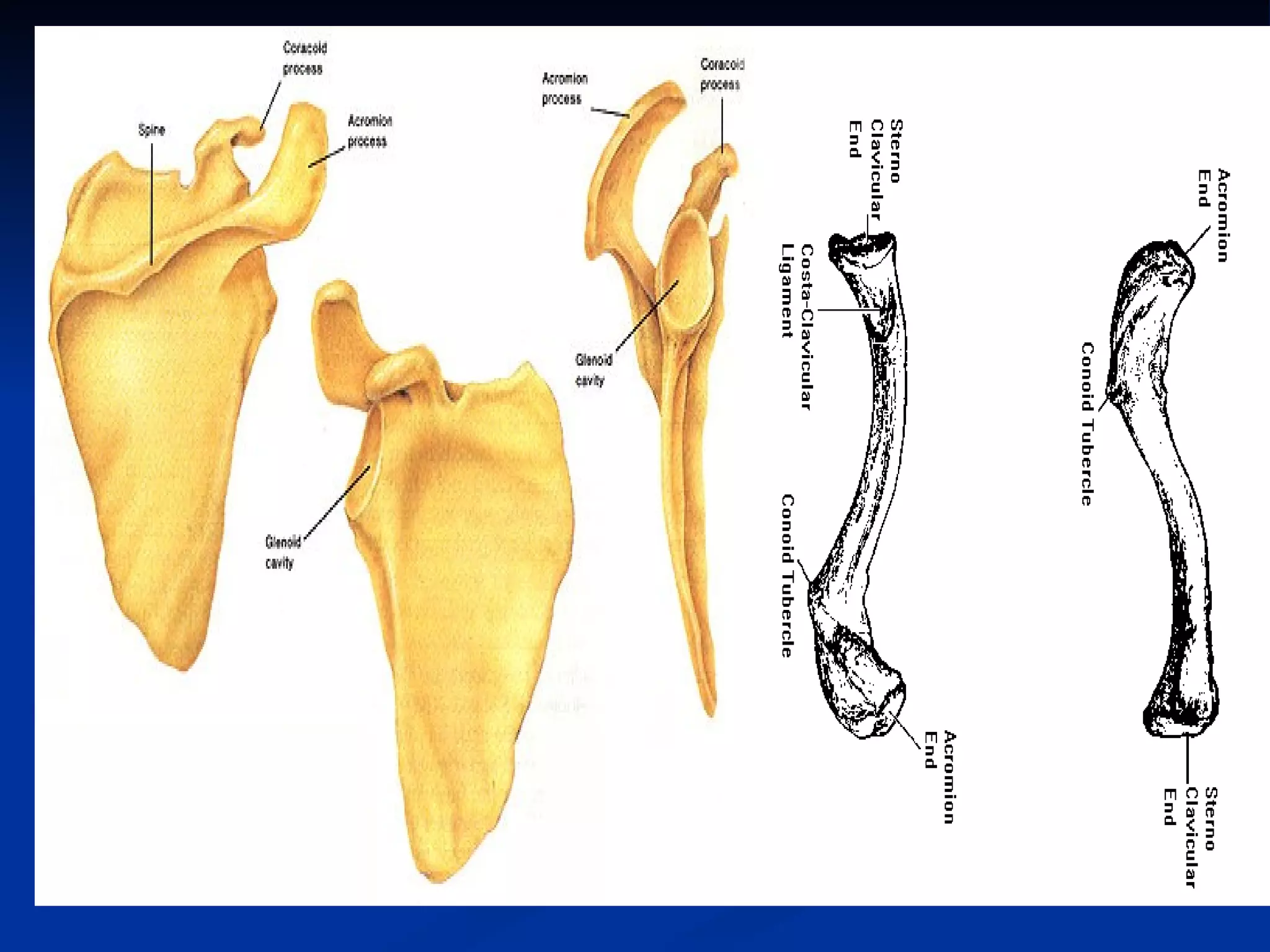
   The clavicle : a
    rod-shaped bone placed
    horizontally above the
    scapula.

   It links the scapula
    to the sternum. It
    limits the movements
    of the scapula.
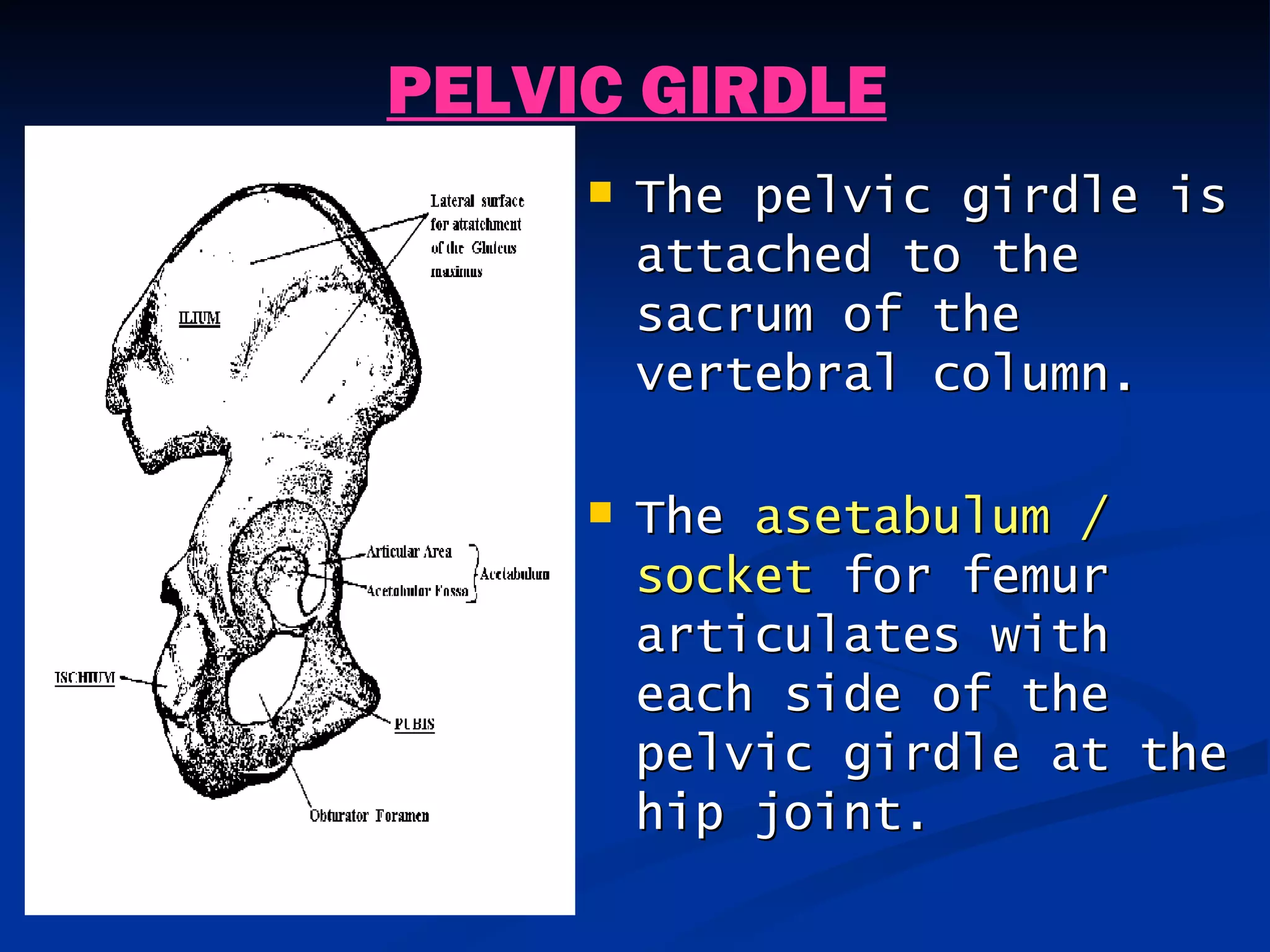
PELVIC GIRDLE
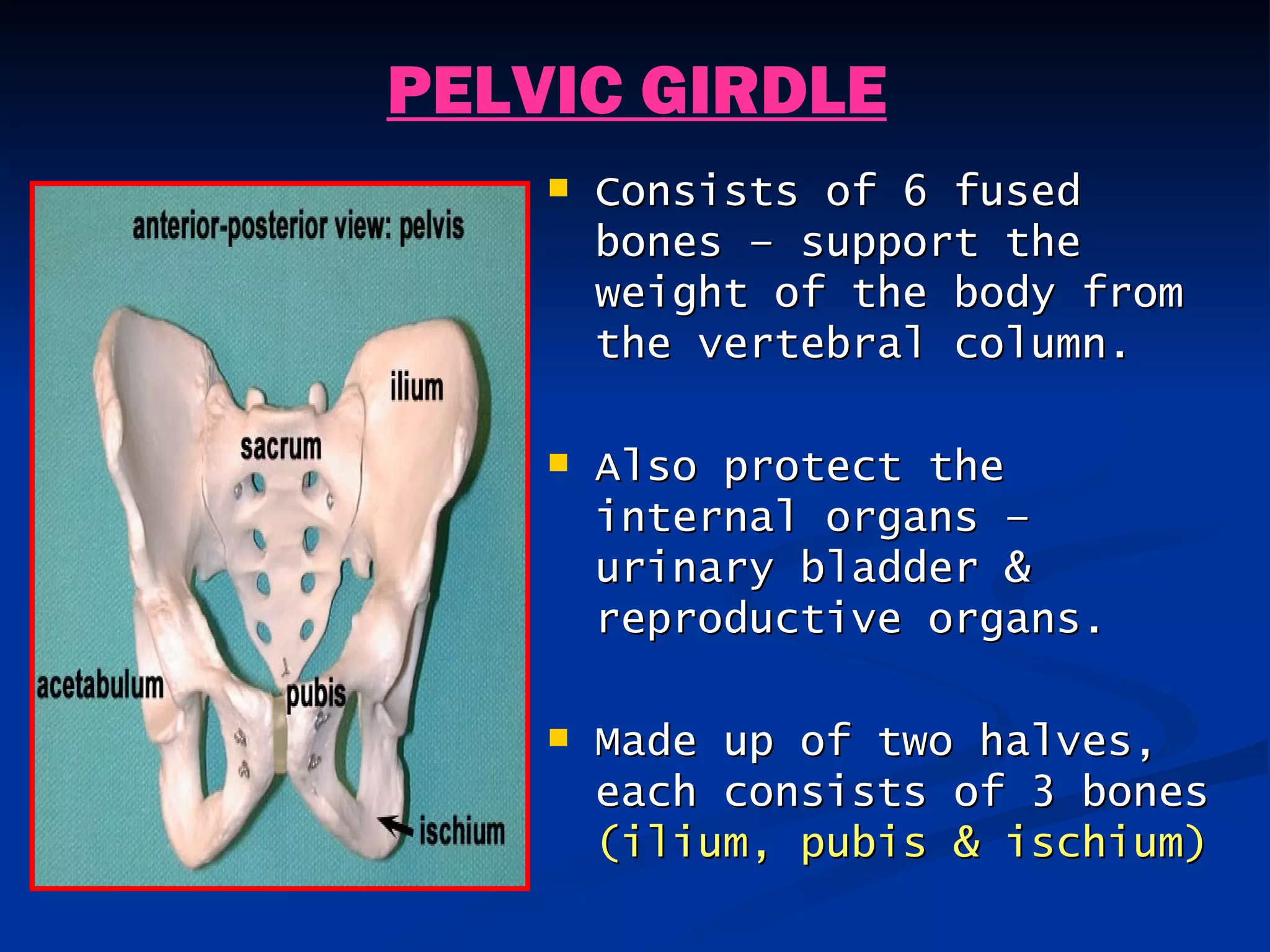
       Consists of 6 fused
        bones – support the
        weight of the body from
        the vertebral column.

       Also protect the
        internal organs –
        urinary bladder &
        reproductive organs.

       Made up of two halves,
        each consists of 3 bones
        (ilium, pubis & ischium)
PELVIC GIRDLE
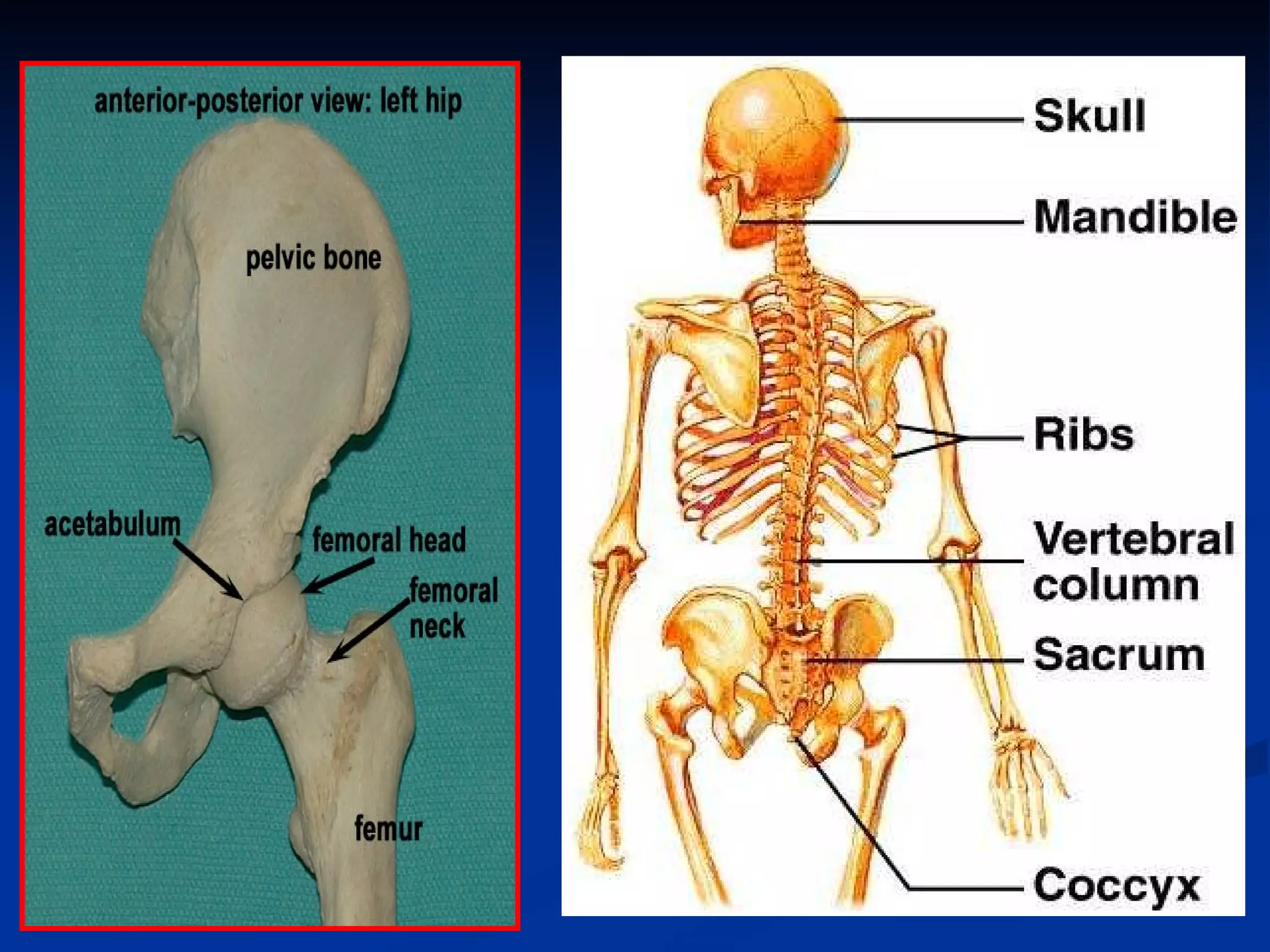
        The pelvic girdle is
         attached to the
         sacrum of the
         vertebral column.

        The asetabulum /
         socket for femur
         articulates with
         each side of the
         pelvic girdle at the
         hip joint.
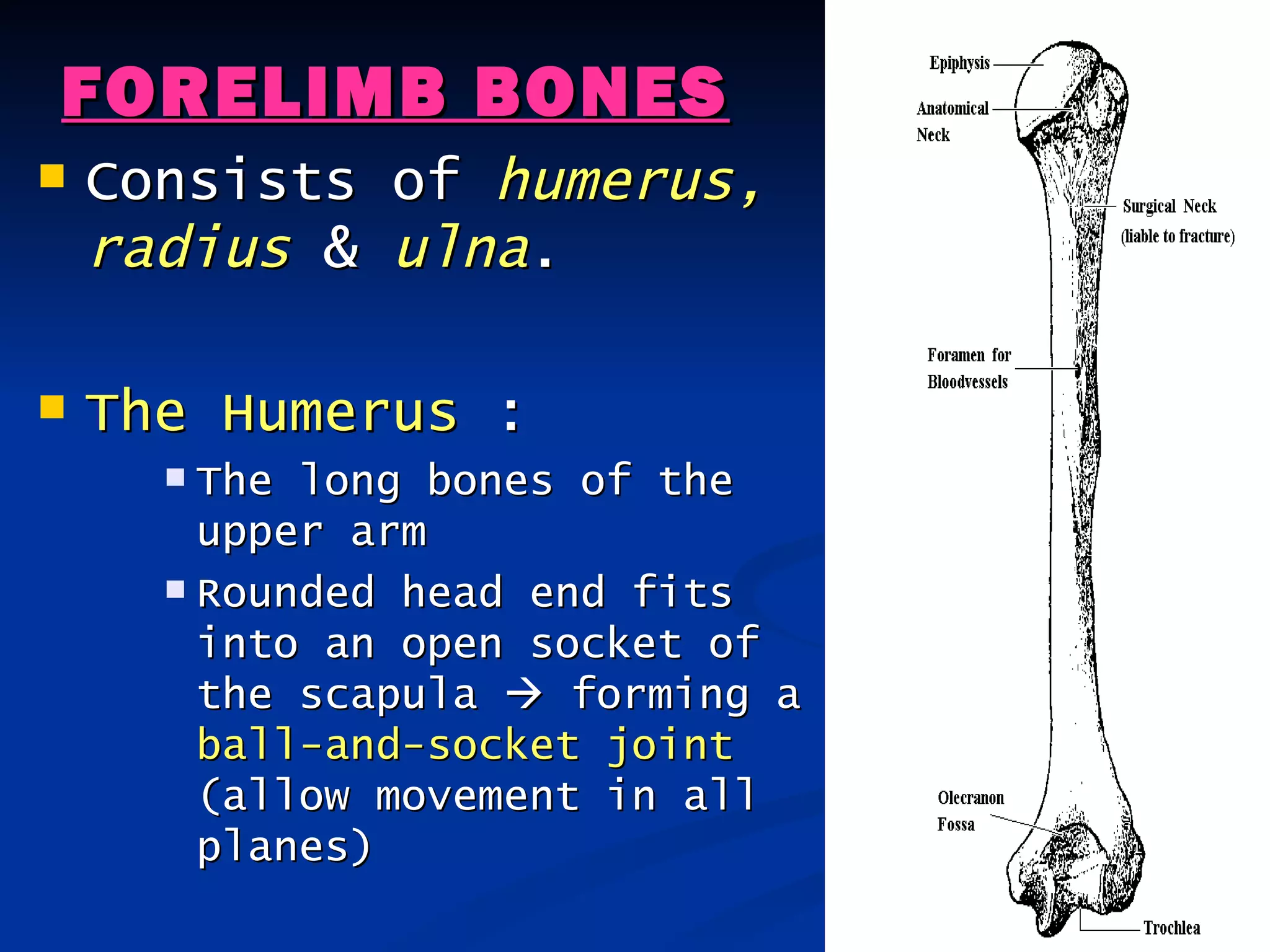
FORELIMB BONES
   Consists of humerus,
    radius & ulna.

   The Humerus :
       The long bones of the
        upper arm
       Rounded head end fits
        into an open socket of
        the scapula  forming a
        ball-and-socket joint
        (allow movement in all
        planes)
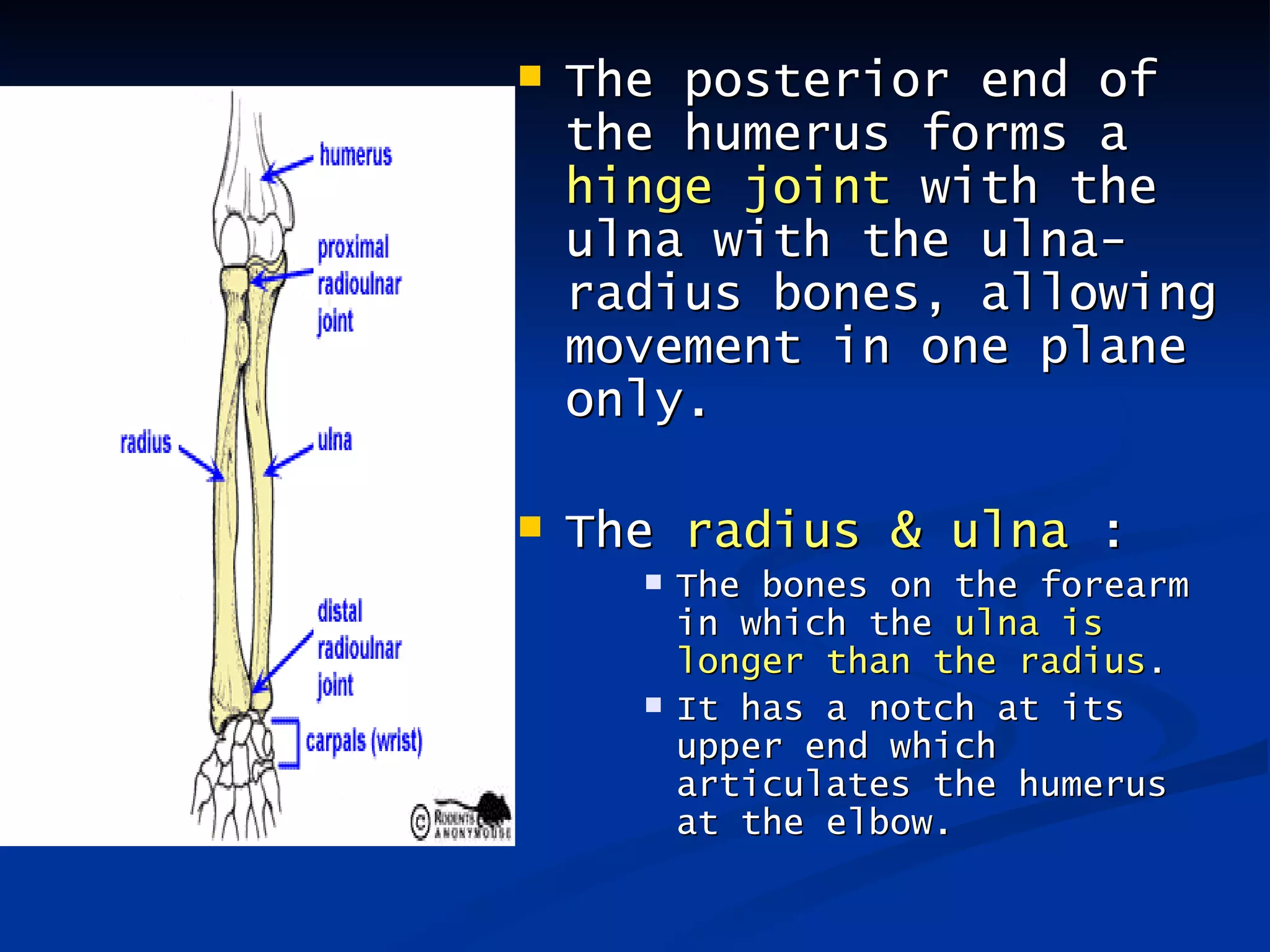
   The posterior end of
    the humerus forms a
    hinge joint with the
    ulna with the ulna-
    radius bones, allowing
    movement in one plane
    only.

   The radius & ulna :
         The bones on the forearm
          in which the ulna is
          longer than the radius.
         It has a notch at its
          upper end which
          articulates the humerus
          at the elbow.
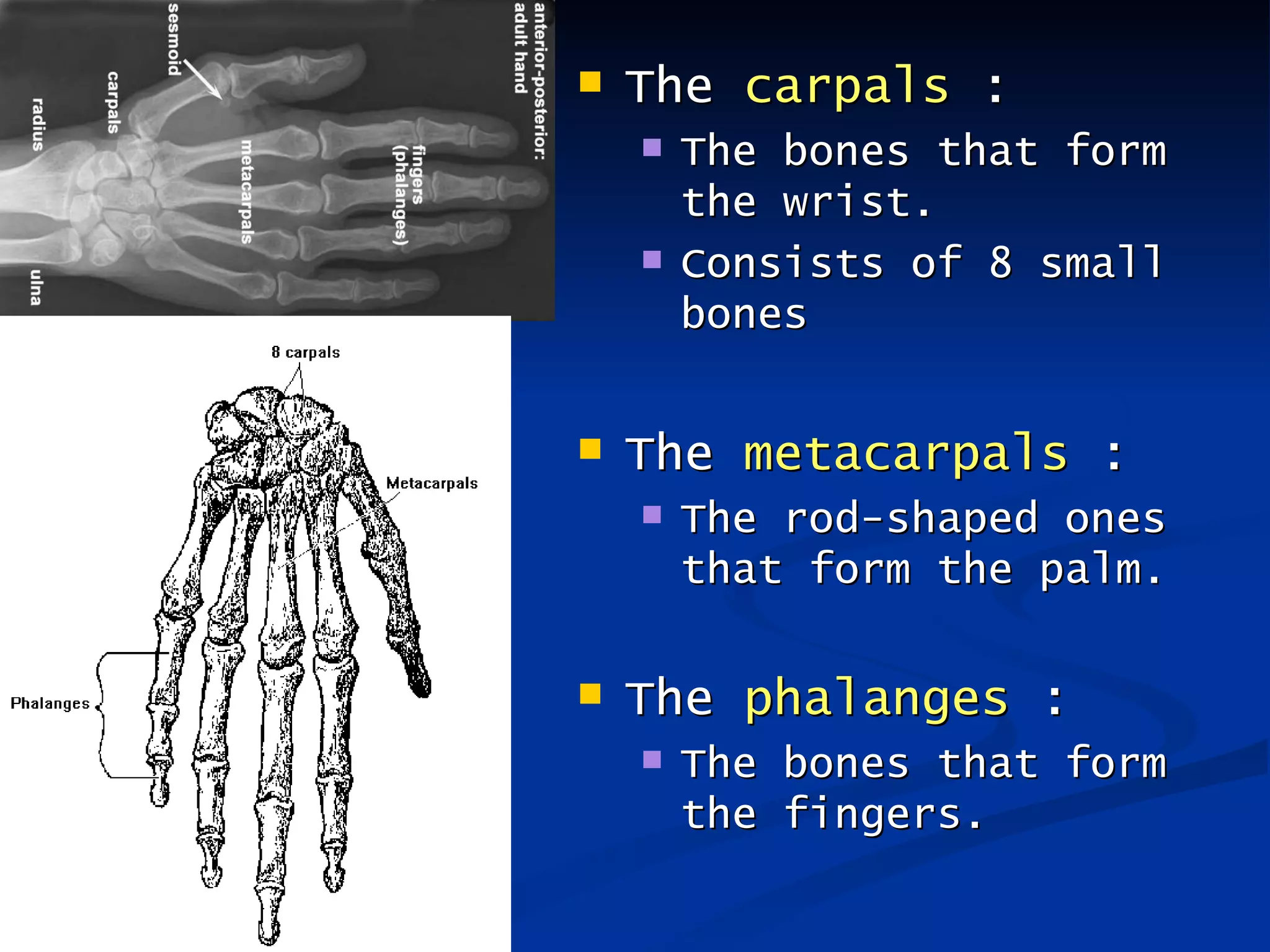
   The carpals :
       The bones that form
        the wrist.
       Consists of 8 small
        bones


   The metacarpals :
       The rod-shaped ones
        that form the palm.

   The phalanges :
       The bones that form
        the fingers.
HINDLIMB

          BONES tibia
    Consists of femur,
    & fibula.

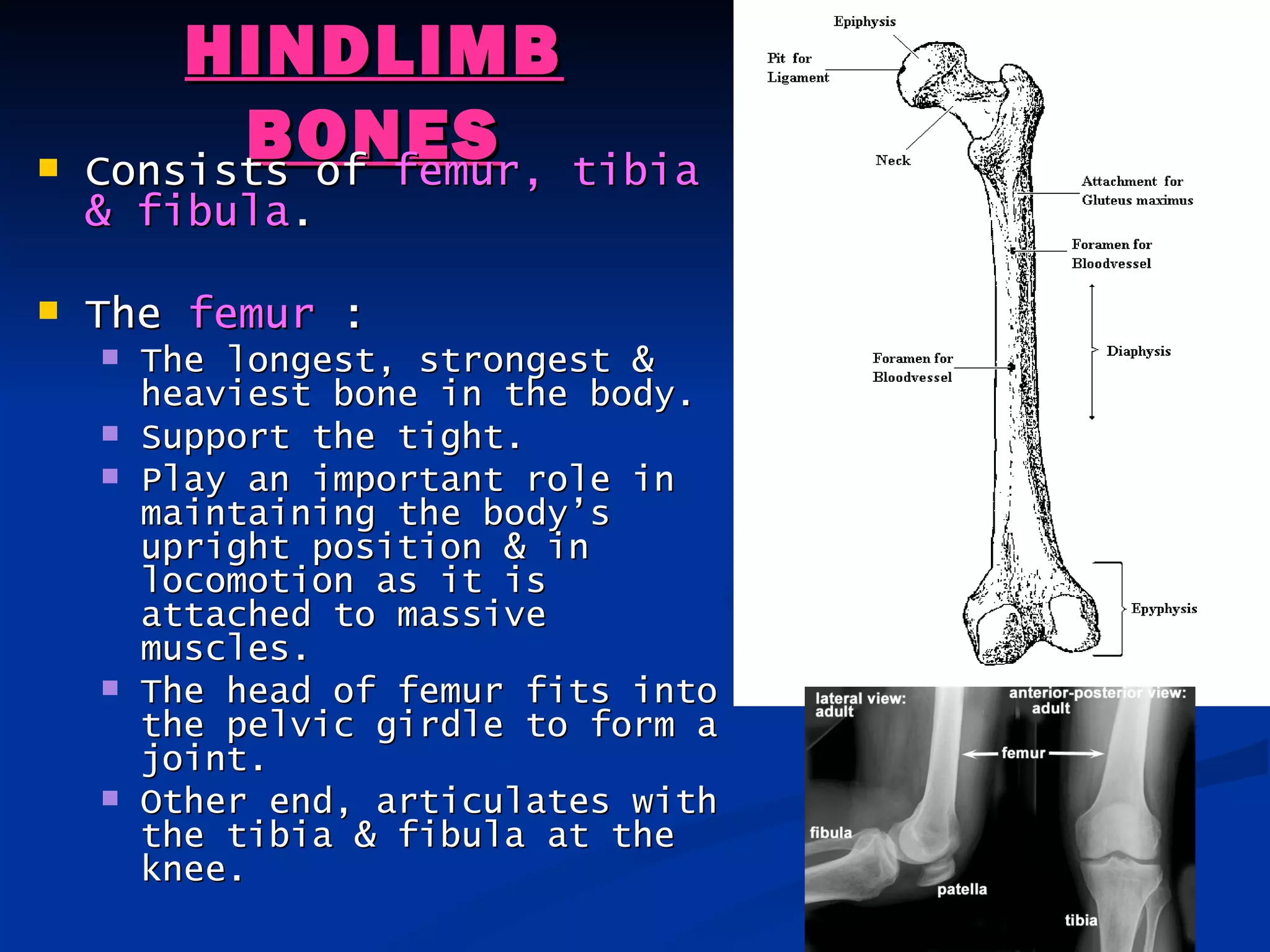
   The femur :
       The longest, strongest &
        heaviest bone in the body.
       Support the tight.
       Play an important role in
        maintaining the body’s
        upright position & in
        locomotion as it is
        attached to massive
        muscles.
       The head of femur fits into
        the pelvic girdle to form a
        joint.
       Other end, articulates with
        the tibia & fibula at the
        knee.
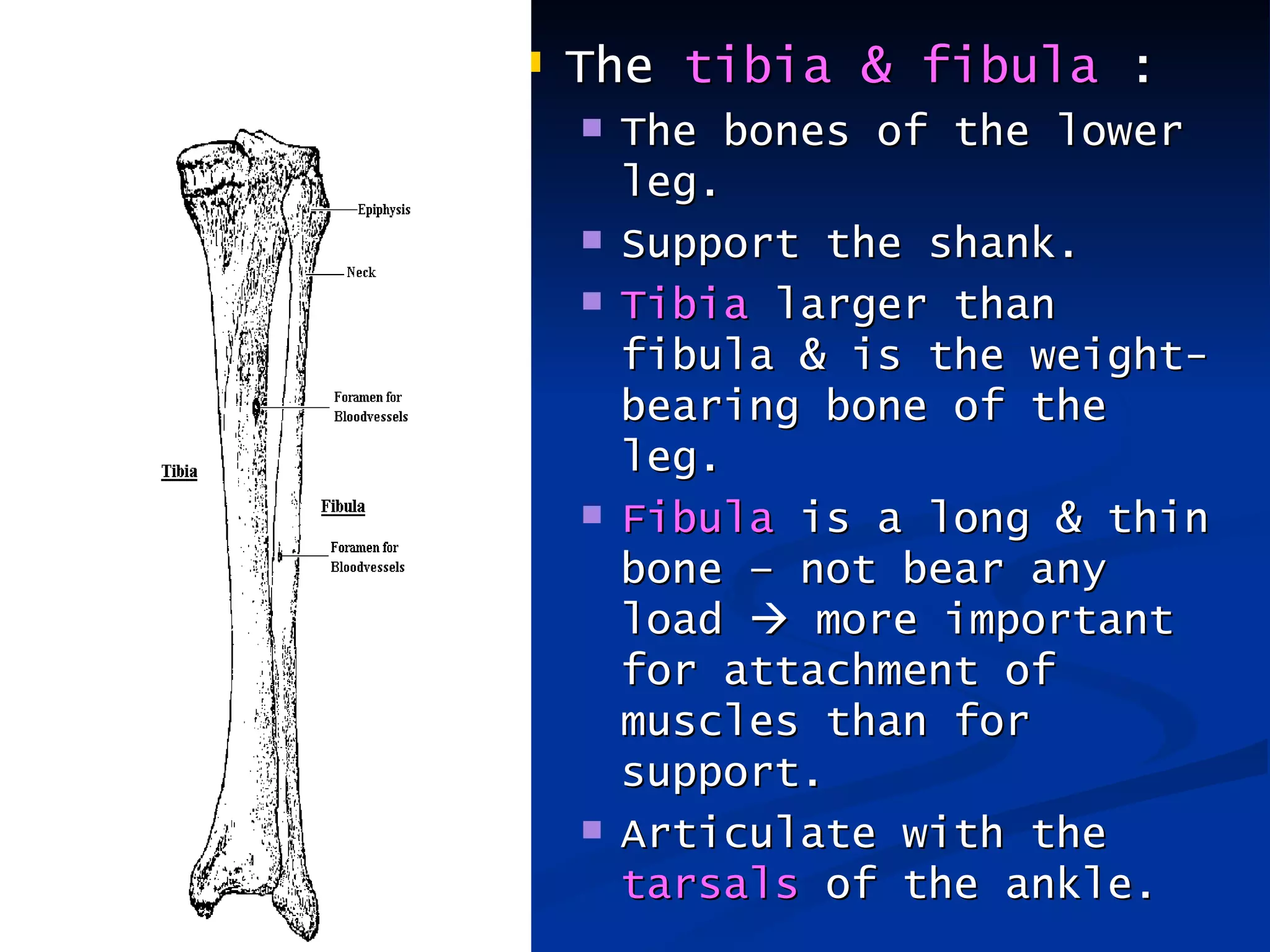
   The tibia & fibula :
       The bones of the lower
        leg.
       Support the shank.
       Tibia larger than
        fibula & is the weight-
        bearing bone of the
        leg.
       Fibula is a long & thin
        bone – not bear any
        load  more important
        for attachment of
        muscles than for
        support.
       Articulate with the
        tarsals of the ankle.
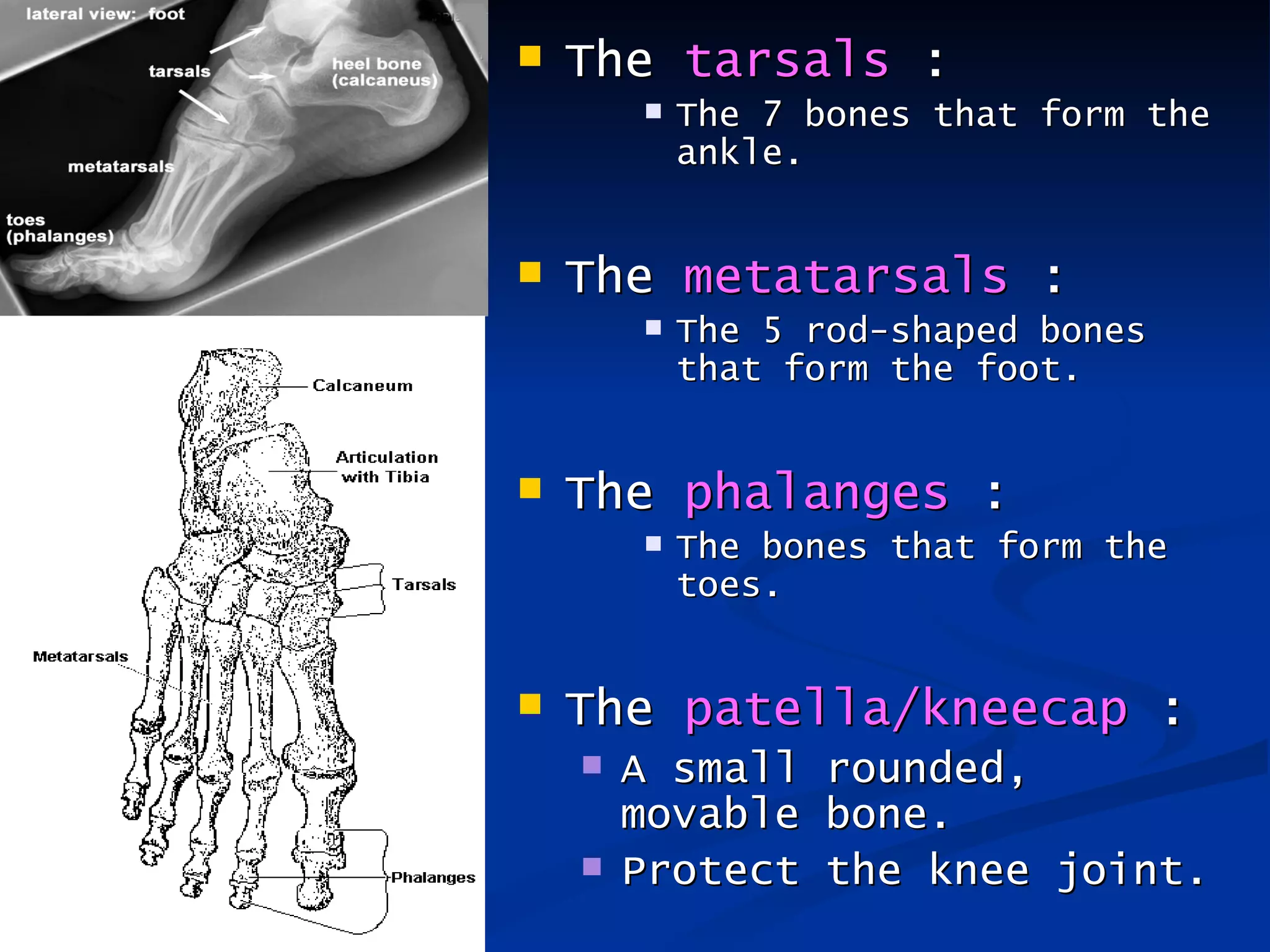
   The tarsals :
           The 7 bones that form the
            ankle.


   The metatarsals :
           The 5 rod-shaped bones
            that form the foot.


   The phalanges :
           The bones that form the
            toes.


   The patella/kneecap :
       A small   rounded,
        movable   bone.
       Protect   the knee joint.

2[1].1 (a) FORM 5

  • 2.
    CONCEPT MAP OFCHAPTER 2 LOCOMOTION & SUPPORT LOCOMOTION & SUPPORT IN SUPPORT IN PLANTS HUMANS & ANIMALS TYPES OF Muscles, ligaments TERRESTRIAL LOCOMOTION AQUATIC PLANTS SKELETON & tendon PLANTS Hydrostatic skeleton Birds Exoskeleton Fish Endoskeleton Grasshopper Appendicular Axial skeleton skeleton Earthworms
  • 4.
    LEARNING OUTCOMES  To explain the necessity for support and locomotion in humans and animals,  To describe problems that could be faced by humans and animals in support and locomotion,  To explain how problems in support and locomotion are overcome in humans and animals,  To name the bones that make up the axial skeleton and appendicular skeleton of the human body
  • 5.
    The Necessity forSupport & Locomotion in Humans & Animals WHY DO HUMANS & ANIMALS NEED SUPPORT? 1. To find the food 2. To find partner for mating 3. To protect/escape from their predator 4. To shelter from bad environment
  • 6.
    The Necessity forSupport & Locomotion in Humans & Animals  Without support, animals & humans would not be able to maintain their body shape  their body collapse under the weight of their own tissues.  Support are provided by some form of skeleton.  Hydrostatic skeleton  Exoskeleton  endoskeleton
  • 7.
    HYDROSTATIC SKELETON  A fluid-filled internal body cavity in which the fluid is held under pressure  maintaining the body shape & providing support for internal organ  The cavity is surrounded by muscles arranged in layers.  The body shape of the animal changes as these muscles contract & relax.
  • 8.
    The animals are soft & flexible, the hydrostatic fluid does protect body parts by acting as a shock absorber.  Examples : earthworm, jellyfish, leech & caterpillar.
  • 9.
    EXOSKELETON  A rigid outer covering usually made up of protein, chitins &/@ calcium salt.  Insects – the cuticle (covered with wax to prevent water loss from the body), cover the body’s surface.  The exoskeleton is jointed / hinged = certain points of the skeleton are flexible & can bend  enabling the movement.
  • 10.
    Exoskeleton restrict the growth of animals  the exoskeleton must be shed from time to time in order for the animal to grow. (ecdysis)  Also found in the shells of molluscs & the bony plates of tortoises.  Examples : insects, crabs, lobsters, tortoise
  • 12.
    ENDOSKELETON  Found in the bodies of all vertebrates including fish, amphibians & birds.  Consist of hard skeleton of bones & cartilage found inside the body – made up of calcium & phosphate.  Works with the muscular system to perform movement & locomotion. It support the body & protects the organs.
  • 14.
    The Necessity forSupport & Locomotion in Humans & Animals  The functions of skeleton :  Provide shape & support  Enables movement (locomotion)  Protects internal organs  Stores calcium & phosphate ions  Produces blood cells  A firm base for the attachment of muscles
  • 15.
    The Necessity forSupport & Locomotion in Humans & Animals Problems that could be faced by humans and animals in support and locomotion,  gravitational force, friction & resistance when moving around  Aspect need to be considered when describing the locomotion of an animal :-  Stability – when it moves, it is temporarily unstable, but its stability will be restored when it stops.  Support – must have enough support from its body’s skeleton  Propulsion – must be propelled in order to move
  • 16.
    HOW TO OVERCOMETHE PROBLEMS?  RESISTANCE & FRICTION – by streamlining their bodies.  GRAVITATIONAL FORCE – most animals have their own supporting structures (fins – fishes, wings – birds & strong limbs – tetrapods & humans)  provide the propulsive force to overcome the problem
  • 17.
    The skeletal system together with its muscles are designed specially to overcome the problems associated with support & locomotion of humans & animals.  To initiate locomotion, the force required is generated by contraction of muscles, whereas the movement is transmitted by the skeleton.
  • 20.
    THE HUMAN SKELETALSYSTEM  The adult human skeleton consist of 206 bones.  Divided into two main parts : the axial skeleton & the appendicular skeleton.  The axial skeleton : made up of the bones that form the vertical axis of the body.  It supports & protects the organs of the head, neck & trunk. (skull, vertebral column, rib cage)
  • 21.
    The appendicular skeleton : made up of the bones that are attached to the axial skeleton.  Include bones of the limbs, the pectoral girdle & the pelvic girdle.
  • 22.
    FUNCTION OF THESKELETON  PROTECTION – the skull protects the brain, the vertebral column protects the spinal cord & the rib cage protects internal organs such as the heart.  SUPPORT – act as a framework to support the soft body parts, to maintain the upright position & to keep the body stable.
  • 23.
    FUNCTION OF THESKELETON  MOVEMENT – bones interact with the skeletal muscle.  BLOOD CELL FORMATION – most of the blood cells are formed in the bone marrow of the long bones.  MINERAL STORAGE – bones act as a reservoir for calcium & phosphorus.
  • 24.
    SKELETAL SYSTEM HUMAN SKELETON AXIAL SKELETON APPENDICULAR SKELETON SKULL VERTEBRAL COLUMN RIB CAGE PECTORAL GIRDLE PELVIC GIRDLE CERVICAL THORACIC FORELIMB BONES LUMBAR HINDLIMB BONES SACRUM COCCYX
  • 26.
    THE SKULL  Made up of 8 cranial bones & 14 facial bones including the upper jaw & the lower jaw.  The facial bones also provide support & protect the entrances to the respiratory system.
  • 27.
    SKULL PARTS FUNCTIONS 8 Cranial bones  Are fused to form immovable joints called sutures.  Protect the brain & the sensory organs. Eye sockets  to protect the eye ball. Nasal bones  to support nose tissues Ear holes  to protect inner part of ears Maxilla (upper jaw)  to support upper teeth Mandible (lower jaw)  to support lower teeth, to enable eating & talking.
  • 28.
    VERTEBRAL COLUMN  Known as the spine/ backbone.  Extends from the base of the skull to the pelvic girdle.  Made up of 33 vertebrae separated from each other by discs of cartilage (intervertebral discs) which absorb shocks & serve as flex point.  This S-shaped column supports & balances the body in a vertical plane & protects the spinal cord, supports the skull & provides a base for the attachment of muscles to the back.
  • 29.
    VERTEBRAL COLUMN  The vertebrae differ in structure & function in different regions of the vertebral column.  A vertebra typically consists of a main body (the centrum), a neural arch & transverse processes.
  • 30.
  • 31.
    VERTEBRAL COLUMN STRUCTURE FUNCTION NEURAL SPINE Provides surface for attachment of ligaments & muscles. TRANSVERSE Provides surface for attachment of PROCESS ligaments & muscles. NEURAL ARCH/ Protects the spinal cord. VERTEBRAL FORAMEN CENTRUM Provides support & absorbs shocks. NEURAL CANAL Provides the passage of nerves from the spinal cord. ARTICULATING Provides surface which articulates SURFACE with the next vertebra.
  • 32.
    TYPES OF VERTEBRAE TYPE OF POSITION NUMBER OF MAIN CHARACTER VERTEBRAE VERTEBRAE Cervical Below the 7  1st one – atlas Vertebra skull vertebra  2nd – axis vertebrae  Large neural canal/vertebral foramen  Short neural spine  Flat centrum  Short transverse processes  Has a pair of vertebrarterial canals
  • 33.
  • 36.
    THORACIC VERTEBRA TYPEOF POSITION NUMBER OF MAIN CHARACTER VERTEBRAE VERTEBRAE Thoracic Thorax 12  Neural canal/ Vertebra vertebral foramen is smaller than cervical vertebra’s  Long neural spine/ spinous processes (for attachment of back muscle)  Thick & big centrum  Short transverse
  • 37.
  • 39.
    LUMBAR VERTEBRA TYPEOF POSITION NUMBER OF MAIN CHARACTER VERTEBRAE VERTEBRAE Lumbar Waist 5  small neural Vertebra canal/ vertebral foramen  short neural spine  thick & big centrum  long transverse processes for muscle attachment
  • 40.
  • 41.
    SACRUM & COCCYX TYPE OF POSITION NUMBER OF MAIN CHARACTER VERTEBRAE VERTEBRAE Sacrum Pelvic 5 fused  Vertebrae fused to region each other  Has four pairs of openings Triangular shape Coccyx Caudal 4 fused  Bones fused to region each other forming a triangular shape which tapers at one end
  • 42.
  • 44.
    THE STERNUM &RIBS  The rib cage consists of 12 pairs of ribs with the thoracic vertebrae at the back portion of the body & join to the sternum in the front portion.  Movement of the rib cage are brought about by intercostal muscles between the ribs.
  • 45.
    THE STERNUM &RIBS  The sternum & ribs enclose & protect the internal organs (the lungs & heart) & play an important role in breathing.
  • 48.
    PECTORAL GIRDLE  Consist of scapula & clavicle.  Links the upper limbs bones to the axial skeleton.  The scapula : bound by muscles to the back of the thorax. It is a flat, triangular bone which provides a surface for the attachment of muscles.
  • 49.
    The clavicle : a rod-shaped bone placed horizontally above the scapula.  It links the scapula to the sternum. It limits the movements of the scapula.
  • 51.
    PELVIC GIRDLE  Consists of 6 fused bones – support the weight of the body from the vertebral column.  Also protect the internal organs – urinary bladder & reproductive organs.  Made up of two halves, each consists of 3 bones (ilium, pubis & ischium)
  • 52.
    PELVIC GIRDLE  The pelvic girdle is attached to the sacrum of the vertebral column.  The asetabulum / socket for femur articulates with each side of the pelvic girdle at the hip joint.
  • 54.
    FORELIMB BONES  Consists of humerus, radius & ulna.  The Humerus :  The long bones of the upper arm  Rounded head end fits into an open socket of the scapula  forming a ball-and-socket joint (allow movement in all planes)
  • 55.
    The posterior end of the humerus forms a hinge joint with the ulna with the ulna- radius bones, allowing movement in one plane only.  The radius & ulna :  The bones on the forearm in which the ulna is longer than the radius.  It has a notch at its upper end which articulates the humerus at the elbow.
  • 56.
    The carpals :  The bones that form the wrist.  Consists of 8 small bones  The metacarpals :  The rod-shaped ones that form the palm.  The phalanges :  The bones that form the fingers.
  • 57.
    HINDLIMB  BONES tibia Consists of femur, & fibula.  The femur :  The longest, strongest & heaviest bone in the body.  Support the tight.  Play an important role in maintaining the body’s upright position & in locomotion as it is attached to massive muscles.  The head of femur fits into the pelvic girdle to form a joint.  Other end, articulates with the tibia & fibula at the knee.
  • 58.
    The tibia & fibula :  The bones of the lower leg.  Support the shank.  Tibia larger than fibula & is the weight- bearing bone of the leg.  Fibula is a long & thin bone – not bear any load  more important for attachment of muscles than for support.  Articulate with the tarsals of the ankle.
  • 59.
    The tarsals :  The 7 bones that form the ankle.  The metatarsals :  The 5 rod-shaped bones that form the foot.  The phalanges :  The bones that form the toes.  The patella/kneecap :  A small rounded, movable bone.  Protect the knee joint.