Sexual ReproductionSexual Reproduction
in Flowering Plantsin Flowering Plants
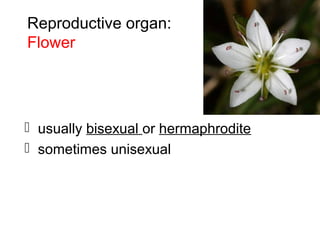
Reproductive organ:
Flower
 usually bisexual or hermaphrodite
 sometimes unisexual
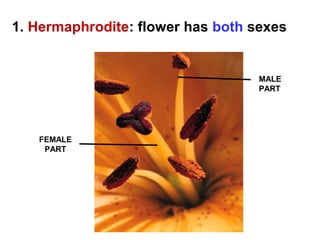
1. Hermaphrodite: flower has both sexes
MALE
PART
FEMALE
PART
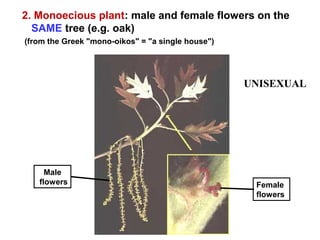
2. Monoecious plant: male and female flowers on the
SAME tree (e.g. oak)
Male
flowers Female
flowers
(from the Greek "mono-oikos" = "a single house")
UNISEXUAL
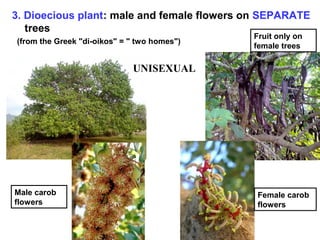
3. Dioecious plant: male and female flowers on SEPARATE
trees
Male carob
flowers
Female carob
flowers
Fruit only on
female trees
(from the Greek "di-oikos" = " two homes")
UNISEXUAL
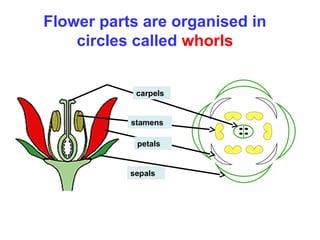
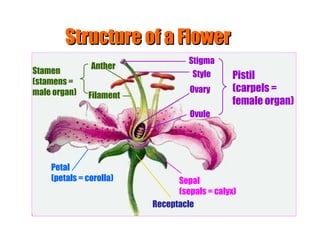
Flower parts are organised in
circles called whorls
sepals
petals
stamens
carpels
Stigma
Style
Ovary
Ovule
Petal
(petals = corolla)
Receptacle
Sepal
(sepals = calyx)
Pistil
(carpels =
female organ)
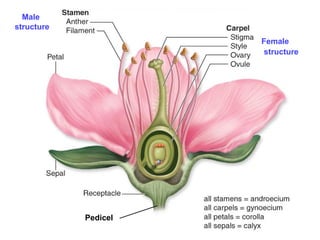
Anther
Filament
Stamen
(stamens =
male organ)
Structure of a FlowerStructure of a Flower
Male
structure
Female
structure
Pedicel
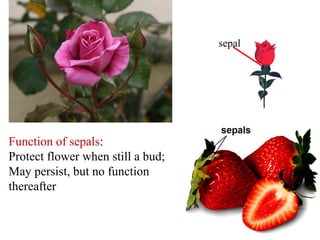
Function of sepals:
Protect flower when still a bud;
May persist, but no function
thereafter
sepal
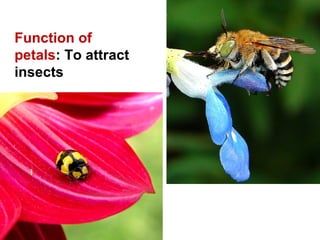
Function of
petals: To attract
insects
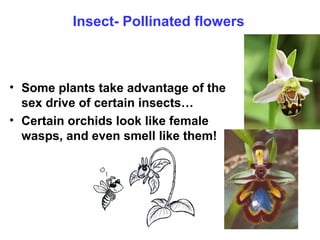
Insect- Pollinated flowers
• Some plants take advantage of the
sex drive of certain insects…
• Certain orchids look like female
wasps, and even smell like them!
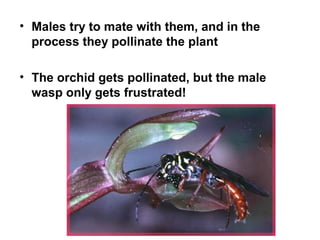
• Males try to mate with them, and in the
process they pollinate the plant
• The orchid gets pollinated, but the male
wasp only gets frustrated!
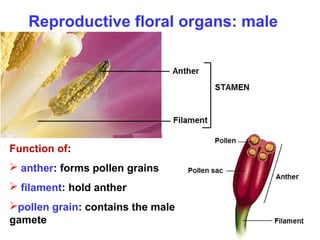
Reproductive floral organs: male
Function of:
 anther: forms pollen grains
 filament: hold anther
pollen grain: contains the male
gamete
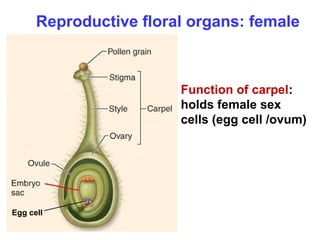
Reproductive floral organs: female
Function of carpel:
holds female sex
cells (egg cell /ovum)
Egg cell
Stigma
Style
Ovary/Carpels
Ovule
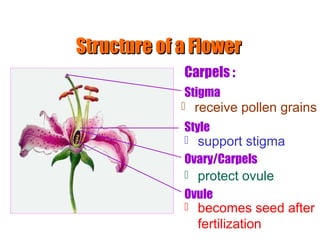
Carpels :
 receive pollen grains
 support stigma
 protect ovule
 becomes seed after
fertilization
Structure of a FlowerStructure of a Flower
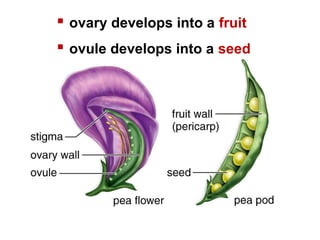
 ovary develops into a fruit
 ovule develops into a seed
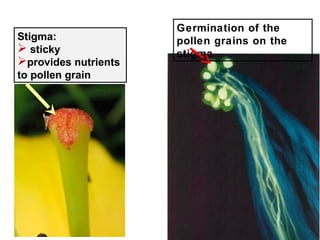
Stigma:
 sticky
provides nutrients
to pollen grain
Germination of the
pollen grains on the
stigma
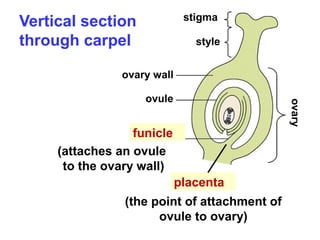
Vertical section
through carpel
(attaches an ovule
to the ovary wall)
(the point of attachment of
ovule to ovary)
funicle
stigma
style
ovary wall
ovule
ovary
placenta
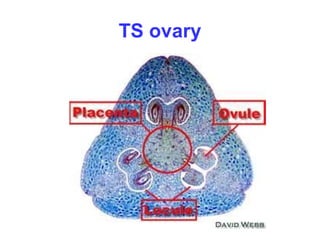
TS ovary
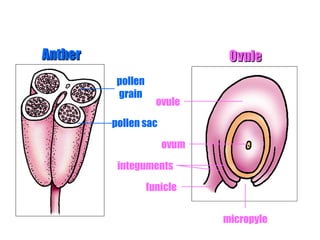
pollen
grain
pollen sac
ovule
micropyle
funicle
integuments
ovum
AntherAnther OvuleOvule
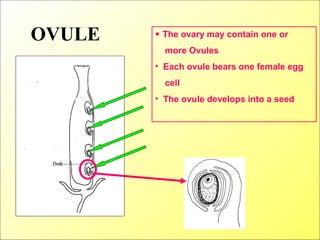
• The ovary may contain one or
more Ovules
• Each ovule bears one female egg
cell
• The ovule develops into a seed
OVULE
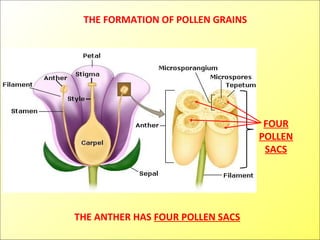
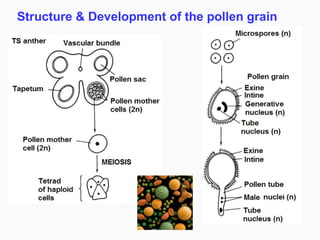
THE FORMATION OF POLLEN GRAINS
THE ANTHER HAS FOUR POLLEN SACS
FOUR
POLLEN
SACS
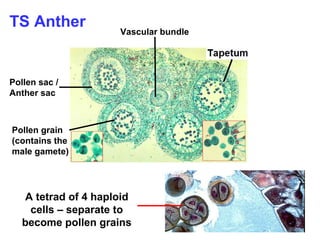
Vascular bundle
Pollen sac /
Anther sac
TS Anther
Pollen grain
(contains the
male gamete)
A tetrad of 4 haploid
cells – separate to
become pollen grains
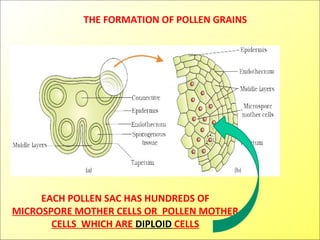
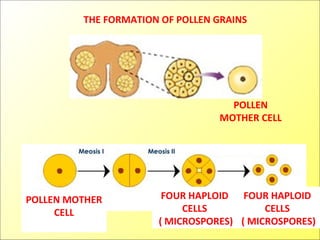
THE FORMATION OF POLLEN GRAINS
EACH POLLEN SAC HAS HUNDREDS OF
MICROSPORE MOTHER CELLS OR POLLEN MOTHER
CELLS WHICH ARE DIPLOID CELLS
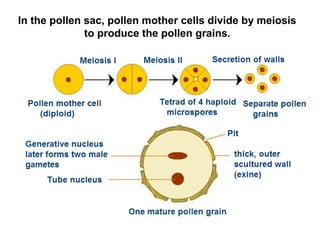
In the pollen sac, pollen mother cells divide by meiosis
to produce the pollen grains.
Structure & Development of the pollen grain
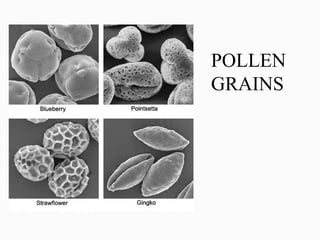
POLLEN
GRAINS
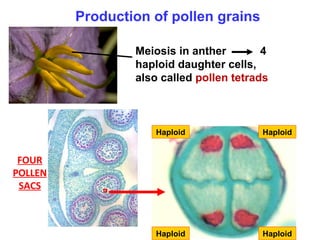
Production of pollen grains
HaploidHaploid
HaploidHaploid
Meiosis in anther 4
haploid daughter cells,
also called pollen tetrads
FOUR
POLLEN
SACS
Haploid
Haploid
HaploidHaploid
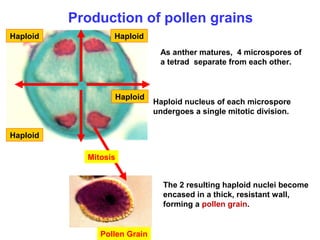
As anther matures, 4 microspores of
a tetrad separate from each other.
Production of pollen grains
Haploid nucleus of each microspore
undergoes a single mitotic division.
The 2 resulting haploid nuclei become
encased in a thick, resistant wall,
forming a pollen grain.
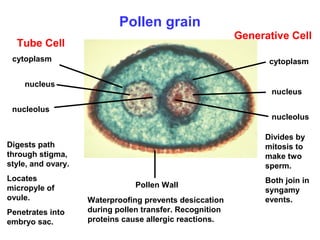
Pollen Grain
Mitosis
Pollen grain
Pollen Wall
Tube Cell
Generative Cell
Waterproofing prevents desiccation
during pollen transfer. Recognition
proteins cause allergic reactions.
cytoplasm cytoplasm
nucleus
nucleus
Digests path
through stigma,
style, and ovary.
Locates
micropyle of
ovule.
Penetrates into
embryo sac.
nucleolus
nucleolus
Divides by
mitosis to
make two
sperm.
Both join in
syngamy
events.
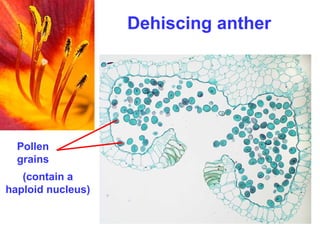
Dehiscing anther
Pollen
grains
(contain a
haploid nucleus)
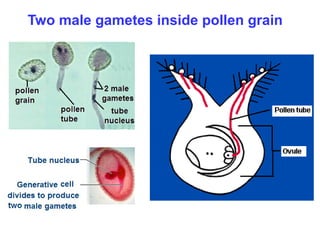
Two male gametes inside pollen grain
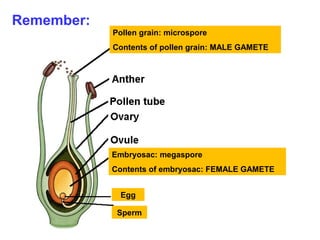
Remember:
Pollen grain: microspore
Contents of pollen grain: MALE GAMETE
Embryosac: megaspore
Contents of embryosac: FEMALE GAMETE
Egg
Sperm
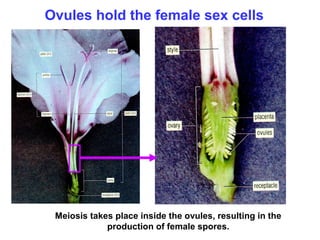
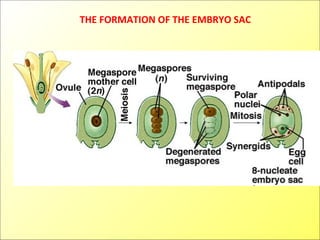
Ovules hold the female sex cells
Meiosis takes place inside the ovules, resulting in the
production of female spores.
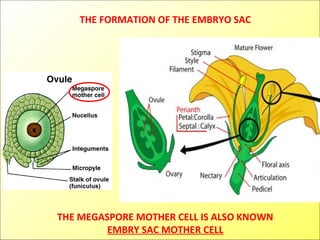
THE FORMATION OF THE EMBRYO SAC
THE MEGASPORE MOTHER CELL IS ALSO KNOWN
EMBRY SAC MOTHER CELL
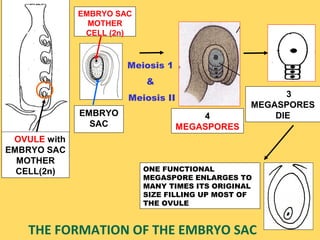
4
MEGASPORES
OVULE with
EMBRYO SAC
MOTHER
CELL(2n)
3
MEGASPORES
DIE
ONE FUNCTIONAL
MEGASPORE ENLARGES TO
MANY TIMES ITS ORIGINAL
SIZE FILLING UP MOST OF
THE OVULE
EMBRYO
SAC
EMBRYO SAC
MOTHER
CELL (2n)
Meiosis 1
&
Meiosis II
THE FORMATION OF THE EMBRYO SAC
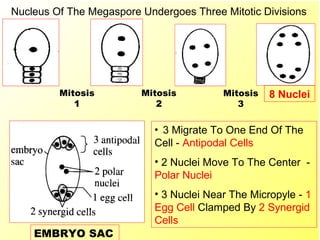
Nucleus Of The Megaspore Undergoes Three Mitotic Divisions
Mitosis
1
Mitosis
2
Mitosis
3
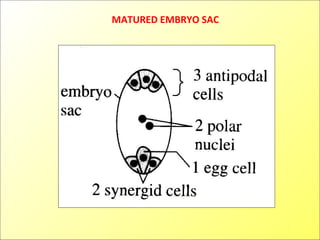
• 3 Migrate To One End Of The
Cell - Antipodal Cells
• 2 Nuclei Move To The Center -
Polar Nuclei
• 3 Nuclei Near The Micropyle - 1
Egg Cell Clamped By 2 Synergid
Cells
EMBRYO SAC
8 Nuclei
MATURED EMBRYO SAC
THE FORMATION OF THE EMBRYO SAC
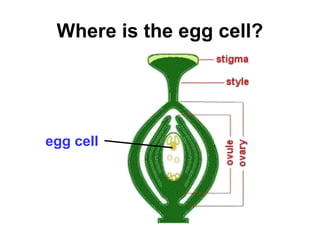
Where is the egg cell?
egg cell
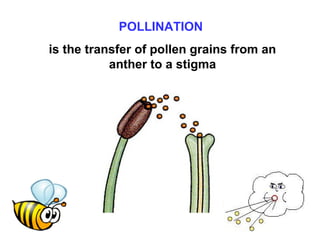
POLLINATION
is the transfer of pollen grains from an
anther to a stigma
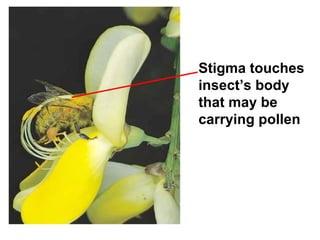
Stigma touches
insect’s body
that may be
carrying pollen
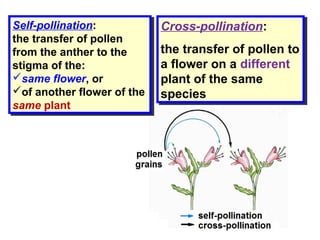
Self-pollination:
the transfer of pollen
from the anther to the
stigma of the:
same flower, or
of another flower of the
same plant
Self-pollination:
the transfer of pollen
from the anther to the
stigma of the:
same flower, or
of another flower of the
same plant
Cross-pollination:
the transfer of pollen to
a flower on a different
plant of the same
species
Cross-pollination:
the transfer of pollen to
a flower on a different
plant of the same
species
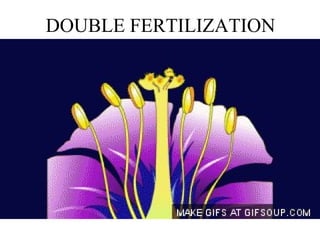
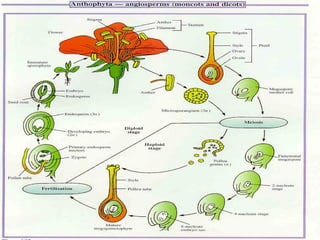
DOUBLE FERTILIZATION
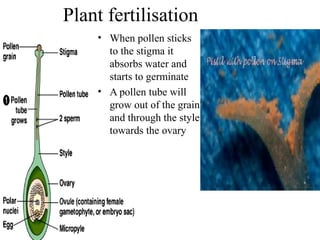
Plant fertilisation
• When pollen sticks
to the stigma it
absorbs water and
starts to germinate
• A pollen tube will
grow out of the grain
and through the style
towards the ovary
Plant fertilisation
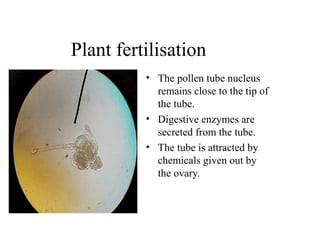
• The pollen tube nucleus
remains close to the tip of
the tube.
• Digestive enzymes are
secreted from the tube.
• The tube is attracted by
chemicals given out by
the ovary.
Plant fertilisation
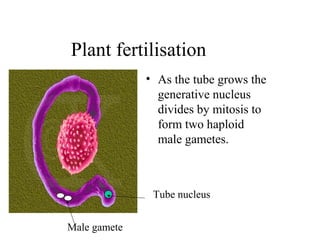
• As the tube grows the
generative nucleus
divides by mitosis to
form two haploid
male gametes.
Tube nucleus
Male gamete
Plant fertilisation
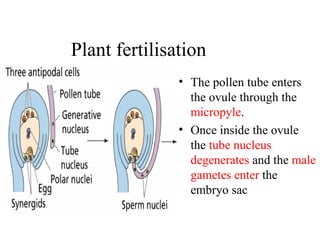
• The pollen tube enters
the ovule through the
micropyle.
• Once inside the ovule
the tube nucleus
degenerates and the male
gametes enter the
embryo sac
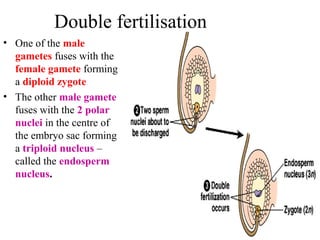
Double fertilisation
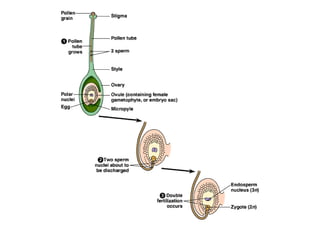
• One of the male
gametes fuses with the
female gamete forming
a diploid zygote.
• The other male gamete
fuses with the 2 polar
nuclei in the centre of
the embryo sac forming
a triploid nucleus –
called the endosperm
nucleus.
• The union of two male gametes with different
nuclei of the embryo sac is termed double
fertilization.
– Double fertilization ensures that the endosperm will
develop only in ovules where the egg has been
fertilized.
– This prevents angiosperms from squandering
nutrients in eggs that lack an embryo.
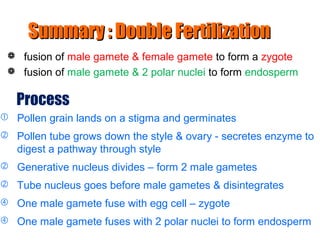
Summary : Double FertilizationSummary : Double Fertilization
 fusion of male gamete & female gamete to form a zygote
 fusion of male gamete & 2 polar nuclei to form endosperm
Process
 Pollen grain lands on a stigma and germinates
 Pollen tube grows down the style & ovary - secretes enzyme to
digest a pathway through style
 Generative nucleus divides – form 2 male gametes
 Tube nucleus goes before male gametes & disintegrates
 One male gamete fuse with egg cell – zygote
 One male gamete fuses with 2 polar nuclei to form endosperm
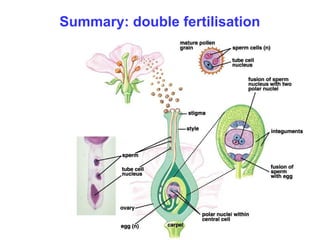
Summary: double fertilisation
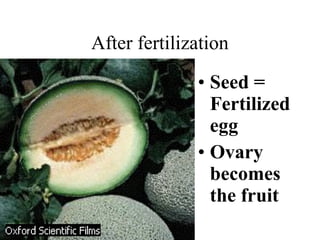
After fertilization
• Seed =
Fertilized
egg
• Ovary
becomes
the fruit
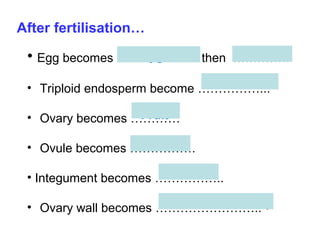
• Egg becomes ……………….. then ….……….
• Triploid endosperm become ……………...
• Ovary becomes …………
• Ovule becomes …………….
• Integument becomes ……………..
• Ovary wall becomes ……………………..
After fertilisation…
Zygote
Endosperm
Seed
Seed coat
Fruit wall / Pericarp
Fruit
Embryo
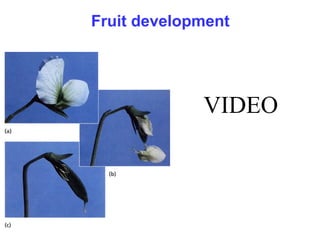
Fruit development
VIDEO
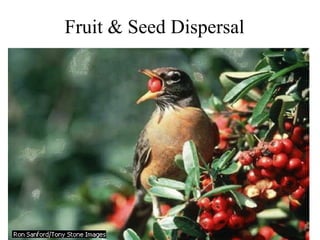
Fruit & Seed Dispersal
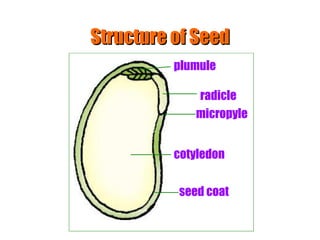
Structure of SeedStructure of Seed
plumule
radicle
micropyle
cotyledon
seed coat
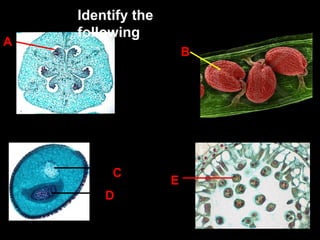
Identify the
following
A
B
C
D
E
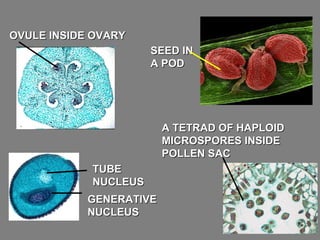
OVULE INSIDE OVARYOVULE INSIDE OVARY
SEED INSEED IN
A PODA POD
TUBETUBE
NUCLEUSNUCLEUS
GENERATIVEGENERATIVE
NUCLEUSNUCLEUS
A TETRAD OF HAPLOIDA TETRAD OF HAPLOID
MICROSPORES INSIDEMICROSPORES INSIDE
POLLEN SACPOLLEN SAC
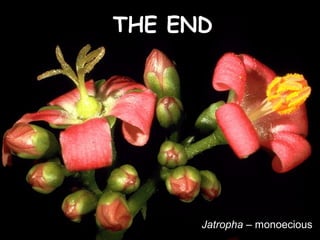
THE END
Jatropha – monoecious
THE FORMATION OF POLLEN GRAINS
POLLEN
MOTHER CELL
FOUR HAPLOID
CELLS
( MICROSPORES)
FOUR HAPLOID
CELLS
( MICROSPORES)
POLLEN MOTHER
CELL
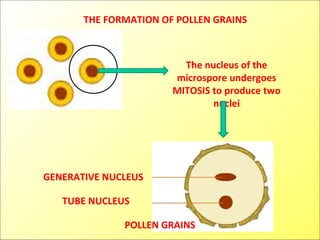
THE FORMATION OF POLLEN GRAINS
The nucleus of the
microspore undergoes
MITOSIS to produce two
nuclei
GENERATIVE NUCLEUS
TUBE NUCLEUS
POLLEN GRAINS