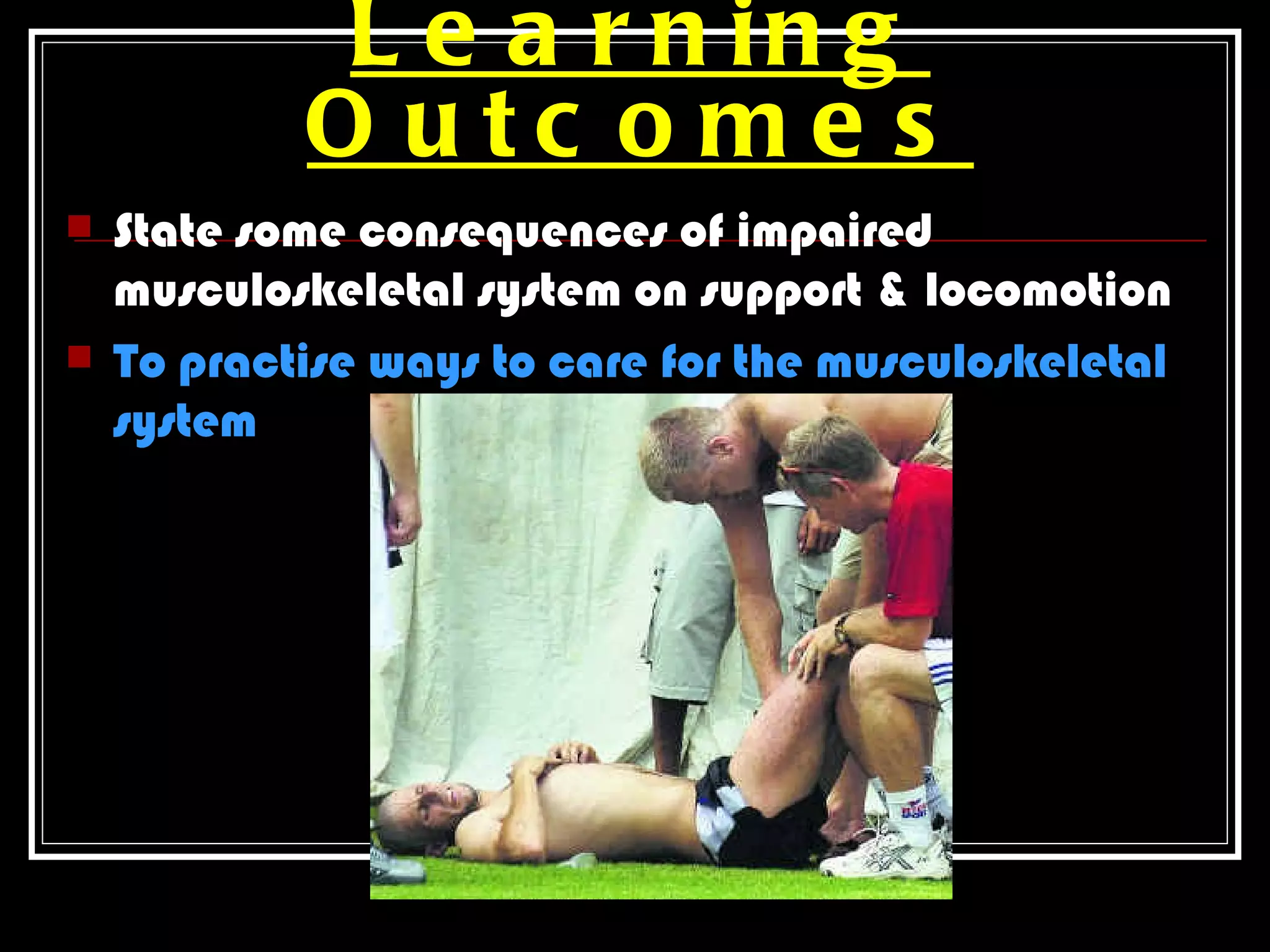
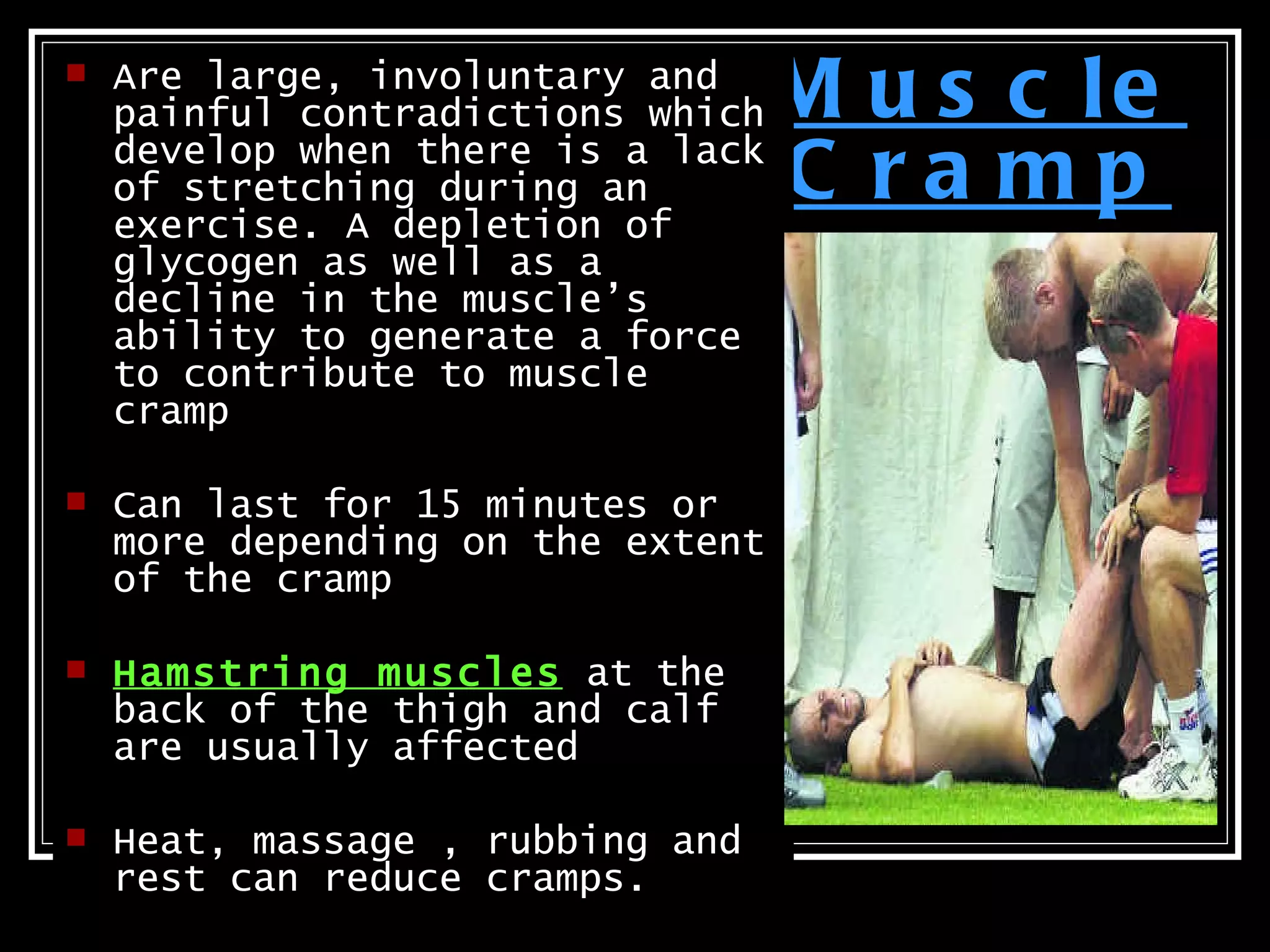
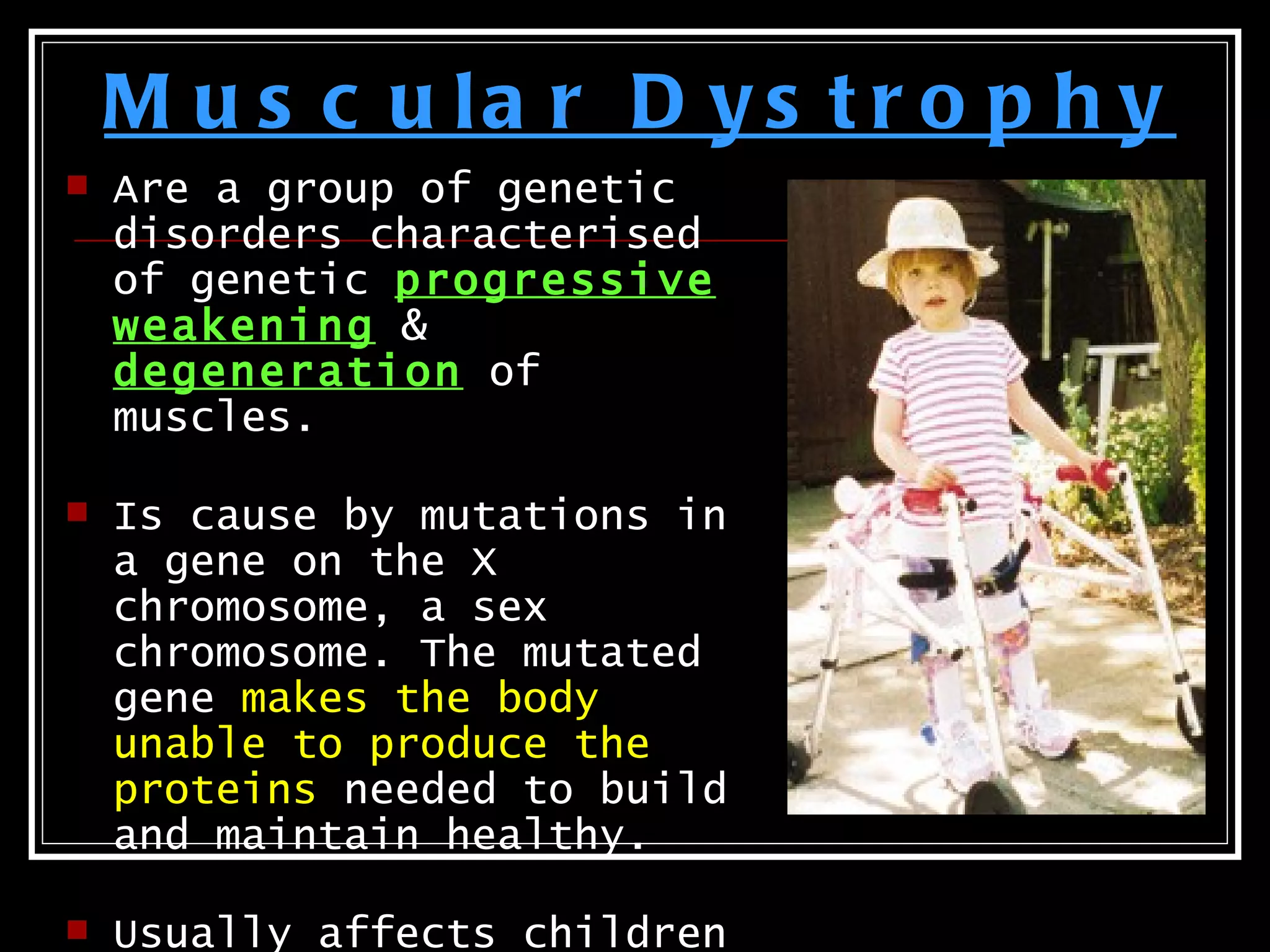
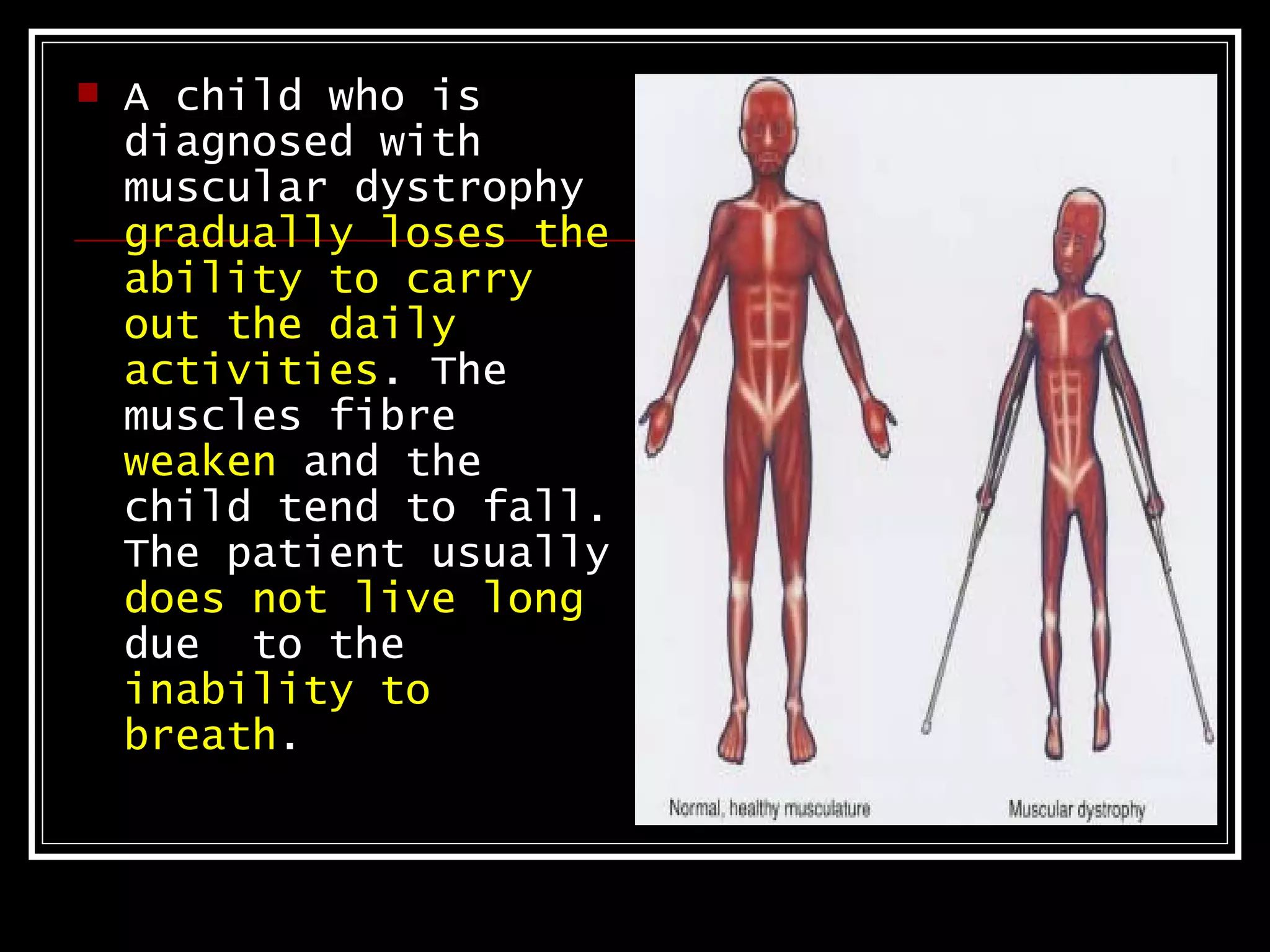
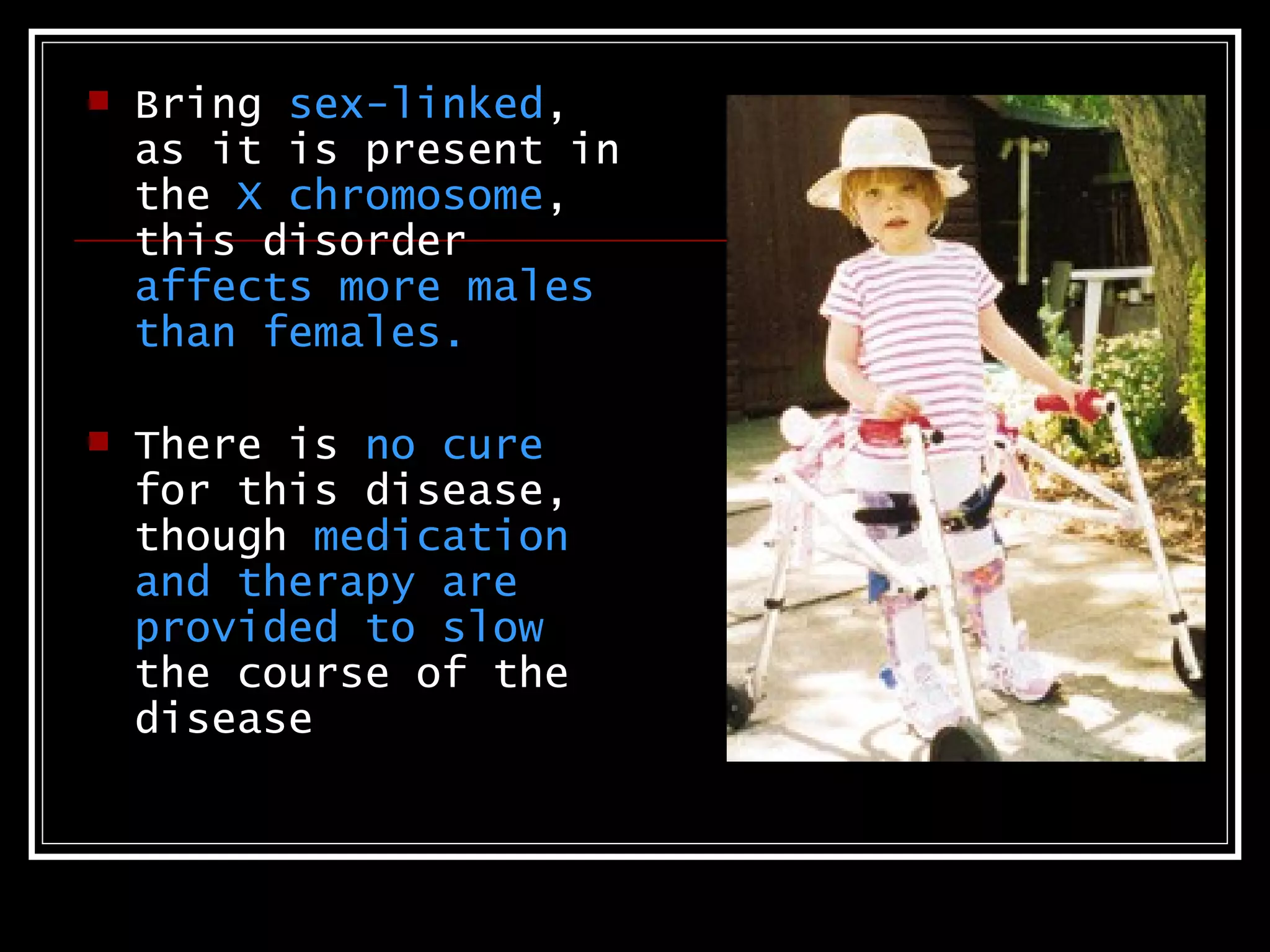
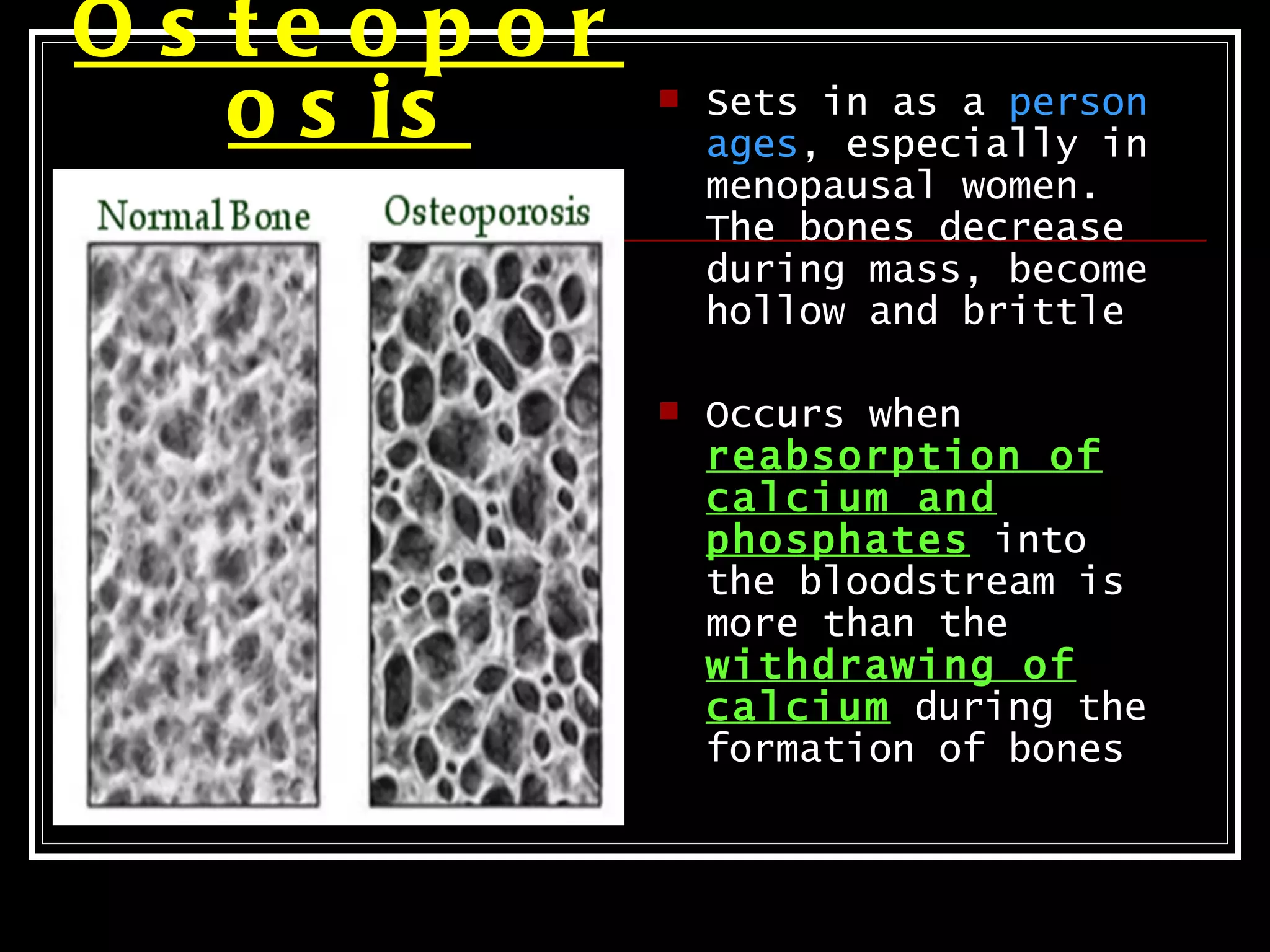
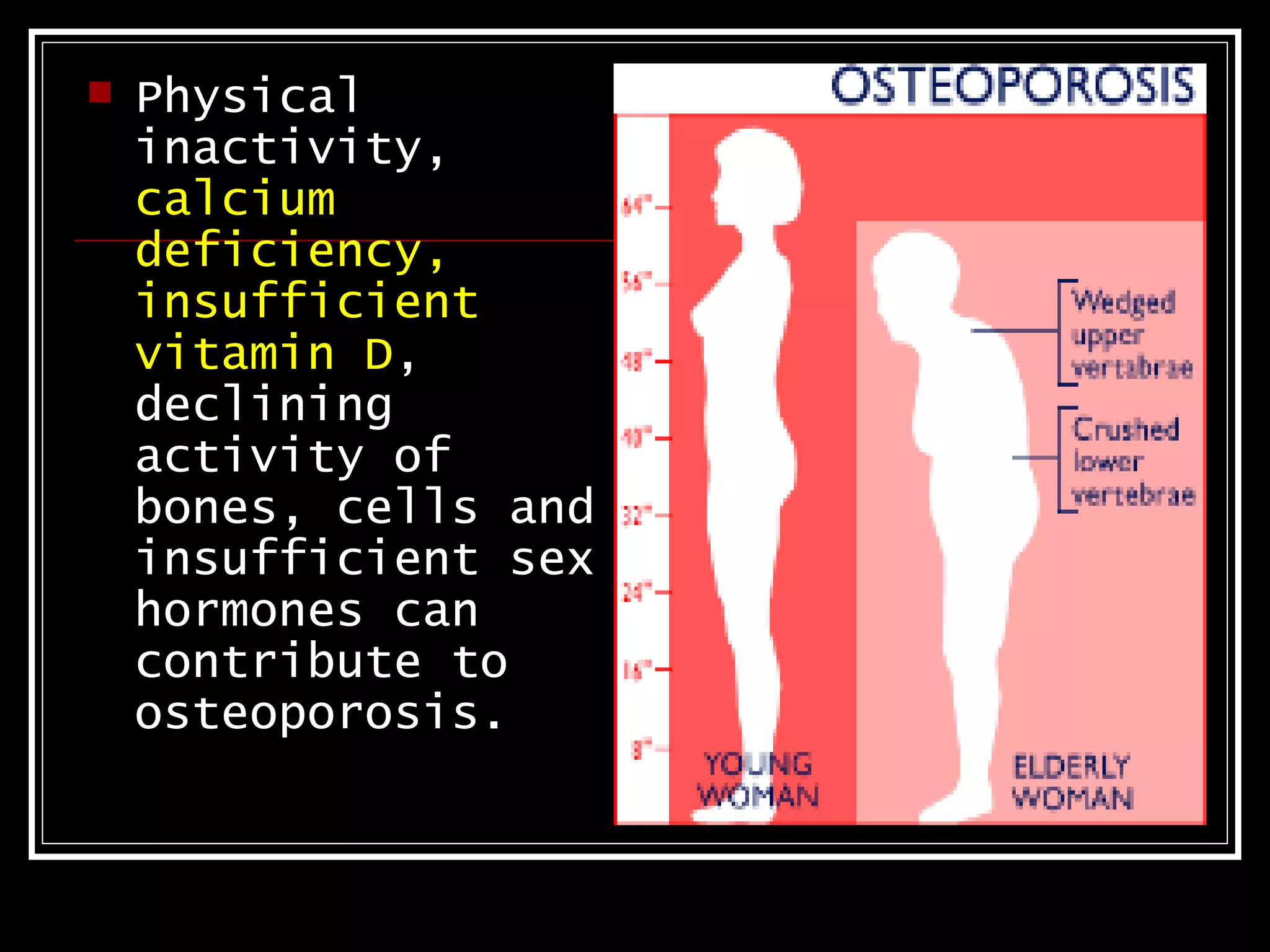
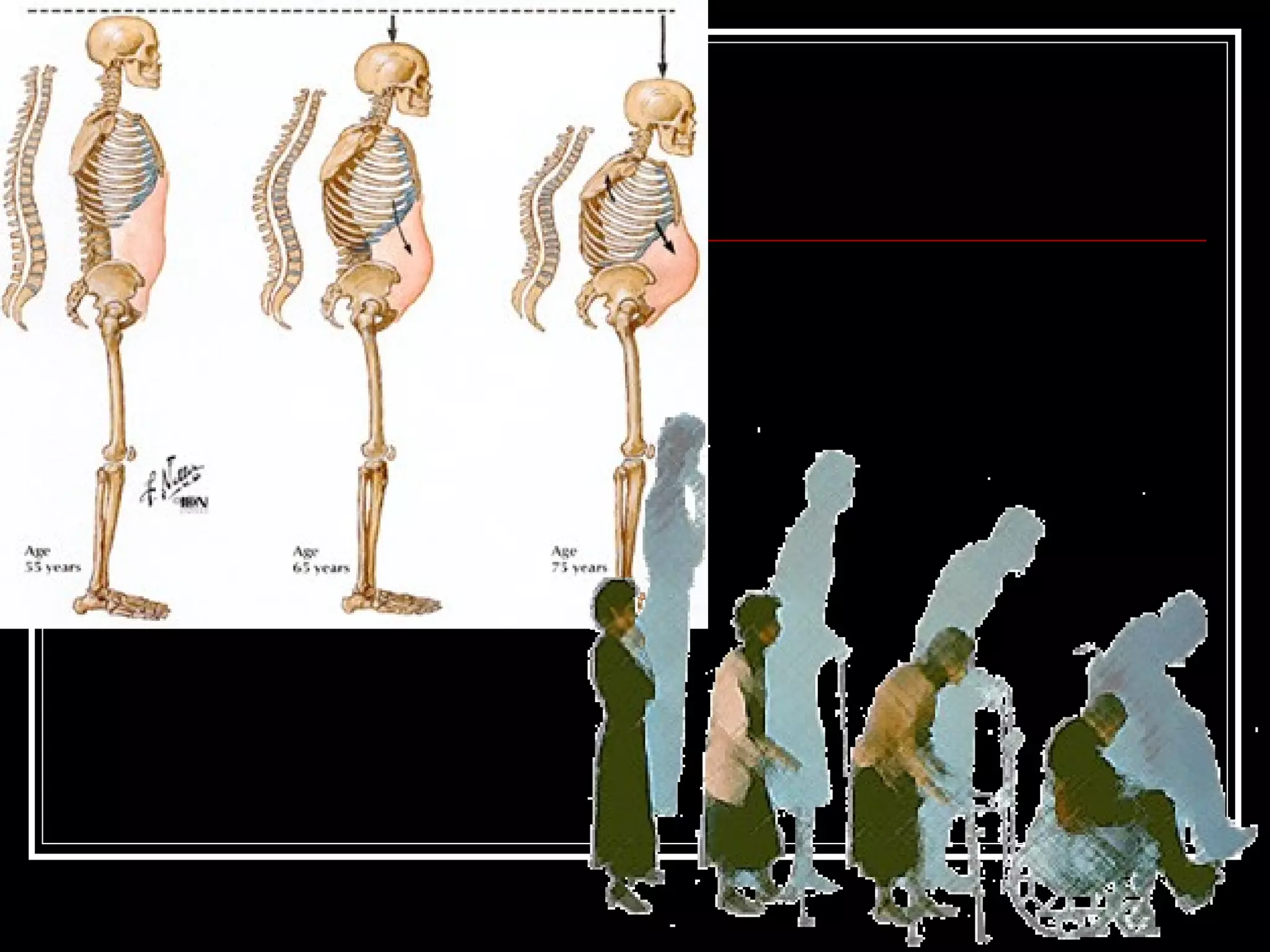
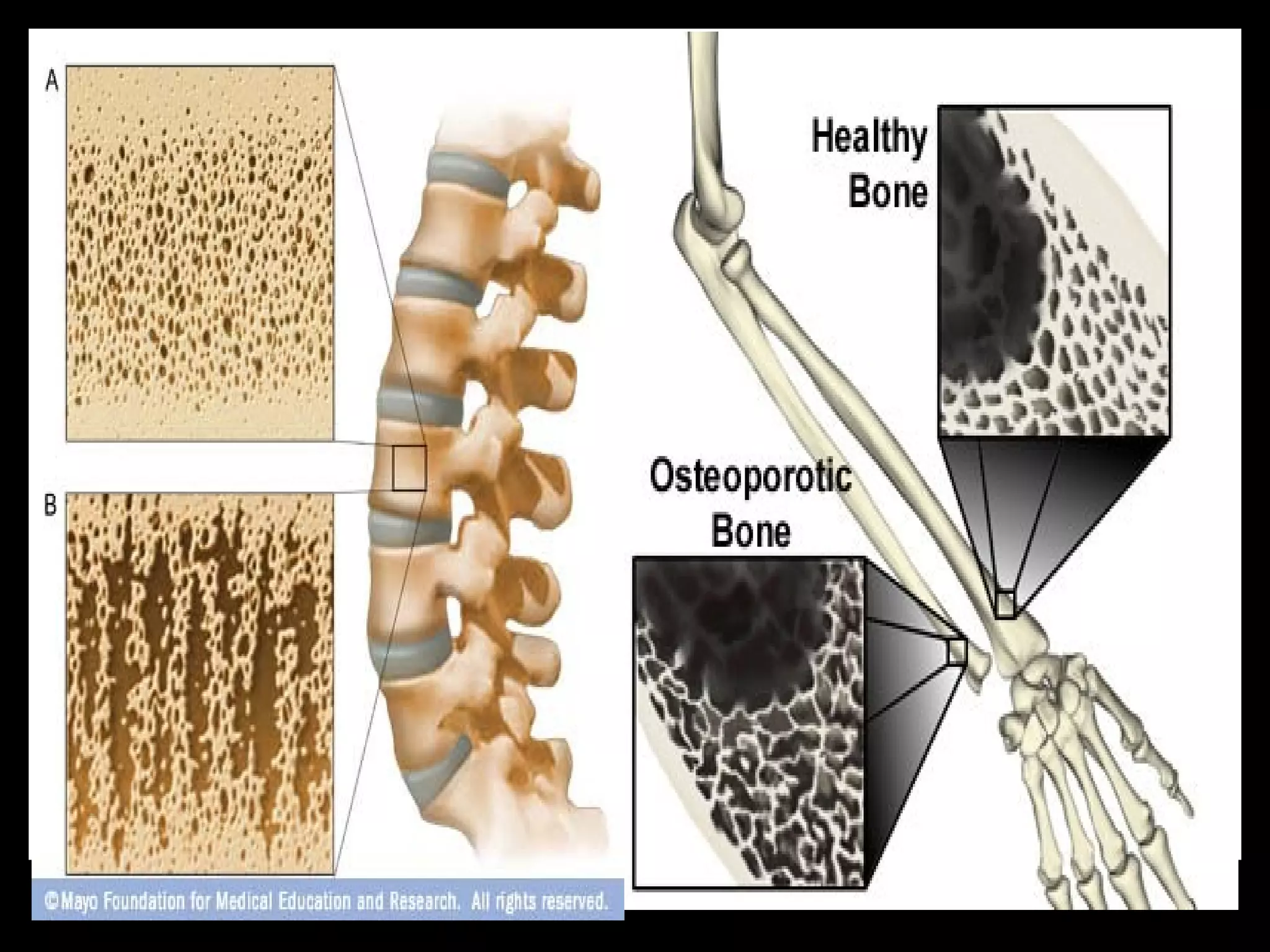
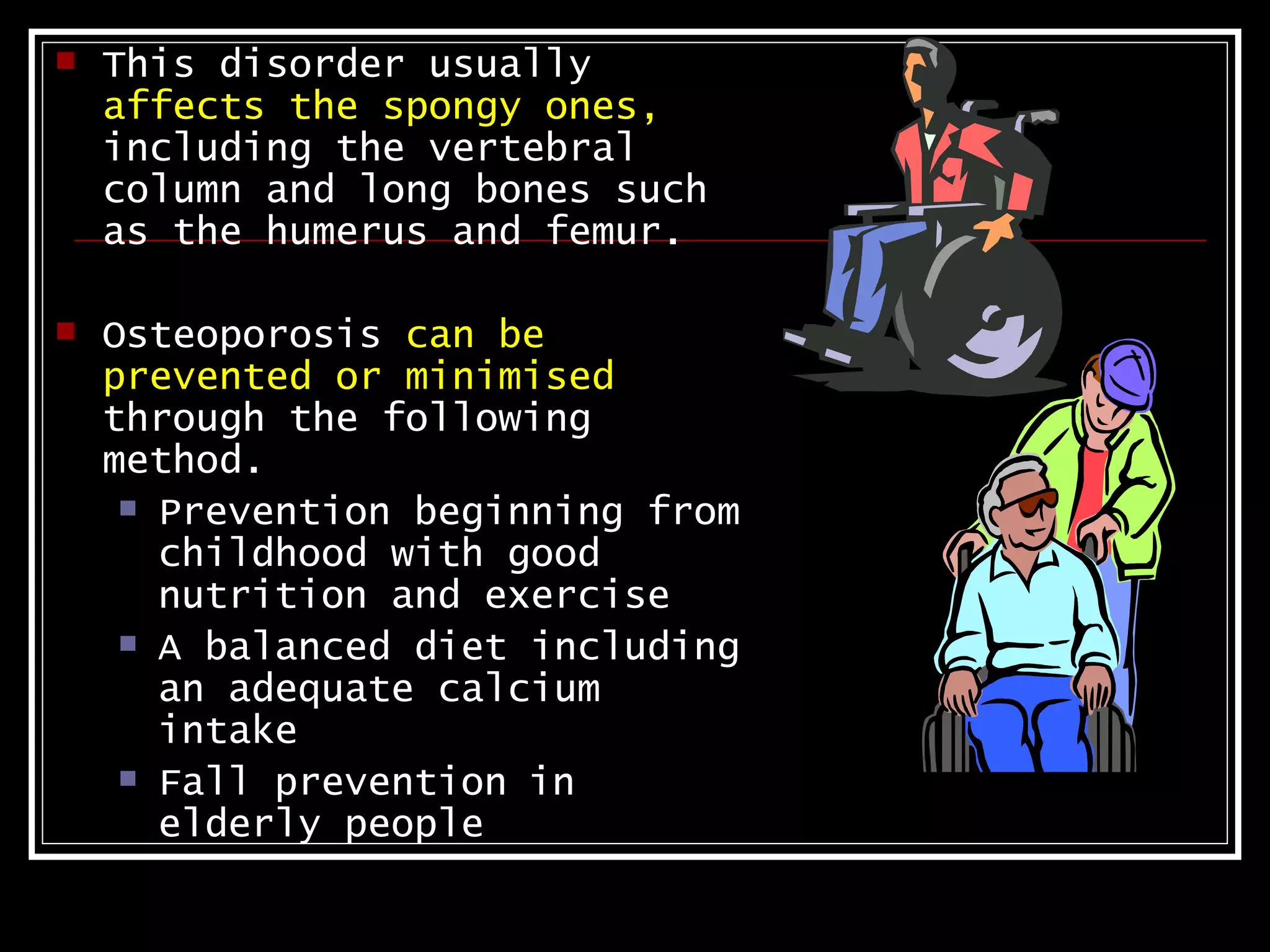
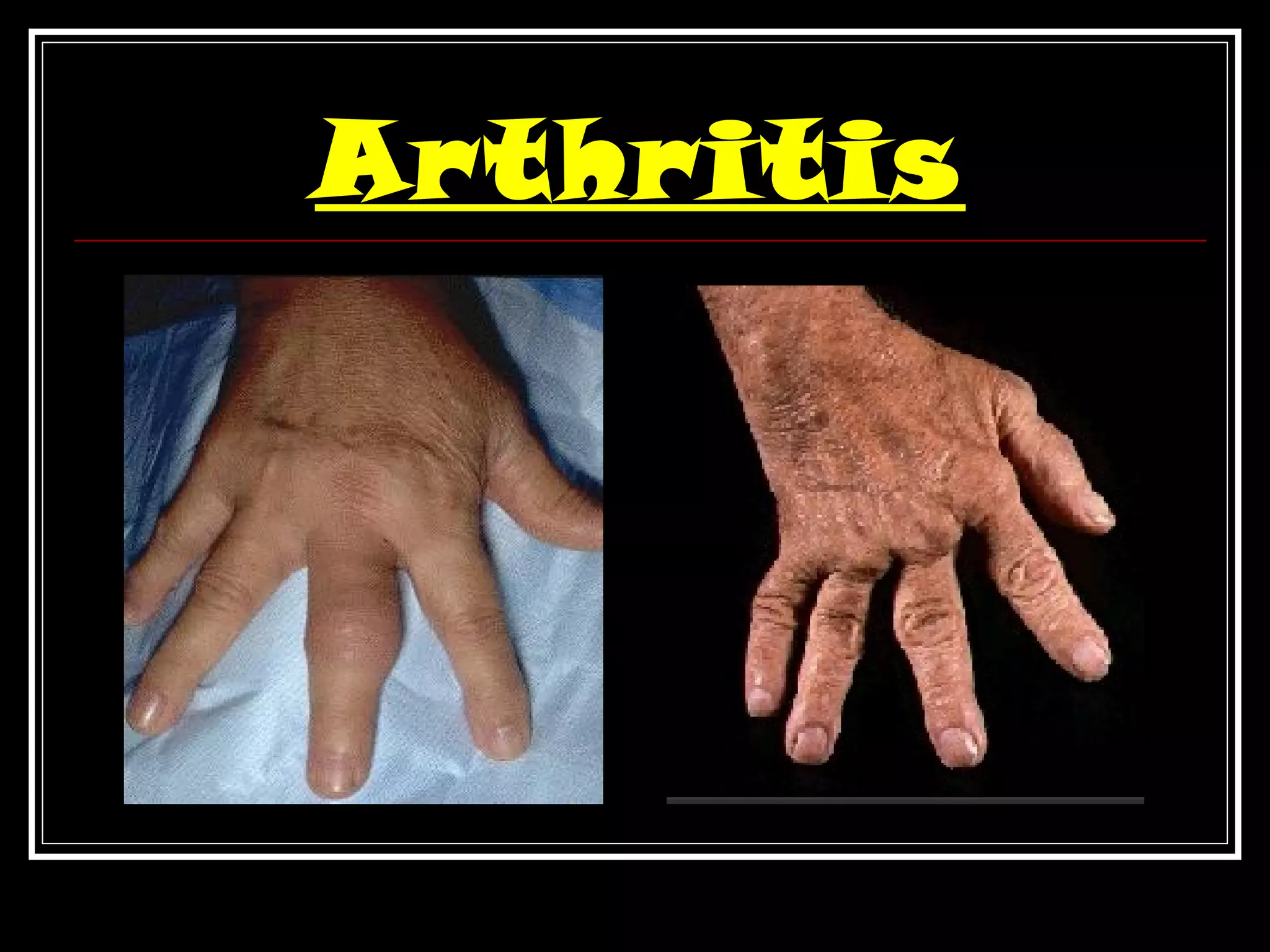
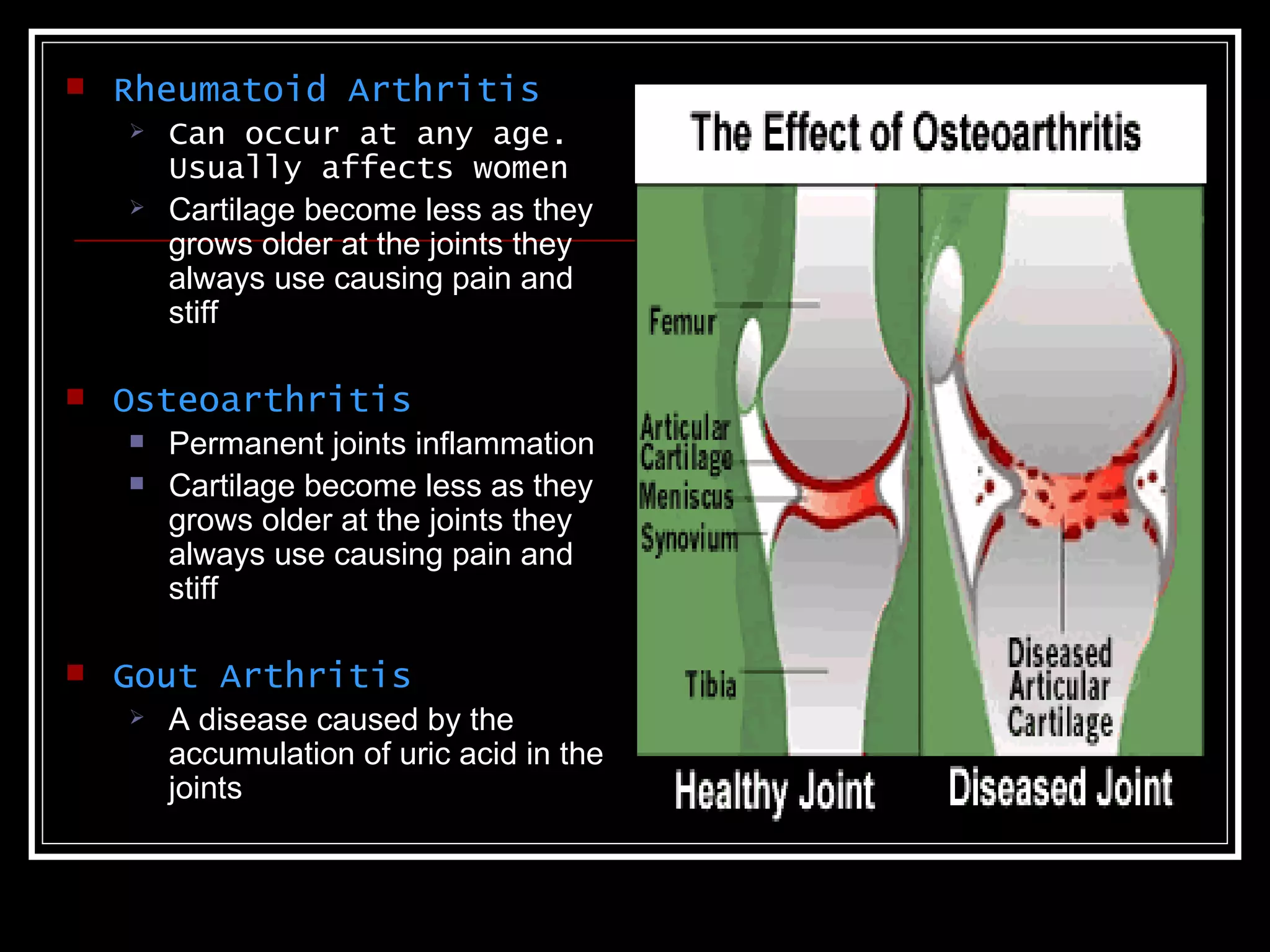
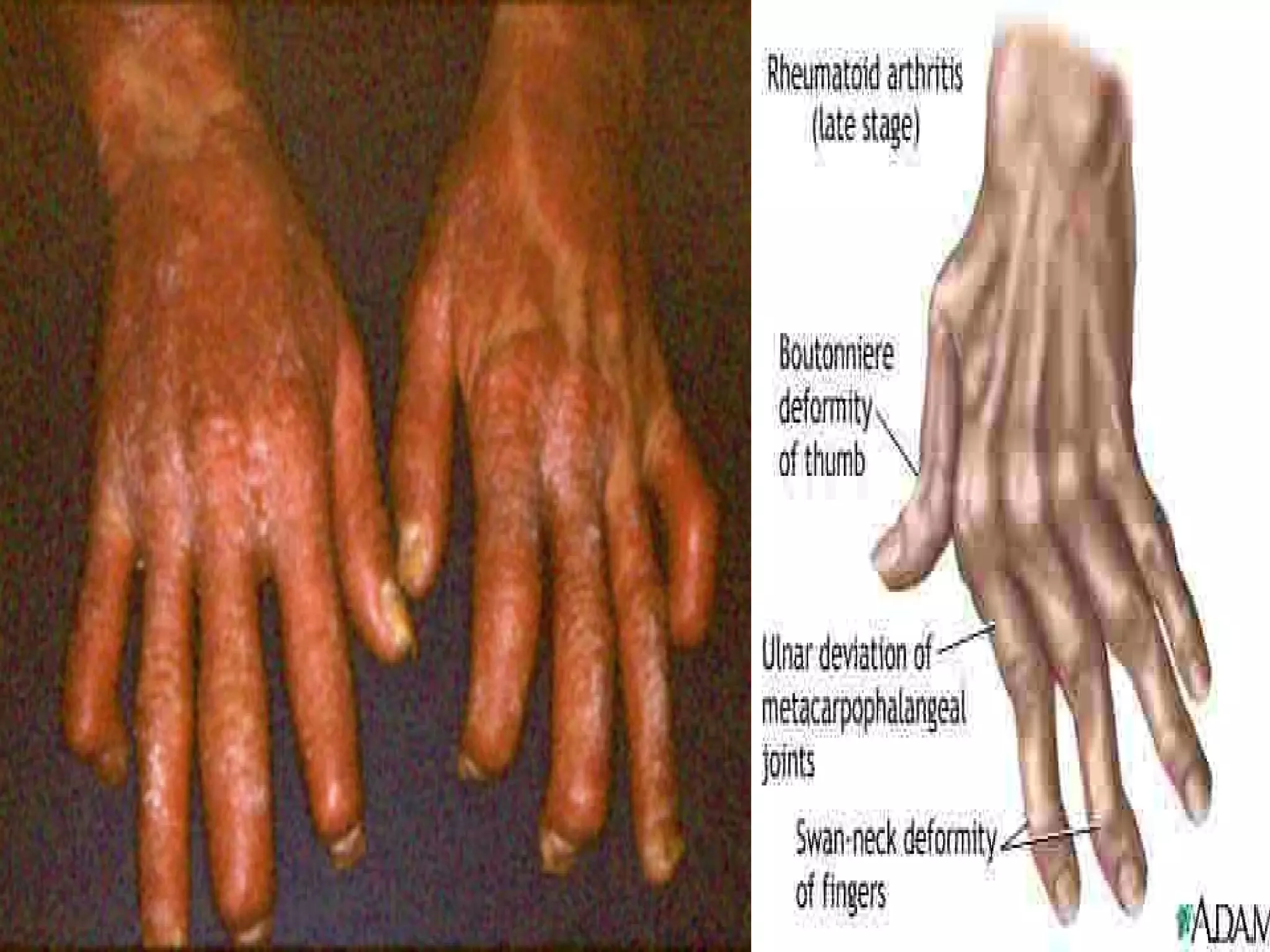
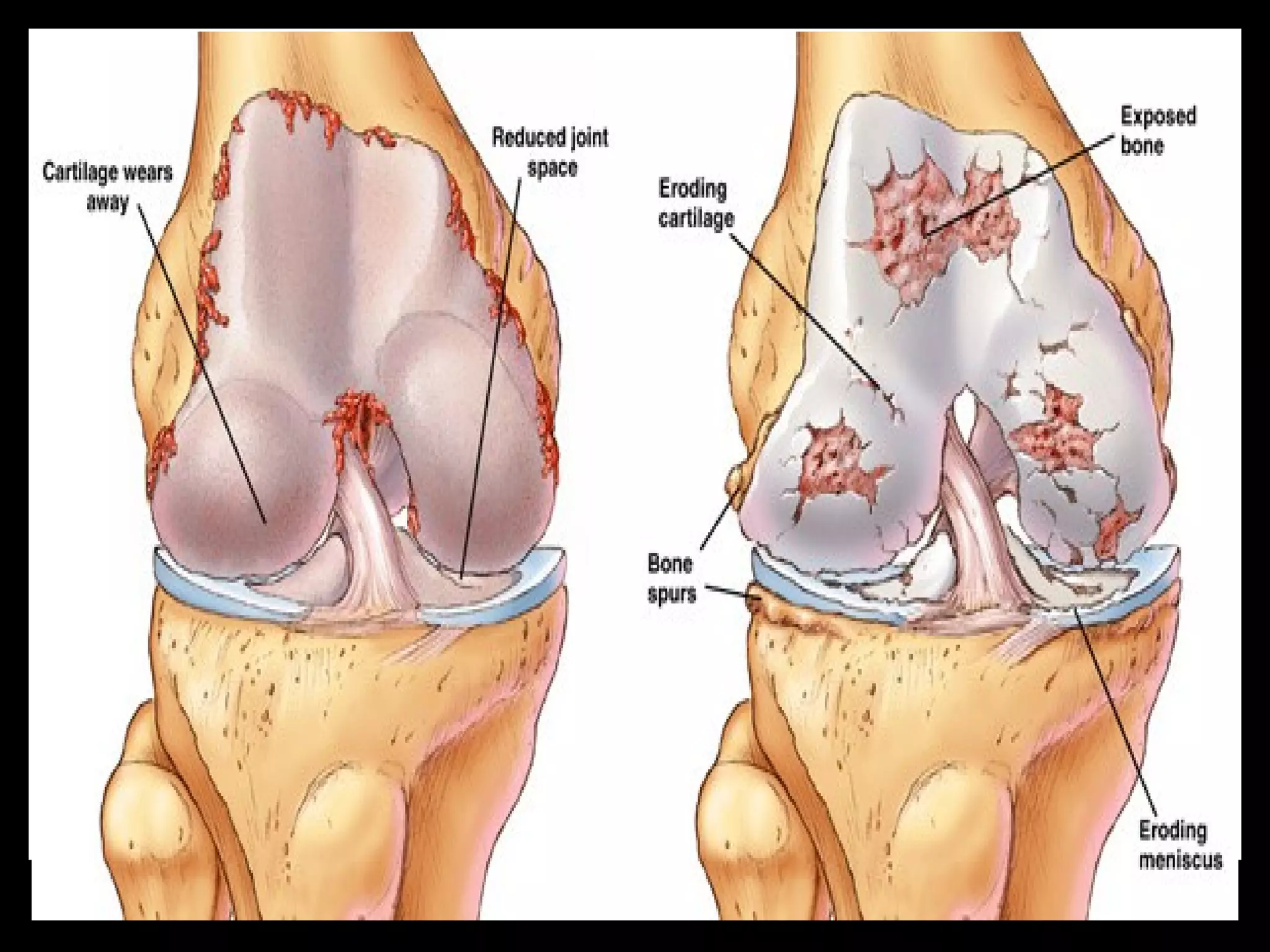
The document discusses several consequences of an impaired musculoskeletal system, including muscle cramps, muscular dystrophy, osteoporosis, arthritis, and impaired mobility. Muscle cramps can last over 15 minutes and affect the hamstrings and calves. Muscular dystrophy is a genetic disorder that causes progressive muscle weakening and loss of strength. Osteoporosis causes bones to become hollow and brittle, increasing risk of fractures. Arthritis causes joint inflammation and cartilage breakdown, resulting in pain and stiffness. An impaired musculoskeletal system can limit one's ability to perform daily activities and move independently.
![Sub 2[1].2 FORM5](https://image.slidesharecdn.com/sub21-2healthymusculoskeletalsystem-120602235534-phpapp02/75/Sub-2-1-2-FORM5-20-2048.jpg)
![Sub 2[1].2 FORM5](https://image.slidesharecdn.com/sub21-2healthymusculoskeletalsystem-120602235534-phpapp02/75/Sub-2-1-2-FORM5-21-2048.jpg)
![Sub 2[1].2 FORM5](https://image.slidesharecdn.com/sub21-2healthymusculoskeletalsystem-120602235534-phpapp02/75/Sub-2-1-2-FORM5-22-2048.jpg)


![6[1].3 form 5](https://cdn.slidesharecdn.com/ss_thumbnails/61-3-respectfultowardsanother-120603003718-phpapp02-thumbnail.jpg?width=640&height=640&fit=bounds)
![4[1].7 FORM 5](https://cdn.slidesharecdn.com/ss_thumbnails/41-7-thegrowthcurve-120603002724-phpapp02-thumbnail.jpg?width=640&height=640&fit=bounds)
![Sub 1[2].2 form 5 a](https://cdn.slidesharecdn.com/ss_thumbnails/sub12-2-circulatorysystem2009a-120602213429-phpapp01-thumbnail.jpg?width=640&height=640&fit=bounds)
![Subtopic 3 1[1] FORM 5](https://cdn.slidesharecdn.com/ss_thumbnails/subtopic3-11-120603001001-phpapp01-thumbnail.jpg?width=640&height=640&fit=bounds)
![6[1].2 form 5](https://cdn.slidesharecdn.com/ss_thumbnails/61-2-causesofvariation-120603003705-phpapp02-thumbnail.jpg?width=640&height=640&fit=bounds)
![4[1].4 FORM 5](https://cdn.slidesharecdn.com/ss_thumbnails/41-4-thecontributionofst-120603003308-phpapp01-thumbnail.jpg?width=640&height=640&fit=bounds)
![Subtopic 3[1].2 FORM 5](https://cdn.slidesharecdn.com/ss_thumbnails/subtopic31-2-120603000911-phpapp01-thumbnail.jpg?width=640&height=640&fit=bounds)
![4[1].2 FORM 5](https://cdn.slidesharecdn.com/ss_thumbnails/41-2-menstrualcycle-120603003033-phpapp01-thumbnail.jpg?width=640&height=640&fit=bounds)
![Sub 1[1].7 form 5](https://cdn.slidesharecdn.com/ss_thumbnails/sub11-7-transportinplants-120602213515-phpapp02-thumbnail.jpg?width=640&height=640&fit=bounds)
![5[1].3 form 5](https://cdn.slidesharecdn.com/ss_thumbnails/51-3geneschromosomes-120603004012-phpapp02-thumbnail.jpg?width=640&height=640&fit=bounds)
![4[1].6 FORM 5](https://cdn.slidesharecdn.com/ss_thumbnails/41-6-growthinmulticellularorganisms-120603003459-phpapp02-thumbnail.jpg?width=640&height=640&fit=bounds)
![Sub 1[1].4 form 5 (part 1)](https://cdn.slidesharecdn.com/ss_thumbnails/sub11-4-lymphaticsystempart1-120602212753-phpapp02-thumbnail.jpg?width=640&height=640&fit=bounds)
![6[1].1 form 5](https://cdn.slidesharecdn.com/ss_thumbnails/61-1-variationinorganisms-120603005250-phpapp01-thumbnail.jpg?width=640&height=640&fit=bounds)
![3[1].3 FORM 5](https://cdn.slidesharecdn.com/ss_thumbnails/31-3-appreciate-120603000912-phpapp02-thumbnail.jpg?width=640&height=640&fit=bounds)
![Sub 2[1].3 FORM 5](https://cdn.slidesharecdn.com/ss_thumbnails/sub21-3supportinplants-120602235702-phpapp02-thumbnail.jpg?width=640&height=640&fit=bounds)
![4[1].3 FORM 5](https://cdn.slidesharecdn.com/ss_thumbnails/41-3earlydevelopmentofzygote-120603003204-phpapp02-thumbnail.jpg?width=640&height=640&fit=bounds)
![4[1].1 FORM 5](https://cdn.slidesharecdn.com/ss_thumbnails/41-1theformationofgametes-120603003019-phpapp01-thumbnail.jpg?width=640&height=640&fit=bounds)
![2[1].1 (c) FORM 5](https://cdn.slidesharecdn.com/ss_thumbnails/21-1c-themechanisimoflocomotioninanimals-120602235904-phpapp01-thumbnail.jpg?width=640&height=640&fit=bounds)
![2[1].1 (b) FORM 5](https://cdn.slidesharecdn.com/ss_thumbnails/21-1b-roleofmusclesligamentstendonsin-120602235830-phpapp02-thumbnail.jpg?width=640&height=640&fit=bounds)


![5[1].1 form 5](https://cdn.slidesharecdn.com/ss_thumbnails/51-1theconceptofinheritance-120603003907-phpapp02-thumbnail.jpg?width=640&height=640&fit=bounds)
![4[1].5 FORM 5](https://cdn.slidesharecdn.com/ss_thumbnails/41-5-floweringplant-120603003443-phpapp01-thumbnail.jpg?width=640&height=640&fit=bounds)
![2[1].1 (a) FORM 5](https://cdn.slidesharecdn.com/ss_thumbnails/21-1a-supportlocomotioninhumansanimals-120602235814-phpapp02-thumbnail.jpg?width=640&height=640&fit=bounds)
![Sub 1[1].6 form5](https://cdn.slidesharecdn.com/ss_thumbnails/sub11-6cardio-120602213456-phpapp01-thumbnail.jpg?width=640&height=640&fit=bounds)
![Sub 1[1].5 form 5](https://cdn.slidesharecdn.com/ss_thumbnails/sub11-5bodydefencemechanism-120602213445-phpapp01-thumbnail.jpg?width=640&height=640&fit=bounds)
![Sub 1[1].8 form 5](https://cdn.slidesharecdn.com/ss_thumbnails/sub11-8-transportoforganiccompound-120602213146-phpapp02-thumbnail.jpg?width=640&height=640&fit=bounds)
![Sub 1[1].3 form 5](https://cdn.slidesharecdn.com/ss_thumbnails/sub11-3-bloodclotmechanism-120602212724-phpapp01-thumbnail.jpg?width=640&height=640&fit=bounds)
![Sub 1[1].2 form 5](https://cdn.slidesharecdn.com/ss_thumbnails/sub11-2-circulatorysystem2009c-120602212659-phpapp01-thumbnail.jpg?width=640&height=640&fit=bounds)
![Sub 1[1].2 form 5](https://cdn.slidesharecdn.com/ss_thumbnails/sub11-2-circulatorysystem2009b-120602212604-phpapp02-thumbnail.jpg?width=640&height=640&fit=bounds)
![Sub 1[1].1 form 5](https://cdn.slidesharecdn.com/ss_thumbnails/sub11-1-theimportanceof-120602212548-phpapp01-thumbnail.jpg?width=640&height=640&fit=bounds)


