BHANU KALRA
FLOWERING PLANTS
*
1
*
Flower- Amodified
shoot-
2
Reproductive
structure of
angiosperms
*
*FLORICULTURE : the cultivation of
flowering plants.
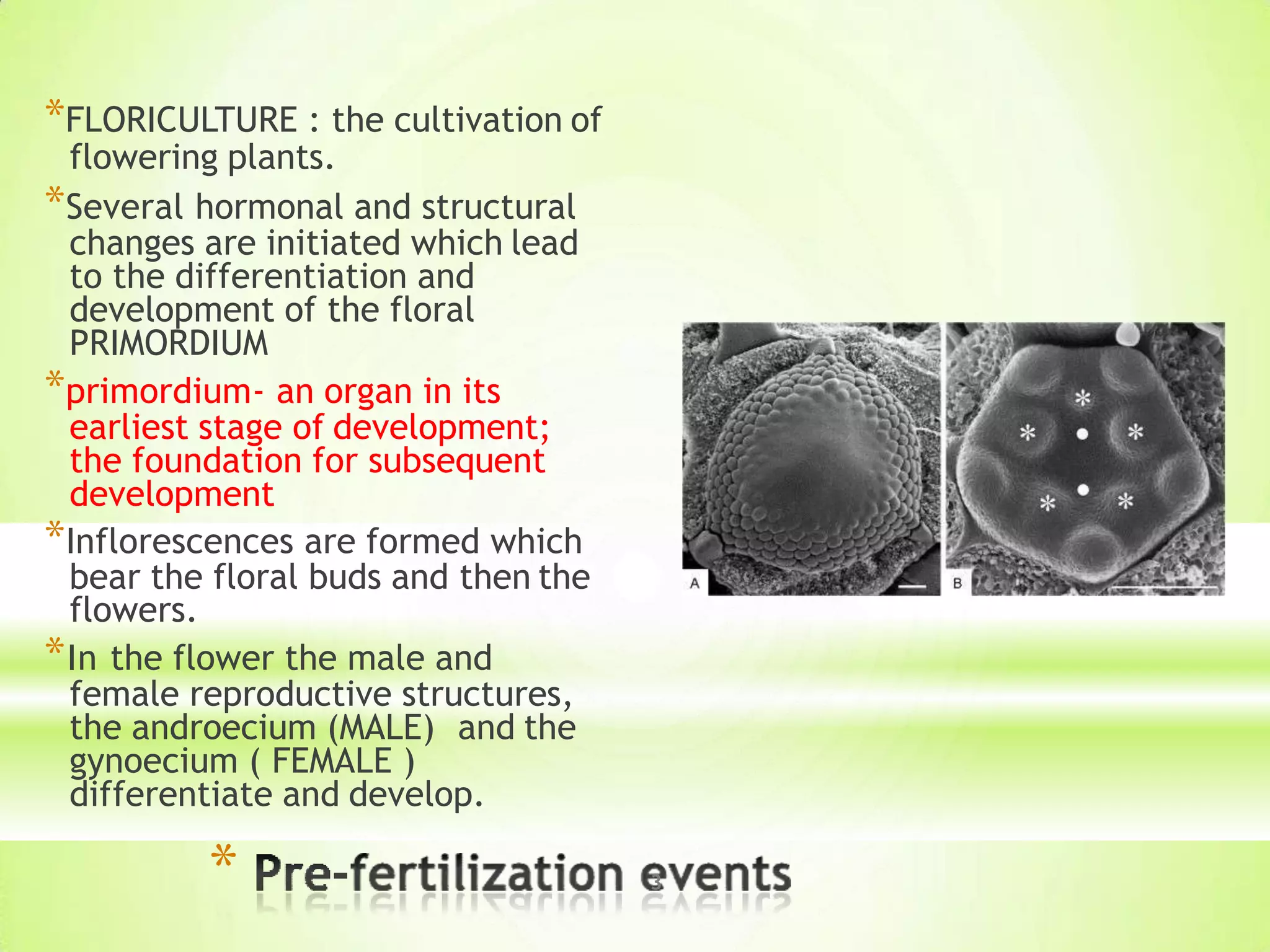
*Several hormonal and structural
changes are initiated which lead
to the differentiation and
development of the floral
PRIMORDIUM
*primordium- an organ in its
earliest stage of development;
the foundation for subsequent
development
*Inflorescences are formed which
bear the floral buds and then the
flowers.
*In the flower the male and
female reproductive structures,
the androecium (MALE) and the
gynoecium ( FEMALE )
differentiate and develop.
3
*
A typical stamen-
• the long and slender stalk
called the filament
• the terminal bilobed structure
called the anther.
• Monothecous
Hibiscus, Dithecous brinjal
The proximal end of the filament
is attached to the thalamus or the
petal of the flower. Check
terminology.
The number and length of
stamens vary.
4
*
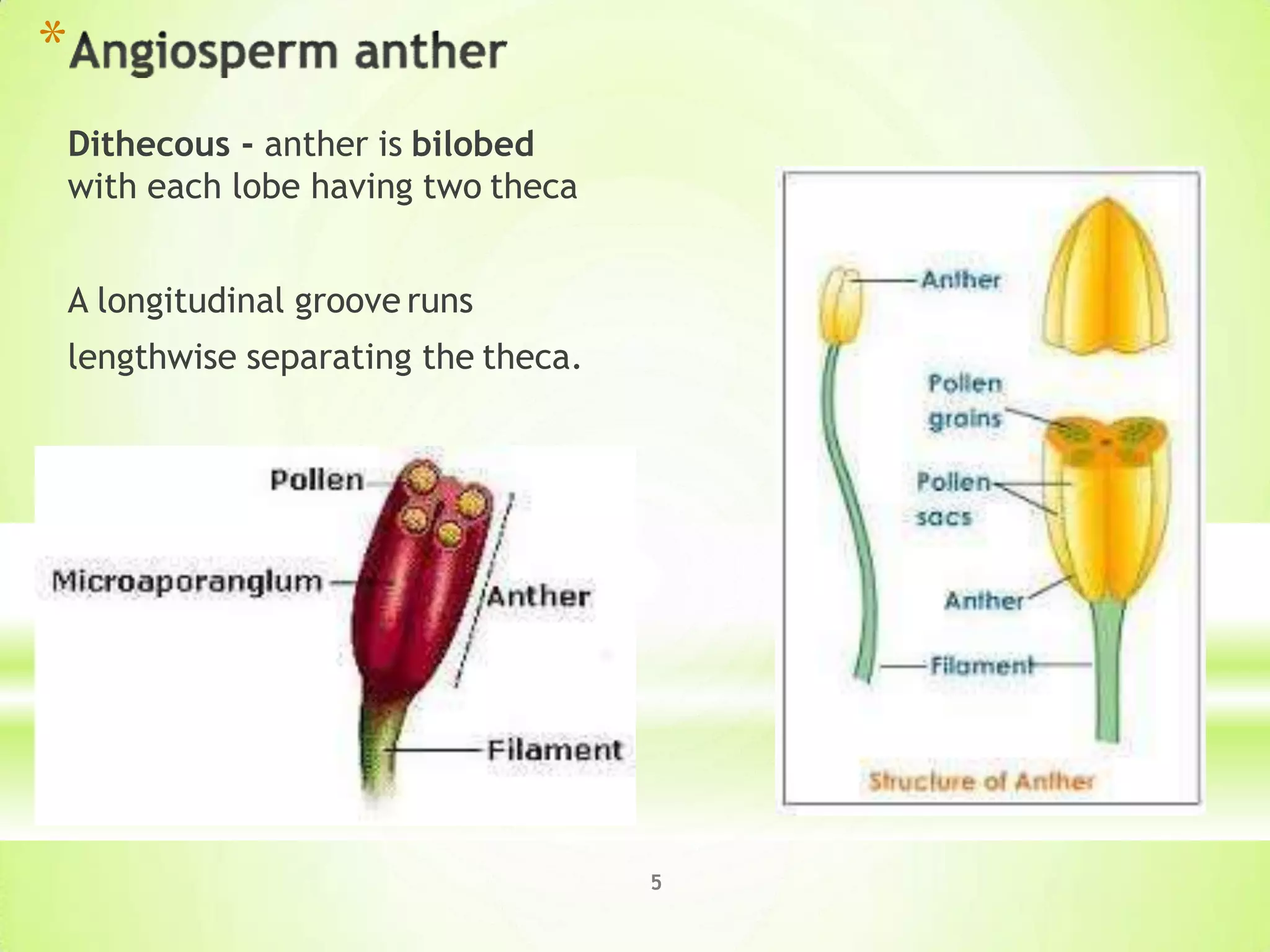
Dithecous - anther is bilobed
with each lobe having two theca
A longitudinal groove runs
lengthwise separating the theca.
5
* 6
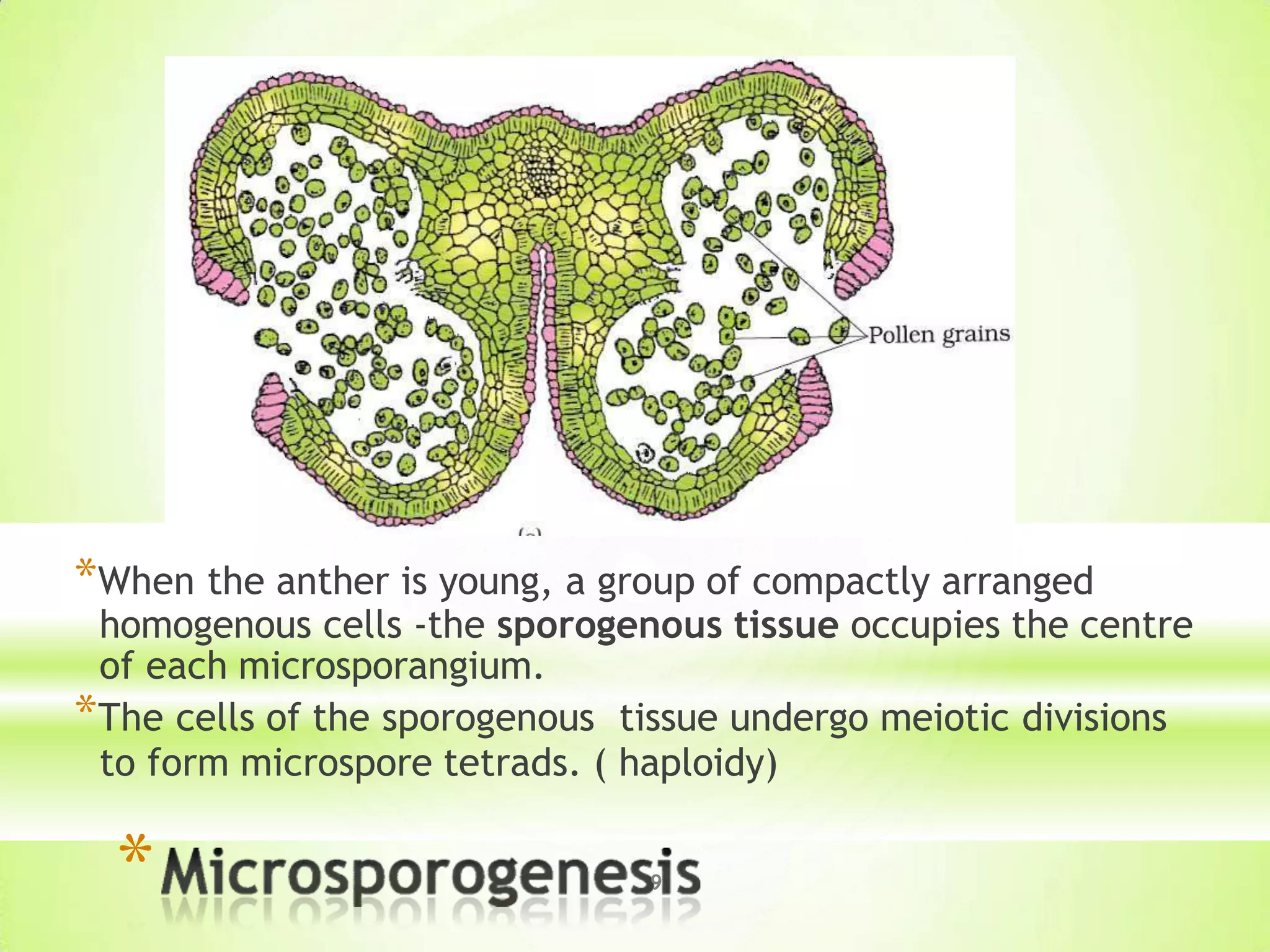
T.S. OF ANANTHER
7
*
*Dithecous - bilobed nature
*The anther is a four-sided (tetragonal) structure - four
microsporangia located at the corners, two in each lobe.
*The microsporangia develop- pollen sacs. They extend
longitudinally ,are packed with pollen grains.
*Structure of microsporangium: In T.S. a typical microsporangium
appears circular in outline. It is generally surrounded by four wall
layers -- the epidermis, endothecium, middle layers and the
tapetum.
*The outer three wall layers perform the function of protection
and help in dehiscence of anther to release the pollen.
* The innermost wall layer is the tapetum. It nourishes the
developing pollen grains. Cells of the tapetum possess dense
cytoplasm and generally have more than one nucleus. Nucleus
divides – without cytoplasmic division- polyploidy
8
*
*When the anther is young, a group of compactly arranged
homogenous cells -the sporogenous tissue occupies the centre
of each microsporangium.
*The cells of the sporogenous tissue undergo meiotic divisions
to form microspore tetrads. ( haploidy)
9
*
Potential
pollen /
Potential
microspore
mother cell
Micro-
spore
Tetrad
Pollen
grains
10
Cells
of
sporangeous
tissue
Four cells
Haploid
Tetrad cells
separates
Meiosis
Micro-
sporogenesis
Anthers
mature,
Stay together
Dehydration
Dissociate
*
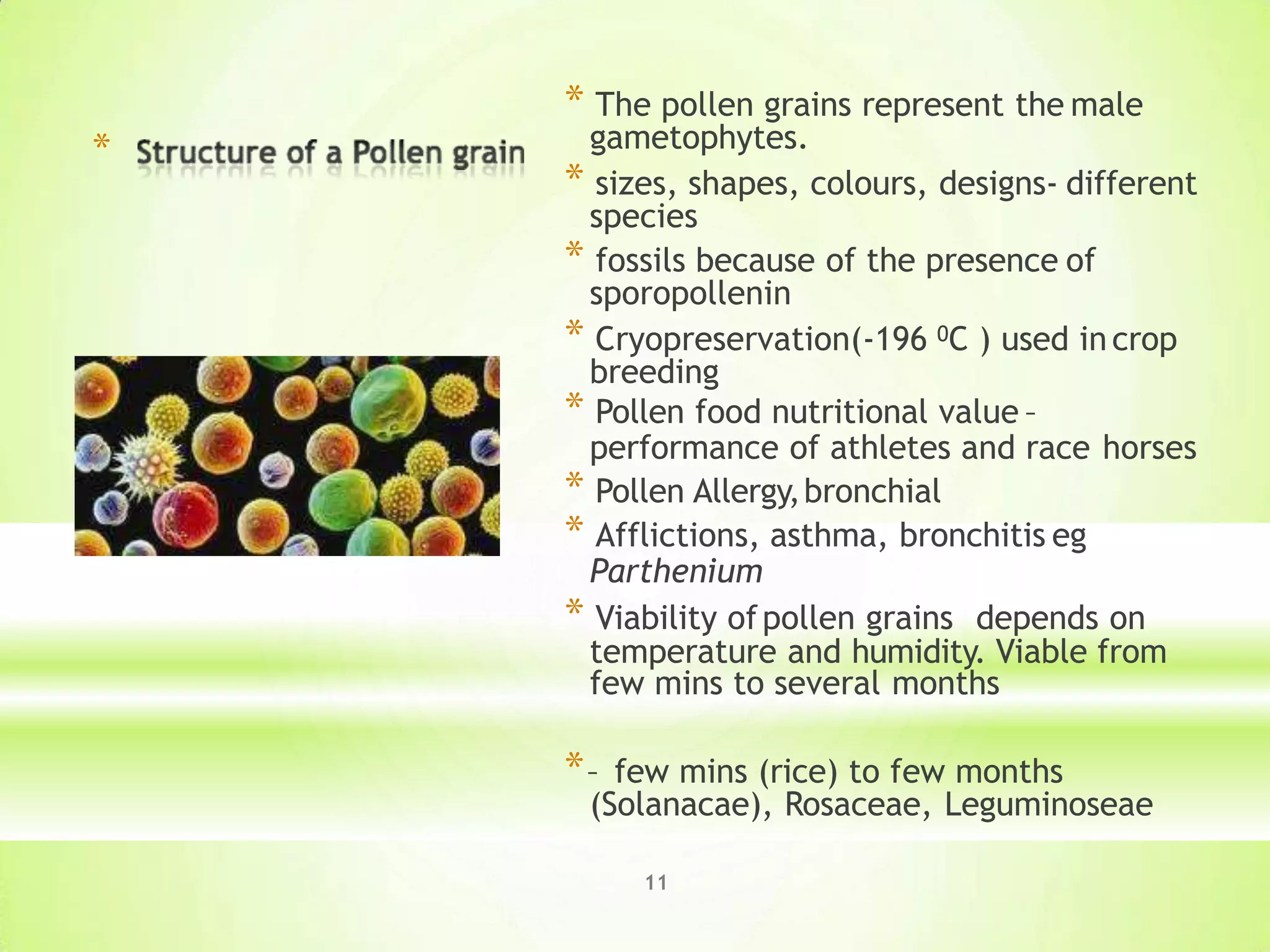
* The pollen grains represent the male
gametophytes.
* sizes, shapes, colours, designs- different
species
* fossils because of the presence of
sporopollenin
* Cryopreservation(-196 0C ) used in crop
breeding
* Pollen food nutritional value –
performance of athletes and race horses
* Pollen Allergy,bronchial
* Afflictions, asthma, bronchitis eg
Parthenium
* Viability ofpollen grains depends on
temperature and humidity. Viable from
few mins to several months
11
*– few mins (rice) to few months
(Solanacae), Rosaceae, Leguminoseae
*Pollen grain wall- exine and intine
*Exine – thick hard ornamental, made up of sporopollenin
( most resistant organic material high temperature, acid, alkalies)
*Germ pore- circular aperture in exine- spropollenin absent.
Pollen tube emerges from germ pore
*The inner wall of the pollen grain intine- a thin and continuous
layer made up of cellulose and p1e2ctin.
13
The cytoplasm of pollen grain is surrounded by a plasma membrane.A
mature pollen grain – ( inside intine and exine )
During development from microspore mitosis – 2 cells
• vegetative cell / tube cell --bigger, has abundant -food reserve and a
large irregularly shaped nucleus.
• generative Cell -- small , spindle shaped with dense cytoplasm & a
nucleus. It floats in the cytoplasm of the vegetative cell.
60 % angiosperms, pollen grains are shed at 2-celled stage.
In others generative cell divides mitotically - the two male gametes
before pollen grains are shed (3-celled stage).
14
15*
*Pistil/gynoecium innermost whorl
*Carpel – stigma , style , Ovary
*Ovary many ovule ( megasporangia) attached to a tissue
inside ovary – placenta – ovarian cavity ( locules) –
*Placentation – recap
*number of ovules in an ovary may be one (wheat,
*paddy, mango) to many (papaya, water melon, orchids).
*Monocarpellary / multicarpellary
*Syncarpous ( pistils fused together) , aopcarpous ( free)
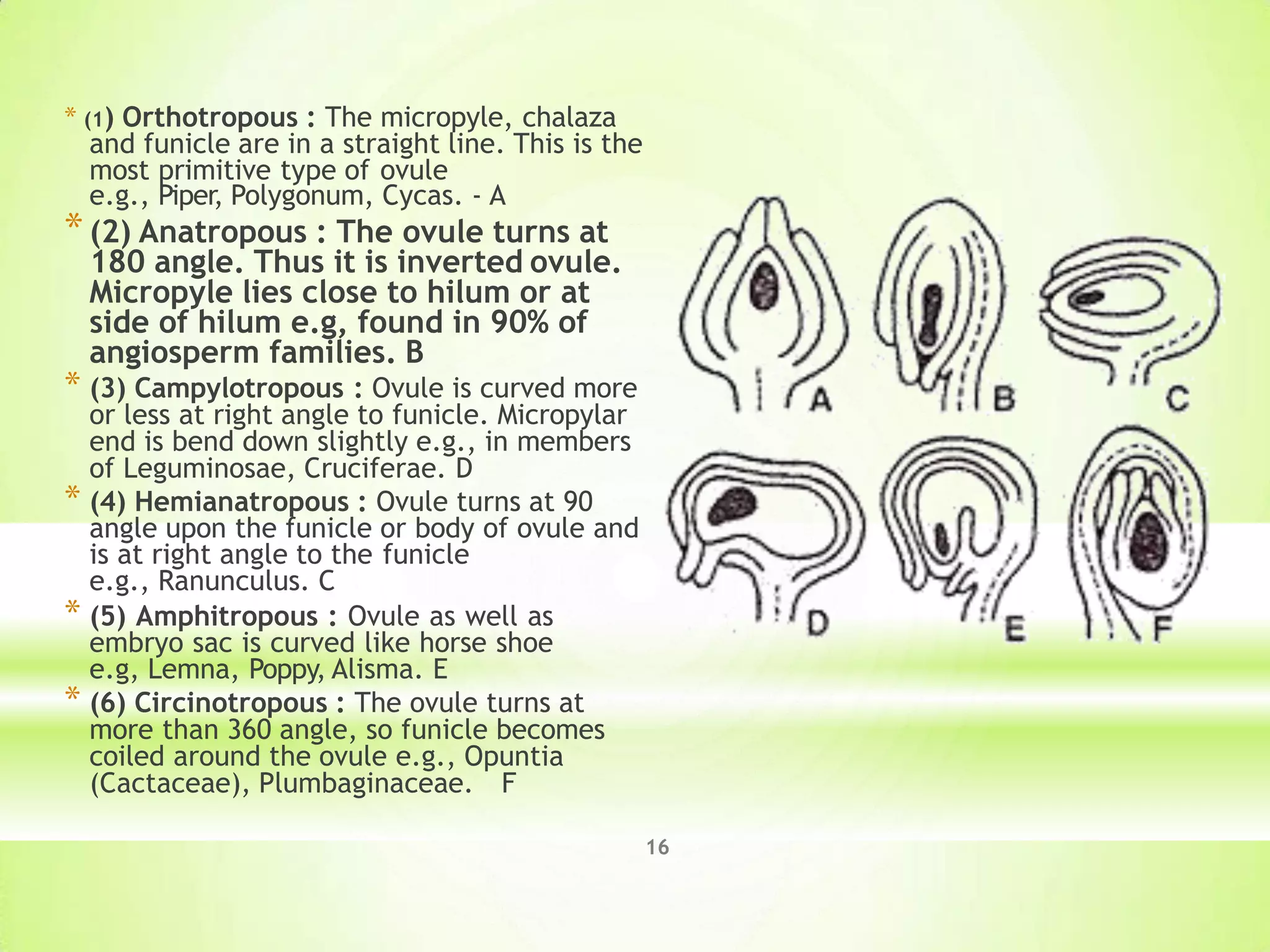
* (1) Orthotropous : The micropyle, chalaza
and funicle are in a straight line. This is the
most primitive type of ovule
e.g., Piper, Polygonum, Cycas. - A
*(2) Anatropous : The ovule turns at
180 angle. Thus it is inverted ovule.
Micropyle lies close to hilum or at
side of hilum e.g, found in 90% of
angiosperm families. B
* (3) Campylotropous : Ovule is curved more
or less at right angle to funicle. Micropylar
end is bend down slightly e.g., in members
of Leguminosae, Cruciferae. D
* (4) Hemianatropous : Ovule turns at 90
angle upon the funicle or body of ovule and
is at right angle to the funicle
e.g., Ranunculus. C
* (5) Amphitropous : Ovule as well as
embryo sac is curved like horse shoe
e.g, Lemna, Poppy, Alisma. E
* (6) Circinotropous : The ovule turns at
more than 360 angle, so funicle becomes
coiled around the ovule e.g., Opuntia
(Cactaceae), Plumbaginaceae. F
16
18
*
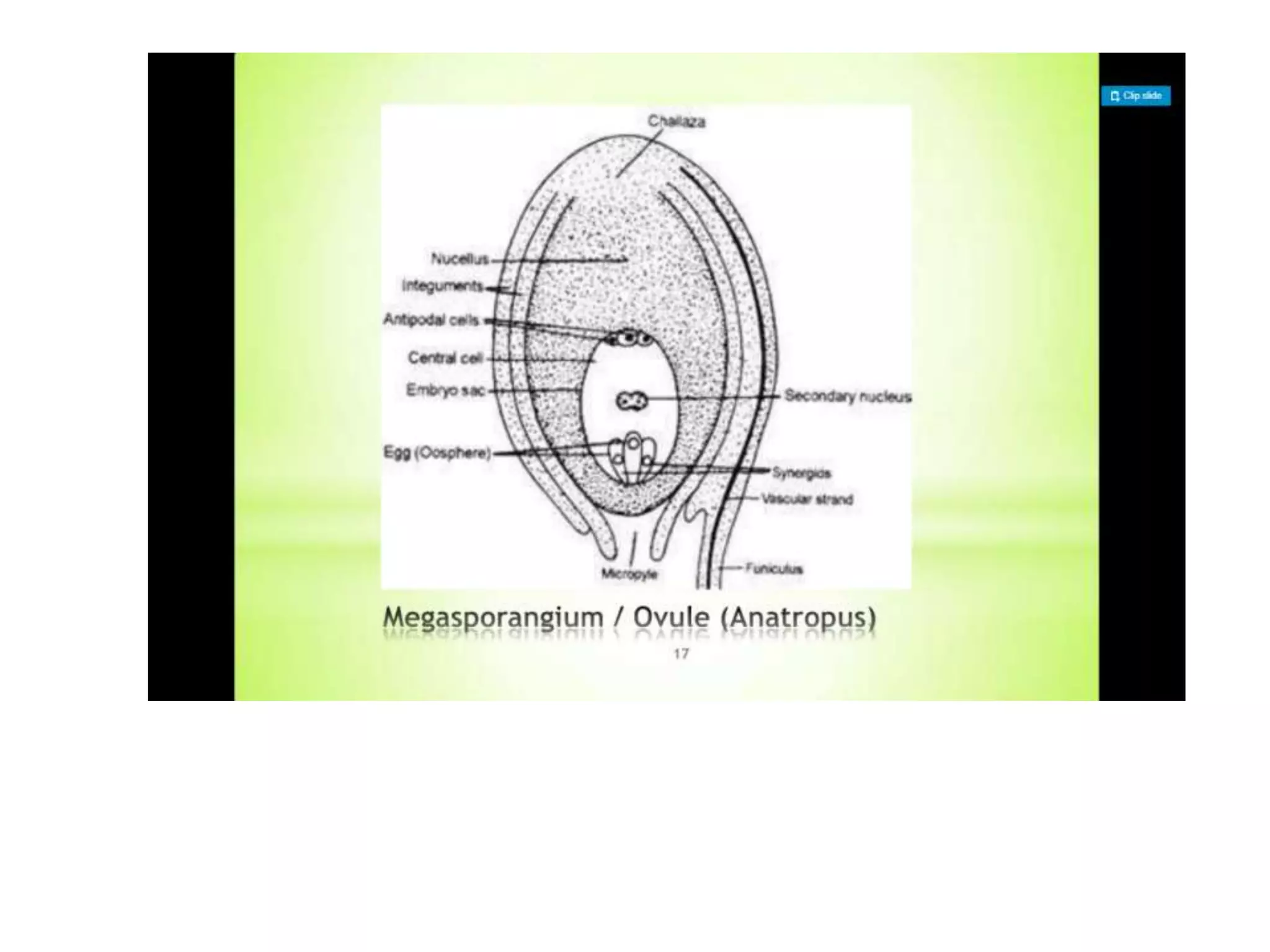
1. Funicle The ovule is attached to the placenta by means of a stalk called
funicle.
2. Hilum The body of the ovule fuses with funicle in the region called
hilum.(hilum - the junction between ovule and funicle)
3. Integuments Each ovule has one or two protective envelopes called
integuments.(inner and outer )
4. Micropyle The integuments leave small opening at one end called micropyle.-
this end is micropylar end.
5. Chalaza Opposite the micropylar end, is the chalaza, representing the basal
part of the ovule.
6. Nucellus Tissue encloses embryo sac
7. Embryo sac
(female
gametophyte)
An ovule generally has a single embryo sac formed from a megaspore
through reduction division.
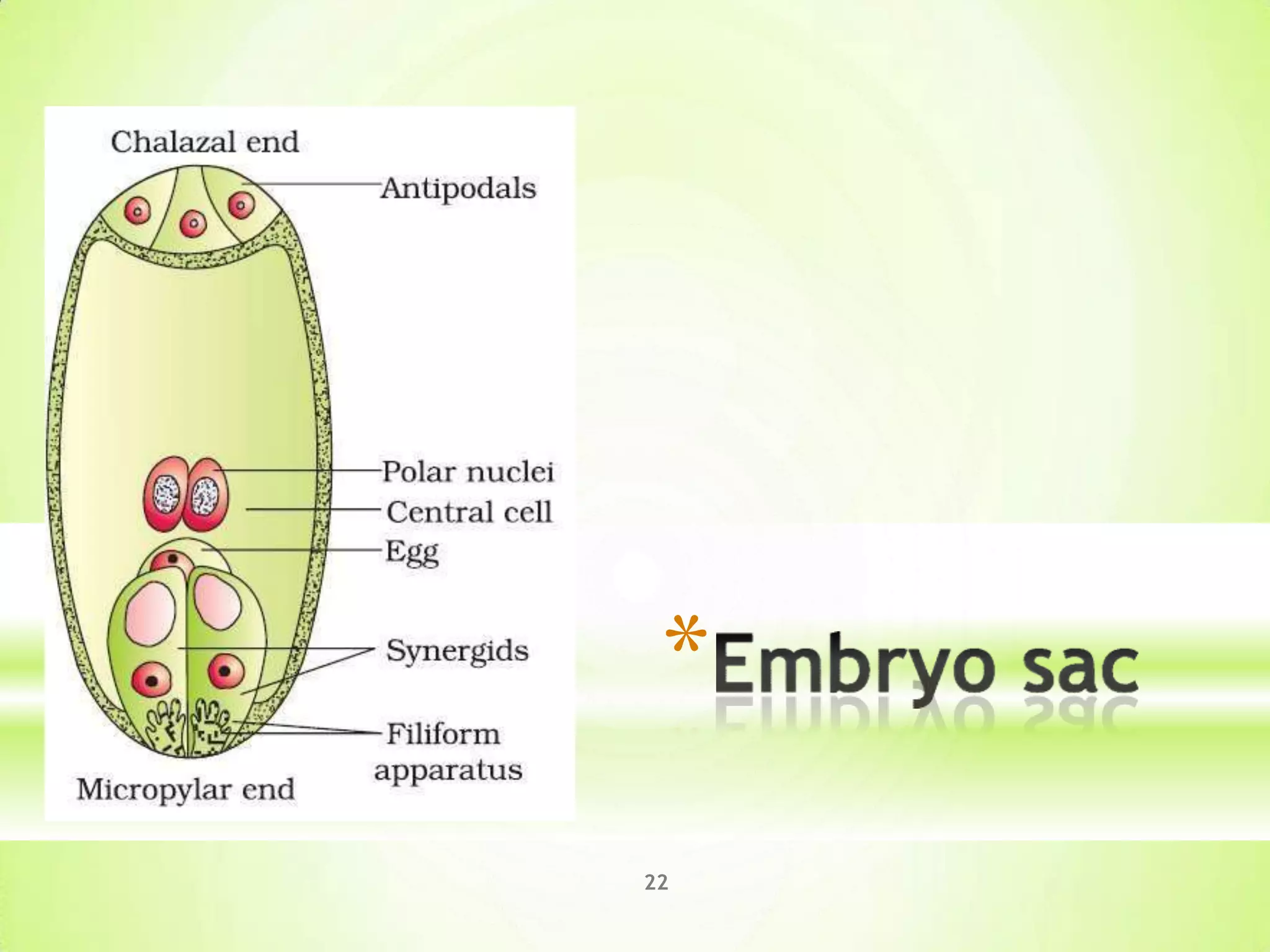
* Nucleate and 7 celled.
1. Egg apparatus- at micropylar end. It has 2 synergids and an egg.
2. Fili form apparatus- synegids – special thickening at micropylar
end. It guides the pollen tube.
3. Antipodals- 3 in number twds chalazal end.
4. Two Haploid nuclei at polar end below egg appataus
*
Megaspore
mother cells
MMC
Deploid
Megaspore
haploid
Monosporic
development
Functional
megasopre
to Embryo
sac
19
Cells in the
nucellus
near
micropylar
region.
Four cells
Haploid
3 near
micropyle
degenerrate
1 functional
megaspore
Meiosis
Mega-
sporogenesis
Functional megaspore enlarges,
mitotic division 2 nuclei – move
opposite poles – 2 mitoic
division- 4 nuclei at each pole
Wall formation only after this
stage
Chalaza end – 3 form antipodals
Micropylar end – 3 form egg
apparatus
Remaining 2 nucei Polar nuclei
in large central cell.
*
Megaspore
mother cells
MMC
Deploid
20
Functional
megasopre
to Embryo
sac
Functional megaspore enlarges, mitotic division 2
nuclei – move opposite poles – 2 mitoic division- 4
nuclei at each pole
Wall formation only after this stage
Chalaza end – 3 form antipodals
Micropylar end – 3 form egg apparatus
Remaining 221nucei Polar nuclei in large central cell.
*
22
Pollination
Transfer of pollen grains from anther to stigma( pistil)
Self pollination
Same flower/ different flower of same plant
Autogamy
Pollination in the same flower
Chasmogamy
Flowers open,
synchrony in pollen
release and stigma
Close arrangement
Cleistogamy
flowers which
do not open at all
Geitonogamy
Different flowers same plant.
Cross- pollination
Two flowers of different plants of same species
Xenogamy
Viola (common pansy), Oxalis, and Commelina
produce two types of flowers chasmogamous, cleistogamous
23
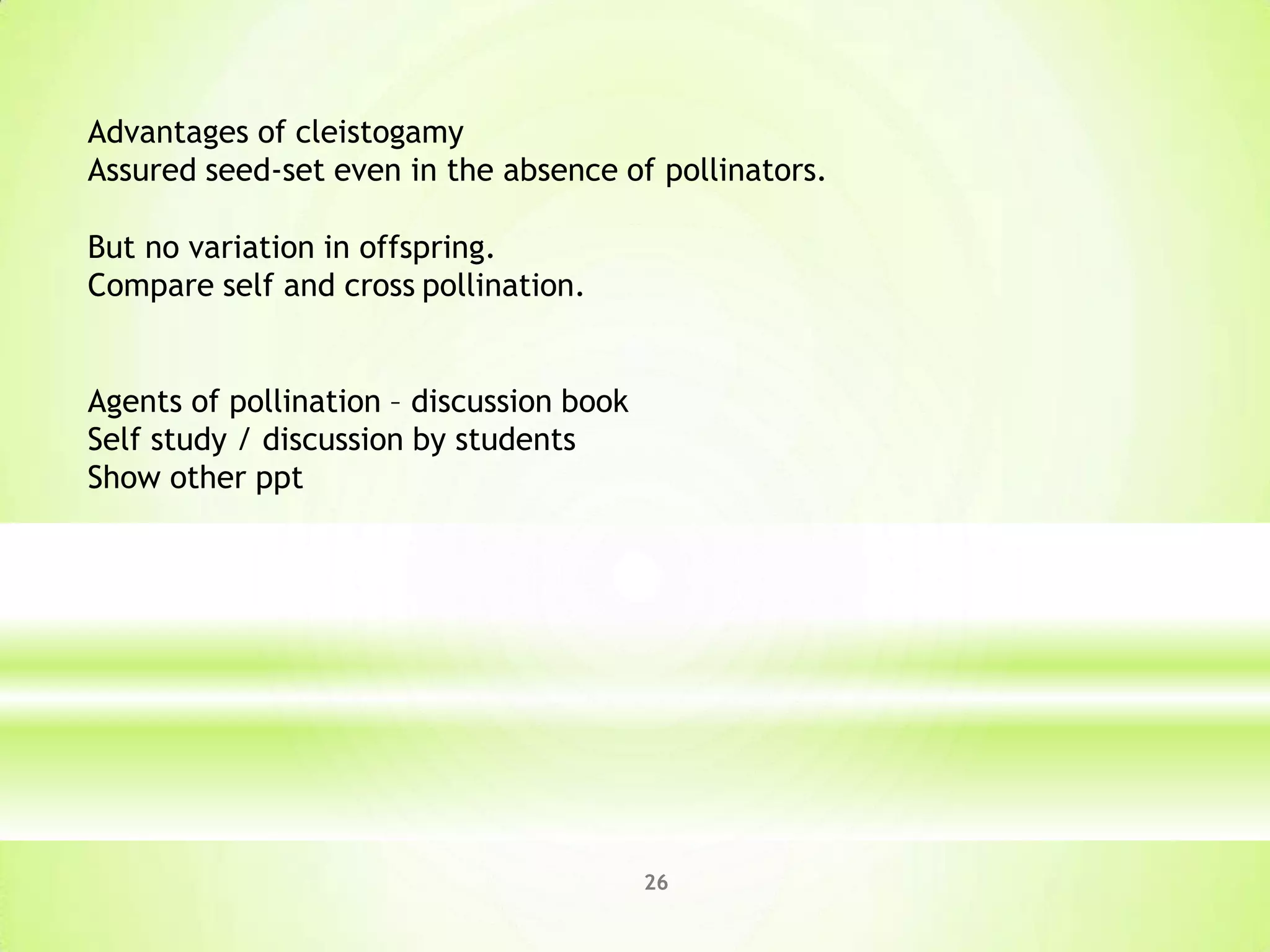
Advantages of cleistogamy
Assured seed-set even in the absence of pollinators.
But no variation in offspring.
Compare self and cross pollination.
Agents of pollination – discussion book
Self study / discussion by students
Show other ppt
26
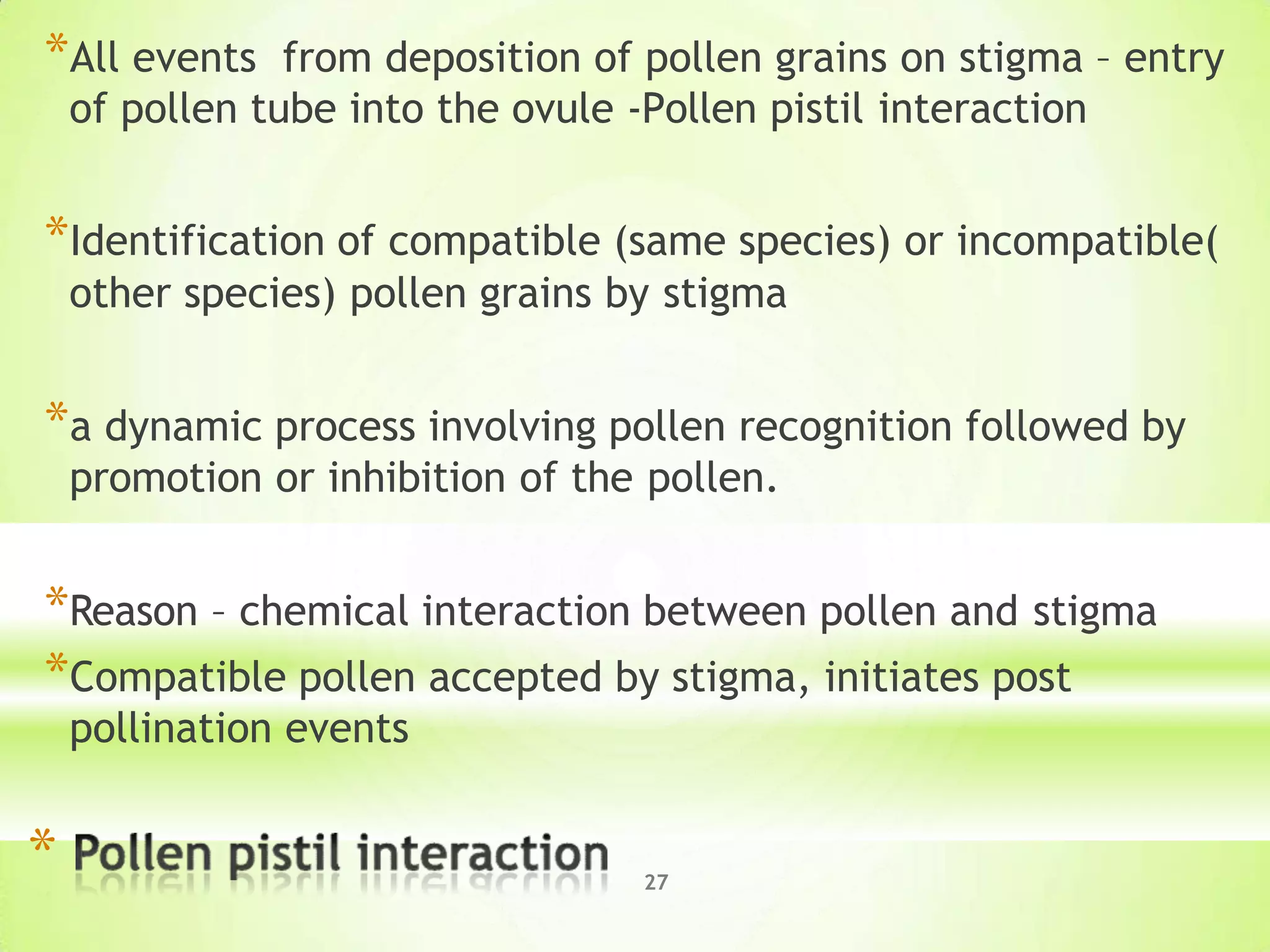
*All events from deposition of pollen grains on stigma – entry
of pollen tube into the ovule -Pollen pistil interaction
27
*Identification of compatible (same species) or incompatible(
other species) pollen grains by stigma
*a dynamic process involving pollen recognition followed by
promotion or inhibition of the pollen.
*Reason – chemical interaction between pollen and stigma
*Compatible pollen accepted by stigma, initiates post
pollination events
*
*
*Germination- formation of pollen tube through germ
pore- content move to pollen tube- through stigma, style
reaches ovary
*pollen grains - two-celled condition (a vegetative cell
and a generate cell)- the generative cell divides and
forms the two male gametes during the growth of pollen
tube in the stigma.
*three-celled condition, pollen tubes carry the two male
gametes from the beginning.
*Pollen tube, after reaching the ovary, enters the ovule
through the micropyle and then enters one of the
synergids through the filiform apparatus
*Interaction is important in plant breeding- for superior
plant development
28
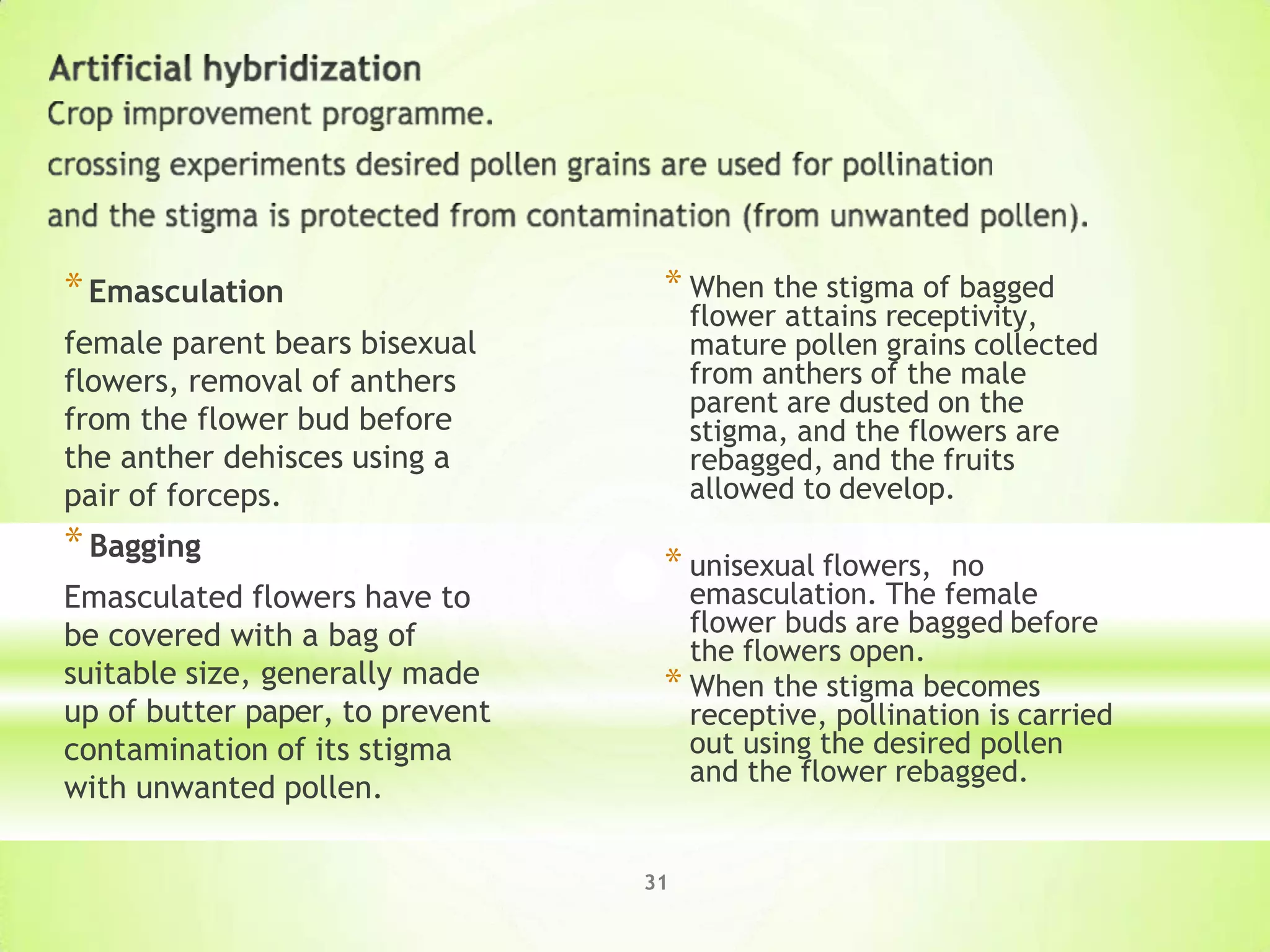
*Emasculation
female parent bears bisexual
flowers, removal of anthers
from the flower bud before
the anther dehisces using a
pair of forceps.
*Bagging
Emasculated flowers have to
be covered with a bag of
suitable size, generally made
up of butter paper, to prevent
contamination of its stigma
with unwanted pollen.
* When the stigma of bagged
flower attains receptivity,
mature pollen grains collected
from anthers of the male
parent are dusted on the
stigma, and the flowers are
rebagged, and the fruits
allowed to develop.
* unisexual flowers, no
emasculation. The female
flower buds are bagged before
the flowers open.
* When the stigma becomes
receptive, pollination is carried
out using the desired pollen
and the flower rebagged.
29
*Emasculation
female parent bears bisexual
flowers, removal of anthers
from the flower bud before
the anther dehisces using a
pair of forceps.
*Bagging
Emasculated flowers have to
be covered with a bag of
suitable size, generally made
up of butter paper, to prevent
contamination of its stigma
with unwanted pollen.
* When the stigma of bagged
flower attains receptivity,
mature pollen grains collected
from anthers of the male
parent are dusted on the
stigma, and the flowers are
rebagged, and the fruits
allowed to develop.
* unisexual flowers, no
emasculation. The female
flower buds are bagged before
the flowers open.
* When the stigma becomes
receptive, pollination is carried
out using the desired pollen
and the flower rebagged.
31
*
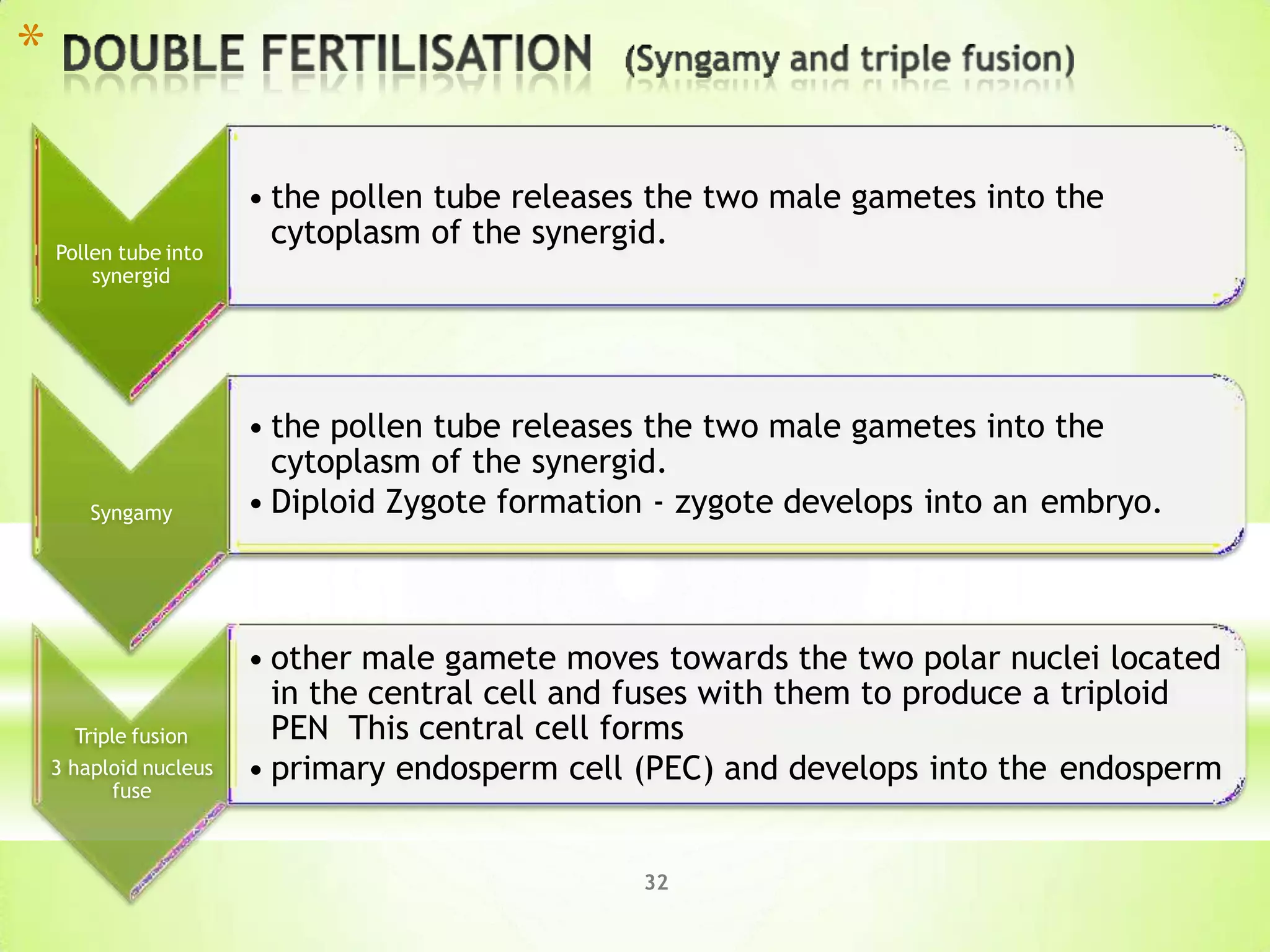
Pollen tube into
synergid
• the pollen tube releases the two male gametes into the
cytoplasm of the synergid.
Syngamy
• the pollen tube releases the two male gametes into the
cytoplasm of the synergid.
• Diploid Zygote formation - zygote develops into an embryo.
Triple fusion
3 haploid nucleus
fuse
• other male gamete moves towards the two polar nuclei located
in the central cell and fuses with them to produce a triploid
PEN This central cell forms
• primary endosperm cell (PEC) and develops into the endosperm
32
*
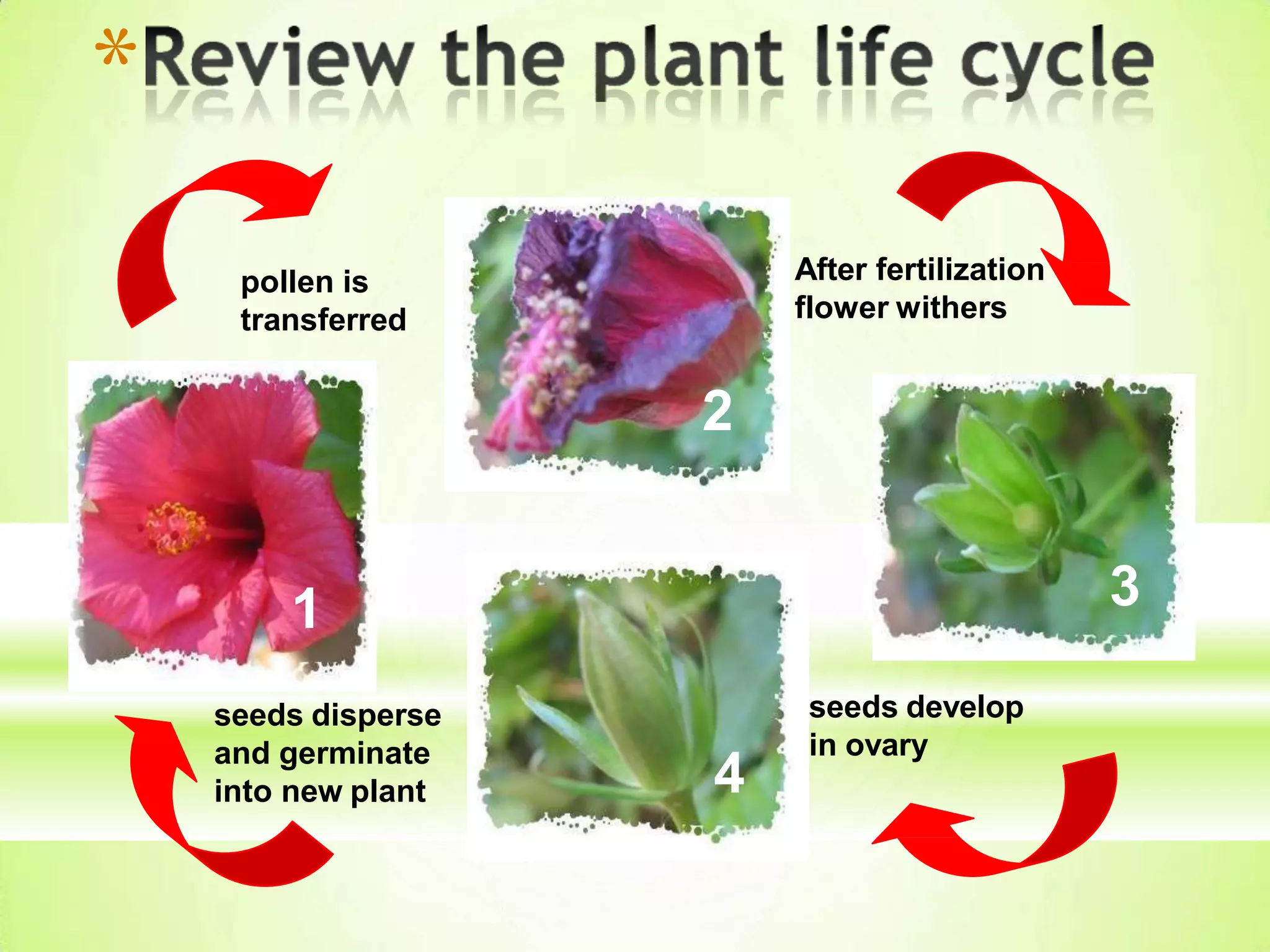
1
4
2
pollen is
transferred
3
After fertilization
flower withers
seeds disperse
and germinate
into new plant
seeds develop
in ovary
4
1 Male gamete fuses
with the 2 polar nuclei
to form the triploid
endosperm nucleus
1 male gamete
fuses with the egg
nucleus to form the
diploid zygote
Double fertilization recap
31
*
*After double fertilization events of endosperm and embryo
development, maturation of ovule(s) into seed(s) and ovary
into fruit, are collectively termed post-fertilisation events.
Endosperm development
Embryogeny
Seed formation
*Endosperm development : Primary Endosperm Cell (Triple
fusion) – Endosperm (3n)
*Endosperm – cells filled with reserved food material -main
source of nutrition for the embryo
*
•The endosperm nucleus
(3N) divides repeatedly
to form the endosperm
in endospermic seeds.
This endosperm acts as
a food store for the
developing seed
•e.g. maize
3N
endosperm
nucleus
2N Zygote
*
Nuclear
• PEN successive nuclear divisions free nuclei. free-
nuclear endosperm. Nuclei free, the cw formation
afterwards.
Cellular
• First and susequent divisions followed by cw
formation
Helobial
• In between above two
• Transvrse wall mucropylar and chalazal
chamber
Non persistant embryo in some seeds,& perisperm till germination
37
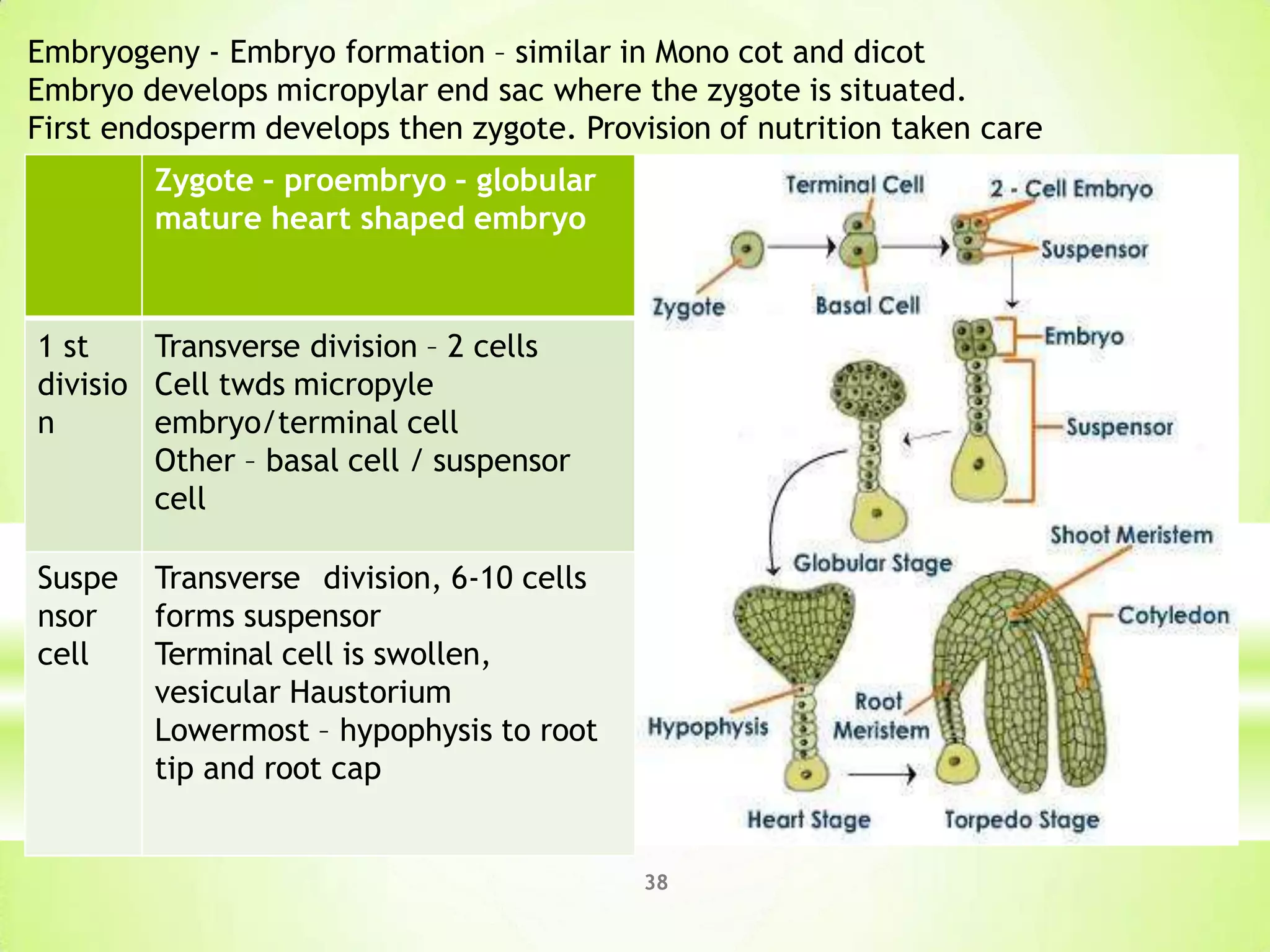
Embryogeny - Embryo formation – similar in Mono cot and dicot
Embryo develops micropylar end sac where the zygote is situated.
First endosperm develops then zygote. Provision of nutrition taken care
Zygote – proembryo – globular
mature heart shaped embryo
1 st Transverse division – 2 cells
divisio Cell twds micropyle
n embryo/terminal cell
Other – basal cell / suspensor
cell
Suspe
nsor
cell
Transverse division, 6-10 cells
forms suspensor
Terminal cell is swollen,
vesicular Haustorium
Lowermost – hypophysis to root
tip and root cap
38
Embryo cell
39
Vertical division at right angles to one another- 4 cells
then transverse division – 8 cells (octant)
Terminal four to plumule
Towds hypophysis to hypocotyle and radical
Proembryo Undifferntiated , globular
To heart shaped- then maturity
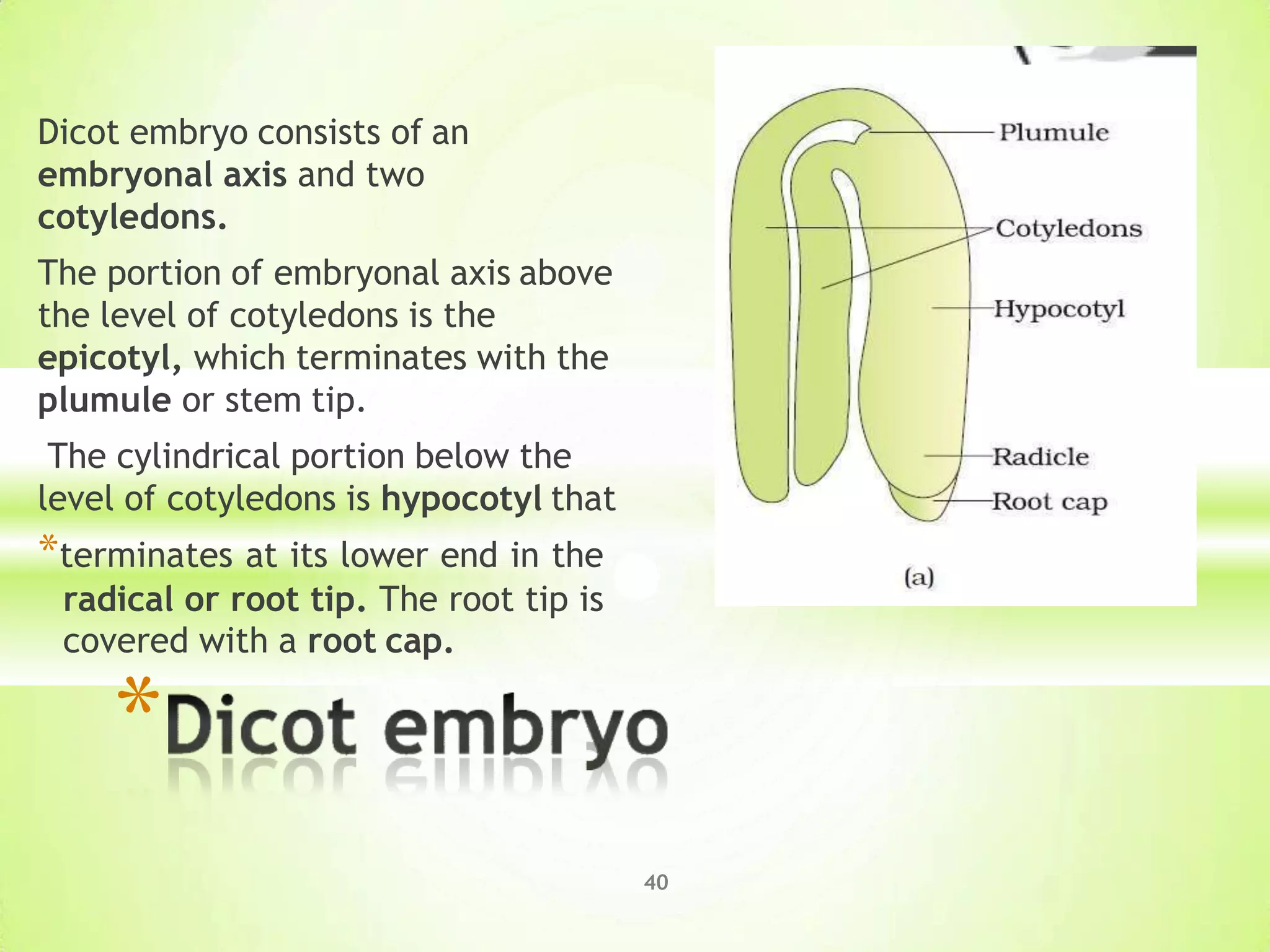
Dicot embryo consists of an
embryonal axis and two
cotyledons.
The portion of embryonal axis above
the level of cotyledons is the
epicotyl, which terminates with the
plumule or stem tip.
The cylindrical portion below the
level of cotyledons is hypocotyl that
*terminates at its lower end in the
radical or root tip. The root tip is
covered with a root cap.
*
40
*In the grass family the cotyledon is
called scutellum - situated towards
one side (lateral) of the embryonal
axis.
* At its lower end, the embryonal axis
has the radical and root cap enclosed
in an undifferentiated sheath called
coleorrhiza.
*The portion of the embryonal axis
above the level of attachment of
scutellum is the epicotyl. Epicotyl
has a shoot apex and a few leaf
primordia enclosed in a hollow foliar
structure, the coleoptile.
37*
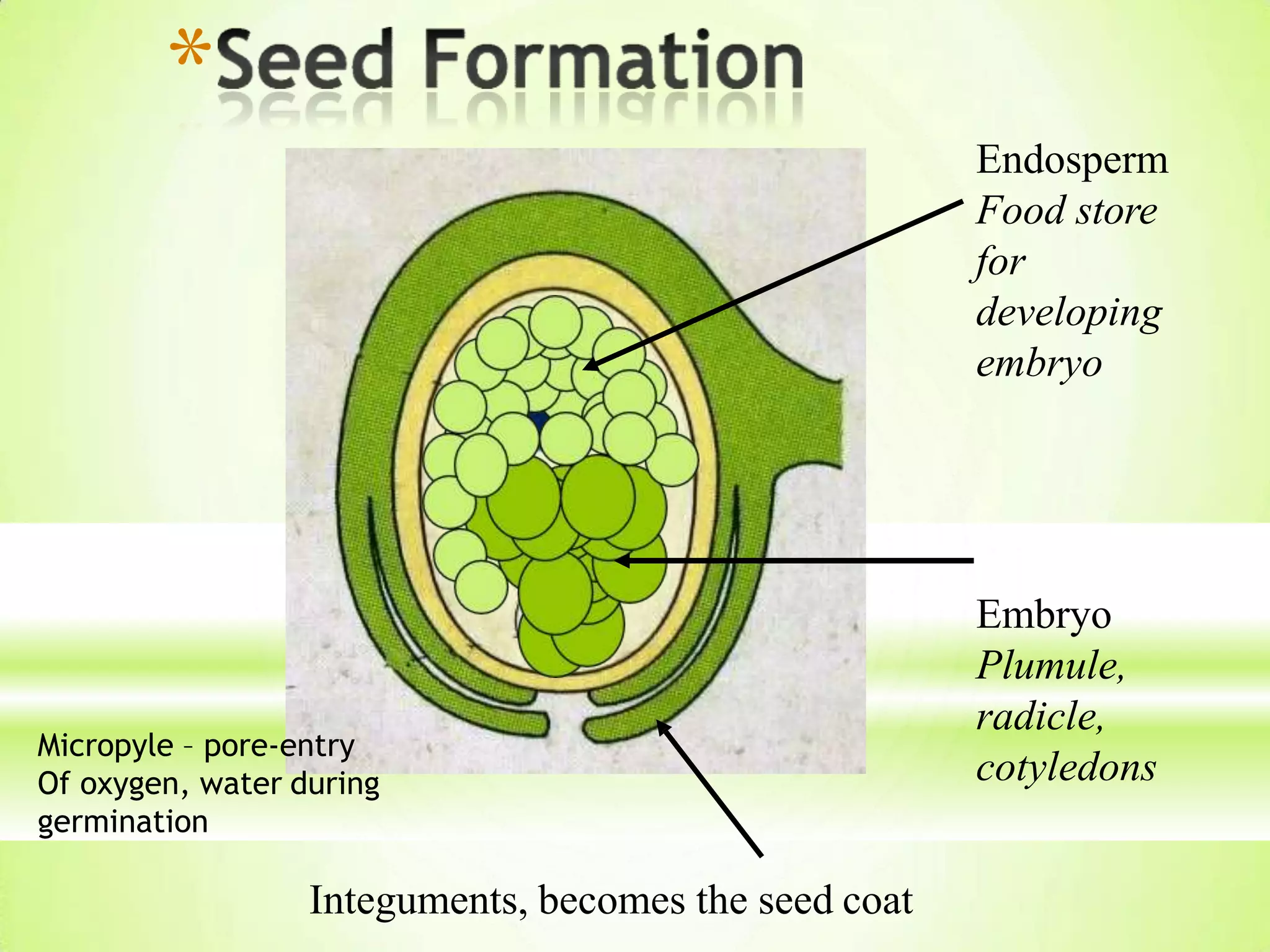
Endosperm
Food store
for
developing
embryo
Embryo
Plumule,
radicle,
cotyledons
Integuments, becomes the seed coat
*
Micropyle – pore-entry
Of oxygen, water during
germination
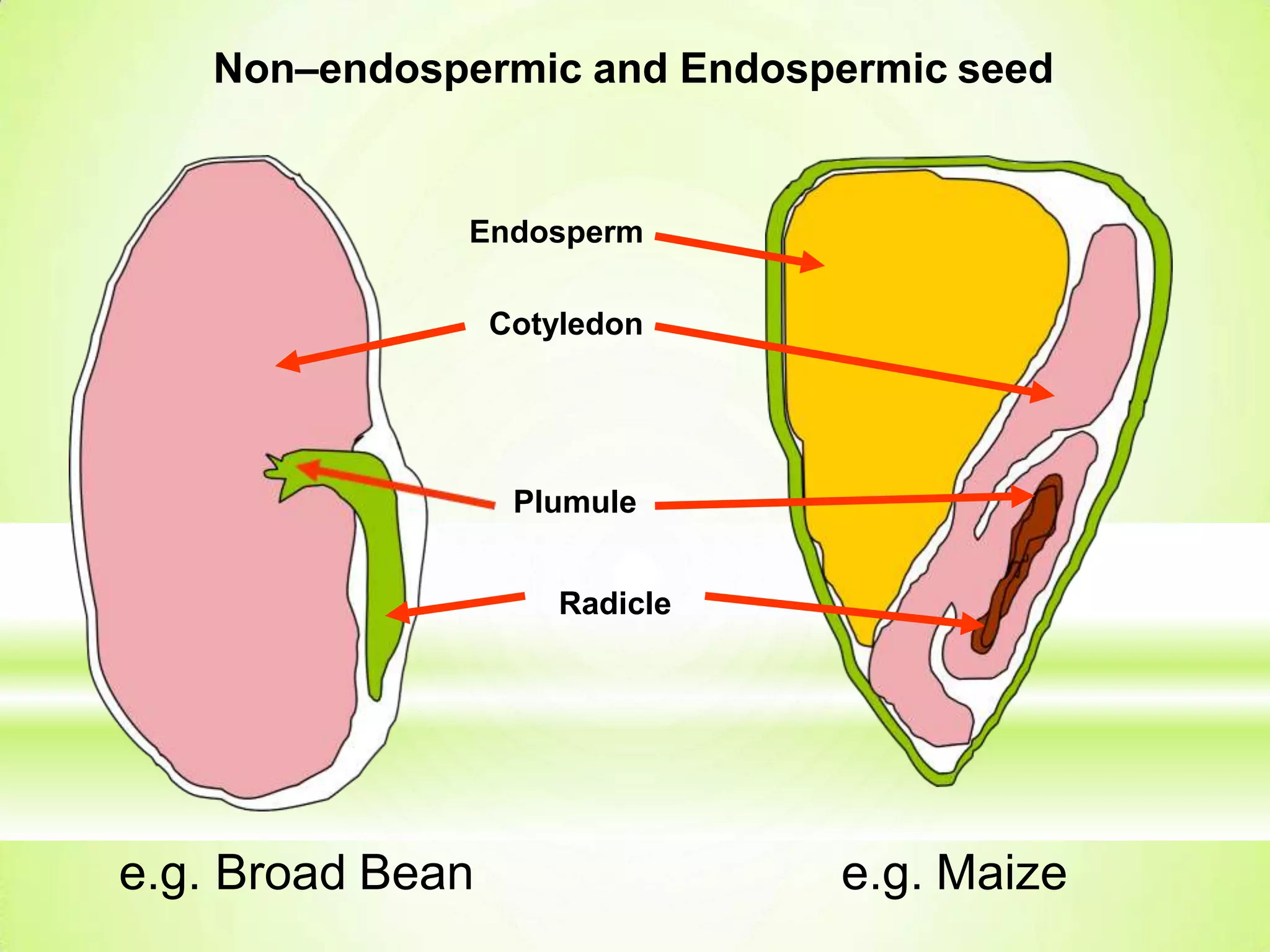
If all the
endosperm is
absorbed by
the developing
embryo the
seed is a non
endospermic
seed e.g. broad
bean, pea,
groundnut
*
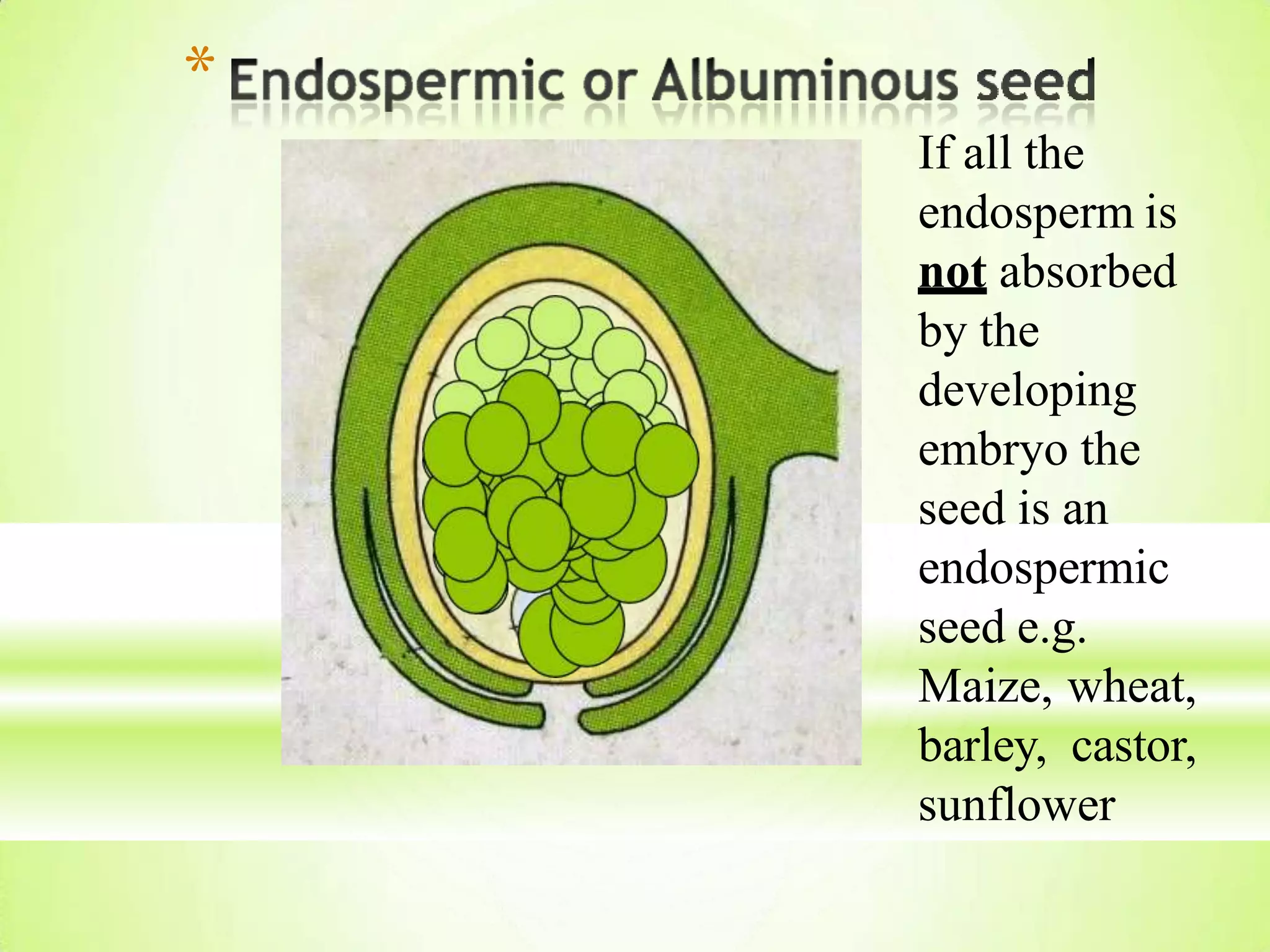
If all the
endosperm is
not absorbed
by the
developing
embryo the
seed is an
endospermic
seed e.g.
Maize, wheat,
barley, castor,
sunflower
*
e.g. Broad Bean e.g. Maize
Plumule
Radicle
Endosperm
Cotyledon
Non–endospermic and Endospermic seed
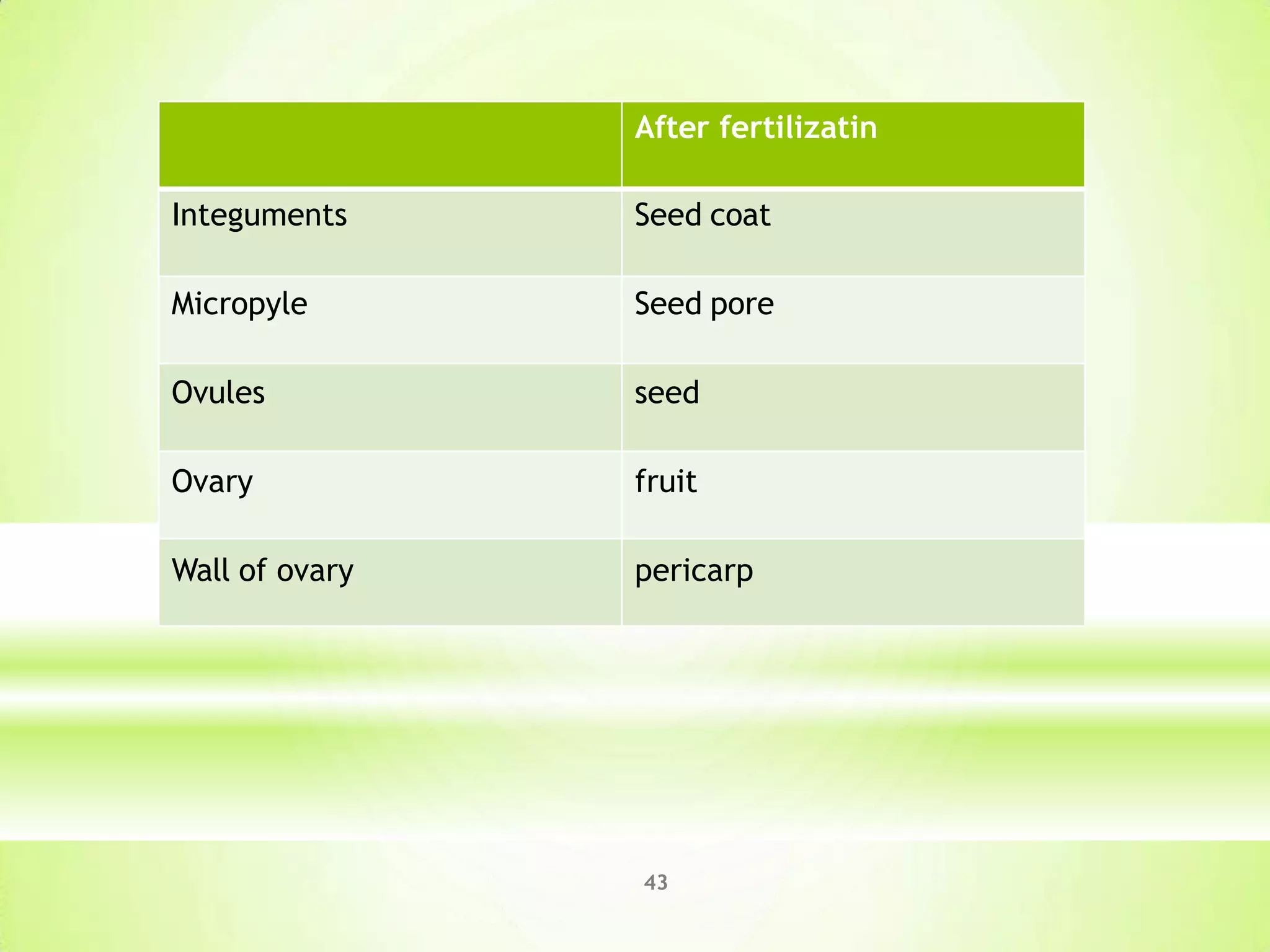
43
After fertilizatin
Integuments Seed coat
Micropyle Seed pore
Ovules seed
Ovary fruit
Wall of ovary pericarp
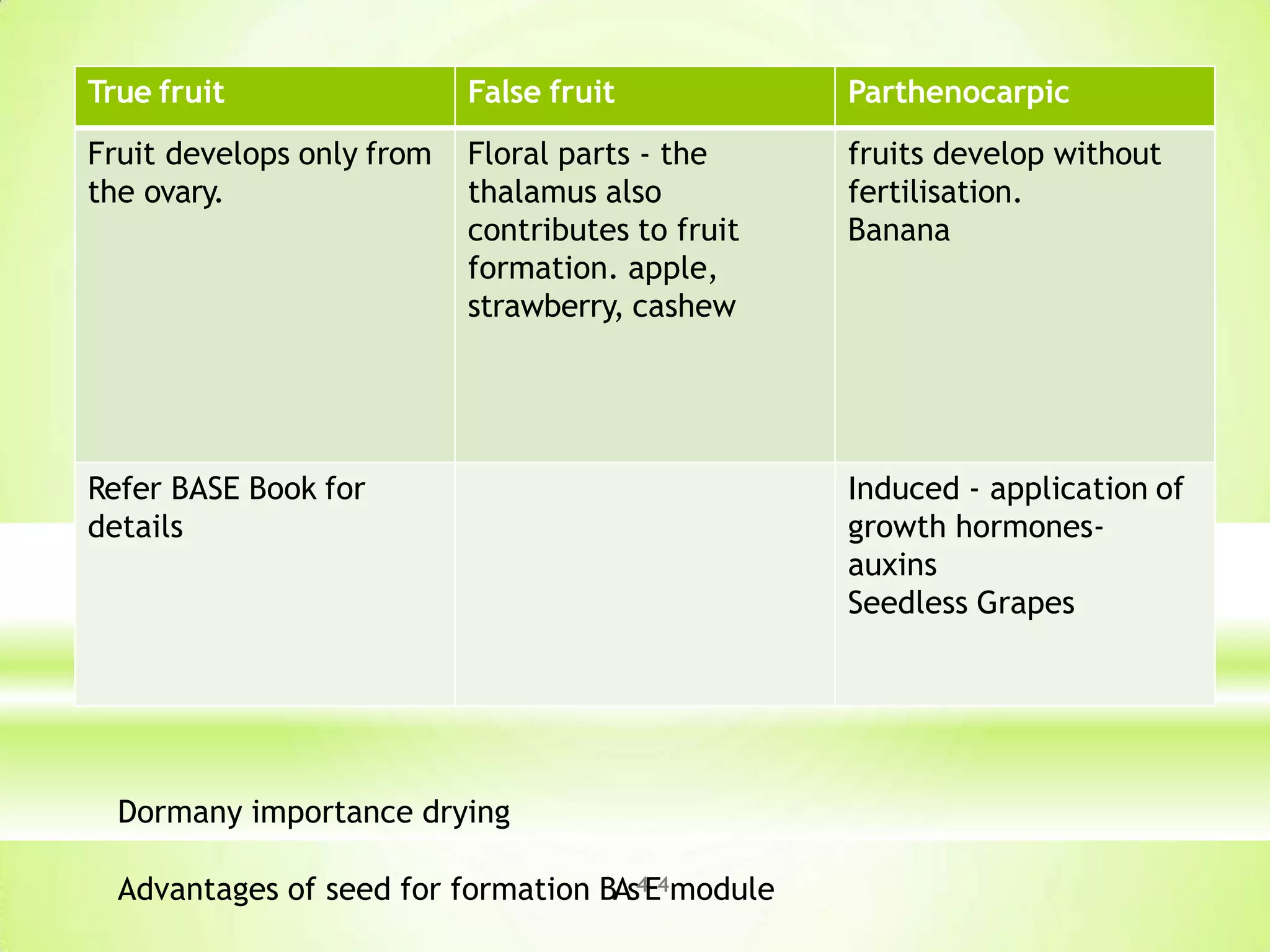
True fruit False fruit Parthenocarpic
Fruit develops only from
the ovary.
Floral parts - the
thalamus also
contributes to fruit
formation. apple,
strawberry, cashew
fruits develop without
fertilisation.
Banana
Refer BASE Book for
details
Induced - application of
growth hormones-
auxins
Seedless Grapes
Dormany importance drying
Advantages of seed for formation BAs4E4module
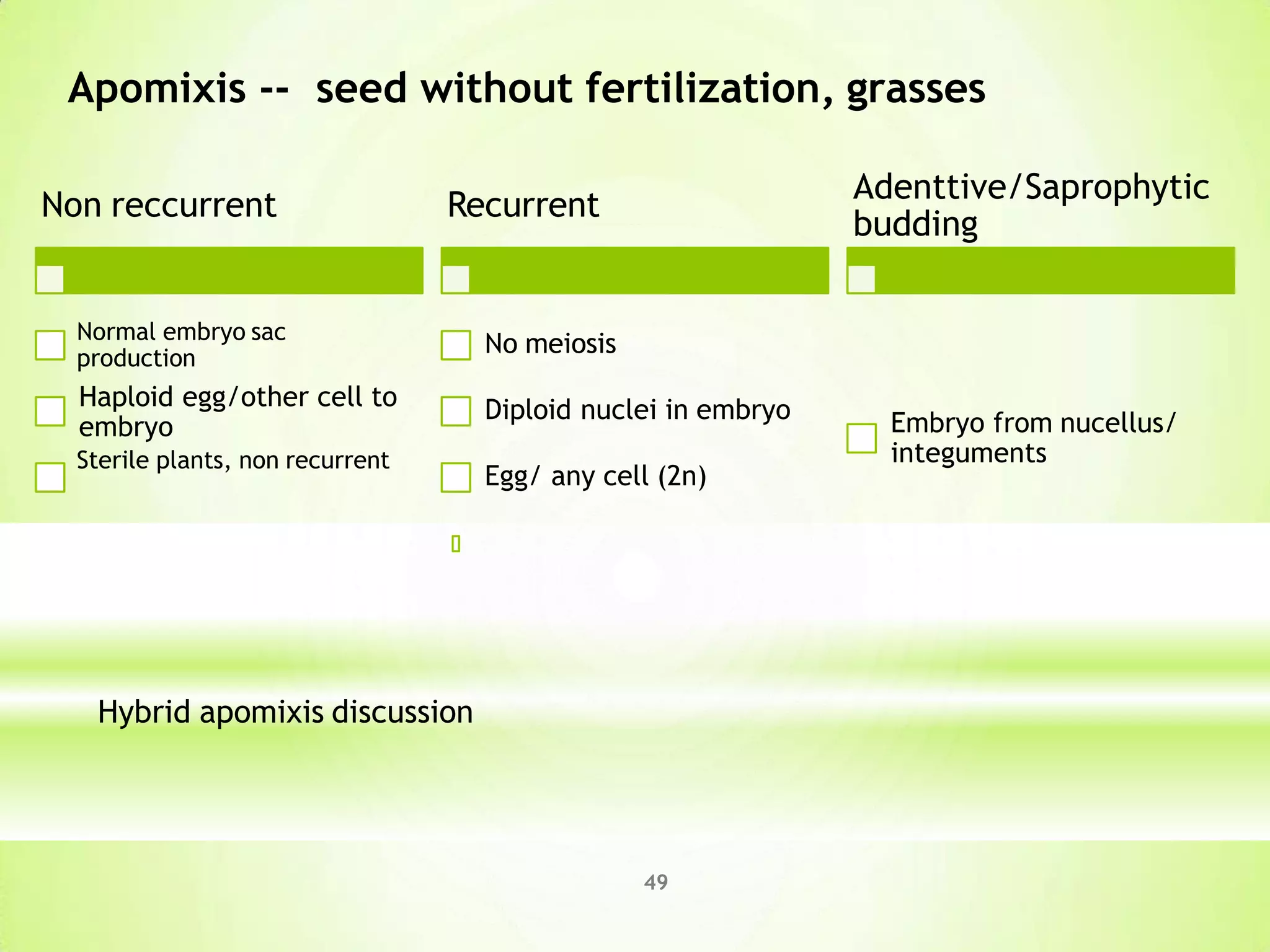
Non reccurrent
Normal embryo sac
production
Haploid egg/other cell to
embryo
Sterile plants, non recurrent
Recurrent
No meiosis
Diploid nuclei in embryo
Egg/ any cell (2n)
Adenttive/Saprophytic
budding
Embryo from nucellus/
integuments
49
Apomixis -- seed without fertilization, grasses
Hybrid apomixis discussion
*More than one embryo in the seed
50
1. Zygote / proembryo into 2/more units -
then in embryo
2. Embryos from other part of embryo sac than
egg say synergids ( antipodals rare)
3. Cells of nucellus integuments – mango, citrus
4. Multiple embryosac in ovule- all fertilised
*

Sexualrepro flowering BY BHANU KALRA

  • 1.
  • 2.
  • 3.
    * *FLORICULTURE : thecultivation of flowering plants. *Several hormonal and structural changes are initiated which lead to the differentiation and development of the floral PRIMORDIUM *primordium- an organ in its earliest stage of development; the foundation for subsequent development *Inflorescences are formed which bear the floral buds and then the flowers. *In the flower the male and female reproductive structures, the androecium (MALE) and the gynoecium ( FEMALE ) differentiate and develop. 3
  • 4.
    * A typical stamen- •the long and slender stalk called the filament • the terminal bilobed structure called the anther. • Monothecous Hibiscus, Dithecous brinjal The proximal end of the filament is attached to the thalamus or the petal of the flower. Check terminology. The number and length of stamens vary. 4
  • 5.
    * Dithecous - antheris bilobed with each lobe having two theca A longitudinal groove runs lengthwise separating the theca. 5
  • 6.
  • 7.
  • 8.
    * *Dithecous - bilobednature *The anther is a four-sided (tetragonal) structure - four microsporangia located at the corners, two in each lobe. *The microsporangia develop- pollen sacs. They extend longitudinally ,are packed with pollen grains. *Structure of microsporangium: In T.S. a typical microsporangium appears circular in outline. It is generally surrounded by four wall layers -- the epidermis, endothecium, middle layers and the tapetum. *The outer three wall layers perform the function of protection and help in dehiscence of anther to release the pollen. * The innermost wall layer is the tapetum. It nourishes the developing pollen grains. Cells of the tapetum possess dense cytoplasm and generally have more than one nucleus. Nucleus divides – without cytoplasmic division- polyploidy 8
  • 9.
    * *When the antheris young, a group of compactly arranged homogenous cells -the sporogenous tissue occupies the centre of each microsporangium. *The cells of the sporogenous tissue undergo meiotic divisions to form microspore tetrads. ( haploidy) 9
  • 10.
    * Potential pollen / Potential microspore mother cell Micro- spore Tetrad Pollen grains 10 Cells of sporangeous tissue Fourcells Haploid Tetrad cells separates Meiosis Micro- sporogenesis Anthers mature, Stay together Dehydration Dissociate
  • 11.
    * * The pollengrains represent the male gametophytes. * sizes, shapes, colours, designs- different species * fossils because of the presence of sporopollenin * Cryopreservation(-196 0C ) used in crop breeding * Pollen food nutritional value – performance of athletes and race horses * Pollen Allergy,bronchial * Afflictions, asthma, bronchitis eg Parthenium * Viability ofpollen grains depends on temperature and humidity. Viable from few mins to several months 11 *– few mins (rice) to few months (Solanacae), Rosaceae, Leguminoseae
  • 12.
    *Pollen grain wall-exine and intine *Exine – thick hard ornamental, made up of sporopollenin ( most resistant organic material high temperature, acid, alkalies) *Germ pore- circular aperture in exine- spropollenin absent. Pollen tube emerges from germ pore *The inner wall of the pollen grain intine- a thin and continuous layer made up of cellulose and p1e2ctin.
  • 13.
  • 14.
    The cytoplasm ofpollen grain is surrounded by a plasma membrane.A mature pollen grain – ( inside intine and exine ) During development from microspore mitosis – 2 cells • vegetative cell / tube cell --bigger, has abundant -food reserve and a large irregularly shaped nucleus. • generative Cell -- small , spindle shaped with dense cytoplasm & a nucleus. It floats in the cytoplasm of the vegetative cell. 60 % angiosperms, pollen grains are shed at 2-celled stage. In others generative cell divides mitotically - the two male gametes before pollen grains are shed (3-celled stage). 14
  • 15.
    15* *Pistil/gynoecium innermost whorl *Carpel– stigma , style , Ovary *Ovary many ovule ( megasporangia) attached to a tissue inside ovary – placenta – ovarian cavity ( locules) – *Placentation – recap *number of ovules in an ovary may be one (wheat, *paddy, mango) to many (papaya, water melon, orchids). *Monocarpellary / multicarpellary *Syncarpous ( pistils fused together) , aopcarpous ( free)
  • 16.
    * (1) Orthotropous: The micropyle, chalaza and funicle are in a straight line. This is the most primitive type of ovule e.g., Piper, Polygonum, Cycas. - A *(2) Anatropous : The ovule turns at 180 angle. Thus it is inverted ovule. Micropyle lies close to hilum or at side of hilum e.g, found in 90% of angiosperm families. B * (3) Campylotropous : Ovule is curved more or less at right angle to funicle. Micropylar end is bend down slightly e.g., in members of Leguminosae, Cruciferae. D * (4) Hemianatropous : Ovule turns at 90 angle upon the funicle or body of ovule and is at right angle to the funicle e.g., Ranunculus. C * (5) Amphitropous : Ovule as well as embryo sac is curved like horse shoe e.g, Lemna, Poppy, Alisma. E * (6) Circinotropous : The ovule turns at more than 360 angle, so funicle becomes coiled around the ovule e.g., Opuntia (Cactaceae), Plumbaginaceae. F 16
  • 18.
    18 * 1. Funicle Theovule is attached to the placenta by means of a stalk called funicle. 2. Hilum The body of the ovule fuses with funicle in the region called hilum.(hilum - the junction between ovule and funicle) 3. Integuments Each ovule has one or two protective envelopes called integuments.(inner and outer ) 4. Micropyle The integuments leave small opening at one end called micropyle.- this end is micropylar end. 5. Chalaza Opposite the micropylar end, is the chalaza, representing the basal part of the ovule. 6. Nucellus Tissue encloses embryo sac 7. Embryo sac (female gametophyte) An ovule generally has a single embryo sac formed from a megaspore through reduction division. * Nucleate and 7 celled. 1. Egg apparatus- at micropylar end. It has 2 synergids and an egg. 2. Fili form apparatus- synegids – special thickening at micropylar end. It guides the pollen tube. 3. Antipodals- 3 in number twds chalazal end. 4. Two Haploid nuclei at polar end below egg appataus
  • 19.
    * Megaspore mother cells MMC Deploid Megaspore haploid Monosporic development Functional megasopre to Embryo sac 19 Cellsin the nucellus near micropylar region. Four cells Haploid 3 near micropyle degenerrate 1 functional megaspore Meiosis Mega- sporogenesis Functional megaspore enlarges, mitotic division 2 nuclei – move opposite poles – 2 mitoic division- 4 nuclei at each pole Wall formation only after this stage Chalaza end – 3 form antipodals Micropylar end – 3 form egg apparatus Remaining 2 nucei Polar nuclei in large central cell.
  • 20.
  • 21.
    Functional megasopre to Embryo sac Functional megasporeenlarges, mitotic division 2 nuclei – move opposite poles – 2 mitoic division- 4 nuclei at each pole Wall formation only after this stage Chalaza end – 3 form antipodals Micropylar end – 3 form egg apparatus Remaining 221nucei Polar nuclei in large central cell.
  • 22.
  • 23.
    Pollination Transfer of pollengrains from anther to stigma( pistil) Self pollination Same flower/ different flower of same plant Autogamy Pollination in the same flower Chasmogamy Flowers open, synchrony in pollen release and stigma Close arrangement Cleistogamy flowers which do not open at all Geitonogamy Different flowers same plant. Cross- pollination Two flowers of different plants of same species Xenogamy Viola (common pansy), Oxalis, and Commelina produce two types of flowers chasmogamous, cleistogamous 23
  • 26.
    Advantages of cleistogamy Assuredseed-set even in the absence of pollinators. But no variation in offspring. Compare self and cross pollination. Agents of pollination – discussion book Self study / discussion by students Show other ppt 26
  • 27.
    *All events fromdeposition of pollen grains on stigma – entry of pollen tube into the ovule -Pollen pistil interaction 27 *Identification of compatible (same species) or incompatible( other species) pollen grains by stigma *a dynamic process involving pollen recognition followed by promotion or inhibition of the pollen. *Reason – chemical interaction between pollen and stigma *Compatible pollen accepted by stigma, initiates post pollination events *
  • 28.
    * *Germination- formation ofpollen tube through germ pore- content move to pollen tube- through stigma, style reaches ovary *pollen grains - two-celled condition (a vegetative cell and a generate cell)- the generative cell divides and forms the two male gametes during the growth of pollen tube in the stigma. *three-celled condition, pollen tubes carry the two male gametes from the beginning. *Pollen tube, after reaching the ovary, enters the ovule through the micropyle and then enters one of the synergids through the filiform apparatus *Interaction is important in plant breeding- for superior plant development 28
  • 29.
    *Emasculation female parent bearsbisexual flowers, removal of anthers from the flower bud before the anther dehisces using a pair of forceps. *Bagging Emasculated flowers have to be covered with a bag of suitable size, generally made up of butter paper, to prevent contamination of its stigma with unwanted pollen. * When the stigma of bagged flower attains receptivity, mature pollen grains collected from anthers of the male parent are dusted on the stigma, and the flowers are rebagged, and the fruits allowed to develop. * unisexual flowers, no emasculation. The female flower buds are bagged before the flowers open. * When the stigma becomes receptive, pollination is carried out using the desired pollen and the flower rebagged. 29
  • 31.
    *Emasculation female parent bearsbisexual flowers, removal of anthers from the flower bud before the anther dehisces using a pair of forceps. *Bagging Emasculated flowers have to be covered with a bag of suitable size, generally made up of butter paper, to prevent contamination of its stigma with unwanted pollen. * When the stigma of bagged flower attains receptivity, mature pollen grains collected from anthers of the male parent are dusted on the stigma, and the flowers are rebagged, and the fruits allowed to develop. * unisexual flowers, no emasculation. The female flower buds are bagged before the flowers open. * When the stigma becomes receptive, pollination is carried out using the desired pollen and the flower rebagged. 31
  • 32.
    * Pollen tube into synergid •the pollen tube releases the two male gametes into the cytoplasm of the synergid. Syngamy • the pollen tube releases the two male gametes into the cytoplasm of the synergid. • Diploid Zygote formation - zygote develops into an embryo. Triple fusion 3 haploid nucleus fuse • other male gamete moves towards the two polar nuclei located in the central cell and fuses with them to produce a triploid PEN This central cell forms • primary endosperm cell (PEC) and develops into the endosperm 32
  • 33.
    * 1 4 2 pollen is transferred 3 After fertilization flowerwithers seeds disperse and germinate into new plant seeds develop in ovary 4
  • 34.
    1 Male gametefuses with the 2 polar nuclei to form the triploid endosperm nucleus 1 male gamete fuses with the egg nucleus to form the diploid zygote Double fertilization recap
  • 35.
    31 * *After double fertilizationevents of endosperm and embryo development, maturation of ovule(s) into seed(s) and ovary into fruit, are collectively termed post-fertilisation events. Endosperm development Embryogeny Seed formation *Endosperm development : Primary Endosperm Cell (Triple fusion) – Endosperm (3n) *Endosperm – cells filled with reserved food material -main source of nutrition for the embryo
  • 36.
    * •The endosperm nucleus (3N)divides repeatedly to form the endosperm in endospermic seeds. This endosperm acts as a food store for the developing seed •e.g. maize 3N endosperm nucleus 2N Zygote
  • 37.
    * Nuclear • PEN successivenuclear divisions free nuclei. free- nuclear endosperm. Nuclei free, the cw formation afterwards. Cellular • First and susequent divisions followed by cw formation Helobial • In between above two • Transvrse wall mucropylar and chalazal chamber Non persistant embryo in some seeds,& perisperm till germination 37
  • 38.
    Embryogeny - Embryoformation – similar in Mono cot and dicot Embryo develops micropylar end sac where the zygote is situated. First endosperm develops then zygote. Provision of nutrition taken care Zygote – proembryo – globular mature heart shaped embryo 1 st Transverse division – 2 cells divisio Cell twds micropyle n embryo/terminal cell Other – basal cell / suspensor cell Suspe nsor cell Transverse division, 6-10 cells forms suspensor Terminal cell is swollen, vesicular Haustorium Lowermost – hypophysis to root tip and root cap 38
  • 39.
    Embryo cell 39 Vertical divisionat right angles to one another- 4 cells then transverse division – 8 cells (octant) Terminal four to plumule Towds hypophysis to hypocotyle and radical Proembryo Undifferntiated , globular To heart shaped- then maturity
  • 40.
    Dicot embryo consistsof an embryonal axis and two cotyledons. The portion of embryonal axis above the level of cotyledons is the epicotyl, which terminates with the plumule or stem tip. The cylindrical portion below the level of cotyledons is hypocotyl that *terminates at its lower end in the radical or root tip. The root tip is covered with a root cap. * 40
  • 41.
    *In the grassfamily the cotyledon is called scutellum - situated towards one side (lateral) of the embryonal axis. * At its lower end, the embryonal axis has the radical and root cap enclosed in an undifferentiated sheath called coleorrhiza. *The portion of the embryonal axis above the level of attachment of scutellum is the epicotyl. Epicotyl has a shoot apex and a few leaf primordia enclosed in a hollow foliar structure, the coleoptile. 37*
  • 42.
    Endosperm Food store for developing embryo Embryo Plumule, radicle, cotyledons Integuments, becomesthe seed coat * Micropyle – pore-entry Of oxygen, water during germination
  • 43.
    If all the endospermis absorbed by the developing embryo the seed is a non endospermic seed e.g. broad bean, pea, groundnut *
  • 44.
    If all the endospermis not absorbed by the developing embryo the seed is an endospermic seed e.g. Maize, wheat, barley, castor, sunflower *
  • 45.
    e.g. Broad Beane.g. Maize Plumule Radicle Endosperm Cotyledon Non–endospermic and Endospermic seed
  • 47.
    43 After fertilizatin Integuments Seedcoat Micropyle Seed pore Ovules seed Ovary fruit Wall of ovary pericarp
  • 48.
    True fruit Falsefruit Parthenocarpic Fruit develops only from the ovary. Floral parts - the thalamus also contributes to fruit formation. apple, strawberry, cashew fruits develop without fertilisation. Banana Refer BASE Book for details Induced - application of growth hormones- auxins Seedless Grapes Dormany importance drying Advantages of seed for formation BAs4E4module
  • 49.
    Non reccurrent Normal embryosac production Haploid egg/other cell to embryo Sterile plants, non recurrent Recurrent No meiosis Diploid nuclei in embryo Egg/ any cell (2n) Adenttive/Saprophytic budding Embryo from nucellus/ integuments 49 Apomixis -- seed without fertilization, grasses Hybrid apomixis discussion
  • 50.
    *More than oneembryo in the seed 50 1. Zygote / proembryo into 2/more units - then in embryo 2. Embryos from other part of embryo sac than egg say synergids ( antipodals rare) 3. Cells of nucellus integuments – mango, citrus 4. Multiple embryosac in ovule- all fertilised *