BIOLOGY FORM 5 CHAPTER 1 : TRANSPORT
LEARNING
          OUTCOMES
• To state what translocation is.
• To explain the importance of
  translocation in plants.
• To describe the process of transpiration.
• To explain the importance of
  transpiration.
• To describe the pathway of water from
  the soil to the leaves.
• To state external conditions affecting
  transpiration
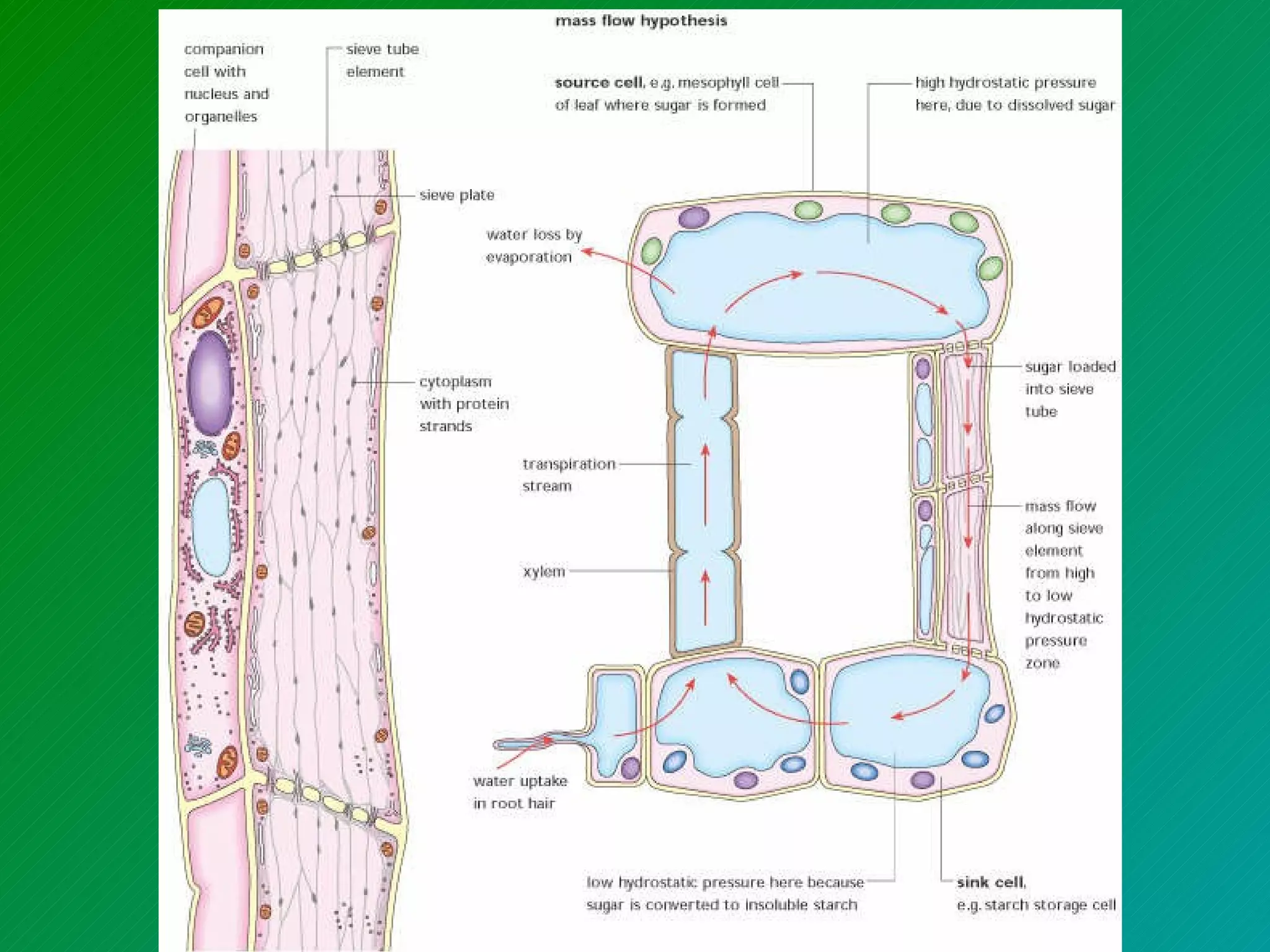
TR A N S L O C A TI
                   ON
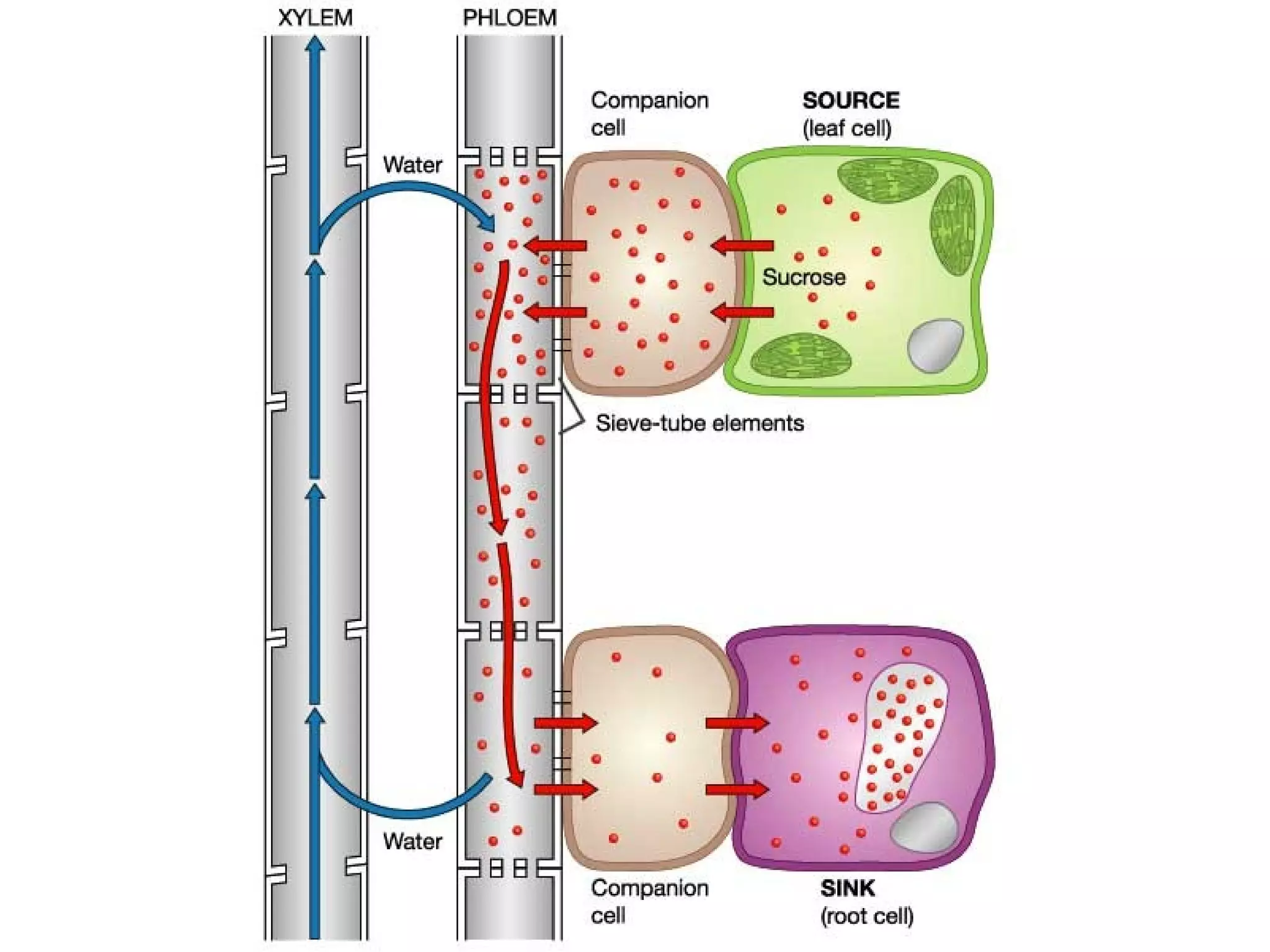
• T h e t r a n s p o r t o f d is s o l v e d
  o r g a n ic f o o d s u b s t a n c e s b y
  t h e p h l o e m.

IM P O R T A N C E O F
 T R A N S L O C A T IO N
• Ensures a plant’s survival
• Organic food molecules can be transported :
  – To the growing regions in the plant for growth &
    development
  – To the plant cells for metabolism
  – Downwards from the leaves to the storage organs such
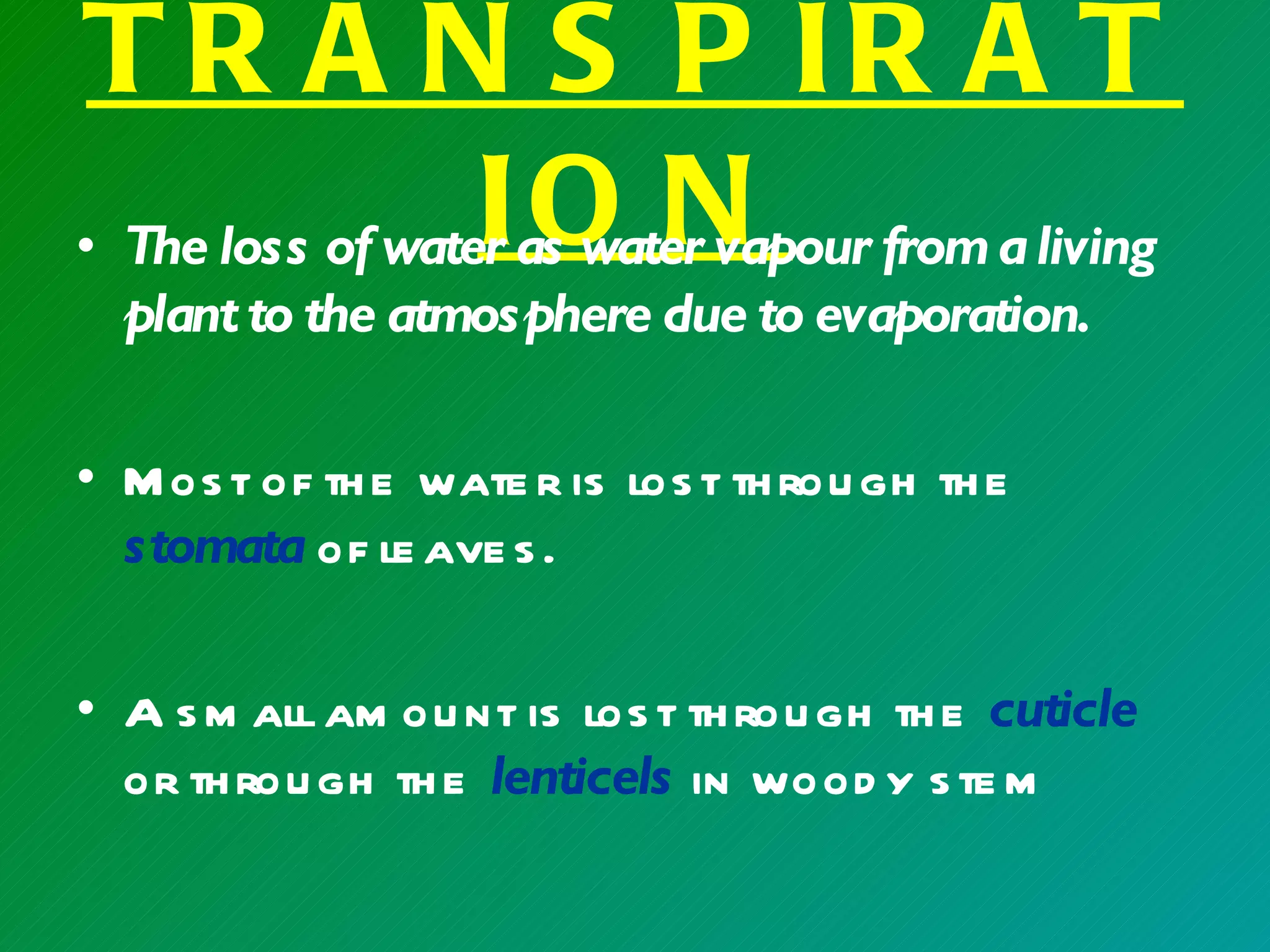
T R A N S P IR A T
                  IO N
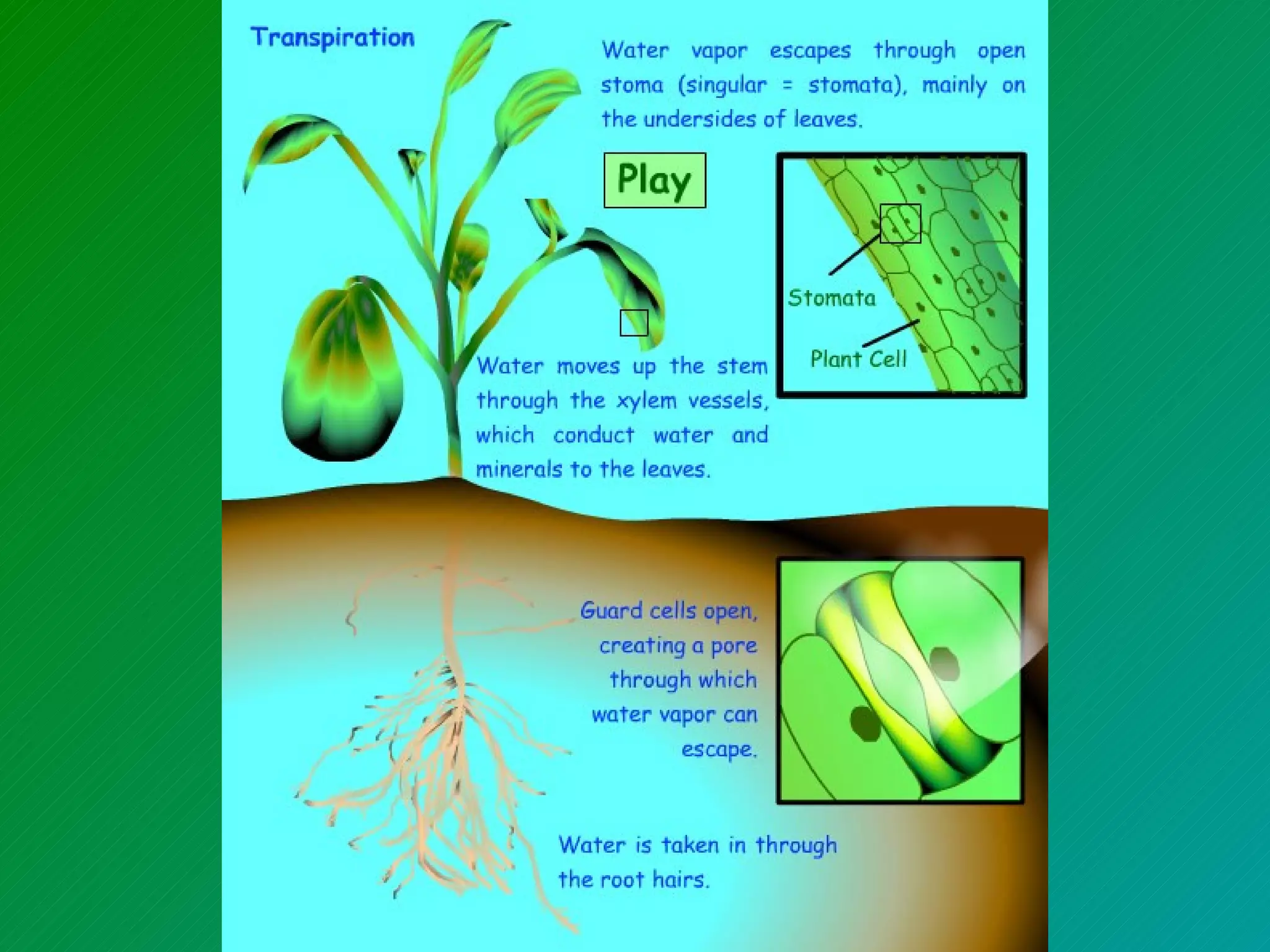
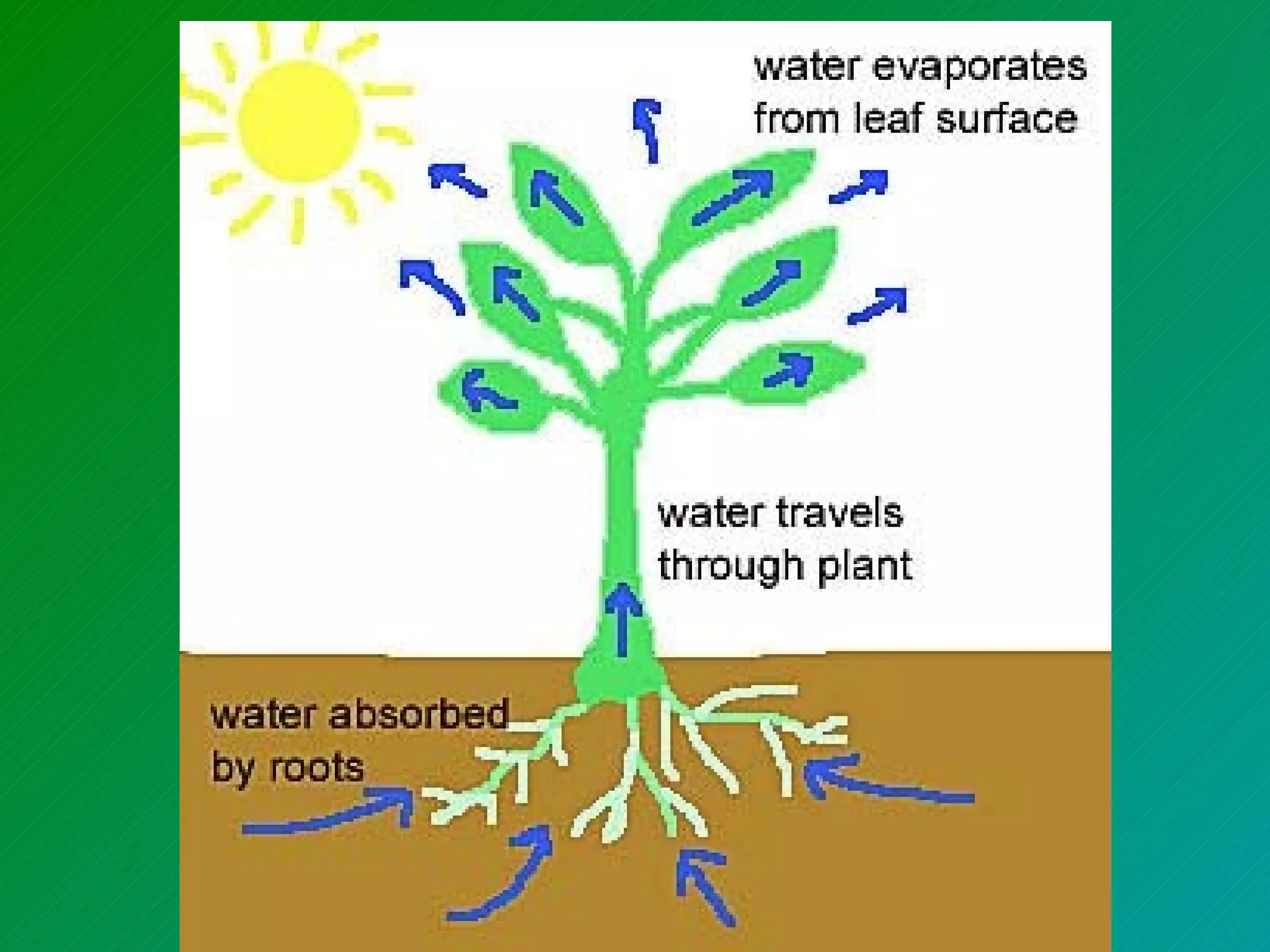
• The loss of water as water vapour from a living
  plant to the atmosphere due to evaporation.

• M os t of th e wate r is los t th rou gh th e
  stomata of le ave s .

• A s m all am ou nt is los t th rou gh th e cuticle
  or th rou gh th e lenticels in wood y s te m
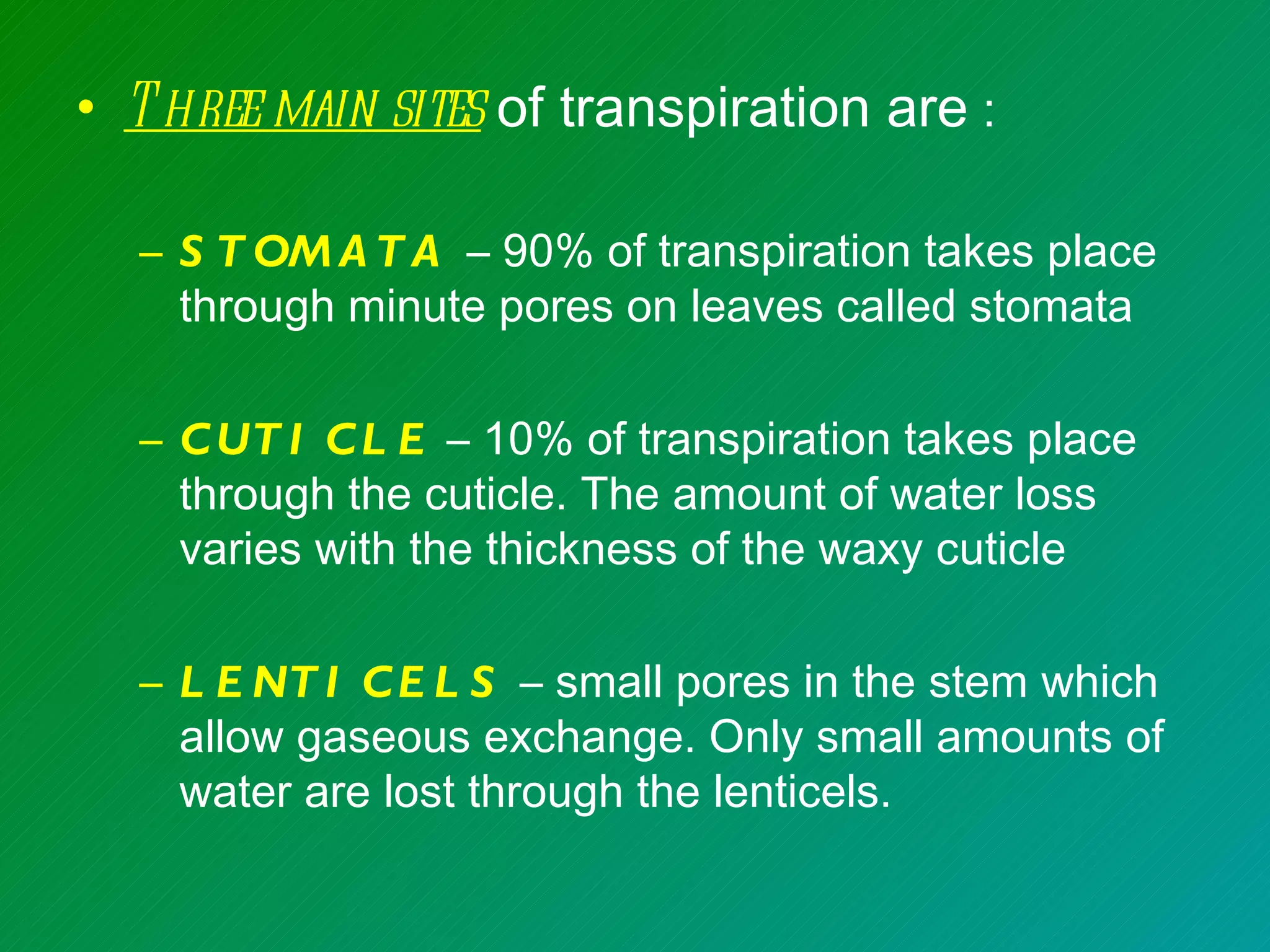
• T hree main sites of transpiration are :

  – S T OM A T A – 90% of transpiration takes place
    through minute pores on leaves called stomata

  – C UT I C L E – 10% of transpiration takes place
    through the cuticle. The amount of water loss
    varies with the thickness of the waxy cuticle

  – L E NT I C E L S – small pores in the stem which
    allow gaseous exchange. Only small amounts of
    water are lost through the lenticels.
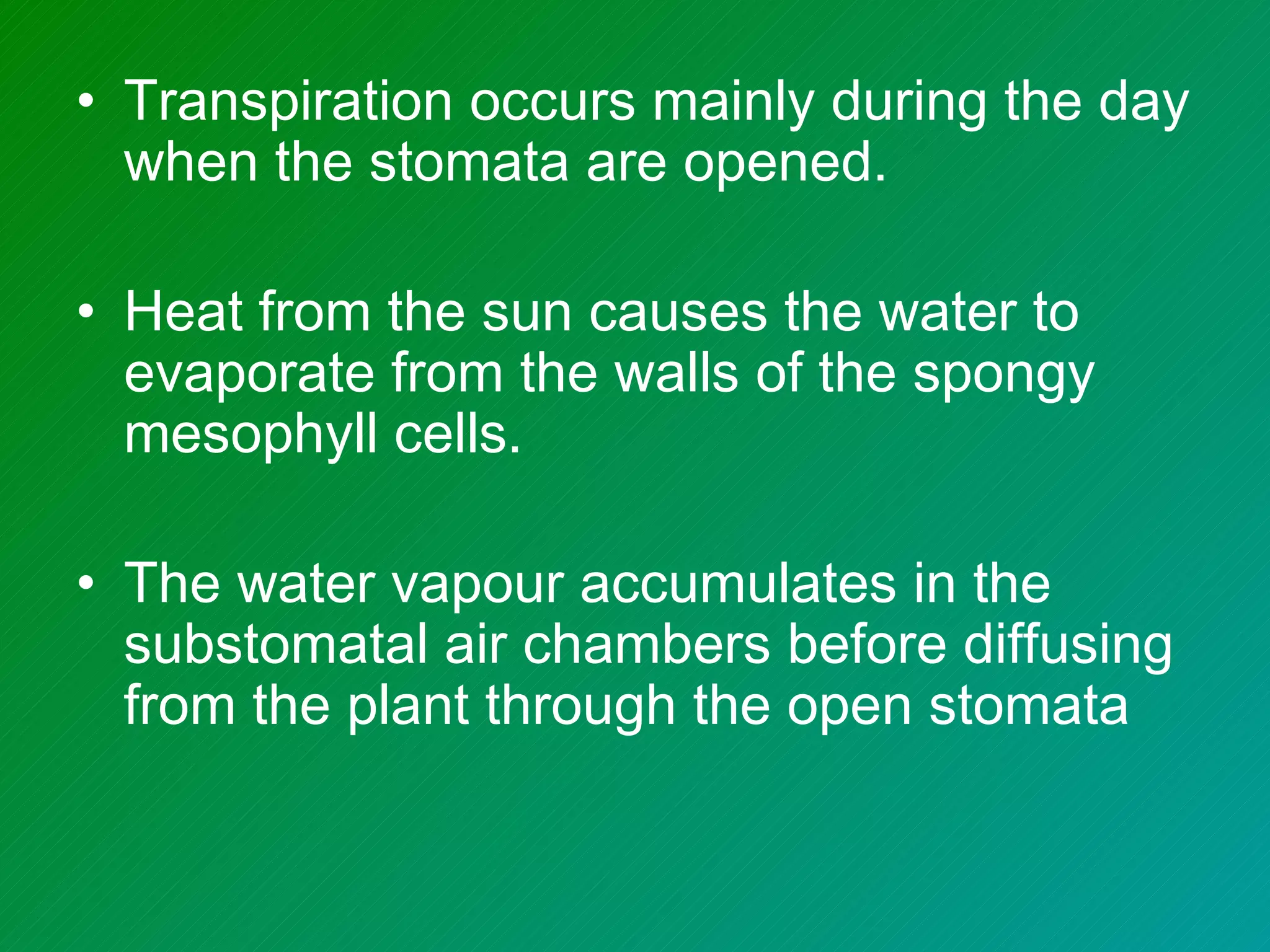
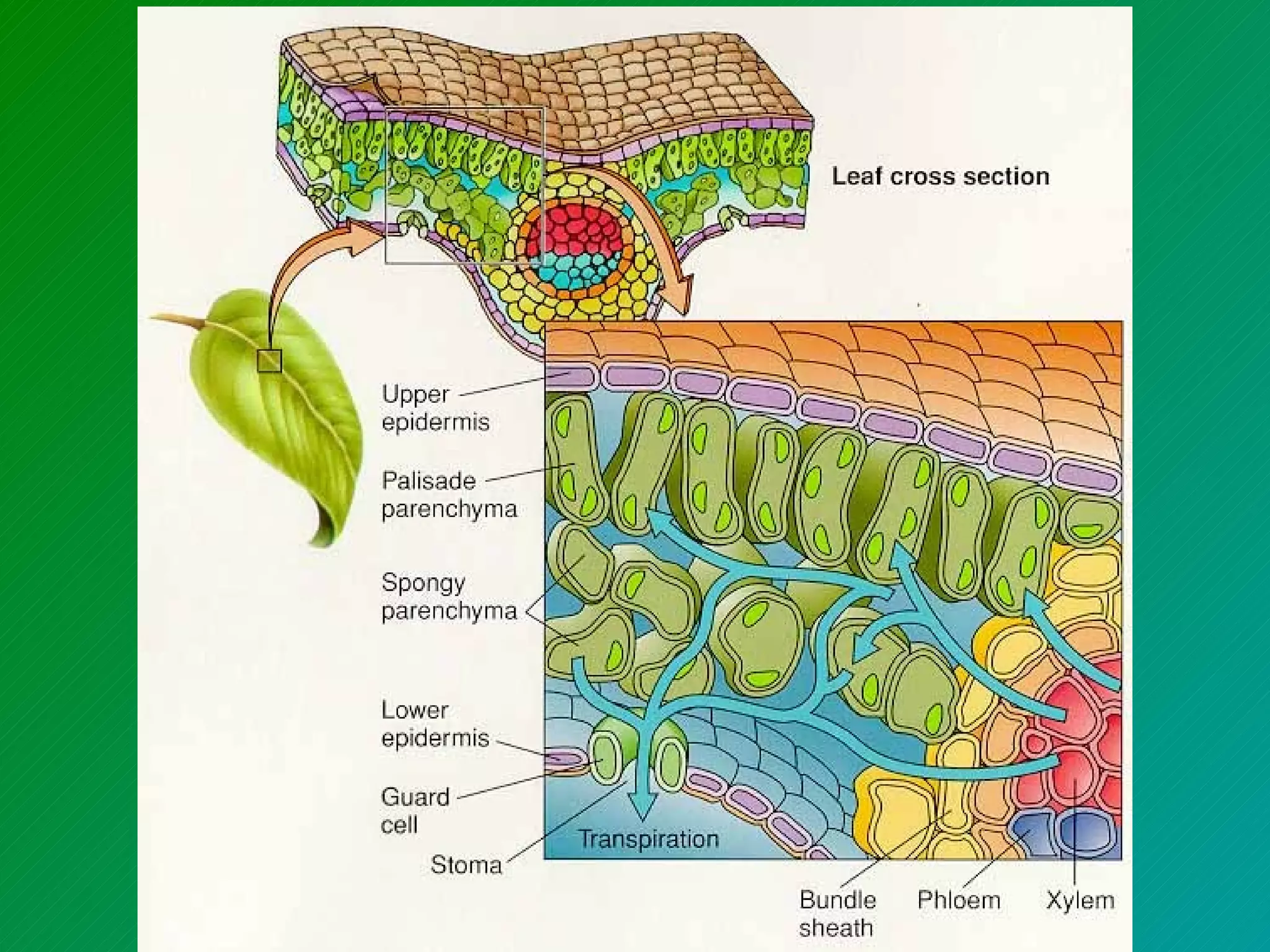
• Transpiration occurs mainly during the day
  when the stomata are opened.

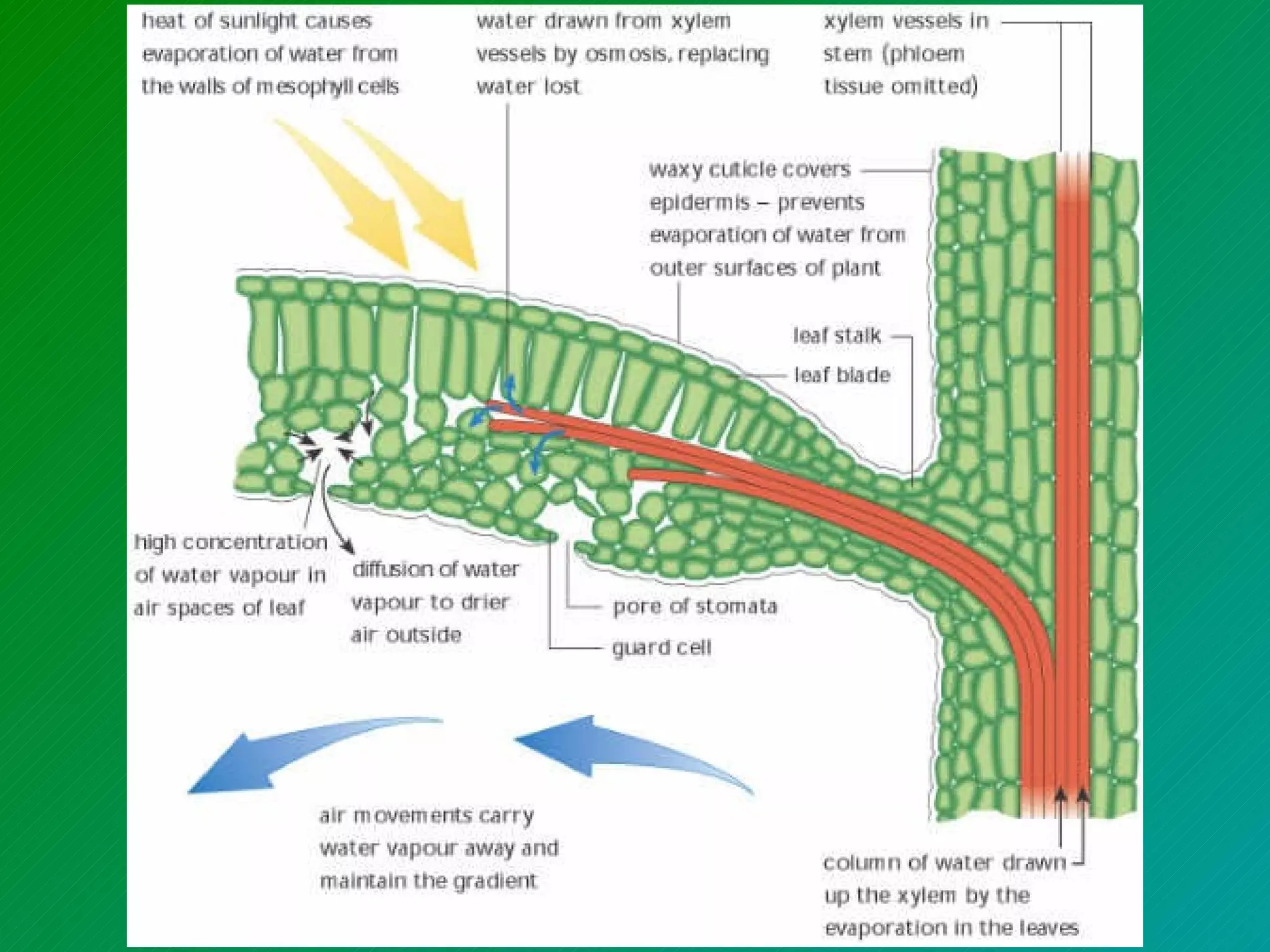
• Heat from the sun causes the water to
  evaporate from the walls of the spongy
  mesophyll cells.

• The water vapour accumulates in the
  substomatal air chambers before diffusing
  from the plant through the open stomata
• Water move into the mesophyll
  cells by osmosis from the
  adjacent cell

• Water flows from the xylem
  vessels along a chain of cells to
  the outermost mesophyll cell.

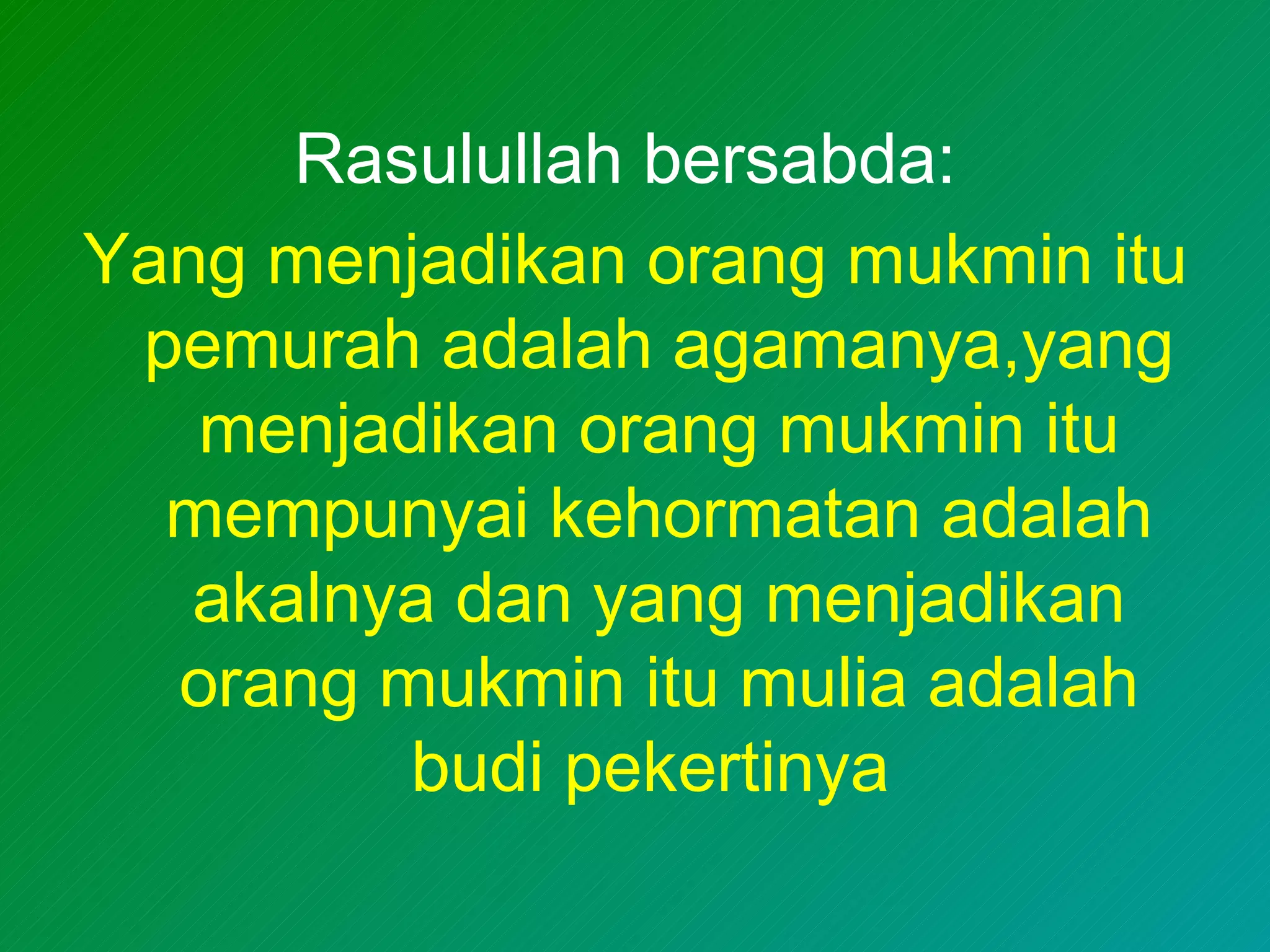
• Water is pulled through the xylem
  vessels from the root to the
T h e I mp o r t a n c e o f
    T r a n s p ir a t io n
• Creates a transpirational pull that pulls
  water & dissolved mineral ions from the
  root to the leaves.

• Water supplied to the plant is used for
  photosynthesis & cell metabolism. Mineral
  ions is used for cell activities & growth &
  development of the plant.
• Water keeps the cell turgid  give support
  to leaves & young stems (herbaceous
  plants).

• To keep the plant cool, an important effect
  particularly in hot condition.

• Water evaporates from the plants to the
  atmosphere faster than it can be absorbed
  from the soil, it is withdrawn from the plant
  cells  flaccid – leading to wilting
P A TH WA Y O F WA TE R
  F R O M T H E S O IL T O
         TH E L E A VE S
• Water & mineral ions are absorbed by young
  roots with thin epidermis. (osmotic forces +
  active transport)
• The pressure of root hairs increases the
  surface area for absorption.
• The cell sap in the root hair cell contains
  sugars, amino acids, & minerals  more
  concentrated than the surrounding dilute soil
  solution.
• Wate r d iffu s e s into th e root ce lls b y
  os m os is .

• Th e e ntry of wate r into th e root ce lls
  d ilu te s its ce ll s ap .

• Th e ce ll s ap of th e ad j nt corte x
                               ace
  ce ll is now m ore conce ntrate d 
  wate r m ole cu le s d iffu s e into th e
  ad j nt root ce ll.
      ace
• The process continues & water is
  transported from one root cell to
  another by osmosis.

• In the cells of the endodermis,
  mineral ions are actively pumped
  from these cells into the solution in
  the xylem vessels in the root.

• Solution in xylem more concentrated
   water enters xylem by osmosis.
• This process creates an upward force called
  ROOT PRESSURE.

• Helps to push water in the xylem up to a
  certain height in the plant.

• Root pressure alone is insufficient to force the
  water to the top part of a tall tree.

• Need CAPILLARITY ACTION &
  TRANSPIRATIONAL PULL.
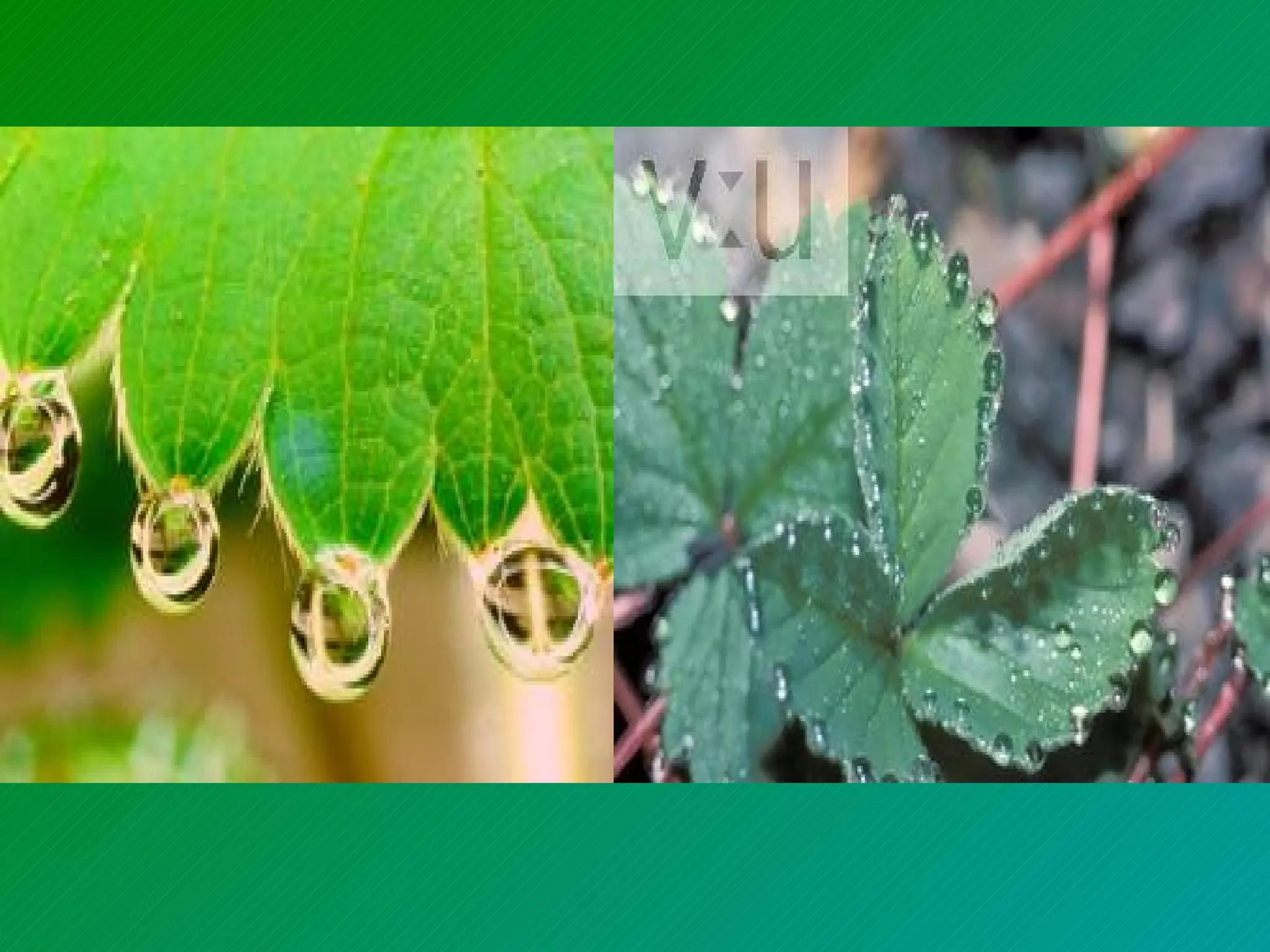
G U T T A T IO N
• In small plants, root pressure can push
  water all the way up the stem & out of
  special pores called hydathodes at the
  edges of leaves  Guttation

• Occurs on cool humid morning when the
  air is too saturated for the water drops to
  evaporate from the leaves.
TH E E XTE R N A L
         C O N D IT IO N S
  A F F E C T IN G T H E R A T E
   O F T R A N S P IR A T IO N
• The external factors that affect the rate of
  evaporation.
   – Air movement
   – Temperature
   – Light intensity
   – Relative humidity
A IR MOVE ME NT
• Movement of air carries away water
  molecules that have diffused from the
  leaves.
• The faster the air movement (wind speed)
  the greater the rate of transpiration.
• When there is little air movement/ in still
  air, water vapour diffusing out of the leaf
  accumulates around the stomata.
• Decreases the concentration gradient of
  water, the transpiration rate reduces.
TE M P E R A TU R E
• A rise in temperature increases the kinetic
  energy of water molecules & increase the
  rate of evaporation (transpiration).

• Lowers the relative humidity of the air 
  increase the rate of transpiration.
• Temperature low, kinetic energy of water
  molecules is decreased.

• Relative humidity of the air is higher 
  decrease the rate of transpiration
L IG H T IN T E N S IT Y
• The light intensity increased, the
  rate of evaporation increases.

• Light not effects evaporation but
  causes the stomata to open 
  increasing water loss from the
  plant.

• At night @ dark, stomata close 
ð ^
• The rate of evaporation depends on the
  difference in concentration of water molecules in
  the sub-stomatal spaces & in the surrounding
  atmosphere.

• The lower the relative humidity of the
  surrounding atmosphere, the faster will the water
  vapour escape from the stomata.

• High relative humidity reduces water loss.
ROOT
       PRESSURE
• If a stem is cut just above ground level,
  a considerable amount of sap will exude
  from the cut stump, showing that there is
  a force pushing water up the stem from
  the roots.

• Its ROOT PRESSURE  The result of an
  active process in which energy from ATP is
  used.
ROOT
        PRESSURE
• Root pressure alone is not strong enough to
  drive water to the tops of tall trees at the
  speeds achieved during a normal growing
  season.
COHESION &
       ADHESION OF
         WATER
• COHESION = the force of attraction
  between the same molecules

• The cohesive forces between water
  molecules hold the continuous columns of
  water together & when water transpires
  from the leaf, the whole of the water
  column moves up the xylem vessels.
• ADHESION = the force of attraction
  between different molecules

• Water molecules tend to adhere to the
  walls of the xylem vessels.

• The adhesive forces can support a
  considerable mass of water.

• Cohesion + adhesion = capillarity (the rise
  of water in a capillary tube).
O P E N IN G &
     C L O S IN G O F
• Dicotyledonous O Mon the lower surface
          S T leaves = A T A
• Monocotyledonous leaves = both the upper &
  lower surfaces.

• Each stoma consists of a pair of kidney-shaped
  guard cells surrounding a stomatal pore.
• A guard cell has a thinner elastic
  outer cell wall & a thicker, less elastic
  inner cell wall. It has a nucleus,
  cytoplasm & chloroplasts.

• The opening & closing of the stomata
  in the leaf controls the diffusion of
  CO2 & O2 into & out of a leaf as well
  as the rate of transpiration.
S TOMA TA L OPE NING
• DAY : photosynthesis occurs & CO2 level is low
  in the leaf.

• Potassium ions (K+) diffuse from surrounding
  epidermal subsidiary cells into the guard cells.

• In many plant species, starch stored in the guard
  cell is converted into malate.

• The accumulation of K+ & malate ions increase
  the osmotic pressure in the guard cell.
• Water enters by osmosis from surrounding
  epidermal cells into the guard cells

• Two guard cells become turgid & curve
  outward & the stoma opens.
S TO M A TA L
• NIGHT : no photosynthesis &G level
      C L O S I N CO2
 is high. Potassium ions move out of the
 guard cells into the epidermal cells.

• Malate ions are converted to starch. The
  osmotic pressure in the guard cells
  decreases.

• Water diffuses out to the surrounding
  epidermal cells by osmosis.
• Guard cells become flaccid & stoma
  closes.

• The stomata also close, when there is
  insufficient water supply & the
  transpiration rate is high.
Rasulullah bersabda:
Yang menjadikan orang mukmin itu
 pemurah adalah agamanya,yang
   menjadikan orang mukmin itu
  mempunyai kehormatan adalah
   akalnya dan yang menjadikan
  orang mukmin itu mulia adalah
         budi pekertinya
Sub 1[1].8   form 5

Sub 1[1].8 form 5

  • 1.
    BIOLOGY FORM 5CHAPTER 1 : TRANSPORT
  • 2.
    LEARNING OUTCOMES • To state what translocation is. • To explain the importance of translocation in plants. • To describe the process of transpiration. • To explain the importance of transpiration. • To describe the pathway of water from the soil to the leaves. • To state external conditions affecting transpiration
  • 3.
    TR A NS L O C A TI ON • T h e t r a n s p o r t o f d is s o l v e d o r g a n ic f o o d s u b s t a n c e s b y t h e p h l o e m. IM P O R T A N C E O F T R A N S L O C A T IO N • Ensures a plant’s survival • Organic food molecules can be transported : – To the growing regions in the plant for growth & development – To the plant cells for metabolism – Downwards from the leaves to the storage organs such
  • 6.
    T R AN S P IR A T IO N • The loss of water as water vapour from a living plant to the atmosphere due to evaporation. • M os t of th e wate r is los t th rou gh th e stomata of le ave s . • A s m all am ou nt is los t th rou gh th e cuticle or th rou gh th e lenticels in wood y s te m
  • 7.
    • T hreemain sites of transpiration are : – S T OM A T A – 90% of transpiration takes place through minute pores on leaves called stomata – C UT I C L E – 10% of transpiration takes place through the cuticle. The amount of water loss varies with the thickness of the waxy cuticle – L E NT I C E L S – small pores in the stem which allow gaseous exchange. Only small amounts of water are lost through the lenticels.
  • 8.
    • Transpiration occursmainly during the day when the stomata are opened. • Heat from the sun causes the water to evaporate from the walls of the spongy mesophyll cells. • The water vapour accumulates in the substomatal air chambers before diffusing from the plant through the open stomata
  • 9.
    • Water moveinto the mesophyll cells by osmosis from the adjacent cell • Water flows from the xylem vessels along a chain of cells to the outermost mesophyll cell. • Water is pulled through the xylem vessels from the root to the
  • 14.
    T h eI mp o r t a n c e o f T r a n s p ir a t io n • Creates a transpirational pull that pulls water & dissolved mineral ions from the root to the leaves. • Water supplied to the plant is used for photosynthesis & cell metabolism. Mineral ions is used for cell activities & growth & development of the plant.
  • 15.
    • Water keepsthe cell turgid  give support to leaves & young stems (herbaceous plants). • To keep the plant cool, an important effect particularly in hot condition. • Water evaporates from the plants to the atmosphere faster than it can be absorbed from the soil, it is withdrawn from the plant cells  flaccid – leading to wilting
  • 17.
    P A THWA Y O F WA TE R F R O M T H E S O IL T O TH E L E A VE S • Water & mineral ions are absorbed by young roots with thin epidermis. (osmotic forces + active transport) • The pressure of root hairs increases the surface area for absorption. • The cell sap in the root hair cell contains sugars, amino acids, & minerals  more concentrated than the surrounding dilute soil solution.
  • 18.
    • Wate rd iffu s e s into th e root ce lls b y os m os is . • Th e e ntry of wate r into th e root ce lls d ilu te s its ce ll s ap . • Th e ce ll s ap of th e ad j nt corte x ace ce ll is now m ore conce ntrate d  wate r m ole cu le s d iffu s e into th e ad j nt root ce ll. ace
  • 19.
    • The processcontinues & water is transported from one root cell to another by osmosis. • In the cells of the endodermis, mineral ions are actively pumped from these cells into the solution in the xylem vessels in the root. • Solution in xylem more concentrated  water enters xylem by osmosis.
  • 20.
    • This processcreates an upward force called ROOT PRESSURE. • Helps to push water in the xylem up to a certain height in the plant. • Root pressure alone is insufficient to force the water to the top part of a tall tree. • Need CAPILLARITY ACTION & TRANSPIRATIONAL PULL.
  • 21.
    G U TT A T IO N • In small plants, root pressure can push water all the way up the stem & out of special pores called hydathodes at the edges of leaves  Guttation • Occurs on cool humid morning when the air is too saturated for the water drops to evaporate from the leaves.
  • 23.
    TH E EXTE R N A L C O N D IT IO N S A F F E C T IN G T H E R A T E O F T R A N S P IR A T IO N • The external factors that affect the rate of evaporation. – Air movement – Temperature – Light intensity – Relative humidity
  • 24.
    A IR MOVEME NT • Movement of air carries away water molecules that have diffused from the leaves. • The faster the air movement (wind speed) the greater the rate of transpiration. • When there is little air movement/ in still air, water vapour diffusing out of the leaf accumulates around the stomata. • Decreases the concentration gradient of water, the transpiration rate reduces.
  • 25.
    TE M PE R A TU R E • A rise in temperature increases the kinetic energy of water molecules & increase the rate of evaporation (transpiration). • Lowers the relative humidity of the air  increase the rate of transpiration. • Temperature low, kinetic energy of water molecules is decreased. • Relative humidity of the air is higher  decrease the rate of transpiration
  • 26.
    L IG HT IN T E N S IT Y • The light intensity increased, the rate of evaporation increases. • Light not effects evaporation but causes the stomata to open  increasing water loss from the plant. • At night @ dark, stomata close 
  • 27.
    ð ^ • Therate of evaporation depends on the difference in concentration of water molecules in the sub-stomatal spaces & in the surrounding atmosphere. • The lower the relative humidity of the surrounding atmosphere, the faster will the water vapour escape from the stomata. • High relative humidity reduces water loss.
  • 28.
    ROOT PRESSURE • If a stem is cut just above ground level, a considerable amount of sap will exude from the cut stump, showing that there is a force pushing water up the stem from the roots. • Its ROOT PRESSURE  The result of an active process in which energy from ATP is used.
  • 29.
    ROOT PRESSURE • Root pressure alone is not strong enough to drive water to the tops of tall trees at the speeds achieved during a normal growing season.
  • 30.
    COHESION & ADHESION OF WATER • COHESION = the force of attraction between the same molecules • The cohesive forces between water molecules hold the continuous columns of water together & when water transpires from the leaf, the whole of the water column moves up the xylem vessels.
  • 31.
    • ADHESION =the force of attraction between different molecules • Water molecules tend to adhere to the walls of the xylem vessels. • The adhesive forces can support a considerable mass of water. • Cohesion + adhesion = capillarity (the rise of water in a capillary tube).
  • 32.
    O P EN IN G & C L O S IN G O F • Dicotyledonous O Mon the lower surface S T leaves = A T A • Monocotyledonous leaves = both the upper & lower surfaces. • Each stoma consists of a pair of kidney-shaped guard cells surrounding a stomatal pore.
  • 33.
    • A guardcell has a thinner elastic outer cell wall & a thicker, less elastic inner cell wall. It has a nucleus, cytoplasm & chloroplasts. • The opening & closing of the stomata in the leaf controls the diffusion of CO2 & O2 into & out of a leaf as well as the rate of transpiration.
  • 34.
    S TOMA TAL OPE NING • DAY : photosynthesis occurs & CO2 level is low in the leaf. • Potassium ions (K+) diffuse from surrounding epidermal subsidiary cells into the guard cells. • In many plant species, starch stored in the guard cell is converted into malate. • The accumulation of K+ & malate ions increase the osmotic pressure in the guard cell.
  • 35.
    • Water entersby osmosis from surrounding epidermal cells into the guard cells • Two guard cells become turgid & curve outward & the stoma opens.
  • 36.
    S TO MA TA L • NIGHT : no photosynthesis &G level C L O S I N CO2 is high. Potassium ions move out of the guard cells into the epidermal cells. • Malate ions are converted to starch. The osmotic pressure in the guard cells decreases. • Water diffuses out to the surrounding epidermal cells by osmosis.
  • 37.
    • Guard cellsbecome flaccid & stoma closes. • The stomata also close, when there is insufficient water supply & the transpiration rate is high.
  • 38.
    Rasulullah bersabda: Yang menjadikanorang mukmin itu pemurah adalah agamanya,yang menjadikan orang mukmin itu mempunyai kehormatan adalah akalnya dan yang menjadikan orang mukmin itu mulia adalah budi pekertinya