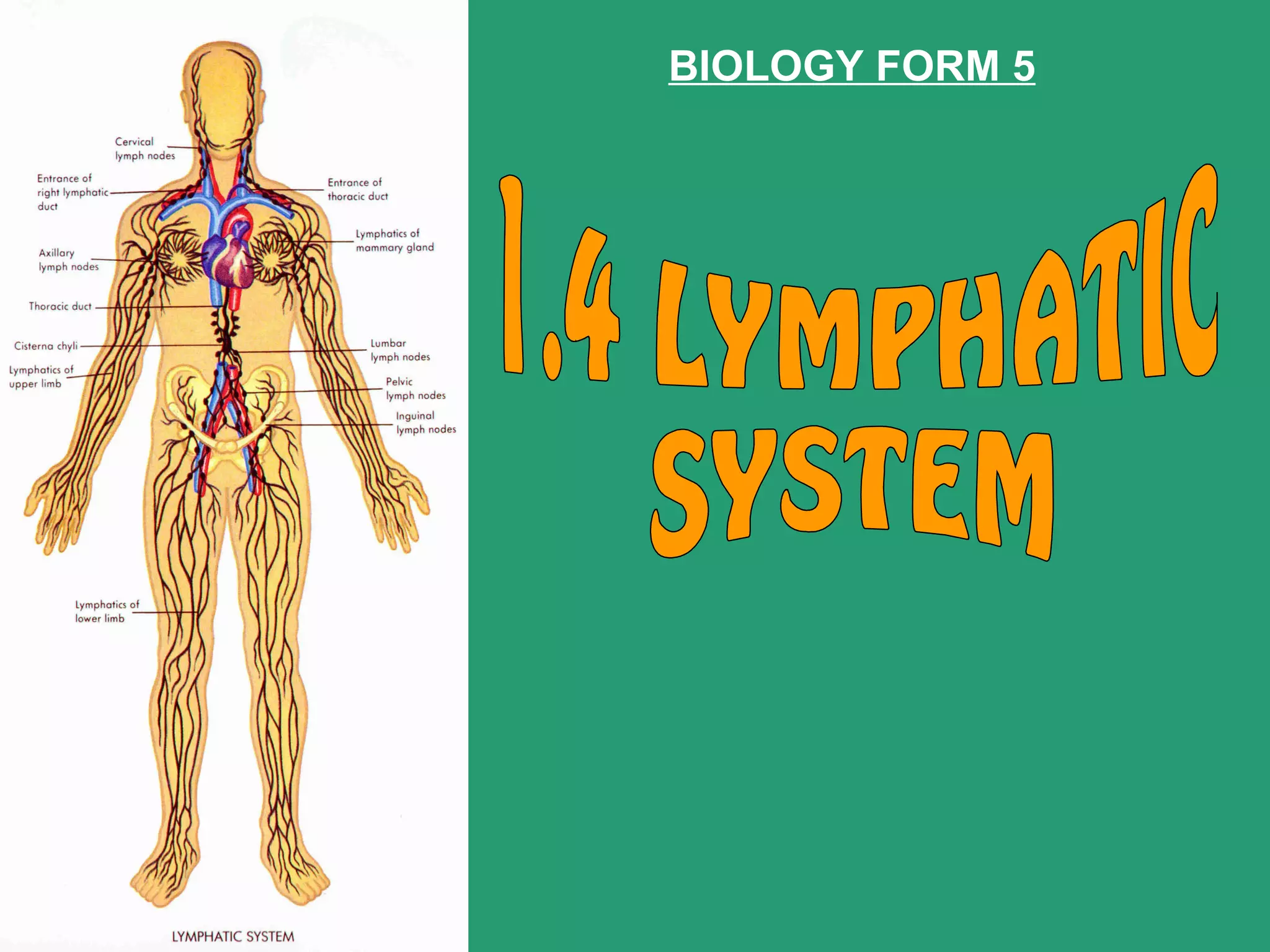
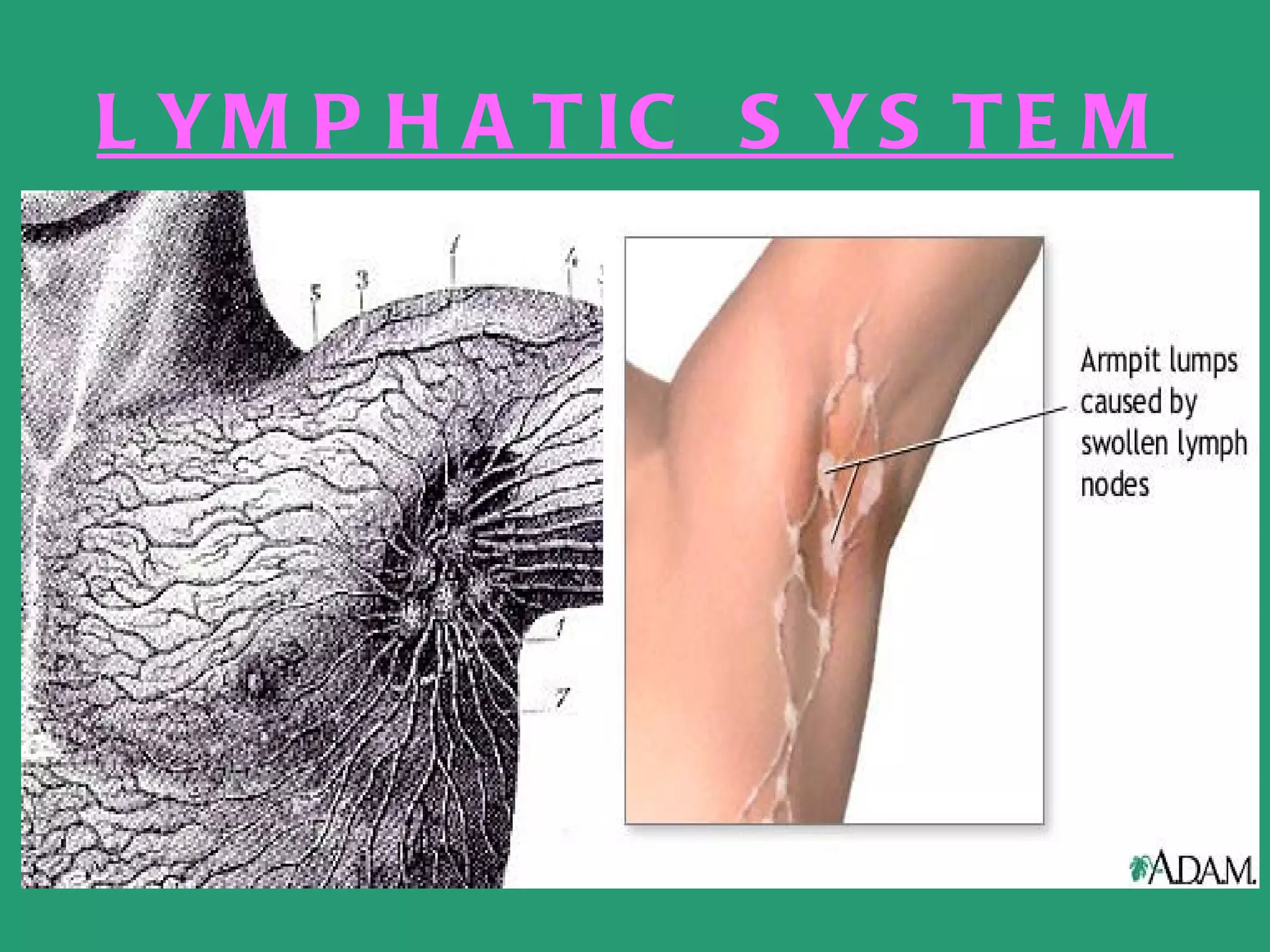
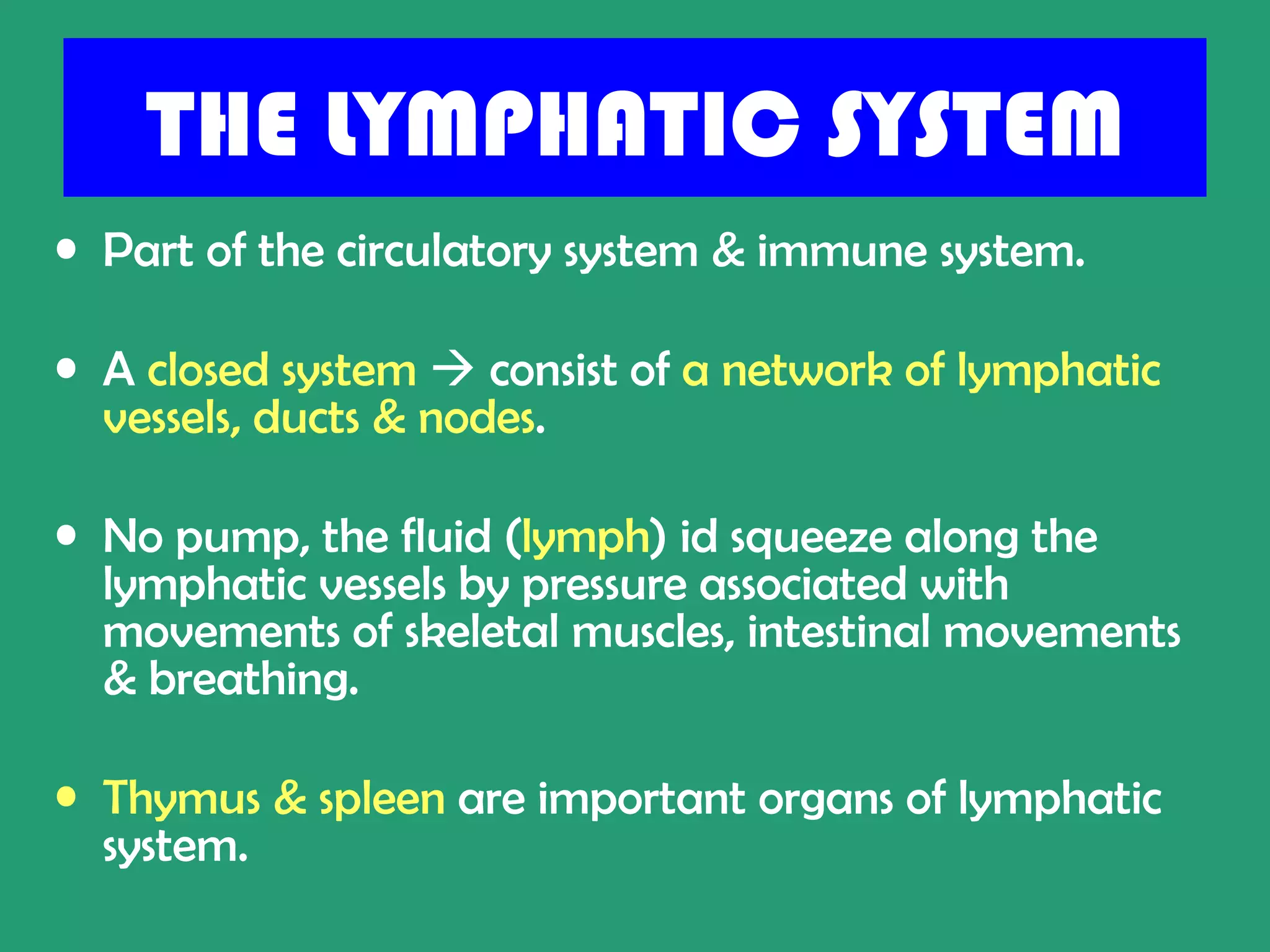
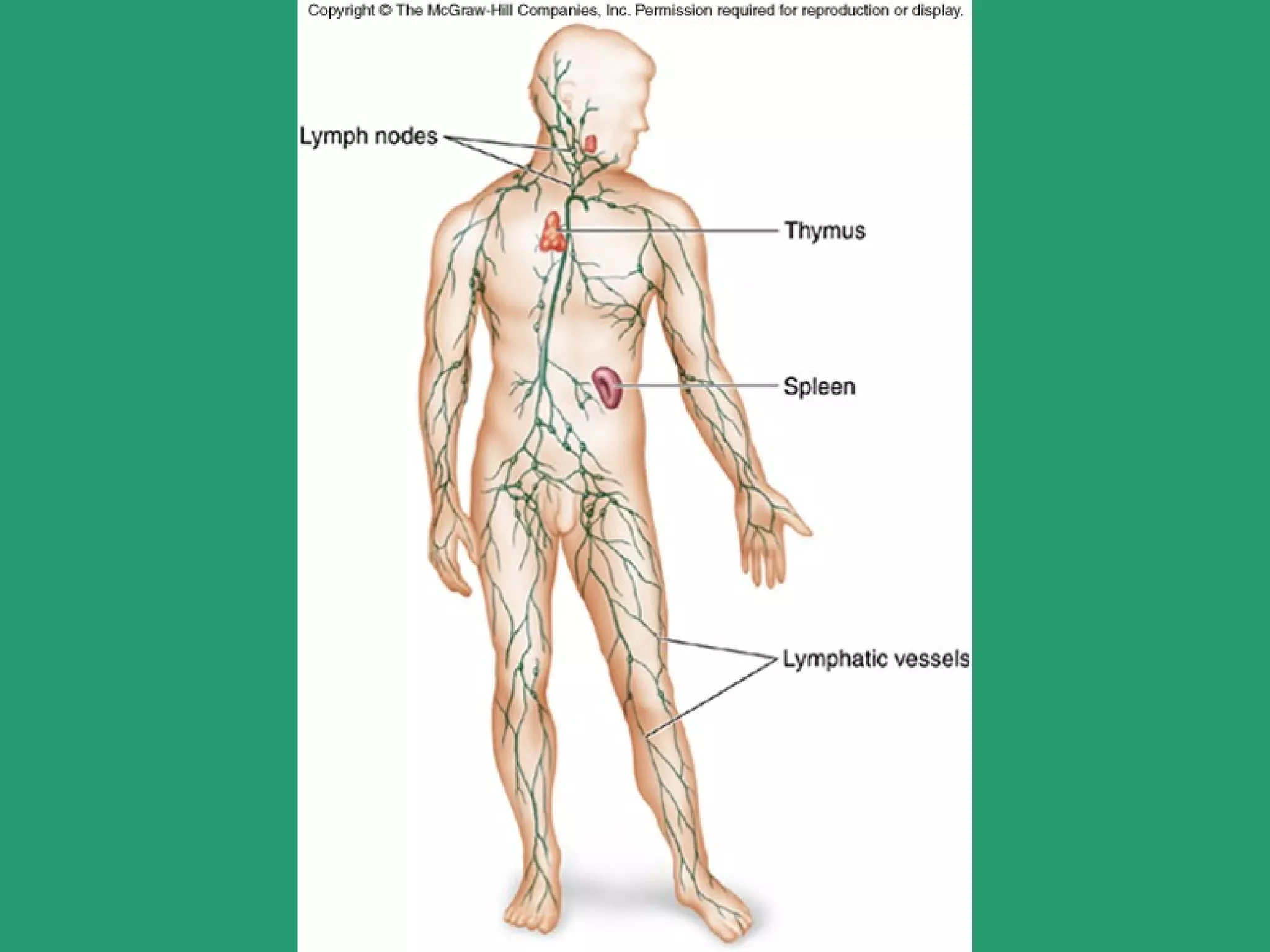
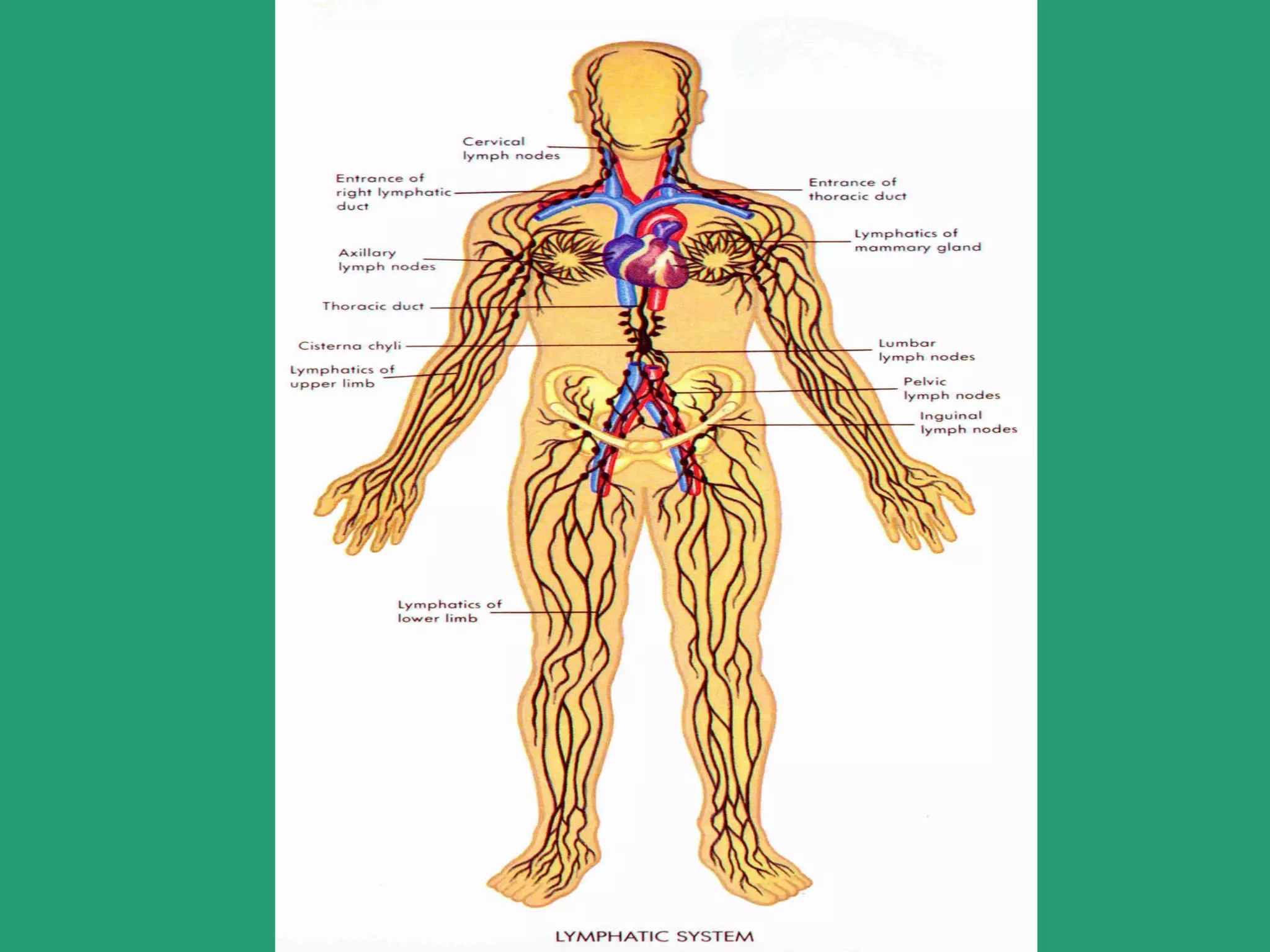
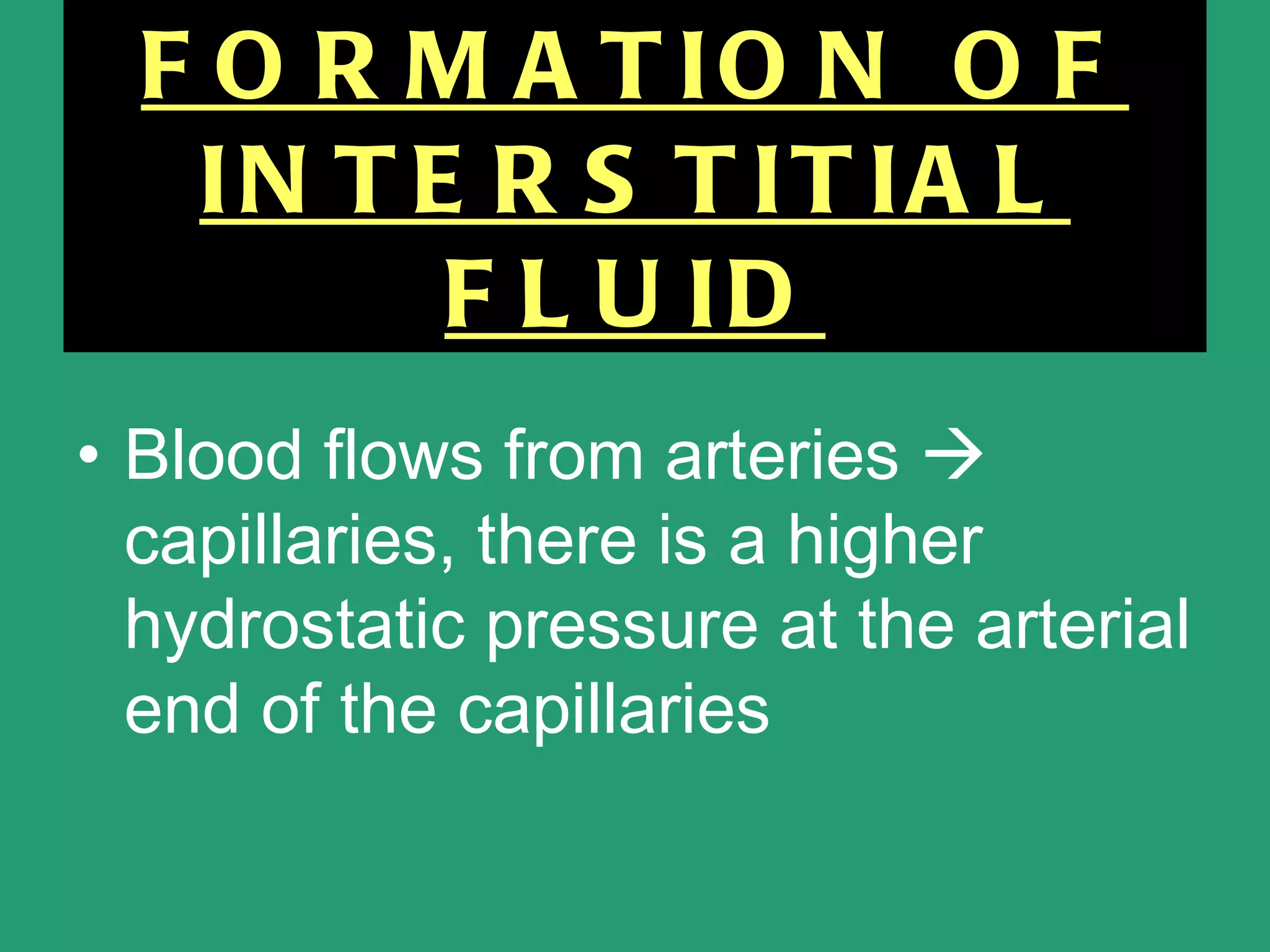
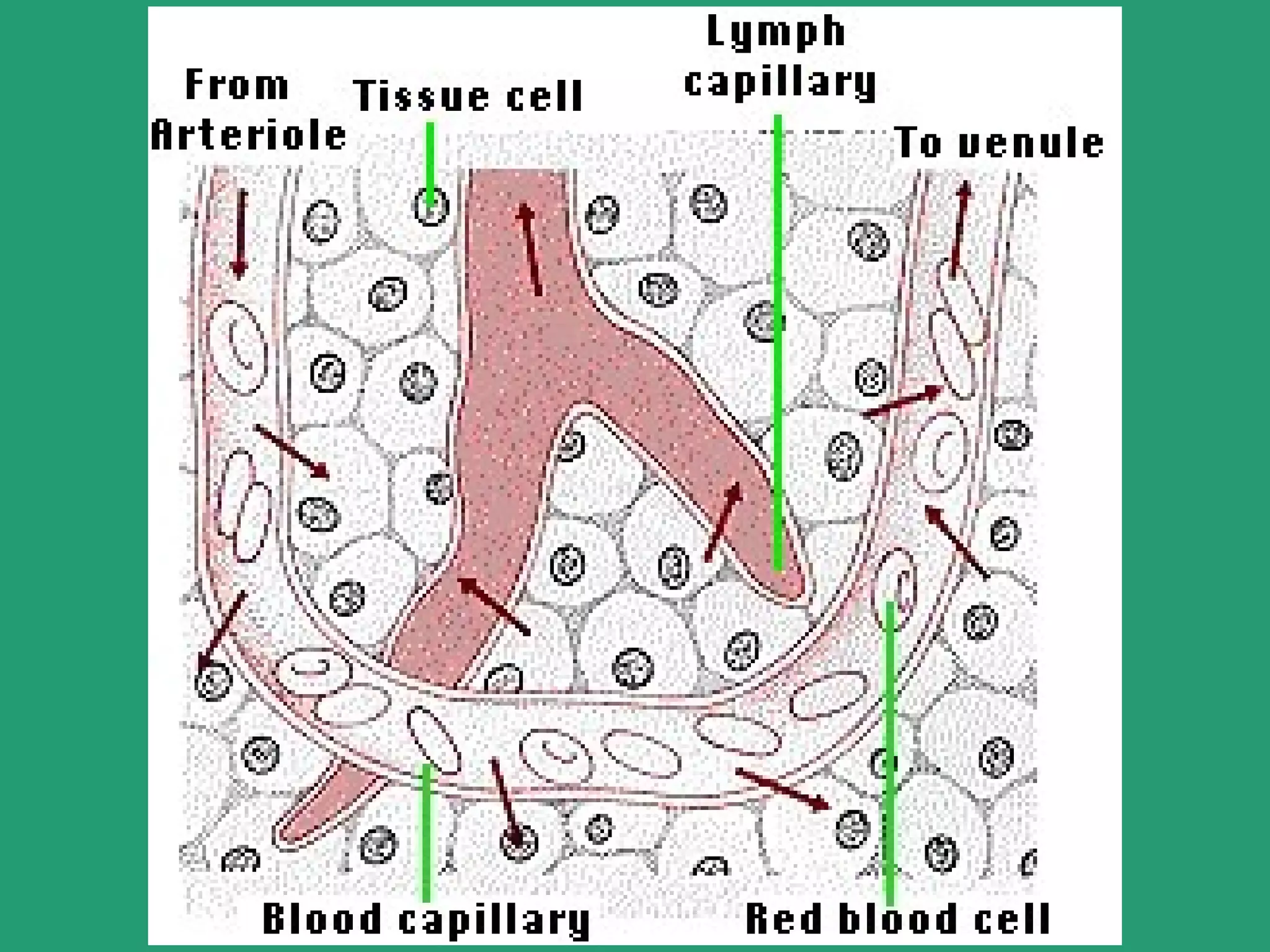
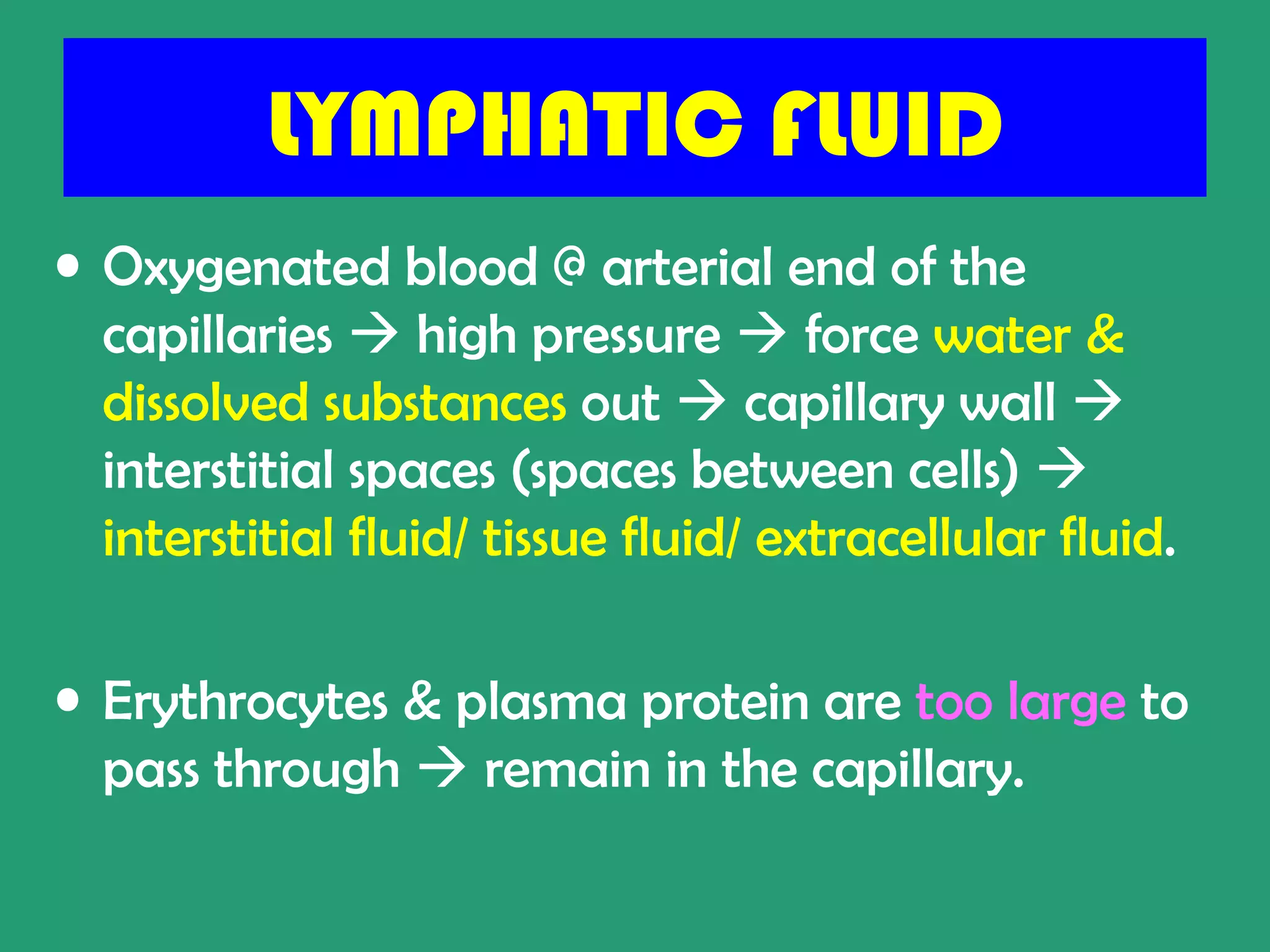
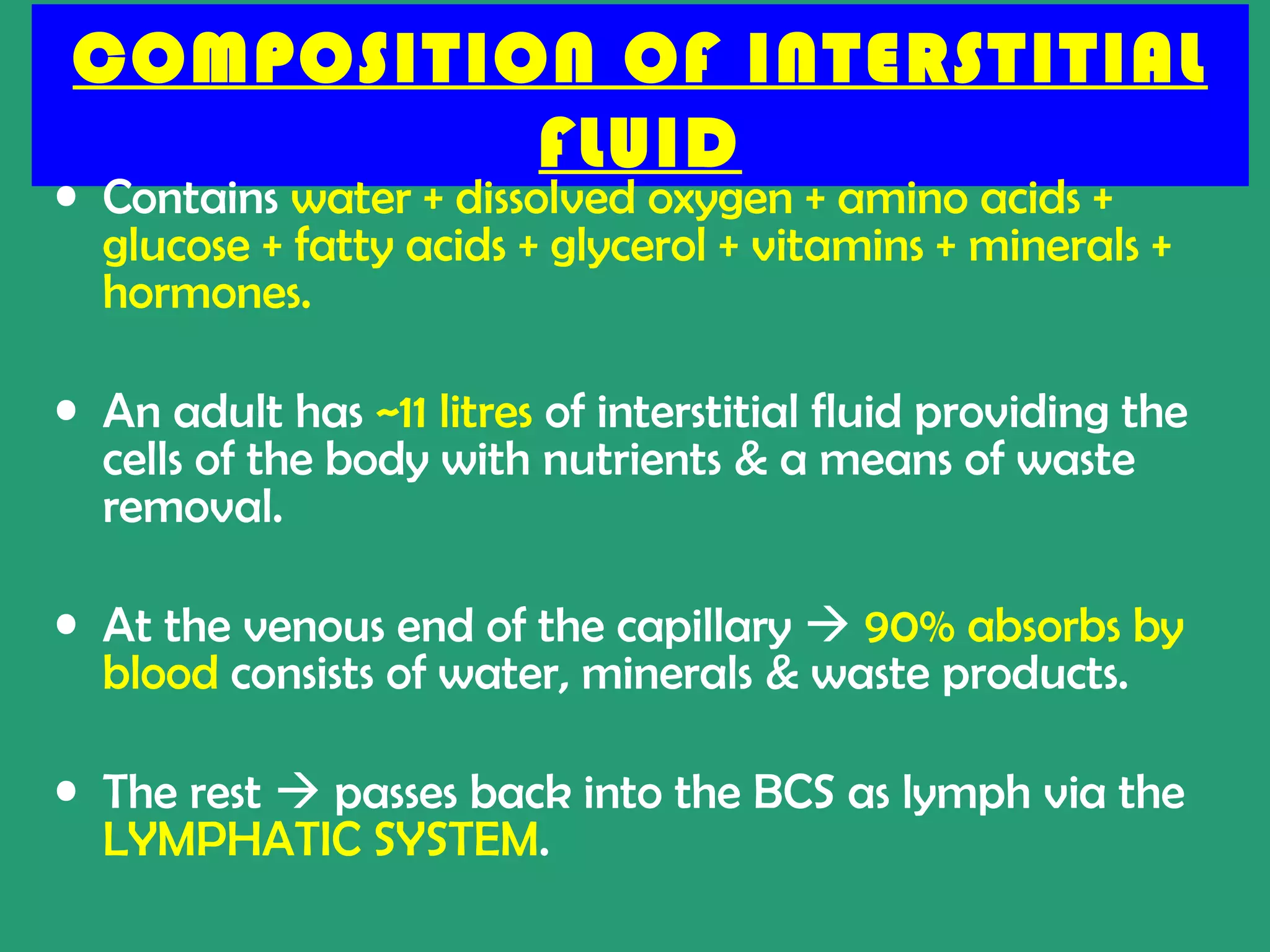
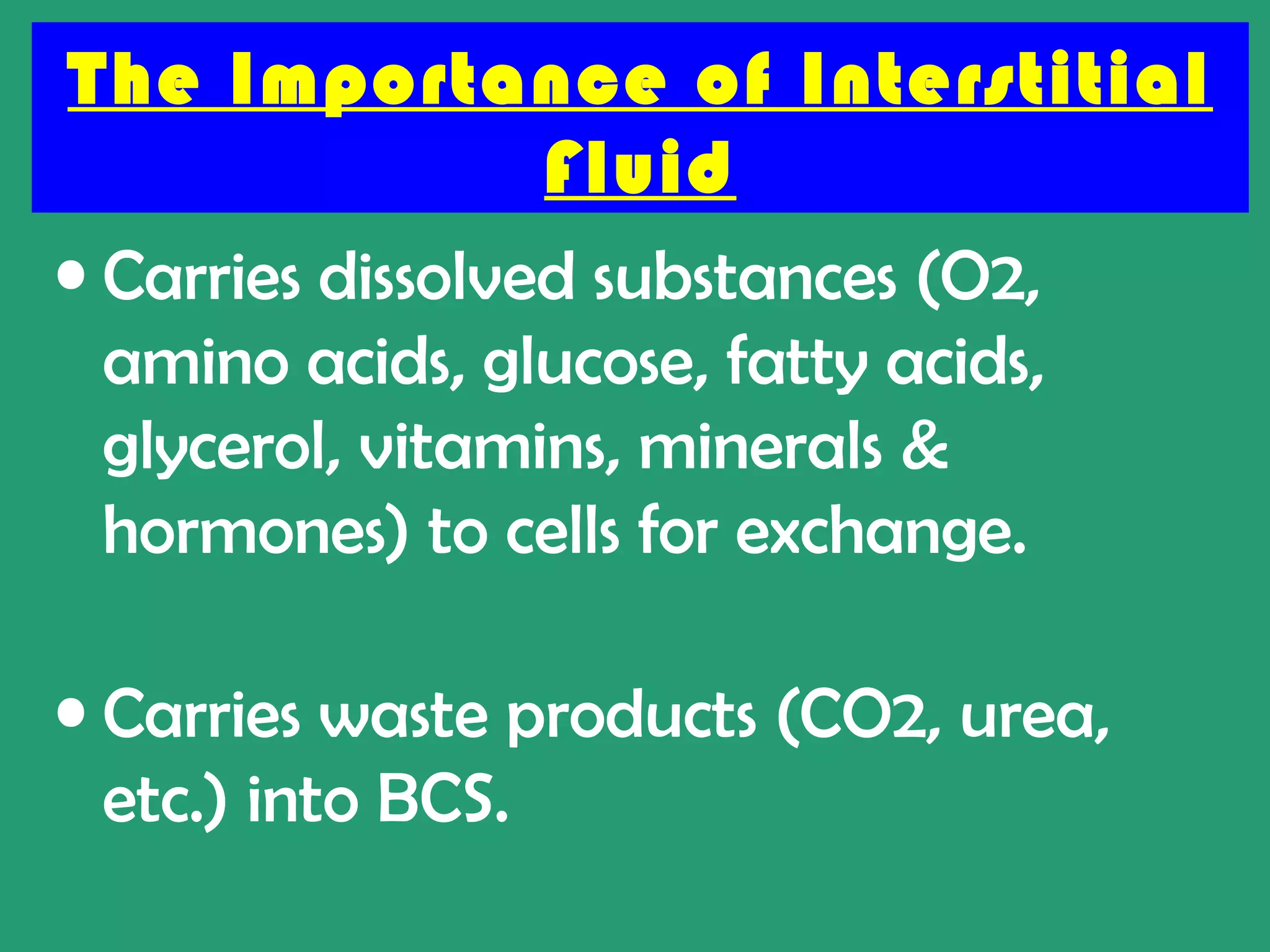
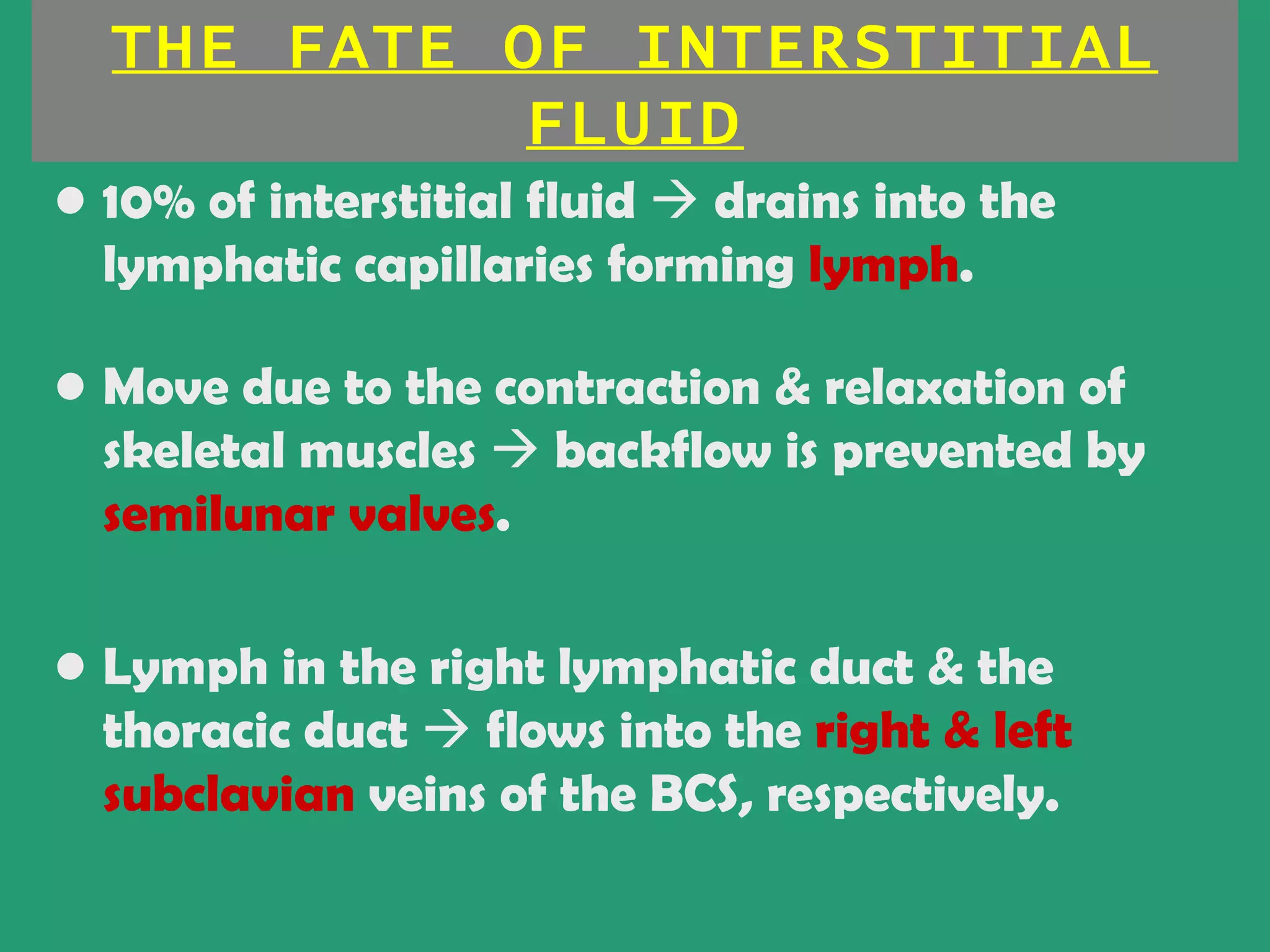
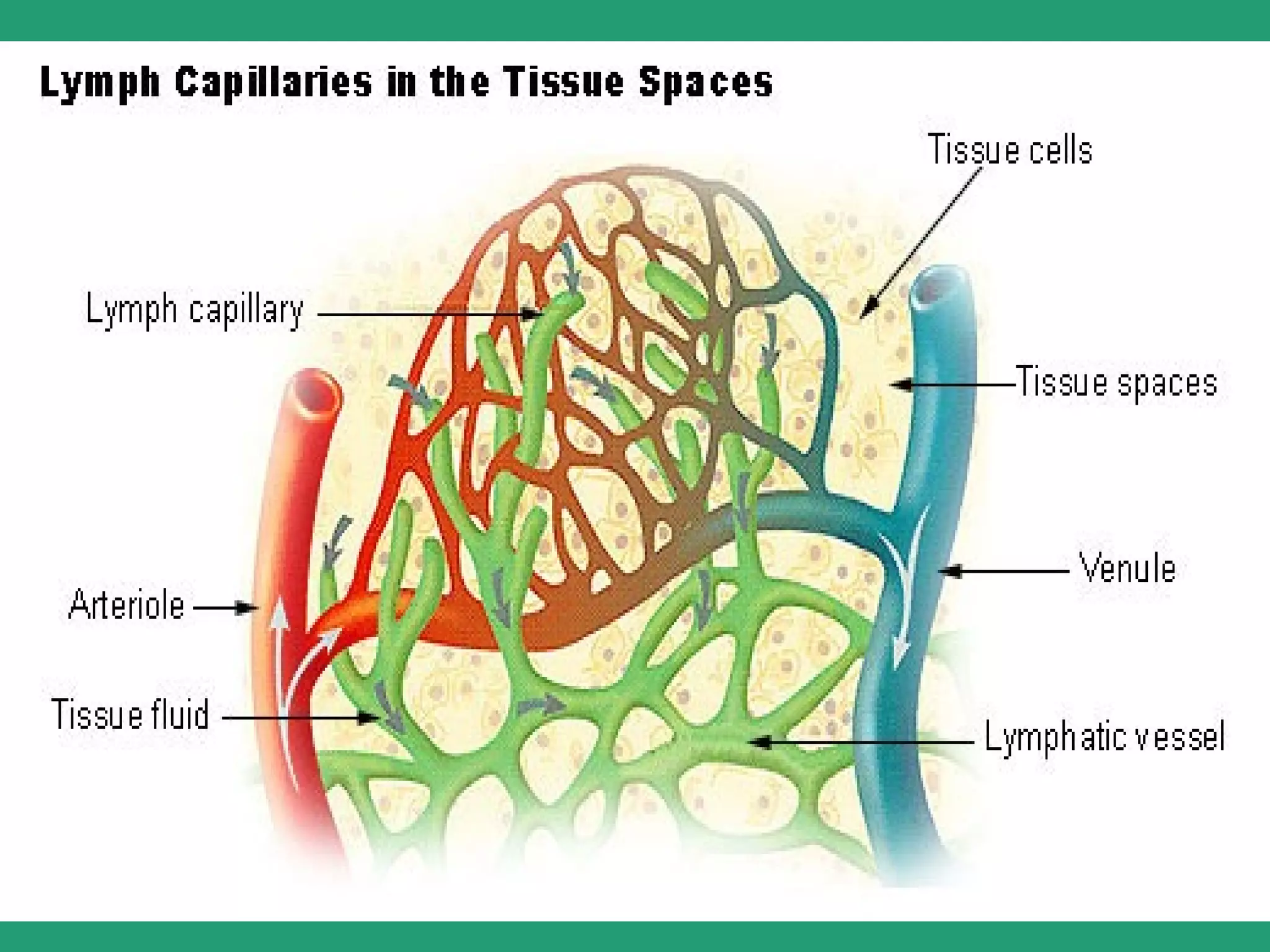
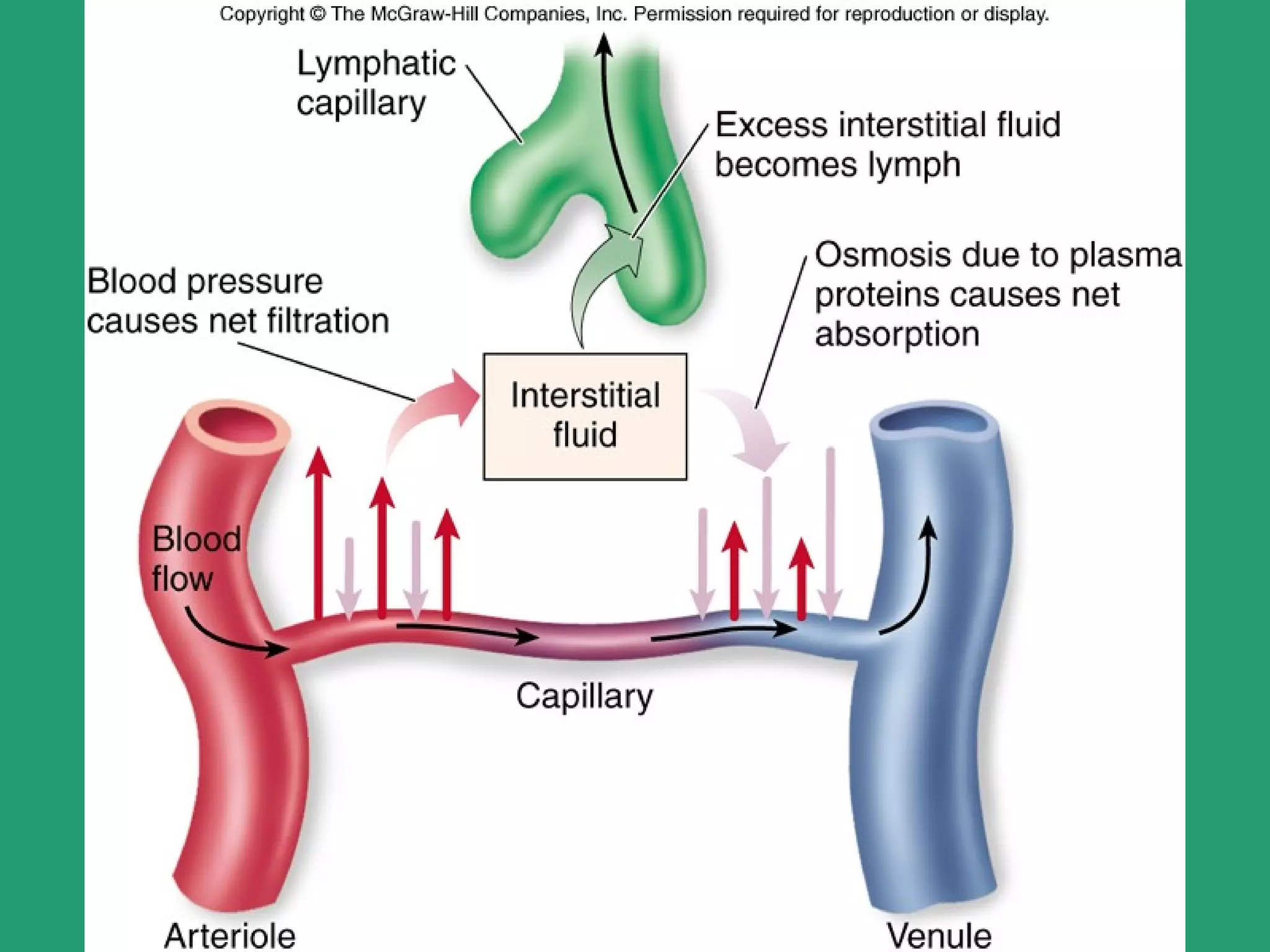
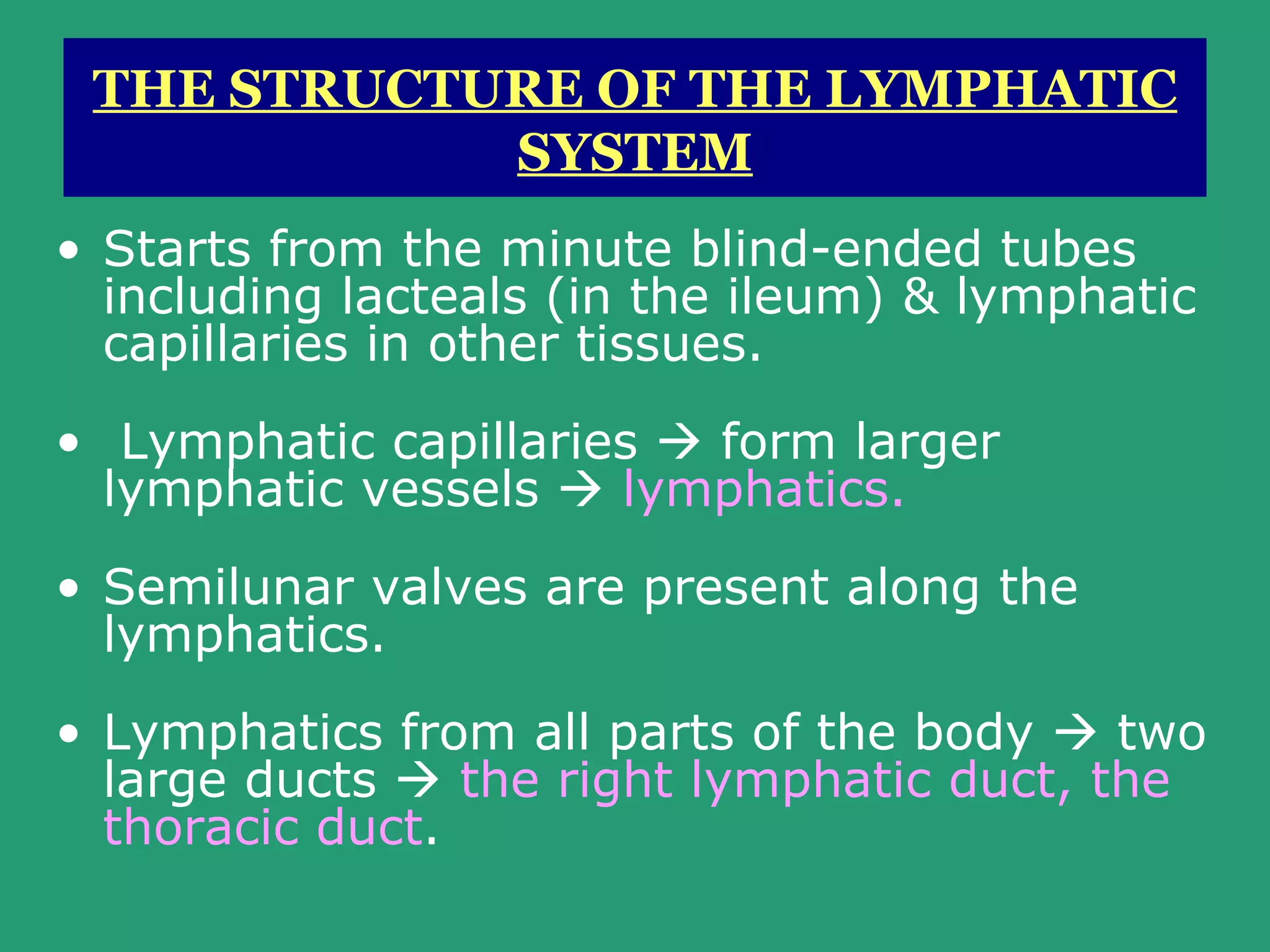
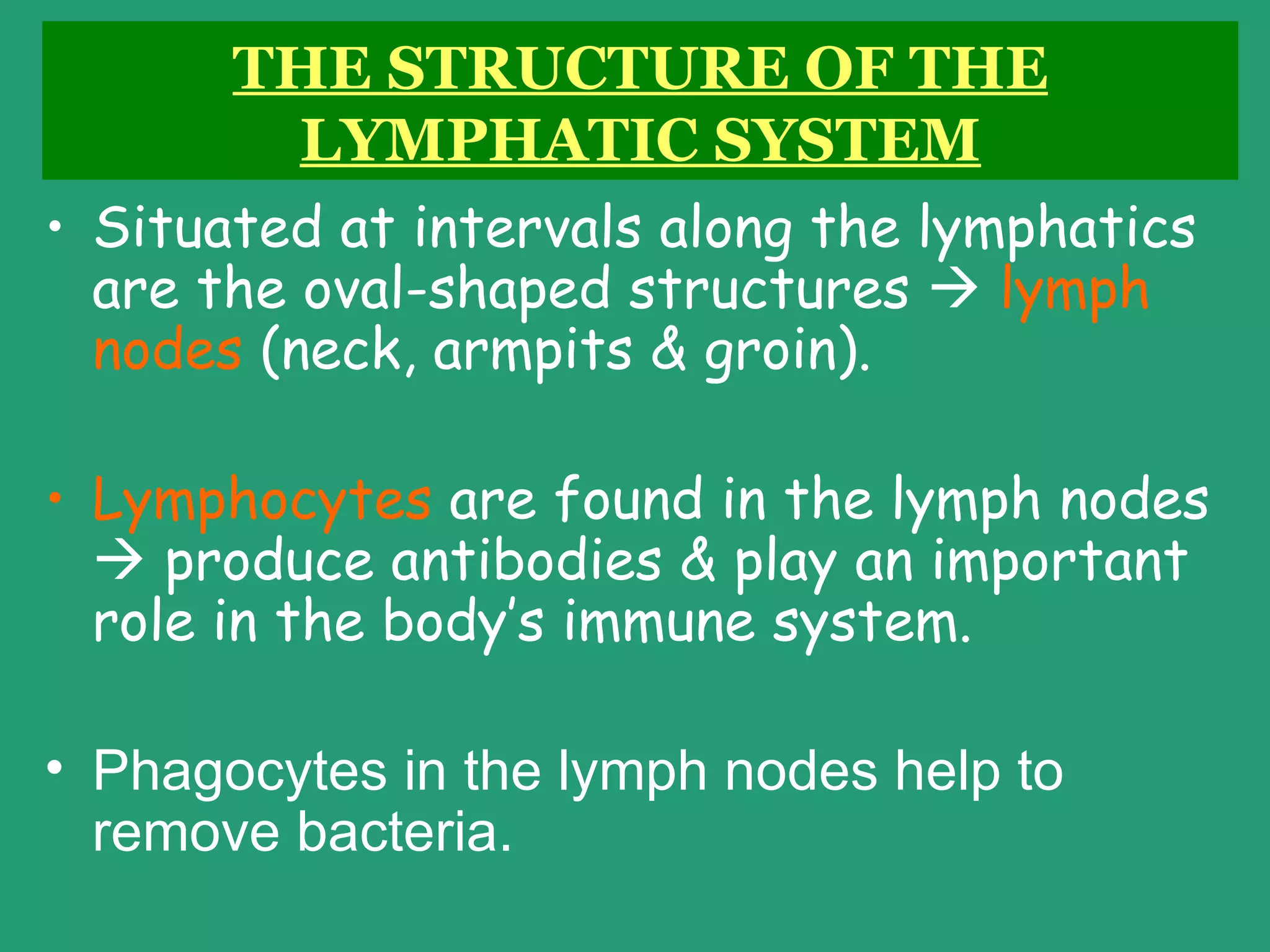
The lymphatic system is part of the circulatory and immune systems. It is made up of lymphatic vessels, ducts, and nodes that transport lymph fluid throughout the body. Interstitial fluid is formed from blood in capillaries and carries nutrients to cells, before 10% drains into lymphatic capillaries as lymph. Lymph is moved through the lymphatic system by muscle movement and flows into the subclavian veins. The lymphatic system includes lymph nodes that help fight infection.
![Sub 1[1].4 form 5 (part 1)](https://image.slidesharecdn.com/sub11-4-lymphaticsystempart1-120602212753-phpapp02/75/Sub-1-1-4-form-5-part-1-17-2048.jpg)
![Sub 1[1].4 form 5 (part 1)](https://image.slidesharecdn.com/sub11-4-lymphaticsystempart1-120602212753-phpapp02/75/Sub-1-1-4-form-5-part-1-18-2048.jpg)


![Chapter 1[1.4 1.6]]](https://cdn.slidesharecdn.com/ss_thumbnails/chapter11-4-1-6-120302031757-phpapp02-thumbnail.jpg?width=640&height=640&fit=bounds)
![Sub 1[1].4 form 5](https://cdn.slidesharecdn.com/ss_thumbnails/sub11-4-lymphaticsystempart2-120602212533-phpapp02-thumbnail.jpg?width=640&height=640&fit=bounds)


![Sub 1[2].2 form 5 a](https://cdn.slidesharecdn.com/ss_thumbnails/sub12-2-circulatorysystem2009a-120602213429-phpapp01-thumbnail.jpg?width=640&height=640&fit=bounds)

![Subtopic 3[1].2 FORM 5](https://cdn.slidesharecdn.com/ss_thumbnails/subtopic31-2-120603000911-phpapp01-thumbnail.jpg?width=640&height=640&fit=bounds)
![Subtopic 3 1[1] FORM 5](https://cdn.slidesharecdn.com/ss_thumbnails/subtopic3-11-120603001001-phpapp01-thumbnail.jpg?width=640&height=640&fit=bounds)
![Sub 2[1].3 FORM 5](https://cdn.slidesharecdn.com/ss_thumbnails/sub21-3supportinplants-120602235702-phpapp02-thumbnail.jpg?width=640&height=640&fit=bounds)
![2[1].1 (c) FORM 5](https://cdn.slidesharecdn.com/ss_thumbnails/21-1c-themechanisimoflocomotioninanimals-120602235904-phpapp01-thumbnail.jpg?width=640&height=640&fit=bounds)
![4[1].6 FORM 5](https://cdn.slidesharecdn.com/ss_thumbnails/41-6-growthinmulticellularorganisms-120603003459-phpapp02-thumbnail.jpg?width=640&height=640&fit=bounds)
![5[1].3 form 5](https://cdn.slidesharecdn.com/ss_thumbnails/51-3geneschromosomes-120603004012-phpapp02-thumbnail.jpg?width=640&height=640&fit=bounds)
![4[1].1 FORM 5](https://cdn.slidesharecdn.com/ss_thumbnails/41-1theformationofgametes-120603003019-phpapp01-thumbnail.jpg?width=640&height=640&fit=bounds)
![4[1].7 FORM 5](https://cdn.slidesharecdn.com/ss_thumbnails/41-7-thegrowthcurve-120603002724-phpapp02-thumbnail.jpg?width=640&height=640&fit=bounds)
![Sub 1[1].7 form 5](https://cdn.slidesharecdn.com/ss_thumbnails/sub11-7-transportinplants-120602213515-phpapp02-thumbnail.jpg?width=640&height=640&fit=bounds)
![4[1].3 FORM 5](https://cdn.slidesharecdn.com/ss_thumbnails/41-3earlydevelopmentofzygote-120603003204-phpapp02-thumbnail.jpg?width=640&height=640&fit=bounds)
![3[1].3 FORM 5](https://cdn.slidesharecdn.com/ss_thumbnails/31-3-appreciate-120603000912-phpapp02-thumbnail.jpg?width=640&height=640&fit=bounds)
![Sub 1[1].5 form 5](https://cdn.slidesharecdn.com/ss_thumbnails/sub11-5bodydefencemechanism-120602213445-phpapp01-thumbnail.jpg?width=640&height=640&fit=bounds)
![4[1].2 FORM 5](https://cdn.slidesharecdn.com/ss_thumbnails/41-2-menstrualcycle-120603003033-phpapp01-thumbnail.jpg?width=640&height=640&fit=bounds)
![6[1].2 form 5](https://cdn.slidesharecdn.com/ss_thumbnails/61-2-causesofvariation-120603003705-phpapp02-thumbnail.jpg?width=640&height=640&fit=bounds)
![4[1].4 FORM 5](https://cdn.slidesharecdn.com/ss_thumbnails/41-4-thecontributionofst-120603003308-phpapp01-thumbnail.jpg?width=640&height=640&fit=bounds)
![Sub 2[1].2 FORM5](https://cdn.slidesharecdn.com/ss_thumbnails/sub21-2healthymusculoskeletalsystem-120602235534-phpapp02-thumbnail.jpg?width=640&height=640&fit=bounds)
![6[1].1 form 5](https://cdn.slidesharecdn.com/ss_thumbnails/61-1-variationinorganisms-120603005250-phpapp01-thumbnail.jpg?width=640&height=640&fit=bounds)
![6[1].3 form 5](https://cdn.slidesharecdn.com/ss_thumbnails/61-3-respectfultowardsanother-120603003718-phpapp02-thumbnail.jpg?width=640&height=640&fit=bounds)


![Sub 1[1].2 form 5](https://cdn.slidesharecdn.com/ss_thumbnails/sub11-2-circulatorysystem2009c-120602212659-phpapp01-thumbnail.jpg?width=640&height=640&fit=bounds)
![Sub 1[1].1 form 5](https://cdn.slidesharecdn.com/ss_thumbnails/sub11-1-theimportanceof-120602212548-phpapp01-thumbnail.jpg?width=640&height=640&fit=bounds)
![Sub 1[1].2 form 5](https://cdn.slidesharecdn.com/ss_thumbnails/sub11-2-circulatorysystem2009b-120602212604-phpapp02-thumbnail.jpg?width=640&height=640&fit=bounds)
![Sub 1[1].8 form 5](https://cdn.slidesharecdn.com/ss_thumbnails/sub11-8-transportoforganiccompound-120602213146-phpapp02-thumbnail.jpg?width=640&height=640&fit=bounds)
![2[1].1 (a) FORM 5](https://cdn.slidesharecdn.com/ss_thumbnails/21-1a-supportlocomotioninhumansanimals-120602235814-phpapp02-thumbnail.jpg?width=640&height=640&fit=bounds)
![2[1].1 (b) FORM 5](https://cdn.slidesharecdn.com/ss_thumbnails/21-1b-roleofmusclesligamentstendonsin-120602235830-phpapp02-thumbnail.jpg?width=640&height=640&fit=bounds)
![4[1].5 FORM 5](https://cdn.slidesharecdn.com/ss_thumbnails/41-5-floweringplant-120603003443-phpapp01-thumbnail.jpg?width=640&height=640&fit=bounds)
![Sub 1[1].3 form 5](https://cdn.slidesharecdn.com/ss_thumbnails/sub11-3-bloodclotmechanism-120602212724-phpapp01-thumbnail.jpg?width=640&height=640&fit=bounds)
![5[1].1 form 5](https://cdn.slidesharecdn.com/ss_thumbnails/51-1theconceptofinheritance-120603003907-phpapp02-thumbnail.jpg?width=640&height=640&fit=bounds)

![Sub 1[1].6 form5](https://cdn.slidesharecdn.com/ss_thumbnails/sub11-6cardio-120602213456-phpapp01-thumbnail.jpg?width=640&height=640&fit=bounds)


