4D‐IGRT:
Certain Phase of Respiration


       Christopher D. Willey, MD, PhD
             Assistant Professor
     Department of Radiation Oncology
  The University of Alabama at Birmingham
Disclosures
• I do occasional speaking/consultation for
  I do occasional speaking/consultation for 
  Varian Medical Systems, Inc.
Learning Objectives
          Learning Objectives
• Discuss rationale for IGRT
  Discuss rationale for IGRT
• Understand the basic process involved in 4D 
  IGRT
• Learn about several gating/motion 
  management strategies
• Simulation and planning concepts for 4D 
  treatment will be discussed.
Outline
• Concepts
• IGRT
  – D fi d
    Defined
  – Technologies
• Applications


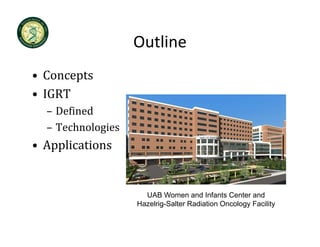
                     UAB Women and Infants Center and
                   Hazelrig-Salter R di ti Oncology Facility
                   H   l i S lt Radiation O    l    F ilit
Big Picture Concepts
          Big Picture Concepts
• Radiation penetrates all tissues
  Radiation penetrates all tissues
• Radiation can destroy all tissues (normal 
  and tumor)
  and tumor)
• Therapeutic ratio:
       Probability of tumor control
    Probability of normal tissue toxicity
• Ideal: Maximize tumor kill, spare normal 
              p
  tissue, and preserve function
Big Picture Concepts
            Big Picture Concepts
• Factors involved in therapeutic ratio:
      • Tumor delineation: CT, PET, MRI, SPECT
      • Precision dose distribution: Brachy, SRS/SBRT, IMRT, 
        Protons  Adaptation
                         p
      • Accurate Delivery:  Immobilization and guidance 
        (IGRT)
      • F ti
        Fractionation and Total dose
                 ti       dT t ld
      • Dose per fraction
                       ,     ,   / , p
      • Dose rate: LDR, HDR, SRS/BT, RapidArc 
      • Radiation modifiers: Radiation protectors and sensitizers
      • Tumor Type
      • Real Estate (Anatomical site): Location, location, location
Big Picture Concepts
                   Big Picture Concepts
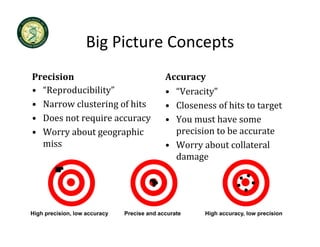
Precision                                    Accuracy
• “Reproducibility”                          • “Veracity”
• Narrow clustering of hits
                   g                         • Closeness of hits to target
                                               Closeness of hits to target
• Does not require accuracy                  • You must have some 
• Worry about geographic                       precision to be accurate
  miss                                       • Worry about collateral 
                                               damage


High precision, low accuracy   Precise and accurate   High accuracy, low precision
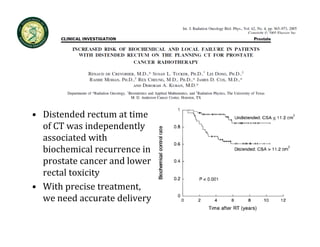
• Distended rectum at time 
  of CT was independently 
  associated with 
  associated with
  biochemical recurrence in 
  prostate cancer and lower 
  rectal toxicity
      t l t i it
• With precise treatment, 
  we need accurate deliveryy
Volumes
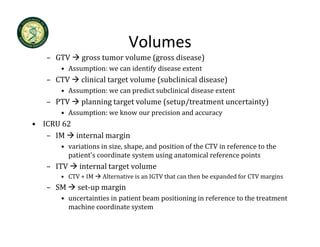
   – GTV     gross tumor volume (gross disease)
       • Assumption: we can identify disease extent
   – CTV     clinical target volume ( b l
              l     l          l    (subclinical disease)
                                               ld       )
       • Assumption: we can predict subclinical disease extent
   – PTV     planning target volume (setup/treatment uncertainty)
       • Assumption: we know our precision and accuracy
• ICRU 62
   – IM  internal margin
                     g
       • variations in size, shape, and position of the CTV in reference to the 
         patient's coordinate system using anatomical reference points
   – ITV     internal target volume
                         g
       • CTV + IM    Alternative is an IGTV that can then be expanded for CTV margins
   – SM     set‐up margin
       • uncertainties in patient beam positioning in reference to the treatment 
                          p            p         g
         machine coordinate system
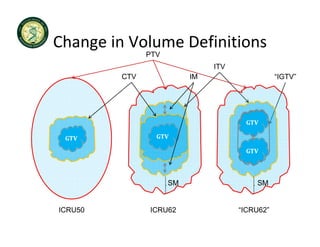
Change in Volume Definitions
Change in Volume Definitions
               PTV
                               ITV
         CTV              IM                    “IGTV”
                                                 IGTV


                                      GTV

 GTV             GTV

                                      GTV


                     SM                  SM


ICRU50         ICRU62                “ICRU62”
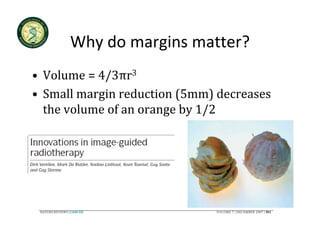
Why do margins matter?
      Why do margins matter?
• Volume = 4/3πr3
  Volume = 4/3πr
• Small margin reduction (5mm) decreases 
  the volume of an orange by 1/2
  the volume of an orange by 1/2
Big Picture Concepts
          Big Picture Concepts
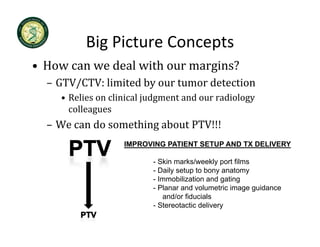
• How can we deal with our margins?
  – GTV/CTV: limited by our tumor detection
    • Relies on clinical judgment and our radiology 
      colleagues
  – We can do something about PTV!!!
                   IMPROVING PATIENT SETUP AND TX DELIVERY
                          - Skin marks/weekly port films
                          - Daily setup to bony anatomy
                          - Immobilization and gating
                          - Planar and volumetric image guidance
                             and/or fiducials
                          - Stereotactic delivery
In Search of Guidance
         In Search of Guidance
• Effectively identify tumor and normal tissue
  Effectively identify tumor and normal tissue
• Accurately align patient and precisely treat
  – Sh ld h l
    Should help with inter‐fraction motion
                 i hi      f    i      i
• What about intra‐fraction motion?
  – Three general approaches:
     • Enlarge PTV margin
     • Prevent motion  possible in some instances but 
       not particularly comfortable
     • Track motion
       Track motion
Definitions
• Image guided radiation therapy (IGRT)
  Image guided radiation therapy (IGRT).   
  Two parts:
  – Use of modern imaging techniques for defining
    Use of modern imaging techniques for defining 
    tumor and normal structures
  – Use of modern imaging techniques to accurately
    Use of modern imaging techniques to accurately 
    and precisely deliver treatment
Broad Definition  6 D s of IGRT
         Broad Definition – 6 D’s of IGRT
  •   Detection and diagnosis
      Detection and diagnosis
  •   Determining biological attributes
  •   Delineation of target and organs at risk
        l          f          d              k
  •   Dose distribution design
  •   Dose delivery assurance
  •   Deciphering treatment response through 
      Deciphering treatment response through
      imaging

Greco, Carlo and Clifton Ling, C.(2008)'Broadening the scope of Image-Guided Radiotherapy (IGRT)',Acta
Oncologica,47:7,1193 — 1200
IGRT Tools
                    IGRT Tools
• Treatment planning:
  – PET/CT
  – MRI
   – 4D CT
     4D CT
• Treatment  delivery:
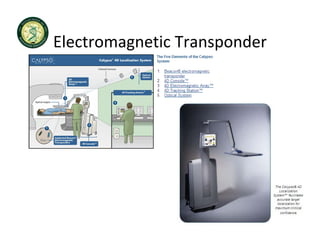
  –   Electromagnetic transponder (Calypso)
      Electromagnetic transponder (Calypso)
  –   Ultrasound
  –   Video
  –   Planar (2D)
  –   Volumetric (3D)
  – Gating (and immobilization)
Electromagnetic Transponder
Electromagnetic Transponder
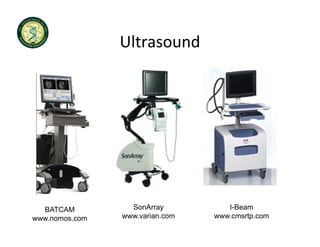
Ultrasound


  BATCAM          SonArray          I-Beam
www.nomos.com   www.varian.com   www.cmsrtp.com
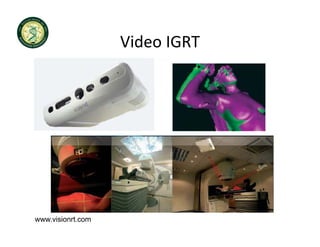
Video IGRT
                   Video IGRT


www.visionrt.com
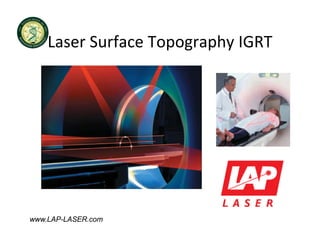
Laser Surface Topography IGRT
    Laser Surface Topography IGRT


www.LAP-LASER.com
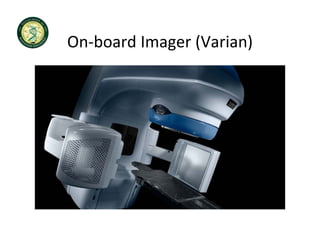
On board Imager (Varian)
On‐board Imager (Varian)
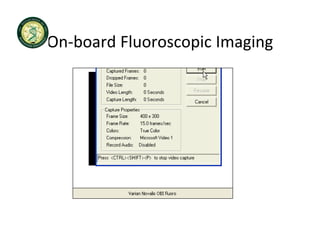
On board Fluoroscopic Imaging
On‐board Fluoroscopic Imaging
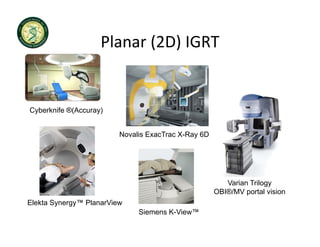
Planar (2D) IGRT
                    Planar (2D) IGRT


Cyberknife ®(Accuray)
C b k if ®(A        )


                         Novalis ExacTrac X-Ray 6D


                                                        Varian Trilogy
                                                     OBI®/MV portal vision
Elekta Synergy™ PlanarVie
       S nerg ™ PlanarView
                              Siemens K-View™
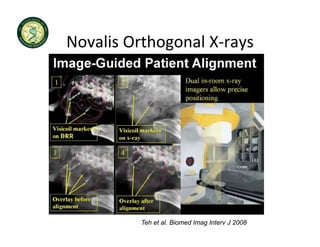
Novalis Orthogonal X rays
Novalis Orthogonal X‐rays


         Teh et al. Biomed Imag Interv J 2008
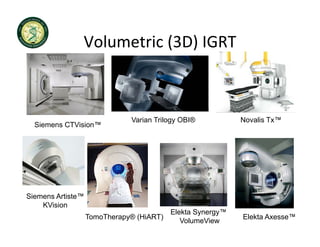
Volumetric (3D) IGRT
               Volumetric (3D) IGRT


                              Varian Trilogy OBI®           Novalis Tx™
  Siemens CTVision™


Siemens Artiste™
    KVision
                                          Elekta Synergy™
                   TomoTherapy® (HiART)                     Elekta Axesse™
                                             VolumeView
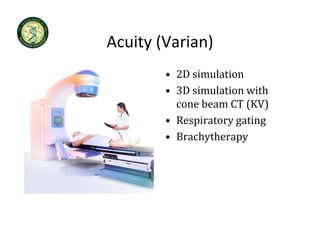
Acuity (Varian)
Acuity (Varian)
        • 2D simulation
          2D simulation
        • 3D simulation with 
          cone beam CT (KV)
                        ( )
        • Respiratory gating
        • Brachytherapy
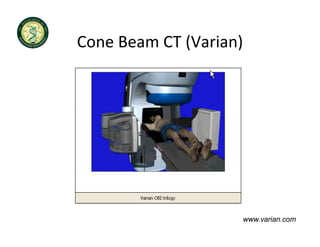
Cone Beam CT (Varian)
Cone Beam CT (Varian)


                    www.varian.com
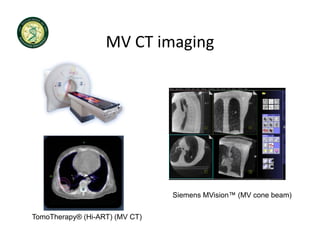
MV CT imaging
                   MV CT imaging


                                Siemens MVision™ (MV cone beam)

TomoTherapy® (Hi-ART) (MV CT)
Prostate
The Problem with Motion
      The Problem with Motion
• Motion is inevitable:
  Motion is inevitable:
  – Interfraction
  – Intrafraction
• Example: Lung tumor motion with free breathing 
  (Liu et al. IJROBP 2007)
  (Li t l IJROBP 2007)
   – 95% of patients will have motion less than…
      • 0 59
        0.59 cm in the AP
                  i h AP
      • 0.4 cm in the lateral
      • 1.34 cm in the SI
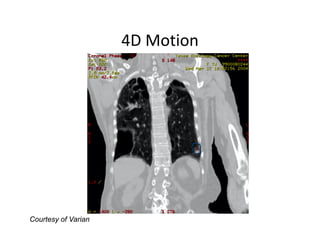
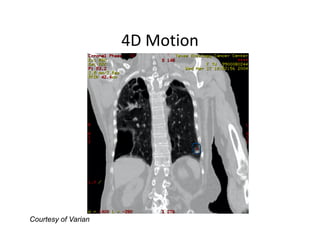
4D Motion
                     4D Motion


Courtesy of Varian
Motion Management Options
   Motion Management Options
• Ignore (ie, account for motion)
• Prevent motion
  – Breath Hold/Breath Control
  – BodyFix (Elekta)
        p              (      )
  – Compression device (Elekta)
• Track the motion
  – Cyberknife (Accuray)
    Cyberknife (Accuray)
  – ExacTrac X‐Ray 6D Adaptive Tracking 
    (Varian/Novalis)
  – 4D CT and respiratory gating
Accounting for Motion
        Accounting for Motion
• Traditional approach for lung tumors:
  – Free breathing CT simulation
  – ICRU50 defined GTV, CTV, and PTV plan
  – Verify patient on conventional simulator and 
    use fluoro to confirm that tumor mass is 
    contained within beam aperture
          i d i hi b
• Modern approach:
  – Respiratory correlated CT imaging (4DCT)
• Alternative:
  – Max excursion breath hold CT
Account for Motion (ITV)
      Account for Motion (ITV)
• Do end expiratory and end inspiratory CT’s
  Do end expiratory and end inspiratory CT s
  – Fuse volumes to create Max Intensity Volume 
    (MIV)
  – Project onto DRR to get Max Intensity 
    Projection (MIP)
    Projection (MIP)
• 4D‐CT  with phases
  – Generate a MIP which gives the ITV for
    Generate a MIP which gives the ITV for 
    contouring
  – Treat patient based on free breathing or “mean” 
    Treat patient based on free breathing or  mean
    CT
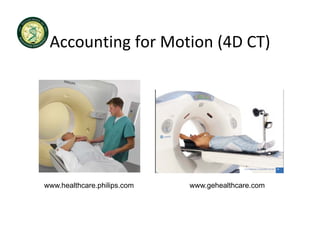
Accounting for Motion (4D CT)
 Accounting for Motion (4D CT)


www.healthcare.philips.com   www.gehealthcare.com
4D CT Approaches
           4D CT Approaches
• Helical  (Philips CT scanner with bellows)
  – Retrospective or prospective respiratory 
    correlated imaging
  – Image data at same respiratory phase is 
    combined from multiple respiratory cycles
• Cine (GE Lightspeed with Varian RPM)
  – Retrospective respiratory correlated imaging
  – Image data gathered for >1 respiratory cycle at 
    each couch position
Retrospective Respiratory 
       Correlation CT (4D Cine)
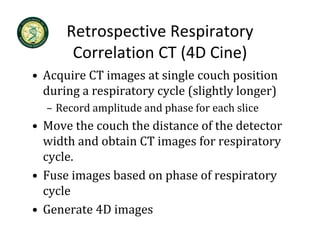
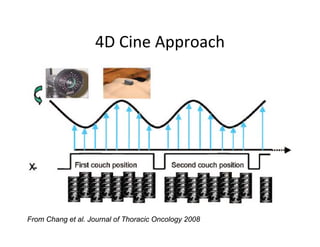
• Acquire CT images at single couch position
  Acquire CT images at single couch position 
  during a respiratory cycle (slightly longer)
  – Record amplitude and phase for each slice
    Record amplitude and phase for each slice
• Move the couch the distance of the detector 
  width and obtain CT images for respiratory 
    idth d bt i CT i         f        i t
  cycle.
• Fuse images based on phase of respiratory 
  cycle
• Generate 4D images
4D Cine Approach
                    4D Cine Approach


From Chang et al. Journal of Thoracic Oncology 2008
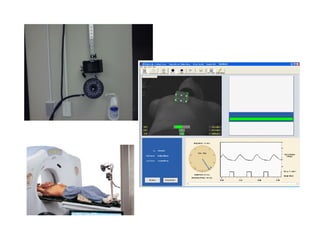
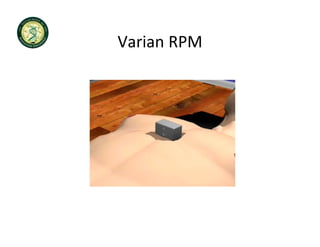
Varian RPM
  Varian RPM


MarkerBlock
MarkerBlock-
4D Motion
                     4D Motion


Courtesy of Varian
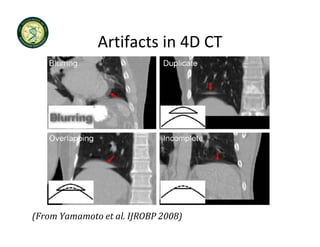
Artifacts in 4D CT
              Artifacts in 4D CT


(From Yamamoto et al. IJROBP 2008)
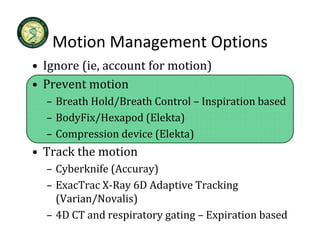
Motion Management Options
   Motion Management Options
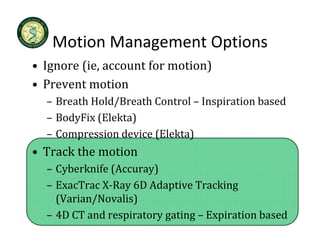
• Ignore (ie, account for motion)
• Prevent motion
  – Breath Hold/Breath Control – Inspiration based
  – BodyFix/Hexapod (Elekta)
        p              (      )
  – Compression device (Elekta)
• Track the motion
  – Cyberknife (Accuray)
    Cyberknife (Accuray)
  – ExacTrac X‐Ray 6D Adaptive Tracking 
    (Varian/Novalis)
  – 4D CT and respiratory gating – Expiration based
Immobilization
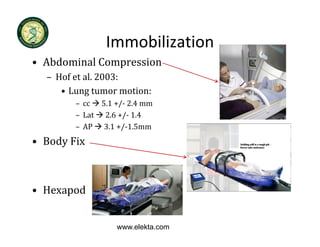
• Abdominal Compression
  – Hof et al 2003:
    Hof et al. 2003:
     • Lung tumor motion: 
        – cc  5.1 +/‐ 2.4 mm
        – Lat  2.6 +/‐ 1.4
        – AP  3.1 +/‐1.5mm
• B d Fi
  Body Fix


• Hexapod


                  www.elekta.com
Breathing Control
                  Breathing Control
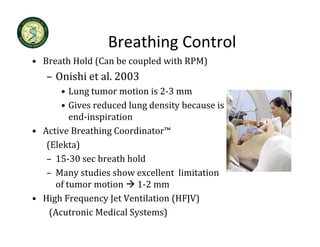
• Breath Hold (Can be coupled with RPM)
   – Onishi et al 2003
     Onishi et al. 2003
       • Lung tumor motion is 2‐3 mm
       • Gives reduced lung density because is
         Gives reduced lung density because is 
         end‐inspiration
• Active Breathing Coordinator™ 
   (Elekta)
   – 15‐30 sec breath hold
   – M
     Many studies show excellent  limitation 
             t di   h        ll t li it ti
     of tumor motion  1‐2 mm
• High Frequency Jet Ventilation (HFJV)
  High Frequency Jet Ventilation (HFJV)
    (Acutronic Medical Systems)
Motion Management Options
   Motion Management Options
• Ignore (ie, account for motion)
• Prevent motion
  – Breath Hold/Breath Control – Inspiration based
  – BodyFix (Elekta)
        p              (      )
  – Compression device (Elekta)
• Track the motion
  – Cyberknife (Accuray)
    Cyberknife (Accuray)
  – ExacTrac X‐Ray 6D Adaptive Tracking 
    (Varian/Novalis)
  – 4D CT and respiratory gating – Expiration based 
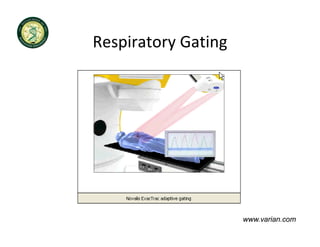
Respiratory Gating/Management
    Respiratory Gating/Management
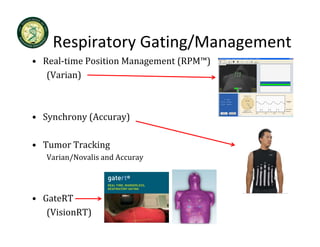
• Real‐time Position Management (RPM™) 
   (Varian)


• Synchrony (Accuray)

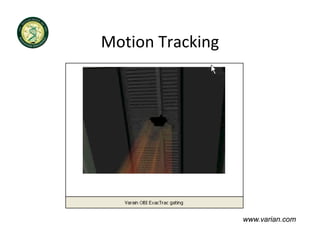
• Tumor Tracking
   Varian/Novalis and Accuray


• GateRT
  GateRT 
   (VisionRT)
Respiratory Gating
Respiratory Gating


                     www.varian.com
Motion Tracking
Motion Tracking


                  www.varian.com
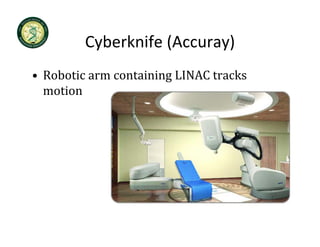
Cyberknife (Accuray)
         Cyberknife (Accuray)
• Robotic arm containing LINAC tracks
  Robotic arm containing LINAC tracks 
  motion
Precise Delivery (IMRT)
         Precise Delivery (IMRT)
• Ix and Trilogy (Varian)
     and Trilogy (Varian)
    – RapidArc™
•   Tx™ (Novalis‐Varian)
    T ™ (N     li V i )
•   Tomotherapy® (HI‐ART)
•   Synergy® (Elekta)
•   Artiste™ (Siemens)
      t ste (S e e s)
•   Compensator based methods
•   Add‐on serial tomotherapy (Best Nomos)
    Add on serial tomotherap (Best Nomos)
4D Verification
              4D Verification
• Imaging:
  – Bone alignment – MV or KV imaging
  – In‐phase KV imaging – with RPM
  – Fluoroscopy
    • Cine EPID
    • Cine KV
  – Active Markers
  – 4D DTS                 Emerging 
  – 4D CBCT              technologies
• Tumor Tracking
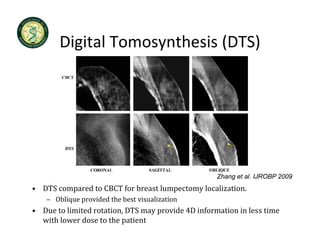
Digital Tomosynthesis
        Digital Tomosynthesis (DTS)


                                                    Zhang et al. IJROBP 2009
• DTS compared to CBCT for breast lumpectomy localization.
    – Oblique provided the best visualization
      Oblique provided the best visualization
• Due to limited rotation, DTS may provide 4D information in less time 
  with lower dose to the patient
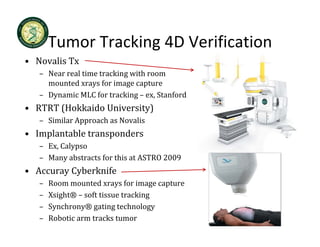
Tumor Tracking 4D Verification
       Tumor Tracking 4D Verification
• Novalis Tx
   – Near real time tracking with room 
                           g
     mounted xrays for image capture
   – Dynamic MLC for tracking – ex, Stanford
• RTRT (Hokkaido University)
  RTRT (Hokkaido University)
   – Similar Approach as Novalis
• Implantable transponders 
   – Ex, Calypso
   – Many abstracts for this at ASTRO 2009
• Accuray Cyberknife
   –   Room mounted xrays for image capture
   –   Xsight® – soft tissue tracking
   –   Synchrony® gating technology
   –   Robotic arm tracks tumor
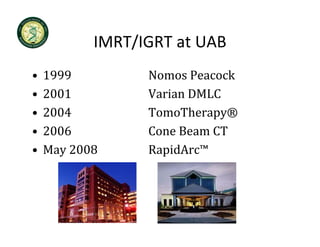
IMRT/IGRT at UAB
           IMRT/IGRT at UAB
•   1999         Nomos Peacock
                 Nomos Peacock
•   2001         Varian DMLC
•   2004         TomoTherapy®
                        h
•   2006         Cone Beam CT
•   May 2008     RapidArc™
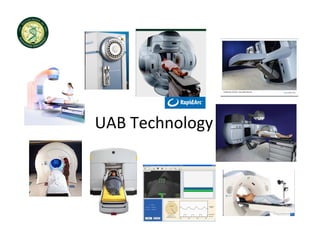
UAB Technology
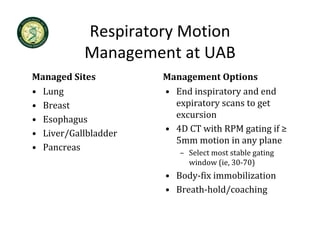
Respiratory Motion 
           Management at UAB
Managed Sites         Management Options
• Lung                • End inspiratory and end 
• Breast                  p      y          g
                        expiratory scans to get 
• Esophagus             excursion
• Liver/Gallbladder   • 4D CT with RPM gating if ≥ 
                        5mm motion in any plane
                        5mm motion in any plane
• Pancreas
                         – Select most stable gating 
                           window (ie, 30‐70)
                      • Body‐fix immobilization
                      • Breath‐hold/coaching
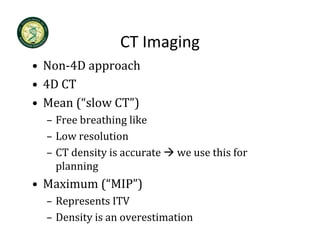
CT Imaging
                 CT Imaging
• Non‐4D approach
• 4D CT
• Mean (“slow CT”)
       (         )
  – Free breathing like
  – Low resolution
    Low resolution
  – CT density is accurate    we use this for 
    p
    planning
           g
• Maximum (“MIP”)
  – Represents ITV
    Represents ITV
  – Density is an overestimation
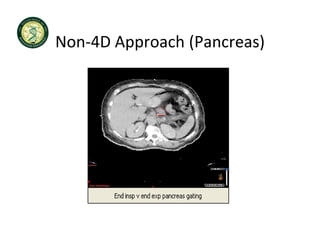
Non 4D Approach (Pancreas)
Non‐4D Approach (Pancreas)
ITV Planning (Part 1)  Non gating
   ITV Planning (Part 1) – Non‐gating
• 4D CT scan performed on GE Lightspeed
  4D CT scan performed on GE Lightspeed 
  with Varian RPM.  
• Maximum Intensity Projection (MIP) is
  Maximum Intensity Projection (MIP) is 
  transferred to Eclipse with free breathing 
  CT.
  CT
• Contouring of structures on MIP provides 
  ITV information.
  ITV i f      i
• Contours are copied to free‐breathing CT for 
  planning
ITV Planning (Part 2) 
     ITV Planning (Part 2) – Gating
• GE workstation does allow for contouring in 3D, but we 
                                          g      ,
  prefer to measure excursion and selection of best phase on 
  the workstation
   – Performed by dosimetrist with resident/attending
     Performed by dosimetrist with resident/attending
• Ideally, we transfer only the phases to be used, but we can 
  transfer entire dataset (VERY LARGE)
• Contouring takes place on one of the phases and then we 
  overlay it on other phases to expand the contour to 
  generate the  ITV (actually the IGTV)
  generate the “ITV” (actually the IGTV)
• OAR will be contoured in a similar fashion.
• Planning is performed based on average densities (MIP is
  Planning is performed based on average densities (MIP is 
  not density correct)
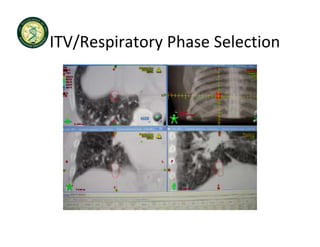
ITV/Respiratory Phase Selection
ITV/Respiratory Phase Selection
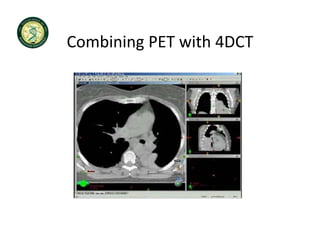
Combining PET with 4DCT
Combining PET with 4DCT
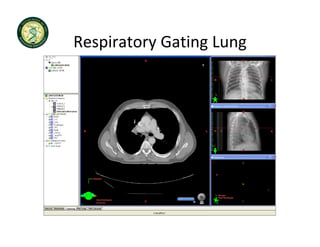
Respiratory Gating Lung
Respiratory Gating Lung
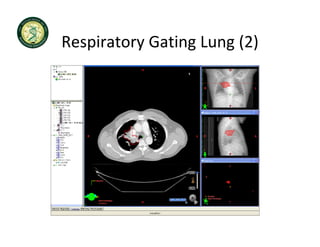
Respiratory Gating Lung (2)
Respiratory Gating Lung (2)
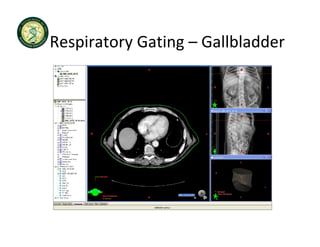
Respiratory Gating  Gallbladder 
Respiratory Gating – Gallbladder
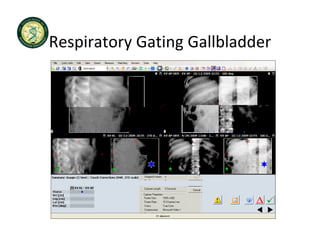
Respiratory Gating Gallbladder
Respiratory Gating Gallbladder
UAB Motion Management Studies
    UAB Motion Management Studies
• ASTRO 2009
  – E l E
    Early Experience with the Use of Gold Fiducial Markers in 
               i       ih h U      f G ld Fid i l M k i
    IGRT of Pancreatic Cancers
     • Rojymon Jacob et al.
     • Conclusion: Additional margins of 0.4 cm(AP), 1.0 cm (SI), and 0.8 
       cm (Lat) are needed around the target for IMRT if skeletal 
       registration is performed without fiducials
  – Respiratory Motion of Different Thoracic Regions 
    Determined by Prospective Gated CT for Treatment Planning
     • S i Sh
       Sui Shen et al.
                  t l
     • 95% Range of Motion of thoracic tumors/nodes were determined 
       on 4D datasets from 90 patients with most significant motion seen 
       in inferior, anterior and lateral lung regions
       i i f i        t i      dl t ll           i
Hypofractionation


The Kirklin Clinic at UAB
Radiobiology Rationale
Radiobiology Rationale
Hypofractionation/SRS/SBRT 
             Overview
• We are finding that hypofractionation
  We are finding that hypofractionation 
  schemes work as well if not better than 
  standard fractionation.
  standard fractionation
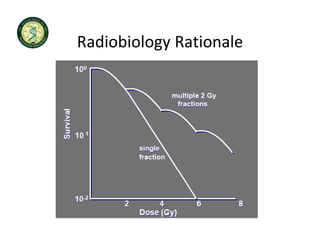
  – More biological effect if given this way
• Oft i
  Often involves tighter margins on tumor
            l    ti ht       i      t
  – Precise Treatment 
  – Less normal tissue toxicity potential
• Absolute Requirement:
  – Accurate treatment     IGRT
SBRT and SRS
                   SBRT and SRS
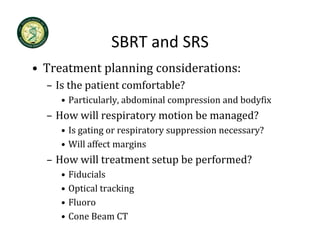
• Treatment planning considerations:
  – Is the patient comfortable?
     • Particularly, abdominal compression and bodyfix
  – How will respiratory motion be managed?
     • Is gating or respiratory suppression necessary?
     • Will affect margins
  – How will treatment setup be performed?
     •   Fiducials
     •   Optical tracking
     •   Fluoro
     •   Cone Beam CT
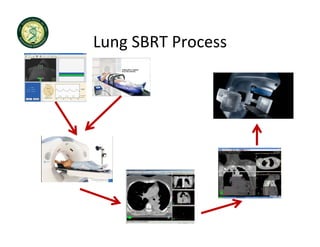
Lung SBRT Process
Lung SBRT Process
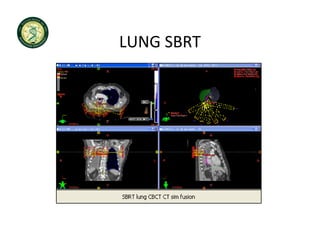
LUNG SBRT
LUNG SBRT
In Vivo Dosimetry at UAB?
       In Vivo Dosimetry at UAB?
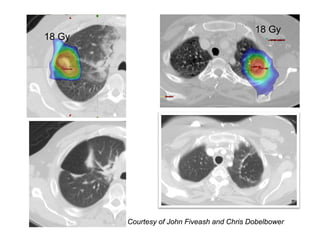
• 15‐20 Gy x 3 in 40 patients
  15 20 Gy x 3 in 40 patients
• ~75% treated for secondary metastases
• 4D CT simulation with abdominal 
             l         h bd     l
  compression
  –   PTV = gated ITV plus 5 mm
  –   < 5 mm tumor motion then no gating
  –   Gated KV or CBCT image guidance
  –   Most commonly 7‐13 beams

                  Courtesy of John Fiveash and Chris Dobelbower
18 Gy
18 Gy


        Courtesy of John Fiveash and Chris Dobelbower
Acknowledgements


• UAB                     – John Fiveash
  –   Janice Carlisle     – Chris Dobelbower
  –   Heather Smith       – Sui Shen
                                 h
  –   Mark Hyatt        • Vanderbilt
  –   Rojymon Jacob
      R j       J b       – J i C
                            Jostin Crass
  –   John Stewart

4 D Igrt

  • 1.
    4D‐IGRT: Certain Phase of Respiration Christopher D. Willey, MD, PhD Assistant Professor Department of Radiation Oncology The University of Alabama at Birmingham
  • 2.
    Disclosures • I dooccasional speaking/consultation for I do occasional speaking/consultation for  Varian Medical Systems, Inc.
  • 3.
    Learning Objectives Learning Objectives • Discuss rationale for IGRT Discuss rationale for IGRT • Understand the basic process involved in 4D  IGRT • Learn about several gating/motion  management strategies • Simulation and planning concepts for 4D  treatment will be discussed.
  • 4.
    Outline • Concepts • IGRT – D fi d Defined – Technologies • Applications UAB Women and Infants Center and Hazelrig-Salter R di ti Oncology Facility H l i S lt Radiation O l F ilit
  • 5.
    Big Picture Concepts Big Picture Concepts • Radiation penetrates all tissues Radiation penetrates all tissues • Radiation can destroy all tissues (normal  and tumor) and tumor) • Therapeutic ratio: Probability of tumor control Probability of normal tissue toxicity • Ideal: Maximize tumor kill, spare normal  p tissue, and preserve function
  • 6.
    Big Picture Concepts Big Picture Concepts • Factors involved in therapeutic ratio: • Tumor delineation: CT, PET, MRI, SPECT • Precision dose distribution: Brachy, SRS/SBRT, IMRT,  Protons  Adaptation p • Accurate Delivery:  Immobilization and guidance  (IGRT) • F ti Fractionation and Total dose ti dT t ld • Dose per fraction , , / , p • Dose rate: LDR, HDR, SRS/BT, RapidArc  • Radiation modifiers: Radiation protectors and sensitizers • Tumor Type • Real Estate (Anatomical site): Location, location, location
  • 7.
    Big Picture Concepts Big Picture Concepts Precision Accuracy • “Reproducibility” • “Veracity” • Narrow clustering of hits g • Closeness of hits to target Closeness of hits to target • Does not require accuracy • You must have some  • Worry about geographic  precision to be accurate miss • Worry about collateral  damage High precision, low accuracy Precise and accurate High accuracy, low precision
  • 8.
    • Distended rectum at time  of CT was independently  associated with  associated with biochemical recurrence in  prostate cancer and lower  rectal toxicity t l t i it • With precise treatment,  we need accurate deliveryy
  • 9.
    Volumes – GTV  gross tumor volume (gross disease) • Assumption: we can identify disease extent – CTV  clinical target volume ( b l l l l (subclinical disease) ld ) • Assumption: we can predict subclinical disease extent – PTV  planning target volume (setup/treatment uncertainty) • Assumption: we know our precision and accuracy • ICRU 62 – IM  internal margin g • variations in size, shape, and position of the CTV in reference to the  patient's coordinate system using anatomical reference points – ITV  internal target volume g • CTV + IM  Alternative is an IGTV that can then be expanded for CTV margins – SM  set‐up margin • uncertainties in patient beam positioning in reference to the treatment  p p g machine coordinate system
  • 10.
    Change in Volume Definitions Change in VolumeDefinitions PTV ITV CTV IM “IGTV” IGTV GTV GTV GTV GTV SM SM ICRU50 ICRU62 “ICRU62”
  • 11.
    Why do margins matter? Why do margins matter? • Volume = 4/3πr3 Volume = 4/3πr • Small margin reduction (5mm) decreases  the volume of an orange by 1/2 the volume of an orange by 1/2
  • 12.
    Big Picture Concepts Big Picture Concepts • How can we deal with our margins? – GTV/CTV: limited by our tumor detection • Relies on clinical judgment and our radiology  colleagues – We can do something about PTV!!! IMPROVING PATIENT SETUP AND TX DELIVERY - Skin marks/weekly port films - Daily setup to bony anatomy - Immobilization and gating - Planar and volumetric image guidance and/or fiducials - Stereotactic delivery
  • 13.
    In Search of Guidance In Search of Guidance • Effectively identify tumor and normal tissue Effectively identify tumor and normal tissue • Accurately align patient and precisely treat – Sh ld h l Should help with inter‐fraction motion i hi f i i • What about intra‐fraction motion? – Three general approaches: • Enlarge PTV margin • Prevent motion  possible in some instances but  not particularly comfortable • Track motion Track motion
  • 14.
    Definitions • Image guidedradiation therapy (IGRT) Image guided radiation therapy (IGRT).    Two parts: – Use of modern imaging techniques for defining Use of modern imaging techniques for defining  tumor and normal structures – Use of modern imaging techniques to accurately Use of modern imaging techniques to accurately  and precisely deliver treatment
  • 15.
    Broad Definition  6 D s of IGRT Broad Definition – 6 D’s of IGRT • Detection and diagnosis Detection and diagnosis • Determining biological attributes • Delineation of target and organs at risk l f d k • Dose distribution design • Dose delivery assurance • Deciphering treatment response through  Deciphering treatment response through imaging Greco, Carlo and Clifton Ling, C.(2008)'Broadening the scope of Image-Guided Radiotherapy (IGRT)',Acta Oncologica,47:7,1193 — 1200
  • 16.
    IGRT Tools IGRT Tools • Treatment planning: – PET/CT – MRI – 4D CT 4D CT • Treatment  delivery: – Electromagnetic transponder (Calypso) Electromagnetic transponder (Calypso) – Ultrasound – Video – Planar (2D) – Volumetric (3D) – Gating (and immobilization)
  • 17.
  • 18.
    Ultrasound BATCAM SonArray I-Beam www.nomos.com www.varian.com www.cmsrtp.com
  • 19.
    Video IGRT Video IGRT www.visionrt.com
  • 20.
    Laser Surface Topography IGRT Laser Surface Topography IGRT www.LAP-LASER.com
  • 21.
  • 22.
  • 23.
    Planar (2D) IGRT Planar (2D) IGRT Cyberknife ®(Accuray) C b k if ®(A ) Novalis ExacTrac X-Ray 6D Varian Trilogy OBI®/MV portal vision Elekta Synergy™ PlanarVie S nerg ™ PlanarView Siemens K-View™
  • 24.
    Novalis Orthogonal X rays Novalis OrthogonalX‐rays Teh et al. Biomed Imag Interv J 2008
  • 25.
    Volumetric (3D) IGRT Volumetric (3D) IGRT Varian Trilogy OBI® Novalis Tx™ Siemens CTVision™ Siemens Artiste™ KVision Elekta Synergy™ TomoTherapy® (HiART) Elekta Axesse™ VolumeView
  • 26.
    Acuity (Varian) Acuity (Varian) • 2D simulation 2D simulation • 3D simulation with  cone beam CT (KV) ( ) • Respiratory gating • Brachytherapy
  • 27.
  • 28.
    MV CT imaging MV CT imaging Siemens MVision™ (MV cone beam) TomoTherapy® (Hi-ART) (MV CT)
  • 29.
  • 30.
    The Problem with Motion The Problem with Motion • Motion is inevitable: Motion is inevitable: – Interfraction – Intrafraction • Example: Lung tumor motion with free breathing  (Liu et al. IJROBP 2007) (Li t l IJROBP 2007) – 95% of patients will have motion less than… • 0 59 0.59 cm in the AP i h AP • 0.4 cm in the lateral • 1.34 cm in the SI
  • 31.
    4D Motion 4D Motion Courtesy of Varian
  • 32.
    Motion Management Options Motion Management Options • Ignore (ie, account for motion) • Prevent motion – Breath Hold/Breath Control – BodyFix (Elekta) p ( ) – Compression device (Elekta) • Track the motion – Cyberknife (Accuray) Cyberknife (Accuray) – ExacTrac X‐Ray 6D Adaptive Tracking  (Varian/Novalis) – 4D CT and respiratory gating
  • 33.
    Accounting for Motion Accounting for Motion • Traditional approach for lung tumors: – Free breathing CT simulation – ICRU50 defined GTV, CTV, and PTV plan – Verify patient on conventional simulator and  use fluoro to confirm that tumor mass is  contained within beam aperture i d i hi b • Modern approach: – Respiratory correlated CT imaging (4DCT) • Alternative: – Max excursion breath hold CT
  • 34.
    Account for Motion (ITV) Account for Motion (ITV) • Do end expiratory and end inspiratory CT’s Do end expiratory and end inspiratory CT s – Fuse volumes to create Max Intensity Volume  (MIV) – Project onto DRR to get Max Intensity  Projection (MIP) Projection (MIP) • 4D‐CT  with phases – Generate a MIP which gives the ITV for Generate a MIP which gives the ITV for  contouring – Treat patient based on free breathing or “mean”  Treat patient based on free breathing or  mean CT
  • 35.
    Accounting for Motion (4D CT) Accounting forMotion (4D CT) www.healthcare.philips.com www.gehealthcare.com
  • 36.
    4D CT Approaches 4D CT Approaches • Helical  (Philips CT scanner with bellows) – Retrospective or prospective respiratory  correlated imaging – Image data at same respiratory phase is  combined from multiple respiratory cycles • Cine (GE Lightspeed with Varian RPM) – Retrospective respiratory correlated imaging – Image data gathered for >1 respiratory cycle at  each couch position
  • 37.
    Retrospective Respiratory  Correlation CT (4D Cine) • Acquire CT images at single couch position Acquire CT images at single couch position  during a respiratory cycle (slightly longer) – Record amplitude and phase for each slice Record amplitude and phase for each slice • Move the couch the distance of the detector  width and obtain CT images for respiratory  idth d bt i CT i f i t cycle. • Fuse images based on phase of respiratory  cycle • Generate 4D images
  • 38.
    4D Cine Approach 4D Cine Approach From Chang et al. Journal of Thoracic Oncology 2008
  • 40.
    Varian RPM VarianRPM MarkerBlock MarkerBlock-
  • 41.
    4D Motion 4D Motion Courtesy of Varian
  • 42.
    Artifacts in 4D CT Artifacts in 4D CT (From Yamamoto et al. IJROBP 2008)
  • 43.
    Motion Management Options Motion Management Options • Ignore (ie, account for motion) • Prevent motion – Breath Hold/Breath Control – Inspiration based – BodyFix/Hexapod (Elekta) p ( ) – Compression device (Elekta) • Track the motion – Cyberknife (Accuray) Cyberknife (Accuray) – ExacTrac X‐Ray 6D Adaptive Tracking  (Varian/Novalis) – 4D CT and respiratory gating – Expiration based
  • 44.
    Immobilization • Abdominal Compression – Hof et al 2003: Hof et al. 2003: • Lung tumor motion:  – cc  5.1 +/‐ 2.4 mm – Lat  2.6 +/‐ 1.4 – AP  3.1 +/‐1.5mm • B d Fi Body Fix • Hexapod www.elekta.com
  • 45.
    Breathing Control Breathing Control • Breath Hold (Can be coupled with RPM) – Onishi et al 2003 Onishi et al. 2003 • Lung tumor motion is 2‐3 mm • Gives reduced lung density because is Gives reduced lung density because is  end‐inspiration • Active Breathing Coordinator™  (Elekta) – 15‐30 sec breath hold – M Many studies show excellent  limitation  t di h ll t li it ti of tumor motion  1‐2 mm • High Frequency Jet Ventilation (HFJV) High Frequency Jet Ventilation (HFJV) (Acutronic Medical Systems)
  • 46.
    Motion Management Options Motion Management Options • Ignore (ie, account for motion) • Prevent motion – Breath Hold/Breath Control – Inspiration based – BodyFix (Elekta) p ( ) – Compression device (Elekta) • Track the motion – Cyberknife (Accuray) Cyberknife (Accuray) – ExacTrac X‐Ray 6D Adaptive Tracking  (Varian/Novalis) – 4D CT and respiratory gating – Expiration based 
  • 47.
    Respiratory Gating/Management Respiratory Gating/Management • Real‐time Position Management (RPM™)  (Varian) • Synchrony (Accuray) • Tumor Tracking Varian/Novalis and Accuray • GateRT GateRT  (VisionRT)
  • 48.
  • 49.
  • 50.
    Cyberknife (Accuray) Cyberknife (Accuray) • Robotic arm containing LINAC tracks Robotic arm containing LINAC tracks  motion
  • 51.
    Precise Delivery (IMRT) Precise Delivery (IMRT) • Ix and Trilogy (Varian) and Trilogy (Varian) – RapidArc™ • Tx™ (Novalis‐Varian) T ™ (N li V i ) • Tomotherapy® (HI‐ART) • Synergy® (Elekta) • Artiste™ (Siemens) t ste (S e e s) • Compensator based methods • Add‐on serial tomotherapy (Best Nomos) Add on serial tomotherap (Best Nomos)
  • 52.
    4D Verification 4D Verification • Imaging: – Bone alignment – MV or KV imaging – In‐phase KV imaging – with RPM – Fluoroscopy • Cine EPID • Cine KV – Active Markers – 4D DTS Emerging  – 4D CBCT technologies • Tumor Tracking
  • 53.
    Digital Tomosynthesis Digital Tomosynthesis (DTS) Zhang et al. IJROBP 2009 • DTS compared to CBCT for breast lumpectomy localization. – Oblique provided the best visualization Oblique provided the best visualization • Due to limited rotation, DTS may provide 4D information in less time  with lower dose to the patient
  • 54.
    Tumor Tracking 4D Verification Tumor Tracking 4D Verification • Novalis Tx – Near real time tracking with room  g mounted xrays for image capture – Dynamic MLC for tracking – ex, Stanford • RTRT (Hokkaido University) RTRT (Hokkaido University) – Similar Approach as Novalis • Implantable transponders  – Ex, Calypso – Many abstracts for this at ASTRO 2009 • Accuray Cyberknife – Room mounted xrays for image capture – Xsight® – soft tissue tracking – Synchrony® gating technology – Robotic arm tracks tumor
  • 55.
    IMRT/IGRT at UAB IMRT/IGRT at UAB • 1999 Nomos Peacock Nomos Peacock • 2001 Varian DMLC • 2004 TomoTherapy® h • 2006 Cone Beam CT • May 2008 RapidArc™
  • 56.
  • 57.
    Respiratory Motion  Management at UAB Managed Sites Management Options • Lung  • End inspiratory and end  • Breast p y g expiratory scans to get  • Esophagus excursion • Liver/Gallbladder • 4D CT with RPM gating if ≥  5mm motion in any plane 5mm motion in any plane • Pancreas – Select most stable gating  window (ie, 30‐70) • Body‐fix immobilization • Breath‐hold/coaching
  • 58.
    CT Imaging CT Imaging • Non‐4D approach • 4D CT • Mean (“slow CT”) ( ) – Free breathing like – Low resolution Low resolution – CT density is accurate  we use this for  p planning g • Maximum (“MIP”) – Represents ITV Represents ITV – Density is an overestimation
  • 59.
  • 60.
    ITV Planning (Part 1)  Non gating ITV Planning (Part 1) – Non‐gating • 4D CT scan performed on GE Lightspeed 4D CT scan performed on GE Lightspeed  with Varian RPM.   • Maximum Intensity Projection (MIP) is Maximum Intensity Projection (MIP) is  transferred to Eclipse with free breathing  CT. CT • Contouring of structures on MIP provides  ITV information. ITV i f i • Contours are copied to free‐breathing CT for  planning
  • 61.
    ITV Planning (Part 2)  ITV Planning (Part 2) – Gating • GE workstation does allow for contouring in 3D, but we  g , prefer to measure excursion and selection of best phase on  the workstation – Performed by dosimetrist with resident/attending Performed by dosimetrist with resident/attending • Ideally, we transfer only the phases to be used, but we can  transfer entire dataset (VERY LARGE) • Contouring takes place on one of the phases and then we  overlay it on other phases to expand the contour to  generate the  ITV (actually the IGTV) generate the “ITV” (actually the IGTV) • OAR will be contoured in a similar fashion. • Planning is performed based on average densities (MIP is Planning is performed based on average densities (MIP is  not density correct)
  • 62.
  • 63.
  • 64.
  • 65.
  • 66.
  • 67.
  • 68.
    UAB Motion Management Studies UAB Motion Management Studies • ASTRO 2009 – E l E Early Experience with the Use of Gold Fiducial Markers in  i ih h U f G ld Fid i l M k i IGRT of Pancreatic Cancers • Rojymon Jacob et al. • Conclusion: Additional margins of 0.4 cm(AP), 1.0 cm (SI), and 0.8  cm (Lat) are needed around the target for IMRT if skeletal  registration is performed without fiducials – Respiratory Motion of Different Thoracic Regions  Determined by Prospective Gated CT for Treatment Planning • S i Sh Sui Shen et al. t l • 95% Range of Motion of thoracic tumors/nodes were determined  on 4D datasets from 90 patients with most significant motion seen  in inferior, anterior and lateral lung regions i i f i t i dl t ll i
  • 69.
  • 70.
  • 71.
    Hypofractionation/SRS/SBRT  Overview • We are finding that hypofractionation We are finding that hypofractionation  schemes work as well if not better than  standard fractionation. standard fractionation – More biological effect if given this way • Oft i Often involves tighter margins on tumor l ti ht i t – Precise Treatment  – Less normal tissue toxicity potential • Absolute Requirement: – Accurate treatment  IGRT
  • 72.
    SBRT and SRS SBRT and SRS • Treatment planning considerations: – Is the patient comfortable? • Particularly, abdominal compression and bodyfix – How will respiratory motion be managed? • Is gating or respiratory suppression necessary? • Will affect margins – How will treatment setup be performed? • Fiducials • Optical tracking • Fluoro • Cone Beam CT
  • 73.
  • 74.
  • 75.
    In Vivo Dosimetry at UAB? In Vivo Dosimetry at UAB? • 15‐20 Gy x 3 in 40 patients 15 20 Gy x 3 in 40 patients • ~75% treated for secondary metastases • 4D CT simulation with abdominal  l h bd l compression – PTV = gated ITV plus 5 mm – < 5 mm tumor motion then no gating – Gated KV or CBCT image guidance – Most commonly 7‐13 beams Courtesy of John Fiveash and Chris Dobelbower
  • 76.
    18 Gy 18 Gy Courtesy of John Fiveash and Chris Dobelbower
  • 77.
    Acknowledgements • UAB – John Fiveash – Janice Carlisle – Chris Dobelbower – Heather Smith – Sui Shen h – Mark Hyatt • Vanderbilt – Rojymon Jacob R j J b – J i C Jostin Crass – John Stewart